It’s day 21 of my posts counting down to the centenary of Maine Road’s opening game and today’s image is a reminder of a European night that was hugely significant. It was the most important European game played by Manchester City at Maine Road.
The game, played on 15 April 1970, saw German side Schalke 04 defeated 5-1 in the ECWC semi-final second leg at Maine Road by City. Subscribers can read the story of that game (and watch video highlights) here:
The image shows Francis Lee in action during that game with the Main Stand and Platt Lane corner in the background. This game led to City playing in their first European final and it seems appropriate to remember that night this week. Joe Mercer’s team went on to win the ECWC (at the time the 2nd most important UEFA club competition).
As well as that image here’s another from the night. This was the celebratory post match pitch invasion. I’d love to hear from any Blues who were there that night. Please use the contact page or leave a comment below. Thanks.
For those unfamiliar with Maine Road this photo may help locate the scene. Number 1 is the Main Stand. Number 4 is the Platt Lane Corner. The pitch invasion image shows one of the corner tunnels but I can’t make out whether it’s the one that used to be position near number 9 or the one shown below at number 6.
Maine Road aerial 1971 from Farewell To Maine Road
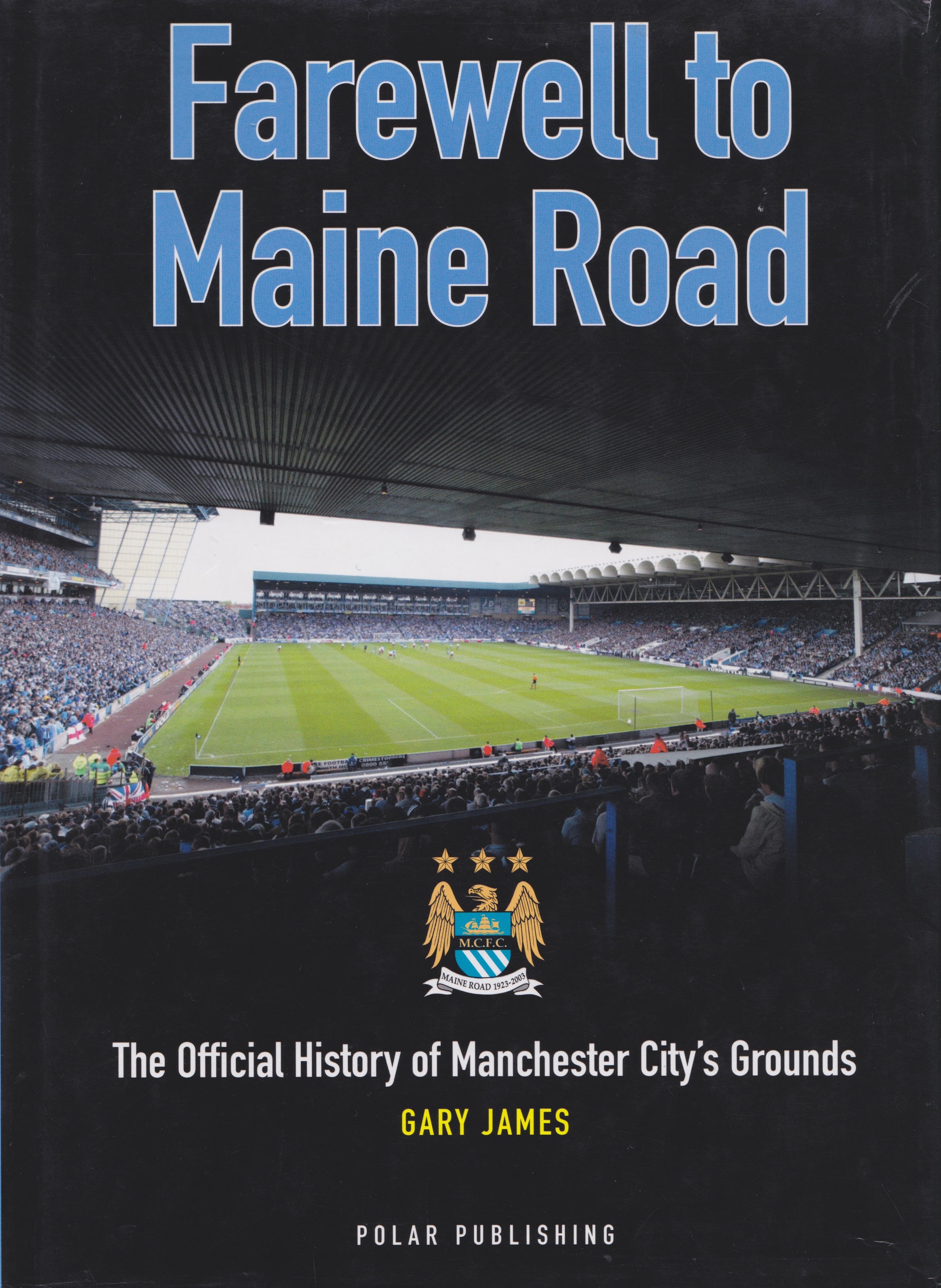
If you’d like to read more on the history of Maine Road, take a look at Farewell To Maine Road, which can be downloaded from this page:
If you enjoy all the free material on my website and would like to support my research and keep this website going (but don’t want to subscribe) then why not make a one-time donation (or buy me a coffee). All support for my research is valued and welcome. It allows me to keep some free material available for all. Thanks.
Last night I did a talk at a branch of the Women’s Institute on the incredible story of the women’s team, the Manchester Corinthians, and our quest to have a plaque erected to them. There were lots of great questions and it was a really nice event. Thanks to all those involved.
Some of the trophies won by the Manchester Corinthians
The story of the Corinthians is an inspiring one and I was delighted to explain the history of the club and why I am so determined to have tributes to them erected. I also explained about the work the Friends of Fog Lane Park are doing too to recognise the women.
There are stories on this website about the Corinthians (follow the links below) but I am delighted to say that last year we received funding from a major source to erect a plaque and, thanks to the donations of many others (including the Dick, Kerr Ladies Foundation), there will be other tributes. The Friends of Fog Lane Park are playing a key role in identifying other ways of recognising the Corinthians.
I’ve been wanting to explain about the support for some time but I am still unable to publicly say who the major funder is – that will come soon – but if all goes as planned we should be able to have an event late this summer to recognise the women and unveil the plaque. Watch this space for details!
If you or a relative played for the Manchester Corinthians or Manchester Nomads (sister club) then please get in touch with me. I’m keen to track down as many women involved as possible so that they can all share in the celebration. In addition, in 2024 I will be publishing the Authorised History of the Corinthians. It would be great to include as many women in that as possible. More on the book here:
It is still possible to donate to the Just Giving page (follow Manchester Corinthians Plaque link below) and all funds raised will be used to develop further tributes to the Corinthians at Fog Lane Park.
Also, if you are interested in a talk on the history of this pioneering club and the women involved then please get in touch. I’d be happy to speak at other Women’s Institute groups, Probus, Rotary, Rotaract, history groups and others. It’s always a good night (and last night there was some nice tea and cake too!).
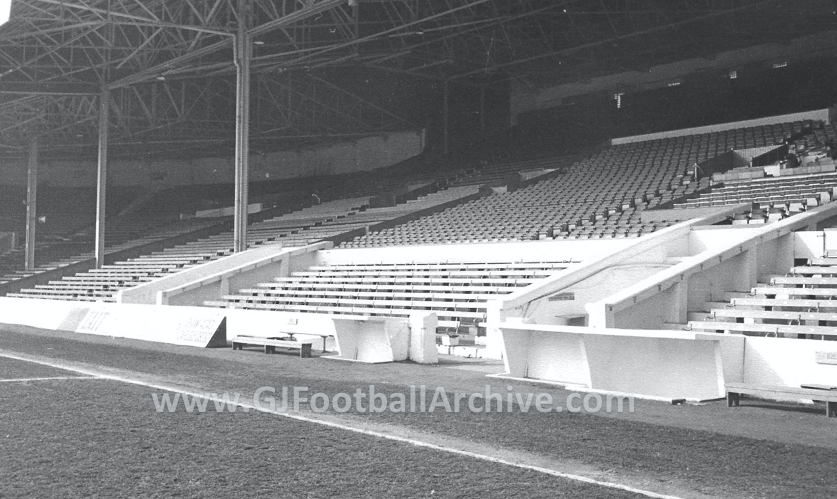
It’s day 20 of my posts counting down to the centenary of Maine Road’s opening game and today’s feature is on the original Maine Road dug outs. Nowadays the playing staff areas take up considerable space wither side of the tunnel at most stadia but for most of Maine Road’s existence there were two concrete bunkers dug out for the manager, physio and maybe one other to sit on. When substitutes were allowed in the 1960s then the sub would also sit there. Inevitably they were cramped and gave an extremely poor view of the game. Basically, the manager would be looking out at leg level.
The main image shows that the City dug out (on the right) had been extended by the time this image was taken in the 1970s. The away dug out (left of the tunnel) is the original size.
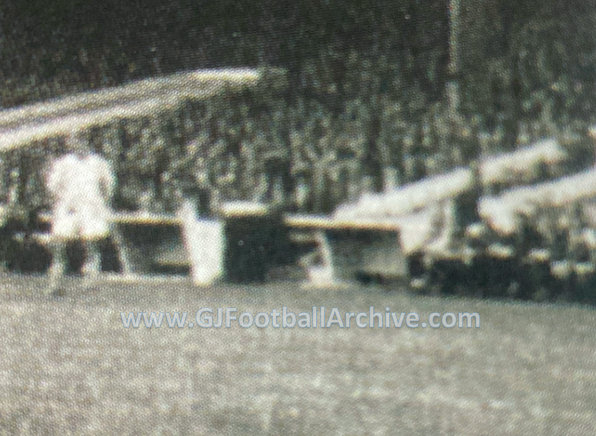
City’s dugouts – which actually were dug out – were built at some point after the main construction of the stadium but I’m not exactly certain when. This image from 1926 shows that small benches were originally positioned/built either side of the tunnel.
1926 City v Fulham, Maine Road. Jimmy McMullan with the ball.
The concrete dugout lasted into the 1970s when more modern bus shelter style ‘dugouts’ (but not ‘dug out’) were erected. This image shows the home bus shelter style dugout in 1983 with manager John Benson. The man with the perm hidden mostly by John Benson is comedian Eddie Large. Physio Roy Bailey is the man closest to the camera.
Mirrorpix photo
Even then the originals remained for some time before being demolished when parts of the white wall were rebuilt. I think they’d been fairly redundant for years though. I have photos of them being used at times during the 1960s and 1970s but this image from the 1950s shows they were empty on many matchdays.
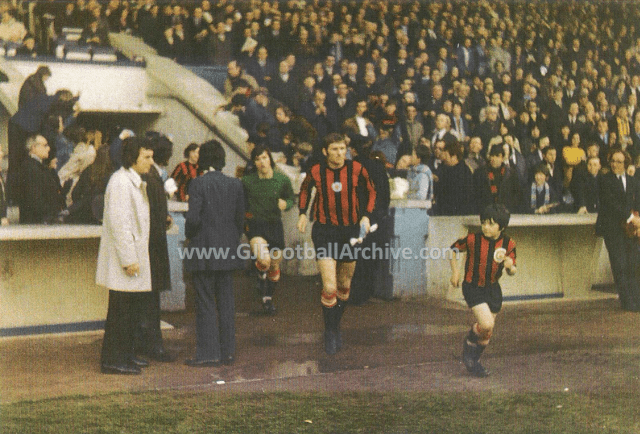
1971 ECWC v Chelsea. Tony Book and mascot Paul Todd. Photo by Alan Jubb
The above image is of the same dugouts in 1971. I tend to think that by this time they were only used if it was a wet day as they provided a little bit of shelter. Notice the bar scarfs in the crowd – blue & white; red & black and one that’s blue & white with a thinner maroon bar too.
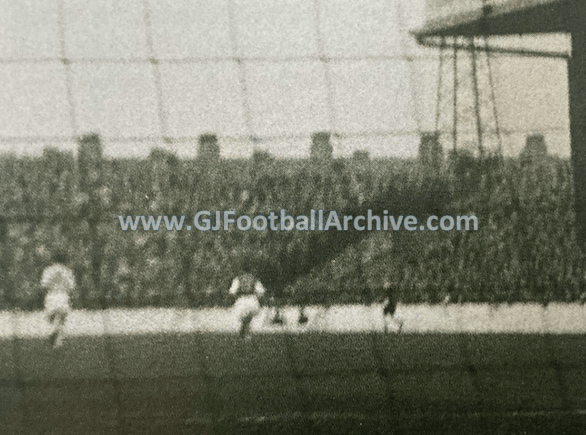
For decades, the manager’s dugouts weren’t the only ‘dugouts’ at the ground as there were also similar arrangements for the police and/or St John Ambulance personnel in Maine Road’s corners. These seemed to be in use into the 1960s as this image shows. Look carefully to the right of the player on the right and you can see two police or St John’s Ambulance staff in a corner dug out near the Kippax. This image is from the early 1960s.
These also disappeared when parts of the white wall were rebuilt and gates added in the corners.
For those unfamiliar with Maine Road this photo may help locate the player dugouts. You can’t really see them but one was positioned in the white wall in front of number 1 and one to the left as we look of the central tunnel next to 1.
Maine Road aerial 1971 from Farewell To Maine Road
If you’d like to read more on the history of Maine Road, take a look at Farewell To Maine Road, which can be downloaded from this page:
If you enjoy all the free material on my website and would like to support my research and keep this website going (but don’t want to subscribe) then why not make a one-time donation (or buy me a coffee). All support for my research is valued and welcome. It allows me to keep some free material available for all. Thanks.
Welcome to Maine Road… It’s day 19 of my posts counting down to the centenary of Maine Road’s opening game. A photograph can bring back so many memories. Today’s is of a simple sign but it welcomed many to Manchester City’s ground for decades.
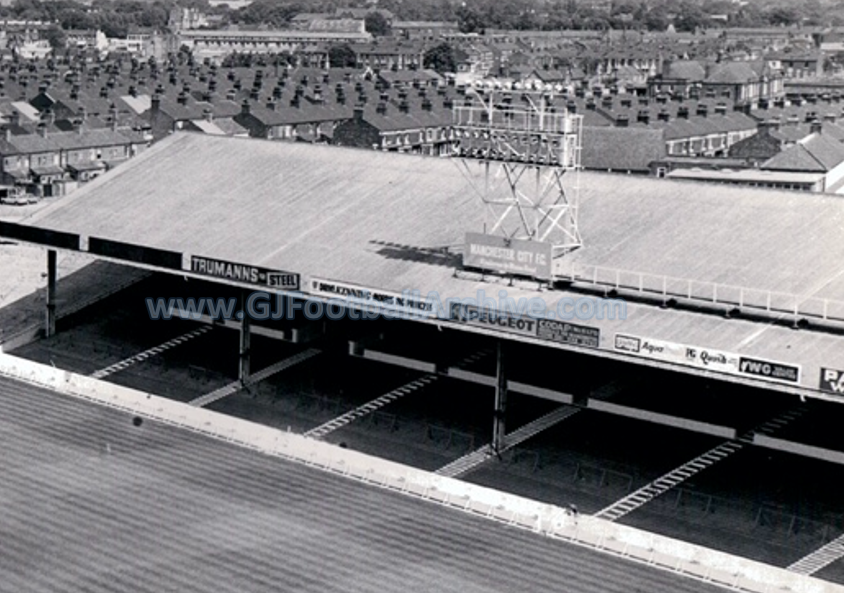
This was replaced by another version of the sign, which was then removed in 1994 when the Kippax Stand was demolished, but for much of the 1970s & 1980s this original sign was a popular part of Maine Road for many fans.
Kippax Stand c.1980
It sat proudly on a metal floodlight gantry on the roof of the Kippax in front of the original central lighting. In later years it was swamped by advertising and extensive roof lighting, once the corner pylons had gone.
Anyone running out from the players’ tunnel would see it straight in front of them. Like the This Is Anfield sign at Liverpool this was a recognisable feature proudly saying Manchester City and Welcome to Maine Road.
For those unfamiliar with Maine Road this photo may help locate where the sign was. You can see the Kippax roof central lighting tower above number 7. The sign was attached to that, opposite the players’ tunnel (number 1).
Maine Road aerial 1971 from Farewell To Maine Road
If you’d like to read more on the history of Maine Road, take a look at Farewell To Maine Road, which can be downloaded from this page:
If you enjoy all the free material on my website and would like to support my research and keep this website going (but don’t want to subscribe) then why not make a one-time donation (or buy me a coffee). All support for my research is valued and welcome. It allows me to keep some free material available for all. Thanks.
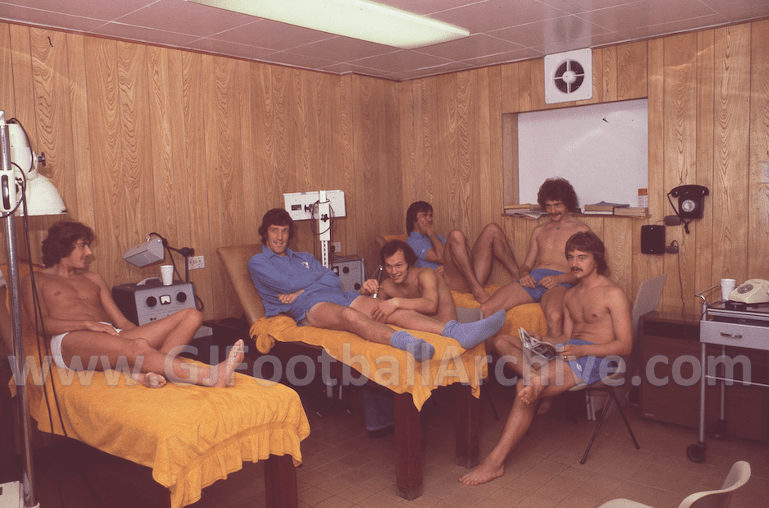
The 1970s Maine Road treatment room… It’s day 18 of my posts counting down to the centenary of Maine Road’s opening game. A photograph can say so much about the era.
This photo shows the treatment room at Maine Road with physio Roy Bailey working on Tommy Booth’s leg. On the bed to the left is Gary Owen and the other players are Dave Watson (on bed to the right either hiding his face or making a secret gesture with his fingers!), Kenny Clements and Tony Henry (with magazine).
What else can we spot? The telephone on the wall (and one on the trolley) and the ‘modern’ equipment. The closed off window, which shows that this room backed on to the main external frontage of the stadium. Years earlier that window would have been glazed with small glass blocks like the others were. There’s the fake wood panelling popular in the 70s – maybe Peter Swales got a job lot from somewhere and had the boardroom, offices and other spaces fitted out in it – the tiled ceiling and the wall heater. All very 1970s.
I’m pretty certain the equivalent facilities at the Etihad & CFA are somewhat more extensive than this but, at the time, City did claim they were ahead of most rivals in this area. Obviously, Roy Bailey would be able to talk more about support (or lack of it) from above, while the players could also talk about how they were treated overall.
For those unfamiliar with Maine Road this photo may help locate where the photo was taken from. It was taken in a room inside the Main Stand, in the lower level, somewhere behind and to the left of number 1.
Maine Road aerial 1971 from Farewell To Maine Road
If you’d like to read more on the history of Maine Road, take a look at Farewell To Maine Road, which can be downloaded from this page:
If you enjoy all the free material on my website and would like to support my research and keep this website going (but don’t want to subscribe) then why not make a one-time donation (or buy me a coffee). All support for my research is valued and welcome. It allows me to keep some free material available for all. Thanks.
Continuing from last week, subscribers to my website are able to download a PDF of the original Farewell To Maine Road book (which retailed at £25) in sections posted each week for the next few weeks. Today, we’ve got the fourth section. Enjoy!
Subscribe to get access – Monthly
If you would like to read the book and download a PDF of it then you can subscribe now at £3 per month or £20 a year. Monthly subscribers access everything posted to the site since 1 October 2022. All subscribers get everything else posted during their subscription too. You could always try a monthly subscription to see what you think (cancel any time).
As well as Farewell To Maine Road annual subscribers get access to everything posted since the site was created in December 2020 (that’s 100s of articles, videos, history talks and PDFs of two other books: Manchester A Football History and my first book From Maine Men To Banana Citizens).
The book has been out of print since 2004 with every copy sold within about six months of publication. Since then I’ve been keen to bring it up to date with stories about the site and the Etihad but that’s not been possible as no publisher has been prepared to invest in the way that Polar Publishing did to ensure it was the right quality.
Copies occasionally appear in second hand book shops or at online retailers but these often sell for ridiculous sums of money. The last time I checked there was one for about £100 here:
When it was published in 2003 apparently, I commented (though I can’t remember saying this, mind you it was 20 years ago): ‘On 320 beautifully illustrated A4 size pages this book tells the story of Maine Road from conception, right through to its final days as a sporting venue. With excellent photographs – including rare illustrations of the stadium during construction never previously published and images from every era – this has been a very interesting book to research, write and compile. I’ve also tried to ensure the views of ordinary fans are included, and some of the most powerful Maine Road moments are captured by the fans who saw them happen.’
In a review, Hugh Ryden wrote in King of the Kippax: ‘The architecture, the moving memories, the reproduction of rare photos and memorabilia and its extensive quotations, make FTMR a must.’
Another King of the Kippax regular Steve Worthington wrote: ‘Following on in the winning formula of his epic “Manchester The Greatest City”, the highly acclaimed author and Manchester City Football Club Historian Gary James has rolled up his sleeves once more and has produced yet another fabulous football book for all to treasure and enjoy. “Farewell to Maine Road” is not only a must for all Manchester City supporters, it is also an essential for all football fans who possess a genuine interest and passion for the history of our great British past time. It catalogues the birth, evolution and ultimate decline of what was once England’s premier and revolutionary provincial football stadium; Maine Road, Moss Side, Manchester M14. Soon to be demolished into oblivion, Maine Road is vividly remembered in all its former glory in this classic portal to the past. Beautifully written with the knowledge and passion you would expect from a lifelong Moss Side Pilgrim, the book provides a definitive literate and graphic illustration of Maine Road’s long and varied history. It contains a rich tapestry of previously unpublished photographs, one of which, a unique atmospheric shot of the famous ‘Ballet on Ice’ (a famous Manchester City V Spurs clash in the late sixties), is arguably worth the cost of the book on it’s own. Having consumed and digested every morsel of information contained within, it is difficult for me to imagine how much painstaking work and dedication it must take to produce and compile a book of such quality. Whilst they continue to produce triumphs such as this, the marriage of Gary James and Polar Publishing is truly one made in a Sky Blue Heaven. This 320-page masterpiece has pushed the boundaries of football publications to a new and higher level and has already prompted tears of nostalgia in my eyes. But don’t take my word for it, sign up a copy and see for yourself, you’ll not be disappointed.’
The publicity blurb said: ‘The only officially approved history of Maine Road is the perfect book for any supporter of City; Maine Road attendee; or general football enthusiast.
‘The book details the history of the stadium focussing on its development, and on the key games and events which have made Maine Road such a famous and important venue. Using first hand accounts, as told by supporters, players, administrators, and the media this book has been written and designed to the same high quality used in the highly acclaimed Manchester: The Greatest City. With special features on all the big City matches, international games, FA Cup semi-finals, League Cup finals, Rugby finals, concerts, religious meetings, and even on United’s use of the stadium during the forties and for European Cup games in the fifties. In addition both City’s former ground Hyde Road and future venue the City of Manchester Stadium have been covered to provide the complete history of City’s three homes.
‘As with earlier works by Gary James & Polar Publishing this book is destined to be regarded as the definitive history of Maine Road & Manchester City’s other grounds.’
My publisher, Julian Baskcomb, commented: ‘Gary James is the appropriate man to write this work after a lifetime’s research on the club and its stadium. As a boy Gary was a regular in the Platt Lane Stand; then at the age of 16 he bought his own season ticket for the Kippax Stand and has been a season ticket holder ever since. He is also a respected journalist with articles for a wide range of publications including The Times and has recently managed the development of Manchester City’s new museum.’
As it’s FA Cup final day I thought I’d make my Maine Road post about the first Manchester derby in the FA Cup to be played at the old stadium… that was in 1955. It’s day 17 of my posts counting down to the centenary of Maine Road’s opening game.
The first FA Cup Manchester derby at Maine Road was played on 29 January 1955 and ended in a 2-0 City win. Subscribers to this site can read the full story of the game below:
Subscribe to get access – Monthly
Read more of this content when you subscribe today. It costs £3 per month (cancel anytime) or £20 a year (see below). For full details on what benefits you get see ‘How To Subscribe’ further down this page.
Read more of this content when you subscribe today. It costs £3 per month (above) or £20 a year (here). For full details on what benefits you get see ‘How To Subscribe’ further down this page.
For those unfamiliar with Maine Road the photo below may help locate where the above was taken from. It was taken looking towards the Popular Side (later Kippax) at the Platt Lane End. Basically the goals near 3 looking towards the tunnel at 8.
Maine Road aerial 1971 from Farewell To Maine Road
If you’d like to read more on the history of Maine Road, take a look at Farewell To Maine Road, which can be downloaded from this page:
If you enjoy all the free material on my website and would like to support my research and keep this website going (but don’t want to subscribe) then why not make a one-time donation (or buy me a coffee). All support for my research is valued and welcome. It allows me to keep some free material available for all. Thanks.
Looking forward to the first ever all Manchester FA Cup final at Wembley tomorrow. To get in the mood why not watch the highlights of the 2011 FA Cup semi here (follow the link):
Prior to this year’s final, the FA Cup semi finals in 1926 and 2011 were the closest we got to one. I wasn’t around in 1926 but I definitely was in 2011! So a couple of years ago I made this special audio recording talking about the years building up to the semi and the day itself from a Manchester City perspective. Many of you have listened to this already but if you haven’t then it tells the story of the 2011 FA Cup semi final and the years between 1976 and that moment in 2011 for City.
I include audio from interviews I did with a variety of people including Khaldoon, Peter Swales, Garry Cook, Brain Marwood and many others.
If you have heard it before then maybe you should listen again to remind yourself of how we all felt and why that game was so significant.
I include a few words from Roberto Mancini recorded in 2011 and at one point he talks about the view that was then being expressed that City were ‘trying’ to buy success (now they say City ‘have’ bought success!). His words are a reminder that City have been having that particular criticism thrown at them for over a decade! Oh well, I wonder how long those criticisms were laid at other clubs who had seen major investment which propelled them forward?
Anyway, get yourself a brew and be prepared to be transported back in time. Here’s the recording:
If you enjoy the recording then please let me know, comment or subscribe to the site. If you don’t fancy doing that then there’s also the option to make a welcome donation to keep this site going (see below). I’ve produced videos/talks like this highlighting key points in Manchester City’s footballing history which subscribers can watch too.
If you enjoy all the free material on my website and would like to support my research and keep this website going (but don’t want to subscribe) then why not make a one-time donation (or buy me a coffee). All support for my research is valued and welcome. It allows me to keep some free material available for all. Thanks.
Read more of this content when you subscribe today. It costs £20 a year to subscribe (it works out £1.67 a month) or £3 if you’d like to sign up a month at a time. Annual subscribers get full access for as long as you subscribe (you can always try it for a month). It’s worth bearing in mind that the 2010 Manchester A Football History cost £24.95 and all subscribers will be able to access all of that for as long as they are a subscriber (plus all the other stuff of course).
It costs £3 a month to subscribe a month at a time. Why not give it a try! Monthly subscribers get access to everything posted since 1 October 2022 for as long as you subscribe.
The only abandoned Manchester derby at Maine Road… It’s day 16 of my posts counting down to the centenary of Maine Road’s opening game and with the FA Cup final tomorrow I thought I’d post a Manchester derby related feature.
This photo is of a section of my book The Pride of Manchester (co-written with Steve Cawley) which shows the scene at the only Manchester derby to be abandoned (without the result standing!).
The game was a League match played on 27 August 1960 (date on original book caption is a typo!) at Maine Road. It was abandoned due to a water-logged pitch with the score at 2-2. City’s scorers were Denis Law and Joe Hayes; United’s were Dennis Viollet and Alex Dawson. Attendance 51,927.
The match was replayed and ended in a 3-1 United win on 4 March 1961 before 50,479.
For those unfamiliar with Maine Road this photo may help locate where the photo was taken from. It was taken on the pitch, somewhere near the Kippax corner/Scoreboard End (roughly on a line from number 2 below, and in front of number 10), looking towards the Platt Lane goal (a little below number 3).
Maine Road aerial 1971 from Farewell To Maine Road27 August 1960 (date on image is incorrect). The abandoned Manchester derby.
If you’d like to read more on the history of Maine Road, take a look at Farewell To Maine Road, which can be downloaded from this page:
If you enjoy all the free material on my website and would like to support my research and keep this website going (but don’t want to subscribe) then why not make a one-time donation (or buy me a coffee). All support for my research is valued and welcome. It allows me to keep some free material available for all. Thanks.
As part of their All-Manchester FA Cup features the Athletic have asked their writers about the most important FA Cup final. Well, as it’s a City-Utd final then it makes sense to highlight the first ever FA Cup final featuring one of the teams. In 1904 Manchester found its first major trophy success and that led to Manchester being established as a footballing city. It’s part of the reason Manchester City retained a special place in the hearts and minds of Mancunians, even when the success faded.
The captain and goalscorer was the great Billy Meredith. The other year, following the purchase of the oldest surviving FA Cup by Sheikh Mansour (to loan to the National Football Museum) I helped Manchester City with the story of the cup and its significance to Manchester. They’ve produced a video telling the story and it can be viewed here:









 Gary James' Football Archive