Maine Road 100 – Day 1 Answers

2023 marks the 100th anniversary of Maine Road’s first game and to commemorate this landmark moment I will be posting a different image and feature on the old stadium each day for the next 100 days. Yesterday I started with a little quiz and asked…

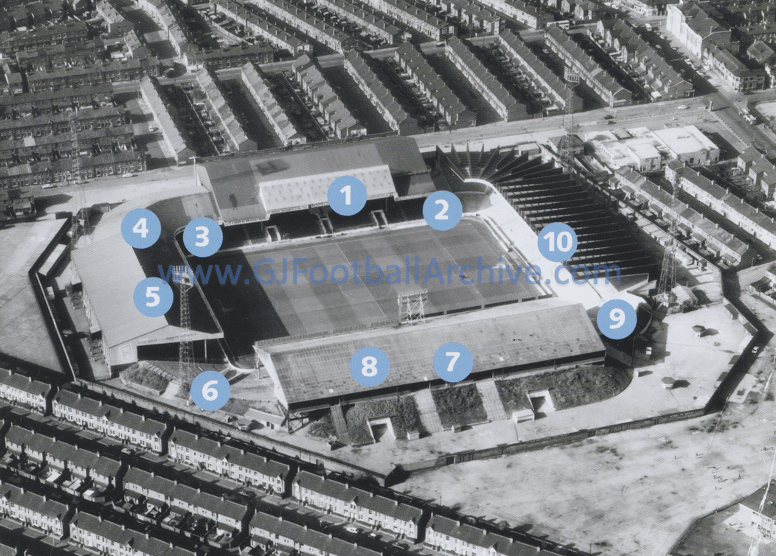
Look at this image of Maine Road from 1971. Can you identify the names/details for every one of the numbered areas of the old ground?

Maine Road aerial 1971 from Farewell To Maine Road

The answers are:

1 – Main Stand 1923-2003 (AKA Grand Stand on occasion)

2 – Main Stand J Block 1973-2003 (area between Main & North Stands

3 – Main Stand G Block 1931-1993 (area between Main & Platt Lane Stands, AKA Family Stand; ‘new’ G Block 1993-2003)

4 – Platt Lane Corner 1931-1993 (corner of Platt Lane leading to Main Stand, AKA Apple Pie Corner; The Boys’ Stand; The Boys’ Corner; ‘new’ Family Stand 1993-2003)

5 – Platt Lane Stand 1935-1993 (alternative ‘new’ Platt Lane 1993-2003; UMBRO Stand was initial name after redevelopment; original unroofed terracing 1923-1935)

6 – Platt Lane/Kippax Corner 1923-1994 (alternative: away section – which also stretched into the Kippax; HH temporary stand late 1990s onwards, which was also dubbed the ‘Alan Ball Stand’ as it was small and didn’t make much noise or the Gene Kelly 2)

7 – Kippax Street Stand 1957-1994 (AKA Popular Side 1923-1957 and replaced by ‘new’ Kippax Stand 1994-2003)

8 – Chanters Corner 1960s-1994 (AKA The Sways)

9 – Windy Corner 1923-1994 (area in between Kippax and North Stand; Alternative: Temporary Stand UU 1997-2003 dubbed the Gene Kelly Stand; original terracing 1923 to 1971 then rebuilt terracing as part of North Stand development)

10 – The North Stand 1971-2003 (alternative: The Scoreboard End 1923-1971 and referred to as The City End in an episode of Coronation Street!)

This image and associated terminology will help those unfamiliar with the specifics of the old ground over the coming weeks as I’ll provide more images, stories and facts about Maine Road. Enjoy!

Subscribers to my site can download the book Farewell To Maine Road, which was published in 2003. Details on this page:

If you enjoy all the free material on my website and would like to support my research and keep this website going (but don’t want to subscribe) then why not make a one-time donation (or buy me a coffee). All support for my research is valued and welcome. It allows me to keep some free material available for all. Thanks.

Choose an amount

£2.50
£5.00
£7.50

Or enter a custom amount

£

Your contribution is appreciated.

Donate
Maine Road 100 – Day 1

2023 marks the 100th anniversary of Maine Road’s first game and to commemorate this landmark moment I will be posting a different image and feature on the old stadium each day for the next 100 days. Day 100 will be the actual centenary of that historic first game. Today I’m starting with a little quiz…

Look at this image of Maine Road from 1971. Can you identify the names/details for every one of the numbered areas of the old ground?

Maine Road aerial 1971 from Farewell To Maine Road

I’ll be posting the answers tomorrow, so watch this space. If you can’t wait that long then subscribers to my site can find the answers on page 13 of Farewell To Maine Road which can be downloaded from this page:

Manchester’s Two Join The League

Today (17 May) in 1892 at the Queens Hotel in Sunderland the Football League accepted two aspiring Manchester clubs into its competitions. Newton Heath applied and were accepted into the First Division and Ardwick applied and were accepted into the new Second Division of the League. Ardwick did not apply to join the top flight and it is believed the two Manchester clubs had an agreement not to go up against each other as in other votes two clubs from the same city had occasionally taken votes from each other. Had they gone head to head it may well have been that either one or no Manchester club would have gained admittance to the League.

I’m Excited Tommy!

As a football historian I love days when history could be made and as a fan I get a bit giddy looking forward to what could be an absolutely incredible evening (and final few weeks of the season). Obviously, history is made every day, win or lose, but when you wake up on a day when there’s a possibility of reaching a major final; of facing the most successful European team of all time; and achieving something few other English teams have managed to achieve then you can’t help but get excited.

These last few days I’ve been writing and reading about a variety of footballing achievements in women’s football and the all-Manchester FA Cup final. I’ve written a couple of pieces for the FA Cup final programme and later today a prominent journalist who I respect will be interviewing me about the history of Manchester football but…. and it’s one I never thought I’d say… even the excitement of the first ever all-Manchester FA Cup final does not excite me as much as tonight’s Manchester City game when the Blues take on Real Madrid in the 2nd leg of the Champions League semi-final.

United fans will know how I feel. I well remember the days when they were reaching the latter stages of a major European competition and that took their focus, not the Manchester derby. My interest will change of course, after tonight (whatever happens) and this weekend when City could win the Premier League (I’m not counting any chickens here, I’m old enough to know how these things can go). I’ll be as excited as ever for an all-Manchester FA Cup final but for now, it’s Europe and Real Madrid that has given me a real buzz. I feel like the comedian Bobby Ball when he used to march on stage, pulling his braces saying to Tommy Cannon: ‘I’m excited, Tommy!’

Bobby Ball

Actually, Tommy’s killjoy responses remind me a bit of some of those critical journalists who always say ‘ah, but….’ ‘Ah, but nothing’ is my response at the moment. Let’s not forget that although the actual cash may seem small in today’s money, Nottingham Forest’s European successes came off the back of significant spending which, in today’s world, would probably have broken the Financial Fair Play rules. I’m not against what Forest achieved, far from it, and only mention it to highlight that truly successful clubs have usually seen massive investment, spending or significant debt established to fund major successes. Money has been the driving force in football since the 1800s.

Anyway, enough of that negativity. Let’s look forward to what could be a thrilling and memorable night in European competition. Football today is highly competitive, look at the Premier League where, in the last 3 seasons alone we’ve already had 2/3rds the winners they enjoyed during the entire decade of the 2000s. You can read more on how more competitive the top of the League actually is today than in past decades here:

Coming back to tonight…. It’s going to be a challenge; it’s going to be tough facing such a serial winner of this competition but with the wonderful coaching of Pep; the talented squad of stars; the backing of passionate fans; and a fair and appropriate level of refereeing it could be a truly great evening. I’m excited! I don’t care how they do it and a simple 1-0 win will be enough. ‘That’ll do for me, Tommy!’

You can read about the 2021 Champions League final here:

Something Special

As well as the ability to download a PDF of Farewell To Maine Road, I’ll be starting a special series of posts on Thursday that I’m sure many fans will find nostalgic, interesting and entertaining in some way. These will be free to download while the Maine Road book is for subscribers only. Watch this space. I’m sure Manchester City fans will enjoy this new series of posts.

For the Farewell To Maine Road book PDF details see:

Managerial Change

On this day (16 May) in 1995 Brian Horton’s time as manager of Manchester City came to an end. It was a sad departure for a man who had brought entertaining, attack-minded football back to Maine Road.

Subscribers can read an interview I did with Brian a few years back here:

Significant Praise is Due for Pep & City

Both the 2010s and the 2020s (already!) have been incredible decades for Manchester City with phenomenal success coming City’s way. Thanks to the astute management and coaching by Pep Guardiola and his staff, together with some extremely talented players, the Blues have been able to celebrate trophy successes on a regular basis. Pep deserves significant praise for what he has achieved and with the potential that City could win the Premier League next weekend it’s time to think back and consider what has been achieved in recent years.

Before I go on (I’ll explain more later) but it is important to spell out that while some in the media keep telling us that the League is less competitive now than ever before, it’s worth pausing to consider that in only the last 3 complete seasons we’ve had 2/3rds the number of title winners they had in the entire decade of the 2000s and half what they had in the 80s and 90s decades too! But, apparently, it’s less competitive now. Think about that as you read what follows please. Thanks.

These are incredibly special times and City fans are truly grateful. The Blues have a Champions League semi final 2nd leg on Wednesday; the prospect of a League title on Sunday and also have the FA Cup final to look forward to. If that’s anything like City’s first trip to the new Wembley in 2011 that will be a special day. No City fan I know are complacent or take anything for granted though and that’s important. As fans it’s important to act like the players and retain an hunger for further glory. City’s brilliant 1960s/70s coach Malcolm Allison once told me to ‘celebrate every success as if it’s your first’ because it’s important to retain the drive and determination.

It’s worth pausing at this stage in the season to reflect on the last decade or so to fully appreciate what the club has achieved. I’ve been doing a few decade comparisons recently, looking at dominant clubs each decade and the competitive nature of English football. I’ve taken each decade (starting with the first complete season, such as 1960-61 through to 1969-70), and looked at the successful teams of that era.

During season 2010-11 through to the end of 2019-20 City managed to win an incredible total of 11 major trophies – a phenomenal figure, especially when compared with the nearest rivals Chelsea who won seven major trophies during that time. No doubt critics will say ‘ah, but there’s less competition’ but that’s absolutely not true, certainly not in terms of our major domestic competitions. It keeps being drummed into us that there’s less competition but that’s really downplaying the achievements of those teams that have challenged.

Between 2010-11 and 2019-20 there were five different Premier League winners. That’s more top flight champions than in each of the previous three decades and the same as in the period 1970-71 to 1979-80 when many people talk of a relatively open title race. How many times do we hear people say ‘back in the 70s and 80s anyone could win the title.’ Well, that may have appeared true at the time but the truth is that only a small group of clubs actually did win it. Even in the 1930s there were only four different champions (Arsenal, Everton, Sunderland & City), although that was only nine complete seasons due to war.

The total number of different champions in each decade since the start of the 1960s is:

1960-61 to 1969-70: 7 (Spurs, Ipswich, Everton, Liverpool, United, City & Leeds)

1970-71 to 1979-80: 5 (Arsenal, Derby, Liverpool, Leeds & Nottm Forest)

1980-81 to 1989-90: 4 (Aston Villa, Liverpool, Everton & Arsenal)

1990-91 to 1999-00: 4 (Arsenal, Leeds, United & Blackburn)

2000-01 to 2009-10: 3 (United, Arsenal & Chelsea)

2010-11 to 2019-20: 5 (United, City, Chelsea, Leicester & Liverpool))

Most fans who were around in the 1990s and 2000s will remember that in both those decades the League seemed totally out of the grasp of most of clubs and that it was only because of the investment in Blackburn (1990s) and Chelsea (2000s) that the duopoly of Arsenal and United was broken. Similarly, the investment in City from 2008 allowed the Blues to challenge again and, to be frank, the same is true for Leicester though clearly on a smaller scale (remember Leicester’s own Financial Fair Play issues – Worth thinking about their example and those of Blackburn, City & Chelsea, plus of course United decades ago, Huddersfield in the 20s and many other clubs which prove that investment is often needed to help increase competition?).

Investing in squads obviously increases the chance of trophy success but it takes an awful lot more than simply buying players to generate major success and to sustain it for a decade or more. As a stark reminder those fans old enough will remember the late 1970s and early 80s when the former West Ham players Malcolm Allison and then John Bond had spells in charge at Maine Road. Both flamboyant characters were hugely talented coaches and they spent a lot of money during their time managing the Blues. But Allison’s side was described as the most expensive team ever assembled when it was embarrassed at Fourth Division Halifax while Bond’s side was unable to mount a serious challenge for the title (though he did manage to get to the FA Cup final with mostly Allison’s team in 1981).

There are plenty of examples, including this season, of teams that have spent an awful lot of money but have failed to achieve the success expected. Money helps but it doesn’t guarantee success.

Talented coaches challenge traditional thinking. They bring in fresh ideas and force rivals to adapt and re-evaluate their own way of doing things. They lift ordinary players into trophy winners and they take supremely talented players to the next level, making them all-time legends who can compete at the very highest levels of European and world football.

Pep Guardiola has achieved all of that and is absolutely the most talented coach working in English football today. He has brought his club sustained success while identifying and developing players to replace established City legends. Throughout his time at City he has kept the club focused and hungry for glory in a way that so few managers ever achieve. Alex Ferguson managed it at United but apart from him and, to a lesser extent, Arsene Wenger at Arsenal no manager has managed to achieve and sustain this at any English club for decades. Let’s not forget either that United borrowed heavily in the late 1980s to give Ferguson the funds to create the most expensive British squad ever assembled at the time. It took a few years and caused much friction with shareholders as the club borrowed more and more but ultimately it all paid off and the success that followed strengthened United’s position significantly – something that is happening at City, though City didn’t fund their success on borrowing, it was from investment (I still find it hard to accept that in any other business investment is good but in football it’s the enemy while borrowing & debt is something we should celebrate!).

In terms of finance, let’s pause to think of turnover and profitability. These have increased significantly for City since the investment in the club in 2008. Sponsorships have increased, attendances have increased, kit deals have increased etc. Some say that there’s something ‘dodgy’ about that. I don’t know the financial ins and outs of any club but I do know that when Alex Ferguson became manager of United there were United did not have the same level of sponsorship they had 15 years later. At United those first 15 years of Ferguson’s reign saw sponsorships increase, attendances increase, kit deals increase etc. exactly like the last 15 years at City. Trophy success, global TV audiences, capacity increases all lead to growth. A forensic financial expert would need to research this but it’s clear that these things happen when a team is successful. Each year we are told of the financial ‘bonus’ a lower tier club gets when it plays in the later stages of a major cup competition, or reaches the play offs. It’s not rocket science and those owners that invest in their clubs do so because they see a return or an increase in the value of their club…. Anyway, back to the competitive nature of football…

Looking at domestic cup competitions the 2010s also saw more different winners than the previous decade. During the seasons 2010-11 to 2019-20 there were eight clubs (Birmingham, Liverpool, Swansea, City, Chelsea, United, Wigan & Arsenal) who found success in the domestic cups as opposed to seven between 2000-01 and 2009-10 (Liverpool, Middlesbrough, Chelsea, United, Spurs, Arsenal & Portsmouth). Okay, so it’s only one extra club but it means that seven different clubs won major domestic trophies between 2001-09 and nine between 2010-11 to 2019-20 in total.

Whichever way you look at it the 2010s demonstrated a greater variety of English clubs finding major trophy success than the previous decade. We’re often being told that football is less competitive now than it was before but in terms of the game’s top domestic honours that’s not true. Obviously, there are disparities within football – most City fans experienced the negatives of that in the 1980s and 1990s – and those of us in Greater Manchester know only too well the plight of our neighbours Oldham, Rochdale and Bury. However, in terms of challenging for titles and domestic honours at the top of the pyramid the statistics prove that competition has been there throughout City’s modern era success. Every trophy has been a challenge and every success has been achieved through dedication and determination.

City fans have a lot to be thankful for and this last decade or so has been remarkable thanks to the endeavours of many, many people. Here’s a reminder of City’s major trophies during the last decade or so under each manager:

Roberto Mancini: Premier League (2012) & FA Cup (2011)

Manuel Pellegrini: Premier League (2014) & League Cup (2014 & 2016)

Pep Guardiola: Premier League (2018, 2019, 2021 & 2022), FA Cup (2019) & League Cup (2018, 2019, 2020 & 2021)

With a FA Cup final coming up, a mouth-watering Champions semi-final v Real Madrid and the rest of the League campaign to play, there’s a strong possibility the trophy honours can be added to soon.

Manchester City Hall of Fame: Joe Corrigan’s significant game

City 2 Tottenham 3

FA Cup Final Replay

14th May 1981

City Team: Corrigan, Ranson, McDonald (Tueart), Reid, Power, Caton, Bennett, Gow, Mackenzie, Hutchison, Reeves

Attendance: 92,500

For Joe Corrigan these two matches may not have brought him a winner’s medal but they did raise his profile nationally and bring him the accolade of ‘man of the final’.  An enormous television audience worldwide witnessed this the 100th FA Cup final and the story of City’s season captured a great deal of attention.  The Blues had commenced the season with Malcolm Allison as manager but results, performances, and a general air of doom and gloom made the first few months extremely difficult.  Then John Bond arrived in October and the atmosphere transformed totally as City progressed to the League Cup semi-finals and the 100th FA Cup final.

City were in control for most of the initial match at Wembley.  Tommy Hutchison had put City into the lead in the 29th minute and the Blues looked unstoppable.  Danger did come from Spurs at times but Joe played magnificently and blocked any danger.  Unfortunately, ten minutes from the end disaster struck.  Tottenham were awarded a free kick twenty yards out.  Osvaldo Ardiles tapped the ball to Glenn Hoddle, who curled it around the wall.  Joe knew he had the shot covered but Hutchison somehow got in the way.  The ball hit his shoulder and was diverted passed Joe and into the net for Tottenham’s equaliser.  Joe:  “I’m sure Hoddle’s free-kick was going wide until Tommy got in the way and deflected it past me.”

Immediately after the equalising goal Joe, clearly disconsolate himself, walked over to the devastated Hutchison, helped him to his feet, and muttered a few words as he patted him on the back.  Clearly at a time when blame would have been easy to apportion the City ‘keeper thought more about the feelings of his team mate than the incident itself.  That says a great deal about Joe’s humanity.

The game went into extra time and with the score at 1-1 after 120 minutes, a replay was scheduled for the following Thursday.  Joe and most of the City side received considerable praise in the media with the Daily Mail stating:  “For what they are worth to the bewildered Tommy Hutchison, the defiant Joe Corrigan, the prodigious Nicky Reid and the inspiring John Bond, my sympathies are with City.  At least they gave their all for 90 minutes and then dredged up a little extra for the additional half-hour.  With the exception of Graham Roberts, Tottenham’s approach was a disgrace.”

All neutrals seemed to share those views and City felt aggrieved.  Personally Joe would have preferred to see the game settled on the Saturday:  “For me the FA Cup Final is all about the Saturday.  The players are all hyped up, the fans are all hyped up, the television is all hyped up.  The Cup Final is meant to be all about who is best on the day.  I’ve no doubt that on the Saturday we were the better team.  The second game did not feel like an FA Cup final.”

Despite Joe’s views, the second game has become recognised as a classic.  It ended 3-2 to Spurs, but contained a couple of superb goals.  The most famous one is Ricky Villa’s 75th minute Tottenham winner, but City fans will always remember Steve Mackenzie’s twenty yard volley as a classic goal.

For Joe the second game put him under more pressure than the first and he certainly performed heroically.  In the years since the final the story of Ricky Villa’s goal has grown and grown yet on the day itself it was the performance of City’s brilliant ‘keeper which won the acclaim.  His profile was raised once again, but undoubtedly Joe would have much preferred to see City win the Cup rather than receive the glory himself.

Maine Road on Granada

I was delighted to play a small part in a news item for Granada Reports on Maine Road. Thanks to Jam Williams-Thomas for asking me if I’d be interviewed. You can watch the extended piece here:

https://www.itv.com/news/granada/2023-05-12/remembering-manchester-citys-former-home-maine-road

Aguero Hat-trick

When Manchester City defeated QPR 6-0 on this day (10 May) in 2015 Sergio Aguero netted a hat-trick for the Blues. His first came after three minutes when he went on a mazy run before clipping the ball over the onrushing Rob Green to give Manuel Pellegrini’s side a perfect start.

Aleksandr Kolarov netted City’s second (a free kick from 30 yards) in the 31st minute and the Blues made it 3-0 when Aguero scored in the 49th minute.

Aguero’s third came from a penalty after David Silva had been pulled down in the 64th minute. James Milner made it 5-0 five minutes later before Silva completed the scoring in the 86th minute. when he ran on to a wonderful back heel from Bony, before rounding goalkeeper Green.

City lineup: Hart (c), Zabaleta, Demichelis, Mangala, Kolarov, Fernando, Fernandinho (Toure 73), Lampard (Bony 62), Milner (Navas 81), Silva, Aguero
Unused: Caballero, Sagna, Clichy, Dzeko

Attendance 44,564 (building work as part of the extension of the South Stand had reduced the capacity).