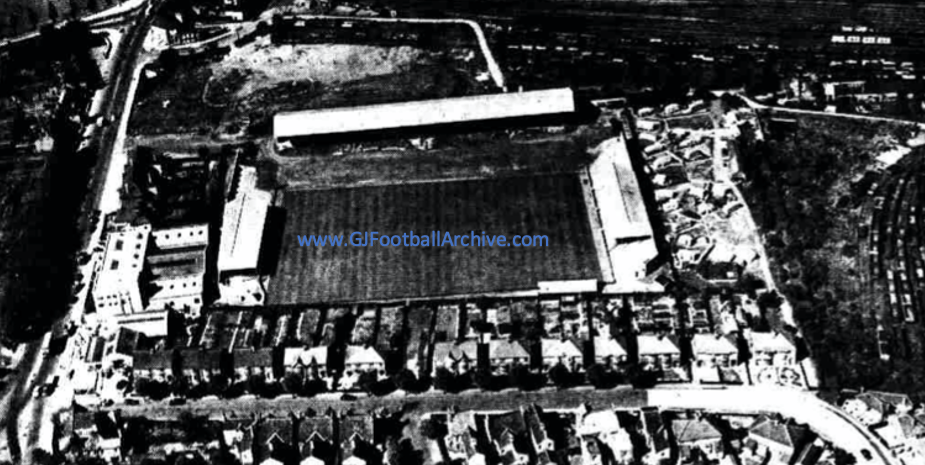
This is week 33 of Historic Name That Ground. As always, please leave your comments in the comments area at the bottom of this website page. Do you recognise this ground? On Friday I’ll post the answer. Here are a few clues…
Can you name the ground featured in the image above? This is a 1950s photo of this ground during a pitch invasion (bonus point for anyone who knows what this game was and why there was a pitch invasion). The ground remains a major sporting venue today and I’m sure many subscribers to my site will recognise it.
Post your answer below in the comments field and I’ll give the answer on Friday.
While you’re here why not subscribe to my site and you can then access every article, interview, audio recording etc. already posted and those that will be posted during your subscription. It costs £20 per year (about £1.67 a month) or you can sign up on a monthly basis at £3 per month (you can cancel at any time, so you could sign sign up for a month, access everything you want and then cancel). You can subscribe below:
Subscribe to get access
Read more of this content when you subscribe today.
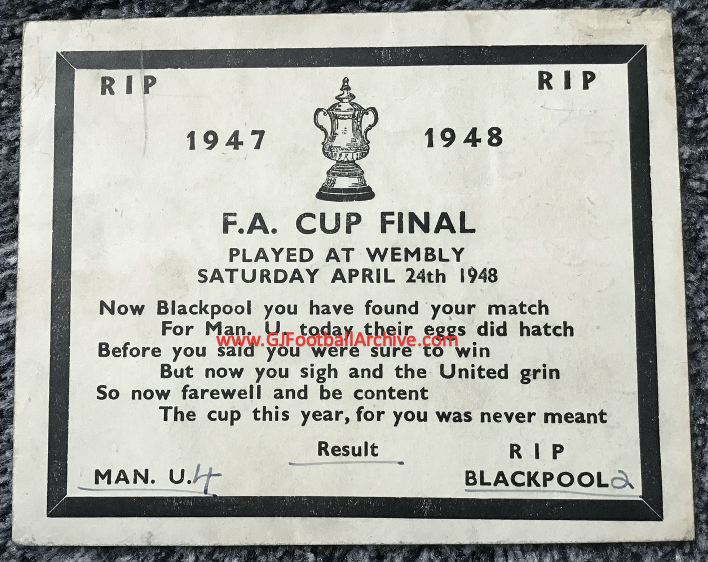
Recently this card was shown to me. It’s a memorial card commemorating Manchester United’s victory over Blackpool in the FA Cup final. The football funeral card business was huge at one point and, in the days of football half-half friendship scarves, was a somewhat macabre way of providing a souvenir of a game. I’ve written a lot on these in recent years and here’s an article I posted a short while ago:
It’s great to see the 1948 card pictured above and it adds to the view that these continued into the 1950s. People have written that the trend for doing football memorial cards died out after World War One but in my article I explain how it continued for decades. It was also a prominent activity with a variety of people profiting from it. Manchester was one of a number of centres for the activity and cards were printed in the city for distribution at games across England.
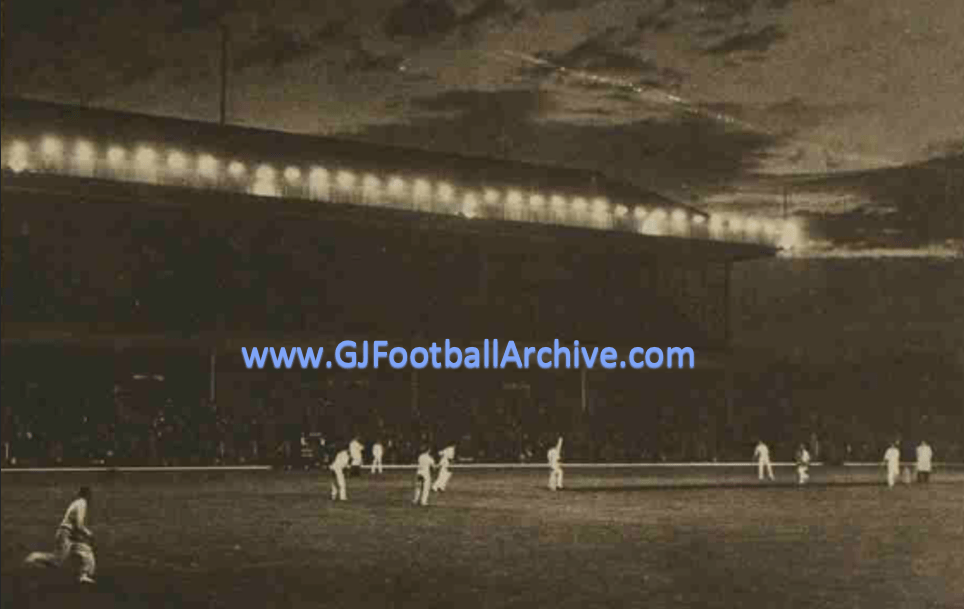
Did you recognise this ground? This is a 1950s photo of this ground which I think is a relatively easy one to get although the players may have put people off the scent a little (bonus point for anyone who knows what this game was). The ground is no longer a major sporting venue today.
The answer is of course Highbury/Arsenal Stadium (whichever you prefer!). The game is Middlesex CCC v Arsenal FC. It was a 13 a side game played on August 11 1952 at the stadium. According to reports at the time this was the first floodlit cricket match to be played in England (though I’m sure there were earlier ones!).
While you’re here why not subscribe to my site and you can then access every article, interview, audio recording etc. already posted and those that will be posted during your subscription. It costs £20 per year (about £1.67 a month) or you can sign up on a monthly basis at £3 per month (you can cancel at any time, so you could sign sign up for a month, access everything you want and then cancel). You can subscribe below:
Subscribe to get access
Read more of this content when you subscribe today.
This is week 32 of Historic Name That Ground. As always, please leave your comments in the comments area at the bottom of this website page. Do you recognise this ground? On Friday I’ll post the answer. Here are a few clues…
Can you name the ground featured in the image above? This is a 1950s photo of this ground which I think is a relatively easy one to get although the players may put people off the scent a little (bonus point for anyone who knows what this game was). The ground is no longer a major sporting venue today.
Post your answer below in the comments field and I’ll give the answer on Friday.
While you’re here why not subscribe to my site and you can then access every article, interview, audio recording etc. already posted and those that will be posted during your subscription. It costs £20 per year (about £1.67 a month) or you can sign up on a monthly basis at £3 per month (you can cancel at any time, so you could sign sign up for a month, access everything you want and then cancel). You can subscribe below:
Subscribe to get access
Read more of this content when you subscribe today.
On this day (24 January) in 2014 Manchester City Ladies (founded in 1988) was relaunched as Manchester City Women. To mark this anniversary the following ‘long read’ article is an excerpt from Manchester City Women: An Oral History (my book published late in 2019 telling the story of the club).
Here’s the excerpt from the book on the club’s relaunch in 2014:
Despite initially being formed as part of Manchester City’s corporate structure in 1988 the women’s team became its own entity affiliated to the parent club by the end of the 1990s. It had its own committees and structure but progression up the leagues had resulted in a need to re-establish closer ties. By the early 2010s it became clear a formal coming together was needed. This surprised some of the players and staff from the 1980s and 1990s, especially when articles appeared claiming the club had been established in 2002. Jane Morley: “It upset Lesley (Wright) that the full history had been ignored. There were stories that the club had been founded by a group of City fans and it came across that it was fairly insignificant. But that wasn’t true. These were women who wanted to play football. Some were City fans but Rita Howard wasn’t, Bev Harrop was a United season ticket holder – So was I. I went to United games with Bev.”
Louise Wakefield: “I felt a bit like we’d been forgot and I thought ‘is it just me?’ but apparently a few of us were feeling left out. We’d done everything for the club. You know, turned up, swollen ankles, and had to play, you know? We felt a bit left out with it.”
Michelle Middleton felt: “aggrieved that the media seemed to think that City had suddenly decided to have a women’s team and didn’t take the time to look into the history but I was happy that the club was still backing the women and were planning to make them as important a part of the club as the men.”
Michelle had played at the formation of the club, with Lesley arriving that same season. Lesley stayed until 2002, with Louise joining the club in 1996, but it wasn’t only players that had been involved before the 2002 date that felt aggrieved at times. Gary Moores: “The waters got muddied around this time and I think some people got a bit upset. I understood fully that what went on in the past is in the past and that it had nothing to do with the relaunched club. I know that upset a few people because some were still tying up the back end of Manchester City Ladies. Since the transfer of the club, I haven’t been to games because it took so much time out of my life. I reached the point where I felt ‘it’s in safe hands now’ and I felt that our part of the transition had been handled well and so I felt I could move away. Previously it had been like the guy spinning the plates… you couldn’t stop because the plates would come crashing down but once City were handed control someone else was able to spin the plates and I could move on.
“I didn’t pay much attention to those who suggested City were a new club because half of it was from people who had only just learned about women’s football because of the birth of the Super League. They were speaking about something that they didn’t actually know much about. They’d dipped into it occasionally. Also, there was the negativity because of the position of Doncaster Belles. That was a shame because we know what Doncaster Belles have done but then there’s these people who see the money that Manchester City as an overall club was supposed to have and then it’s suggested that City had used that money to buy their place but they hadn’t. It was built on the back of years of commitment by players and volunteers. That first season after there were about half a dozen players who had been with us for years.
“I remember being on holiday about two years after the WSL place was given and there was a woman who was a big City Women fan there. We got chatting and I told her of my connection but she didn’t believe me. She got her laptop out and started to quiz me. ‘Okay, where did Krystal Johnson come from?’ I said ‘Manchester City Ladies’ and she said that she’d played for one of the Sheffield clubs not City but that was the season when there was the transition from winter to summer football and the club had no games. The players went off to play for other clubs to keep fit but even on City’s own website the previous club line gave the impression these had all arrived from other clubs. All of that added to this view that it was a new club. There were about six or seven players like this I think.”
Inevitably there were going to be issues to resolve as the transition took place. As with the period in 2002 when some long established players and committee members felt the club was being taken from them, some of the committee and players felt similar feelings. Transformations are always difficult but with the media choosing to promote the view that ‘new club’ City were in the process of obtaining a WSL place at the expense of Doncaster Belles, it was always going to be tough to satisfy all former players and committee members. The noise, particularly in the media, did not overshadow what was actually happening however. Many current and former players were delighted with the potential for a stronger relationship. Rowena Foxwell: I think got a bit excited when City Ladies became more professional and then they changed the name to Women. I think because women’s football was on the telly more, and it was great that our Club was getting a professional team. We all thought ‘if we were 20 years younger, we could have played in that’. So we got a bit giddy about it.”
Rowena had seen some of the incorrect details of the club’s birth and decided to be proactive: “I was clicking through and there was this piece on how City Ladies started in 2002 or whatever it was! So I emailed Vicky Kloss, the Head of Communication at City, and just said to her that I was part of the original team… still in touch with a lot of them… be great if we could get involved… do you know that some of the facts on there are wrong? I think the fact that we got angry about the fact that they’d got it wrong, just shows how passionate we were.”
Debbie Darbyshire: Vicky Kloss wanted it right. Vicky’s good like that. She’s always keen to make sure things are right. She called [Gary James] in and started the process of getting it all right.”
Rowena’s email was passed on to City’s Damaris Treasure, then Head of Public Affairs. She was heavily involved with the relaunch and wanted to get the facts correct. She immediately contacted Rowena and pushed to ensure the history of the team was properly recorded and that those involved felt valued for what they had achieved. Rowena Foxwell: “Many of us were invited to the relaunch. We obviously rocked up to the Etihad. There were a few people that we hadn’t seen probably since we played. So you know that was nice, and it was nice that the City acknowledged us as the original team.”
Damaris Treasure: I started working with Don Dransfield on the then City Ladies when we announced the formalisation of the relationship with the Club in 2012. I was then part of the core team who bid for the WSL license, and led the re-launch as City Women in 2014. The day of the re-launch as Manchester City Women will forever be a highlight for me. Thinking back on all that day and all the people in the room – the original City Ladies squad, the new City Women squad, more media than we thought possible, legends of the men’s game (Patrick Vieira, Claudio Reyna), City leadership – it’s actually quite incredible that all those people came together. But it’s also indicative of just how right that moment was and how ready people were to invest in it.”
Jane Boardman: “I think you know the club went some way to recognise that this was a relaunch and not a launch, which I think was very important. A number of us got invited to the relaunch event. I think it’s important that the club continues to stay community-focused and I think that they do achieve that.”
Heidi Ward: “I think I was really pleased that the relaunch got the press coverage that it did, because it lifted the women’s game. I knew that City were going to put money in to it and they were going to make the facilities and whatever. They are now absolutely brilliant. They wanted to give women the same opportunity as men and that’s just absolutely amazing. To be fair, I didn’t think it would get to the level where it is now, so that’s incredible really. If you look at the players now, they all look like athletes. They are all similar shapes and sizes and they are all really fit and healthy. Look at Steph Houghton – her physique has changed and she’s a complete athlete now. And the skills and the level of football has just raised in the last few years as well.
“I’m used to watching men’s football and I’ve never wanted to compare it to men’s football because it felt like a different game. I think there was a bit of a gap and now, at the highest level, I don’t see that. There’s different skills and there’s different strengths, but what City have done has changed things. I think it’s amazing.”
Kate Themen was delighted that City were investing but was unhappy with the media focus on the fate of Doncaster Belles: “I thought the FA could have handled it much better. I think that was a structural issue, because it was a shame that Doncaster had lost their place, but when the FA sets up a league structure, which is essentially a franchise structure then these things happen. It wasn’t City’s issue it was the FA’s for having a structure whereby it allowed teams to do that.”
Lesley Wright: “I remember Rowena Foxwell asking if we were going to the relaunch. It was very nice and it was great to be invited. I think most of us that went to the relaunch were City fans as well as players so it meant more in some ways. Manuel Pellegrini was there. I think it was good how it was done because it showed that City were taking it seriously. It was a major step forward. It wasn’t just about using the money that Sheikh Mansour provided. It was the same as with the men. They invested in the club. They took the core of the England women’s team and they’ve brought in others. The whole point of the WSL was to create a platform to develop English talent and so I’m pleased that City have focused on bringing in and developing English players. Along the way they’ve brought in people like Carli Lloyd to help of course, but they’re developing talent the right way. It costs a lot of money and it can be difficult to sustain that but, like the men, they know what they want and they’re developing the club to achieve that. Opening the Academy and creating that ground takes it to a different level again.”
Damaris: “It was a really interesting time when we re-launched City Women, because there were teams that had been doing great things for a long time, Arsenal being the most notably successful, but we had a strong sense, which is generally how we do things anyway, of doing things well and doing things right by the highest possible standards. So, in some ways we treated this as a blank slate. Also, the way that we generally work at City is that we are all responsible for both the men’s and the women’s teams. Everyone working on City Women at that time was working in Premier League football as well as with the WSL, so there was a great range of experience being shared between the teams.
Neil Mather: “I was chuffed to bits as I still am and I still get a huge buzz going to watch them. It was always my dream that there would be a women’s professional league and that they’d get the opportunities that the men got.”
Louise Wakefield: “I’m really pleased and I’m really pleased because of where we’ve come from, you know? I hope people understand that rags to riches story. The Arsenals have always had that structure but I think the rags to riches story that City have had over all those years is remarkable. The media should push that. There could be documentaries on it. I was about two seasons away from the change. I wasn’t far away at all. If it wasn’t for an incident I had at a turning point where I was starting to progress, I’d have been in that era. I’d have been in every progression from 1996, apart from the current first team. If you’ve got that money behind you and you’ve got that training and you go training every day… and you’re not playing on pitches that are up to here, you’re going to progress. If I was 17 playing now I’d have been a lot better player.”
Lindsay Savage was delighted when the relaunch occurred: “Brilliant, City is such a big club and it is great to see them challenging for everything. They are really inspiring young girls to follow their dream and are fantastic role models.”
Rita Howard: “I was happy with the relaunch…No, I was jealous. Definitely jealous that this has happened and that I have missed out because of time. But very happy for women now and for girls coming through. They’ve now got something to aspire to. It absolutely heartens me when I see girls coming here to my school who are already in teams and it’s a given that they are going to continue to play. When I first started teaching here I was like a frontrunner of the girls football. We might have a good five-a-side team but struggle beyond that. Since then we have had a team that won a tournament.”
The need for football lower down the pyramid to receive investment is there. Jane Morley, who is still involved in promoting the sport to young girls in the regions, hopes the wider public begin supporting community clubs financially: “It is important to remember that as great as it is what’s happened to City and the other clubs in the WSL for most women’s teams it is still as it has always been. You rent a grass pitch, a referee turns up, the opposition arrive and you play a game. The pitches vary, the conditions can be poor… it’s not changed. You can still find games that have no dressing rooms…. Changing in cars and so on. I still think the women’s game has to fit in with the men’s game. Playing at 2pm on a Sunday to fit in with men’s games in the morning.”
It will take some time for benefits at the highest level to trickle down the leagues but football as played in female competition is in a much better place now than it was only a few years ago. City remain determined to see football as football, without a differentiation. Damaris Treasure: “Bringing City Women in to Manchester City formally was only the beginning of City’s relationship with women’s football. I now work for City Football Group based in Australia, and the blueprint created in Manchester was replicated with our team in Melbourne (who have since gone on to win pretty much everything going). In the same way as Manchester, the women’s team are fully integrated with the men’s team, train at the same facilities, and have been credited with raising the bar for women’s football in Australia. We’ve got a girls academy at New York City FC, and long term we would love to see more women’s teams as part of CFG.
You can buy my history of the Manchester City Women’s team here:
This was a sample of the content available on GJFootballArchive.com. If you would like to view everything on this site then please subscribe below. It works out about £1.67 a month if you take out an annual subscription (£20 per year) or £3 a month if you’d like to sign up for a month at a time. Each subscriber gets full access to the 500+ articles posted so far and the hundreds scheduled to be posted in the coming weeks.
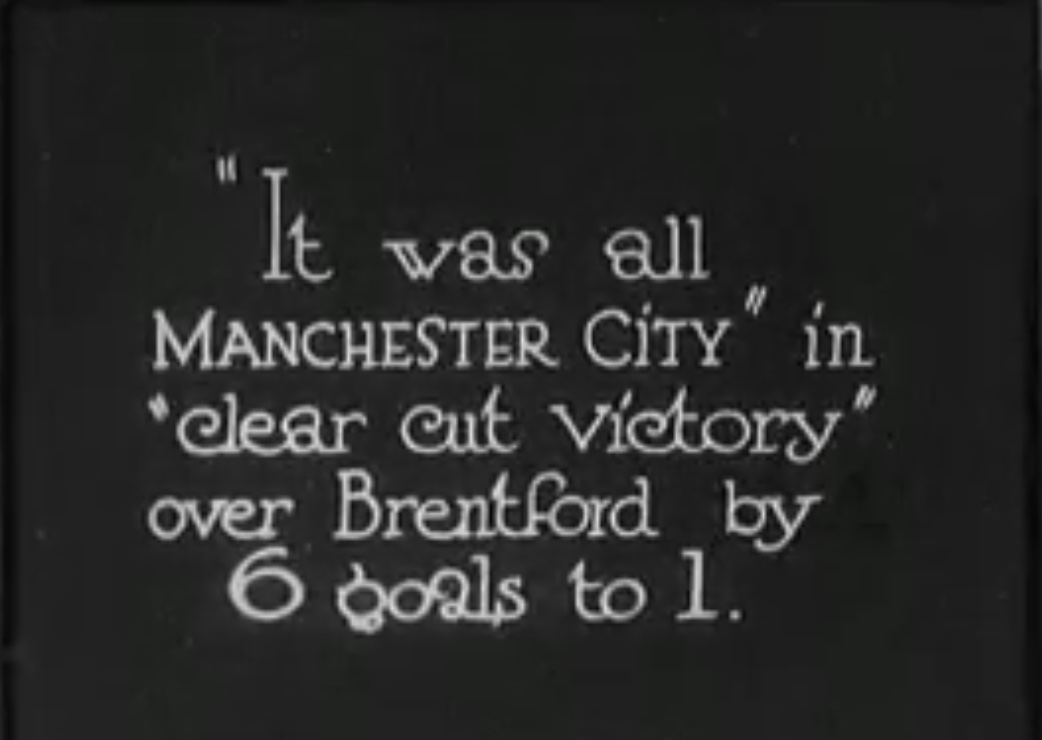
Here’s film from this day (23 January) in 1932 of Manchester City playing Brentford at Maine Road. The 1930s was a good era for both clubs – in fact Brentford challenged City for the 1936-37 League title. The game shown here is a FA Cup tie at Maine Rd in front of 56,190.
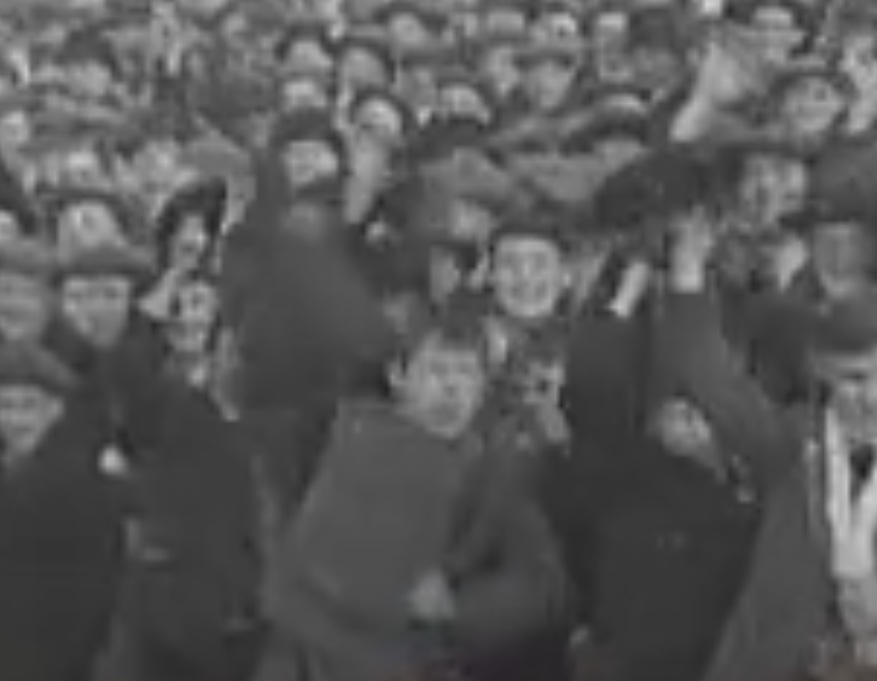
The game is the second on this film and starts after about 1 minute 25 seconds. Watch out for some lads obviously playing up for the camera at the start of the City-Brentford clip. My favourite is the lad who larks around with his coat (below image).
There’s also a cracking City goal right at the end of the clip. Enjoy!
On this day (22nd January) in 1977 Brian Kidd scored four as Manchester City defeated Leicester 5-0 in the only League game featuring City to be staged during January 1977. Mike Doyle scored the other.
Did you recognise the ground? This is a 1950s photo of this ground which during that decade underwent some major changes. The ground remains a League venue today and Manchester City have played there in a prominent game. Much of the area will still be recognisable to those who visit the ground.
The answer is Peterborough United’s London Road ground (now known as Weston Homes Stadium), photographed in 1957.
While you’re here why not subscribe to my site and you can then access every article, interview, audio recording etc. already posted and those that will be posted during your subscription. It costs £20 per year (about £1.67 a month) or you can sign up on a monthly basis at £3 per month (you can cancel at any time, so you could sign sign up for a month, access everything you want and then cancel). You can subscribe below:
Subscribe to get access
Read more of this content when you subscribe today.
On this day (21st January) in 1976 goals from Peter Barnes, Ged Keegan, Alan Oakes and Joe Royle in the semi-final second leg against Jack Charlton’s Middlesbrough guaranteed Manchester City an appearance in the League Cup final. The Blues had lost the first leg 1-0 to a Boro side that included Graeme Souness. The aggregate score was 4-1.
Here’s the story of that game and the situation around MCFC at the time with quotes from interviews I have performed with Alan Oakes and Rodney Marsh.
Subscribe to get access
Read more of this content when you subscribe today.
I didn’t realise this was available but here’s film of a talk plus Q&A I did about the early history of football in Manchester. It’s of interest to anyone keen on the origins of football or any of the Manchester clubs… Indeed the social history of Manchester. It lasts about 55 minutes and was part of the promotional work connected with my book ‘The Emergence of Footballing Cultures: Manchester 1840-1919’, published by Manchester University Press.
Here’s the recording:
If you are interested in the book then that can be bought direct from Manchester University Press or via usual retailers, such as Amazon:





 Gary James' Football Archive