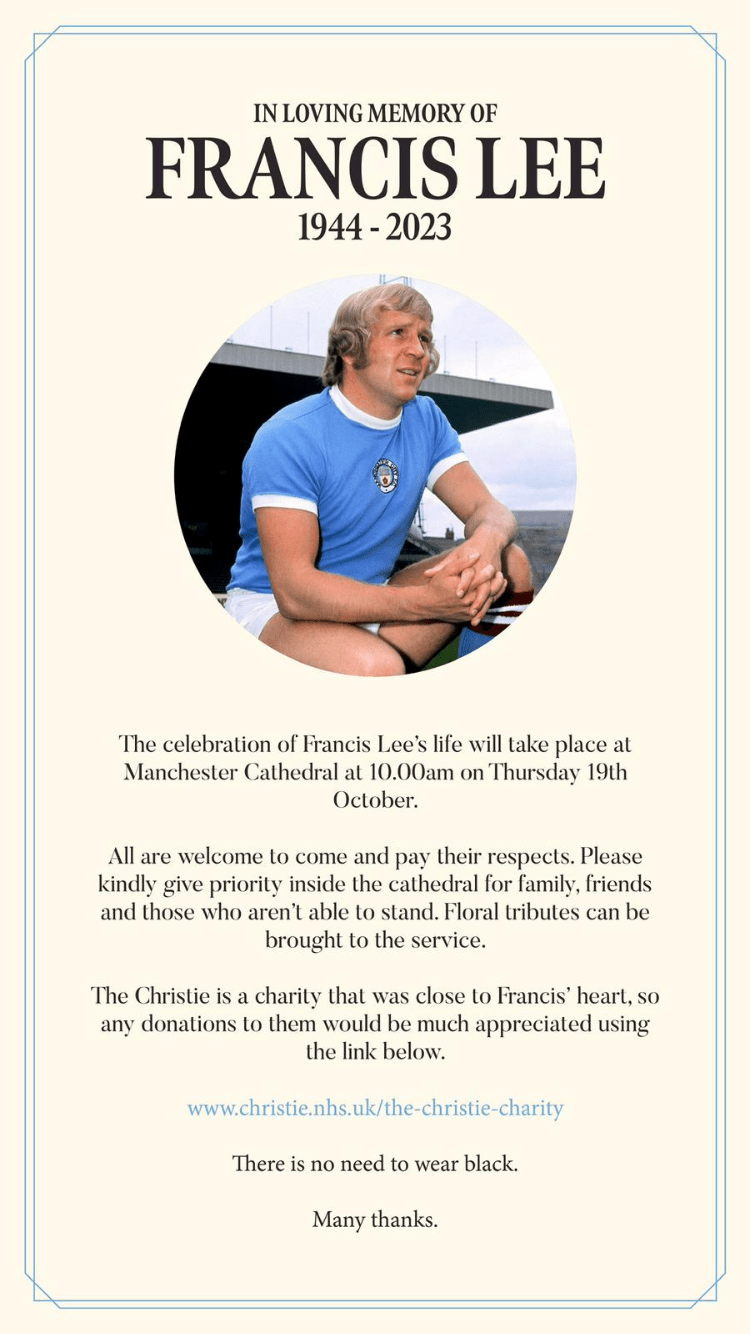
Francis Lee’s Funeral

Today was an emotional day but it was also a perfect sendoff for Francis Lee. I was at Manchester Cathedral to pay my respects and it was great hearing the tributes to Francis today, particularly the one from Will Perry and Francis’s son Jonny. They did him proud. Great to see many Blues & former players there, plus Barry ‘look at his face’ Davies. The former players from City included Mike Summerbee of course, Tony Book, Micah Richards, Peter Barnes, Tommy Booth, Asa Hartford, Joe Royle and Alan Oakes. Former physio Roy Bailey was there, as was Fred Eyre, and playing representatives of Bolton and Derby. Colin Bell’s son Jon was also present which was fantastic to see.

One of the things that came across well from Jonny’s eulogy was his dad’s sense of humour. Jonny revealed how Franny often told interviewers fake facts like how he could play the piano to classical concert standard and some of these jokes have made it into obituaries. Brilliant – it also means I now need to go back through my interviews with him to see if I can spot any Franny wind ups!

Franny’s mate John Gildersleeve also revealed how the two of them were travelling back from a holiday in Dubai when Franny (MCFC chairman at the time) received a phone call from BBC Radio Manchester. The interviewer knew that Franny had been out of the country but didn’t know where and asked if he’d been trying to sign a player. Franny said he had and that the Blues were in negotiation to buy a strong relatively unknown defender. He said that he couldn’t say much but he could reveal the player’s name. He then gave the BBC a Dutch sounding version of John Gildersleeve’s name – and according to the tale we heard the BBC fell for it!

The service included Blue Moon played on the cathedral organ (quite emotional) and recordings of What a Wonderful Life (Louis Armstrong) and You Got It (Roy Orbison), plus hymns Dear Lord and Father of Mankind and, of course, Abide With Me. As well as family and friends, City’s Danny Wilson added to the eulogies with an appropriate and appreciated contribution about what Franny meant to City.

In addition to family, friends, colleagues and former players there were many, many fans there paying their respects. I think Francis would’ve loved that.

After the service at the Cathedral there was a private family cremation and other commemorations marking Franny’s life.

Franny was a wonderful player, businessman and man. Today Manchester and the world recognised that.

If you missed reading my interview with Francis from 2010 you can read it below. For those who wonder why Francis was so significant hopefully this will give an indication. This is one of many interviews I did with Francis over the decades and I want to include this one today as it was written up as a Q&A style piece with Francis’ own words documented. I hope it captures the spirit of the legendary Bolton, City, Derby and England player.

IN SEARCH OF THE BLUES – Francis Lee

For today’s feature author Gary James met up with former Bolton, City and England star Francis Lee.  In a glittering career Francis won two League Championships, the ECWC, League Cup and the FA Cup.

Francis, let’s begin with your early career at Bolton.  Can you explain how that started?

I was a member of the groundstaff and I set myself a target that I had to get into the first team by the time I was 17 or 18 and if I didn’t I was going to go back to college and train as a draughtsman.  That was my plan, but I managed to get into the first team at 16 and I made my debut against City (5/11/60).  We won 3-1 and I scored a header at 3.15 against Bert Trautmann – I think Bert must have thought he was getting over the hill for me to score a header past him!  It was a great day and there were some very good players on both sides – Nat Lofthouse of course.  Ken Barnes and Denis Law were playing for City.

I kept my place for about six games and then the following season I had 5 games, then in 1962-63 I was top scorer with 12 goals from 23 League games.

You were playing out on the wing those days and topped the goalscoring charts each season at Bolton from 1962 until you left.  Was that your preferred position?

I think my best position was as support striker to a big fella.  I only played in that role twice really – at Bolton with Wyn Davies when I scored 23 League goals one season and then at City with Wyn again when I scored 33 League goals in 1971-72.  A lot of my career was spent at centre-forward at City and at Derby which is a bit of a difficult position to play if you’re only 5ft 7.  When I played for England I was support to Geoff Hurst and that suited me.  When I played at centre-forward I had my back to the ball but when I was support striker – the free player – that suited me fine.  I could pick up the ball going forward and that was great.

At Bolton you scored 106 goals in 210 appearances.  A great record, but when you left the club the stories were that you were in dispute.  Is that true?

Well, what happened is that Bolton had got relegated in 1964 and, despite a near-miss in 1965 when we finished third, it didn’t feel as if we were going forward.  My ambition was still to see how far I could develop in the game and in the back of my mind I had the ambition to play for England, but I wasn’t even selected for the under 23s.  The story was going around that I was difficult to handle – which is funny because Joe Mercer said that I was the easiest player to handle at one point.

At one point I remember asking the manager why I wasn’t earning as much as Wyn Davies who had been brought in to score goals.  I was top goalscorer but Wyn was paid more and the manager said:  “you’re too young!” but Wyn was only about a year older than me.

Were you difficult to handle at Bolton?

I was opinionated and ambitious, but not difficult.  I think that message was going around because I was on a weekly contract at that time and the club knew that it would be difficult for them to stop me moving on if another club came in.  So any player with a reputation for being difficult would not be on anyone else’s shopping list, would they?  Bolton offered me a new contract worth something like £150 a week but before that I was on £35.  That actually upset me more and I said: “if you now think I’m worth £150 a week what about all those years you’ve been underpaying me?”  It wasn’t the money that was an issue it was the way they handled it.  What they were doing was trying to get me on that contract and then my value would increase if someone came in to buy me.   Once they saw how dissatisfied I was with the way they were handling it, they said that it’d be best if we made a clean break, and so I said I’d pack the game in.  I had my business by then and so I said:  “give me my employment cards and I’ll pack it in.”  They thought I was bluffing. 

It’d been a decent season so far – I’d scored 9 goals in 11 games including when we beat the great Liverpool side in the League Cup – but then it all stopped in September 1967.  They gave me my cards and that was it.

Were you absolutely certain you’d pack it all in at that point?

I kept myself fit but I was working on my business.  I was driving my lorry around, collecting the waste paper and so on.  The business was growing and I felt that if I wasn’t wanted then I’d concentrate on that.  It was always my fallback.  It was only a small business really.

I know how stories can get exaggerated over the years, but is it true that in between games you were going around collecting the waste paper?

I used to drive my lorry during the week and even on the Thursday or Friday before a game I’d be collecting waste paper.  I used to put on a flat cap and muffler so that nobody would recognise me!  In summer I worked long hours and I was earning more in the summer months than I was playing football in Division One.  I also played cricket.  At one point it looked like I was going to be a footballer and cricketer but the season overlap meant I had to concentrate on football.

In the end I was driving articulated lorries and it was getting to be a very good business.  My last job was the day before I signed for City!  I roped and sheeted about 15 ton of paper and cardboard from a spinning mill in Bolton.  Took it to the Sun Paper Mill in Blackburn and when I got back about 5pm I got a call from Joe Mercer.  He didn’t give his name at first but I recognised him and he said:  “Where’ve you been?” I told him I’d been playing golf – I couldn’t play the game at all then but I couldn’t tell him what I had been doing!  I asked him:  “who is that?”  He said:  “Tom Jones.”  I said: “It doesn’t sound like Tom Jones, sounds more like a man called Mercer!”

Did you immediately want to sign for City?

Other teams had shown interest in signing me.  Liverpool offered £100,000 I understand but then when I wasn’t playing it affected my price.  In later years Shanks often used to grab me and say in that strong Scottish accent:  “Son, I should’ve signed ya the night I saw ya!”

City was just right of course.  It meant the business could carry on.  I don’t know if Bolton had told Joe about my contract or the £150 offer but the first thing he said to me before we talked it through was:  “I’ll be honest with you son.  We’ve no money.  We’re skint!”  I said:  “It doesn’t matter.  I’ll just be delighted to start playing again.” 

I signed for City for £60 a week – remember I’d turned down £150 at Bolton – and in the end it was well worth it.  The way the team developed and, of course, when I realised my ambition and played for England.

City paid £60,000 – actually they paid £40,000 down and £20,000 on the drip!  I was told I should get about 5% of the fee but then the League wouldn’t allow it because I’d left under strained circumstances or something.

I left a lot of friends of mine at Bolton – Freddie Hill, a great friend, Tommy Banks, Roy Hartle, Gordon Taylor – and we had some great times.  Those of us who had come through the ranks were poorly paid for the job we were doing at the time, but we enjoyed ourselves.  I never had any argument with the players, fans or people at Bolton, it was just those that ran it.  I loved my time at Bolton.

When you joined City the Blues were ninth in Division One after losing 5 of the 11 games played.  But the side was transformed from the moment you came.  Unbeaten in your first 11 League games.  Were you the difference?

The team just clicked and I was only part of a good group of players.  We had that great run up to Christmas, then a bit of a blip, but in the New Year we just rattled on.  It was a terrific period.  Mike Summerbee was playing at centre-forward and our culture at the time was to play with five forwards.  It was very unusual for the time.  The only system we played was that we all played we had ten players who went up together, and ten who defended together.  When we won the League at Newcastle at the end of the season it was wonderful and particularly special because none of us had ever won anything significant.  This was our first major success and that’s why the following season the ordeal of playing a European Cup tie was so tough.

Was it just inexperience that caused City to lose the Fenerbahce European Cup tie 2-1 on aggregate?

None of us had played in Europe before.  Mike Summerbee had only made his England debut against Scotland in February 1968.  Colin Bell had played in two England friendlies, but apart from that none of us had any concept of what it could be like in Turkey.  Had we played the first leg in Istanbul and the second at Maine Road I think we’d have gone through, but the goalless 1st leg at Maine Road killed us really.  We worked hard in Istanbul and it was a creditable result over there but we were out and it was because we were inexperienced.  It was a culture shock.

Despite the Fenerbahce setback did it feel as if City could find further success?

No confidence was at a real low after that game.  We’d had a bad run and only had a small squad so we struggled.  But that was the way it was.  Most clubs had small squads but what Shankly used to do at Liverpool was sign a couple of players each season just to ensure that those who were first choice felt the pressure and remained hungry for the game.  Back then the motivation for all of us was to be in the team and to keep your place.  The money was significantly different if you lost your place – City used to have this thing where we’d get a bonus depending on the size of the attendance as well as goals, wins and so on.  That motivated you to ensure you did all you could to entertain as well as win – you wanted the crowds to grow. 

Effectively you could double your wage by simply being in the team.  That’s a big incentive. 

Francis Lee (left) and Mike Summberbee (right) threaten the Fenerbahce goal in City’s first European Cup tie in 1968.

You mentioned about squad size, I think younger readers may be surprised to read that City tried to keep the same eleven players game after game, competition after competition.  Would you have enjoyed a squad rotation policy when you played?

The aim of a footballer is to play.  Why would anyone want to be rested?  If a manager had said to me ten minutes before full time that he wanted to bring me off even though I was playing well, I’d have told him “no way!  I’m enjoying myself.  This is what you bought me for, now let me do it!”  It wouldn’t matter what the manager says I’d want to stay on.  That’s what the game is about – enjoyment!  Every player wanted to play.  None of us wanted to be on the bench. 

People talk about the number of games played today but in 1969-70, ignoring domestic friendlies and the Charity Shield, you played 71 competitive games for England and City.  Would squad rotation have helped?

No. Playing is always better than being on the training pitch and I used to love playing, so I tried not to miss a game.  It didn’t matter whether it was an England friendly, Anglo-Italian cup or whatever, I wanted to play and represent my club and my country.  I think it’s best for all players.  Look at Tevez.  He’s improved his fitness and form by playing, and I think a lot of players are like that.  He needs to play, and that’s what I always wanted. 

Some of the other players from the 1969-70 season have talked about Franny’s Grand Slam.  Your aim to win four trophies in one season inspired them.  What do you remember of that?

Well, we wanted to win every game so it seemed natural to me that we should go for all four.  We won the League Cup and Cup Winners’ Cup, so that wasn’t bad.  In the FA Cup we were odds on to win at Old Trafford because we’d beaten them so many times.  We ended up suffering a rare defeat at United, but it was one of those we should really have won based on form and everything.  We were doing okay in the League then we had a few injuries – Mike, Colin Bell and Neil Young were injured at key times – otherwise I think we would have won three trophies.  But the thing about the ‘Grand Slam’ was that it was the ambition of the place.  I remember we were going to London on the train and could see Wembley, and I shouted to the lads to take a look because two of our ‘Grand Slam’ games would be played there!

1971 ECWC v Chelsea. Francis Lee. Photo by Alan Jubb

Moving forward a couple of years, the success started to disappear.  There had been the takeover that ultimately led to Peter Swales being Chairman, and of course we missed the title by a point in 1972.  What had changed?

Rodney Marsh has told you himself that his signing made a difference.  Malcolm played Rodney and disrupted a team that I’m convinced would have won the League that year.  Derby won it when they were in Majorca or somewhere!  I don’t blame Rodney… that season our luck changed and everything went against us.  There was one game near the end where we should have had a couple of penalties for hand ball but because this was the season when we got that record number of penalties they weren’t given. 

Thinking about the penalties, a lot has been made about you ‘diving’ but the factual evidence is that the majority of penalties were given for things like handball or fouls on other players.  Nevertheless, the myths survive.  So, big question, did you ever dive?

I couldn’t say that I always stayed on my feet unless I was absolutely knocked down.  In those days you used to get some horrendous treatment by the defenders, but I will tell you that the season before those penalties we only had a couple, and before that I think it was one.  The reason we got so many in 1971-72 is that they had changed the law, plus we were going for the title so we were putting sides under a lot of pressure and they reacted.  I was fouled only 5 times out of the 13 league penalties we got.

When I was attacking I used to play the odds.  If a defender was coming towards me I’d carry on, or I’d run towards the defender because there were only three things that could happen – he pulls me down, he gets the ball of me – well done, or I get a cracking shot at goal.  So the odds were in my favour.  You have to play them.

I think the reason people go on about penalties with me is because I was the one taking them.  It didn’t seem to matter what they were given for, the headlines were that I had scored from a penalty.  The season after I think we only got one penalty and by the time I moved to Derby they already had a penalty taker so that was it.  I would say that for every dubious penalty that was awarded there were another twenty that we should have had.

Francis Lee’s first penalty for City January 1968 v Sheffield United
Francis Lee scoring penalty v Manchester United 1971-72 season

Was the move to Derby something you really wanted?

No.  By that time my business was substantial so going to Derby was going to cause problems.  Derby offered City more than anyone else and so I went there.  We won the title in my first season – I’d only signed a contract for a year – and they were a very good side, so I stayed with them for another season.  The pitch was awful – even Maine Road’s pitch was better – but we could have won the European Cup that second season.  We won the first leg of a tie with Real Madrid 4-1 but I missed the return because I’d been sent off in the Hunter incident against Leeds.  We lost 5-1.

They actually changed the rule after that saying it was unfair to automatically ban a player from a European game after a domestic match when the player had yet to be proved to be guilty or not guilty.  There wasn’t much chance of me being ‘not guilty’ – the footage was there for everyone to see!

There was that memorable game when you came back to Maine Road and scored for Derby at the Platt Lane end of the ground.  I was in the stand that day and I remember a surreal moment when City fans cheered your goal.  Did that happen or is it just my memory?

Yes, it did happen.  Then I think they thought:  “What have we done, he’s playing for them!”

I enjoyed my football and I loved scoring so when I scored and the film shows me smiling it was because I’d scored what I thought was a good goal.  I picked it up with my back to the line, went through two people and on to score the goal.  I loved the goal and it is true that everyone applauded.  It had nothing to do with City or revenge or anything like that.  I think I enjoyed about 95% of every game I ever played.  It was fun.  A great way to earn a living, so on that day I was happy.

People often suggest that City sold you too soon and that had you stayed a couple of seasons longer we might have won the title ourselves.  Do you hold this view?

I think if I’d have stayed and Mike Summerbee – remember he was sold a year after me – then I do think we’d have mounted a serious challenge for the title.  Mike had more to offer.

After two seasons at Derby you retired, but you were still relatively young.  Why?

I had about 110 people working for me and my business was taking over.  I was travelling all over the country for my business and was trying to fit the football training in as well.  I needed to concentrate on the business.  Had I been playing in Manchester or Bolton then I may have carried on.  I was only 32.  Derby wanted me to stay on, and I made a promise to Dave Mackay that if I was to return to football then I’d do it for him.  Tommy Docherty tried to persuade me to join United but I’d made that promise and wouldn’t do it.

You developed your business interests and horse racing over the following twenty years, but then suddenly you were back, mounting takeover of City.  Why?

I wasn’t really looking to get back into the game at all during those years.  I had a good and successful career outside of the game and was happy.  But the takeover was one of those things that happened.  I should have known that it wouldn’t work.  The biggest problem we faced at the start was having to build the new Kippax Stand.  We ended up spending about £16m in the end – even removing the waste from underneath the old terracing should have cost only £80,000 but ended up costing about £1.8m.  I thought then that I’d always been lucky in life and then suddenly my luck had changed.  Everything we tried to do became an issue and the Kippax was a bit of a millstone.

It’s extraordinary when you think that at that time Jack Walker had put some money into Blackburn and Everton had had some money put into it, and we put money into City, but prior to that no one ever put money into a football club.  They bought shares but never invested, we did invest.  But the financial state of the club was appalling.

It strikes me that off the pitch things did improve significantly, but on the pitch we struggled.  What’s your view?

People like John Dunkerley worked very hard during that spell and the training facilities were improved and so on.  Then, just when we finished the Kippax Manchester Council started to talk to me about becoming tenants of the new stadium – now that turned out to be the best thing that happened to City during the decade that followed.  We spent a lot of time working with them and talking with various people to make it happen.  Full marks must go to the Council for having the foresight and it became very important for City to become anchor tenants.  I think I had a lot of bad luck as Chairman and things certainly didn’t work on the pitch, but I do think that was one thing that the club got right.

Why did it fail on the field?

I don’t know.  Maybe the footballers didn’t enjoy playing as much as they ought to have done.  We also had a few problems with managers but I’d better not get into that.

Finally, many people claim the 1970 League Cup Final was your greatest City game, do you feel that?

I don’t view it like that.  I don’t think of individual games in that way.  My job was to score goals and win games, and so I look at my career and see what goals I’ve scored.  You have to look at the club during your time there and see what that club won and what you contributed to the overall success of the club, not necessarily individual games. 

My role was to make things happen, and if I was making things happen, especially if it was causing some aggravation for the opposition, then I was happy.  When you hear the opposition players shouting things like: “don’t let him turn!” that’s a real pat on the back.  You know you’re getting to them.

In terms of individual games or goals… I don’t see it in those terms.  In the championship season I think one of the goals I scored at West Ham (18/11/67) was the best goal I’ve ever scored.  I was playing against Bobby Moore and I think I had a fantastic game but, because they are trophy winning games in their own right, cup finals tend to be remembered mostly by others.

I always think that a top class player should go on to the pitch and have enough confidence in his own ability to know that it is very rare for him to have a bad game.  It’s not arrogance or anything, but it is the mark of a top class player.  If you go onto the pitch feeling that then more often than not you will have a good game.  The next step is to take it up the levels until you walk on to the pitch believing you’ll have a great game and score a couple of goals.  At City most of us developed that confidence and on some days, when the entire team was at that level, we had some tremendous games.  That Newcastle title decider was like that.

Francis Lee after scoring at Newcastle

Francis Lee

It’s going to be an emotional day today as it is the funeral of Francis Lee. I’ll be at the cathedral to pay my respects but I also wanted to mark today by including here an interview I did with him back in 2010. This is one of many interviews I did with Francis over the decades and I want to include this one today as it was written up as a Q&A style piece with Francis’ own words documented. I hope it captures the spirit of the legendary Bolton, City, Derby and England player.

IN SEARCH OF THE BLUES – Francis Lee

For today’s feature author Gary James met up with former Bolton, City and England star Francis Lee.  In a glittering career Francis won two League Championships, the ECWC, League Cup and the FA Cup.

Francis, let’s begin with your early career at Bolton.  Can you explain how that started?

I was a member of the groundstaff and I set myself a target that I had to get into the first team by the time I was 17 or 18 and if I didn’t I was going to go back to college and train as a draughtsman.  That was my plan, but I managed to get into the first team at 16 and I made my debut against City (5/11/60).  We won 3-1 and I scored a header at 3.15 against Bert Trautmann – I think Bert must have thought he was getting over the hill for me to score a header past him!  It was a great day and there were some very good players on both sides – Nat Lofthouse of course.  Ken Barnes and Denis Law were playing for City.

I kept my place for about six games and then the following season I had 5 games, then in 1962-63 I was top scorer with 12 goals from 23 League games.

You were playing out on the wing those days and topped the goalscoring charts each season at Bolton from 1962 until you left.  Was that your preferred position?

I think my best position was as support striker to a big fella.  I only played in that role twice really – at Bolton with Wyn Davies when I scored 23 League goals one season and then at City with Wyn again when I scored 33 League goals in 1971-72.  A lot of my career was spent at centre-forward at City and at Derby which is a bit of a difficult position to play if you’re only 5ft 7.  When I played for England I was support to Geoff Hurst and that suited me.  When I played at centre-forward I had my back to the ball but when I was support striker – the free player – that suited me fine.  I could pick up the ball going forward and that was great.

At Bolton you scored 106 goals in 210 appearances.  A great record, but when you left the club the stories were that you were in dispute.  Is that true?

Well, what happened is that Bolton had got relegated in 1964 and, despite a near-miss in 1965 when we finished third, it didn’t feel as if we were going forward.  My ambition was still to see how far I could develop in the game and in the back of my mind I had the ambition to play for England, but I wasn’t even selected for the under 23s.  The story was going around that I was difficult to handle – which is funny because Joe Mercer said that I was the easiest player to handle at one point.

At one point I remember asking the manager why I wasn’t earning as much as Wyn Davies who had been brought in to score goals.  I was top goalscorer but Wyn was paid more and the manager said:  “you’re too young!” but Wyn was only about a year older than me.

Were you difficult to handle at Bolton?

I was opinionated and ambitious, but not difficult.  I think that message was going around because I was on a weekly contract at that time and the club knew that it would be difficult for them to stop me moving on if another club came in.  So any player with a reputation for being difficult would not be on anyone else’s shopping list, would they?  Bolton offered me a new contract worth something like £150 a week but before that I was on £35.  That actually upset me more and I said: “if you now think I’m worth £150 a week what about all those years you’ve been underpaying me?”  It wasn’t the money that was an issue it was the way they handled it.  What they were doing was trying to get me on that contract and then my value would increase if someone came in to buy me.   Once they saw how dissatisfied I was with the way they were handling it, they said that it’d be best if we made a clean break, and so I said I’d pack the game in.  I had my business by then and so I said:  “give me my employment cards and I’ll pack it in.”  They thought I was bluffing. 

It’d been a decent season so far – I’d scored 9 goals in 11 games including when we beat the great Liverpool side in the League Cup – but then it all stopped in September 1967.  They gave me my cards and that was it.

Were you absolutely certain you’d pack it all in at that point?

I kept myself fit but I was working on my business.  I was driving my lorry around, collecting the waste paper and so on.  The business was growing and I felt that if I wasn’t wanted then I’d concentrate on that.  It was always my fallback.  It was only a small business really.

I know how stories can get exaggerated over the years, but is it true that in between games you were going around collecting the waste paper?

I used to drive my lorry during the week and even on the Thursday or Friday before a game I’d be collecting waste paper.  I used to put on a flat cap and muffler so that nobody would recognise me!  In summer I worked long hours and I was earning more in the summer months than I was playing football in Division One.  I also played cricket.  At one point it looked like I was going to be a footballer and cricketer but the season overlap meant I had to concentrate on football.

In the end I was driving articulated lorries and it was getting to be a very good business.  My last job was the day before I signed for City!  I roped and sheeted about 15 ton of paper and cardboard from a spinning mill in Bolton.  Took it to the Sun Paper Mill in Blackburn and when I got back about 5pm I got a call from Joe Mercer.  He didn’t give his name at first but I recognised him and he said:  “Where’ve you been?” I told him I’d been playing golf – I couldn’t play the game at all then but I couldn’t tell him what I had been doing!  I asked him:  “who is that?”  He said:  “Tom Jones.”  I said: “It doesn’t sound like Tom Jones, sounds more like a man called Mercer!”

Did you immediately want to sign for City?

Other teams had shown interest in signing me.  Liverpool offered £100,000 I understand but then when I wasn’t playing it affected my price.  In later years Shanks often used to grab me and say in that strong Scottish accent:  “Son, I should’ve signed ya the night I saw ya!”

City was just right of course.  It meant the business could carry on.  I don’t know if Bolton had told Joe about my contract or the £150 offer but the first thing he said to me before we talked it through was:  “I’ll be honest with you son.  We’ve no money.  We’re skint!”  I said:  “It doesn’t matter.  I’ll just be delighted to start playing again.” 

I signed for City for £60 a week – remember I’d turned down £150 at Bolton – and in the end it was well worth it.  The way the team developed and, of course, when I realised my ambition and played for England.

City paid £60,000 – actually they paid £40,000 down and £20,000 on the drip!  I was told I should get about 5% of the fee but then the League wouldn’t allow it because I’d left under strained circumstances or something.

I left a lot of friends of mine at Bolton – Freddie Hill, a great friend, Tommy Banks, Roy Hartle, Gordon Taylor – and we had some great times.  Those of us who had come through the ranks were poorly paid for the job we were doing at the time, but we enjoyed ourselves.  I never had any argument with the players, fans or people at Bolton, it was just those that ran it.  I loved my time at Bolton.

When you joined City the Blues were ninth in Division One after losing 5 of the 11 games played.  But the side was transformed from the moment you came.  Unbeaten in your first 11 League games.  Were you the difference?

The team just clicked and I was only part of a good group of players.  We had that great run up to Christmas, then a bit of a blip, but in the New Year we just rattled on.  It was a terrific period.  Mike Summerbee was playing at centre-forward and our culture at the time was to play with five forwards.  It was very unusual for the time.  The only system we played was that we all played we had ten players who went up together, and ten who defended together.  When we won the League at Newcastle at the end of the season it was wonderful and particularly special because none of us had ever won anything significant.  This was our first major success and that’s why the following season the ordeal of playing a European Cup tie was so tough.

Was it just inexperience that caused City to lose the Fenerbahce European Cup tie 2-1 on aggregate?

None of us had played in Europe before.  Mike Summerbee had only made his England debut against Scotland in February 1968.  Colin Bell had played in two England friendlies, but apart from that none of us had any concept of what it could be like in Turkey.  Had we played the first leg in Istanbul and the second at Maine Road I think we’d have gone through, but the goalless 1st leg at Maine Road killed us really.  We worked hard in Istanbul and it was a creditable result over there but we were out and it was because we were inexperienced.  It was a culture shock.

Despite the Fenerbahce setback did it feel as if City could find further success?

No confidence was at a real low after that game.  We’d had a bad run and only had a small squad so we struggled.  But that was the way it was.  Most clubs had small squads but what Shankly used to do at Liverpool was sign a couple of players each season just to ensure that those who were first choice felt the pressure and remained hungry for the game.  Back then the motivation for all of us was to be in the team and to keep your place.  The money was significantly different if you lost your place – City used to have this thing where we’d get a bonus depending on the size of the attendance as well as goals, wins and so on.  That motivated you to ensure you did all you could to entertain as well as win – you wanted the crowds to grow. 

Effectively you could double your wage by simply being in the team.  That’s a big incentive. 

You mentioned about squad size, I think younger readers may be surprised to read that City tried to keep the same eleven players game after game, competition after competition.  Would you have enjoyed a squad rotation policy when you played?

The aim of a footballer is to play.  Why would anyone want to be rested?  If a manager had said to me ten minutes before full time that he wanted to bring me off even though I was playing well, I’d have told him “no way!  I’m enjoying myself.  This is what you bought me for, now let me do it!”  It wouldn’t matter what the manager says I’d want to stay on.  That’s what the game is about – enjoyment!  Every player wanted to play.  None of us wanted to be on the bench. 

People talk about the number of games played today but in 1969-70, ignoring domestic friendlies and the Charity Shield, you played 71 competitive games for England and City.  Would squad rotation have helped?

No. Playing is always better than being on the training pitch and I used to love playing, so I tried not to miss a game.  It didn’t matter whether it was an England friendly, Anglo-Italian cup or whatever, I wanted to play and represent my club and my country.  I think it’s best for all players.  Look at Tevez.  He’s improved his fitness and form by playing, and I think a lot of players are like that.  He needs to play, and that’s what I always wanted. 

Some of the other players from the 1969-70 season have talked about Franny’s Grand Slam.  Your aim to win four trophies in one season inspired them.  What do you remember of that?

Well, we wanted to win every game so it seemed natural to me that we should go for all four.  We won the League Cup and Cup Winners’ Cup, so that wasn’t bad.  In the FA Cup we were odds on to win at Old Trafford because we’d beaten them so many times.  We ended up suffering a rare defeat at United, but it was one of those we should really have won based on form and everything.  We were doing okay in the League then we had a few injuries – Mike, Colin Bell and Neil Young were injured at key times – otherwise I think we would have won three trophies.  But the thing about the ‘Grand Slam’ was that it was the ambition of the place.  I remember we were going to London on the train and could see Wembley, and I shouted to the lads to take a look because two of our ‘Grand Slam’ games would be played there!

Moving forward a couple of years, the success started to disappear.  There had been the takeover that ultimately led to Peter Swales being Chairman, and of course we missed the title by a point in 1972.  What had changed?

Rodney Marsh has told you himself that his signing made a difference.  Malcolm played Rodney and disrupted a team that I’m convinced would have won the League that year.  Derby won it when they were in Majorca or somewhere!  I don’t blame Rodney… that season our luck changed and everything went against us.  There was one game near the end where we should have had a couple of penalties for hand ball but because this was the season when we got that record number of penalties they weren’t given. 

Thinking about the penalties, a lot has been made about you ‘diving’ but the factual evidence is that the majority of penalties were given for things like handball or fouls on other players.  Nevertheless, the myths survive.  So, big question, did you ever dive?

I couldn’t say that I always stayed on my feet unless I was absolutely knocked down.  In those days you used to get some horrendous treatment by the defenders, but I will tell you that the season before those penalties we only had a couple, and before that I think it was one.  The reason we got so many in 1971-72 is that they had changed the law, plus we were going for the title so we were putting sides under a lot of pressure and they reacted.  I was fouled only 5 times out of the 13 league penalties we got.

When I was attacking I used to play the odds.  If a defender was coming towards me I’d carry on, or I’d run towards the defender because there were only three things that could happen – he pulls me down, he gets the ball of me – well done, or I get a cracking shot at goal.  So the odds were in my favour.  You have to play them.

I think the reason people go on about penalties with me is because I was the one taking them.  It didn’t seem to matter what they were given for, the headlines were that I had scored from a penalty.  The season after I think we only got one penalty and by the time I moved to Derby they already had a penalty taker so that was it.  I would say that for every dubious penalty that was awarded there were another twenty that we should have had.

Was the move to Derby something you really wanted?

No.  By that time my business was substantial so going to Derby was going to cause problems.  Derby offered City more than anyone else and so I went there.  We won the title in my first season – I’d only signed a contract for a year – and they were a very good side, so I stayed with them for another season.  The pitch was awful – even Maine Road’s pitch was better – but we could have won the European Cup that second season.  We won the first leg of a tie with Real Madrid 4-1 but I missed the return because I’d been sent off in the Hunter incident against Leeds.  We lost 5-1.

They actually changed the rule after that saying it was unfair to automatically ban a player from a European game after a domestic match when the player had yet to be proved to be guilty or not guilty.  There wasn’t much chance of me being ‘not guilty’ – the footage was there for everyone to see!

There was that memorable game when you came back to Maine Road and scored for Derby at the Platt Lane end of the ground.  I was in the stand that day and I remember a surreal moment when City fans cheered your goal.  Did that happen or is it just my memory?

Yes, it did happen.  Then I think they thought:  “What have we done, he’s playing for them!”

I enjoyed my football and I loved scoring so when I scored and the film shows me smiling it was because I’d scored what I thought was a good goal.  I picked it up with my back to the line, went through two people and on to score the goal.  I loved the goal and it is true that everyone applauded.  It had nothing to do with City or revenge or anything like that.  I think I enjoyed about 95% of every game I ever played.  It was fun.  A great way to earn a living, so on that day I was happy.

People often suggest that City sold you too soon and that had you stayed a couple of seasons longer we might have won the title ourselves.  Do you hold this view?

I think if I’d have stayed and Mike Summerbee – remember he was sold a year after me – then I do think we’d have mounted a serious challenge for the title.  Mike had more to offer.

After two seasons at Derby you retired, but you were still relatively young.  Why?

I had about 110 people working for me and my business was taking over.  I was travelling all over the country for my business and was trying to fit the football training in as well.  I needed to concentrate on the business.  Had I been playing in Manchester or Bolton then I may have carried on.  I was only 32.  Derby wanted me to stay on, and I made a promise to Dave Mackay that if I was to return to football then I’d do it for him.  Tommy Docherty tried to persuade me to join United but I’d made that promise and wouldn’t do it.

You developed your business interests and horse racing over the following twenty years, but then suddenly you were back, mounting takeover of City.  Why?

I wasn’t really looking to get back into the game at all during those years.  I had a good and successful career outside of the game and was happy.  But the takeover was one of those things that happened.  I should have known that it wouldn’t work.  The biggest problem we faced at the start was having to build the new Kippax Stand.  We ended up spending about £16m in the end – even removing the waste from underneath the old terracing should have cost only £80,000 but ended up costing about £1.8m.  I thought then that I’d always been lucky in life and then suddenly my luck had changed.  Everything we tried to do became an issue and the Kippax was a bit of a millstone.

It’s extraordinary when you think that at that time Jack Walker had put some money into Blackburn and Everton had had some money put into it, and we put money into City, but prior to that no one ever put money into a football club.  They bought shares but never invested, we did invest.  But the financial state of the club was appalling.

It strikes me that off the pitch things did improve significantly, but on the pitch we struggled.  What’s your view?

People like John Dunkerley worked very hard during that spell and the training facilities were improved and so on.  Then, just when we finished the Kippax Manchester Council started to talk to me about becoming tenants of the new stadium – now that turned out to be the best thing that happened to City during the decade that followed.  We spent a lot of time working with them and talking with various people to make it happen.  Full marks must go to the Council for having the foresight and it became very important for City to become anchor tenants.  I think I had a lot of bad luck as Chairman and things certainly didn’t work on the pitch, but I do think that was one thing that the club got right.

Why did it fail on the field?

I don’t know.  Maybe the footballers didn’t enjoy playing as much as they ought to have done.  We also had a few problems with managers but I’d better not get into that.

Finally, many people claim the 1970 League Cup Final was your greatest City game, do you feel that?

I don’t view it like that.  I don’t think of individual games in that way.  My job was to score goals and win games, and so I look at my career and see what goals I’ve scored.  You have to look at the club during your time there and see what that club won and what you contributed to the overall success of the club, not necessarily individual games. 

My role was to make things happen, and if I was making things happen, especially if it was causing some aggravation for the opposition, then I was happy.  When you hear the opposition players shouting things like: “don’t let him turn!” that’s a real pat on the back.  You know you’re getting to them.

In terms of individual games or goals… I don’t see it in those terms.  In the championship season I think one of the goals I scored at West Ham (18/11/67) was the best goal I’ve ever scored.  I was playing against Bobby Moore and I think I had a fantastic game but, because they are trophy winning games in their own right, cup finals tend to be remembered mostly by others.

I always think that a top class player should go on to the pitch and have enough confidence in his own ability to know that it is very rare for him to have a bad game.  It’s not arrogance or anything, but it is the mark of a top class player.  If you go onto the pitch feeling that then more often than not you will have a good game.  The next step is to take it up the levels until you walk on to the pitch believing you’ll have a great game and score a couple of goals.  At City most of us developed that confidence and on some days, when the entire team was at that level, we had some tremendous games.  That Newcastle title decider was like that.
On This Day: City Signed Francis Lee

On this day (9 October) 56 years ago Manchester City signed Francis Lee. It is now also a week since the news of his death was released. Here is a long profile of him that I’ve written, together with links to other stories and audio tributes too:

A World Cup international for England, Francis Lee remains one of Manchester City’s most famous former players and one of the Club’s greatest heroes.

Early Life

Born in Westhoughton, on the edge of Bolton, Francis remembers that sport played a big part in his early life.  His father used to play a lot of football with him and encouraged him to develop his skills.  The young Francis would play any other sporting activity, but it was football which brought him to the attention of the local scouts.  

While training at Horwich Technical College an offer came from Bolton Wanderers:  “I went to college in Horwich but left to sign for Bolton.  The principal said I was stupid but my father, who had spent forty years working in a cotton mill doing something he didn’t like, said why not give it a crack.  He said I could always go back to college if I didn’t make the grade, and the idea was to give myself a year.  Within six months I thought I had a chance of making it.”

Francis’ new footballing career was about to develop at an incredible pace.  On Bonfire Night 1960, he made his debut at the age of 16 after only appearing in eight Central League matches.  The game was, co-incidentally, against Manchester City and Bolton won 3-1 with Francis marking a superb debut with a goal:  “I scored at exactly 3.15.  I know because there was a photo of me the next day, heading past Bert Trautmann with the time on the stand clock in the background.”

To score a debut goal against such a legendary goalkeeping figure was clearly something Francis could hardly have dreamed of six months earlier, and inevitably it was enough to keep the Westhoughton youngster in the side for the following five League games.  A further five games followed in 1961-62, and then the next season Francis found himself having a sustained run in the side making 23 League appearances and scoring twelve goals.  Four of those goals came from the penalty spot, including two in a game at West Bromwich Albion in September, and it’s fair to say Francis’ success from the penalty spot throughout his career helped to develop his name.  

Malcolm’s Bath

During January 1964 Francis played against Malcolm Allison’s Bath City in the FA Cup.  On a miserable and difficult pitch at non-League Bath Bolton were awarded a penalty.  Francis prepared to take the kick but as he did so he heard his own captain whisper to another Bolton player:  “He’s due to miss one, you know.”  Whether it was the conditions or the vote of ‘no confidence’ is unclear but the penalty was not one of Francis’ best.  It did, however, go into the net off the inside of the post.  It may not have been the perfect penalty, but it certainly made Bath’s Malcolm Allison notice the player, and it saved Bolton from an embarrassing defeat.  

The match went to a replay and the Trotters won the return 3-0 with Francis once again scoring from the penalty spot.  Francis’ approach to penalty taking is clear:  “You’ve got to want to take penalties to be good at it.  You’ve got to enjoy it.  The kick itself is the easy part.  Any player who can’t hit the corner of the goal from twelve yards shouldn’t be playing.  Nerve is the key.  Everyone said I blasted the ball, but I used to aim for the stanchion and hit the ball at three-quarter speed, pretending I was passing the ball fifty or sixty yards.  I would take a long run up to give the ‘keeper longer to think about it – it gave him less of an idea which side I was going to hit it.”

Time to Leave

Francis’ career at Bolton continued until October 1967.  By that time he had made a total of 210 League and cup appearances and netted 106 goals, and was clearly a man other sides were interested in.  Unfortunately, his final year had become a difficult one as far as his relationship with the club was concerned:  “It was enjoyable at Bolton, but frustrating.  I really wanted to get away from the age of 18 or 19 because I could see they were going nowhere.  The wages were poor and the club just wasn’t changing with the times on or off the field.  My contract was up in the June (1967) and they didn’t want to sell me, so I signed a monthly contract.  Bolton said they would never sell me and offered £150 a week to stay.  I was only on £30 at the time, but I knew the only chance to further my ambition was to leave.  By October I had served my contract, and the option, and virtually retired!  I hadn’t played football for about three weeks.  I just did a bit of training on my own.  Eventually, Bolton realised they had a rapidly depreciating asset.”

Manchester City were interested from the start.  Malcolm Allison remembered Francis from the Bath-Bolton match and, of course, he had played in the Bolton-City Second Division game in November 1965, but the Blues were not the only interested party.  Stoke made an offer; Wolves were very keen; and Bill Shankly at Liverpool had also been very interested, but in the end it was Joe Mercer and Malcolm Allison who got their man.  

At one point Mercer turned to the player and said:  “I hope you will sign.  We feel we’ve got the start of a good side.  We are just one player short, and we think you are that player.  The odd goal or two will turn us into a great team.”

But even after the main negotiations had been agreed the transfer still stuttered – the League refused to accept the registration at first.  Eventually Francis did sign, and his transfer did help turn City into a great side as Mercer predicted.  Within seven months of his arrival the Blues were League Champions for the first time since 1937.

Playing on the right, with Mike Summerbee as centre-forward, Francis scored sixteen League goals in 31 games and ended that Championship season as second highest goalscorer – only three short of Neil Young.  There had been many thrilling and memorable performances with famous victories over Tottenham, Manchester United, and the last day tussle with Newcastle all grabbing the headlines.  Francis was a key player in each of these games, but it’s fair to say he excelled throughout the season.  Prior to his arrival, City had lost five of the eleven games they had played, with Francis in the side that record improved considerably and they were worthy champions.  Mercer had been right, Francis was the last piece of the jigsaw.

Cup Success

Much was expected of the Blues at the start of the following season, but injury to Tony Book affected City more than anyone could have anticipated.  In addition, every side seemed to raise its game when it faced City making average opposition appear like world beaters.  Francis was moved into the number nine shirt for the second half of the season and, although league form remained mixed, City started to compete well in the FA Cup.  Francis: “Having murdered everybody in my first season, we floundered as soon as the next season started.  We thought we had a divine right to go out and thrash people.  Mike (Summerbee) didn’t start very well at centre-forward because opponents got wise to his style.  So they changed us.  I was perfectly happy, it didn’t matter where I played.  But I don’t think centre-forward was my best position.  I was happiest when I was supporting a big striker.”

“When I played for England, Geoff Hurst was the striker up front, and when City bought big Wyn Davies I scored 33 goals one season.  In my time at Maine Road there was talk of buying Joe Royle or John Toshack and I think if we had, my record would have been better.”

The 33 goals mentioned by Francis came in 1971-72 and remains the second highest total of goals scored in a League season by a Blue, but before that Francis played in three major finals for City.  The first, the FA Cup in 1969, saw City defeat Leicester 1-0 with a goal from Neil young:  “I was delighted to beat Leicester and win the cup, but I didn’t have the best preparation for the Final.  I’d been out since the semi with a leg strain, and though I was fit, I had missed a couple of weeks’ training.  I don’t think I played outstandingly, I just had an average game, which was a shame.”

Less than a year later Francis did play a major part in the League Cup success over West Bromwich Albion, and the ECWC win over Polish side Gornik Zabrze.  Writing in his autobiography in 1970 Francis felt the Gornik match had been tough at times:  “The result was better than we dared hope.  Secretly, I thought beforehand that Gornik were going to be really difficult, and that with Mike Summerbee out we could easily struggle unless we hit absolutely peak form.  After eleven minutes Neil Young snapped up a chance presented to him by a lapse on the part of Poland’s international ‘keeper Kostka, and two minutes from half-time I hit a penalty in via the ‘keeper’s legs.”

“Our rhythm was disturbed for a while when Doyle was carried off in the first half with a leg injury, but we seemed to be cantering to victory when the Poles surprisingly pulled back the score to 2-1 in the 69th minute.  The rain had started to bucket down, and even when they scored I felt our only chance of losing the game was if it was called off.  There was a real fear of this at one time, but Gornik obviously sensed they were back in with a chance because they tried to put the pressure on us.  Even their goal was diverted off George Heslop and I think Joe Corrigan would have saved but for this.”

“In the last few minutes I think Gornik got the message that we had been on top throughout the game and intended staying on top.  We certainly felt we were good winners.”

Derby Move

After Gornik, City were seen as one of football’s most glamorous sides and Francis, with his never say die, bustling style, was a firm favourite.  His goals in 1971-72 brought City within a point of the title, and then in 1974 the Blues reached Wembley again in the League Cup final.  Sadly, the game ended in defeat, and at the end of that season Francis was sold to Derby County:  “I didn’t want to leave, I felt I had a couple more good seasons in me but Tony Book (the manager) said he thought it would be better if I went.”

Francis moved to Derby County and, as if to prove City wrong, the entertaining forward helped his new club to the League title:  “I think City would have won the League that season if I’d stayed.  The season before I signed for Derby, they won four away games.  We won seven after I arrived and won the League.”

Of course, Francis’ success wasn’t only confined to club football. He was also a wonderful England forward, scoring ten goals in 27 international appearances between December 1968 and April 1972.  There are many who felt his international career should have continued for at least another year, however it is worth stressing that he appeared for England at a time when there were many, many quality attackers desperate to make an impression.  The England side of 1970, for example, is believed to be one of the strongest national sides of all time.  Francis himself believes the 1970 side was one of quality:  “I played three games in the 1970 World Cup finals and I felt we had a better side than in ’66.  The players who had won the Cup were more experienced and I think the fringe players were better.  If we hadn’t gone out to West Germany in extra-time in the quarters, I think we would have gone on to win it.  Brazil certainly didn’t fancy playing us.”

Retirement

In 1976 Francis retired.  His final game came on 24th April 1976 when he scored twice for Derby against Ipswich in the final two minutes – a perfect way to end a great career.

After football, Francis spent most of his time developing his business interests, most notably his toilet paper manufacturers, and horse racing training.  His business interests had started while he was still a Bolton player and helped make Francis a multi-millionaire. Inevitably there was often talk during the 1980s and early 90s that Francis would one day turn his attention back to City.  During 1993-94 the fans backed a campaign to help him take over the Club, and he went on to replace Peter Swales as Chairman.  Off the pitch, the structure of the Blues improved considerably, however on the pitch activities struggled.  

In 1998 Francis stepped down as Chairman.  After that time Francis continued to be a major shareholder and regular attendee at City.  It’s fair to say his time as Chairman did not bring the level of success everybody anticipated, but his time as a player certainly brought more rewards than any neutral could have predicted on the day he signed in October 1967.

Francis will always be remembered as one of Manchester City’s greatest international players, and a firm favourite with supporters.

You can hear me and Mike Sweeney talk briefly about him here:

Here’s a tribute on the Blue Moon Podcast I did with David Mooney:

Francis Lee’s first MCFC penalty is remembered here:

Francis Lee

It is with immense sadness that I write this but the news has now been announced that the former Bolton, Manchester City, Derby & England star Francis Lee has died. There are so many things to say but probably best if I post here a long profile of him that I’ve previously written:

A World Cup international for England, Francis Lee remains one of Manchester City’s most famous former players and one of the Club’s greatest heroes.

Early Life

Born in Westhoughton, on the edge of Bolton, Francis remembers that sport played a big part in his early life.  His father used to play a lot of football with him and encouraged him to develop his skills.  The young Francis would play any other sporting activity, but it was football which brought him to the attention of the local scouts.  

While training at Horwich Technical College an offer came from Bolton Wanderers:  “I went to college in Horwich but left to sign for Bolton.  The principal said I was stupid but my father, who had spent forty years working in a cotton mill doing something he didn’t like, said why not give it a crack.  He said I could always go back to college if I didn’t make the grade, and the idea was to give myself a year.  Within six months I thought I had a chance of making it.”

Francis’ new footballing career was about to develop at an incredible pace.  On Bonfire Night 1960, he made his debut at the age of 16 after only appearing in eight Central League matches.  The game was, co-incidentally, against Manchester City and Bolton won 3-1 with Francis marking a superb debut with a goal:  “I scored at exactly 3.15.  I know because there was a photo of me the next day, heading past Bert Trautmann with the time on the stand clock in the background.”

To score a debut goal against such a legendary goalkeeping figure was clearly something Francis could hardly have dreamed of six months earlier, and inevitably it was enough to keep the Westhoughton youngster in the side for the following five League games.  A further five games followed in 1961-62, and then the next season Francis found himself having a sustained run in the side making 23 League appearances and scoring twelve goals.  Four of those goals came from the penalty spot, including two in a game at West Bromwich Albion in September, and it’s fair to say Francis’ success from the penalty spot throughout his career helped to develop his name.  

Malcolm’s Bath

During January 1964 Francis played against Malcolm Allison’s Bath City in the FA Cup.  On a miserable and difficult pitch at non-League Bath Bolton were awarded a penalty.  Francis prepared to take the kick but as he did so he heard his own captain whisper to another Bolton player:  “He’s due to miss one, you know.”  Whether it was the conditions or the vote of ‘no confidence’ is unclear but the penalty was not one of Francis’ best.  It did, however, go into the net off the inside of the post.  It may not have been the perfect penalty, but it certainly made Bath’s Malcolm Allison notice the player, and it saved Bolton from an embarrassing defeat.  

The match went to a replay and the Trotters won the return 3-0 with Francis once again scoring from the penalty spot.  Francis’ approach to penalty taking is clear:  “You’ve got to want to take penalties to be good at it.  You’ve got to enjoy it.  The kick itself is the easy part.  Any player who can’t hit the corner of the goal from twelve yards shouldn’t be playing.  Nerve is the key.  Everyone said I blasted the ball, but I used to aim for the stanchion and hit the ball at three-quarter speed, pretending I was passing the ball fifty or sixty yards.  I would take a long run up to give the ‘keeper longer to think about it – it gave him less of an idea which side I was going to hit it.”

Time to Leave

Francis’ career at Bolton continued until October 1967.  By that time he had made a total of 210 League and cup appearances and netted 106 goals, and was clearly a man other sides were interested in.  Unfortunately, his final year had become a difficult one as far as his relationship with the club was concerned:  “It was enjoyable at Bolton, but frustrating.  I really wanted to get away from the age of 18 or 19 because I could see they were going nowhere.  The wages were poor and the club just wasn’t changing with the times on or off the field.  My contract was up in the June (1967) and they didn’t want to sell me, so I signed a monthly contract.  Bolton said they would never sell me and offered £150 a week to stay.  I was only on £30 at the time, but I knew the only chance to further my ambition was to leave.  By October I had served my contract, and the option, and virtually retired!  I hadn’t played football for about three weeks.  I just did a bit of training on my own.  Eventually, Bolton realised they had a rapidly depreciating asset.”

Manchester City were interested from the start.  Malcolm Allison remembered Francis from the Bath-Bolton match and, of course, he had played in the Bolton-City Second Division game in November 1965, but the Blues were not the only interested party.  Stoke made an offer; Wolves were very keen; and Bill Shankly at Liverpool had also been very interested, but in the end it was Joe Mercer and Malcolm Allison who got their man.  

At one point Mercer turned to the player and said:  “I hope you will sign.  We feel we’ve got the start of a good side.  We are just one player short, and we think you are that player.  The odd goal or two will turn us into a great team.”

But even after the main negotiations had been agreed the transfer still stuttered – the League refused to accept the registration at first.  Eventually Francis did sign, and his transfer did help turn City into a great side as Mercer predicted.  Within seven months of his arrival the Blues were League Champions for the first time since 1937.

Playing on the right, with Mike Summerbee as centre-forward, Francis scored sixteen League goals in 31 games and ended that Championship season as second highest goalscorer – only three short of Neil Young.  There had been many thrilling and memorable performances with famous victories over Tottenham, Manchester United, and the last day tussle with Newcastle all grabbing the headlines.  Francis was a key player in each of these games, but it’s fair to say he excelled throughout the season.  Prior to his arrival, City had lost five of the eleven games they had played, with Francis in the side that record improved considerably and they were worthy champions.  Mercer had been right, Francis was the last piece of the jigsaw.

Cup Success

Much was expected of the Blues at the start of the following season, but injury to Tony Book affected City more than anyone could have anticipated.  In addition, every side seemed to raise its game when it faced City making average opposition appear like world beaters.  Francis was moved into the number nine shirt for the second half of the season and, although league form remained mixed, City started to compete well in the FA Cup.  Francis: “Having murdered everybody in my first season, we floundered as soon as the next season started.  We thought we had a divine right to go out and thrash people.  Mike (Summerbee) didn’t start very well at centre-forward because opponents got wise to his style.  So they changed us.  I was perfectly happy, it didn’t matter where I played.  But I don’t think centre-forward was my best position.  I was happiest when I was supporting a big striker.”

“When I played for England, Geoff Hurst was the striker up front, and when City bought big Wyn Davies I scored 33 goals one season.  In my time at Maine Road there was talk of buying Joe Royle or John Toshack and I think if we had, my record would have been better.”

The 33 goals mentioned by Francis came in 1971-72 and remains the second highest total of goals scored in a League season by a Blue, but before that Francis played in three major finals for City.  The first, the FA Cup in 1969, saw City defeat Leicester 1-0 with a goal from Neil young:  “I was delighted to beat Leicester and win the cup, but I didn’t have the best preparation for the Final.  I’d been out since the semi with a leg strain, and though I was fit, I had missed a couple of weeks’ training.  I don’t think I played outstandingly, I just had an average game, which was a shame.”

Less than a year later Francis did play a major part in the League Cup success over West Bromwich Albion, and the ECWC win over Polish side Gornik Zabrze.  Writing in his autobiography in 1970 Francis felt the Gornik match had been tough at times:  “The result was better than we dared hope.  Secretly, I thought beforehand that Gornik were going to be really difficult, and that with Mike Summerbee out we could easily struggle unless we hit absolutely peak form.  After eleven minutes Neil Young snapped up a chance presented to him by a lapse on the part of Poland’s international ‘keeper Kostka, and two minutes from half-time I hit a penalty in via the ‘keeper’s legs.”

“Our rhythm was disturbed for a while when Doyle was carried off in the first half with a leg injury, but we seemed to be cantering to victory when the Poles surprisingly pulled back the score to 2-1 in the 69th minute.  The rain had started to bucket down, and even when they scored I felt our only chance of losing the game was if it was called off.  There was a real fear of this at one time, but Gornik obviously sensed they were back in with a chance because they tried to put the pressure on us.  Even their goal was diverted off George Heslop and I think Joe Corrigan would have saved but for this.”

“In the last few minutes I think Gornik got the message that we had been on top throughout the game and intended staying on top.  We certainly felt we were good winners.”

Derby Move

After Gornik, City were seen as one of football’s most glamorous sides and Francis, with his never say die, bustling style, was a firm favourite.  His goals in 1971-72 brought City within a point of the title, and then in 1974 the Blues reached Wembley again in the League Cup final.  Sadly, the game ended in defeat, and at the end of that season Francis was sold to Derby County:  “I didn’t want to leave, I felt I had a couple more good seasons in me but Tony Book (the manager) said he thought it would be better if I went.”

Francis moved to Derby County and, as if to prove City wrong, the entertaining forward helped his new club to the League title:  “I think City would have won the League that season if I’d stayed.  The season before I signed for Derby, they won four away games.  We won seven after I arrived and won the League.”

Of course, Francis’ success wasn’t only confined to club football. He was also a wonderful England forward, scoring ten goals in 27 international appearances between December 1968 and April 1972.  There are many who felt his international career should have continued for at least another year, however it is worth stressing that he appeared for England at a time when there were many, many quality attackers desperate to make an impression.  The England side of 1970, for example, is believed to be one of the strongest national sides of all time.  Francis himself believes the 1970 side was one of quality:  “I played three games in the 1970 World Cup finals and I felt we had a better side than in ’66.  The players who had won the Cup were more experienced and I think the fringe players were better.  If we hadn’t gone out to West Germany in extra-time in the quarters, I think we would have gone on to win it.  Brazil certainly didn’t fancy playing us.”

Retirement

In 1976 Francis retired.  His final game came on 24th April 1976 when he scored twice for Derby against Ipswich in the final two minutes – a perfect way to end a great career.

After football, Francis spent most of his time developing his business interests, most notably his toilet paper manufacturers, and horse racing training.  His business interests had started while he was still a Bolton player and helped make Francis a multi-millionaire. Inevitably there was often talk during the 1980s and early 90s that Francis would one day turn his attention back to City.  During 1993-94 the fans backed a campaign to help him take over the Club, and he went on to replace Peter Swales as Chairman.  Off the pitch, the structure of the Blues improved considerably, however on the pitch activities struggled.  

In 1998 Francis stepped down as Chairman.  After that time Francis continued to be a major shareholder and regular attendee at City.  It’s fair to say his time as Chairman did not bring the level of success everybody anticipated, but his time as a player certainly brought more rewards than any neutral could have predicted on the day he signed in October 1967.

Francis will always be remembered as one of Manchester City’s greatest international players, and a firm favourite with supporters.

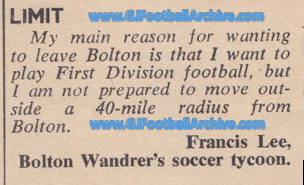
Francis Lee Makes His Views Known

On this day (29 September) Francis Lee’s views on leaving Bolton Wanderers were published in Soccer Star magazine. Hmm, I wonder where he ended up? Do a search on this website and you’ll find the answer. Surprisingly the editorial team didn’t spot the spelling mistake in Wanderers.

Manchester’s First FA Cup

As part of their All-Manchester FA Cup features the Athletic have asked their writers about the most important FA Cup final. Well, as it’s a City-Utd final then it makes sense to highlight the first ever FA Cup final featuring one of the teams. In 1904 Manchester found its first major trophy success and that led to Manchester being established as a footballing city. It’s part of the reason Manchester City retained a special place in the hearts and minds of Mancunians, even when the success faded.

The captain and goalscorer was the great Billy Meredith. The other year, following the purchase of the oldest surviving FA Cup by Sheikh Mansour (to loan to the National Football Museum) I helped Manchester City with the story of the cup and its significance to Manchester. They’ve produced a video telling the story and it can be viewed here:

https://www.mancity.com/citytv/mens/manchesters-first-trophy-1904-fa-cup-documentary-63745781

For more on the significance of this FA Cup trophy check out the category 1903-04 in the drop down list below.

A League is Born

On this day (17 April) in 1888 the first meeting of the Football League was held in Manchester. The following report names the clubs accepted and the others who wanted to join the League. It has often been written in Manchester United related books that Newton Heath applied to join the League in 1888 but didn’t receive enough votes to be accepted. That is completely untrue as no one actually had to apply nor was a vote taken. Clubs were asked and some tried to push to get included but Newton Heath were neither asked nor were they pushing for acceptance either. Nor were Ardwick or Manchester Asoociation who, to be frank would’ve been the most famous Manchester club at this time.

Bolton Wanderers were the only team from present day Greater Manchester to be asked/selected for the first League season.

Manchester Courier, 18 April 1888

The plaque is positioned on the corner of Mosley Street and Market Street/Piccadilly in Manchester.

Finding 1904 Objects

As a trained historian I am always wary about saying that something is the first or that something’s an absolute fact unless I can properly prove it. It’s important to not jump to assumptions and to act responsibly. The quest to uncover football’s history and ensure the facts not the fiction are recorded drives me on. In addition, I am keen to locate items that can link us directly with a particular moment or achievement. So I’d just like to talk about a few items that I’ve been desperate to locate for several years…

There are many items from Manchester City’s long history that I have been searching for over many, many years. I could write a book about them but here’s the story of a few objects connected with the 1904 FA Cup final and one item I’m after tracking down survived for years and I’ve discovered that it was housed in Burnley for at least 40 years.

Many objects connected with Manchester’s first major trophy success still exist including the original-style FA Cup (housed at the National Football Museum – go and take a look when you can); a watch presented to manager Tom Maley (and some of the others presented to the players); a banner made by members of the Alexander Family (club officials and directors from 1894 through to the modern day; the flag is in City’s archive); players’ medals and various newspaper cuttings and photographs. However, there are three important items that I know existed that have vanished.

I am going to start with the 1904 FA Cup final ball, which was stored in Burnley into the 1950s.

Hillman’s Ball

At the end of the 1904 FA Cup final goalkeeper Jack Hillman charged past an opponent to pick up the ball and claim it as his own. The 1904 FA Cup final became the possession of City’s Hillman and he kept hold of it throughout his life. For many years he had it on display in his sweet shop on Thurston Street, Burnley and it is believed it was still in that building at the time of Hillman’s death in 1952.

According to reports the ball was painted in City’s colours – Cambridge Blue and White was worn for the 1904 final – and was inscribed as the 1904 English Cup winning ball. Back then the FA Cup was more commonly known as the English Cup.

Following Hillman’s death there is uncertainty over what happened to the ball. It seems it stayed in Burnley, so if there’s anyone reading with information please get in touch. If the ball managed to survive into the 1950s then it is possible it is still around somewhere.

I managed to get a Burnley newspaper to do a piece on this a few years back but sadly no one came forward with any information.

Film of the Final

The 1904 FA Cup final was filmed and shown in pubs and exhibition halls for at least a month after the final. Several copies of the film must have existed as it was shown in multiple locations at similar times but, to date, none of these copies have been found. Many photos from the 1904 final (including this one of Meredith scoring) are believed to have been taken from the original footage. In recent years older football films have been located in the north-west and I live in hope that one day a metal film cannister will be found with the words ‘1904 English final’ scrawled across will be identified.

The Players’ Shirts

Not one of the 1904 FA Cup final shirts has ever been found despite many of the players saving other equally important shirts. The 1904 shirt carried no badge and as City played a League game only 2 days after the final and travelled straight to Everton from London, it’s possible the same kit was worn again. Players such as Billy Meredith and Sandy Turnbull did save other important shirts and it’s possible the kits may have stayed within family circles but not recognised for their significance due to the lack of a badge. Frank Booth, a prominent member of the team, died in 1919 and is buried in Denton – maybe his family retained the shirt and it still resides in the region?

If you know of any of these items and can help locate them then please do. The film is probably the one that appeals most to me, but both the ball and a shirt would be great finds too.

You can find out more about 1904 here:

The Munich Air Disaster: A Long Read

6th February is of course the anniversary of the Munich Air Disaster. Back in 2008 I researched and wrote the following 8000+ word piece on the Munich Air Disaster. It spells out the story of the disaster; the spirit of Manchester at the time and explains how the tragedy affected individuals from both Red and Blue Manchester. It’s a long read but I hope people stick with it. It’s something we should all think about and remember.

My thoughts are with the victims, their families and friends.

One event has been written about more than any other in the history of the game within the Manchester region and that event is also by far the most tragic and devastating moment in Mancunian sport.  Ignoring stadium disasters such as Hillsborough, Bradford, and Bolton, the Munich Air Disaster was the worst tragedy to affect any English club.  It brought the near destruction of an entire team of good quality, successful players.

The story of the disaster has been covered extensively over the years and has featured in many television documentaries and even in feature length dramatisations, however it is worth assessing the way the disaster took hold of the people of the region and how it was viewed by all Mancunians at the time.

The simple facts of the story are that 23 people, including eight Manchester United players, were killed in the disaster on 6th February 1958, but the circumstances surrounding it need explaining.  United had progressed to the quarter-finals of the European Cup where they were to face Red Star Belgrade on a two-legged basis.  The first leg, played at Old Trafford on 14th January was watched by a crowd of around 35,000 and ended in a 2-1 victory – Eddie Colman and Bobby Charlton the scorers.  The following month, on 5thFebruary, the Reds played the second leg and drew the game 3-3, thereby winning the tie 5-4 on aggregate.  It was the second time United had reached the semi-final stage and there was a strong feeling this was to be United’s year, although AC Milan and Real Madrid had also reached the semi-final stage.  Madrid it has to be remembered had won the competition in its first two seasons, and would ultimately win the trophy for five consecutive seasons.  Madrid were a phenomenal side.

As well as their progress in Europe the Reds were also challenging for the League title and had already reached the fifth round of the FA Cup, and many of their young players were national figures.

After the game in Belgrade the Reds stayed overnight in the city.  There had been an official banquet after the match and manager Matt Busby spent much of the evening in the company of Frank Swift, his former City team mate who was by this time a leading journalist, and several other journalists and friends.  The journey home began the next morning (Thursday) and for many years rumours that United were under pressure to return home to ensure they were back in plenty of time for their Saturday fixture with League leaders Wolves has been suggested.  Clearly the Football League would not have wanted European football to jeopardise a game that was already viewed by many as the deciding factor in the Championship race (a Wolves victory would place United eight points behind the leaders with only 13 games to go), however it is highly debateable that the League or FA would have placed pressure on United at this moment.  It is possible United felt the pressure of course, as they had gone against the English authorities the previous year by entering the European Cup.

At Belgrade there were a few delays caused by lost passports and the like, however the weather was also poor.  The previous day’s game had been played in wintry conditions and by the time the flight left Belgrade visibility was poor but still not bad enough to cause a cancellation.  The journey back to Manchester was intended to get the players home by teatime, with a stop off at Munich for refuelling.  

In Germany snow was falling and the conditions were deteriorating, however after a short refuel the plane was ready to take off again at 2pm.  The pilot Captain James Thain and his co-pilot Captain Kenneth Rayment prepared for take-off with Rayment taking the controls.  Thain later gave his version of what happened next:  

“As Ken opened the throttles, which were between us on the central pedestal, with his right hand, I followed with my left hand.  When they were fully open I tapped his hand and held the throttles in the fully open position.  Ken moved his hand and I called ‘full power’ and, looking at the instruments in front of me, said ‘Temperatures and pressures correct and warning lights out’.  I then called out the speed in knots as the aircraft accelerated.  The engines sounded an uneven note and the needle on the port pressure gauge started to fluctuate.  I felt a pain in my left hand as Ken pulled the throttles back and said ‘Abandon take-off’. I held the control column fully forward while Ken put on the brakes.

“What had happened was boost surging, which was not uncommon with Elizabethans at the time, particularly at airports like Munich, because of their height above sea level.  Over-rich mixture caused the power surge, but though the engines sounded uneven there was not much danger that the take-off power of the aircraft would be affected.  The Eliza­bethans were very powerful in their day and you could actually have taken off on one engine.  Knowing that one cause of boost surging was opening the throttles too quickly, Ken said that at the start of our next run he would open the throttles a little before releasing the brakes and then continue to open them more slowly.  Ken opened the throttles to twenty-eight inches, released the brakes; and off we went again.”

The plane struggled further:  “I took the decision to abandon the take-off this time.  We were halfway down the runway with the throttles fully open when I saw the starboard engine steady itself at fifty-seven­ and-a-half inches but the port pressure run to sixty inches and beyond.  I wanted to discuss this with the BEA station engineer.

“The station engineer, William Black, came to the cockpit to check the trouble and we explained about the boost surging.  He said it was fairly common at airports like Munich.”

The engineer explained how Thain and Rayment could overcome the problem but also suggested he could retune the engines but explained that an overnight stop would then be required.  This was not something the pilot felt was necessary, and so the decision was taken to make a third attempt at take-off.  

The United players, management and other passengers were in the airport building at this stage and so had to be recalled to the aircraft.  In the airport building Duncan Edwards sent a telegram to his landlady saying:  “All flights cancelled – stop – flying tomorrow – stop – Duncan.”  Manchester Evening Chronicle journalist Alf Clarke telephoned the newspaper with similar news.  

For most of the players and some of the journalists the period in the airport was typical of the experience most feel when waiting for a delayed flight.  Some of the players were buying drinks and snacks, others simply sat around waiting.  Journalists Franks Swift and Eric Thompson were lightening the mood.  According to another journalist, Frank Taylor, in his eyewitness account of the disaster The Day A Team Died:  

“The comics, Frank Swift and Eric Thompson, had taken over.  Eric, small and round, had picked up Big Swifty’s overcoat and he was shuffling around the room like a lost grizzly bear, the coat almost trailing the floor, the arms hanging hugely by his sides.  Big Swifty was trying to cram his massive torso into Eric’s coat.  ‘Must have shrunk’ he was saying with that gormless grin so famed in the sporting world.  ‘Or maybe I’ve growed on this trip’.”

Earlier Swift had entertained some of the passengers with stories from his playing career.  

Once the passengers returned to the plane Thain and Rayment attempted the third – and fatal – take off.  Frank Taylor’s book on the disaster has become the best eyewitness account of how the events unfolded, and he explores in detail the take off and events that followed.  Suffice to say that at two minutes past three the pilots were given clearance to take off but were told that if they were not airborne by four minutes past three the clearance would become void.  This suggests any take off later than four minutes past would not be allowed and a considerable wait would occur.  Taylor: 

“I wonder what went through their [the pilots] minds then?  Did they feel under pressure?  If they didn’t get the aircraft airborne within the next two minutes, they might face a much longer delay on the ground.  In the passengers’ cabin, we didn’t know the pilots had been warned they had two minutes to make up their minds whether or not to go.”

The decision was taken to go and by this time the mood of many of the passengers was quite subdued.  Some were extremely nervous about the flight, while others tried to focus on other things.  Survivor Bill Foulkes later told journalists that the passengers had felt unsettled and that one of the players chose to move to the back of the aircraft where most of the journalists sat:  

“David Pegg said ‘I’m not sitting here.  It’s not safe’, and went to the back of the plane.  And I seem to remember Frank Swift standing up near the back and saying something like, ‘that’s right, lads, this is the place to be’.  We set off and I remember looking out of the window.  They had big windows, those Elizabethans.  I remember seeing the snow coming down and the slush flying about and then there was a terrible noise, the kind you might expect to hear of a car suddenly left a smooth road and started running over rocks.”

The plane’s speed had been increasing until this point and despite the general air of anxiety all had seemed well. Captain Thain later told the German inquiry his view of what happened:  

“When it reached 117 knots I called out ‘V1’ [velocity one, the speed at which it is no longer safe to abandon take off] and waited for a positive indication of more speed so that I could call ‘V2’ [119 knots – the speed required before taking off].  Suddenly the needle dropped back to 112, and then 105.  Ken shouted ‘Christ, we can’t make it,’ and I looked up from the instruments to see a lot of snow and a house and a tree, right in the path of the aircraft.”

Later it was discovered that the engineer had incorrectly re-fitted the air speed indicator meaning it gave an incorrect reading.  From that point on the plane careered off the runway and headed towards a house positioned beyond the airport.  Thain:  

“The aircraft went through a fence and crossed a road and the port wing hit the house.  The wing and part of the tail were torn off and the house caught fire.”

Little has been said over the years about the fate of the people living in the house at the time.  The occupants were the Winkler family.  The husband was out, presumably at work, and the eldest daughter was at a friend’s at the time of the crash but the girl’s mother, Anna, was at home sewing together with her three other children.  According to German reports two of the children were having an afternoon nap and were thrown out of the burning house by Anna, who also escaped, while the other child – a four year old – managed to escape by crawling out through a window.  

The left wing of the plane and part of the tail were ripped off the rest of the aircraft, while the cockpit smashed into a tree and the fuselage into a hut that contained a fuel-loaded truck.  This exploded.

Hans Birnbaum, a Munich fuel merchant, was one of only a handful of witnesses and he said at the time:  

“The visibility was poor so not many people saw what happened.  I was only 200 metres away when the plane crashed and the force of the explosion of the petrol was so powerful that I was knocked down by it.  When I got up I saw flames and smoke pouring out of two houses and debris flying through the air.  I ran to the plane and saw the plane had broken in pieces.”

What followed was a remarkable series of brave incidents by a number of the passengers, most notably goalkeeper Harry Gregg.  Gregg actually returned to the plane to rescue a baby and its mother, and is recorded as dragging Bobby Charlton and Dennis Viollet clear, and of giving assistance to other members of the flight.  He has regularly disputed the tag of ‘hero’ often used by the media when describing him.  In truth though he was a hero.

Emergency vehicles ultimately arrived and the passengers – both those alive and those that had passed away – were rushed to the Rechts Der Isar hospital.

At the hospital it was not immediately obvious that the patients being brought in were connected with Manchester United.  As far as the doctors were concerned these were victims of an air crash and who they were was irrelevant at first, then the head of the neuro-surgical department professor Frank Kessel started to treat the patients and he immediately recognised Frank Swift.  Swift, at this point, remained a major international name and was hugely popular wherever he went.  He was the first English goalkeeper to appear in the Berlin Olympic stadium – playing for English champions City in a highly publicised propaganda match against a German national XI in 1937 – and was well known to Kessel as the professor had actually lived in Manchester for a while and was known to attend football matches.  He knew who Swift was, although he did not quite understand why he was in Munich, and then he spotted Swift’s old City teammate Matt Busby.  “Das ist ein Englische Fussball spiel” he is reported to have exclaimed as he recognised that the combination of two former City players meant this was an English football team.  Inevitably it became obvious the side was United.

Swift and Busby were both still alive at this point, although Swift was badly injured and died shortly afterwards as he was being carried into the hospital.  Kessel had hoped to save the former ‘keeper but sadly his main aorta artery had been severed apparently by his seat belt.  Busby’s life was also in the balance and he would have the last rites administered to him twice, but eventually after 71 days he returned to Manchester.

Two other men were also struggling – players Johnny Berry and Duncan Edwards.  Berry also pulled through although his playing career came to an end due to the injuries he suffered, while Edwards fought on for 15 days before he died of kidney failure.  It was the saddest moment for most Mancunians as Edwards’ fight for survival had brought much hope, but the moment he passed away signalled the end of Busby’s great side.

In total twenty-three people died as a result of the air disaster.  They included eight members of United’s playing staff:

Geoffrey Bent (a reserve player for the Munich trip meaning his journey was ultimately unnecessary, 25 year old Bent had earlier made 12 League appearances for the Reds) 

Roger Byrne (popular captain, Byrne made a total of 277 appearances in League, Cup and Europe, and had appeared in 33 internationals – he was two days short of his 29th birthday at the time of the crash)

Eddie Colman (21 year old Colman made 107 League, Cup & European appearances)

Duncan Edwards (the most famous member of the team, 21 year old Edwards made 175 League, Cup and European appearances and had appeared in 18 internationals)

Mark Jones (24 year old Jones made 120 League, Cup and European appearances)

David Pegg (22 year old Pegg made 148 League, Cup and European appearances and had made one international appearance)

Tommy Taylor (26 year old Taylor made 189 League, Cup and European appearances and 19 internationals)

Liam ‘Billy’ Whelan (Like Bent 22 year old Whelan was a reserve for the Belgrade game, in total he had appeared in 96 League, Cup and European games, netting 52 goals and made 5 Eire international appearances)

Three members of United staff:

Walter Crickmer (United secretary and manager in 1931-32 & 1937-45) 

Tom Curry (trainer and former Newcastle & Stockport player)

Bert Whalley (coach and former Stalybridge Celtic and United player). You can read more about Bert Whalley (who was a friend of my grandad’s) here:

Eight journalists:

Alf Clarke (Manchester Evening Chronicle)

Don Davies (Manchester Guardian)

George Follows (Daily Herald)

Tom Jackson (Manchester Evening News)

Archie Ledbrooke (Daily Mirror)

Henry Rose (Daily Express)

Frank Swift (News of the World & former City goalkeeper and England captain)

Eric Thompson (Daily Mail)

The other victims were:

Tom Cable (steward)

Capt Kenneth Rayment (co-pilot)

Willie Satinoff (Manchester businessman)

Bela Miklos (travel agent)

The following all survived the crash:

Johnny Berry – was in a coma for two months following the disaster and was never able to resume his playing career.  He suffered brain damage and according to other survivors his hand-eye co-ordination had gone.  Within 12 months of the disaster he and his family were ordered to leave their club house and his employment cards arrived in the post.  Berry’s problems continued throughout his life (he passed away in 1994) and understandably his wife never forgave United for their treatment of the family.

Jackie Blanchflower – suffered renal damage and various broken bones, including his pelvis, and despite his youth (he was only 25) he was unable to play again.  He had been destined to play for Northern Ireland in the 1958 World Cup finals but struggled to make a decent non-footballing career instead.  Like Berry, Blanchflower was told to leave his club house a few months after the disaster, even though his wife was pregnant and it was clear the family would struggle.  New Chairman Louis Edwards gave him a job loading pies on to lorries at his meat factory and it was reported in The Lost Babes that he refused to go to Old Trafford after being turned away when he asked for match tickets for his doctor.  He passed away in 1998.

Matt Busby – after a long fight to regain fitness Busby returned to his role as United’s manager and ultimately created a new side which, in 1968, became the first English side to win the European Cup.  He was awarded the CBE in 1958 and then was knighted in 1968.  He remained a key presence at Old Trafford until his death in 1994.

Bobby Charlton – went on to become recognised as one of United and England’s greatest players.  He was part of Busby’s new side during the Sixties and featured in the successes of that side.  He was a member of the 1966 World Cup winning team.

Bill Foulkes – As with Charlton he managed to return to action and feature in the new United, winning the European Cup in 1968.  

Harry Gregg – Appeared in the 1958 FA Cup final and remained with United until 1966.  Had a spell as United goalkeeping coach from 1978 until 1981.  He has remained keen to challenge perceptions of Munich throughout his life and has tried to fight to help the families of the victims and the survivors – the majority of whom found life extremely difficult after the disaster.

Ken Morgans – although he returned to action in April 1958 he was never able to establish himself in the side post-Munich.  In March 1961 he was transferred to Swansea and also had a spell at Newport County.

Albert Scanlon – had been left for dead initially as rescue workers searched for those who looked more likely to survive.  He suffered a fractured skull but managed to return to England within a month.  Sadly he was transferred out of United in November 1960 and felt he had been betrayed by the club, in particular by new Chairman Louis Edwards and by Matt Busby.  In later life Scanlon worked 12 hour shifts as a security guard.

Dennis Viollet – resurrected his career and played in the 1958 FA Cup final, however in January 1962 he was sold to Stoke City.  According to friends his personality and approach to life changed significantly after Munich.  In later life he suffered with a brain tumour – many believe this had been caused by the bang to his head he received at Munich – and he passed away in the States during 1999.  

Ray Wood – By the time of Munich the 1957 FA Cup final ‘keeper Wood had lost his place to Gregg and inevitably, post Munich, the ‘keeper was unable to regain his position – he made one first team appearances (a 4-0 defeat at Wolves on 4/10/58).  He was transferred to Huddersfield in December 1958 and played over 200 league games for them.  He passed away in 2002. 

The other survivors were:

  • Frank Taylor – the only journalist to survive and he went on to write the highly acclaimed The Day A Team Died.  He was also awarded the OBE and passed away in 2002. 
  • Peter Howard – Daily Mail Photographer 
  • Ted Ellyard – Photographer 
  • Mrs Vera Lukic and baby daughter Venona – Passengers (saved by Manchester United player Harry Gregg) 
  • Eleanor Miklos – Wife of the travel agent that arranged the trip who died in the crash 
  • George ‘Bill’ Rodgers – Radio officer
  • Belosja Tomasevic – Passenger 
  • James Thain – Captain 
  • Rosemary Cheverton – Stewardess
  • Margaret Bellis – Stewardess

Over the years Munich has come to mean different things.  For some it is a strong reminder of the pioneering spirit of Fifties United and of the quality of those unfortunate young men who passed away in such devastating circumstances.  Others have seen it as an important step towards the globalisation of the United name and brand.  In fact there are some that see the disaster as a means of capitalising on tragedy and in Jeff Connor’s publication The Lost Babes he explores in detail the way the disaster has been used to generate income for others – he talks of the 1998 benefit match which raised around £1m but over £90,000 was paid to Eric Cantona’s agent for expenses in relation to the Frenchman’s appearance in the game – and of the use of Munich in merchandise, museums, television and other areas of the media.

For most true Mancunian United-supporting families it is the players they think of first, rather than the specifics of the tragedy.  Actor and Salford born United fan Christopher Eccleston talked of the players during an interview with Denis Campbell in 2002:  

“Some of my earliest memories are of my dad talking about the Babes, specifically Duncan Edwards. ‘He was a man at 16,’ he always said.  He was a great guy but kept his feelings to himself, but at any mention of that team he suddenly became filled with emotion.

“My mum was an Old Trafford trolley-dolly.  She used to push a trolley round the side of the pitch selling Bovril.  Just recently she said, very casually, ‘When we finished work we used to see Duncan standing at the bus stop after the game eating fish and chips.’  Can you imagine Ryan Giggs doing that?  My dad would talk about them as players while my mum talked about their personalities, like ‘Roger Byrne’s very good looking but you can tell he’s moody’.”

Back in 1958 when the first news of the crash filtered back to Manchester, the city was in shock.  No one could understand or accept what they were hearing.  Former City Chairman Eric Alexander, who in 1958 was part of City’s ground committee and was also working in the area, remembers the moment he heard the news:  

“I heard people in the street on Deansgate shouting.  I was struggling to make out what they were saying but it sounded as if something had happened to United.  The noise and emotion ran high and I had to find out.  I rushed out on to the street and heard what had happened.  It made me feel sick.  It was one of those moments that you dread.  It was awful.

“It affected everybody in Manchester.  No question.  We knew the players obviously, but we also knew the journalists.  We all lost something very significant that day.”

By 6pm a special edition of Alf Clarke’s newspaper, the Manchester Evening Chronicle, was on sale:  

“About 28 people, including members of the Manchester United football team, club officials, and journalists are feared to have been killed when a BEA Elizabethan airliner crashed soon after take-off in a snowstorm at Munich airport this afternoon.  It is understood there may be about 16 survivors.  Four of them are crew members.”  

It also included Clarke’s match report and referred to his telephone conversation earlier in the afternoon.  

Gradually accurate information started to emerge, but the strength of feeling was such that thousands of Mancunians walked the streets of the city dazed, shocked and confused.  Clearly, the death of any of those players in tragic circumstances would have been greeted with a shared feeling of grief but the size of the disaster and the impact it had on football and on the city reached incredible levels. Supporters of all sides felt the grief and the relationship between the Manchester region clubs at this point was not a difficult one.  There were rivalries of course, but with City and United both sets of supporters shared the pain of the tragedy.  Matt Busby and Frank Swift were tremendous City heroes, while many of the players had grown up in the city and were known to Red and Blue alike.  Viollet and Scanlon had been City fans as boys, while Byrne came from Gorton.

In the Busby household as the news filtered through members of his family and Swift’s gathered on the day of the disaster.  Little was known, but the news did come through that Busby was amongst the survivors.  The Manchester Evening Chronicle reported the reaction:  

“Said Mrs. Busby: ‘Thanks God he’s safe’ but the family could not celebrate.  They did not know whether he had been injured and also in the house was Mrs. Frank Swift, upset and ill with no news of her husband.  Finally Mrs. Swift’s son-in-law came to the house and said he would break the news to her that her husband was unaccounted for.  He drove her home in his car.”

Swift was of course a journalist by this point, and each of the journalists were major local figures.  Don Davies, Henry Rose, Archie Ledbrooke and the others were well known and popular reporters who had covered the game in Manchester for many, many years.  Davies, who went under the name of an Old International, had reported on almost every significant moment to affect Mancunian football for years.

Bert Trautmann, City’s German goalkeeper, heard the news of the crash at home.  He was listening to the radio and was immediately engulfed with sadness.  One of the victims, Frank Swift, had been his predecessor at City, but most of the other victims were also known to him personally.  Once he managed to gather his thoughts he started to consider how his understudy Steve Fleet was feeling.

Steve’s story is typical of the way the players felt:  “It is one of those events that make you realise that life itself is a greater game than football.  It matures you.  It makes you realise what life is all about and though it’s difficult at the time to understand, it did actually put football in its place.  Football was not important in the weeks that followed the crash.

“I had lots of friends at United, but Eddie Colman was my best friend.  Up to his death we were as close as anybody could be.  He was going to be the best man at my wedding.  When he died it was terrible.  Eddie lived in Archie Street – the inspiration for Coronation Street – and I lived close by.  On the night of the crash we all congregated at his house and we waited for news.  None of us had a telephone in those days, so the only way we could find out what was happening was by going to the off-licence down the road and call United.  I kept going off to do it.   Les Olive was answering the ‘phone at Old Trafford and he said to me ‘Steve, I know you’re very close to his family, can you tell them that Eddie’s gone’.  I then had to go back to Eddie’s house and tell his mum and dad.  Something you never think you have to do, especially at that age.  His dad couldn’t accept it.  He said I must be wrong.  He went down to the off-licence and made a call himself.

“It was awful, but that was the way it was for a lot of people.”

The following day the City players met at Maine Road.  Bert Trautmann rushed to see Steve Fleet:  “Bert understood more than anyone how I felt about losing Eddie.  He taught me how to handle grief and come to terms with it.  It was not easy but Bert had such humility and a caring attitude he helped me tremendously to overcome one of the worst periods of my life.  He also offered to help United in any way he could.  You see, we all knew the United players.  We’d socialise with them, and they were just like us.  Bobby Charlton, when he was living in digs, would sometimes come to our house for his tea.  We were all close – Red or Blue didn’t come into it.”

German-national Bert contacted United and offered to help with translation, contacts and with whatever the Reds felt they needed. 

Despite their grief, the City players were told they had to carry on with their own preparations for Saturday’s League game at Spurs.  Cliff Lloyd, secretary of the Manchester-based PFA, had called for the suspension of the weekend’s games –something City’s players, and those of other clubs in the region desperately wanted – but within 24 hours of the crash the League insisted that only United’s game would be called off.  

Reluctantly, the Blues travelled to London on Friday 9th.  It is known that later that day the City players went to a cinema in North London with the hope of watching the latest newsreel footage showing the tragic scenes however, according to British Movietone, newsreel footage did not arrive until four days after the disaster and so the players could only wonder what the devastating scenes were like.  Although City players do hold a view that they saw some crash related footage that night in London.  City were to play at Tottenham the following day, and were staying overnight in the capital.  They felt isolated from the news and changed their routine in the hope that they could find out all they could. 

Inevitably at Tottenham the players wore black armbands and, full of emotion, they lined up for a two-minute silence – impeccably observed by all fans.  This silence was more personal than any the players had previously been involved with – only four days later Ken Branagan, Dave Ewing, Joe Hayes, Roy Little and others would attend the funeral of Gorton born United captain Roger Byrne.  It wasn’t the only funeral they attended, but it does indicate that the players’ thoughts were hardly on a game that most players across the country had wanted called off.  

Understandably the crash affected the City team that day and the Spurs game ended in a 5-1 defeat.

Similar scenes appeared at football matches across the country and locally Bury faced Oldham at Gigg Lane and the players and spectators stood in two minutes silence prior to kick-off as a mark of respect for the Munich victims.  The Bury Silver Band played ‘Abide with me’.

Many of the region’s players mixed socially with United’s.  Other victims and survivors had grown up in the city and were known to Red and Blue alike.  United’s Viollet and Scanlon had been City fans as boys.

That evening it was reported that UEFA were considering what to do with the European Cup semi finals.  Real Madrid had stated they felt the competition should be suspended and that the Reds should be awarded the European Cup – this was a generous move – but UEFA did not want to do that.  Instead, UEFA said they would be speaking with the FA about the selection of a team to replace United in the competition.  UEFA made it clear they wanted City to take United’s place, while the Blues immediately made it known that they would not be interested in taking United’s place, and that City would do all they could to help the Reds compete in the competition.  Eric Alexander:  

“Our thoughts were with United.  They had to take part.  Part of the recovery process had to be United’s return to action – all Mancunians knew that – and we wanted to do all we could to help them go forward.”         

The FA’s response was a surprising one and, when reported, it was said that the FA had stated that the decision would be theirs, not UEFA’s.  Fortunately, common sense prevailed and the Reds were able to compete, however in the 1990s social commentators and writers talked of this period cynically and gave the impression that somehow City had tried to take some glory and had proactively pushed themselves forward as European replacements.  This is totally unfair but the comment does show how much society changed in the decades after the disaster.  Many football followers use the term ‘Munich’ as an insult, while others claim the Blues did not support United in their hour of need and tried to gain reflected glory via the European offer.  The views of both groups are totally abhorrent.    

The region was in a state of combined grief, and then the bodies started to be returned to Manchester.  The Old Trafford gymnasium became a makeshift mortuary, while families made plans.  Thousands of supporters, rival fans, and ordinary supporters gathered to pay their last respects and each funeral saw scenes of Mancunians lining roadsides as funeral processions passed by.

The story dominated every aspect of Manchester life and for those who had never quite grasped what the game was about and why it was so important to the region, this terrible disaster soon brought understanding, and it has to be stressed that this awful tragedy was not simply one affecting a single football team.  It affected an entire city, region, and in many ways a nation.  Many of the players were major international footballers, but more than that many of the other victims were highly respected, renowned journalists with a real passion for Manchester and its people.  Daily Express journalist Geoffrey Mather provides his view of how the news filtered through the newspaper industry on his website www.northtrek.plus.com:  

“As news spread, the city went silent.  The grief settled like a fog: it was everywhere.  Survivors were struggling for life, manager Matt Busby among them.  I was features editor of the Daily Express in Manchester.  I was in the office being told by the then editor, Roger Wood, that I would be in charge of all inside pages apart from Sport.  I could call on any sub-editor on the editorial floor whenever I liked.

“The London editor, Sir Edward Pickering, was visiting at the time and decisions came quickly.  William Hickey, normally on Page 3, was relegated to Page 13.  Virtually the whole of the paper was United.  I protested about my role.  ‘I know nothing about football’ I argued.  Roger Wood brushed that aside – ‘I will put someone from Sport in a seat behind you’.  And so the long night began and decisions made at that early stage paid off.  There were not to be any edition times.  The pages would roll as they were made ready.  The paper churned out all night long.  It was a superb operation on the part of staff.  I lost count of the number of pages prepared, run, re-done.  At some late stage – a landmark – I had a half page of thumbnail pictures of those involved.  The Daily Mail people were said to be reading our first edition to see whether their own man was alive.

“Henry Rose, best-known of Northern sports writers, had gone down with the Busby Babes.  Esther Rose, his niece, was the only one on the editorial floor who did not know this.  When she was finally told, she was crying as she was led out of the office.  Rose’s executive chair was empty.  His was a considerable presence whether in the building or Press box.  The line-up as his funeral went by the office days later was almost Presidential.”

Rose’s funeral was the largest of the non-United players.  Express journalist Desmond Hackett wrote a moving tribute to him and it is recorded that taxi drivers offered their services free to anyone who was going to the funeral.  The funeral procession travelled by Rose’s former office – his work place was actually every significant football ground in the country – the impressive glass fronted Daily Express building in Great Ancoats, and then travelled on to Southern Cemetery, close to Maine Road where some of the other victims, would be buried and where the great Billy Meredith would also be buried the following April.

Understandably, five decades later, the air crash still bears significance at Old Trafford.  The Manchester United museum understandably pays tribute to the victims, but so does the Manchester City museum at the City of Manchester Stadium with a timeline recording the victims.  This is significant because the disaster touched all Mancunians regardless of team supported, or played for.

Surprisingly, considering the strong feelings of the supporters of all of the region’s clubs, the footballing authorities seemed to misjudge the mood.  Not only had they refused to call off all games scheduled for the Saturday following the disaster, but they also made plans for the continuation of all competitions United were involved with.  The decision was taken to progress with the League.  

Inevitably Manchester and football had to keep going although, understandably, United’s game against Wolves was cancelled and their FA Cup tie against Sheffield Wednesday was delayed by four days.  In between the fixtures of all other clubs continued as normal and the first senior match to be played within Manchester by either United or City was the Blues game against Birmingham City on 15th February 1958.  This match has largely been forgotten by the media, but as the first game played after Munich the details of the day need to be remembered.

It was a deeply emotional affair, with few in the mood for football.  It is clear there was no appetite amongst fans for the Birmingham game.  It felt wrong to be playing an important match while people were still fighting for their lives, and others were being buried. Significantly, a lower crowd than usual – only 23,461 – attended Maine Road for this fixture.  City’s average for the six previous home matches had been 43,000, and the season’s average would be 32,765.

The match programme was full of tributes with every editorial space, other than the Birmingham page and the team sheet, being given over to the tragedy.  There were photographs of all the victims.  The programme editor accurately wrote:  

“Next to Old Trafford, the impact of the Munich air disaster has been felt nowhere more severely nor with more regret than here at Maine Road.  Players, officials and sports writers on that ill-fated plane were our friends and yours.”

City Chairman Alan Douglas added:  

“City are convinced United will recover and eventually return to their exalted place in the world of football.  And if we can do anything to help them in any way, however small, to achieve that objective, we shall regard it as a privilege to do it.”

Captain Dave Ewing talked of the United players:  

“On and off the field they were a grand bunch of fellows, and it is impossible to realise we shall never see some of them again.”

Former captain Roy Paul’s comments included mention of the press: 

“whom I knew intimately and for whom I had such a high regard.  They all had a part to play in this great game of ours, and right well they played it.  We shall miss them all.”

This was still an emotional time for all Mancunians.  The tragedy seemed to touch each and every Mancunian personally, and inevitably the game itself was played in an extremely mournful atmosphere.  Abide with Me, with soloist Sylvia Farmer, was played by the Beswick Prize Band pre-match and every fan stood, head bowed to remember Manchester’s victims.  City fan Dave Wallace writing in Century City talks of the game:  

“It was pouring down.  I did not switch to the Kippax but watched it from the perimeter wall at the Scoreboard End.  The band played Abide With Me and all in the Main Stand stood up removed their hats and sang it with their heads bowed.  It made the hairs on the back of your neck stand up.  The rain continued unabated and the game was called off in the fortieth minute, the pitch a quagmire.  It was as though the heavens were sending a tearful message of sympathy to Manchester.”

The heavy rain and miserable atmosphere proved to all that life was more important than a game of football.  

United Chairman Harold Hardman and new secretary Les Olive were guests of honour, and they were encouraged by City to approach several City players to fill the gaps left by the crash.  It was clearly something they did not want to do but it was absolutely vital, and attempts were made to sign City’s Irish international Fionan ‘Paddy’ Fagan but for unknown reasons this failed.  Many clubs, most memorably City, Liverpool, and Nottingham Forest, offered United whatever assistance they could. 

The Munich disaster affected all Mancunians and all involved with sport in Manchester.  In the years that have followed, the City-Birmingham game has largely been forgotten.  As with all abandoned games it was wiped from the records, however perhaps there has also been a subconscious effort to forget the day as it was such a painful one.  Manchester had not yet found the strength to carry on and look to the future – that would come with United’s first home game.

On Wednesday 19th February an emotional night saw the Reds compete in their first post-Munich match.  A highly emotional evening saw Survivors Harry Gregg and Bill Foulkes take to the field with new signings Ernie Taylor and Stan Crowther (both given special dispensation to play in the FA Cup after competing for other clubs), and relatively inexperienced players Ian Greaves, Freddie Goodwin, Ron Cope, Colin Webster, Alex Dawson, Mark Pearson and Shay Brennan.  Ian Greaves later admitted how he felt replacing Roger Byrne:  

“I can remember the dressing room was very quiet. I couldn’t get Roger out of my mind; I was getting changed where he would have sat. I was wearing his shirt…” 

The game was watched by a crowd of 59,848 – the second highest home crowd of the season (63,347 witnessed the derby with City in August), and only United’s fifth domestic attendance over 50,000 at this point in the season.  This was 6,000 more than the previous cup tie and over 18,000 more than the previous home League game against Bolton.  Many non-football followers attended that night, as did the supporters of other clubs.  The feeling was that everybody wanted to help the Reds.

The game ended 3-0 to the Reds with goals from Brennan (2) and Dawson, and three days later the first home League game after Munich ended in a 1-1 draw against Nottingham Forest before 66,124 – this would prove to be United’s biggest Old Trafford attendance of the 1950s.

Much has been made in the more recent past about the effect of Munich on United and it is clear in pure statistical terms that the disaster did have an initial impact on attendances.  The average crowd for the seasons prior to Munich stood at 35,458 (1953-4), 35,960 (1954-55), 39,254 (1955-56) and 45,481 (1956-57).  For the 1957-58 season the final average was 46,073, but this rocketed to 53,258 for 1958-59, however by 1962 support had dropped back to a more typical figure of 33,491 (fifth best in the League).  This was one of three seasons in the 1960s when support averaged less than 40,000 and it was only when the Reds found major success under Busby in the mid to late Sixties that crowds reached in excess of 50,000 on a regular basis.  In general though the Reds spent most of the 15 years post-Munich as one of football’s top three best-supported sides and then in the period post 1972 they tended to be the best supported club year after year.

In terms of on the pitch performance and atmosphere around United it is clear the disaster continued to have an effect for many years.  In 1958 itself the Reds were swept along on a tide of emotion to the 1958 FA Cup final, but their European campaign ended with a 5-2 aggregate defeat to AC Milan. 

The FA Cup final saw them defeated 2-0 by Bolton and Tony Pawson, writing in the Observer, gave a realistic assessment of the game: 

”In prospect yesterday’s Cup Final was more likely to be distinguished by its emotional impact than the quality of the football.  So it proved, except that there was little of the expected excitement.  Manchester rarely seemed likely to crown their wonderful recovery with this last triumph.  Bolton are essentially an effective rather than an attractive team, and they won because they were always marking more closely, tackling harder, and, above all, moving more quickly to meet the ball.  Their play was, in fact, ideally suited to upset their opponents.

“Manchester United, who had won through to the Final as much by their enthusiasm and spirit as by their skill, now found themselves outmatched in determination, in strength and in the will to win.  Tactically, too, Bolton were their masters, for they kept with relentless persistence to a plan that was simple and effective.  Edwards, keeping always at Taylor’s side, cut him off from the ball, destroying at once the cohesion of Manchester’s attack.  Without the inspiration of Taylor’s constructive and cunning passes, United’s forwards had nothing to offer except the power and thrust of Charlton, who was left to challenge on his own the competent Bolton defence.

“Cope was outstanding in Manchester’s defence, playing with a coolness and command that was lacking in the fretful play of their backs and wing-halves.”

Pawson added:  “For Manchester it was a day of dust and ashes as their weaknesses were ruthlessly exposed by opponents who harried them from start to finish. It wasn’t that they were overawed by the occasion, simply that they lacked the ability to counter so fierce a challenge.

“There remained Charlton to save the game for United, and it is a measure of the remarkable advance he has made that he came near to doing it.  Bolton’s superiority was unquestioned, but twice he nearly snatched the game from them.  In the first half he sent Hopkinson diving to save, brilliantly, a shot of tremendous power; in the second, a shot which might have turned the game thundered against the inside of the post and rebounded to the goalkeeper.  A year ago Charlton would have manoeuvred the ball awk­wardly and automatically to his left, but these shots were hit with equal ease and force with either foot.  In midfield his bursts of speed and close control of the ball made him a lonely threat throughout.  Surprisingly, however, as the game progressed, he lay deeper and deeper, giving Bolton, who were otherwise untroubled, too much time to guard against his sudden raids.

“From the start it was clear that Bolton were setting too fast a pace for United; and within minutes they were ahead.  A long pass from Banks to Birch, a centre to the far post, and Lofthouse came near to rushing the ball in as Gregg hesitated.  The corner kept Bolton on the attack, and when Taylor headed clear, Edwards sent the ball back across the goal and Lofthouse, again at the far post, ran in to glide it home.  Birch continued to trouble the defence, and once when he varied his long centres by turning inwards himself and shooting left-footed, Gregg for the first time took the ball with his usual confidence.  United had their chance at last as Taylor, winning the ball for once, sent a measured pass out to Webster, and Viollet drove the ball over from close in as it was pulled back to him.  In the main, however, play was disjointed and destructive, with Bolton neater and more frequent in their attacks.”

United trainer Jack Crompton felt United were never going to win that final:  “Coming back and finding what was left of the team.  It was a difficult time.  We’d lost the final before we even went to Wembley, and once it started we were never in it.  It was all Bolton, even though it was a foul on Gregg when Nat Lofthouse scored.”