On this day (14 March) in 1990 the Manchester Evening News featured Bob Scott’s plans for Manchester’s 1996 Olympic Bid (remember this was not the first bid by the city either – there was an attempted bid for the 1992 Games). These articles make interesting reading now. Note also the involvement of Rick Parry – a man well known in football circles then and now (he later was one of the key figures behind football’s league restructuring).
I’ve included this as part of my feature on Manchester City in the 1990s as ultimately these Olympic bids led to the building of the City of Manchester Stadium (present day Etihad). Back in 1990 though the preferred site for a new stadium was in Trafford and Manchester City had held discussions even then on moving to the new stadium even though it would have meant City moving out of the City of Manchester.
Notice how the footballing activities were to be shared between City, United, Everton and Liverpool. Also, the velodrome is mentioned as the Tameside Velodrome but it is of course the one build near the present day Etihad.
This feature is part of my series on Manchester City in the 1990s and you can read about the opening months of 1990 below. This series of articles and features will run throughout March with indepth articles some days and smaller ‘on this day’ style posts on others. There will be flashbacks to great games, players and more. Every day in March will offer something to enjoy.
Subscribers will get access to everything, while some on this day material will be free for all to view.
If you want to know more on this incredible decade for Manchester City Football Club then why not subscribe and read it all? The following 1,300 word article on the end of the 1989-90 season is available to subscribers below. Enjoy!
Subscribe to get access – Monthly
Read more of this content when you subscribe today. It costs £3 per month (cancel anytime) to access everything posted since 1 October 2022 or there’s a special annual rate below which gives greater access and works out much cheaper.
Read more of this content when you subscribe today. It costs £3 per month (above) or £20 a year (here) to access everything posted since the site was created in December 2020. This special rate works out about £1.67 a week and gives access to everything posted, including PDFs of 3 of my books.
On this day (14 March) in 2023 Erling Haaland scored five against RB Leipzig in the UEFA Champions League. It was a phenomenal performance, coming in Manchester City’s 7-0 (8-1 on aggregate) thrashing of the German side.
When asked about the goals afterwards City manager Pep Guardiola commented: ‘Five goals… The problem for this guy is if he doesn’t score two or three goals he will be criticised.’ That just about summed things up well as for weeks prior to this Haaland, despite his incredible record was often criticised by some in the media. For example, the former Liverpool player Jamie Carragher had been critical in February 2023: ‘I’ve felt this season when he’s scored his goals, I think we’ve only seen 60 per cent of Haaland. You think of that goal he scored on the first game of the season against West Ham, the space in behind, he makes that run.’
‘I know that’s not there that often with the way City play. He’s come from a league and Borussia Dortmund where it’s a counter-attacking league and it’s end to end and you see that blistering pace. You don’t see it. He may have actually picked the wrong club to actually get the best out of him.’
No one connected with Manchester City was feeling like that, especially not as Leipzig were thrashed.
Haaland’s display against Leipzig took him to 39 goals for the season in all competitions. This is a new City club record for the most strikes in a single season, beating Tommy Johnson’s record established in 1928-29 when he scored 38 in 40 League and cup games. Haaland achieved the record in 36 games. You can read about Tommy Johnson here:
Other records tumbled that night too. Haaland’s five against Leipzig equalled the record for the most goals in a Champions League game. His achievements matched Lionel Messi for Barcelona against Bayer Leverkusen in 2012, and Luiz Adriano for Shakhtar Donetsk against BATE Borisov in 2014.
After Leipzig, Haaland had scored 33 goals in 25 Champions League games, becoming the youngest player to cross the 30-goal mark at 22 years and 236 days old, 116 days younger than previous recorder holder Kylian Mbappe.
Haaland had netted 10 in the competition by the end of the Leipzig game that was better than any City player had previously managed in a single campaign in the Champions League… and of course the campaign was not over!
After the match Haaland told BT Sport: ‘My super strength is scoring goals. A lot of it is being quick in the mind and trying to put it where the goalkeeper is not…
The series of articles covering Manchester City in the 1990s continues today with the 1994-95 season. Another significant season and this article is almost 5,000 words long. It’s available to subscribers, so why not subscribe and relive this extraordinary season? As with all these 1990s subscriber features it contains material from interviews I’ve performed with key figures from that time.
Here’s the 5000 word article on that season:
Subscribe to get access – Monthly
Read more of this content when you subscribe today. It costs £3 per month (cancel anytime) to access everything posted since 1 October 2022 or there’s a special annual rate below which gives greater access and works out much cheaper.
Read more of this content when you subscribe today. It costs £3 per month (above) or £20 a year (here) to access everything posted since the site was created in December 2020. This special rate works out about £1.67 a week and gives access to everything posted, including PDFs of 3 of my books.
This series of articles and features will run throughout March with indepth articles some days and smaller ‘on this day’ style posts on others. There will be flashbacks to great games, players and more. Every day in March will offer something to enjoy.
Subscribers will get access to everything, while some on this day material will be free for all to view.
If you want to know more on this incredible decade for Manchester City Football Club then why not subscribe and read it all? If you’d like to know more about subscribing then see:
The series of articles covering Manchester City in the 1990s continues today with the 1993-94 season. It was such an important (and at times complicated season) that this article on that season is over 9,000 words long. It’s like a book in itself! It’s available to subscribers, so why not subscribe and relive this extraordinary season? As with all these 1990s subscriber features it contains material from interviews I’ve performed with key figures from that time. In particular this one contains quotes from Peter Swales and Francis Lee which they discussed with me personally.
Here’s the 9000+ word article on that season:
Subscribe to get access – Monthly
Read more of this content when you subscribe today. It costs £3 per month (cancel anytime) to access everything posted since 1 October 2022 or there’s a special annual rate below which gives greater access and works out much cheaper.
Read more of this content when you subscribe today. It costs £3 per month (above) or £20 a year (here) to access everything posted since the site was created in December 2020. This special rate works out about £1.67 a week and gives access to everything posted, including PDFs of 3 of my books.
This series of articles and features will run throughout March with indepth articles some days and smaller ‘on this day’ style posts on others. There will be flashbacks to great games, players and more. Every day in March will offer something to enjoy.
Subscribers will get access to everything, while some on this day material will be free for all to view.
If you want to know more on this incredible decade for Manchester City Football Club then why not subscribe and read it all? If you’d like to know more about subscribing then see:
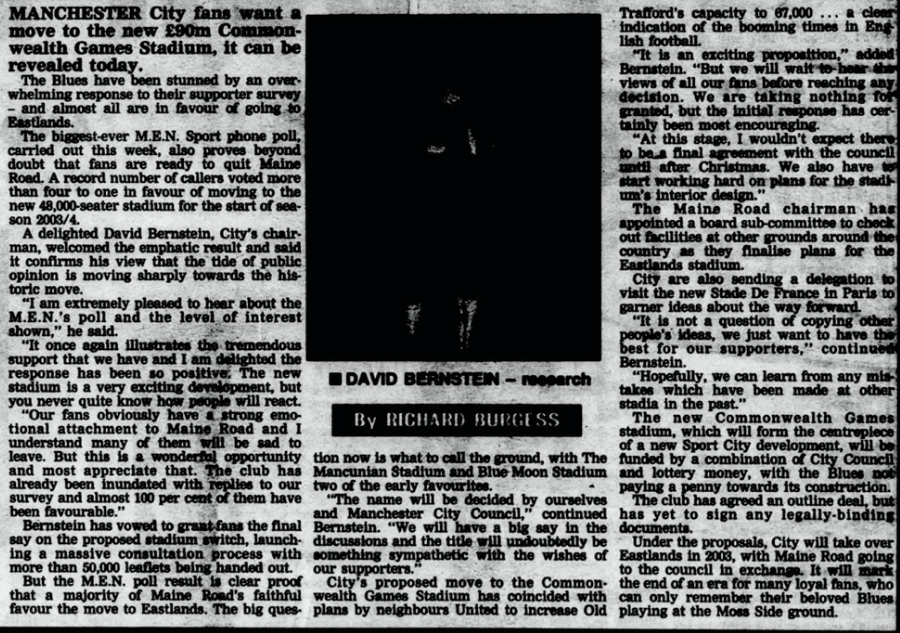
Here’s a 1990s reminder of how things can change. This cutting is from November 1998 – a time when Manchester City fans were still dismayed at how the club had ended up in the third tier of English football for the first time. Remember 6 years earlier City were challenging for a top four finish in the Premier League (ultimately finishing 5th for the second season). Despite being in their lowest ever position the fans were asked about the possibility of moving to a new 48,000 capacity stadium.
Overwhelmingly they said yes and, well, the rest is history. Without this commitment would any of the modern day success have happened?
The series of articles covering Manchester City in the 1990s continues with a game against reigning champions Arsenal on this day (10 March) in 1990. It was a match City should have won but there were a few jitters and a great deal of banter on the terraces too. It was all connected with that infamous Gary Crosby goal (3 March in 1990) which had caused City to lose 1-0 atNottingham Forest. You can read about that elsewhere on my website but have a read of this match report from the Arsenal game and you’ll see that it was still being referred to and still in the minds of all those connected with City. The Manchester Evening News headline above (mentioning ‘clanger’) wasn’t particularly helpful as it now gave fans the feeling that clangers had happened in consecutive games. That wasn’t fair on either Dibble or on Redmond.
Worth noting that David White scored for City and the Arsenal goal was scored by Brian Marwood, who has spent most of the last 15 years helping the modern day City find success.
For more on that season, have a read of this 1,300 word article on the end of the 1989-90 season. It is available to subscribers below. Enjoy!
Subscribe to get access – Monthly
Read more of this content when you subscribe today. It costs £3 per month (cancel anytime) to access everything posted since 1 October 2022 or there’s a special annual rate below which gives greater access and works out much cheaper.
Read more of this content when you subscribe today. It costs £3 per month (above) or £20 a year (here) to access everything posted since the site was created in December 2020. This special rate works out about £1.67 a week and gives access to everything posted, including PDFs of 3 of my books.
If you’re interested in women’s football or in football in Trafford or Manchester here are some video interviews we did as part of the work on the #WEuro2022 Heritage Lottery funded project for Trafford. These interviews are with women who played for Manchester Corinthians, Manchester City, Manchester United, FC Redstar, & Macclesfield:
Also, here’s my talk explaining about the history of women’s football:
This talk on the history of women’s football was staged at the National Football Museum on 1st July as part of my work on a consultancy basis with Trafford local archives. The talk lasts about 47 mins. Enjoy!
There will be a video of the panel discussion mentioned in this talk that will appear as a part 2 later. Maybe next week?
The Trafford Archive website I mention during my talk is available here:
Alongside all the football at Maine Road the 1990s saw a series of major concerts held at Manchester City’s old stadium. On this day (9 March) in 1990 tickets for the following August’s concert by Prince were advertised.
You can find out more about Maine Road and its first concerts here:
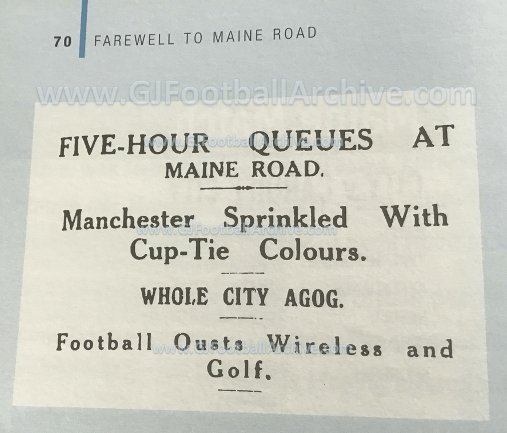
Today (8 March) marks the centenary of a record Manchester City set on this- the record is the highest attendance on a club ground! Happy 100th anniversary! The record set in 1924 saw 76,166 attend City v Cardiff. City had moved to their new Maine Road stadium in August 1923. The capacity of the venue was estimated at around 90,000 but was actually approximately 83,000 when the stadium opened (it was enlarged in 1931 and 1935).
In its first season the capacity was tested and, on this day (8 March) in 1924 the largest attendance for any footballing fixture (including three FA Cup Finals) in Manchester gathered to watch the Blues. This was also, at the time, the record crowd for any game played on an English club ground. It was beaten ten years later when 84,569 watched City v Stoke – so It’s 100 years of this record for the Blues!
You can read about the remarkable day in 1924 below:
Subscribe to get access
Read more of this content when you subscribe today. It costs £20 a year (access to everything) or £3 per month (see below).
Read more of this content when you subscribe today. It costs £20 a year (see above) or £3 per month (cancel anytime; access to everything posted since 1 October 2022).
This has been a sample of the material on http://www.GJFootballArchive.com If you would like to read all the in-depth articles (including the entire Manchester A Football History book and the audio interview with John Bond) then please subscribe. It works out about £1.67 a month if you take out an annual subscription (£20 per year) or £3 a month if you’d like to sign up for a month at a time. Each subscriber gets full access to the 260+ articles posted so far and the hundreds scheduled to be posted in the coming weeks.
Let’s all learn more about the sporting activities of our mums and grans this International Women’s Day. I’ve been researching into the pioneering women who played for Manchester Corinthians and its sister clubs for years and years and their stories are quite remarkable. BUT some of them had previously kept quiet because of reactions they may have had or assumed others were simply not interested in their incredible exploits. In fact, during my research, I have met women who had not told their families that they played football and so asking the simple question ‘Did you play football, Nan?’ will sometimes bring out a wonderful aspect of your nan’s life. So, I urge you all to ask your mum, mam, ma, mātā, mom, madar, mama, nan, gran, nani, nana, nonna, granny, babushka, grandma (or whatever term of affection you use for your mother or grandmother) about playing sport.
Ask your mam or your nan if she played – you never know what you’ll hear! I have had players talk to me during my years of research into the Corinthians who had kept it quiet from their own families, so granny may well have been one of the club’s pioneering figures – or a leading light at another club whose story needs to be told – but just hasn’t talked about it!
If you find a Corinthian then get in touch. I really don’t want to leave anybody out of my book.
As well as asking your mam or your nan, how about helping the book get published by subscribing to it? You will get a copy of the book (posted before it appears in the shops) and your name will be included in a special roll of honour published within the book if ordered by 31st March 2024 here:
Manchester Corinthians: The Authorised History
The story of a pioneering women’s club as told to Gary James by those who were there
£19.95
Opportunities to buy multiple copies, sponsor the book or donate to ensure it’s published to the size and standard the women who played deserve exist. Please email Gary@GJFootballArchive.com for more information on those opportunities.
This book is a must for anyone interested in Manchester or women’s football and will consist of over 300 pages. It will be fully illustrated throughout and subscribers can order it now for £19.95 (including UK postage and packaging). All orders received before 31st March 2024 will have the purchaser’s name included within the special roll of honour at the back of the book. You can order the book for someone else – all details will be checked and confirmed before publication.
The book will be published this summer.
If you live outside the UK then please contact for details of additional postage costs.
You do not need to have a PayPal account to order – use the ‘Pay with PayPal’ button above and it will give you the option to pay by credit/debit card without creating a PayPal account.
The book will include the story of the club as told by the women involved, alongside a significant amount of archive material. Myths will be corrected and the facts of this pioneering club will be told in an easy to read format.
Guided by founder Percy Ashley, the club went on to represent Manchester, football and female endeavour for decades, winning major international tournaments in Europe and South America. The Corinthians are, without doubt, one of the most important football clubs ever to come from Manchester and they were a prominent and pioneering club in so many ways.
As well as the interviews and dozens of archive trips there’s been a concerted effort to compile as comprehensive list as possible on women who played for the club. I’ve managed to compile a list of around 300 women who played for the club. Objects and trophies have also been rediscovered. This is the type of detailed research I enjoy. It’s time consuming, difficult and often frustrating but occasionally you find a little gem that adds significantly to our knowledge. There have been quite a few of those.
The Hebden Bridge talk when the campaign for a Blue Plaque and other tributes was publicly announced, December 2021
I’m still keen to hear from any former player who can add their voices to the history of the club, though the research and writing stage will be ending soon, so please get in touch as soon as possible. Please email Gary@GJFootballArchive.com with your name, rough dates you played and contact details.
Those subscribing to the book will receive a copy signed by author Gary James and posted out to subscribers before it appears in any shop or is distributed to any retailer. This is the ONLY way to guarantee your copy.
Manchester Corinthians: The Authorised History will include interviews with players from every era of the club from a founding player back in 1949 through to those playing for the club in its final days over 40 years later (yes, that’s right – over 40 years later!). The book will finally tell the story of the club from start to finish via the voices of the women who played. Via these voices the entire history of the club will be explained with the key figures identified and remembered. There’s a remarkable trail of women linking the first game with the last.
The book will be published to a similar style and quality to the acclaimed Manchester City Women: An Oral History and is destined to be another landmark publication on a major, pioneering women’s football club. Dozens of former players have been interviewed for this book and their remarkable stories and memories will be supported with an amazing array of photographs, newspaper articles, match programmes, trophies and other items of memorabilia from every era of the club’s existence.
Alongside chapters chronicling the history of the club there will also be features on founder Percy Ashley, who dedicated his life to promoting women’s football, and on Gladys Aikin (a key figure not only with the Corinthians but also with the early years of the Women’s Football Association) and George Aikin, who continued to take the Corinthians on tours into the 1980s. There will be special features on the major tours of the 1950s and 1960s when Percy Ashley led the Corinthians to major international success.
The cover of the book will be worked on by the designer over the coming months but following feedback from former players the maroon has been replaced with a darker blue, more reminiscent of the colour most frequently worn by the Corinthians (based on the reports, programmes and other material found so far and the majority of comments from players). This may still change of course (‘The Authorised History’ will probably change colour too). The back will contain later images and wording.
If you’d like to purchase my earlier book on women’s football then a limited number of copies, signed by me, are still available. You can order that and other books here:






 Gary James' Football Archive