On this day (30 March) in 1960 Manchester City defeated West Ham United 3-1 with goals from Colin Barlow, Denis Law and Billy McAdams. You can read more on this period for City with a series of articles posted on the 1950s and 1960s. Why not start with the following subscriber article on Manchester City during the 1959-60 season? If you’d like to read this 1200 word article, plus all other articles on the site, then please subscribe (see below).
Subscribe to get access
Read more of this content when you subscribe today. It costs £3 per month (cancel anytime) or sign up for a year at the discounted price of £20 per year (works out £1.67 per month). Subscribers access the 1000+ articles posted so far and the others scheduled during the life of your subscription.
65 years ago today 15 March 1960) Huddersfield Town’s Denis Law signed for Manchester City for £55,000 – £10,000 more than the previous British transfer record fee.
Here for subscribers is an overview of that transfer plus footage from Law’s debut and other material.
Subscribe to get access
If you would like to read this and all the in-depth articles on this site (including the entire Manchester A Football History book and the audio interview with John Bond) then please subscribe. It works out about £1.67 a month if you take out an annual subscription (£20 per year) or £3 a month if you’d like to sign up for a month at a time. Each subscriber gets full access to everything posted so far and everything scheduled during your subscription.
Back in the late 1960s there was a popular Manchester City chairman whose family had been involved with the club since the very beginning of the club. That was Albert Alexander. Here’s a profile I wrote in 2012 on him. It’s about 900 words long and is free to read. Enjoy!
Albert Alexander was the second generation of the Alexander family to play a prominent role in the development and history of Manchester City. His father, also Albert, had been involved with the Club from the 1890s and had held various positions including vice-chairman, and even manager for a spell in 1925-26.
Like his father, the younger Albert dedicated his life to the Blues. Inevitably, he spent most of his boyhood watching the Club develop and, as he grew, he became more involved with behind the scenes work at the Club’s first home Hyde Road. He was a member of the Ground Committee which performed crucial activities such as stewarding and ground maintenance.
Alexander also managed the Club’s A team and provided support in whatever way necessary to ensure the Blues succeeded. He was more than happy to work through the ranks and take on any duty necessary. His son Eric, who was Chairman in the early 1970s, remembers that his father had suffered during the First World War but that didn’t stop him from putting his energies into the Blues: “He was a very good footballer and cricketer but he was gassed in the Great War and had to give it up. It affected him throughout his life, although it’s fair to say he recovered enough to fulfil a happy normal life apart from playing of course.
“He took up golf, but his love for football was such that he started the ‘A’ team at City. He started it in 1921 and ran it through until 1963. He enjoyed working with the youngsters and developing them. He gained an awful lot of satisfaction from that, particularly when players like Matt Busby developed their skills and style as part of the ‘A’ team.”
Ultimately, after many years of loyal service Alexander became a City director. This came after the Blues became aware that Manchester United were hoping he would join their board. It is highly likely Alexander would have turned the Reds down, and it was appropriate that he became a director at Maine Road. It was an honour he deserved for years of dedication to the City cause.
While director he felt the passion all fans feel for the Blues and he also felt the pain and worries during the Club’s struggles in the early Sixties. He wanted better and, in 1965 as fans demonstrated following City’s lowest attended League game, he came out to face them and talk with them about his hopes and ambitions for the Club. He apologised for City’s appalling decline. It says much about his courage and the respect fans had for him that they dispersed. It is doubtful whether any other director would have been respected in this manner at such a low point.
Understandably, Alexander who was City’s Chairman by this point wanted to see his side successful and later that summer he appointed Joe Mercer as manager. It was a brave decision as Mercer had been out of work for a year and had suffered a stroke at Aston Villa. Other names, such as former City hero Peter Doherty and Liverpool manager Bill Shankly, had been expected to be appointed by the media, so this move could easily have been seen negatively.
Alexander guided City through the successful years of the Mercer-Allison period and was probably the first Chairman to be hugely popular with fans. Everyone seemed to love ‘Little Albert’ as Mercer dubbed him.
Many of City’s achievements during these years were dedicated to Alexander by Mercer, while journalist Bill Fryer commented in 1970: “He is highly revered in the game and by the public, and I have no doubt good deals have been done for City out of Albert’s friendships because in reality the whole of football is a ‘club’.”
Sadly, despite the Chairman’s popularity, his final years saw him suffer at the hands of the 1970 takeover battle. Alexander found out about the takeover when he received a knock on his door at breakfast one day. It was a complete shock to him.
The takeover destroyed much that was good about City at this point, including the Mercer-Allison partnership. However, it is rarely mentioned how the takeover affected Alexander, the man who had guided City with distinction through some dark days when no one else wanted to know. He had taken the Club from the lowest point it had experienced since joining the League, to a position of strength with trophies galore. Those bidding for control wanted the glory, Alexander’s motives were somewhat different – like all true fans he wanted City no matter what.
Alexander stood down as Chairman and was made Life President – an honour first given to Lawrence Furniss seven decades earlier, proving the significance of this recognition. Unfortunately, Alexander’s health was deteriorating by this point and he passed away soon after.
Manchester City owes a great deal to the dedication of Albert Alexander and the other members of his family. The Alexanders helped guide the Blues from the 1890s through to the reign of Peter Swales, and in some ways on via the continuing involvement of Eric Alexander (still a regular attendee until his death in 2019). Their contribution should never be forgotten.
If you enjoy all the free material on my website and would like to support my research and keep this website going (but don’t want to subscribe) then why not make a one-time donation (or buy me a coffee). All support for my research is valued and welcome. It allows me to keep some free material available for all. Thanks.
Read more of this content when you subscribe today. It costs £20 a year to subscribe (it works out £1.67 a month) or £3 if you’d like to sign up a month at a time. Annual subscribers get full access for as long as you subscribe (you can always try it for a month). It’s worth bearing in mind that the 2010 Manchester A Football History cost £24.95 and all subscribers will be able to access all of that for as long as they are a subscriber (plus all the other stuff of course).
It costs £3 a month to subscribe a month at a time. Why not give it a try! Monthly subscribers get access to everything posted since 1 October 2022 for as long as you subscribe.
Here’s film of Denis Law making his debut on this day (19 March) in 1960 at Elland Road against Leeds. He was, of course, making his first appearance for Manchester City following his transfer from Huddersfield Town. Notice the photographers lining up to catch him. This was an uncommon sight at football back then and demonstrates how significant Law’s transfer was at the time.
You can read more about Law elsewhere on this site. There’s also a series of articles already posted on the 1950s and 1960s for Manchester City. Why not start with the following subscriber article on Manchester City during the 1959-60 season? If you’d like to read this 1200 word article, plus all other articles on the site, then please subscribe (see below).
Subscribe to get access
Read more of this content when you subscribe today. It costs £3 per month (cancel anytime) or sign up for a year at the discounted price of £20 per year (works out £1.67 per month). Subscribers access the 1000+ articles posted so far and the others scheduled during the life of your subscription.
The series of features on the 1950s continues with this subscriber article on Manchester City during the 1959-60 season. If you’d like to read this 1200 word article, plus all other articles on the site, then please subscribe (see below).
Subscribe to get access
Read more of this content when you subscribe today. It costs £3 per month (cancel anytime) or sign up for a year at the discounted price of £20 per year (works out £1.67 per month). Subscribers access the 1000+ articles posted so far and the others scheduled during the life of your subscription.
Starting tomorrow I’ll be posting a series of articles on Manchester City in the 1950s. It will be similar to the series I’ve posted on the 1960s, 1970s, 1980s etc. The series will start with a subscriber article on the 1949-50 season – a season that saw Bert Trautmann make his City debut.
On this day (24 February) in 1940 Denis Law was born. Law who passed away in January, achieved major success in a glittering career for Huddersfield, Manchester City and Manchester United. He would have been 85 years old today.
There are plenty of articles mentioning Law on this site, here are those tagged with his name:
Today’s article on the 1960s is free for anyone to read and tells the story of Manchester City signing Denis Law back on 15 March 1960. There’s also film here of his debut and a great colour film of City and Law that season (see below). City manager Les McDowall had been after signing Denis Law for many, many months before he finally signed the Scottish striker for a British record fee of £55,000 the day before the transfer deadline on 15 March 1960. It had been a tense negotiation. Law himself had expected to join Arsenal to link up with his Scottish colleague Tommy Docherty, however, Huddersfield were adamant that they could not sell Law for anything less than £55,000.
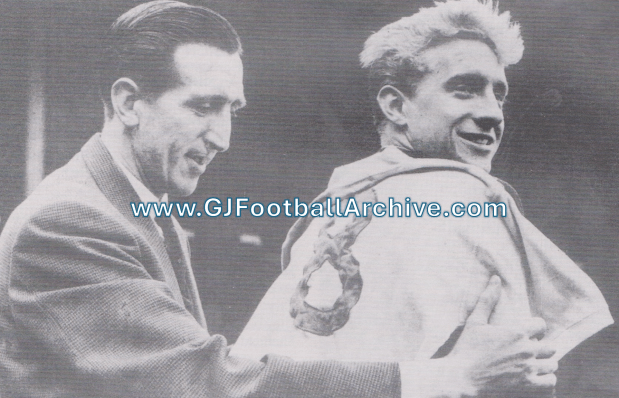
Ken Barnes welcomes Denis Law to Maine Road, 1960
It all came to a head at Leeds Road where Arsenal had sent coach Ron Greenwood to negotiate a good deal. At the same time City, represented by Les McDowall and Chairman Alan Douglas, were keen to sign the 20 year old Scotsman. The Gunners had only given Greenwood power to offer £25,000 plus David Herd, making a total of £50,000, whereas McDowall and Douglas were able to discuss the pros and cons of offering more. The discussions and negotiations went on while Law himself was playing Table Tennis in the games room. When the young player was summoned he quickly realised that his move to Arsenal was off and, after less than ten minutes, he agreed to join the Blues at a cost that was said to be three times his weight in gold.
Denis Law’s Manchester City debut 1960
Law made his debut a memorable one by scoring in the 4-3 defeat at Leeds on 19th March 1960. You can view Law’s first goal for City here:
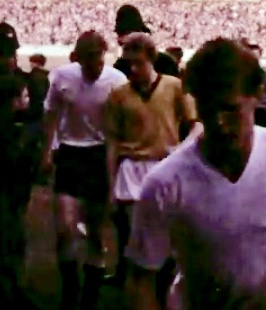
I think the commentary was added some time after and that the commentary was done in a studio over the top. The commentator (is it Stuart Hall?) mentions City’s kit as being old gold and black but colour film of kit from that season shows City wearing yellow and maroon – as can be seen in this wonderful film from that same year which includes Tottenham v City from about 5 minutes in:
Eleven days after Law’s debut he scored again as City defeated West Ham 3-1. He made one other appearance, away at Chelsea, before the player became the subject of his first controversy at the Club. Law was selected to play for Scotland at Hampden Park on 9th April – the date of the vital home game with West Bromwich Albion – and the City management took the view that playing for your country was more important than playing for your club. This angered many supporters, who realised that a Law-less City would struggle and that relegation was still a strong possibility. The Blues were only two points above the relegation zone.
The controversy heightened when other clubs took a different view and refused to release players. The City Board then felt justified in asking the League for a postponement, but the League refused. In the programme for the game, the Board outlined their views and explained how the circumstance had occurred. The article ended by stressing that the situation of club V Country cannot be allowed to continue.
As expected, without Law the Blues were defeated 1-0.
You can find out more on Manchester City in the 1959-60 season by reading the following article on the season. This is available to subscribers.
Subscribe to get access
Read more of this content when you subscribe today. It costs £3 per month (cancel anytime) or sign up for a year at the discounted price of £20 per year (works out £1.67 per month). Subscribers access the 1000+ articles posted so far and the others scheduled during the life of your subscription.
If you enjoy all the free material on my website and would like to support my research and keep this website going (but don’t want to subscribe) then why not make a one-time donation (or buy me a coffee). All support for my research is valued and welcome. It allows me to keep some free material available for all. Thanks.
Denis Law had such a wonderful footballing career, with so many periods deserving focus. Inevitably – and rightly – many will focus on his exploits with Manchester United and Scotland. Following his death I’d like to add to the tributes out there by highlighting a couple of periods of his career that may be being overlooked. It’s totally understandable, but today I’d like to highlight his Manchester City career. A career that saw him become a City legend. Not many manage to become idolised at both City and United in equal measure (Meredith & Kidd are the other prominent two I can think of) but Law managed it.
He was signed by City in March 1960 from Huddersfield Town for a record figure of £55,000 – £10,000 more than the previous British transfer record. It was a bold move by Les McDowall but was clear proof that City were still a force to be reckoned with, particularly as they had managed to fight off the likes of Arsenal to sign the 20 year old.
Denis Law signs for City from Huddersfield
Law was a lethal finisher, and a genuine crowd pleaser. His first goal for the Blues came during his debut match at Leeds United on 19th March 1960, although City were defeated by the odd goal in seven. His second League game brought another goal as West Ham were defeated 3-1 at Maine Road on 30th March. He ended the season with 7 appearances.
The following season he was top scorer with 19 League goals – 1 more than Joe Hayes – and again made the headlines with an amazing goalscoring feat in an abandoned cup tie. On 28th January City were defeating Luton 6-2 with Law scoring all City’s goals, when the match was abandoned. In the replay, Law again scored but this time City were defeated 3-1 in conditions which Law himself believed were worse than the original game.
In addition to his performances for City, Law was making a name for himself with his country. He made 5 international appearances during his first two seasons at Maine Road, and was an obvious choice for his beloved Scotland.
All the media interest which understandably focused on Law helped to make him known throughout the footballing world and, with City still struggling to find consistency during the early sixties, it was perhaps inevitable that he would move on. In the end he was transferred to Italian side Torino for another record. This time he became Britain’s first £100,000 footballer when the Italians paid City £110,000 for his signature in July 1961.
After a little over a year in Italy, Law returned to Manchester. This time to help United. In his first season there he helped the Reds avoid relegation, but regrettably City suffered as a consequence. While at Old Trafford, Law found the success that had not seemed possible at Maine Road.
In July 1973 after becoming a legend with the Reds – please go and read everything you can about his career at Old Trafford – he was given a free transfer. City manager Johnny Hart quickly made arrangements to sign the player, and on his second City debut he again scored (twice) as Birmingham were defeated 3-1. Of the City side he joined in 1973 only Alan Oakes remained from his final City game in 1961, and the Blues were in an entirely different position.
The late sixties and early seventies had seen City achieve phenomenal success and eclipse Law’s United side, and so rather than join a poor, struggling side, law was now with a team of entertainers capable of tremendous success. He had also joined a team renowned for its unpredictability!
Johnny Hart was replaced by disciplinarian Ron Saunders as manager, and the entire mood of the club changed. Saunders seemed to be at odds with many of the club’s more senior professionals and his handling of the stars was often attacked. For a while there were rumours of player power, especially when City started plummeting down the table. Inevitably, Saunders was sacked and his replacement, Tony Book, managed to change the approach. On the final day of the season, it was as a member of Book’s side that Law scored his final – and most memorable – League goal.
It was scored with his last kick in League football, and he often said it was the worst he had ever felt after scoring a goal. It wasn’t his last competitive goal in football or even for City – people often incorrectly claim it was but he played on into the 1974-75 season, scoring for City in a competitive game at the start of that season.
A page from Manchester A Football History by Gary James
City fans usually remember Denis Law more for that particular goal than for any other moment in his City career. That goal was widely held responsible at the time of ‘sending Manchester United into the Second Division’. In actual fact, the goal was irrelevant as United would have gone down in any case, but it has become a landmark goal and inevitably keeps the name of Law in the minds of Blues fans everywhere. Law’s City career deserves to be remembered for much more.
Less than two months earlier he made his final appearance at Wembley as a member of City’s League Cup final team. That game ended in a 2-1 defeat, but then it did take place during Ron Saunders’ period as manager. Had the atmosphere of the club changed prior to Wembley then it’s possible Law’s illustrious career would have ended with a League Cup winners’ medal.
1974 League Cup final Tommy Booth, Francis Lee, Frank Munro, Denis Law.
Denis Law only managed three seasons with City in total, but in each of those seasons he did enough to make the headlines and become a member of City’s hall of fame. During the mid 1970s The King’s Head pub at Crown Point, Denton became a shrine to football and its sign depicted “The King” Denis Law. Although the nickname was awarded to him at Old Trafford, the pub sign depicted him in a City shirt – the team that first brought him to Manchester. It should never be forgotten that Law is a hero to both Blues and Reds.
I’ve just heard the sad news that yet another legendary footballer has passed away. Denis Law, who achieved major success in a glittering career for Huddersfield, Manchester City and Manchester United, has died aged 84.
I’ll post more on him over the coming days but, once again, following Bobby Kennedy and Tony Book this is yet another sad day for Manchester football.
There are plenty of articles mentioning Law on this site, here are those tagged with his name:




 Gary James' Football Archive