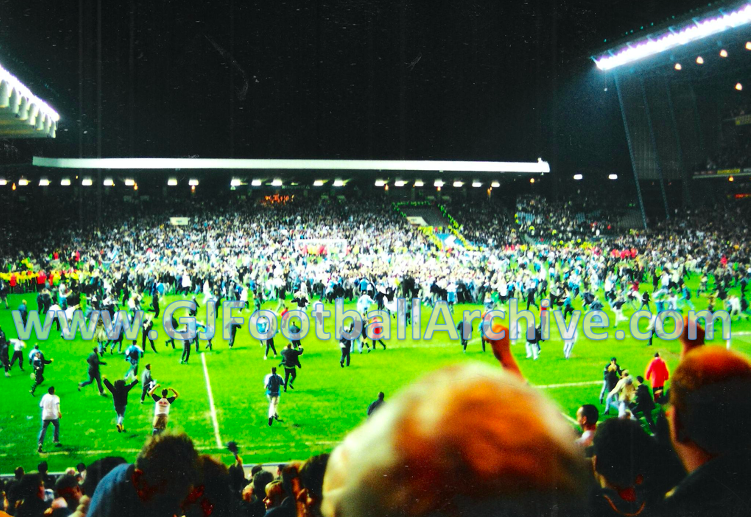
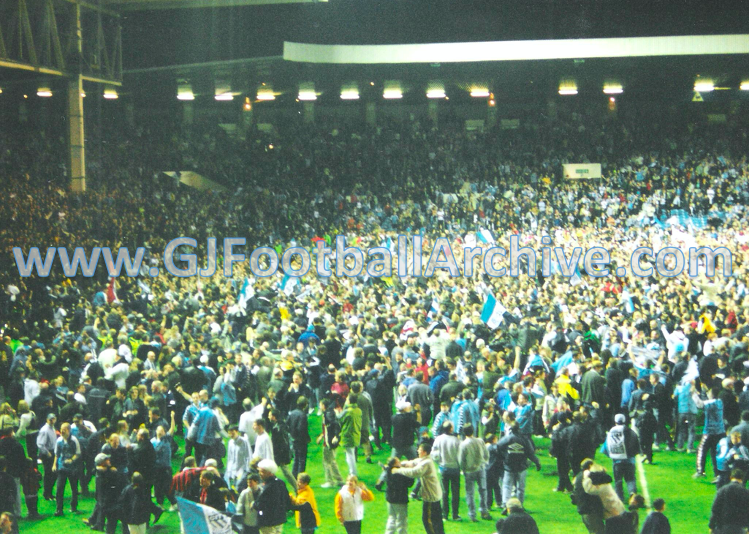
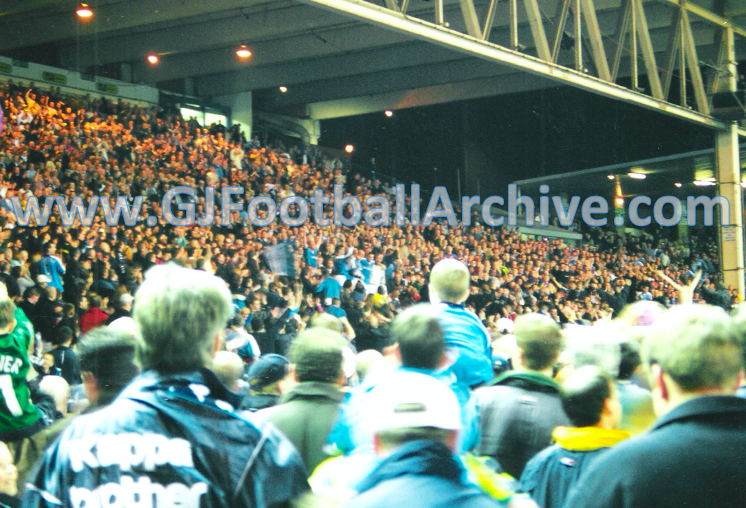
It’s day 89 of my posts counting down to the centenary of Maine Road’s opening game. Today – Pitch invasions! There were lots of celebratory (and some not so celebratory!) pitch invasions at Maine Road over the years. The League title in 1937 saw one, as did promotion games and other matches, such as the 1970 ECWC semi-final victory over Schalke.
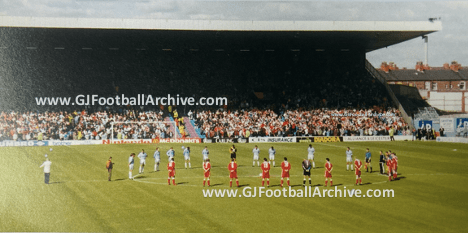
The photographs on this post are all from City’s promotion match with Birmingham in 2000 and were taken by me from the Platt Lane Stand.
Promotion pitch invasion v Birmingham 2000Promotion pitch invasion v Birmingham 2000Promotion pitch invasion v Birmingham 2000, looking towards the players in the Main Stand
If you’d like to read more on the history of Maine Road, take a look at Farewell To Maine Road, which can be downloaded from this page:
If you enjoy all the free material on my website and would like to support my research and keep this website going (but don’t want to subscribe) then why not make a one-time donation (or buy me a coffee). All support for my research is valued and welcome. It allows me to keep some free material available for all. Thanks.
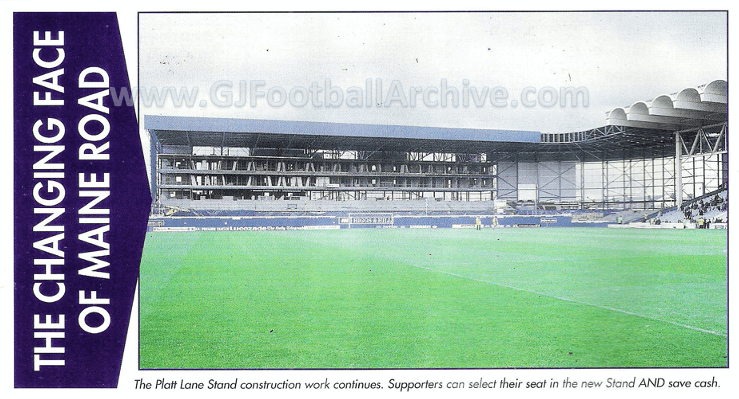
Day 67 of my posts counting down to the centenary of Maine Road’s opening game is this night time cutting from the MCFC match programme of the new Platt Lane. Oh, don’t get me started! This was the perfect example of how Swales, Niven et all downgraded Maine Road from one of England’s leading venues to a mishmash of odd stands. Swales was responsible for the club’s overall direction and Niven was the director responsible for stadium development.
The old Platt Lane held about 9,500, the new stand when opened in March 1993 was less than 5,000. You can read about what happened on the stand’s opening day here:
If you enjoy all the free material on my website and would like to support my research and keep this website going (but don’t want to subscribe) then why not make a one-time donation (or buy me a coffee). All support for my research is valued and welcome. It allows me to keep some free material available for all. Thanks.
Day 59 of my posts counting down to the centenary of Maine Road’s opening game is the story of the day Celtic and Rangers played a game at Maine Road as a combined Glasgow XI. That day was the great City player Billy Meredith’s testimonial.
It was played on 29 April 1925 and saw a MEREDITH XI versus RANGERS & CELTIC XI.
A series of benefit matches and events were organised for Billy Meredith following his retirement in 1924, with this match being the most significant event. Somehow Meredith had convinced Rangers and Celtic to form one side to take on a team of Lancashire based players selected by Meredith himself. The Meredith side, playing in red and white, contained City favourites Frank Roberts and Charlie Pringle, plus of course Meredith, and former City star Horace Barnes – a Preston player at the time of the match. City’s legendary trainer Jimmy Broad trained the team.
The Glasgow side, playing in blue and white, contained five Celtic players – including Jimmy McGrory – and six Rangers men. Former City full-back Johnny McMahon was one of the linesmen, while the other was an ex-United star George Wall, who incredibly smoked a pipe throughout the match.
Meredith testimonial programme, as seen in From Maine Men To Banana Citizens by Gary James
According to the Manchester Evening Chronicle report: ‘Many old friendships were renewed at Maine Road on Wednesday night, and we all laughed at Meredith trying the old backheel to the half-back business with very little success. Incidentally the main image above is of Meredith a couple of years earlier with the Hyde Road ground in the background.
A few moments from the match, including the teams posing for photographs. The footage concentrates on Meredith pre-match, and also shows the Popular Side (later Kippax) and Platt Lane end. The camera was placed in front of the Platt Lane end, close to the goal for much of the action (Platt Lane is the stand numbered 4 & 5 in the image below, although that stand was still unroofed back in 1925).
If you enjoy all the free material on my website and would like to support my research and keep this website going (but don’t want to subscribe) then why not make a one-time donation (or buy me a coffee). All support for my research is valued and welcome. It allows me to keep some free material available for all. Thanks.
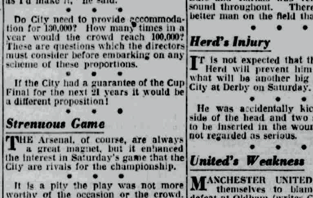
Day 57 of my posts counting down to the centenary of Maine Road’s opening game is a follow on from yesterday. It’s a cutting from the same newspaper, which was produced shortly after City and Arsenal had met at Maine Road in February 1935. It also follows on from some recent articles about stadium improvements. Here, the rumour was that City were planning to make Maine Road a 130,000 capacity venue.
February 1935 City v Arsenal Maine Road extension plans
Maine Road was only 12 years old but already it held a record individual crowd (84,569) for a game on a club ground that still stands today and it held the record League crowd (set at the game with Arsenal in February 1935). It had been expanded a little with the extension to the Platt Lane Corner (near the Main Stand and numbered 3 on the 1971 aerial photo lower down the page).
There was a development plan being developed which would see both the Platt Lane End and Scoreboard End have roofs added and be extended and then attention would turn to the Kippax where a double deck stand was suggested. By that time it was felt the stadium would hold 130,000. As it was the 1930s extensions meant it’s capacity was viewed as about 86,000.
The Platt Lane Stand (number 5 below) was built in 1935 (the old terracing was extended at the back on wooden steps and a roof was erected over the terracing) to the plan but World War Two meant the other plans were put on hold. They were eventually dropped and the next major development would be the Kippax roof and terracing extension in 1957.
Back in February 1935 the local media debated how often City would need a 100,000 capacity venue. The view was that, unless City could persuade the FA to move the FAC Final to Maine Road, then only one game a season would attract that kind of figure to the ground. With United in Division Two for much of the 1930s, and being watched by exceptionally low crowds, the game that most fans saw as the biggest meeting back then was the visit of Arsenal. How times change!
This 1971 aerial image shows the proximity of the housing on Thornton Road (bottom left, near number 6) and behind the North Stand (number 10). They were planned to be demolished in Lee’s 1994 plan.
Maine Road aerial 1971 from Farewell To Maine Road
If you’d like to read more on the history of Maine Road, take a look at Farewell To Maine Road, which can be downloaded from this page:
If you enjoy all the free material on my website and would like to support my research and keep this website going (but don’t want to subscribe) then why not make a one-time donation (or buy me a coffee). All support for my research is valued and welcome. It allows me to keep some free material available for all. Thanks.
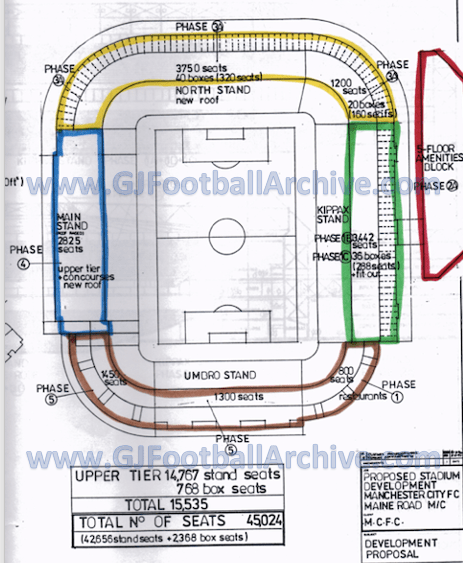
Day 55 of my posts counting down to the centenary of Maine Road’s opening game is a follow on from one from a few days ago. I posted a 1994 plan of what might have been in terms of Maine Road’s development and here’s more on that plan.
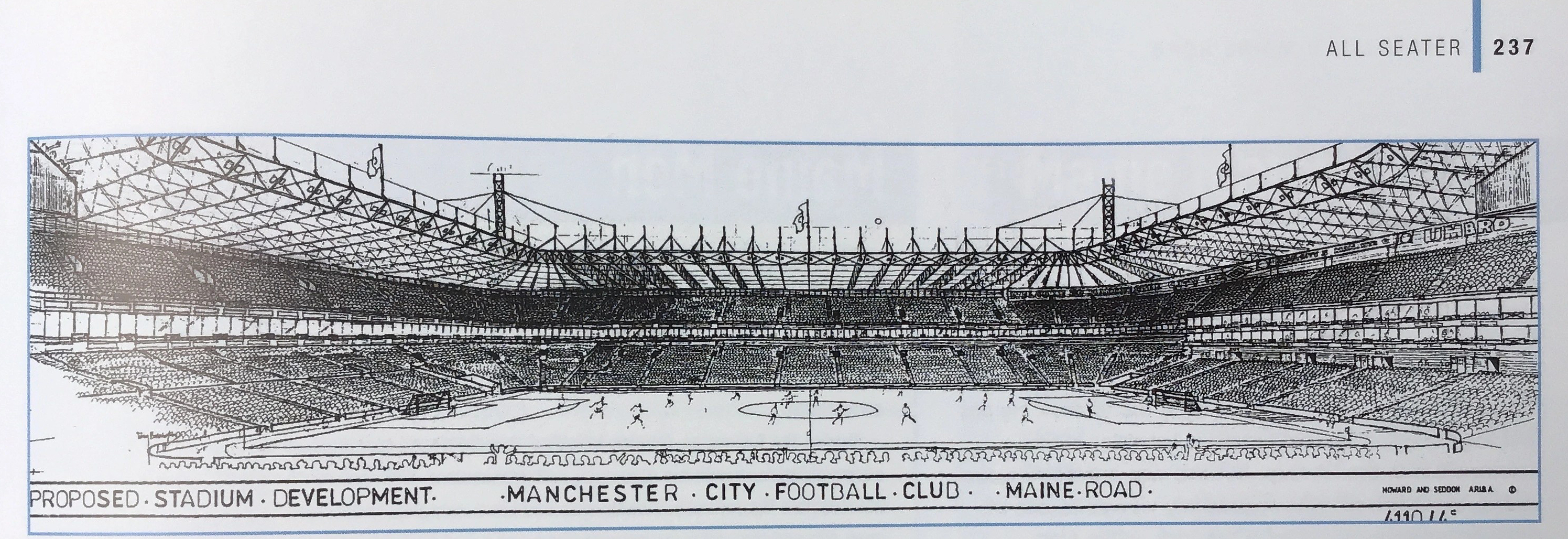
This image is of how the entire stadium was supposed to look. To explain the colour image looks towards the stadium from above the Kippax car park. The North Stand is on the right and the Platt Lane on the left. The black and white image is from the other side of the ground, looking towards the Kippax from the Main Stand.
1990s Maine Rd redevelopment plans as seen in Farewell To Maine Road
You can see from the black and white image that the plan was to replicate the general look of the new Kippax (being planned at this stage – this was January 1994 and the old Kippax was still standing) around the ground. The North Stand was to have a second tier added and hospitality boxes between the levels, like the new Kippax. The Platt Lane was to have a second tier added above the two lines of existing hospitality boxes.
The Main Stand would have part of the seating chopped away and a new second tier added.
To facilitate all of this some houses were to be bought and demolished on the streets immediately behind the North Stand and the Kippax/Platt Lane corner.
The new Kippax was the first phase of the development but Manchester’s bids for the Olympics changed thinking. Couple that with relegation in 1996 and the wholesale redevelopment of Maine Road was postponed after the Kippax opened and then dropped completely.
As mentioned previously, Lee’s plans would have seen the new Kippax followed by a phased development of each of the other three stands. These images might give an indication of how it would have progressed.
This 1971 aerial image shows the proximity of the housing on Thornton Road (bottom left, near number 6) and behind the North Stand (number 10). They were planned to be demolished in Lee’s 1994 plan.
Maine Road aerial 1971 from Farewell To Maine Road
If you’d like to read more on the history of Maine Road, take a look at Farewell To Maine Road, which can be downloaded from this page:
If you enjoy all the free material on my website and would like to support my research and keep this website going (but don’t want to subscribe) then why not make a one-time donation (or buy me a coffee). All support for my research is valued and welcome. It allows me to keep some free material available for all. Thanks.
The 54th post in my series counting down to the centenary of Maine Road’s opening game is a simple reminder of City fans and players paying their respects. The main image is from the game with Liverpool at the end of the 1995-96 season. That day City fans and the players paid tribute to former chairman Peter Swales. We all knew it would be respected even though many fans had not forgiven Swales for how he and his supporting directros had transformed the club from a major, profitable European trophy winning club into one that was struggling financially and out of touch with its traditional rivals.
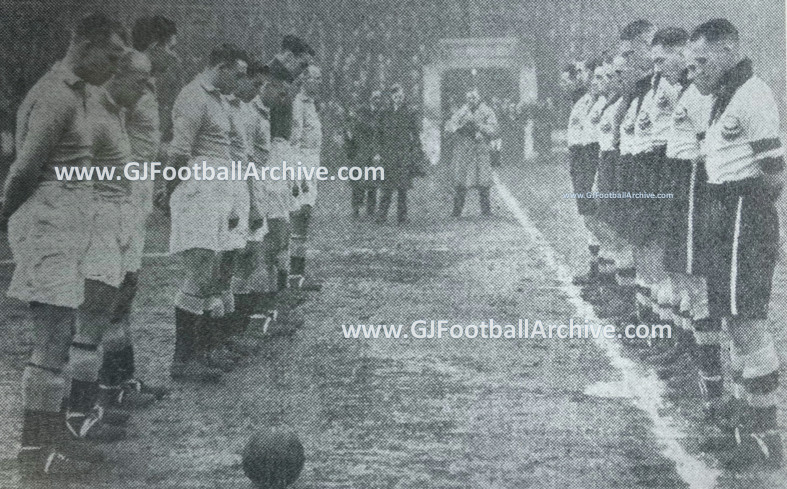
There have been many minute’s silences, or two minutes in many cases going back, at Maine Road. This image is from the two minutes silence for King George V in January 1936. That day City faced Luton. Note: back then we did not cancel games the weekend after a monarch’s death.
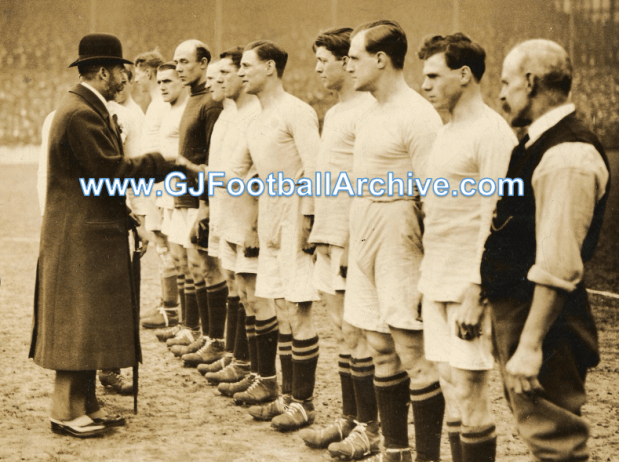
Here are two photos of King George V in happier times when he visited Hyde Road in 1920:
King George V at Hyde Road in 1920 The King with the Mayor in Hyde Road’s ‘Royal Box’. Notice Lawrence Furniss stood, behind the King. Furniss was a major figure from the 1880s to the 1940s at City.
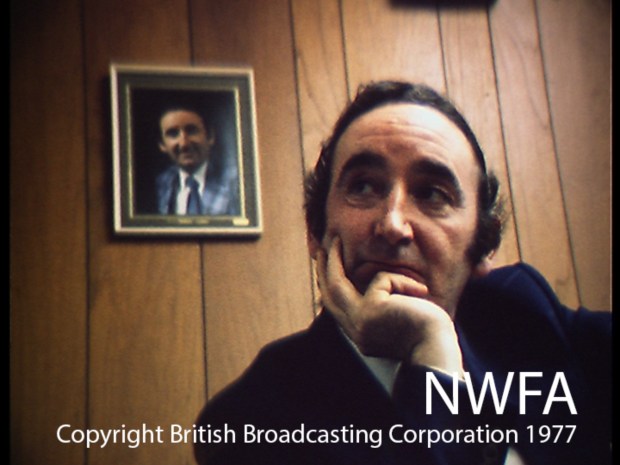
Here’s an image from a film that Will McTaggart and I showed during our Boys In Blue film show. This was from a film profile of the Manchester City chairman Peter Swales.
You can use this 1971 image to work out where the images of fans/players paying their respects were taken. The colour image of City v LFC was taken from the new Platt Lane Stand which was built where numbers 4 & 5 are. I was sat in the stand that day, looking towards the North Stand (10). The King George V silence sees the players lined up in front of the players tunnel (1) with the camera on the pitch looking towards that tunnel.
Maine Road aerial 1971 from Farewell To Maine Road
If you’d like to read more on the history of Maine Road, take a look at Farewell To Maine Road, which can be downloaded from this page:
If you enjoy all the free material on my website and would like to support my research and keep this website going (but don’t want to subscribe) then why not make a one-time donation (or buy me a coffee). All support for my research is valued and welcome. It allows me to keep some free material available for all. Thanks.
For day 49 of my posts counting down to the centenary of Maine Road’s opening game I’ve posted this plan of what might have been. These were developed in January 1994 shortly after Francis Lee became chairman.
The Kippax needed to be replaced and the plans by former chairman Peter Swales and his supporting directors had been to bolt plastic seats on to the lower part of the original Kippax terracing with a reprofiled second tier behind. Lee ripped up those plans and within days had created a plan which would see the entire ground extended, not simply the building of a new Kippax.
The new Kippax was the first phase of that development but Manchester’s bids for the Olympics changed thinking. Couple that with relegation in 1996 and the wholesale redevelopment of Maine Road was postponed and then dropped completely.
Lee’s plans would have seen the new Kippax followed by a phased development of each of the other three stands. I haven’t got chance to work through every step here but these images might give an indication of how it would have progressed.
1990s Maine Rd redevelopment plans as seen in Farewell To Maine Road
Here’s an aerial photo of the ground in 1995 with the Kippax nearing completion:
If you’d like to read more on the history of Maine Road, take a look at Farewell To Maine Road, which can be downloaded from this page:
If you enjoy all the free material on my website and would like to support my research and keep this website going (but don’t want to subscribe) then why not make a one-time donation (or buy me a coffee). All support for my research is valued and welcome. It allows me to keep some free material available for all. Thanks.
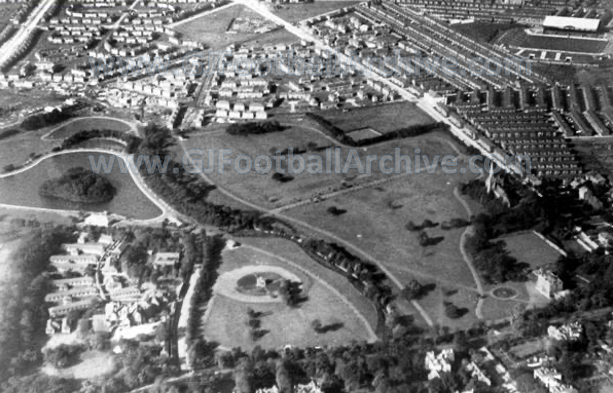
For day 48 of my posts counting down to the centenary of Maine Road’s opening game I’ve posted this aerial photo from 1925. People often talk about Maine Road being surrounded by tightly packed housing and it was but there was also quite a bit of green too, as this image shows.
Additional housing was erected in the area towards the top in the years that followed. In fact I think the entire estate was being built at the time this photo was being taken.
Maine Road is of course in the top right of this image. Notice also the sports ground at the top right corner of Platt Fields Park. This had a number of uses over the years and I think it was a police ground at this time. It later became City’s Platt Lane training ground of course.
1925 Aerial photo of Maine Road and Platt Fields Park
If you’d like to read more on the history of Maine Road, take a look at Farewell To Maine Road, which can be downloaded from this page:
If you enjoy all the free material on my website and would like to support my research and keep this website going (but don’t want to subscribe) then why not make a one-time donation (or buy me a coffee). All support for my research is valued and welcome. It allows me to keep some free material available for all. Thanks.
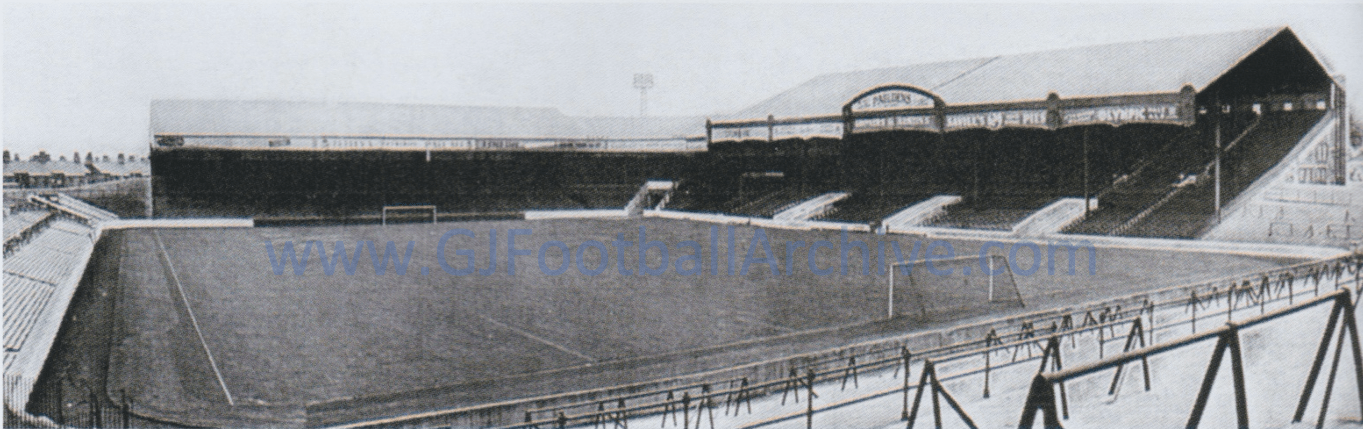
For day 47 of my posts counting down to the centenary of Maine Road’s opening game I’ve posted this photo from 1954. Lots changed at the stadium but a few things to look out for…
The original Main Stand roof has an advert where the architect Charles Swain had envisaged the club’s name (who says commercialisation of football is a new thing?).
The original floodlights can be seen (or at least one in the Platt lane corner). These were switched on for the first time in 1953
The Players’ tunnel is still its original size before the seating in the directors box was brought forward above the tunnel.
Here’s an aerial photo of Maine Road from 1971 to help with understanding of what’s what and to compare. So this was only taken 17 years after the main image but so much changed. The main image was taken from the old Scoreboard End (somewhere close to number 10 but obviously from the old terracing) looking towards the Platt Lane. The old floodlight was behind number 4 and you can see the second set of lights there in the image below. The Maine Stand roof had obviously changed between these images.
Maine Road aerial 1971 from Farewell To Maine Road
If you’d like to read more on the history of Maine Road, take a look at Farewell To Maine Road, which can be downloaded from this page:
If you enjoy all the free material on my website and would like to support my research and keep this website going (but don’t want to subscribe) then why not make a one-time donation (or buy me a coffee). All support for my research is valued and welcome. It allows me to keep some free material available for all. Thanks.
It’s 1941 and there are air raids across Manchester… For day 46 of my posts counting down to the centenary of Maine Road’s opening game I’ve posted this map. What does it signify? Well, the map shows Maine Road as it looked between 1931 and 1934, before the main part of the Platt Lane Stand was built (and after the corner was erected). But that’s not why I’ve posted it. I’ve posted it because of those pen circles that appear on it.
This is actually a Manchester City Council plan of buildings hit by bombs in the area immediately east of the Maine Road stadium. As you can see a house in Thornton Road was hit but none of the Maine Road stadium itself was hit in those January 1941 raids on Manchester. The stadium had a lucky escape but sadly many residents and Mancunians did not.
1941 Bomb damage near Maine Road
Here’s an aerial photo of Maine Road from 1971 to give a feel for the site. The Platt Lane corner is number 3 and Thornton Road is the street that backs on to Maine Road near number 6.
Maine Road aerial 1971 from Farewell To Maine Road
If you’d like to read more on the history of Maine Road, take a look at Farewell To Maine Road, which can be downloaded from this page:
If you enjoy all the free material on my website and would like to support my research and keep this website going (but don’t want to subscribe) then why not make a one-time donation (or buy me a coffee). All support for my research is valued and welcome. It allows me to keep some free material available for all. Thanks.







 Gary James' Football Archive