Recently an academic article of mine offering advice and examples to those researching sports history or working within the industry was published. Normally, it is behind an academic paywall but you can download it for free during October here (it’s free, you may as well have a look):
On 17th of this month I posted the first part of a two part feature on the royal family and Manchester City. Now, as promised, here’s the second part focusing on visits to Manchester City by the UK monarchs over the decades plus a few other snippets. Enjoy this free to read article…
Before I start with part two here’s a link to the first part of the feature:
Over the years Manchester City has proved to be a very popular club for visits by significant members of the British Royal family and of other nations’ royalty. Whether this has anything to do with the club’s success, the stadium’s importance, or the role of Manchester in terms of industry and commercial activity is unclear (probably a bit of all of that!). There have been two major royal visits to Maine Road and there has been a significant visit to the club’s former ground at Hyde Road (though some people incorrectly think there have been two!). In addition, the Queen and the Duke of Edinburgh plus other senior royals visited the City of Manchester Stadium (now Etihad) twice for the Commonwealth Games. Prince Philip was creating history by becoming the first senior member of the Royal family to visit two of City’s venues.
The first Royal visit to Maine Road was on 20 October 1934 when the Duke of York (future King George VI, Queen Elizabeth II’s father) watched City’s 1-0 defeat by Derby County. Prior to the match the Duke was introduced to both sides and then he took his seat at the front of the Directors’ Box. The previous year he had witnessed City’s FA Cup final defeat to Everton at Wembley.
The next major Royal visit came on Thursday 7 May 1964 when Prince Philip witnessed a City-United derby match. The game had been organised by the Variety Club of Great Britain as a charity fund raiser for underprivileged children, and it had been hoped a capacity crowd of over sixty thousand would be present, however appalling weather limited the attendance to approximately 36,000. Philip, as with the Duke of York thirty years earlier, sat in the Directors’ Box, although this time, according to newspaper reports the box had been decked out with flowers and was christened the Royal Box for the evening.
The game ended with Philip presenting the Duke of Edinburgh Cup to United’s captain Denis Law on the pitch in the pouring rain. Thousands of children, according to local reports, swarmed on to the pitch, as the Duke became drenched. Interestingly, Philip’s visit to the Commonwealth Games in 2002 also saw him suffer with the rain. Perhaps he remembered his 1964 visit as he waited for the 2002 Games to end!
City’s current stadium has welcomed a variety of international royal guests, including the former King of Spain, Juan Carlos I, who attended City v Liverpool in March 2017, while Maine Road saw several visits by middle eastern princes and others over the years.
The most significant Royal visit of all to a City venue has to be the 1920 appearance of King George V at Hyde Road. This was the first visit to a provincial ground by a reigning monarch and as such is of immense importance. A month or so earlier the King had gone to watch a FA Cup tie at Stamford Bridge between Chelsea and Leicester.
It has been suggested that twenty years earlier, however, Queen Victoria’s son, the Prince of Wales (future King Edward VII), attended Hyde Road. This is a myth – please don’t believe it! I’m always keen on finding evidence and the author who propagated this story actually mistook City director Joshua Parlby for the future King on a photograph!
I’ve performed extensive research on this so-called visit and have revealed in earlier books (most notably Farewell To Maine Road in 2003) that the visit did not occur. As with all myths I try to work backwards to understand how these things take hold and why some become convinced (don’t get me started on the myth about Anna Connell!). I find it helps to get to the source because that way it becomes clear why someone who hasn’t performed detailed research becomes convinced. So, here’s the story of how some authors have incorrectly claimed a royal visit in 1900…
Back in 1930 City’s first true history, Manchester City Football Club Souvenir History by Fred Johnson, stated: ‘The Hyde Road ground was honoured with the presence of His Majesty the King on March 27th 1900 when Liverpool were opposed.’ This is clearly a typographical error as the incident it refers to is the visit of King George on 27 March 1920 (Liverpool were the visitors).
This explains the birth of the error but a photograph has also been produced by one author ‘showing’ the King at Hyde Road. It shows nothing of the sort and the photo (below) is clearly a red herring. It is Hyde Road (the stand in the background is the Stone Yard Stand) but the two gentlemen wearing top hats have been claimed to be leading royals with the one closest to the camera supposedly future King Edward. However, he is not. I’ve compared these photos to others in my collection and published in the early 1900s. These images are actually from the visit of future Prime Minister Arthur Balfour in September 1900.
Balfour was the only significant visitor that day and his head actually appears on the image (between the ladies and the top-hatted men). One of the women is described as Balfour’s daughter on another photo from this day. The top-hatted gent at the back is City director W. Richmond (director between 1896 and 1902), while the other top-hatted man looks an awful lot like Joshua Parlby (the club’s former manager and a director in 1900).
Regardless of this myth, it is amazing that three successive monarchs had attended City’s grounds, albeit in George VI’s case he was still Duke of York when he attended Maine Road in 1934.
Subscribe to get access
While you’re here why not subscribe to my website. It costs £20 per year (works out about £1.67 a month) and for that every subscriber gets access to a PDF of both Manchester A Football History and From Maine Men to Banana Citizens (both out of print) plus the hundreds of articles, interviews and videos already posted and a guaranteed 4 new exclusive articles per month (usually a lot more than that!). I am not employed to do any research and so subscribers help fund detailed research into football’s history. Thanks for supporting my work if you do already subscribe or buy my books.
In March 1920 King George V – the present King’s great-grandfather – visited Hyde Road to watch City V Liverpool. This was the first time a reigning monarch had attended a match outside of London and as such this was a major honour for the Blues. Here for subscribers is the story of that day….
Subscribe to get access
Read more of this content when you subscribe today. Subscribers get full access to everything on the site, including the entire Manchester A Football History book.
On this day (21 August) a Wednesday night meeting with Liverpool ended in a 2-1 victory for Manchester City. You can see highlights of the game (and relive the days of night matches on the Kippax/at Maine Rd) including two David White goals here:
One of the earliest stars of League Football died on this day (12th June) in 1902. Jimmy Ross, who was a major figure for almost three seasons with Manchester City and had competed in every season of League football since the League was established in 1888, died with an illness described as “an acute skin disease and a raging fever.”
At the time of his death Ross was a Manchester City player. His last first team appearance was appropriately against Preston North End in the First Round of the F.A. Cup in January 1902.
City helped his mother, whom he was looking after at the time of his death, financially. They also arranged the funeral and he was buried at Southern Cemetery (according to newspaper reports of the time he was buried in a grave that contained another City player – Bride – who had died a couple of years earlier). Several City players/personalities carried the coffin, including Billy Meredith.
Chanting at football games is rarely documented correctly with many myths, rumours and stories developing over the years. This feature is designed to give a potted overview of the development of singing at City.
I explained about some of the chants in this talk recently:
Now, for subscribers is an 1800 word article on the history and development of chants at Manchester City:
Subscribe to get access
Read more of this content and everything on the site when you subscribe today.
On this day (April 9) in 2005 a 90th minute volley from Kiki Musampa – his first for the Blues – at the northern end of the stadium gave Manchester City a 1-0 home victory over eventual European Champions Liverpool. This was Stuart Pearce’s first league victory as City manager.
The Musampa goal was described at the time as a ‘spectacular volley’ – You can judge for yourself here:
Former City and England captain Pearce guided the Blues through the final nine games of 2004-05 after the departure of Kevin Keegan. Apart from a 2-1 defeat in his first game, the Blues were unbeaten until the end of the season. This run included the victory over Liverpool and wins over Birmingham (3-0), Portsmouth (2-0) and Aston Villa (2-1).
As a result Pearce was named the Barclays Premiership Manager of the Month for April.
This weekend marks the latest in the series of games between one of the Manchester clubs and a Liverpool team. Today (9 April 2022) relegation worried Everton face United and tomorrow League Champions and leaders City take on second placed Liverpool at the Etihad. Much will be made of the Manchester-Liverpool rivalry and it is true that the two cities have been rivals for over 150 years (it certainly predates the building of the Ship Canal!) BUT the football clubs have not always been rivals. In fact Utd and Liverpool have been close over the decades at times while the on-the-pitch rivalry between City and Liverpool was extremely strong in the late 60s and 70s.
The strength of the two conurbations’ footballing rivalries came during the late 1960s but intensified in the late 70s. Prior to this one-off seasons may have seen grudge matches or significant games between clubs from the cities but nothing more than that. In fact for many, many years Manchester United and Liverpool, for example, were extremely close. They once put forward a suggestion to the Football League that all home teams should wear red and away teams white – the rest of football soon got wise to the plan!
There was also the time when United and Liverpool ‘fixed’ a game of football. It’s a long story (amazingly United’s solicitor was part of the ‘neutral’ investigating committee!) and can be read here:
The rivalry between the footballing clubs developed in the 60s and there were many significant games between all the clubs in the two cities with several prominent matches (there were significant grudge matches between Everton and City for example in the 60s and at one point Liverpool’s Bill Shankly told the media that City were Liverpool’s biggest rival!).
Back in 1995 I interviewed former Manchester City boss John Bond at his home. The interview lasted about two hours and here’s a brief snippet from that interview where Bond talks about beating Liverpool on Boxing Day 1981.
The Blues won 3-1 (Bond, Hartford & Reeves) then two days later (Bond says it’s the next day in this clip but it was 28th December) City defeated Wolves 2-1 at Maine Rd. John discusses a brilliant goal from Trevor Francis. City went top of the League after the Wolves victory.
Stick with the clip because it ends with Bond’s views on how Liverpool used to react to wins and defeats. I’d best not comment – have a listen:
I’ve covered one particularly bitter moment in the City-Liverpool rivalry from the 80s that concerns John Bond here:
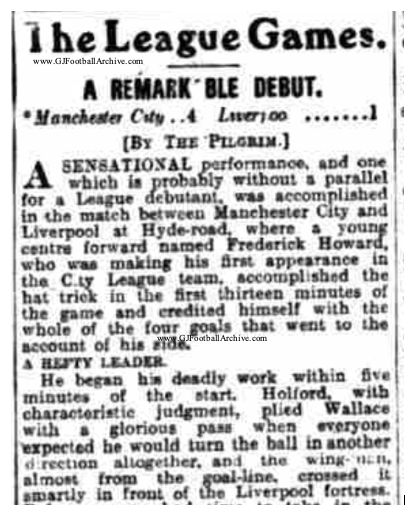
I hope this weekend’s games between go well and it’d be great if one of Manchester’s Blues could score four goals as Fred Howard did on his debut against Liverpool – see:
On this day (January 20) in 1900 the attendance stats (see image) seen here were published in various newspapers. Of course, as a historian who researches these sorts of things it does not surprise me at all that Manchester City were the best supported club at this stage. However, I can understand why some may have been surprised back then. City had only just been promoted for the first time the previous season.
In the end Manchester’s Blues ended the season as the third best supported club with an average of 16,000 (League champions Aston Villa attracted 19,825 and 5th placed Newcastle 16,725). City ended the season 7th in the top division.
For those wondering Newton Heath (Manchester United) averaged 6,225 and were the 16th best supported club. Liverpool averaged 11,325 and were 5th best supported club.
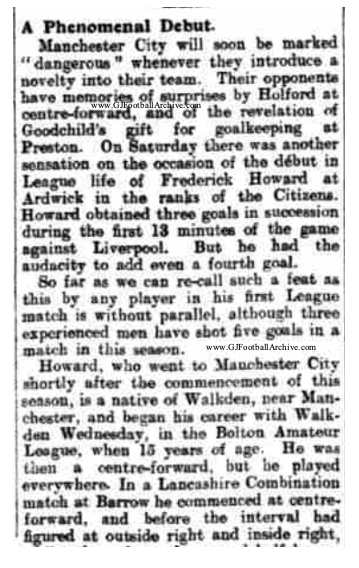
On this day (18th January) in 1913 Manchester City’s Fred Howard scored four goals on his debut against Liverpool at Hyde Road. I love the description of Howard in one report of this game: ‘Howard, a hefty individual who apparently does not believe in allowing the full backs free kicks, had pounced on the ball’. I think we’ve all seen a few ‘hefty individuals’ who did not ‘believe in allowing the full backs free kicks’ over the years!
A report also warns that Howard: ‘would do well to remember that he will not always be served as he was on this occasion. Nor will he have a much easier task’. I’m pretty sure Howard did not expect to score four goals in every game.
Howard, from Walkden, ended his City career after scoring 43 goals in 90 first team competitive games. Note in this article (below) the use of the nickname Citizens to describe the Blues. Maybe one day I’ll do a piece on club nicknames but I do know that many fans didn’t feel the word Citizens (or Cityzens as it is usually written these days at the club) had much to do with the club when City re-adopted it a few years back. It was certainly used a lot when talking of the club from 1894 through to perhaps the inter-war period.
Three of Howard’s goals came in a 13 minute spell as the Blues won 4-1. It was regarded as the greatest debut feat by any player at the time. Even now, over a century later, it’s hard to think of any player having a better debut.
Over the years plenty have talked of players scoring hat-tricks on debuts around the globe but how often do you hear of a player scoring four in the top flight of a major League against a team that is regarded as one of your main rivals? After this game Liverpool had dropped to 13th in the First Division, while City were fifth.
This was just a brief taster of the content in GJFootballArchive.com. If you would like to read the in-depth, longer articles (including the entire Manchester A Football History book) then please subscribe below. It works out about £1.67 a month if you take out an annual subscription (£20 per year) or £3 a month if you’d like to sign up for a month at a time. Each subscriber gets full access to the 500+ articles posted so far and the hundreds scheduled to be posted in the coming weeks.
Subscribe to get access
Sign up today to ensure you can access all the content on GJFootballArchive.com


 Gary James' Football Archive