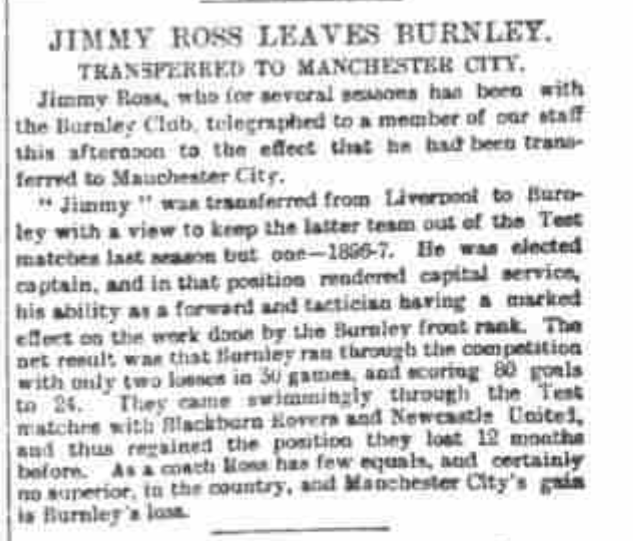
On this day (7th February) in 2021 League leaders Manchester City managed a 4-1 victory over reigning Champions Liverpool. It was the Blues’ greatest win at Anfield for over 80 years.
The Blues have struggled to win at Anfield over the last 40 years (I don’t need to go through the stats, City fans get bombarded with them every time there’s a game at Anfield! So the 2021 resounding victory over Liverpool was significant. City ended up winning the League by 12 points with Manchester United second.
In 1937 the Blues managed a 5-0 victory on Good Friday (and three days later won 5-1 at Maine Road). That season the Blues went on to win the League, as they did in 2021 of course.
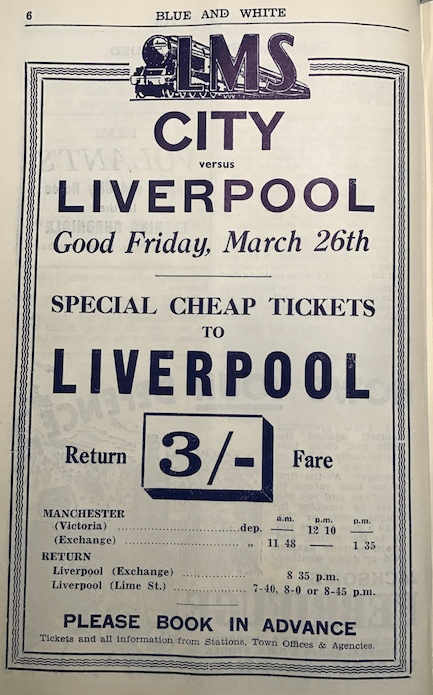
As the above advert shows, it cost 3 shillings for a return train fare to Anfield that day (sadly no fans were allowed in 2021).
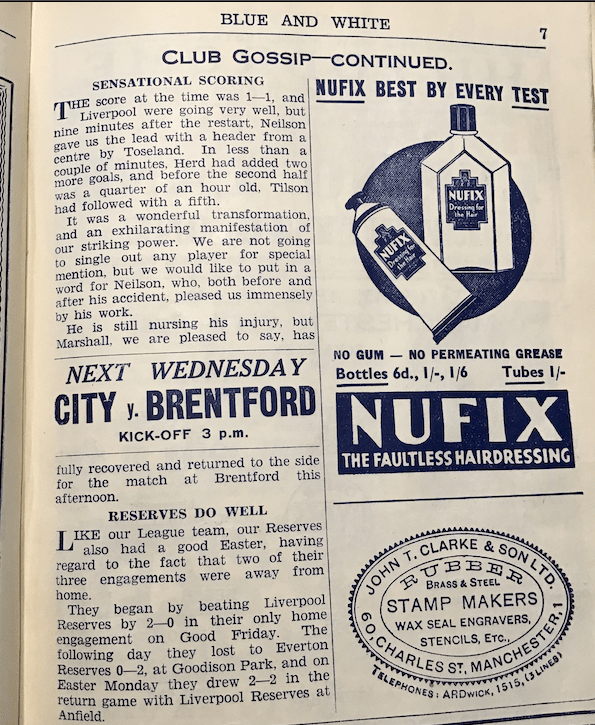
Here’s how the MCFC match programme remembered the 1937 victory:
I love that advert – so appropriate!
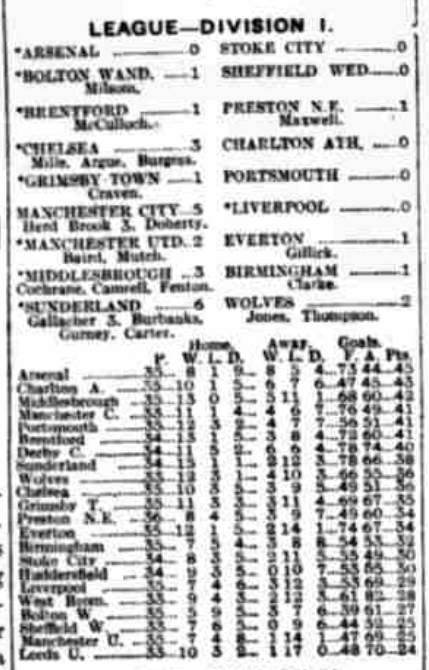
Here are the League results and table following that historic win at Anfield. It’s interesting to see which clubs are no longer members of football’s top division and which of today’s giants are missing.
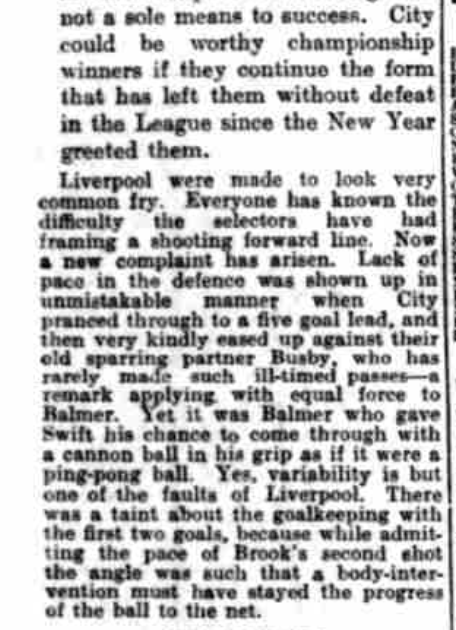
Here are a few snippets from a Liverpool based newspaper telling the story of that day:
Here’s a few stats from the victory over Liverpool in 2021:
Sterling became the third player to score 100 or more goals under Guardiola, after Barcelona’s Lionel Messi (211) and City’s Sergio Aguero (120).
Of all players to score at least 10 goals within the top five European leagues (England, France, Germany, Italy and Spain) this season, only Borussia Dortmund’s Erling Haaland (20 years 2021 days) is younger than Phil Foden (20 years 255 days). Now where have we heard of Haaland?
Since netting his first goal of the season on 15 December 2020, Ilkay Gundogan had scored at least three more Premier League goals than any other player (nine).
At 20 years and 255 days Phil Foden is the youngest player to score and assist in a Premier League game at Anfield.
Oleksandr Zinchenko made his 50th Premier League appearance on that day.
Subscribe to get access
If you would like to read the blog’s other in-depth, longer articles (including the entire Manchester A Football History book) then please subscribe below. It works out about £1.67 a month if you take out an annual subscription (£20 per year, sign up here) or £3 a month (below) if you’d like to sign up for a month at a time.
If you would like to read the blog’s other in-depth, longer articles (including the entire Manchester A Football History book) then please subscribe below. It works out about £1.67 a month if you take out an annual subscription (£20 per year, above) or £3 a month (sign up here) if you’d like to sign up for a month at a time.
I’ve been doing quite a bit of research into attendance figures this week and thought I’d share a couple of findings which may surprise some. There has been a lot of talk in recent years about certain clubs having ‘empty seats’ and I think many Manchester City fans will remember the Manchester Evening News feature where a young journalist used a red highlighter to circle every empty seat he saw at a particular game. This was challenged by fans, including myself, who questioned the time the image he utilised had been taken and the purpose of the article.
Since then fans of rival clubs have often pointed their finger at City and accused the club of having ‘empty seats’ at every game and so I’ve decided to look at the last 30 years and compare each top flight team. Obviously, I could compare average attendances and leave it at that, but as so many people talk about ‘empty seats’ I’ve decided to take a different approach and look at the difference between the highest crowd for each club in a season and that club’s average attendance. I’ve taken the highest attendance as this gets over any potential issue with the reported capacity of a ground.
The average attendance for each club is inevitably lower than the highest crowd and with away support typically being about 3,000, any difference of a few hundred between the figures could simply be additional segregation for high profile games or maybe away allocations not selling out. Once we get into the thousands then that would suggest the home allocations have not sold out.
Comparing the highest crowd with the average may not necessarily be the best way to compare clubs but it does give an indication of how full a stadium is or not, so it fits with those who obsess about ‘empty seats’.
As well as comparing those figures I’ve also compared the highest crowd with the lowest crowd for each club. The difference between these attendances shows how many ‘empty seats’ (to use that awful phrase) a club has for certain games each season.
Okay, so what does all this show? Well, I’ll be explaining more in another article soon but a few headlines to include here that may surprise some fans are:
Manchester City have generally had one of the ‘fuller’ stadia over the last 30 years since the Premier League was established, even during seasons when the Blues were out of the top division.
In 2000-01 (a relegation season for City) the difference between City’s highest crowd and average attendance was 571 and the difference between their highest and lowest crowds was 2576. At Liverpool the equivalent differences were 1,107 and 6,332, meaning that typically there were about twice as many ‘empty seats’ at Anfield than at City and that the worst attended League fixture at Anfield had 6,332 less people at it than their best. At Everton the differences were even greater: 6,130 between highest and average with 12,590 the difference between the highest and lowest attended games. Aston Villa’s figures were even more extreme.
In 1998-99 (City’s only season in the third tier) some games were, quite frankly, poorly attended when compared with the best in the Premier League but remember this was the 3rd tier. Those crowds were extraordinary for that league. City fans often believe the ground sold out every week but sadly it didn’t and the difference between City’s best crowd and worst attendance was 8,180, which seems excessive. However, comparing this to the Premier League clubs of the era or today’s giants shows that some had even greater differences. For example, Aston Villa (9,682 difference), Everton (9,828), Leeds (10,243), Liverpool (8,833), Wolves (9,109) and so on. Ultimately, City’s figures in the third tier were absolutely astounding compared to some of those clubs who were in the Premier League or 2nd tier.
In 2004-05 the difference between City’s highest and lowest attendances was 4,768. Aston Villa’s was 11,281; Everton’s was 8,146; Leeds’ was 9,911; Leicester was 8,982; Liverpool’s was 9,160 etc.
These are just a few examples of attendance analysis I’m currently performing and there is so much more to say. Often fans of some clubs will say that the capacity of their stadium limits attendances and there is obviously truth in that, but if a club’s lowest attendance is almost 9,000 lower than their best (as with Liverpool in 2004-05) then the capacity of the stadium is not an issue on that day. A few hundred and it’s an issue, but almost 9,000?
Watch this space for more information over the coming months. The whole ‘empty seats’ accusations are ridiculous and statistics show that all clubs have experienced this phenomenon on occasion during the Premier League era.
On this day (17 January) in 1925 Manchester City’s Frank Roberts scored four as Liverpool were defeated 5-0 in Division One.
Roberts’ feat was remarkable because he was playing as centre-forward (a position he seemingly was not keen on playing) due to regular centre-forward Tommy Browell being struck down with influenza.
He normally played as City’s inside-right, his preferred position.
It was Roberts’ first outing as centre-forward that season and it was the first time he’d ever scored four in a game. It made him the League’s top scorer with 24 goals so far that season.
City’s opening goal had been scored by legendary, amateur footballer Max Woosnam in the opening minute. Sadly, accurate time keeping was not a feature of football then (some would argue that some referees still don’t have accurate time keeping but that’s for another day) and so we don’t know how few seconds this was actually netted in. Some reports say straight from the kick-off.
The Liverpool Echo talked of the game starting in a gale which worked against the Liverpool club (some local newspapers still make excuses for their teams). The Athletic News makes no such comment preferring, instead, to talk of City’s ‘lightening like movements’ and their approach being ‘the way to win’.
Subscribe to get access
This was just a taster of the content in GJFootballArchive.com. If you would like to read the in-depth, longer articles (including the entire Manchester A Football History book and From Maine Men To Banana Citizens) then please subscribe. It works out about £1.67 a month if you take out an annual subscription (£20 per year, here) or £3 a month (below) if you’d like to sign up for a month at a time. Annual subscribers get full access to everything posted on the site.
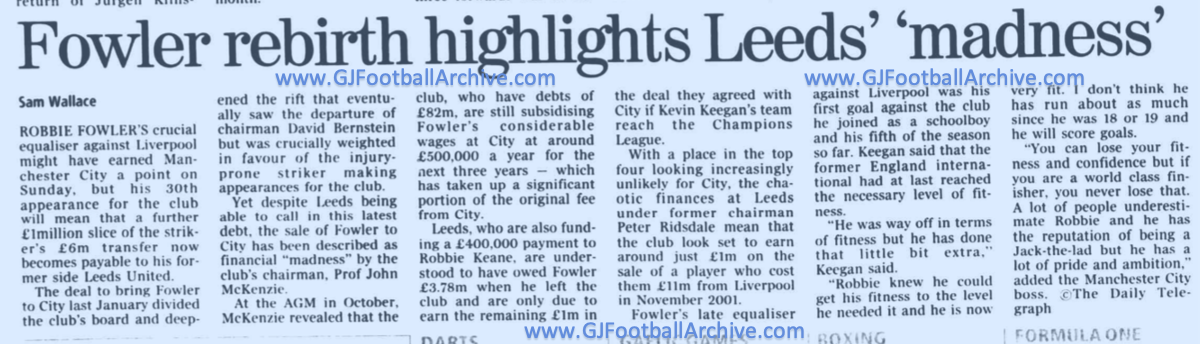
Today (28 December) in 2003 47,201 witnessed Robbie Fowler’s 90th minute equaliser as Kevin Keegan’s Manchester City drew 2-2 with Liverpool at their present day stadium. Nicolas Anelka had scored the first for City that day. This was the first season at the new stadium for the Blues. Here’s a contemporary feature written by Sam Wallace on Robbie Fowler. Written following the Liverpool draw:
You can read other features on the 2003-04 season here:
On this day (26 December) in 1981 Manchester City defeated Liverpool 3-1 at Anfield but it was a day marred when City keeper Joe Corrigan was felled by a bottle thrown at him. Here’s highlights of the game plus a brief audio clip of John Bond talking about the LFC reaction that day.
In 1995 I interviewed former City boss John Bond at his home. The interview lasted about two hours and here’s a brief snippet from that interview where he talks about that win over Liverpool on Boxing Day 1981.
The Blues won 3-1 (Bond, Hartford & Reeves) then two days later (Bond says it’s the next day in this clip but it was 28th December) City defeated Wolves 2-1 at Maine Rd. John discusses a brilliant goal from Trevor Francis. City went top of the League after the Wolves victory.
Stick with the clip because it ends with Bond’s views on how Liverpool used to react to wins and defeats. I’d best not comment – have a listen:
As League Cup holders Manchester City expected to challenge for honours again in 1976-77. It became a remarkable season with some incredible highs; important transfers; return form injury and much more. You can read all about that season in this 2000+ word article.
Subscribe to get access
This article is available to subscribers. Annual subscribers get access to everything posted on this site since December 2020 (including PDFs of 2 out of print books and audio interviews with Malcolm Allison John Bond etc.) while monthly subscribers get access to everything posted since 1 October 2022. It costs £20 for annual subscription (here) and £3 per month for monthly subscription (below)
This article is available to subscribers. Annual subscribers get access to everything posted on this site since December 2020 (including PDFs of 2 out of print books and audio interviews with Malcolm Allison John Bond etc.) while monthly subscribers get access to everything posted since 1 October 2022. It costs £20 for annual subscription (above) and £3 per month for monthly subscription (here)
Recently an academic article of mine offering advice and examples to those researching sports history or working within the industry was published. Normally, it is behind an academic paywall but you can download it for free during October here (it’s free, you may as well have a look):
On 17th of this month I posted the first part of a two part feature on the royal family and Manchester City. Now, as promised, here’s the second part focusing on visits to Manchester City by the UK monarchs over the decades plus a few other snippets. Enjoy this free to read article…
Before I start with part two here’s a link to the first part of the feature:
Over the years Manchester City has proved to be a very popular club for visits by significant members of the British Royal family and of other nations’ royalty. Whether this has anything to do with the club’s success, the stadium’s importance, or the role of Manchester in terms of industry and commercial activity is unclear (probably a bit of all of that!). There have been two major royal visits to Maine Road and there has been a significant visit to the club’s former ground at Hyde Road (though some people incorrectly think there have been two!). In addition, the Queen and the Duke of Edinburgh plus other senior royals visited the City of Manchester Stadium (now Etihad) twice for the Commonwealth Games. Prince Philip was creating history by becoming the first senior member of the Royal family to visit two of City’s venues.
The first Royal visit to Maine Road was on 20 October 1934 when the Duke of York (future King George VI, Queen Elizabeth II’s father) watched City’s 1-0 defeat by Derby County. Prior to the match the Duke was introduced to both sides and then he took his seat at the front of the Directors’ Box. The previous year he had witnessed City’s FA Cup final defeat to Everton at Wembley.
The next major Royal visit came on Thursday 7 May 1964 when Prince Philip witnessed a City-United derby match. The game had been organised by the Variety Club of Great Britain as a charity fund raiser for underprivileged children, and it had been hoped a capacity crowd of over sixty thousand would be present, however appalling weather limited the attendance to approximately 36,000. Philip, as with the Duke of York thirty years earlier, sat in the Directors’ Box, although this time, according to newspaper reports the box had been decked out with flowers and was christened the Royal Box for the evening.
The game ended with Philip presenting the Duke of Edinburgh Cup to United’s captain Denis Law on the pitch in the pouring rain. Thousands of children, according to local reports, swarmed on to the pitch, as the Duke became drenched. Interestingly, Philip’s visit to the Commonwealth Games in 2002 also saw him suffer with the rain. Perhaps he remembered his 1964 visit as he waited for the 2002 Games to end!
City’s current stadium has welcomed a variety of international royal guests, including the former King of Spain, Juan Carlos I, who attended City v Liverpool in March 2017, while Maine Road saw several visits by middle eastern princes and others over the years.
The most significant Royal visit of all to a City venue has to be the 1920 appearance of King George V at Hyde Road. This was the first visit to a provincial ground by a reigning monarch and as such is of immense importance. A month or so earlier the King had gone to watch a FA Cup tie at Stamford Bridge between Chelsea and Leicester.
It has been suggested that twenty years earlier, however, Queen Victoria’s son, the Prince of Wales (future King Edward VII), attended Hyde Road. This is a myth – please don’t believe it! I’m always keen on finding evidence and the author who propagated this story actually mistook City director Joshua Parlby for the future King on a photograph!
I’ve performed extensive research on this so-called visit and have revealed in earlier books (most notably Farewell To Maine Road in 2003) that the visit did not occur. As with all myths I try to work backwards to understand how these things take hold and why some become convinced (don’t get me started on the myth about Anna Connell!). I find it helps to get to the source because that way it becomes clear why someone who hasn’t performed detailed research becomes convinced. So, here’s the story of how some authors have incorrectly claimed a royal visit in 1900…
Back in 1930 City’s first true history, Manchester City Football Club Souvenir History by Fred Johnson, stated: ‘The Hyde Road ground was honoured with the presence of His Majesty the King on March 27th 1900 when Liverpool were opposed.’ This is clearly a typographical error as the incident it refers to is the visit of King George on 27 March 1920 (Liverpool were the visitors).
This explains the birth of the error but a photograph has also been produced by one author ‘showing’ the King at Hyde Road. It shows nothing of the sort and the photo (below) is clearly a red herring. It is Hyde Road (the stand in the background is the Stone Yard Stand) but the two gentlemen wearing top hats have been claimed to be leading royals with the one closest to the camera supposedly future King Edward. However, he is not. I’ve compared these photos to others in my collection and published in the early 1900s. These images are actually from the visit of future Prime Minister Arthur Balfour in September 1900.
Balfour was the only significant visitor that day and his head actually appears on the image (between the ladies and the top-hatted men). One of the women is described as Balfour’s daughter on another photo from this day. The top-hatted gent at the back is City director W. Richmond (director between 1896 and 1902), while the other top-hatted man looks an awful lot like Joshua Parlby (the club’s former manager and a director in 1900).
Regardless of this myth, it is amazing that three successive monarchs had attended City’s grounds, albeit in George VI’s case he was still Duke of York when he attended Maine Road in 1934.
Subscribe to get access
While you’re here why not subscribe to my website. It costs £20 per year (works out about £1.67 a month) and for that every subscriber gets access to a PDF of both Manchester A Football History and From Maine Men to Banana Citizens (both out of print) plus the hundreds of articles, interviews and videos already posted and a guaranteed 4 new exclusive articles per month (usually a lot more than that!). I am not employed to do any research and so subscribers help fund detailed research into football’s history. Thanks for supporting my work if you do already subscribe or buy my books.
In March 1920 King George V – the present King’s great-grandfather – visited Hyde Road to watch City V Liverpool. This was the first time a reigning monarch had attended a match outside of London and as such this was a major honour for the Blues. Here for subscribers is the story of that day….
Subscribe to get access
Read more of this content when you subscribe today. Subscribers get full access to everything on the site, including the entire Manchester A Football History book.
On this day (21 August) a Wednesday night meeting with Liverpool ended in a 2-1 victory for Manchester City. You can see highlights of the game (and relive the days of night matches on the Kippax/at Maine Rd) including two David White goals here: