It’s Day 96 of my Maine Road 100 countdown (not long to go now!) to the centenary of Maine Road’s first game and a brief post on the first and last first team penalty takers at Maine Road. Anyone know who they were? I’m sure many people reading this were there when the last penalty was taken in a first team game at Maine Road. Got it?
That’s right the last first team competitive penalty taken at Maine Road was by Stuart Pearce on 21 April 2002 v Portsmouth. He missed (Elsewhere on this site I tell the story of that day – well worth reading if you’re wondering what was so special about it).
The first penalty at Maine Road was also missed. That was taken by Frank Roberts in the opening game v Sheffield United on 25 August 1923.
Of course Garry Bradbury will claim it’s actually him who took the last penalty at Maine Road as he took one for Merseyside CSA in the Supporters’ Club challenge against Prestwich & Whitefield, in a match that was claimed to be the final game at Maine Road on 12 June 2003.
If you have enjoyed this series of articles and posts on Maine Road then why not become a subscriber and access all the other great content. To find out more see:
For Day 91 of the 100 day Maine Road countdown until the centenary of City’s old stadium is a flashback to one of the earliest seasons for the old place. In particular I’m talking about a remarkable City victory against Crystal Palace in the FA Cup, way back in 1926. Why is this significant? Well, it was possibly the first season or at the least the prime example of a season when the old phrase ‘Typical City!’ was first established. Fortunately Typical City rarely raises its head these days but back in 1925-26 it was very much to the fore. Read on for more…
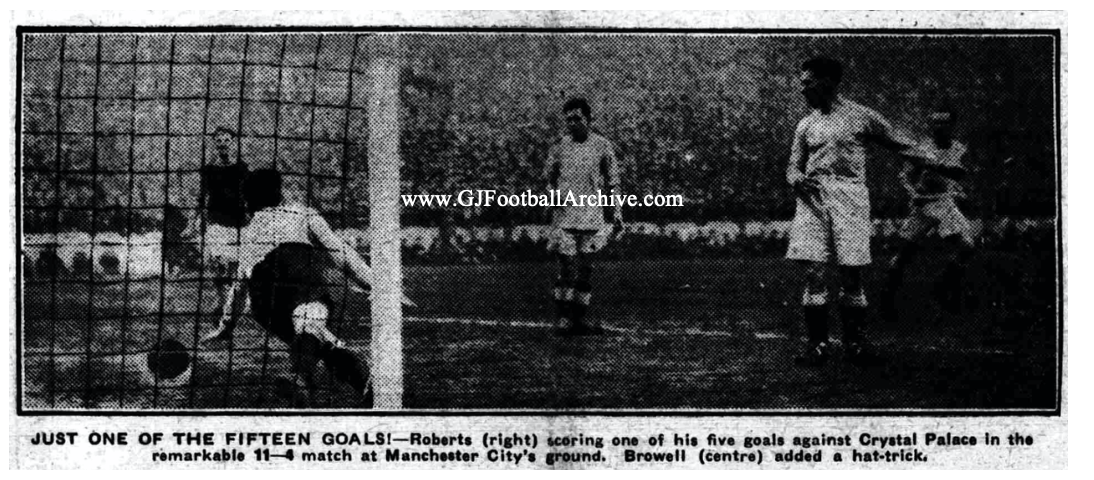
City hadn’t had a manager since November 1925 (believing instead that vice chairman Albert Alexander could lead the other directors in selecting the team) and were struggling in the League when the Blues played a FA Cup fifth round tie against Crystal Palace on 20 February 1926. The tie turned out to be a fifteen goal thriller with City in rampant form.
By half-time the score at Maine Road was 7-0 to the Blues, but Palace would not give up and quickly pulled back four goals. City were knocked out of their period of complacency and soon found their goalscoring touch again.
By the end it was 11-4 and, according to a number of spectators present on the day, Manchester fans rushed on at the final whistle and carried off the Palace ‘keeper Callendar shoulder high. It’s the sort of thing City fans would do back then! Apparently he had played extremely well and, somehow, managed to keep the score down, although one cannot help wondering if he’d have been given such a reception had the scores been reversed.
Frank Roberts was the City star for this particular game, scoring a remarkable five, while Tommy Browell also earned a few plaudits with his hat-trick. Browell had been ill for most of the week and had been unable to train.
With no management and such a miserable time in the League, no one could believe how City had been able to deliver such strong cup performances.
Remarkably, film of the game has survived and can be viewed here:
For post 76 of my Maine Rd 100 countdown a reminder of a day when over 74,000 watched managerless Manchester City at Maine Road. The image is of Frank Roberts, a City star that day. That day (30 January 1926) City faced Huddersfield Town in a FA Cup tie at Maine Road, watched by 74,799.
The following article, for subscribers to GJFootballArchive.com, provides the background story to the tie and film of the game.
Subscribe to get access – Annual
If you would like to view this article then please subscribe below. It works out about £1.67 a month if you take out an annual subscription (£20 per year) or £3 a month if you’d like to sign up for a month at a time (below). Annual subscribers get full access to the 1000+ articles posted so far and the hundreds scheduled to be posted in the coming weeks.
If you would like to view this article then please subscribe below. It works out about £1.67 a month if you take out an annual subscription (£20 per year, above) or £3 a month if you’d like to sign up for a month at a time (here). Monthly subscribers get full access to everything posted since 1 October 2022 and the hundreds scheduled to be posted in the coming weeks.
Day 59 of my posts counting down to the centenary of Maine Road’s opening game is the story of the day Celtic and Rangers played a game at Maine Road as a combined Glasgow XI. That day was the great City player Billy Meredith’s testimonial.
It was played on 29 April 1925 and saw a MEREDITH XI versus RANGERS & CELTIC XI.
A series of benefit matches and events were organised for Billy Meredith following his retirement in 1924, with this match being the most significant event. Somehow Meredith had convinced Rangers and Celtic to form one side to take on a team of Lancashire based players selected by Meredith himself. The Meredith side, playing in red and white, contained City favourites Frank Roberts and Charlie Pringle, plus of course Meredith, and former City star Horace Barnes – a Preston player at the time of the match. City’s legendary trainer Jimmy Broad trained the team.
The Glasgow side, playing in blue and white, contained five Celtic players – including Jimmy McGrory – and six Rangers men. Former City full-back Johnny McMahon was one of the linesmen, while the other was an ex-United star George Wall, who incredibly smoked a pipe throughout the match.
Meredith testimonial programme, as seen in From Maine Men To Banana Citizens by Gary James
According to the Manchester Evening Chronicle report: ‘Many old friendships were renewed at Maine Road on Wednesday night, and we all laughed at Meredith trying the old backheel to the half-back business with very little success. Incidentally the main image above is of Meredith a couple of years earlier with the Hyde Road ground in the background.
A few moments from the match, including the teams posing for photographs. The footage concentrates on Meredith pre-match, and also shows the Popular Side (later Kippax) and Platt Lane end. The camera was placed in front of the Platt Lane end, close to the goal for much of the action (Platt Lane is the stand numbered 4 & 5 in the image below, although that stand was still unroofed back in 1925).
If you enjoy all the free material on my website and would like to support my research and keep this website going (but don’t want to subscribe) then why not make a one-time donation (or buy me a coffee). All support for my research is valued and welcome. It allows me to keep some free material available for all. Thanks.
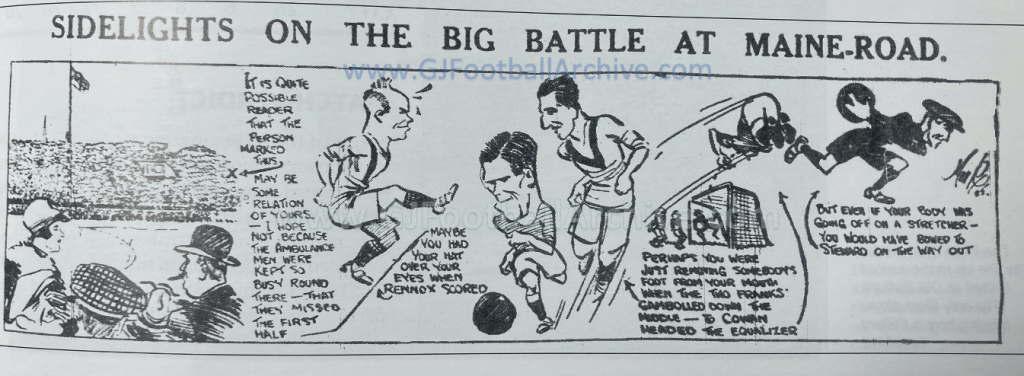
It’s day 35 of my posts counting down to the centenary of Maine Road’s opening game and today’s images are a reminder of the first Manchester derby played at Maine Road.
The game, played on 12 September 1925 (United had been in the Second Division when City first moved to Maine Road), saw City & United draw 1-1 before 66,000. This was at the time the highest Manchester derby crowd ever. It was later eclipsed with the record on a club ground being 78,000 (Maine Road). There have been higher at Wembley of course.
Sam Cowan scored for City and Clatworthy Rennox for United. Later this season the return derby at Old Trafford saw City win 6-1:
These images show Cowan’s goal and a drawing of the game’s highlights. Note the crowd references in the drawing.
Guess which game I’m going to cover tomorrow…. This was the first derby at Maine Road. Maybe it’s time to remember the last one?
For those unfamiliar with Maine Road this photo may help locate the end Cowan’s goal was scored at. In the days before the Popular Side (later Kippax) was roofed this was the goal mouth at the Platt Lane end (number 3/5) with the unroofed terracing beyond the players being located around number 8.
Maine Road aerial 1971 from Farewell To Maine Road
If you’d like to read more on the history of Maine Road, take a look at Farewell To Maine Road, which can be downloaded from this page:
If you enjoy all the free material on my website and would like to support my research and keep this website going (but don’t want to subscribe) then why not make a one-time donation (or buy me a coffee). All support for my research is valued and welcome. It allows me to keep some free material available for all. Thanks.
Tomorrow Manchester City face Arsenal in the League and there’s the possibility that national goalscoring records could be broken once again. A few weeks back I calculated that if Erling Haaland maintained a goal a game ratio in the remaining League fixtures for Manchester City he would better Tommy Johnson’s 38 goal tally by a goal. Since then Haaland, who is already City’s seasonal record scorer in all competitions, has indeed kept up that ratio – in fact he has surpassed it – and has now broken another barrier: 30 League goals in a season.
To celebrate this I’ve put together a feature comparing every player who has scored 30 goals or more for City, plus those Premier League goalscorers whose achievements could be bettered by Haaland this season. Here goes….
Subscribe to get access – Monthly
This article is available for subscribers. It costs £3 a month (here) or £20 a year (below) to access this and other articles on the site, including books, videos and 100s of articles. Why not try it for a month?
This article is available for subscribers. It costs £20 a year (here) to access this and everything else on the site, including books, videos and 100s of articles.
When Manchester City and Fulham these sides met on this day (6 April) at Easter 1928 City were fighting for promotion out of Division Two, while Fulham were desperate to avoid relegation. It was a Good Friday game and a crowd of 50,660 attended, though some reports claimed it was a 60,000 crowd (these were the days before Peter Swales though!).
The match was not as entertaining as other fixtures between the Blues and the Cottagers during this period, although the first few minutes suggested otherwise. The Daily Dispatch reporter explained: “Though they had a strong wind and sun against them, Manchester City opened the scoring in practically the first advance they made. Marshall taking a pass by Sharp almost from the flag on the half-volley and crashing it into the net.”
After 30 minutes Fulham went further behind when their left-back Barrett handled a shot from Marshall. Frank Roberts netted the resultant penalty. Ten minutes later McNab scored a consolation goal for Fulham.
In summary the Daily Dispatch claimed that the penalty – hotly disputed by Fulham – was the only significant difference between the sides (well it did end 2-1!).
Today (20 February) in 1926 Manchester City recorded an amazing victory. It was a fifth round FA Cup tie with Crystal Palace to Maine Road. The Blues, without a manager since November, were being managed by committee with director Albert Alexander senior making the final decisions. It’s an incredible thought that a director without ever being known as a player, could make these decisions but Alexander was a knowledgeable football man and had been with the club since formation in 1894.
By half-time the score was 7-0 to the Blues, but Palace would not give up and quickly pulled back four goals. City were knocked out of their period of complacency and soon found their goalscoring touch again. By the end it was 11-4 and, according to a number of spectators present on the day, Manchester fans rushed on at the final whistle and carried off the Palace ‘keeper shoulder high. Apparently he had played extremely well and, somehow, managed to keep the score down, although one cannot help wondering if he’d have been given such a reception had the scores been reversed.
Frank Roberts was the City star for this particular game, scoring a remarkable five, while Tommy Browell also earned a few plaudits with his hat-trick. With no management and such a miserable time in the League, no one could believe how City had been able to deliver such strong cup performances. Here’s film of the game:
On this day (17 January) in 1925 Manchester City’s Frank Roberts scored four as Liverpool were defeated 5-0 in Division One.
Roberts’ feat was remarkable because he was playing as centre-forward (a position he seemingly was not keen on playing) due to regular centre-forward Tommy Browell being struck down with influenza.
He normally played as City’s inside-right, his preferred position.
It was Roberts’ first outing as centre-forward that season and it was the first time he’d ever scored four in a game. It made him the League’s top scorer with 24 goals so far that season.
City’s opening goal had been scored by legendary, amateur footballer Max Woosnam in the opening minute. Sadly, accurate time keeping was not a feature of football then (some would argue that some referees still don’t have accurate time keeping but that’s for another day) and so we don’t know how few seconds this was actually netted in. Some reports say straight from the kick-off.
The Liverpool Echo talked of the game starting in a gale which worked against the Liverpool club (some local newspapers still make excuses for their teams). The Athletic News makes no such comment preferring, instead, to talk of City’s ‘lightening like movements’ and their approach being ‘the way to win’.
Subscribe to get access
This was just a taster of the content in GJFootballArchive.com. If you would like to read the in-depth, longer articles (including the entire Manchester A Football History book and From Maine Men To Banana Citizens) then please subscribe. It works out about £1.67 a month if you take out an annual subscription (£20 per year, here) or £3 a month (below) if you’d like to sign up for a month at a time. Annual subscribers get full access to everything posted on the site.
City hadn’t had a manager since November and were struggling in the League when the Blues played a FA Cup fifth round tie against Crystal Palace on this day (20th February) in 1926. The tie, played at Maine Road turned out to be a fifteen goal thriller with City in rampant form.
By half-time the score was 7-0 to the Blues, but Palace would not give up and quickly pulled back four goals. City were knocked out of their period of complacency and soon found their goalscoring touch again.
By the end it was 11-4 and, according to a number of spectators present on the day, Manchester fans rushed on at the final whistle and carried off the Palace ‘keeper Callendar shoulder high. Apparently he had played extremely well and, somehow, managed to keep the score down, although one cannot help wondering if he’d have been given such a reception had the scores been reversed.
Frank Roberts was the City star for this particular game, scoring a remarkable five, while Tommy Browell also earned a few plaudits with his hat-trick. Browell had been ill for most of the week and had been unable to train.
With no management and such a miserable time in the League, no one could believe how City had been able to deliver such strong cup performances.
Remarkably, film of the game has survived and can be viewed here: