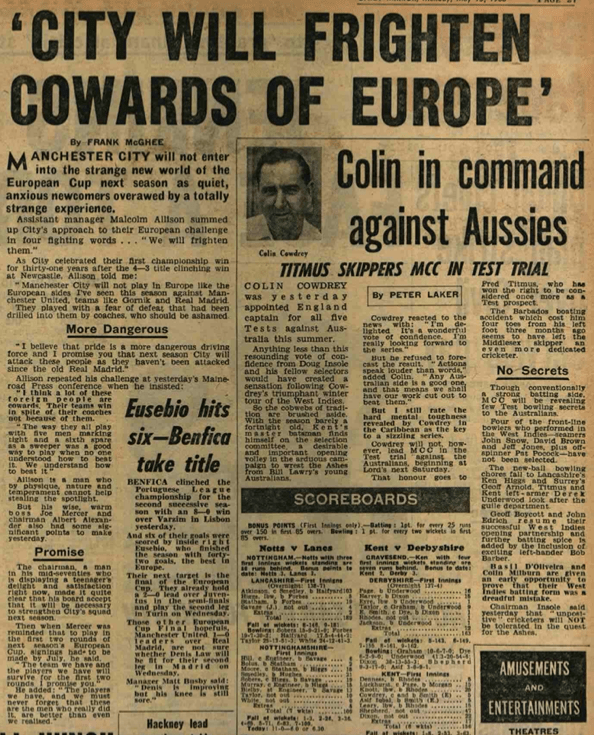
This article from January 1964 is a reminder of a time when domestic competition took priority over European competition. Back then the Football League was able to tell its clubs to move a European Cup quarter final if it clashed with a League Cup game in the same city. The matter was brought to a head when United, due to play a European tie at Old Trafford, were told to move that game as City were planning on playing a League Cup semi final on the same night. It’s unlikely a similar decision would be made today of course.
You can find out more on Manchester City during the 1963-64 season below. If you’d like to read this 1700 word article, plus all other articles on the site, then please subscribe (see below). As with most of the other features in this series it includes words from interviews I have performed with those who were there.
Subscribe to get access
Read more of this content when you subscribe today. It costs £3 per month (cancel anytime) or sign up for a year at the discounted price of £20 per year (works out £1.67 per month). Subscribers access the 1000+ articles posted so far and the others scheduled during the life of your subscription.
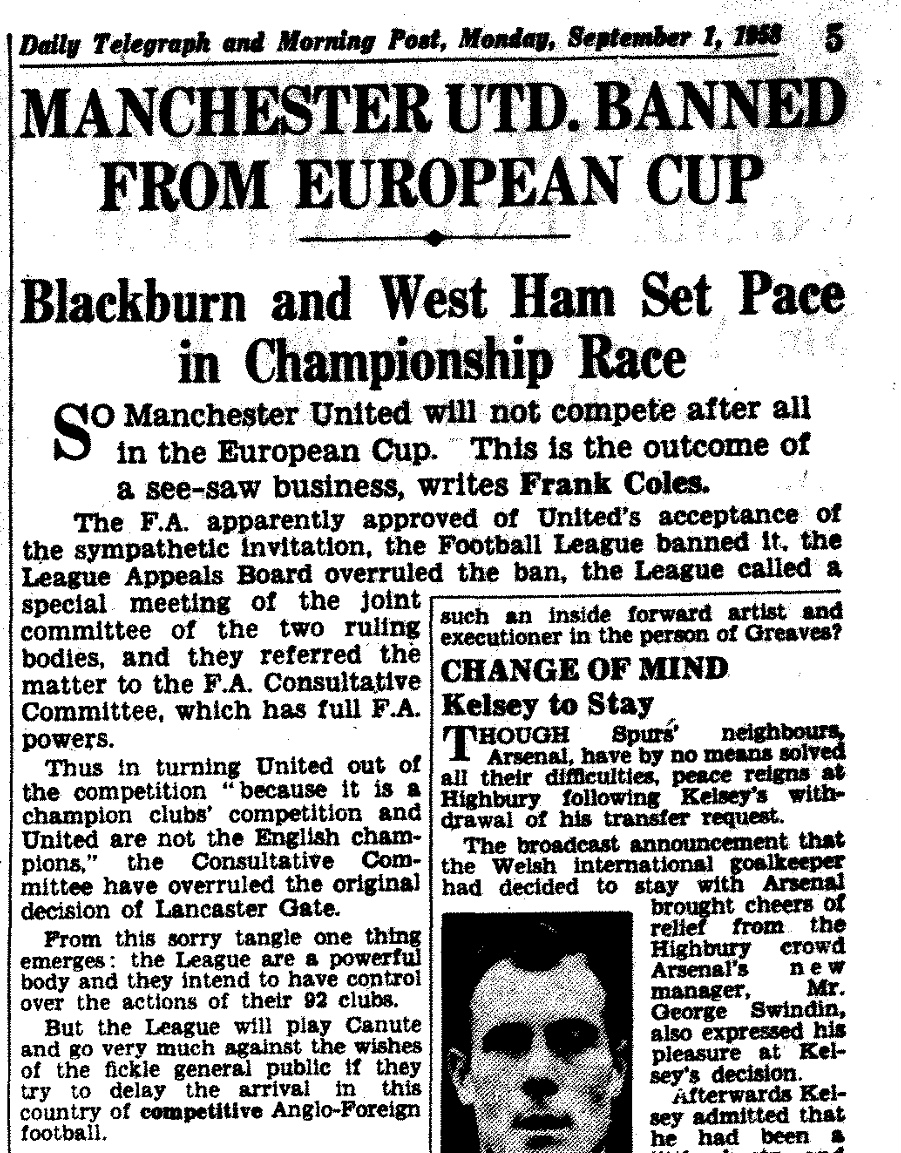
On this day (1 September) in 1958 it was revealed that Manchester United were to be prevented from taking a special place that had been awarded to them in the European Cup. UEFA had offered United the place as a mark of sympathy following the Munich Air Crash and the FA had approved the move but then discussions within the League proved problematic, leading to the Football League banning the move.
This cutting even quotes an unnamed official who basically said the European Cup is for champions and United ‘are not the English champions.’ It was all a mess and distasteful.
To understand the full story/impact of the Munich Air Disaster and how it affected all of Manchester then have a read of this:
Each year, following the end of the UEFA football season I update the UEFA European Span of Success table. What is this? It’s a list of those clubs who have won two or more major UEFA tournaments showing the span between their first UEFA success and their most recent. The list may surprise some who think that football is all about those perceived as European giants with ‘history’.
The table hasn’t really changed much from last year as Real Madrid were Champions League winners. Atalanta, who won the Europa League, and Olympiacos (Conference winners) have only won one major European trophy and so they do not yet make it on to the list of multiple winners:
European Span of success 2024
The ‘history’ ‘no history’ thing really irritates me. All clubs have history and even when that’s recognised some still go on about history as if it started in 1992, 1999 or 2008 etc. depending on whether your club was successful or your rivals were failing. The two highest placed English teams are West Ham and Manchester City, who both found major European success before some of those clubs recognised today as Europe’s elite.
Obviously, this table does not show the number of major trophies won, but it does give an indication of trophy winning longevity for those who obsess on ‘my cup’s bigger than yours’ and similar debates. Personally, I think we should all be proud of our club’s achievements and not worry about what a rival has won.
West Ham have the second longest span of all Europe’s clubs and City have the fourth equal. Nice work Hammers and Blues!
The above table includes the four major UEFA tournaments: European Cup/Champions League; European Cup Winner’s Cup; UEFA Cup/Europa League & the Europa Conference League. It does not include non-UEFA tournaments such as the Mitropa Cup and Fairs Cup. Nor does it include the Intertoto Cup or similar.
I’m sure some will say but why aren’t the Mitropa or Fairs Cups in there? It’s a good point but these were not UEFA tournaments, though I recognise that the Mitropa Cup had some significant clubs competing in it. It was predominantly an East European competition and participants were not spread over the entire continent.
With the Fairs Cup… It is true that this was later transformed into the UEFA Cup and I have included all UEFA Cup finals in my analysis. But the Fairs Cup had an odd series of entry rules at times. Cities, rather than clubs, often entered with Barcelona beating London in one final for example. It was set up as a friendly type of competition with cities that had staged trade fairs playing each other. As time wore on entry came via the League Cup or League position in England, which added significance to it. But two teams from the same city were not allowed to participate, which meant that teams finishing way down the table could be (and were) included if those above them were multiple clubs from the same city.
In 1970 Manchester City’s Mike Doyle joked that by winning the League Cup he was satisfying his aim of ‘keeping United out of Europe’ (he joked about creating car stickers with that slogan!) because it appeared at that time that United’s only chance of Europe had gone with City’s qualification for the Fairs Cup.
1970 ECWC
City went on to win the ECWC that season, meaning that Fairs Cup place was opened up to League position, but United had finished lower down the table anyway and qualified for the Watney Cup instead. Actually, the Watney Cup is one worth talking about, but I’ll save that for another day. In 1970 Fourth placed Derby County qualified for the Watney Cup, while 5th to 7th (Liverpool, Coventry and Newcastle) all got a Fairs Cup place, alongside 12th placed Arsenal (Fairs Cup winners). I’ve not investigated this fully but it does seem odd that the Watney Cup took precedence over the Fairs Cup.
Arsenal’s 1970 Fairs Cup success was their first European trophy but is not included in the span, neither are those Fairs Cup wins of Barcelona. However, as quite a few Arsenal fans seemed to get a bit upset when the table was posted last year I’ve decided to include the Fairs Cup in the following version of the table. So this table is the winners of the main UEFA competitions I mentioned earlier plus the Fairs Cup with its odd rules:
European Span of success 2024 including Fairs Cup
Hopefully, those Arsenal fans who were somewhat upset last year will now be happy. Note that West Ham have now been overtaken by Roma and that Barcelona are now above Manchester City, Bayern & Atletico Madrid. Both ‘Rome’ and ‘Barcelona’ won the Fairs Cup when it was city based and not club based.
Arsenal are now 18th in this combined table, behind their fellow English clubs West Ham, City, Chelsea, United and Liverpool.
As an example of the odd qualification rules in place for the Fairs Cup at times it’s worth looking at the 1969 qualification via the English League system.
In 1969 champions Leeds entered the European Cup. The ECWC place went to FA Cup winners Manchester City and the Fairs Cup places went to: Arsenal (4th), Southampton (7th) and Newcastle (9th). Swindon had won the League Cup, beating Arsenal in the final, but the Fairs Cup organisers wouldn’t allow them to participate as they were not a top flight club! This adds to the reason the competition is usually excluded. It is certainly not a UEFA competition in any case.
Similarly, Everton (3rd), Chelsea (5th), Spurs (6th) and West Ham (8th) who all finished above Newcastle were denied because of the rule that only one club from each city be allowed. So Liverpool and Arsenal’s inclusion meant their rivals stood less chance of winning the trophy than Newcastle simply because there were multiple clubs in their cities.
That rule does make me wonder what would have happened if both Manchester clubs had qualified for the competition as City are within the city of Manchester boundaries and United are not. Would the two clubs have challenged any decision not to include one of them based on the age old argument of Manchester’s boundaries?
Maybe I’ll post more on the odd rules of football competitions and tell the story of some of those long forgotten competitions.
If you’re interested in the wider span of success for English clubs (listing those who have the longest span between their first trophy and most recent, not simply European trophies) then take a look at this (Manchester City are second):
If you enjoy all the free material on my website and would like to support my research and keep this website going (but don’t want to subscribe) then why not make a one-time donation (or buy me a coffee). All support for my research is valued and welcome. It allows me to keep some free material available for all. Thanks.
On this day (18 September) in 1968 Manchester City’s first European Cup fixture against Fenerbahce ended goalless at Maine Road. This was the first time two British clubs from the same city had competed in the European Cup. Here’s a match report of the City game:
Francis Lee (left) and Mike Summberbee (right) threaten the Fenerbahce goal in City’s first European Cup tie in 1968.
Subscribers can read a feature about that game here:
Subscribe to get access – Monthly
This article is available to subscribers. It costs £3 per year (cancel anytime) to subscribe and monthly subscriver get full access to all the articles, interviews and books published since 1 October 2022. There’s also a special annual option (see below).
This article is available to subscribers. It costs £20 a year (£1.67 per month) to subscribe and for that you get full access to all the articles, interviews and books already published since the site was created in December 2020 and throughout your subscription.
Following Sevilla’s, West Ham’s and Manchester City’s successes in major UEFA competition this season I’ve updated the UEFA European Span of Success table. What is this? It’s a list of those clubs who have won two or more major UEFA tournaments showing the span between their first UEFA success and their most recent. The list may surprise some who think that football is all about those perceived as European giants with ‘history’.
The ‘history’ ‘no history’ thing really irritates me. All clubs have history and even when that’s recognised some still go on about history as if it started in 1992, 1999 or 2008 etc. depending on whether your club was successful or your rivals were failing. Both West Ham and Manchester City found major European success before some of those clubs recognised today as Europe’s elite and while this table does not show the number of major trophies won, it does give an indication of trophy winning longevity for those who obsess on ‘my cup’s bigger than yours’ and similar debates. Personally, I think we should all be proud of our club’s achievements and not worry about what a rival has won.
West Ham have the second longest span of all Europe’s clubs and City have the fifth. Nice work Hammers and Blues!
Anyway, here’s the table showing all those with two or more successes:
European span of success 2023, showing EC/CL, ECWC, UEFA/Europa & Europa Conference
The table includes the four major UEFA tournaments: European Cup/Champions League; European Cup Winner’s Cup; UEFA Cup/Europa League & the Europa Conference League. It does not include non-UEFA tournaments such as the Mitropa Cup and Fairs Cup. Nor does it include the Intertoto Cup or similar.
I’m sure some will say but why aren’t the Mitropa or Fairs Cups in there? It’s a good point but these were not UEFA tournaments, though I recognise that the Mitropa Cup had some significant clubs competing in it. It was predominantly an East European competition and participants were not spread over the entire continent.
With the Fairs Cup… It is true that this was later transformed into the UEFA Cup and I have included all UEFA Cup finals in my analysis. But the Fairs Cup had an odd series of entry rules at times. Cities, rather than clubs, often entered with Barcelona beating London in one final for example. It was set up as a friendly type of competition with cities that had staged trade fairs playing each other. As time wore on entry came via the League Cup or League position in England, which added significance to it. But two teams from the same city were not allowed to participate, which meant that teams finishing way down the table could be (and were) included if those above them were multiple clubs from the same city.
In 1970 Manchester City’s Mike Doyle joked that by winning the League Cup he was satisfying his aim of ‘keeping United out of Europe’ (he joked about creating car stickers with that slogan!) because it appeared at that time that United’s only chance of Europe had gone with City’s qualification for the Fairs Cup.
1970 ECWC
City went on to win the ECWC that season, meaning that Fairs Cup place was opened up to League position, but United had finished lower down the table anyway and qualified for the Watney Cup instead. Actually, the Watney Cup is one worth talking about, but I’ll save that for another day. In 1970 Fourth placed Derby County qualified for the Watney Cup, while 5th to 7th (Liverpool, Coventry and Newcastle) all got a Fairs Cup place, alongside 12th placed Arsenal (Fairs Cup winners). I’ve not investigated this fully but it does seem odd that the Watney Cup took precedence over the Fairs Cup.
Arsenal’s 1970 Fairs Cup success was their first European trophy but is not included in the span, neither are those Fairs Cup wins of Barcelona. As an example of the odd qualification rules at times it’s worth looking at the 1969 qualification via the English League system.
In 1969 champions Leeds entered the European Cup. The ECWC place went to FA Cup winners Manchester City and the Fairs Cup places went to: Arsenal (4th), Southampton (7th) and Newcastle (9th). Swindon had won the League Cup, beating Arsenal in the final, but the Fairs Cup organisers wouldn’t allow them to participate as they were not a top flight club! This adds to the reason the competition is not included.
Similarly, Everton (3rd), Chelsea (5th), Spurs (6th) and West Ham (8th) who all finished above Newcastle were denied because of the rule that only one club from each city be allowed. So Liverpool and Arsenal’s inclusion meant their rivals stood less chance of winning the trophy than Newcastle simply because there were multiple clubs in their cities.
That rule does make me wonder what would have happened if both Manchester clubs had qualified for the competition as City are within the city of Manchester boundaries and United are not. Would the two clubs have challenged any decision not to include one of them based on the age old argument of Manchester’s boundaries?
Maybe I’ll post more on the odd rules of football competitions and tell the story of some of those long forgotten competitions.
If you enjoy all the free material on my website and would like to support my research and keep this website going (but don’t want to subscribe) then why not make a one-time donation (or buy me a coffee). All support for my research is valued and welcome. It allows me to keep some free material available for all. Thanks.
Congratulations Manchester City. So many thoughts, emotions and memories this weekend as the Blues won the Champions League for the first time. In one of those wonderful coincidences of fate it’s significant that City’s first ever European Cup away game was against a team from Istanbul (Fenerbahce) in 1968 and that the trophy was finally won there almost 55 years later.
If you’ve not seen it before have a look at City goalkeeper Harry Dowd’s cine film from 1968 and that first European Cup trip. Will McTaggart and I were grateful to Harry’s family when they loaned this to the North West Film Archive for preservation and copying. We were able to show some of it (and Harry’s other films) in our Boys in Blue film show a few years back. So many of the sites will be familiar but so much has changed too.
I was only a baby when City first competed in Istanbul but now, as a grown adult with adult children of my own, I was able to experience the final in the flesh. Nothing beats that!
It has been a wonderful journey over these decades. I was born at a time when Manchester City were a power. A major club with a significant trophy-winning pedigree and glamour. They were one of Europe’s finest and they won their first major European trophy in 1970 (the European Cup Winners’ Cup – at the time UEFA’s second most important competition).
1970 ECWC
In my life City have now won: 1 European Cup, 1 ECWC, 8 League titles, 4 FA Cups and 8 League Cups but it’s not been easy.
People will talk about investment and money and, like the majority of trophy-winning clubs, that has happened of course. But there’s also been considerable years of under-investment, of people benefiting from the club in terms of prestige, status and personal finance, and not putting anything back.
The City that was swashbuckling and winning trophies of my early childhood was cast aside by those running my club. They allowed others to seize the initiative – In the 1970s City won three times as many trophies as United; by the time I was 15 City had not spent any time during my life outside the top flight (United had) and remained the 3rd best supported club; When I was 25 City were still the last Manchester side to win the League… I could go on my club was downgraded by those in charge during the late 1970s & 1980s who placed a club that had been profitable into one that was in debt with a stadium that was needing investment. They treated some injured players, like Paul Lake, appallingly. Penny-pinching all the way while they had their ‘status’.
A shock relegation in 1983, exacerbated by the penny-pinching and debts being piled on (oh, and some directors then buying up large numbers of shares at low prices which they would later profit enormously from!), meant City were starting to fall behind.
Our chairman Peter Swales appeared on TV often saying things like: ‘You can’t plan in football. You take every game, every week and every season as it comes.’ How we all thought ‘you’re the top man, if you’ve got no plan – any plan – we’re doomed!’
Youth development helped City compete at the end of the 80s and early 90s, finishing 5th two years running and building for a positive future. Then our directors messed it all up with managerial changes and a takeover was launched by former hero Francis Lee. After a bitter battle, which also split our supporters club, Lee gained control but the club had been badly managed and was in a worse state than he’d expected. A new stand had to be built (the old board’s ‘plan’ was going to include some plastic seats being bolted on to the old Kippax terracing – that’s the kind of forward looking ‘plan’ those guys specialised in!) and the club’s merchandising set-up meant that individuals gained more than the club. There appeared to be lots of ‘dodgy’ contracts issued during the final weeks of the old board’s reign if the material Lee showed me several years back is correct.
Lee made a massive mistake – appointing Alan Ball as manager – and after that the playing side collapsed and the real fall from grace followed. The Swales days had robbed the club of its assets and then we fell. Thankfully, David Bernstein, Chris Bird, David Makin and John Wardle, plus supporting figures like Dennis Tueart and Alastair Mackintosh, saved the club and the rebirth happened. I would like to stress though that City were only out of the PL from 1996 to 2000 and then again 2001-02. Five years and only one of which was in the third tier, so when people talk about City as coming from the 3rd tier that’s true but it was not the club’s normal position – that was as a leading top flight team.
The years 1983 to 2002 were the ones out of character (in general) with the club’s 143 year history, not 2008 onwards – though these are now incredibly special times at a level not experienced before despite the success the club has previously enjoyed.
Since 2002 City have been a Premier League club once more and then of course there’s the investment from 2008 which has not only got City back to a period of strength within the game that it held when I was a toddler, but those in charge have planned and grown the club to a level never before seen. Their planning and direction – evidenced from day one – has taken City to a new height. People will talk about money but if it was just about money then why didn’t the club find League success 2 years after being purchased like Chelsea did? Or reach a CL final within 5 years like Chelsea did? This was never just about money. It was about planning and changing the way football clubs operate for the long term.
All these years after the investment City have finally found European success at the highest level and it’s incredible. It has been a long journey from Istanbul to Istanbul.
On this day (18 September) in 1968 Manchester City’s first European Cup fixture against Fenerbahce ended goalless at Maine Road. You can read about that game here:
Subscribe to get access – Monthly
This article is available to subscribers. It costs £3 per year (cancel anytime) to subscribe and monthly subscriver get full access to all the articles, interviews and books published since 1 October 2022. There’s also a special annual option (see below).
This article is available to subscribers. It costs £20 a year (£1.67 per month) to subscribe and for that you get full access to all the articles, interviews and books already published since the site was created in December 2020 and throughout your subscription.
Manchester City at Sporting tonight… The great coach Malcolm Allison was a major trophy winner at both clubs, so here’s a feature on Allison’s Manchester City career with particular emphasis on his boasts, and City’s first European days for the Blues.
This article is available to subscribers to this site. If you’re not a subscriber, do a few searches on here and see what content is already on my site. This includes audio interviews with John Bond and others, plus the entire contents of two of my books.
Subscribe to get access
Read more of this content when you subscribe today.



 Gary James' Football Archive