Continuing the series of features on the 1960s, here’s a subscriber article on Manchester City during the 1960-61 season. If you’d like to read this 1200 word article, plus all other articles on the site, then please subscribe (see below).
Subscribe to get access
Read more of this content when you subscribe today. It costs £3 per month (cancel anytime) or sign up for a year at the discounted price of £20 per year (works out £1.67 per month). Subscribers access the 1000+ articles posted so far and the others scheduled during the life of your subscription.
There’s a lot of furore this week about Manchester City’s decision to wear their new Oasis inspired kit instead of their home kit for their Champions League game with Inter Milan. Lots are talking about tradition, heritage and the like, so I thought I’d add a few words here that might have been overlooked or forgotten. So here goes…
Firstly, my position is clear that I’ve always been keen to see City wear home colours/blue for every fixture possible (whether home, away or at a neutral venue) but I’m a pragmatist and know that’s no longer likely. History and tradition does mean something but of course, when it comes to football, traditions change frequently. People may think City have only ever worn a particular colour at home or that the traditional away colours are red & black but these things are not true. Times change.
When it comes to wearing alternative kits at home it has been done more often than perhaps people realise. In fact the only decade when it hasn’t happened appears to be the 2010s – I say appeared because I haven’t got evidence of every home game in the 1890s and 1900s!
These last few days have caused some to recall the Middlesbrough game when David James went up front and the two Tottenham games at Maine Road in 80s/90s when the referee felt the kits were too close and City ended up changing. But there have been many other occasions. In fact it’s well over 100 years since City first chose to wear away colours/alternative strips at home when they didn’t need to!
The image above of Neil Young comes from the 1971 ECWC semi-final v Chelsea. Notice that Young is wearing City’s away colours.
Often when there was a clash of colours in a cup game City would wear their away strip. Games in the 1920s right through to 1970s saw the Blues don maroon, red/black and even scarlet at times at Maine Road.
Here’s another image from that Chelsea semi final:
1971 ECWC v Chelsea. Francis Lee. Photo by Alan Jubb
To the right you can see the North Stand under construction, as you can in the Young image.
Other games in living memory (not necessarily mine, but living memory for many older blues) include:
January 1971 – City v Wigan in FA Cup (red & black)
September 1970 – City v Bologna in Anglo-Italian Cup (red & black)
January 1968 – City v Reading in FA Cup (all maroon)
March 1966 – City v Everton in FA Cup (all maroon)
March 1966 – City v Leicester in FA Cup (all maroon)
March 1956 – City v Everton in FA Cup (maroon shirts, white shorts)
In earlier decades City often chose to wear an away shirt for cup ties where there was a clash. Prior to 1921 the FA rule was that home teams would have to change if there was a clash.
In March 1924 City chose to wear a kit they described as ‘Lucky scarlet’ for a FA Cup tie with Cardiff at Maine Road. So for well over 100 years City have often chosen to wear alternative kits at home instead of traditional blue when they didn’t need to.
Personally, I’d still prefer City to always wear blue no matter where they play, but that’s never going to happen anyway.
Incidentally, if you’d like to read more on the history of Maine Road, take a look at Farewell To Maine Road, which can be downloaded from this page:
If you enjoy all the free material on my website and would like to support my research and keep this website going (but don’t want to subscribe) then why not make a one-time donation (or buy me a coffee). All support for my research is valued and welcome. It allows me to keep some free material available for all. Thanks.
The latest International Football History Conference will be staged in two weeks time at Cardiff City’s stadium. Delegates from around the world will meet up to discuss football (of all codes). It’s always a great conference and it’s a great opportunity to meet other historians, writers, researchers and enthusiasts. The details are:
International Football History Conference 2024 (#Footycon24)
7 & 8 June 2024 at Cardiff City Football Club
Guest speaker: Professor Florence Ayisi (film maker of Zanzibar Soccer Queens & others)
The 2024 annual International Football History Conference will take place at Cardiff City F.C. and will be held over two days (7 & 8 June 2024). There will be a fantastic collection of papers being presented with contributions from leading academics from across the globe including many leaders in their field, as well as early career researchers and others with a passion for football (of all codes) research.
The conference organisers are: Max Portman, University of Chichester, Professor Wray Vamplew, University of Edinburgh and Dr. Gary James, Visiting Research Professor at New York University & Honorary Research Fellow at De Montfort University.
Gary James: ‘The inaugural International Football History Conference was staged in 2017 and proved popular with leading academics, early career researchers, football historians and students. That was followed in 2018 & 2019 by further enjoyable conferences. Covid meant we had to cancel our 2020 & 2021 conferences but, in 2022 we returned with another great conference. In 2023 we took the conference to Glasgow and the historic Hampden Park Stadium, which added further to its status. This year we’re taking it to Wales for the first time and are delighted to be staging it at Cardiff City’s home. This year’s event promises to be another significant conference with world leading research presented, while also providing networking opportunities, as well as the potential for collaborations.’
**** THE TITLES OF PRESENTATIONS ARE DOCUMENTED BELOW ****
The conference will run from Friday morning c.08.30 and end on Saturday about 18.00. There is anticipated to be social gatherings on both Thursday 6 June for those arriving the day before the conference and one on the evening of Friday 7 June.
COST OF ATTENDANCE £139 (delegates in employment) and £129 (students/unwaged/retired delegates). Held at Cardiff City FC 08:30 to 18:00 on both days. You can book here:
In 2022 & 2023 we added a special day rate for those who can only attend on one day and we’re doing that again this year for those who can only attend on one day. The day rate is £76 (delegates in employment) and £67.50 (students/unwaged/retired delegates).
Delegates will need to make their own arrangements regarding accommodation & travel for the conference. We hope to have a social gathering on Friday evening in central Cardiff. If you would like some advice on where to stay please contact the organisers via footycon@outlook.com
As with previous years there will be awards in connection with papers presented. Routledge will be providing these for a daily Best Paper Award and for a new inclusivity award.
Here is a draft list of presenters and topics (the timings and specific details will folllow):
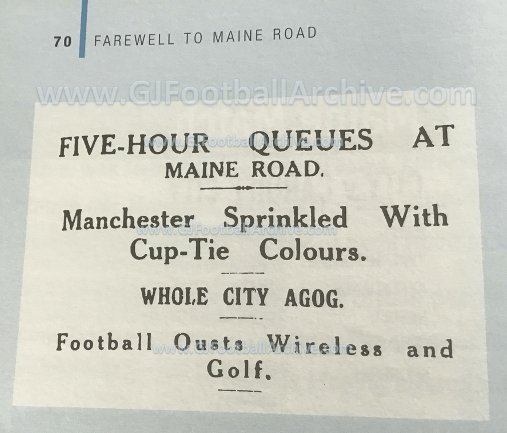
Today (8 March) marks the centenary of a record Manchester City set on this- the record is the highest attendance on a club ground! Happy 100th anniversary! The record set in 1924 saw 76,166 attend City v Cardiff. City had moved to their new Maine Road stadium in August 1923. The capacity of the venue was estimated at around 90,000 but was actually approximately 83,000 when the stadium opened (it was enlarged in 1931 and 1935).
In its first season the capacity was tested and, on this day (8 March) in 1924 the largest attendance for any footballing fixture (including three FA Cup Finals) in Manchester gathered to watch the Blues. This was also, at the time, the record crowd for any game played on an English club ground. It was beaten ten years later when 84,569 watched City v Stoke – so It’s 100 years of this record for the Blues!
You can read about the remarkable day in 1924 below:
Subscribe to get access
Read more of this content when you subscribe today. It costs £20 a year (access to everything) or £3 per month (see below).
Read more of this content when you subscribe today. It costs £20 a year (see above) or £3 per month (cancel anytime; access to everything posted since 1 October 2022).
This has been a sample of the material on http://www.GJFootballArchive.com If you would like to read all the in-depth articles (including the entire Manchester A Football History book and the audio interview with John Bond) then please subscribe. It works out about £1.67 a month if you take out an annual subscription (£20 per year) or £3 a month if you’d like to sign up for a month at a time. Each subscriber gets full access to the 260+ articles posted so far and the hundreds scheduled to be posted in the coming weeks.
For post 77 in my Maine Rd 100 countdown a reminder of a record City have held for almost a century! This image is of a day in 1924 when City attracted the highest crowd on a club ground. The drawing is looking from the Main Stand towards the Popular Side, later Kippax. It’s no longer the record attendance because it was beaten by another record crowd at Maine Rd a decade later. Want to know more? The read on…
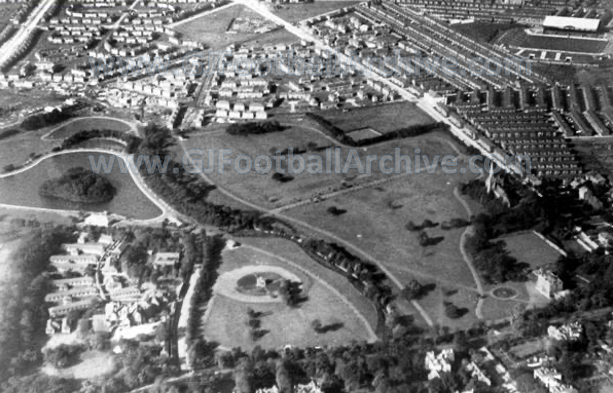
1925 Aerial photo of Maine Road and Platt Fields Park
A record Manchester City have held for 99 years was set on 8 March in 1924 – the record is the highest attendance on a club ground! The record set in 1924 saw 76,166 attend City v Cardiff. City had moved to their new Maine Road stadium in August 1923. The capacity of the venue was estimated at around 90,000 but was actually approximately 83,000 when the stadium opened (it was enlarged in 1931 and 1935).
In its first season the capacity was tested and, on that day (8 March) in 1924 the largest attendance for any footballing fixture (including three FA Cup Finals) in Manchester gathered to watch the Blues. This was also, at the time, the record crowd for any game played on an English club ground. It was beaten ten years later when 84,569 watched City v Stoke. You can read about the remarkable day in 1924 below:
Subscribe to get access
Read more of this content when you subscribe today. It costs £20 a year (access to everything) or £3 per month (see below).
Read more of this content when you subscribe today. It costs £20 a year (see above) or £3 per month (cancel anytime; access to everything posted since 1 October 2022).
This has been a sample of the material on http://www.GJFootballArchive.com If you would like to read all the in-depth articles (including the entire Manchester A Football History book and the audio interview with John Bond) then please subscribe. It works out about £1.67 a month if you take out an annual subscription (£20 per year) or £3 a month if you’d like to sign up for a month at a time. Each subscriber gets full access to the 260+ articles posted so far and the hundreds scheduled to be posted in the coming weeks.
After a glittering career with Preston, Everton and Liverpool, striker David Johnson joined Manchester City on this day (21 March) in 1984. Johnson scored on his City debut – an 83rd minute equaliser v Cardiff in a game the Blues went on to win 2-1 (Image is of that goal). Unfortunately, despite a reputation as a lethal striker – and hard evidence of achievement – Johnson’s time at Maine Road was not particularly successful. After one goal in four (plus two as substitute) games Johnson moved to play soccer in North America in May 1984.
Johnson died in November 2022 and the following piece was written by Samuel Meade and published in the Mirror:
A record Manchester City have held for 99 years was set on this day (8 March) in 1924 – the record is the highest attendance on a club ground! Happy anniversary! The record set in 1924 saw 76,166 attend City v Cardiff. City had moved to their new Maine Road stadium in August 1923. The capacity of the venue was estimated at around 90,000 but was actually approximately 83,000 when the stadium opened (it was enlarged in 1931 and 1935).
In its first season the capacity was tested and, on this day (8 March) in 1924 the largest attendance for any footballing fixture (including three FA Cup Finals) in Manchester gathered to watch the Blues. This was also, at the time, the record crowd for any game played on an English club ground. It was beaten ten years later when 84,569 watched City v Stoke. You can read about the remarkable day in 1924 below:
Subscribe to get access
Read more of this content when you subscribe today. It costs £20 a year (access to everything) or £3 per month (see below).
Read more of this content when you subscribe today. It costs £20 a year (see above) or £3 per month (cancel anytime; access to everything posted since 1 October 2022).
This has been a sample of the material on http://www.GJFootballArchive.com If you would like to read all the in-depth articles (including the entire Manchester A Football History book and the audio interview with John Bond) then please subscribe. It works out about £1.67 a month if you take out an annual subscription (£20 per year) or £3 a month if you’d like to sign up for a month at a time. Each subscriber gets full access to the 260+ articles posted so far and the hundreds scheduled to be posted in the coming weeks.
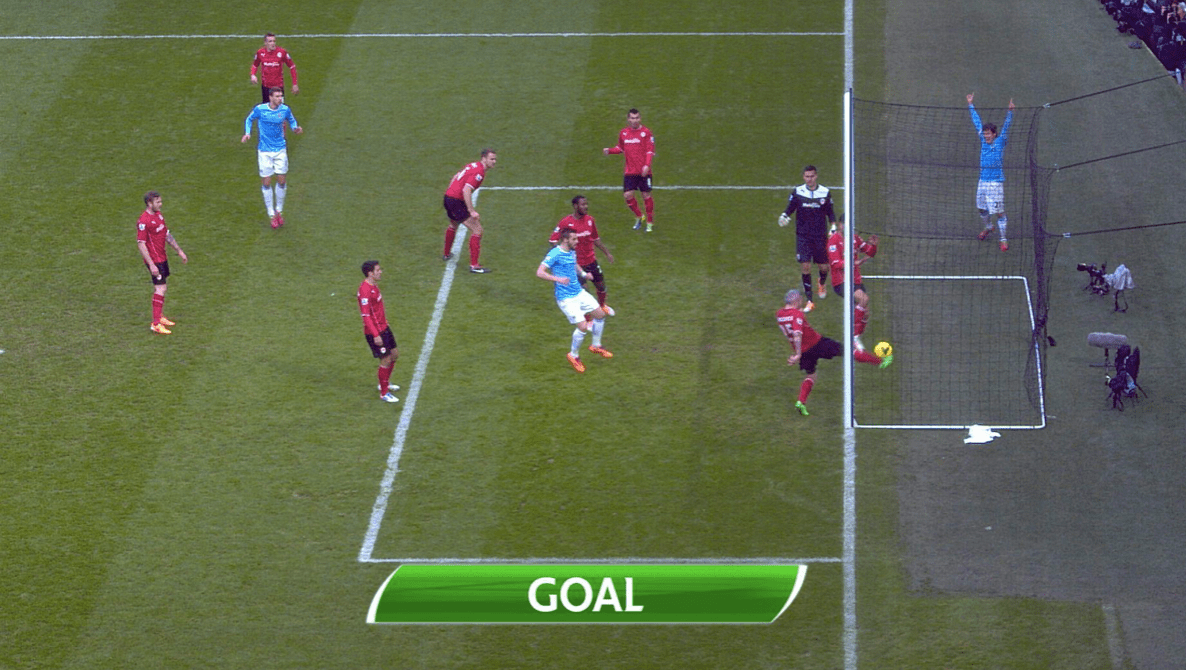
On this day (18th January) in 2014 Edin Dzeko netted Manchester City’s 100th competitive goal of the 2013-14 season.
The goal was City’s opener against Cardiff and was also the first Premier League goal to be awarded after the use of goal line technology. The Blues became the fastest team in history to reach 100 goals.


 Gary James' Football Archive