Attendance: 30,495; City 0 United 1 (first Charity Shield match between the sides)
The Champions beat the Cup holders under floodlights with a goal from local lad Dennis Violet. United are the better side while City seem a little pedestrian. Charity is much in evidence, however, as the Reds are allowed to replace ‘keeper Wood with their reserve David Gaskell when injury strikes.
On this day (13 October) in 2002 Fifties goalscoring star Billy McAdams died. During his Manchester City career he made 134 first team appearances and scored 65 goals. He had joined City on 6 December 1953 and on 2 January 1954 McAdams, signed from Distillery, made his debut. It was a memorable one as he scored an equaliser in the 49th minute against Sunderland at Maine Road. The game was played in poor, foggy conditions but City won.
A week after the Sunderland game, McAdams scored a hat-trick in City’s 5-2 Cup win at Bradford. He followed that with an equaliser in the 56th League derby match at Old Trafford. His arrival and goalscoring streak was viewed as refreshing that season..
I’ll be writing a little bit more on McAdams in my article in the Manchester City match programme v Brighton next week.
Over the last couple of years, usually when there’s a Manchester Derby, a number of myths, inaccuracies and twisting of the facts occurs. It’s usually just fan banter. I don’t normally get involved and try to ensure that whatever I post is factually based and something that is true. However, this week a number of supposed facts about the relationship between City and United have been posted that someone has claimed are ‘facts’ I’ve promoted in my work. So, to allow everyone to see the truth and what I have actually stated I’ve included below the supposed facts as they have been posted by others and then followed that with the truth based on years of research, triangulation etc. First of all the supposed ‘facts’…
This image has been posted outlining ways in which Manchester City are supposed to have helped United. Many of these are inaccurate, complete fabrications or exaggerated and I’d like to state quite clearly the following image does not reflect my views (apart from the bit I’ve added saying: ‘Not to be quoted – Inaccurate’).
This image is not my work and is not to be quoted as it contains inaccuracies.
So, now for the facts…
Starting from the top… 1931 – Nowhere do I say in my writing that City provided United with kit. I have never found any evidence whatsoever to say this is true. I do quote a City fan in my work who talks about how United fans gave themselves the nickname Rags in the 1930s because their kit looked ragged, but that’s a fan story and does not correlate with any evidence of City providing any kit to the Reds.
In any case United are known to have worn blue before 1931 and at no time, based on years of research by lots of people, did City give United kit. After World War Two City asked fans to help City get kit via fan clothing rations, but that’s not connected with United or 1931. I think (but don’t know, so don’t misquote this) that United may have done the same.
Next the stuff about 1945. I am mystified as to where all that stuff has come from about players going from City to United to help with construction? That’s definitely not something from any book or article I’ve written and no research I’m aware of (certainly not by me) has ever claimed this. I’d love to know what evidence has been found for this. If it’s there then great, but evidence and triangulation are definitely needed when supposed ‘facts’ like these are written.
Also, Old Trafford was bombed in 1941 not 1945 and United used Maine Rd for about 8 years.
Next the first point about 1958… Again I’d love to know where all that stuff about wages, transport & equipment costs has come from. I’ve never written that. City offered to help United in whatever way they could but to say City covered the costs of all that is a massive exaggeration.
On the second point about 1958… United did continue to play in the European Cup after Munich so that’s wrong for a start. UEFA did not offer City a place in the competition that City turned down. What happened was that UEFA said if United couldn’t play on then it would be right for City, as a Manchester club, to continue on United’s behalf. The FA said that they would choose a team not UEFA and that it would be Wolves (as they had been second in League). City said they would help United however possible to ensure they played on – that was their aim. Bert Trautmann offered translation services etc.
The problem is that whenever City’s help for United is exaggerated (or anything like this either way) it makes it easier for others to challenge and then the genuine, real facts get lost. City have helped United a lot over the last 125 years and the facts do not need exaggerating. In my books I talk of City’s cash donations in the early years of the last century which are all properly documented and recorded; of the two clubs working together in an act that was widely perceived by the media as protecting United and killing off the threat from Manchester Central; of the close-relationship between the clubs at times; of the offer to use Maine Road in 1941 (they did offer but that fact gets lost with all that inaccurate stuff); of the offer to use Maine Road again in 1956; of the close relationship and support in 1958… You can read the facts of all this in Manchester A Football History and also in various articles on this site. In fact the whole Manchester A Football History is available to download for annual subscribers here:
Sorry to have gone on about this but facts, evidence and triangulation are important. These are essential to my work and so when someone tells me that a load of inaccurate information is being circulated as fact and that it’s come directly from my work then I have to explain. Banter between rival fans is one thing but please don’t exaggerate or twist stories and claim that I’ve said they are facts when I haven’t.
On this day (4 October) in 1930 the Manchester derby ended City 4 United 1. It was the Reds’ ninth straight defeat of the season and they were relegated at the end of it. The Athletic News claimed: “City obviously grew sympathetic and declined to rub it in.” That’s the kind of wording they could have used again to describe the October 2022 derby when City were leading 6-1! Here’s the detailed story of that day:
Subscribe to get access
Read more of this content when you subscribe today. £20 per year to subscribe and for that you get access to all the interviews, articles and books already posted. Those subscribing £20 a year have access to everything posted since December 2020.
Read more of this content when you subscribe today. You can subscribe at either £20 per year (above) or at £3 per month here (cancel any time). For those subscribing £3 per month you will be able to access all content from October 2022 onwards for as long as you are a subscriber. Those subscribing £20 a year have access to everything posted since December 2020.
As we build up to the Manchester derby this weekend the usual questions of who represents Manchester best crops up, as does the ‘you’re not from Manchester’ argument. People also talk about Manchester history and so on, so I thought I’d write a few thoughts here to hopefully help anyone with their Manchester geography, history etc. Some fans will love this; some may hate it, but either way it’s all factual. Here goes….
On the question of history: The earliest recorded game for Manchester United (as Newton Heath) is in November 1880 (against Bolton Wanderer’s 2nd team) while the earliest recorded game for Manchester City (as St Mark’s West Gorton) was one week earlier than United’s game. Much is made of the 1878 formation date but that’s a bit of a red herring. There is no evidence of football participation by the Heathens until November 1880. From 1878 Newton Heath did play cricket and perform athletics. Similarly, St Mark’s are known to have played cricket from the 1860s but this does not mean the club should trace its history of football activity to 1867 (or any other date prior to 1880). I go into a lot more detail on all of this in The Emergence of Footballing Cultures: Manchester 1840-1919 but subscribers can also read the evidence & more via the following link:
Of course City was the first of the two clubs to take on the Manchester name, doing so in 1894. That year Newton Heath also tried to reform as Manchester but were prevented from doing so as there was already a Manchester FC in existence (the rugby club). Again you can read the evidence and facts in the Emergence of Footballing Cultures:
Also on the question of history… Manchester City were the first to find national success when they won the Second Division title in 1899 (also becoming the first Manchester side to earn promotion). City were also the first Manchester team to win a major trophy when they won the FA Cup in 1904. United were the first team to win the League with their first national success coming in 1908. United were the first to win a European trophy, winning the European Cup at Wembley in 1968, while City’s first European trophy (the European Cup Winners’ Cup) came in 1970 at Vienna. Both successes of course predate the first UEFA-tournament successes of Liverpool, Barcelona, Arsenal, Chelsea, Juventus and so many other perceived European giants (note: The Fairs Cup was not a UEFA tournament).
On representing the city of Manchester the point is often made, usually by City fans, that United ‘don’t come from Manchester’, so here’s a bit about geography: It is true that Old Trafford is not in the city of Manchester and that it’s in the borough of Trafford (not Salford as some say). United have been based there since 1910. Of course Trafford is within Greater Manchester, just as Bolton, Wigan, Rochdale, Stockport, Tameside and the city of Salford are. Prior to 1910 United played in Clayton and Newton Heath. At the time of their formation Newton Heath was not a part of Manchester. It was added to the city in 1890.
Similarly, West Gorton, where Manchester City was first founded as St Mark’s (West Gorton) was not part of the city of Manchester until 1890. Neither club was based in the city of Manchester at time of formation. City’s roots included various moves and name changes, with them settling in Ardwick in 1887. Ardwick had been incorporated into Manchester in 1838, meaning that from 1887 the Blues were based within the city of Manchester. The club moved to Maine Road in 1923 and their current home in 2003, both of which were within the city of Manchester by the time of the club’s move. Whichever way you look at it City have been based in the city of Manchester since 1887 while Newton Heath/United were based in the city of Manchester from 1890 to 1910. So for those who would like the maths that’s 135 years v 20 years.
In terms of first blood in the Manchester derby… Newton Heath beat Ardwick in the first derby in a first team competition that still counts today. That was the FA Cup in 1890-91 and you can read about that here:
Ultimately, all of these are merely bragging rights for particular views but I thought I’d post the facts because, all too often the facts get misreported and myths profligate.
Over the years there has been a lot of discussion on Denis Law and his backheeled goal for Manchester City v Manchester United at Old Trafford in April 1974. If you’re a Blue you tend to say it relegated United; if you’re a Red you tend to say ‘absolutely not! It made no difference.’ So, for this feature I decided to focus on the facts, emotion and mood of the era to paint an accurate picture of that day and the significance or not of that goal. Hopefully, Blues & Reds alike will gain a good understanding of it all. I include quotes from some of the interviews I’ve performed in the past. This article will be free to read until 27th September then it’s available to subscribers only. Here goes…
Subscribe to get access
If you have read this and enjoyed it then please subscribe and access more content like this. No one pays for my research and so please support my writing if you can. Subscribers get access to everything on here, including the entire Manchester A Football History book and my first book. It costs £20 a year (works out £1.67 per month).
Prior to this weekend’s meeting between the men’s teams of Manchester City and United there have been 187 derbies. This weekend’s will be the 188th (people often miss the first derby!) Here’s the breakdown of those games and links to articles:
Played 187 City Won: 57 United Won: 77 Drawn: 53
The first derby was a FA Cup tie in 1891-92. This is often overlooked these days but was a full-bloodied competitive FA Cup tie so always has to be included in records etc. The details of that game can be read here:
My website carries a lot of content about derby games, as well as plenty on City and United, so have a look and see whether there’s anything of interest. This link is a search of Manchester derby content:
Ferguson’s £9m side are destroyed in the most one-sided Manchester derby in years by Machin’s bargain basement Blues. By the 36thminute City race to a remarkable three goal lead and, despite a magnificent goal from Hughes, they are rampant. “Fergie Out” cry the United fans as the fifth enters the net.
On this day (20 September) in 1947 a crowd of approximately 78,000 witnessed the first post-war Manchester derby. A tense match ended goalless before the derby’s record crowd on a club ground. This attendance remained the highest for a Manchester derby until the 2011 FA Cup semi-final at Wembley Stadium. The return fixture, also played at Maine Road, was watched by 71,690. Subscribers can read the story of the 1947 game (background, match report, statistics etc.) below:
Subscribe to get access
You can read this detailed article when you subscriber (plus all other material on the site). It costs £20 a year (£1.67 per month) to subscribe
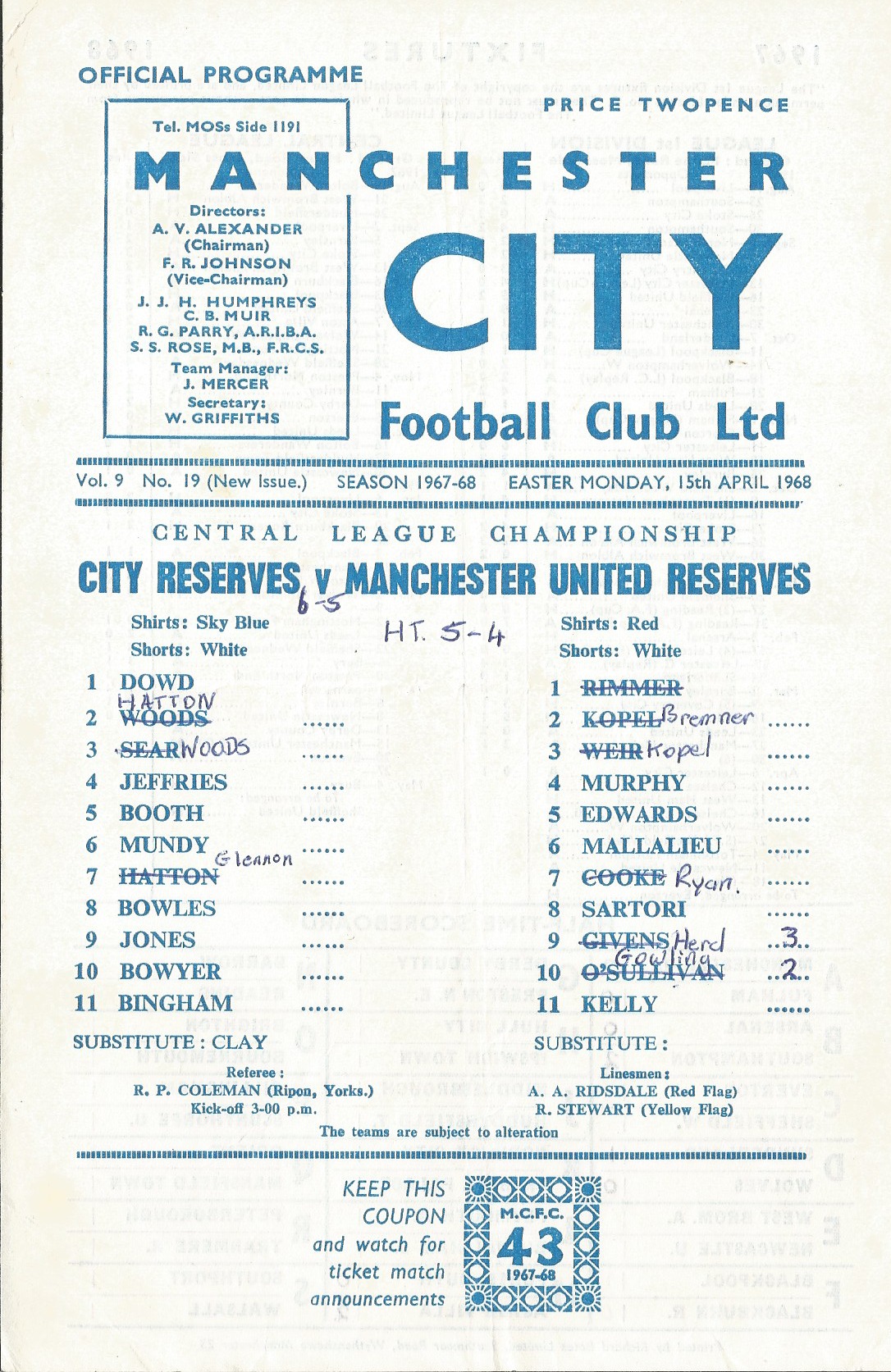
I was recently asked by Brendan Gahan if I ‘had any details of a Central League derby at Maine Rd that finished 6-5 to City. I think it was either 66/67 or 67/ 68, there was a decent crowd of around 20,000.’ We’ll, I do. The answer is…
The game was played on 15 April 1968 and was watched by 2,503 (not quite the 20,000 remembered). City’s scorers were Mundy, Clay, Jones (2), Cunliffe and Bingham. The City starting 11 included Ricky Hatton’s father Ray: Dowd, Hutton, Woods, Jeffries, Booth, Mundy, Glennon, Clay, Jones, Cunliffe & Bingham.According to the programme (provided by Dave Masey) the half time score had been 5-4 to City and the United scorers were Herd 3 and Gowling 2.
I have statistics for most Manchester City Central League games (and first team of course) into the 2000s. If you’re a subscriber to my site and have a query get in touch and I’ll see if I can answer your query. Thanks.
Subscribe to get access
Read more of this website when you subscribe today. £20 a year (about £1.67 per month) gets you access to all the articles, interviews, books & more already published on this site and those published over the next year. You’ll also be supporting my research and writing. I am not employed by anyone to do this research, so your subscriptions help enormously.
Sorry! This product is not available for purchase at this time.



 Gary James' Football Archive