On this day (15th March) in 1960 Huddersfield Town’s Denis Law signed for Manchester City for £55,000 – £10,000 more than the previous British transfer record fee.
Here for subscribers is an overview of that transfer plus footage from Law’s debut and other material.
Subscribe to get access
If you would like to read this and all the in-depth articles on this site (including the entire Manchester A Football History book and the audio interview with John Bond) then please subscribe. It works out about £1.67 a month if you take out an annual subscription (£20 per year) or £3 a month if you’d like to sign up for a month at a time. Each subscriber gets full access to the 280+ articles posted so far and the hundreds scheduled to be posted in the coming weeks.
The first Manchester derby at Manchester City’s new stadium (then called the City of Manchester Stadium, now the Etihad) occurred on this date (14th March) in 2004. For pride’s sake it was important Kevin Keegan’s side did not lose that fixture, but with United some 13 places above the Blues pre-match Ferguson’s side were clear favourites. It was time for City to upset the form book.
On a wonderful day, perhaps the best the stadium had enjoyed in its inaugural year, a terrific atmosphere helped Keegan’s side achieve a memorable victory. Fowler opened the scoring in the third minute and Macken made it 2-0 after 32 minutes. Scholes made it 2-1 three minutes later.
In the second half goals from Mancunian Trevor Sinclair (73) and Shaun Wright-Phillips made it 4-1 to the Blues. You can hear my interview with Trevor Sinclair about this game here:
Matt Dickinson (The Times): “Humiliated by Manchester City last season, Sir Alex Ferguson and his men used the pain to fuel their drive to the title. Humiliated again yesterday, they are condemned to live with the despair for months – perhaps even years.”
Keegan felt the win was thoroughly deserved: “We had played better against Chelsea and lost. But against United we got that important early goal which gave us something to hang on to. We had personnel problems because we had players doing jobs that don’t come naturally to them and also had to make two enforced changes at the interval.”
Chris Bailey explained the significance of the match in the Manchester Evening News: “Maine Road saw some pulsating derbies in its time but few could have matched this first-ever neighbourly spat at Eastlands. And how satisfying that Kevin Keegan’s side should choose this day of all days to win their first home game since October 18 and banish all thoughts of the drop.”
In 2012 Dennis Tueart, who was a director at the time of the stadium move, told me his memories of that derby match, believing it was an important moment in the stadium’s inaugural season: “When we moved to the stadium Kevin Keegan worried about whether the atmosphere would be the same and I told him that fans would take a bit of time getting used to it because they were no longer sat with the people they’d been with for years. The dynamics were different. He felt we should try and get fans in the ground earlier, but I said that performance on the pitch would be the most significant factor.
“When we beat United 4-1 in the first derby at the stadium the atmosphere was incredible. Kevin came to me afterwards and said ‘I see what you mean’. That then set the tone of the place. The place was rocking – people were singing as they walked down the spirals at the end of the match and the atmosphere was absolutely superb.”
If you would like to read about other Manchester derbies then check out this:
This was a brief taste of the material on http://www.GJFootballArchive.com If you would like to read all the in-depth articles (including the entire Manchester A Football History book and the audio interview with John Bond) then please subscribe. It works out about £1.67 a month if you take out an annual subscription (£20 per year) or £3 a month if you’d like to sign up for a month at a time. Each subscriber gets full access to the 500+ articles posted so far and the hundreds scheduled to be posted in the coming months.
The 1980-81 season was one of City’s most remarkable and culminated in two appearances at Wembley. At the season’s start, however, a trip to Wembley seemed like one of Manager Malcolm Allison’s more imaginative dreams, especially as the Blues succumbed to successive defeats to a Kevin Keegan inspired Southampton (2-0) and newly promoted Sunderland (4-0).
Subscribe to get access
Read more of this content when you subscribe today.
On this day (March 7) Manchester City defeated West Bromwich Albion 2-1 in the League Cup final. City’s goalscorer were both grandfathers of modern day player Tommy Doyle. They were Glyn Pardoe and Mike Doyle. Sadly both men have since passed away. I interviewed Glyn Pardoe (photo is of Glyn with Janice Monk and Steve Mackenzie at one of my book launches) a number of times over the years, including one of my first ever interviews back in the early 1990s (it was for my biography of Joe Mercer and Glyn was a wonderful, welcoming man). Back in January 2004 I interview Glyn for my then regular Manchester City match programme series In Search of the Blues. Here is that interview as it was written up for the programme:
Glyn Pardoe holds the record for the youngest player to make his debut with the Blues. At the age of 15 years and 314 days he played in City’s 11th April 1962 meeting with Birmingham City. He went on to play throughout City’s glorious late sixties period and made a total of 374 (plus 2 as substitute) appearances.
Gary James, author of Farewell To Maine Road, caught up with Glyn to discuss his playing career and his present day activities.
Let’s start with your role today, I’m sure many of our readers will have heard you on local radio this season. Can you explain your role?
I work with Ian Cheeseman, Jimmy Wagg and the others at GMR to provide my views on what’s happening on the pitch. Part of that is actually sat next to Ian summarising, and part of it is after the match when I am one of the guys talking to callers and generally talking about City. It’s a great role and I love chatting to fans. Ian and Jimmy are nice lads as well, and the great thing for me is that I enjoy it. I love listening to supporters giving their views and I like to stress that the game is still all about opinions. It doesn’t matter what else changes, football is a great game to talk about.
How did it all come about?
You have to go back to the eighties when I was still working for the Club. Back then Ian Cheeseman was doing the Club videos of each game, while I was working with the Reserves and the Youth teams. I was asked to give my opinions of each first team game for the Club videos, and so I’d work with the Reserves in the morning, then head off up to the old commentary gantry at Maine Road for the first team.
Eventually that stopped of course, but then a few months ago I got a call from Ian. Totally out of the blue really… I didn’t ever consider I could do the same thing on radio. Ian asked if I could help for one game, so I did, then afterwards they kept asking me back.
Did you find it difficult?
At first it was hard, although I don’t think any of that came across. Unlike the old days of working on the video, I was not too familiar with every one of the first team squad, so it took some time to work out the characteristics of each player. I also have a day job of course – it’s security reception work – so that had to be taken in to consideration. Nevertheless, it has been a great experience and I do enjoy doing it.
Going back to your early career, making your debut at such an early age must have been a shock?
Well you’d think so, and I’m sure it was, but I did actually get to find out a few days before, so that helped. If I’d have found out on the morning I don’t know how I’d have coped. I don’t think I ever thought about my age. I’m sure others did, but to me it was just a great opportunity.
Your debut came against Birmingham in 1962. Do you remember much about the game?
Not really, except we lost 4-1 at home and I was up against a tough centre-half called Trevor Smith. I wore the number nine shirt for that game – I later played in almost every position! I don’t think I did a great deal, but I know I kept my place for the next 3 games.
These were not particularly good days as far as fans were concerned, but how did it feel to be a player during those first few years of your career?
The great side of the 1950s had disintegrated really. We still had a few of the players in the side like Trautmann and Hayes, but the rest of the side was mainly youngsters finding their feet. It was difficult because there was a general air of despondency. We’d go to places like Blackburn and expect to win. We’d take the lead, but end up losing 4-1 (1st May 1963) and I think that said it all. We didn’t know how to win matches. At the time I knew nothing else really, but when you do start to find success you suddenly realise how bleak the atmosphere inside the Club had been just a couple of seasons earlier.
Because you made your debut at such an early age did you think ‘this is it, I’ve made it’?
Not a chance! They’d never have allowed me to think like that anyway. I remember playing on the Saturday, and then walking up to the ground on the Monday and having to knock to be allowed in. As far as everybody was concerned I was a Reserve – or even a youth player I suppose – not a first teamer. You never actually ‘made it’ until you were a first team regular and even then you could never be complacent. Even when we were winning all the trophies there was a very real fear that your contract would not be renewed. I remember worrying each summer, thinking that I’d be forced to move on.
In those days the Club had total control and as a player you were simply glad to be there. We’ve gone to the other extreme now, but for me I don’t think I ever felt I’d made it. Even when we were the most successful side in the Country.
How do you feel the mid-sixties transformation of the Club’s fortunes came about?
Joe Mercer and Malcolm Allison came in. That’s it really. I remember when the Club was at its lowest and we had no hope, ambition, or direction and as a player you really worried about where we were heading and who the new guy might be. I was still only about 18 and had no idea how it would all pan out of course. Then Joe arrived, followed by Malcolm, and everything started to improve. Training improved considerably and so you started to realise how football could be improved and enjoyed.
What were your first impressions of Mercer & Allison?
Joe was a very respectable figure. We knew what he’d achieved as a player and he had a great approach. He was quiet but very supportive. A real calming influence. Lovely.
My first impression of Malcolm – remember I was still only a lad – was that he was very loud. He liked to shout a lot! Naturally, I got used to that, but at first it was a bit of a shock. Malcolm was a terrific coach and we all learnt so much from him. He was fantastic once you got to know him, and together they both turned us into a great side.
In the 1965-6 promotion season I only missed the opening game, so it was their arrival which made me a regular first teamer. I’d had good runs before that of course, but once they arrived I hardly missed a match, and enjoyed the successes.
The 1970 League Cup Final saw you score the winning goal 12 minutes into extra-time – presumably a great moment?
Fantastic! It’s always a great feeling when you score, but when you score in a cup final it’s tremendous. A truly great memory.
Not too long after that you suffered with a serious leg injury sustained in the Manchester derby. Did you realise how bad it was at the time?
I knew very little at the time. It was the December 1970 game at Old Trafford and there was a collision between me and George Best. Apparently I broke my leg and an artery was trapped, but I have no memory of what followed. I’ve been told that I was within twenty minutes of losing my leg. They had decided that removing my leg would save my life, but fortunately the operation they eventually did meant that my leg was saved as well. I was in a daze for at least four or five hours and really have no idea of the worry my family and friends went through.
You were only 24 when the injury occurred, and it was a long struggle back to fitness after that wasn’t it?
I missed the rest of that season, all the next, and didn’t play again in the first team until November 1972. Even then my appearances were limited. I managed 32 League appearances during 1973-4 and played in the League Cup Final with Wolves, but my career was really over.
Even now I still haven’t got full movement back, but I do feel fortunate that I am still alive and I still have my leg.
Personally, considering your age at the time I feel the blow you suffered was equal if not greater than the tragedy suffered by Paul Lake and by Colin Bell. Presumably you regard it as your worst moment?
I don’t like thinking about worst moments. Football was all about enjoyment to me. I feel very lucky to have been in such a successful side, and to play during a great period. Not many people are given the opportunity in the first place, so it all has to be great.
Which players were you closest with during your career?
Alan Oakes is my cousin of course, so I’d been playing with him since I was very young. The two of us, plus Mike Doyle and Colin Bell were known as the Big Four because we were always together. We played golf a lot and so were always seen together, but the whole of the playing staff was close in those days. We had a great team spirit.
After your playing days finished you continued to work with the Club. Did you enjoy that period?
I worked with the youth sides, and winning the Youth Cup against United in 1986 was a great moment. The lads had so much enthusiasm – Paul Moulden, Paul Lake, Steve Redmond, Andy Hinchcliffe, Ian Brightwell and the others. That gave me great satisfaction but people forget that we came close to winning it again three years later. Watford beat us in the final, but that side contained players like Neil Lennon, Ged Taggart and Ashley Ward. To think that so many of the players from those two sides went on to play international football or make a name for themselves at other clubs makes you appreciate the quality we had at the time. Those kids had ability, and it brought me and the others a lot of satisfaction.
Finally, how did the fans treat you during your time at the Club?
Always great. They were very supportive – even when we were struggling at the start of my career. They gave me fantastic treatment throughout my career, and I still enjoy meeting and talking with them today.
Here’s film of that 1970 final:
A reminder that you can still watch my 1 hour plus talk on Manchester City crowds, support, chants and Maine Road here. It’s free to watch:
I’m keen to hear thoughts on the idea of doing other talks like this for subscribers to my site. If you’re interested then please get in touch and let me know what you’d like me to talk on. I have quite a few ideas I’m keen to do and am also open to suggestions. Thanks.
If you enjoy the talk then please subscribe to my site. I am a self employed historian and spend all my working week writing, researching and publishing my work. I am not an employee of any organisation (I know some think I’m employed by a football club but I’m not an employee of any club). I am independent of any organisation and care passionately about the quality and accuracy of my work.
A limited amount of content will always be free for anyone to read but those subscribing will have access to everything on this site for as long as they subscribe. For subscribers I guarantee to post a minimum of 4 articles alongside adding material from my archives each month (in practice it’s been much more than this!). To subscribe costs £3 a month or £20 a year (a reminder that the 2010 edition of Manchester A Football History cost £24.95 when published and is now out of print but available to subscribers as a downloadable pdf as part of their subscription.).
If you’re uncertain whether to subscribe or not then why not subscribe for a month at £3 and see if you’re getting value for money. The £20 annual subscription works out about £1.67 a month for a guaranteed 4 new articles per month and access to everything else posted in the archive.
You can subscribe here:
Subscribe to get access
Read everything on this website when you subscribe today.
Earlier today (Saturday March 5 at 3pm UK time) I did an online talk/presentation on the history of Manchester City’s support and match day at Maine Road. It was a celebration of fans and a reminder of Maine Road. I’ve now posted below a free to view video of the talk for anyone to watch…
The online talk lasted over 1 hour and was recorded live, so you should able to access it anywhere.The talk covered the history of Manchester City’s support with particular reference to:
•Match day ritual at Maine Road
•The Viking Call
•The ‘Boys Stand’
•Record crowds
•Songs & chants
•Fancy dress, bananas & bells
•Fanzines
•The Supporters Club
I had a couple of technical issues but you can watch it now here:
I’m keen to hear thoughts on the idea of doing other talks like this for subscribers to my site. If you’re interested then please get in touch and let me know what you’d like me to talk on. I have quite a few ideas I’m keen to do and am also open to suggestions. Thanks.
If you enjoy the talk then please subscribe to my site. I am a self employed historian and spend all my working week writing, researching and publishing my work. I am not an employee of any organisation (I know some think I’m employed by a football club but I’m not an employee of any club). I am independent of any organisation and care passionately about the quality and accuracy of my work.
A limited amount of content will always be free for anyone to read but those subscribing will have access to everything on this site for as long as they subscribe. For subscribers I guarantee to post a minimum of 4 articles alongside adding material from my archives each month (in practice it’s been much more than this!). To subscribe costs £3 a month or £20 a year (a reminder that the 2010 edition of Manchester A Football History cost £24.95 when published and is now out of print but available to subscribers as a downloadable pdf as part of their subscription.).
If you’re uncertain whether to subscribe or not then why not subscribe for a month at £3 and see if you’re getting value for money. The £20 annual subscription works out about £1.67 a month for a guaranteed 4 new articles per month and access to everything else posted in the archive.
You can subscribe here:
Subscribe to get access
Read more of this content when you subscribe today.
Today (March 5 2022) Manchester City’s women’s team takes on Chelsea in the 11th final of the FA Women’s League Cup. This is a hugely important trophy to Manchester’s Blues and to commemorate today’s final, here’s a piece looking at the history of the competition from Manchester City’s view point. The League Cup, sponsored by Continental during the seasons Manchester City have won the competition and therefore known as the Continental Cup, was the first national competition won after the relaunch. As such it became highly significant.
City supporter David Sheel explains how the first final was viewed: “The club put on some coaches for us. It was night match – that doesn’t help. It was played at Adams Park, Wycombe Wanderers’ ground. There were two coaches. The first was full of parents and young academy girls and a few supporters with the second just supporters. All free. We went – sadly a lot couldn’t go because it was a week night – and we played against Arsenal. A team full of established top players who had beat us 4-0 at City in the League. But, like semi final win over Chelsea at Hyde, there was just something about that night. Arsenal were all over us at times and did everything but score. Our defence was outstanding but we also had a few chances at the other end. Got to half-time nil-nil and you’re thinking ‘just one chance, please.’ I can remember the goal… Joey Johnston went down the line, whipped the ball in and Izzy Christiansen, the smallest player on the pitch, headed it in. There were four of us sat together – the coaches had arrived just before kick off so we’d had to leg it in and grab the first spaces you could find. The four of us jumped up but we were surrounded by Arsenal fans. They started giving us some abuse. The goal was in the 73rd minute and we hung on.
“When the final whistle went I was as proud of that achievement as I was in 2011 when the men won the FA Cup. To me personally it was the same. I never ever felt I’d see the men win anything in my life and then the same was true with the women. I was so proud of the club. After that they did the trophy presentation and I picked up some of the tinsel that got fired out of the cannons when they did the presentation. All the players came over to the side afterwards. Jill Scott was showing me her medal. They shared it with the fans. They even let me put my hands on the trophy. We were all there together. A bit like the men and their success in 2011 I think this told the outside world that City were here to do business. Inside the club the ambition was there but until you win a major trophy the other clubs may not take you seriously.”
When I interviewed her in 2018-19 player Abbie McManus remembered: “That feeling of beating Arsenal, who have dominated women’s football for years and years. At the time we were perceived to be a bunch of nobodies that have just thrown a team together and everyone was saying you’re just throwing money at it. I didn’t actually play that game. I got sent off the game before so I missed it! But watching the game and the feeling of that win. Being the underdog. I don’t think that feeling will ever come back.”
Izzy Christiansen scored in the final and told me how she felt: “An amazing feeling to score in that game. There’s no other words to describe it. It was just probably one of the best days of my life, the fact that the ball hit the back of the net. The fact that it meant that we, as a team, and a club, got our first trophy. That kind of set us off on our journey really. We had a taste of success at the start and that’s where we’ve stayed, wanting success.”
The Blues went on to win the Continental Cup in 2014, 2016 and 2019. City’s finals:
2014 City 1 Arsenal 0
Goalscorer: Christiansen (73)
Attendance: 3,697 (Adams Park, High Wycombe).
Referee Nigel Lugg (Surrey)
2016 City 1 Birmingham City 0 (aet)
Goalscorer: Bronze (105)
Attendance: 4,214 (Academy Stadium, Manchester).
Referee Rebecca Welch (Durham)
2019 Arsenal 0 City 0 (City won 4-2 on penalties)
Attendance: 2,424 (Bramall Lane, Sheffield).
Referee Lucy Oliver (Newcastle)
Let’s hope the Blues can add another piece of silverware today. Thanks to Dave Coop for the photo at the top of this page.
You can find out more about the history of City Women in my book Manchester City Women: An Oral History. Follow the link for details of how to buy:
It’s FA Cup week AND Manchester Derby week, so the time seems right to post this special 1 hour long audio I produced last year on Manchester City’s FA Cup semi final victory over Manchester United at Wembley on April 16 2011. This recording looks at the game and the years between the 1976 League Cup success and the FA Cup glory of 2011. The 2011 semi-final was a crucial step in City’s journey since the 2008 takeover and I felt it was vital to do a special marking this.
So what’s in this special recording? Well, I’ve included exclusive material from interviews and recordings I’ve done over the years with Garry Cook, Brian Marwood, Roberto Mancini, Peter Barnes and Peter Swales. Why Swales? Well, have a listen and you’ll hear why. Basically though I’m trying to set the tone for why the 2011 FA Cup semi final victory and overcoming Manchester United was so significant.
On Mancini… I include a few words from him recorded in 2011 and at one point he talks about the view that was then being expressed that City were ‘trying’ to buy success (now they say City ‘have’ bought success!). His words are a reminder that City have been having that particular criticism thrown at them for over a decade! Oh well, I wonder how long those criticisms were laid at other clubs who had seen major investment which propelled them forward?
Anyway, get yourself a brew and be prepared to be transported back in time. Here’s the recording:
If you enjoy the recording then please let me know, comment or subscribe to the site. If it’s of interest then, over the coming months and years, I’ll produce others like this highlighting key points in Manchester City – and Manchester’s – footballing history. It costs £20 a year to subscribe (it works out £1.67 a month) or £3 if you’d like to sign up a month at a time to get full access for as long as you subscribe (you can always try it for a month). It’s worth bearing in mind that the 2010 Manchester A Football History cost £24.95 and all subscribers will be able to access all of that for as long as they are a subscriber (plus all the other stuff of course). You can subscribe below.
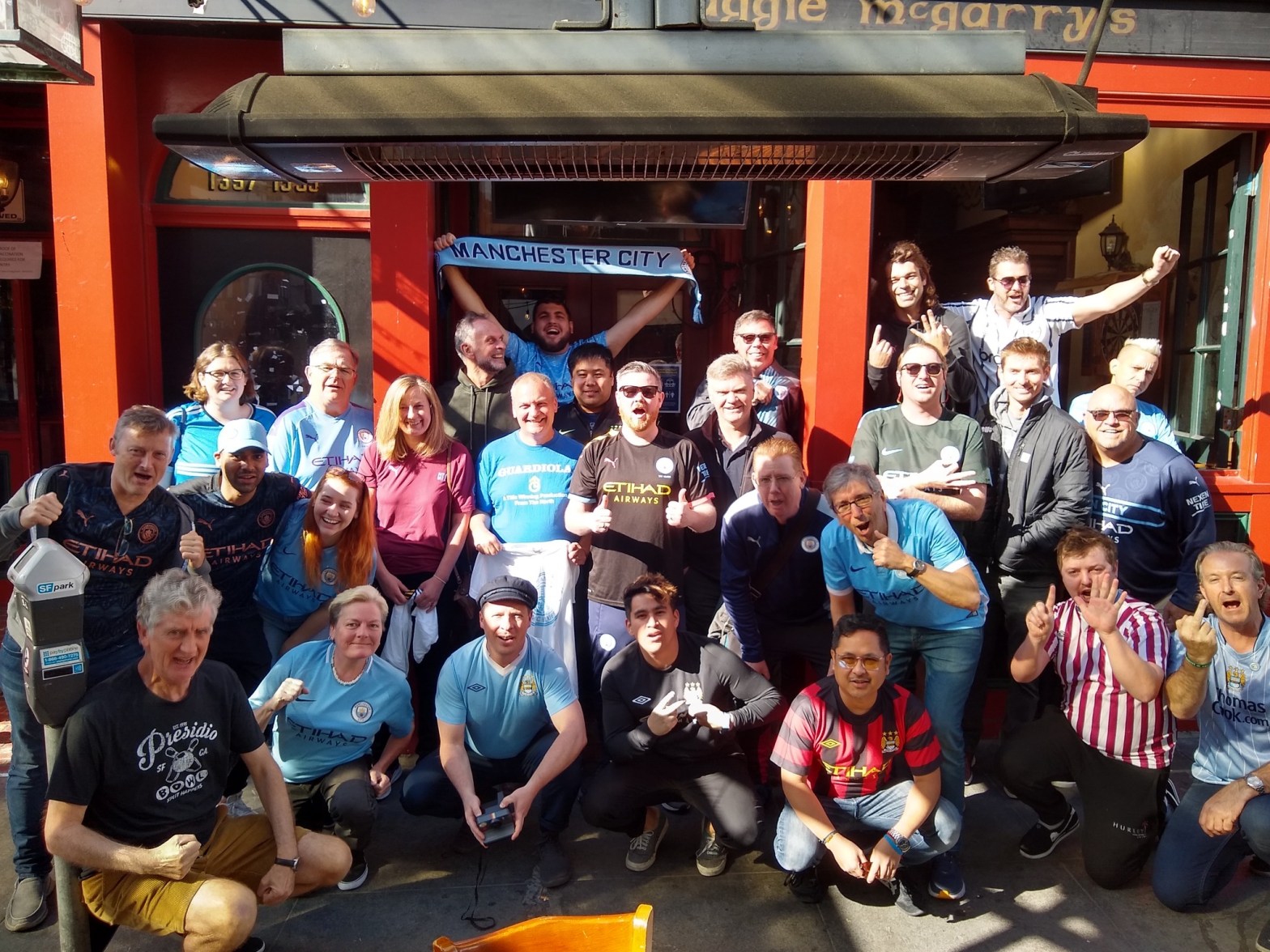
Recently I’ve been in San Francisco and was there when Manchester City played Spurs. I was invited to watch the game at Maggie McGarry’s with the San Francisco Blues. It was a great experience (we’ll ignore the result!) and here are a few thoughts and a bit of film from the day….
Firstly, I want to pay tribute to ALL the City fans who were there and who made us feel so welcome. It’s clearly a great supporters club and we really enjoyed our time there.
I’ve always been proud of the fact that MCFC has been a welcoming club over the decades and fans of the Blues have tended to be welcomed no matter where they are from or who they are. The San Francisco Blues are just as welcoming with wonderful hospitality too.
The branch contained several exiled Mancs, British and Irish members, as well as many, many US born City fans. This was great to see and I enjoyed listening to their stories of how they became City fans, or of how they came together to watch games at the bar. Two Mancs actually went to the same school (1 year apart) but didn’t know each other until they met in San Francisco through their City support. One was a history teacher in the States and asked me ’Was Billy Meredith guilty of the bribery charge?’ Hopefully, US children will now hear the rights and wrongs of FA investigations into perceived nouveau riche clubs, as City were called back in 1905 (I know!).
Some had travelled a couple of hours to get to the bar for the 930am kick off (California time of course!). from what I heard the same happens for earlier kick offs – some feat when you consider a regular 3pm UK kick off would be 7am local time. The landlord, who is also a Blue, opens the bar early for City games.
A few of the branch members had travelled to the Champions League final last year and others told me of their plans to get to the away games at Everton and Peterborough. The atmosphere on Manchester Derby Day is always special there – I think we’re all looking forward to next weekend. I’ll be in my regular seat by then of course but if you are a Blue in San Francisco get yourself down to Maggie McGarry’s.
I often get angry when rival fans or some in the media criticise football supporters for their loyalty, or when some state that ALL City fans are this or that when the truth is that we’re varied and have come to support City in lots of different ways. We live all over the world and show our dedication to the cause in ways that some don’t understand. Fans spend a considerable time, amount of money or put themselves out in lots of different ways to support their club.
I could go on but I’d just like to say thanks again to the San Francisco Blues. Their facebook page is here:
David Humphreys from the branch is heavily involved with a football club called San Francisco Vikings, formed in 1922. They focus on bringing kids through from age 3 onwards to adult leagues and to sponsor kids who can’t pay to play.
It may be some time before I’m in San Francisco again, but when I do make it I’ll aim to get back to the San Francisco Blues. Thanks again for making us so welcome.
The Blues had ended the 2008-09 season tenth under manager Mark Hughes.
Manager
Roberto Mancini replaced Mark Hughes as manager midway through the season in December 2009.
League Overview
The season commenced with four straight League victories over Blackburn (2-0), Wolves (1-0), Portsmouth (1-0) and Arsenal (4-2). Of these the Arsenal match brought most headlines. It had been viewed as the first true test of Mark Hughes’ new look City, although both Tevez and Robinho were injured.
If you would like to read the full article and other pieces like this then please subscribe below. It works out about £1.67 a month if you take out an annual subscription (£20 per year) or £3 a month if you’d like to sign up for a month at a time. Each subscriber gets full access to the 500+ articles posted so far and the hundreds scheduled to be posted in the coming weeks.
Subscribe to get access
Read more of this content when you subscribe today.
On this day (27th February) in 1993 Manchester City defeated Nottingham Forest 2-0 at the City Ground in the Premier League. The scorers were David White and Garry Flitcroft. The win in this first Premier League season was important to City of course but this game was also the last time Brian Clough managed a side against City.
Look carefully at the above photo – clearly that’s David White, but look at the Forest player to the left of the image. Yes, it’s Roy Keane.
I did the last recorded interview with Peter Swales back in 1995-96 and I asked him about Brian Clough and the England job. Swales had been the boss of the FA Selection Committee for many years and Clough never seemed to be given the chance to manage England. Swales responded to my question about Clough by saying words to the effect of ‘We could’ve had Cloughie at England – and at City – bit he’d have wanted to run the whole thing. And that was my job.’
In the interview Swales explained that Clough had wanted the City job in 1983 (when Billy McNeill was appointed).


 Gary James' Football Archive