
Remembering 2011

In the build up to the FA Cup semi final this weekend why not have a listen to my special 1 hour audio recording commemorating an earlier important FA Cup semi final?

This audio recording was made to commemorate the tenth anniversary of Manchester City’s FA Cup semi final victory over Manchester United at Wembley (April 16 2011). It looks at the years between the 1976 League Cup success and the FA Cup glory of 2011. The 2011 semi-final was a crucial step in City’s journey since the 2008 takeover and I felt it was vital to do a special marking this.

So what’s in this special recording? Well, I’ve included exclusive material from interviews and recordings I’ve done over the years with Garry Cook, Brian Marwood, Roberto Mancini, Peter Barnes and Peter Swales.  Why Swales? Well, have a listen and you’ll hear why. Basically though I’m trying to set the tone for why the 2011 FA Cup semi final victory was so significant.

On Mancini… I include a few words from him recorded in 2011 and at one point he talks about the view that was then being expressed that City were ‘trying’ to buy success (now they say City ‘have’ bought success!). His words are a reminder that City have been having that particular criticism thrown at them for well over a decade!

Anyway, get yourself a brew and be prepared to be transported back in time. Here’s the recording:

If you enjoy the recording then please let me know, comment or subscribe to the site. Subscribers get access to videos of talks I’ve done highlighting key points in Manchester City’s footballing history. It costs £20 a year to subscribe (it works out £1.67 a month) or £3 if you’d like to sign up a month at a time to get full access for as long as you subscribe (you can always try it for a month). It’s worth bearing in mind that the 2010 Manchester A Football History cost £24.95 and that, together with my first book published in 1989 are free to download for all annual subscribers. You can subscribe below. If you don’t fancy subscribing but do want to support this site, my research or have enjoyed the audio recording then why not donate? See below. Thanks.

Subscribe to get access to the full site -Annual

£20 per year to access everything since the site was created in December 2020.

Subscribe to get access to the full site -Monthly

£3 per month to access everything posted since 1 October 2022

If you enjoy all the free material on my website and would like to support my research and keep this website going (but don’t want to subscribe) then why not make a one-time donation (or buy me a coffee). All support for my research is valued and welcome. It allows me to keep some free material available for all. Thanks.

Choose an amount

£2.50
£5.00
£7.50

Or enter a custom amount

£

Your contribution is appreciated.

Donate
MCFC & LFC: Attendance Malarky

For some reason whenever Manchester City and Liverpool are due to meet at the Etihad there’s quite a lot of nonsense said about attendances so I thought I’d best get some analysis done and post it here. It’s always nice to post the facts not the fiction, so here goes (some of this may surprise those who only listen to the negativity about Etihad crowds and the positivity about Anfield attendances, not the facts).

The general criticism City get is often about ’empty seats’. No club can boast that every single season ticket holder or fan who has bought a ticket attends every game for which they’ve bought the ticket, so inevitably there are ’empty seats’ at most games for all clubs. Family tragedy, illness, emergency, work commitments, travel problems etc. all contribute to missing fans. As we don’t have a system whereby you have to get a note from a family member to pass on to the club’s manager (it seems some think you do need to get permission!) if you’re going to miss a game it is impossible to have an accurate record of who simply cannot be bothered to attend, rather than a specific reason that stops them attending.

Personally, I think it’s all nonsense and I’d much rather focus on tickets sold as that is something that can be compared. So, here are some facts based on attendances at Anfield and the Etihad since City’s new stadium was built in 2003:

Since 2003 City have attracted a higher average attendance than Liverpool in all but 5 seasons. Some will say ‘ah, but the Etihad’s capacity has been larger than Anfield for most of that time’ and that is true, but that’s only significant if Anfield is a sell out every game. So it’s also worth looking at those seasons to see if Liverpool attendances show a full stadium or not.

Well, Anfield was not full every game. In fact Liverpool’s lowest home League crowd of the season has been lower than City’s in every season except five since 2003. Add to that that City’s lowest PL crowd at the Etihad since 2003 is higher than three of Liverpool’s home PL attendances. The four lowest individual League crowds experienced at either Anfield or the Etihad since 2003 are:

34,663 Liverpool v Portsmouth, 17/3/04 (ended the season 4th)

35,064 Liverpool v Portsmouth, 14/12/04 (ended the season 5th & Champions League winners)

35,400 Liverpool v Bolton, 1/1/11 (ended the season 6th)

35,776 City v Fulham, 18/11/06 (ended the season 14th)

That 34,663 Liverpool crowd was some 10,699 below capacity. Had the crowd been 44,163 (still less than season’s highest of 44,374) that would have added another 500 to Liverpool’s average attendance that season.

Away allocations and segregation impact on whether a stadium is full of course, but we can assume that an away allocation is approximately 3,000 for Premier League games. As Anfield’s stated capacity in 2003 was 45,362 (it was reported as 45,522 by 2010), it is fair to assume that the actual maximum number of tickets available to Liverpool fans is about 42,100. So any crowd less than that figure is not a sell out (assuming zero away fans – of course there could be a full away allocation and spaces elsewhere but for the purpose of this let us give Liverpool the benefit of the doubt and assume there are zero away fans).

In 2003-04 there were 6 League games at Anfield that attracted less than 42,100. As we’ve already seen Liverpool’s average could have increased by 500 had their lowest crowd been closer to the season’s highest, so imagine what the increase would have been had all these games been full.

That pattern is repeated in other seasons. In 2004-05 the average crowd at City was less than Liverpool’s stated capacity, and that season Anfield again officially had over 10,000 empty seats for their lowest League crowd of the season. Had they filled Anfield every game then they’d have attracted a higher average than City, but they didn’t.

In 2010-11 there were 6 games attracting less than 42,100 at Anfield with the lowest again officially having over 10,000 empty seats.

Of course City have also had over 10,000 empty seats for some games, though not since 24/8/2008 when 36,635 watched City v West Ham at a time when there were rumours of players’ wages not being paid and even the existence of the club was in doubt.

Anfield last officially had over 10,000 empty seats for a Premier League game in 2011 for the visit of Bolton.

Over the last decade both clubs have tended to enjoy capacity crowds for every game, subject to away allocations and segregation, but that is definitely not true for either club prior to that. I find it ridiculous that City receive so much inaccurate reporting of crowds when actual official figures paint a different picture.

Some will try to make out that official figures are incorrect but of course these things are audited and, in any case, when rival fans criticise City they tend to imply its attendances in recent years that are inaccurate. Yet when comparing Liverpool and City’s crowds it is clear that City were attracting better crowds than Liverpool twenty years ago and that Liverpool’s lowest official crowds were lower than City’s.

Oh, it’s all a load of codswallop. Those who attend games know the truth and the facts and evidence paint a picture somewhat different to those ‘Emptyhad’ and ‘Anfield’s always been full’ jibes aimed at City fans.

Manchester City v Kyiv

Despite beating Kyiv 1-0 thanks to a Kolarov goal at home Manchester City were knocked out of the UEFA Cup on this day (17 March) in 2011. The first leg had ended in a 2-0 defeat. You can watch highlights of the second leg here:

https://www.mancity.com/citytv/match-highlights/2011/march/manchester-city-dynamo-kyiv-long-highlights

This season would of course end in success with City winning the FA Cup.

Goalscoring Nationalities

Prior to this weekend’s game with Spurs, Manchester City have had players from 41 different nations score for the Blues in the Premier League. Can you remember them all? The following 1200 word article tells the story…

Subscribe to get access

Read this content when you subscribe today. It costs £20 a year or £3 per month (see below). Annual subscribers access everything posted to the site including interviews, talks, books and hundreds of articles plus everything posted during your subscription.

Subscribe to get access

Monthly subscribers (£3, cancel anytime) get access to everything posted to the site since 1 October 2022 plus everything posted during your subscription.

2011 – What It Meant Historically

Manchester football historian Gary James assesses what City’s 2011 FA Cup success means from a historical perspective. This was written in April 2011 and is published here to provide consideration of how that point in history was viewed at the time. It has not been altered to reflect later views.

Subscribe to get access

Read more of this content when you subscribe today. If you’d like to support my research then why not subscribe? Every subscription directly helps support my research and provides annual subscribers with access to everything posted on this site, including the entire Manchester A Football History and From Maine Men To Banana Citizens books, plus interviews, articles and more. I am not employed by anyone and all my research is self funded or comes from subscriptions to this site.

Subscribe to get access

Read more of this content when you subscribe today. You can subscribe at either £20 per year (above) or at £3 per month here (cancel any time). For those subscribing £3 per month you will be able to access all content from October 2022 onwards for as long as you are a subscriber. Those subscribing £20 a year have access to everything posted since December 2020.

Showing Your Colours

In January this year the Newcastle Chronicle published a story that intrigued me. It talked of the history of fans wearing football scarves and suggested that a Newcastle fan in 1932 was the first to be photographed wearing a football scarf. The article explained that previously it had been claimed that an Arsenal supporter at a 1934 FA Cup tie had been the first filmed/photographed wearing a traditional bar scarf.  This set me off looking into the history of football scarves and of fans showing their colours.

So, here for subscribers to my site is a 1400 word article on showing your colours, focusing on the stories associated with Manchester City…

Subscribe to get access

Read more of this content when you subscribe today. It only costs £20 a year and throughout your membership you get full access to everything published on the site, including the entire Manchester A Football History book and my first book From Maine Men To Banana Citizens to download. You can also sign up a month at a time for £3 per month. My commitment is to publish at least 4 new lengthy articles per month but in practice I’ve posted a lot more than that. Why not sign up for a month and give it a try?

Eleven Years On: 2011 FA Cup

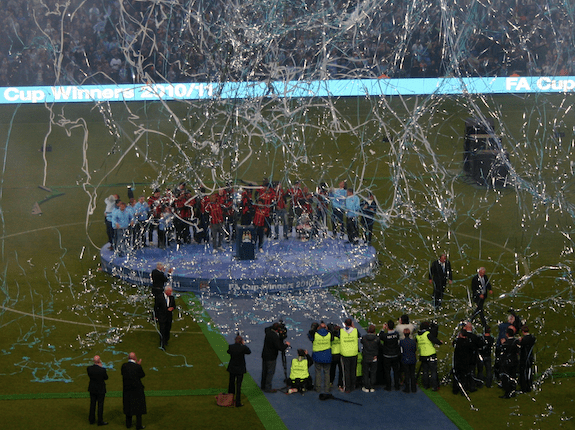
Had we all been allowed to attend matches last season I would have marked the tenth anniversary of Manchester City’s 2011 FA Cup success with a programme feature. Sadly, Covid prevented that and now, a year on, I want to commemorate the eleventh anniversary of that FA Cup success. How time flies!

There are so many angles to that first major success of the modern era for Manchester City and it is impossible to cover them all here. Elsewhere on this website I talk about the 2011 FA Cup run, especially that semi-final win over Manchester United. If you’ve not heard it have a listen to this:

Today I’ll focus on the final itself…

This is a subscriber article. It costs £3 a month to subscribe OR take out an annual subscription at £20 (works out about £1.67 a month). All subscribers get full access to everything throughout their subscription.

Subscribe to get access

Read more of this content when you subscribe today.

The Poznan

The experience of attending a football match isn’t just about seeing great football (but I love those of us who support Manchester City have been blessed with that over the last few years of course!), it’s about what happens in the stands and around the stadium. Fan culture has been something that has mattered to me for decades and I love the atmosphere and mood around watching City.

City fans have had a great reputation for their humour and their ability to add something different to the match day experience. From the 1890s when fans would bring musical instruments and wear fancy dress to City games at the Blues’ Hyde Road ground, through to the 1980s banana craze and on to recent years, attending City games has always been more than simply watching a match.

So for today’s subscriber piece I want to talk about something that swept the club in 2010-11 that has this season been making steps towards returning en masse at the stadium. That is The Poznan! 

The following 1,700 word article is available to all subscribers to this site (see below). If you don’t subscriber then why not join up? It costs £20 a year (that works out about £1.67 a month) and for that you get access to every article on here, plus some audio interviews and PDFs of the entire Manchester A Football History and From Maine Men To Banana Citizens books. You’ll also get everything else added during your period of subscription. You can also give it a try by subscribing at £3 per month (cancel any time) if you’d prefer. Whichever subscription is taken out you then access everything. Thanks.

Subscribe to get access

Read this article and the rest of the content when you subscribe today.

The 2011 All-Manchester FA Cup Semi Final: 1 Hour Special Audio

It’s FA Cup week AND Manchester Derby week, so the time seems right to post this special 1 hour long audio I produced last year on Manchester City’s FA Cup semi final victory over Manchester United at Wembley on April 16 2011. This recording looks at the game and the years between the 1976 League Cup success and the FA Cup glory of 2011. The 2011 semi-final was a crucial step in City’s journey since the 2008 takeover and I felt it was vital to do a special marking this.

So what’s in this special recording? Well, I’ve included exclusive material from interviews and recordings I’ve done over the years with Garry Cook, Brian Marwood, Roberto Mancini, Peter Barnes and Peter Swales.  Why Swales? Well, have a listen and you’ll hear why. Basically though I’m trying to set the tone for why the 2011 FA Cup semi final victory and overcoming Manchester United was so significant.

On Mancini… I include a few words from him recorded in 2011 and at one point he talks about the view that was then being expressed that City were ‘trying’ to buy success (now they say City ‘have’ bought success!). His words are a reminder that City have been having that particular criticism thrown at them for over a decade! Oh well, I wonder how long those criticisms were laid at other clubs who had seen major investment which propelled them forward?

Anyway, get yourself a brew and be prepared to be transported back in time. Here’s the recording:

If you enjoy the recording then please let me know, comment or subscribe to the site. If it’s of interest then, over the coming months and years, I’ll produce others like this highlighting key points in Manchester City – and Manchester’s – footballing history. It costs £20 a year to subscribe (it works out £1.67 a month) or £3 if you’d like to sign up a month at a time to get full access for as long as you subscribe (you can always try it for a month). It’s worth bearing in mind that the 2010 Manchester A Football History cost £24.95 and all subscribers will be able to access all of that for as long as they are a subscriber (plus all the other stuff of course). You can subscribe below.

Subscribe to get access to the full site

£20 per year to access everything

Match Stats for the 2011 FA Cup Semi-final

City 1-0 United (HT 0-0)

Yaya Toure 52

City: 25 Hart 04 Kompany (yellow card), 05 Zabaleta (yellow card), 13 Kolarov, 19 Lescott, 11 Johnson (Wright-Phillips 79), 18 Barry, 21 Silva (Vieira 86), 34 De Jong (yellow card), 42 Y Toure, 45 Balotelli (yellow card). Substitutes 12 Taylor, 38 Boyata, 07 Milner, 08 Wright-Phillips, 24 Vieira, 10 Dzeko, 27 Jo

United: 01 Van der Sar, 03 Evra, 05 Ferdinand, 15 Vidic, 22 O’Shea (Fabio Da Silva 84), 13 Park Ji-Sung, 16 Carrick, 17 Nani, 18 Scholes (red card), 25 Valencia (Hernandez 65), 09 Berbatov (Anderson 74). Substitutes 29 Kuszczak, 12 Smalling, 20 Fabio Da Silva, 08 Anderson, 28 Gibson, 07 Owen, 14 Hernandez

Referee: Dean

Attendance: 86,549

Eleven Year Ago Today – Dzeko’s First Goal!

On this day (30 January) in 2011 Roberto Mancini’s Manchester City team faced Notts County in the FA Cup. Edin Dzeko’s first City goal came on this day too!

In the build-up to the Notts County tie much was made of the fact that County were the world’s oldest League team and that they were facing the world’s richest club – as usual ignoring the hard fact that it was City’s owner that was wealthy not the club itself. Who’d have thought then that ten years later we’d still be hearing this same old claptrap!

Television, in particular, liked to build up the David and Goliath aspect to it.  For neutrals it added to the interest perhaps, but for the Blues it continued to give a false impression of the stage they were at in their development.  

Subscribe to get access

If you would like to read the rest of this piece and everything else on this site then please subscribe. It works out about £1.67 a month if you take out an annual subscription (£20 per year) or £3 a month if you’d like to sign up for a month at a time. Why not sign up for a month, see what’s here and then cancel if you don’t think it’s appropriate for you? Each subscriber gets full access to the 500+ articles posted so far and the hundreds scheduled to be posted in the coming weeks.