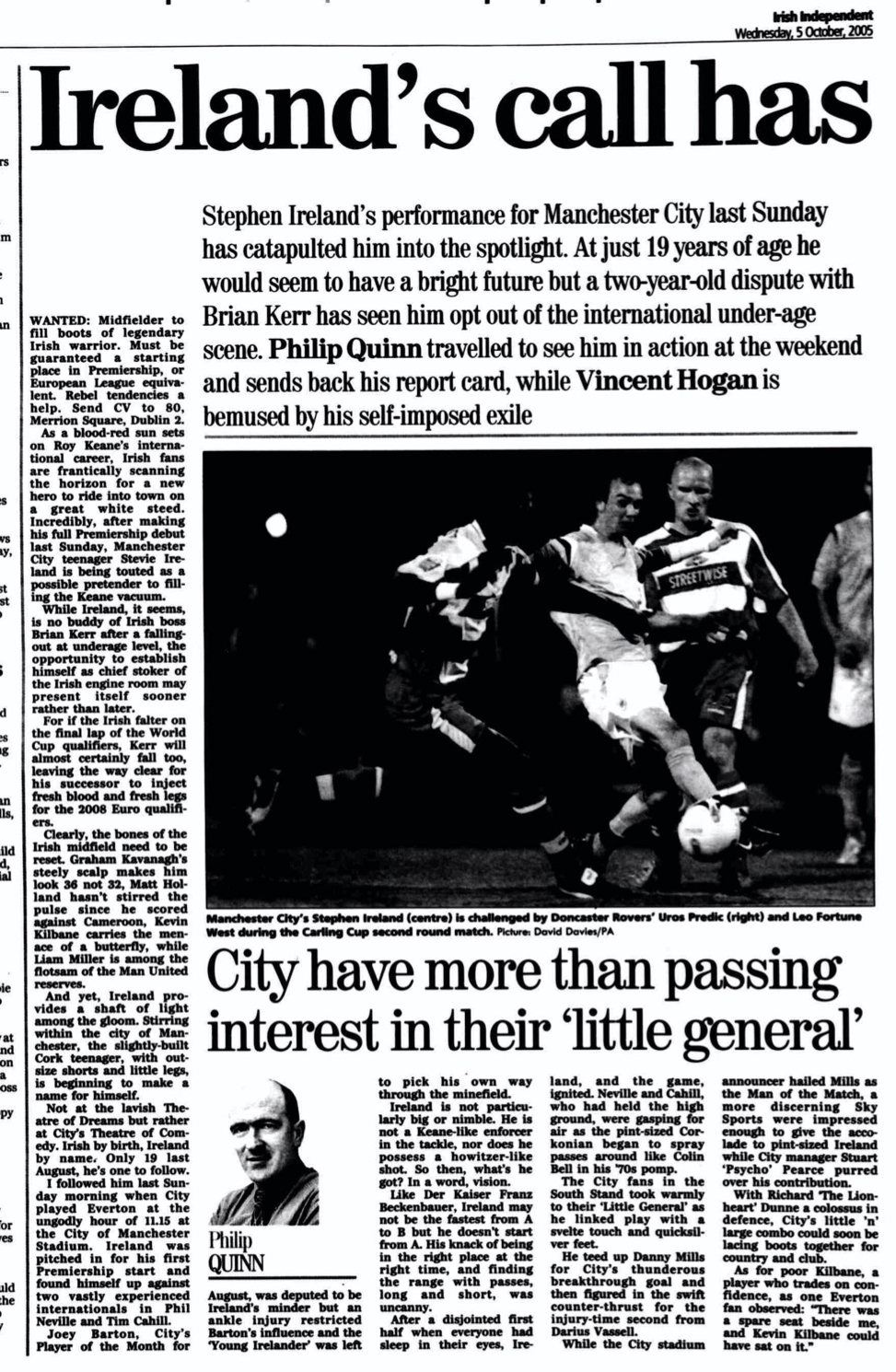
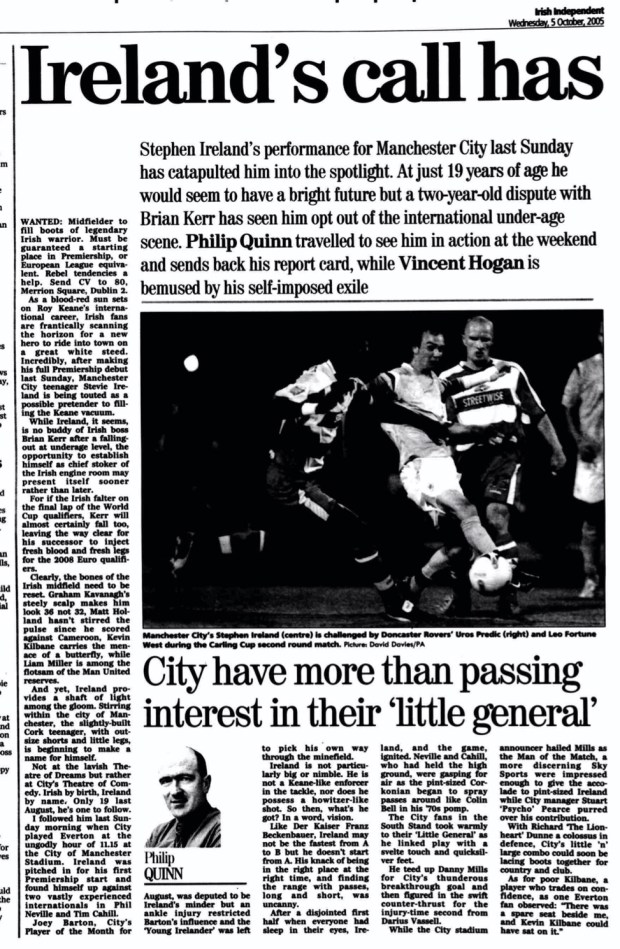
The 2000s: This Is Our City

This doesn’t feel that long ago but it’s twenty years (this article is from 26 October 2005) since the This Is Our City campaign was doing the rounds on Manchester billboards. Back then phrases like ‘Real Manchester’ formed part of a campaign by City to make the club’s presence felt across the city. Some of these (like the one mentioned in the image) were attacked by rival fans, but overwhelmingly City’s own support felt positively about the campaign.

A few years later this campaign was part of the inspiration behind the ‘Welcome To Manchester’ poster that welcomed Carlos Tevez to City.

You can find our more on the 2000s across this website with articles for everyone plus some articles for subscribers. Here’s a 3,100 word article on the 2005-06 season (below) for anyone subscribing.

Subscribe to get access

This article is for subscribers to my website. It costs £20 a year to access everything on the site since creation in December 2020. That includes articles, history talks, videos, interviews & more. There’s also a monthly option below. Monthly subscription costs £3 per month to access everything on the site since 1 October 2022 (cancel anytime). All subscribers access all new material until their subscription ends. Why not give it a try for a month?

Sunday Morning Blues

Everton, so often a bogey team back then for Manchester City, were defeated 2-0 on this day (2 October) in 2005.  This was the first Sunday morning kick off in the Premier League and the match commenced at 11.15 with some fans making a point of the early start by wearing pyjamas.  It was also Stephen Ireland’s first full Premiership game.  Before the match he admitted to being “very nervous” and post-match he commented that the rest of the team had supported him:  “That helped me ease my nerves and settle in as one of them.” You can see highlights and read more about the game below:

If you enjoy all the free material on my website and would like to support my research and keep this website going (but don’t want to subscribe) then why not make a one-time donation (or buy me a coffee). All support for my research is valued and welcome. It allows me to keep some free material available for all. Thanks.

Choose an amount

£2.50
£5.00
£7.50

Or enter a custom amount

£

Your contribution is appreciated.

Donate

Subscribe to get access

If you’ve enjoyed this then why not subscribe? Every subscription directly helps support my research and provides the subscriber with access to everything posted on this site, including the entire Manchester A Football History and From Maine Men To Banana Citizens books, plus interviews, articles and more. I am not employed by anyone and all my research is self funded or comes from subscriptions to this site.

The 2000s: This Week 2005-06

Continuing the weekly series on Manchester City’s seasons from 1999-2000 through to 2008-09. Each week I’ll be publishing here the story of a different season of that remarkable ten-year period. Today we have a 3,100 word article on the 2005-06 season (below).

Subscribe to get access – Annual

This article is for subscribers to my website. It costs £20 a year to access everything on the site since creation in December 2020. That includes articles, history talks, videos, interviews & more. There’s also a monthly option below.

Subscribe to get access – Monthly

Monthly subscription costs £3 per month to access everything on the site since 1 October 2022 (cancel anytime). All subscribers access all new material until their subscription ends. Why not give it a try for a month?

Starting Monday: The 2000s

Starting on Monday is a new weekly series on Manchester City’s seasons from 1999-2000 through to 2008-09. Each week I’ll be publishing an article here telling the story of a different season of that remarkable ten-year period. The series will start on Monday with an 8,800 word article on 1999-2000 and will end with the 2008-09 season. There will be a new season each week, following on chronologically.

Subscribe to get access – Annual

This series will be for subscribers to my website. It costs £20 a year to access everything on the site since creation in December 2020. That includes articles, history talks, videos, interviews & more. There’s also a monthly option below.

Subscribe to get access – Monthly

This series will be for subscribers to my website. Monthly subscription costs £3 per month to access everything on the site since 1 October 2022 (cancel anytime). All subscribers access all new material until their subscription ends. Why not give it a try for a month?

MCFC & LFC: Attendance Malarky

For some reason whenever Manchester City and Liverpool are due to meet at the Etihad there’s quite a lot of nonsense said about attendances so I thought I’d best get some analysis done and post it here. It’s always nice to post the facts not the fiction, so here goes (some of this may surprise those who only listen to the negativity about Etihad crowds and the positivity about Anfield attendances, not the facts).

The general criticism City get is often about ’empty seats’. No club can boast that every single season ticket holder or fan who has bought a ticket attends every game for which they’ve bought the ticket, so inevitably there are ’empty seats’ at most games for all clubs. Family tragedy, illness, emergency, work commitments, travel problems etc. all contribute to missing fans. As we don’t have a system whereby you have to get a note from a family member to pass on to the club’s manager (it seems some think you do need to get permission!) if you’re going to miss a game it is impossible to have an accurate record of who simply cannot be bothered to attend, rather than a specific reason that stops them attending.

Personally, I think it’s all nonsense and I’d much rather focus on tickets sold as that is something that can be compared. So, here are some facts based on attendances at Anfield and the Etihad since City’s new stadium was built in 2003:

Since 2003 City have attracted a higher average attendance than Liverpool in all but 5 seasons. Some will say ‘ah, but the Etihad’s capacity has been larger than Anfield for most of that time’ and that is true, but that’s only significant if Anfield is a sell out every game. So it’s also worth looking at those seasons to see if Liverpool attendances show a full stadium or not.

Well, Anfield was not full every game. In fact Liverpool’s lowest home League crowd of the season has been lower than City’s in every season except five since 2003. Add to that that City’s lowest PL crowd at the Etihad since 2003 is higher than three of Liverpool’s home PL attendances. The four lowest individual League crowds experienced at either Anfield or the Etihad since 2003 are:

34,663 Liverpool v Portsmouth, 17/3/04 (ended the season 4th)

35,064 Liverpool v Portsmouth, 14/12/04 (ended the season 5th & Champions League winners)

35,400 Liverpool v Bolton, 1/1/11 (ended the season 6th)

35,776 City v Fulham, 18/11/06 (ended the season 14th)

That 34,663 Liverpool crowd was some 10,699 below capacity. Had the crowd been 44,163 (still less than season’s highest of 44,374) that would have added another 500 to Liverpool’s average attendance that season.

Away allocations and segregation impact on whether a stadium is full of course, but we can assume that an away allocation is approximately 3,000 for Premier League games. As Anfield’s stated capacity in 2003 was 45,362 (it was reported as 45,522 by 2010), it is fair to assume that the actual maximum number of tickets available to Liverpool fans is about 42,100. So any crowd less than that figure is not a sell out (assuming zero away fans – of course there could be a full away allocation and spaces elsewhere but for the purpose of this let us give Liverpool the benefit of the doubt and assume there are zero away fans).

In 2003-04 there were 6 League games at Anfield that attracted less than 42,100. As we’ve already seen Liverpool’s average could have increased by 500 had their lowest crowd been closer to the season’s highest, so imagine what the increase would have been had all these games been full.

That pattern is repeated in other seasons. In 2004-05 the average crowd at City was less than Liverpool’s stated capacity, and that season Anfield again officially had over 10,000 empty seats for their lowest League crowd of the season. Had they filled Anfield every game then they’d have attracted a higher average than City, but they didn’t.

In 2010-11 there were 6 games attracting less than 42,100 at Anfield with the lowest again officially having over 10,000 empty seats.

Of course City have also had over 10,000 empty seats for some games, though not since 24/8/2008 when 36,635 watched City v West Ham at a time when there were rumours of players’ wages not being paid and even the existence of the club was in doubt.

Anfield last officially had over 10,000 empty seats for a Premier League game in 2011 for the visit of Bolton.

Over the last decade both clubs have tended to enjoy capacity crowds for every game, subject to away allocations and segregation, but that is definitely not true for either club prior to that. I find it ridiculous that City receive so much inaccurate reporting of crowds when actual official figures paint a different picture.

Some will try to make out that official figures are incorrect but of course these things are audited and, in any case, when rival fans criticise City they tend to imply its attendances in recent years that are inaccurate. Yet when comparing Liverpool and City’s crowds it is clear that City were attracting better crowds than Liverpool twenty years ago and that Liverpool’s lowest official crowds were lower than City’s.

Oh, it’s all a load of codswallop. Those who attend games know the truth and the facts and evidence paint a picture somewhat different to those ‘Emptyhad’ and ‘Anfield’s always been full’ jibes aimed at City fans.

One Week Today: Free History Talk on Manchester City 2005 to 2009

I’m delighted to say I’ll be performing the next free online History Talk this time next week (Wednesday 29 March at 6pm until 7pm). This talk will be on Manchester City FC between 2005 to 2009. It’ll last about 1 hour and is free to attend but places must be reserved in advance. It will follow a similar format to previous talks I’ve done on the origins of MCFC but this one will specifically focus on the transformational period of 2005 to 2009. I’ll talk about the development of MCFC during the period.

During the 2000s I spent considerable time behind the scenes interviewing and meeting those who played a part in this transformational period. I’ll discuss the development of the club from the dedicated chairmanship of John Wardle, through a season or so of Thaksin Shinawatra and on to Khaldoon Al Mubarak. I will talk about meetings I attended and interviews I performed during this period, including discussions with all three chairmen, plus other significant figures.

This hour will include the opportunity to ask questions as I’m keen to hear your thoughts on these transformational years for the club.

The event will be live on Zoom on 29/3/23 at 6pm and a link will be sent to all those who have registered for the event beforehand (probably earlier that day). THIS WILL BE EMAILED OUT SEPARATELY AND NOT VIA THE EVENTBRITE WEBSITE.

You can register here:

You must register here if you want to get involved. If you’d like an example of what the talk will be like take a look at:

The talk will last about 1 hour and will be online on zoom, so you should be able to access it anywhere.

You can see posts about other History Talks here:

https://gjfootballarchive.com/tag/history-talks/

Next Free History Talk: Manchester City 2005 to 2009 on 29 March

I’m delighted to say I’ll be performing the next free online History Talk on Wednesday 29 March at 6pm until 7pm. This talk will be on Manchester City FC between 2005 to 2009. It’ll last about 1 hour and is free to attend but places must be reserved in advance. It will follow a similar format to previous talks I’ve done on the origins of MCFC but this one will specifically focus on the transformational period of 2005 to 2009. I’ll talk about the development of MCFC during the period.

During the 2000s I spent considerable time behind the scenes interviewing and meeting those who played a part in this transformational period. I’ll discuss the development of the club from the dedicated chairmanship of John Wardle, through a season or so of Thaksin Shinawatra and on to Khaldoon Al Mubarak. I will talk about meetings I attended and interviews I performed during this period, including discussions with all three chairmen, plus other significant figures.

This hour will include the opportunity to ask questions as I’m keen to hear your thoughts on these transformational years for the club.

The event will be live on Zoom on 29/3/23 at 6pm and a link will be sent to all those who have registered for the event beforehand (probably earlier that day). THIS WILL BE EMAILED OUT SEPARATELY AND NOT VIA THE EVENTBRITE WEBSITE.

You can register here:

You must register here if you want to get involved. If you’d like an example of what the talk will be like take a look at:

The talk will last about 1 hour and will be online on zoom, so you should be able to access it anywhere.

You can see posts about other History Talks here:

https://gjfootballarchive.com/tag/history-talks/

Villa Defeated

Today (14 March) in 2006 Manchester City defeated Aston Villa 2-1 to reach the FA Cup quarter-final. City’s goals were scored by Georgios Samaras (17 minutes) and Darius Vassell (48). Steve Davis netted for Villa with five minutes to go but the Blues managed to hold out for the win.

City boss Stuart Pearce commented: ‘I was so proud of my players – they were fantastic. All of them were outstanding. I thought we played pretty well when we did the things we’re good at. There was a bit of pressure on us – people think being at home it was a foregone conclusion but it never is.’

Dunne, Samaras and Barton

No, not a firm of solicitors but the goalscorers when Manchester City defeated Charlton Athletic 3-2 on this day (12 February) in 2006. Some described Barton’s 62nd minute goal as his greatest ever goal. You can judge for yourself… Highlights of the game here:

Goalscoring Nationalities

Prior to this weekend’s game with Spurs, Manchester City have had players from 41 different nations score for the Blues in the Premier League. Can you remember them all? The following 1200 word article tells the story…

Subscribe to get access

Read this content when you subscribe today. It costs £20 a year or £3 per month (see below). Annual subscribers access everything posted to the site including interviews, talks, books and hundreds of articles plus everything posted during your subscription.

Subscribe to get access

Monthly subscribers (£3, cancel anytime) get access to everything posted to the site since 1 October 2022 plus everything posted during your subscription.