The series of articles covering Manchester City in the 1990s continues today with the 1993-94 season. It was such an important (and at times complicated season) that this article on that season is over 9,000 words long. It’s like a book in itself! It’s available to subscribers, so why not subscribe and relive this extraordinary season? As with all these 1990s subscriber features it contains material from interviews I’ve performed with key figures from that time. In particular this one contains quotes from Peter Swales and Francis Lee which they discussed with me personally.
Here’s the 9000+ word article on that season:
Subscribe to get access – Monthly
Read more of this content when you subscribe today. It costs £3 per month (cancel anytime) to access everything posted since 1 October 2022 or there’s a special annual rate below which gives greater access and works out much cheaper.
Read more of this content when you subscribe today. It costs £3 per month (above) or £20 a year (here) to access everything posted since the site was created in December 2020. This special rate works out about £1.67 a week and gives access to everything posted, including PDFs of 3 of my books.
This series of articles and features will run throughout March with indepth articles some days and smaller ‘on this day’ style posts on others. There will be flashbacks to great games, players and more. Every day in March will offer something to enjoy.
Subscribers will get access to everything, while some on this day material will be free for all to view.
If you want to know more on this incredible decade for Manchester City Football Club then why not subscribe and read it all? If you’d like to know more about subscribing then see:
A new series of articles starts tomorrow on Manchester City in the 1990s. There will be a seasonal journey through a truly important decade when Manchester City began the decade hoping to challenge for the Premier League. People often forget how things changed that decade. A giant of a club at the start of the decade and one that the whole football world recognised as being part of English football’s aristocracy. By the end of the decade it was the loyalty of fans that most recognised the club for.
Those that claim City has ‘no history’ may learn something about a decade that is often highlighted for its failings but which actually had some wonderful, incredible, positive moments too. This series of features will show how that decade actually went and will hopefully help to explain why the narrative of ‘third tier club that got lucky’ is so wrong! For the entire month of March there will be features to make every Blue proud, while also recognising the true nature of football – some times it’s great being a fan and sometimes it’s awful. That’s football!
Re-live the highs and lows of the 1990s decade from tomorrow onwards.
If you’d like to read everything in this series then please subscribe. Details below:
Following on from the series of articles and features on the 1970s and 1980s over the last few months a new series on Manchester City in the 1990s will be starting in March. As with the 1970s & 1980s there will be different content posted each day from indepth articles on each of the seasons through to on this day reminders of games, players and more.
Some of the material will be available for subscribers only and some will be free for anyone to read. If you’d like to know how to subscribe and read all the incredible content on here then see:
Feel free to send in ideas or areas that you’d like me to discuss on 1990s Manchester City. I’m always open to adapting stories or content based on feedback. Thanks for reading.
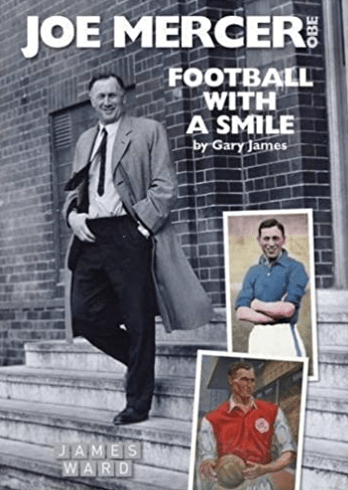
Late in 1993 Jimmy Wagg interviewed me on GMR about my new book on Joe Mercer. Next month it’ll be 30 years (I know!) since that book came out and so I thought I’d post the recording of the interview with Jimmy from that year. The quality is not great (neither are my answers at times!) but you can now hear the recording on my website.
If you want to hear why I did the book and the answers I gave back then have a listen now. Here goes (again apologies for the quality of the recording):
While you’re here why not have a look at all the other articles, interviews, videos and material on this site. Subscribers get access to everything and this includes PDFs of the entire Manchester A Football History book; From Maine Men To Banana Citizens (my first book) and Farewell To Maine Road. There are also audio recordings of my interviews with John Bond, Malcolm Allison, George Graham etc. It costs £3 per month or £20 per year. Details of how to subscribe below:
If you enjoy all the free material on my website and would like to support my research and keep this website going (but don’t want to subscribe) then why not make a one-time donation (or buy me a coffee). All support for my research is valued and welcome. It allows me to keep some free material available for all. Thanks.
One Manchester club seems to be getting everything right, winning League titles, European trophies and so on while the other appears to be in self-destruct mode with demonstrations against the owner and all sorts of worrying stories appearing in the media. Sound familiar? This was actually the situation on this day (11 September) in 1993 when Manchester City (not United) were the team in crisis and United (not City) were the team winning Leagues and European trophies.
This cutting is from 11 September 1993 and highlights the proposed takeover by Francis Lee of the Blues. Peter Swales had been City’s chairman for twenty years during which he’d taken the club from being a major, profitable power to one that was heavily in debt – debt that was hampering the club’s development – with a stadium that was being downgraded almost every day via a lack of serious investment. Across at United the club appeared relatively stable with a stadium that was being invested in. They also had one of the game’s most talented and successful managers while City had gone through a series of managers in the previous few years. City were a relatively stable top flight team though by 1993. Brian Horton was now City’s boss and he seemed to offer a positive style of football but the wider problems of the club were never far away. All sound familiar still?
I do find it amazing that City and United seem to have swapped roles so emphatically since 1993 in terms of how the clubs are managed, invested in, stadium developments and so on.
For those unaware of what happened to City or those who perhaps support United and are looking to see what happened and whether history will repeat here’s a brief overview: United dominated football for most of the 1990s & 2000s while City’s Lee takeover was successful. Lee, however, was unable to revive City’s fortunes and build on the fifth place finished that had occurred in 1991 and 1992. Although much of the financial infrastructure of City was improved following the takeover, the dismissal of Horton as manager and a poor appointment in Alan Ball led to relegation. Further issues followed as star players left, managers were sacked or left and the Blues ended up in the 3rd tier (for one season – too many believe City were a 3rd tier club who eventually got lucky but they were a top 6 team who fell apart!).
Could history repeat itself with the roles reversed? Unlikely United will ever fall as low as City but it is worth noting that City never expected to fall that low. Also, removing Swales from power was something that fans had been wanting for decades. It only became a possibility when a former hero announced he could take over the club BUT even then the hopes and ambition of all Blues could not be met.
For Day 92 of the Maine Road 100 countdown I’m taking a look at the history of the Kippax Stand… Enjoy!
2024 will mark 30 years since we said goodbye to the terraced Kippax Stand and for those of us old enough to remember those days at Maine Road that stand, above all else, represented the passion fans had for their club.
Unlike most other grounds City’s main terracing ran the full length of the pitch and wasn’t tucked away behind a goal. Because of its positioning the Kippax breathed life into every area of the stadium and was huge. Originally, it held in excess of 35,000, but even in its final days it still gave the impression of power and passion.
The Kippax was originally known as the Popular Side, matching a similarly dominant feature of the Blues’ Hyde Road ground, when it opened in 1923. That first season it held an estimated 35,000 in a crowd of 76,166 – then a national record attendance for a club ground. In 1934 when 84,569 packed into the stadium City’s vast stand may well have held almost 40,000. Incidentally, that 84,569 became the new national record attendance for a club ground (a record that still stands as Wembley is a national stadium, not officially a club ground). You can read about that crowd and game here:
Incidentally, I know City fans get a lot of abuse these days from fans of certain other clubs about filling stadia etc. Well, if you need any ammunition that 84,569 record crowd is over 22,000 higher than Liverpool’s record crowd (61,905 – a figure which wouldn’t get anywhere near City’s top ten crowds!).
Throughout the period up to the mid-50s the Popular Side developed its reputation but it was when it was roofed in 1957 that it became the true heart of the club. Back then it was extended slightly, although legislative changes had reduced terracing capacities by this time. The club announced it would be known as The Kippax Street Stand and that is what it officially remained until 1994 although most of us knew it simply as The Kippax. Its capacity by this time was about 32,000, reducing to 26,155 by the end of the 1970s.
The Kippax accommodated fans of every age and gender and, although it was a formidable place for opposition supporters, it was a welcoming stand for Manchester’s Blues. Young children would sit on the walls and railings, while older fans would find their own preferred viewing spot. Here’s a few snippets about the old stand:
Originally four vast tunnels (one in each corner and two built into the stand) and two significant stairways allowed fans to move onto the Popular Side.
A flag pole, positioned at the back of the terracing up to 1957, allowed a blue and white flag emblazoned with the words City FC to proudly fly. The flag was then re-positioned until it disappeared for good in the 1960s. See:
Chanters Corner, also known as The Sways, was the area where the more vocal members of City’s support gathered. Packed above a tunnel and next to the segregation fence, fans here often generated the main chants.
The 1960s saw The Kippax’s reputation grow. Fans sang their way through success after success as Joe Mercer’s Aces won the European Cup Winners’ Cup and every domestic trophy possible. The Kippax would begin every game with the chant “Bring on the Champions!” and then follow up with a song for every player as they warmed up.
The final capacity of The Kippax was 18,300 – making this the largest terraced area at a League ground on its final day (The Kop held its final game on the same day but had a smaller capacity).
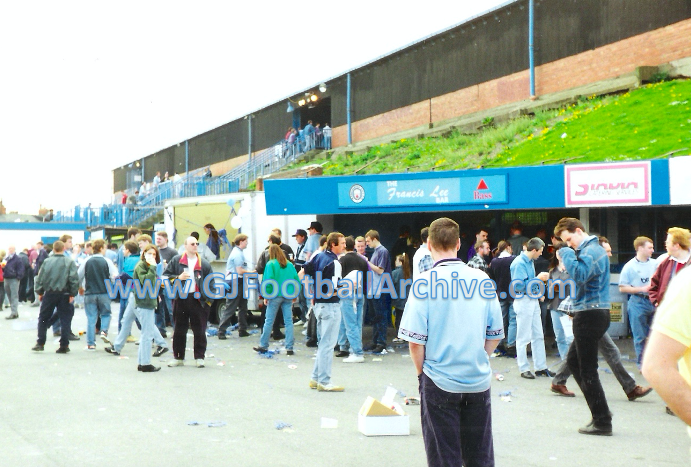
The Kippax was used for the last time on 30 April 1994 for the visit of Chelsea.
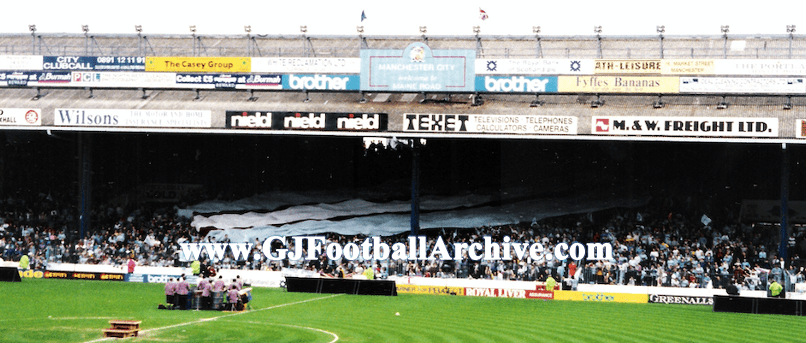
The Blue Print flag was a popular presence on many match days from the late 1980s until 1994, making its last appearance at The Kippax’s final game. The flag had been reduced in size by then. But it still covered much of the terracing. Blue Print was a City fanzine and they had paid for the flag.
Segregation was unnecessary for most of the stand’s existence, but by the end of the 1960s a rope would often be used to separate City and United fans on derby day. This was replaced by permanent barriers in the mid-70s which were increased over the years to keep home and away fans apart. Away fans were positioned at the Platt Lane end of the stand by this time.
It says much about the passion of the place that in the late 1970s the BBC came to film The Kippax chanting and in full flow.
In 1985 when City defeated Charlton 5-1 in a promotion decider on the final day of the season the Kippax was so packed that supporters remain convinced that its official capacity of 26,155 was significantly exceeded. Those of us on the terraces that day will never forget the shock we all experienced when the official crowd of 47,285 was announced – some 5,000 short of capacity!
The Kippax is no more, but those of us who experienced the stand will never forget its power, passion and presence. Its spirit lives on with thousands of Blues who stood there now bringing their own children and grandchildren to the Etihad who, if legislation allows, will soon be able to stand in a section specifically created for that purpose.
If you’re interested you can read how Maine Road got its name here:
While you’re here I’d like to thank you for taking the time and trouble to visit my website. I am not employed by anyone and no one pays me to do research or interviews. I do not have sponsorship or advertising either. I’ve set up this website to help share my 32 years plus writing and research. The intention is to develop the archive and to provide access to as much of my material as possible over the coming weeks, months & years. Subscribers can already access over 280 articles/posts including the entire Manchester A Football History book and audio interviews with former City bosses Malcolm Allison and John Bond.
It costs £20 a year (it works out £1.67 a month) or £3 if you’d like to sign up a month at a time to get full access for as long as you subscribe (see below). Thanks for the support, Gary.
Subscribe to get access – Annual
This has been a sample of the material on http://www.GJFootballArchive.com If you would like to read all the in-depth articles and listen to the audio interviews then please subscribe. It works out about £1.67 a month if you take out an annual subscription (£20 per year). Each subscriber gets full access to the 1000+ articles posted so far and the hundreds scheduled to be posted in the coming weeks.
This has been a sample of the material on http://www.GJFootballArchive.com If you would like to read all the in-depth articles and listen to the audio interviews then please subscribe. It works out about £3 a month if you take out a monthly subscription (cancel anytime; access everything since 1 October 2022).
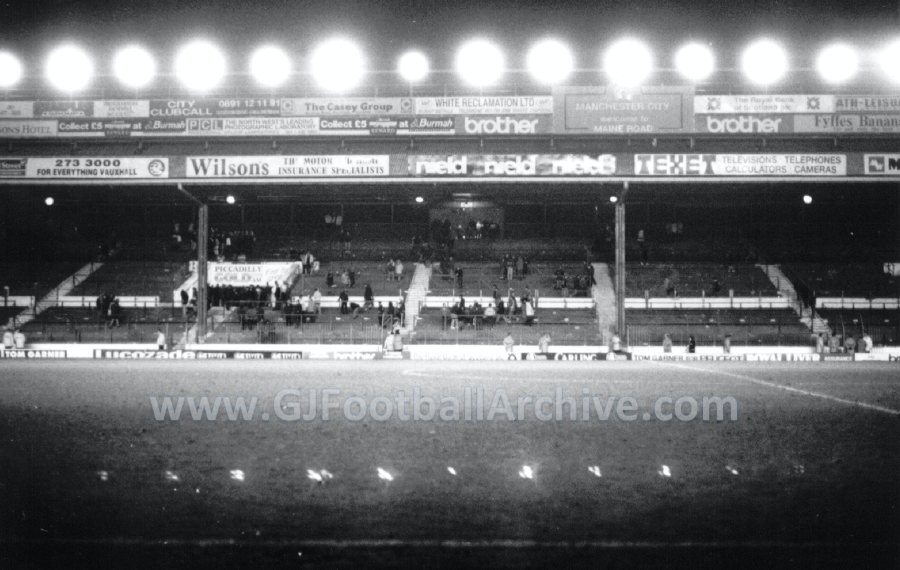
Day 66 of my posts counting down to the centenary of Maine Road’s opening game is this night time image of the Kippax. This was taken in Maine Road’s final season and was loaned to me a few decades ago by the fanzine Blueprint (Phill Gatenby). Compare this with my Day 65 image and you’ll see the floodlights are now on the roof, alongside more adverts plus the Welcome To Maine Road sign is a newer version.
For its final game that season the Kippax had a higher official capacity than all other standing areas, including the Kop which also went on that day in April 1994.
This 1971 aerial image shows the Kippax (7 & 8) from the back. The stand was demolished in 1994:
Maine Road aerial 1971 from Farewell To Maine Road
If you’d like to read more on the history of Maine Road, take a look at Farewell To Maine Road, which can be downloaded from this page:
If you enjoy all the free material on my website and would like to support my research and keep this website going (but don’t want to subscribe) then why not make a one-time donation (or buy me a coffee). All support for my research is valued and welcome. It allows me to keep some free material available for all. Thanks.
Day 65 of my posts counting down to the centenary of Maine Road’s opening game is this image of the Kippax. When this was taken in the 1980s its capacity was over 26,500 in a 52,600 capacity Maine Road. Note the iconic Trumann’s for steel advert.
This 1971 aerial image shows the Kippax (7 & 8) from the back. The stand was demolished in 1994:
Maine Road aerial 1971 from Farewell To Maine Road
If you’d like to read more on the history of Maine Road, take a look at Farewell To Maine Road, which can be downloaded from this page:
If you enjoy all the free material on my website and would like to support my research and keep this website going (but don’t want to subscribe) then why not make a one-time donation (or buy me a coffee). All support for my research is valued and welcome. It allows me to keep some free material available for all. Thanks.
Day 64 of my posts counting down to the centenary of Maine Road’s opening game is this image taken by Steve Worthington from behind the old Kippax Stand during its final season. Notice the player named bar – this one after Francis Lee – and if you look carefully the second staircase visible (left) is the staircase to nowhere which was blocked off in the early 1970s following the safety legislation (that followed the Ibrox disaster) that outlawed the original style of staircase. The one closest to the camera was remodelled but the other was blocked off (see previous Maine Road 100 posts for details).
Steve Worthington’s photo was taken from the area behind the kippax, slightky 1971 aerial image shows the 1957 roof over the Kippax (7 & 8) which was demolished in 1994:
Maine Road aerial 1971 from Farewell To Maine Road
If you’d like to read more on the history of Maine Road, take a look at Farewell To Maine Road, which can be downloaded from this page:
If you enjoy all the free material on my website and would like to support my research and keep this website going (but don’t want to subscribe) then why not make a one-time donation (or buy me a coffee). All support for my research is valued and welcome. It allows me to keep some free material available for all. Thanks.
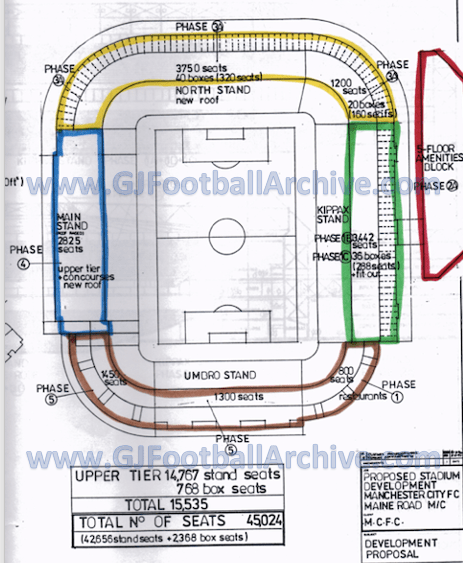
Day 55 of my posts counting down to the centenary of Maine Road’s opening game is a follow on from one from a few days ago. I posted a 1994 plan of what might have been in terms of Maine Road’s development and here’s more on that plan.
This image is of how the entire stadium was supposed to look. To explain the colour image looks towards the stadium from above the Kippax car park. The North Stand is on the right and the Platt Lane on the left. The black and white image is from the other side of the ground, looking towards the Kippax from the Main Stand.
1990s Maine Rd redevelopment plans as seen in Farewell To Maine Road
You can see from the black and white image that the plan was to replicate the general look of the new Kippax (being planned at this stage – this was January 1994 and the old Kippax was still standing) around the ground. The North Stand was to have a second tier added and hospitality boxes between the levels, like the new Kippax. The Platt Lane was to have a second tier added above the two lines of existing hospitality boxes.
The Main Stand would have part of the seating chopped away and a new second tier added.
To facilitate all of this some houses were to be bought and demolished on the streets immediately behind the North Stand and the Kippax/Platt Lane corner.
The new Kippax was the first phase of the development but Manchester’s bids for the Olympics changed thinking. Couple that with relegation in 1996 and the wholesale redevelopment of Maine Road was postponed after the Kippax opened and then dropped completely.
As mentioned previously, Lee’s plans would have seen the new Kippax followed by a phased development of each of the other three stands. These images might give an indication of how it would have progressed.
This 1971 aerial image shows the proximity of the housing on Thornton Road (bottom left, near number 6) and behind the North Stand (number 10). They were planned to be demolished in Lee’s 1994 plan.
Maine Road aerial 1971 from Farewell To Maine Road
If you’d like to read more on the history of Maine Road, take a look at Farewell To Maine Road, which can be downloaded from this page:
If you enjoy all the free material on my website and would like to support my research and keep this website going (but don’t want to subscribe) then why not make a one-time donation (or buy me a coffee). All support for my research is valued and welcome. It allows me to keep some free material available for all. Thanks.







 Gary James' Football Archive