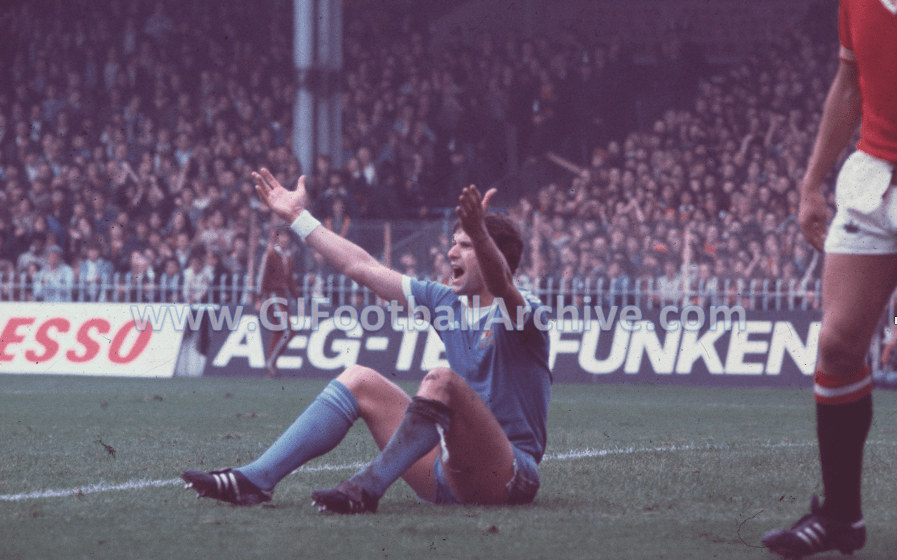
Day 6 of my posts counting down to the centenary of Maine Road’s opening game continues with another segregation image. This is a late 1970s Manchester derby image and the City player is Mike Doyle but look beyond him at the segregation and perimeter fencing. As well as the railings in front of the Kippax Stand the away section (to the right) has an additional chicken wire style temporary fence in front of the United fans.
This was a period when United fans had an extremely bad reputation for pitch invasions and crowd actions and City had been forced to install this additional netting for this derby match after consultation with the police.
The fencing didn’t last of course and so this image is extremely unusual.
If you’d like to read more on the history of Maine Road, take a look at Farewell To Maine Road, which can be downloaded from this page:
If you enjoy all the free material on my website and would like to support my research and keep this website going (but don’t want to subscribe) then why not make a one-time donation (or buy me a coffee). All support for my research is valued and welcome. It allows me to keep some free material available for all. Thanks.
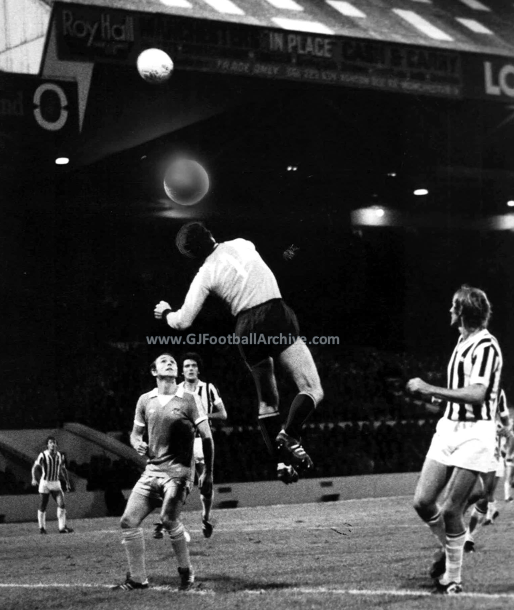
It’s day 24 of my posts counting down to the centenary of Maine Road’s opening game. With many Manchester City fans currently in Istanbul getting ready for tonight’s final I thought I’d post another Maine Road image with a European theme. Today’s feature is on this image of City facing Juventus in 1976.
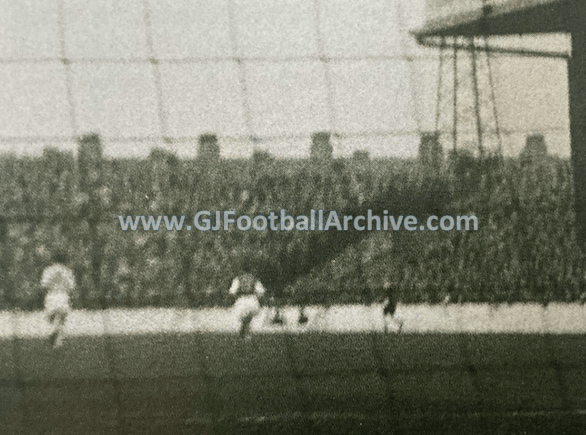
That night Brian Kidd scored the only goal in City’s 1-0 UEFA Cup victory, played on 15 September. But, look at the photo closely and you’ll see there are two balls! Why? Well, often in the days of black and white press photos newspapers wouldn’t quite get the shot they wanted. They’d sometime tippex on, or even cut and stick a ball on an action photo to create either a more dramatic image, or simply to ensure they could fit the image on the space available.
Modern technology has made it easier to ‘move’ the ball to a more convenient place, but it has also allowed photos to be taken quickly and in bursts. Also, once colour photography was used in national newspapers any cutting and pasting or tippexing seemed too obvious. Although this added ball definitely looks fake so I’m not certain any reader would have been fooled.
I’ve seen plenty of images like this over the years and I find them both fascinating and frustrating. I’d like the true image to be shown, but I also am intrigued as to how they felt they made the image better. For those wondering the City player is Dennis Tueart and the stand in the background is the Main Stand.
For those unfamiliar with Maine Road this photo may help. The roof shown is to the left of number 1 below – you can see the bit where it drops down to the next level. The tunnel is the one on the far left of the Main Stand below where the roof line changes. City were attacking the Platt Lane (stand is numbered 4 & 5) in the image.
Maine Road aerial 1971 from Farewell To Maine Road
If you’d like to read more on the history of Maine Road, take a look at Farewell To Maine Road, which can be downloaded from this page:
If you enjoy all the free material on my website and would like to support my research and keep this website going (but don’t want to subscribe) then why not make a one-time donation (or buy me a coffee). All support for my research is valued and welcome. It allows me to keep some free material available for all. Thanks.
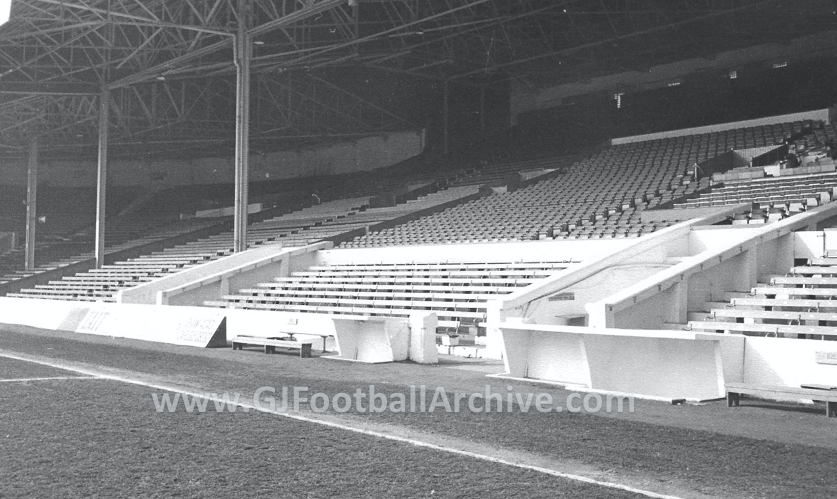
It’s day 20 of my posts counting down to the centenary of Maine Road’s opening game and today’s feature is on the original Maine Road dug outs. Nowadays the playing staff areas take up considerable space wither side of the tunnel at most stadia but for most of Maine Road’s existence there were two concrete bunkers dug out for the manager, physio and maybe one other to sit on. When substitutes were allowed in the 1960s then the sub would also sit there. Inevitably they were cramped and gave an extremely poor view of the game. Basically, the manager would be looking out at leg level.
The main image shows that the City dug out (on the right) had been extended by the time this image was taken in the 1970s. The away dug out (left of the tunnel) is the original size.
City’s dugouts – which actually were dug out – were built at some point after the main construction of the stadium but I’m not exactly certain when. This image from 1926 shows that small benches were originally positioned/built either side of the tunnel.
1926 City v Fulham, Maine Road. Jimmy McMullan with the ball.
The concrete dugout lasted into the 1970s when more modern bus shelter style ‘dugouts’ (but not ‘dug out’) were erected. This image shows the home bus shelter style dugout in 1983 with manager John Benson. The man with the perm hidden mostly by John Benson is comedian Eddie Large. Physio Roy Bailey is the man closest to the camera.
Mirrorpix photo
Even then the originals remained for some time before being demolished when parts of the white wall were rebuilt. I think they’d been fairly redundant for years though. I have photos of them being used at times during the 1960s and 1970s but this image from the 1950s shows they were empty on many matchdays.
1971 ECWC v Chelsea. Tony Book and mascot Paul Todd. Photo by Alan Jubb
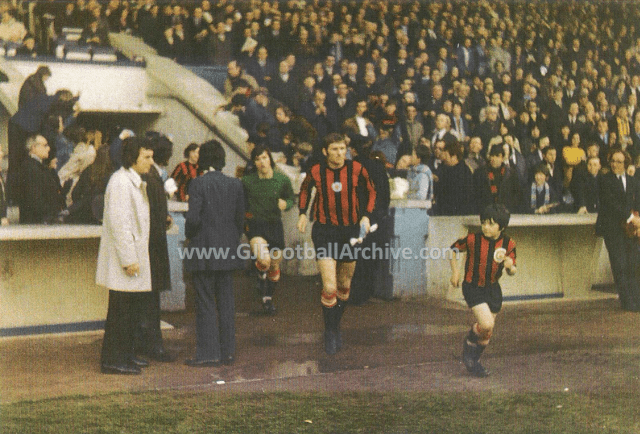
The above image is of the same dugouts in 1971. I tend to think that by this time they were only used if it was a wet day as they provided a little bit of shelter. Notice the bar scarfs in the crowd – blue & white; red & black and one that’s blue & white with a thinner maroon bar too.
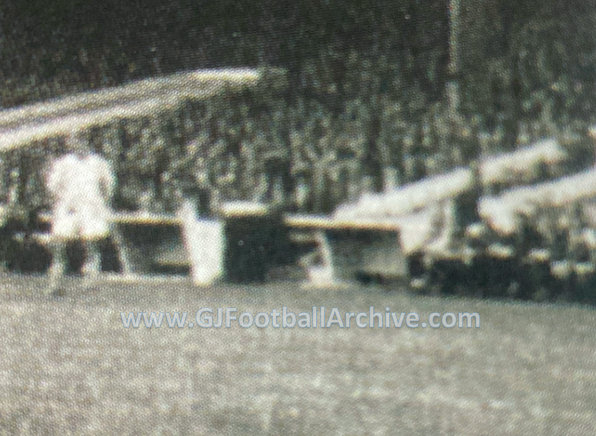
For decades, the manager’s dugouts weren’t the only ‘dugouts’ at the ground as there were also similar arrangements for the police and/or St John Ambulance personnel in Maine Road’s corners. These seemed to be in use into the 1960s as this image shows. Look carefully to the right of the player on the right and you can see two police or St John’s Ambulance staff in a corner dug out near the Kippax. This image is from the early 1960s.
These also disappeared when parts of the white wall were rebuilt and gates added in the corners.
For those unfamiliar with Maine Road this photo may help locate the player dugouts. You can’t really see them but one was positioned in the white wall in front of number 1 and one to the left as we look of the central tunnel next to 1.
Maine Road aerial 1971 from Farewell To Maine Road
If you’d like to read more on the history of Maine Road, take a look at Farewell To Maine Road, which can be downloaded from this page:
If you enjoy all the free material on my website and would like to support my research and keep this website going (but don’t want to subscribe) then why not make a one-time donation (or buy me a coffee). All support for my research is valued and welcome. It allows me to keep some free material available for all. Thanks.
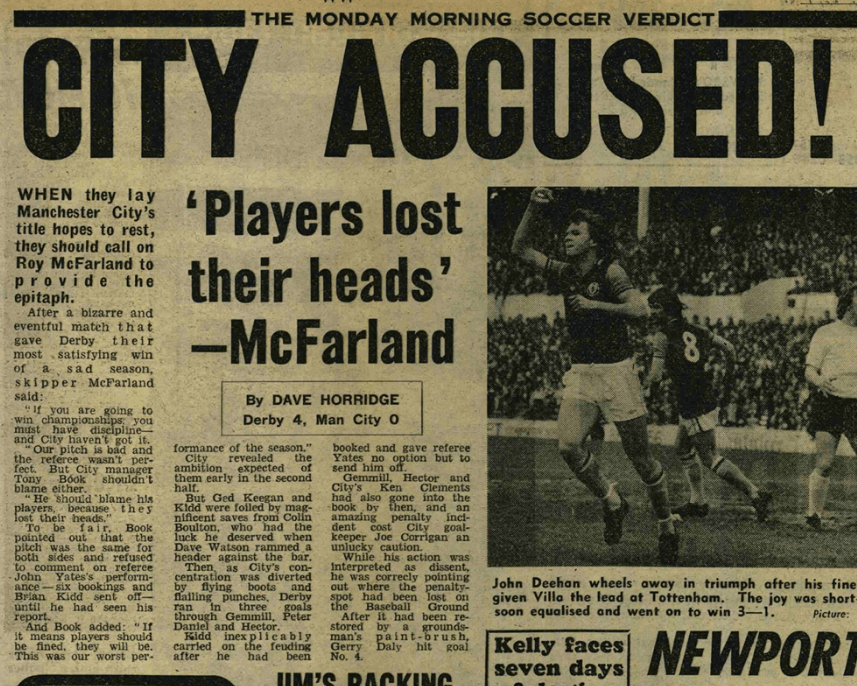
City were still in with a shout of the title after three successive victories against Middlesbrough (1-0), West Bromwich Albion (2-0), and Birmingham (2-1) when they went to the Baseball ground to face Derby County on this day (30 April) in 1977. The game was televised and it included one of those moments that made commentator John Motson quite giddy.
The pitch was quite muddy and when Derby got a penalty City ‘keeper Joe Corrigan challenged where the penalty spot was believed to be and insisted on it being properly measured. At one point he counted out the steps, much to the delight of the crowd.
Unfortunately, this had been a bad tempered game against a team struggling. It ended in 4-0 City defeat at Derby and it was a huge set back, especially as Derby scored all four in the last 25 minutes. In addition Brian Kidd was sent off.
The Blues remained second however, two points behind reigning champions Liverpool, one point above Ipswich, and Tony Book remained determined. The truth was, however, that with four games to go, time was running out. As with European competition at this time, Liverpool were used to surviving the League marathon, City were not and the Blues missed the title by a point. It would’ve been different had this game gone City’s way.
Follow this link to watch the highlights on youtube:
On this day (11 January) in 1977 Joe Royle ensured Manchester City progressed to face Newcastle United in the FA Cup by scoring the only goal of the Third Round replay at West Bromwich Albion. The first game had ended in a 1-1 draw at Maine Road. You can read more about the 1976-77 season here:
On this day (7 January) in 1977 the BBC in the northwest showed this incredible profile. On several occasions over the last decade myself & Will McTaggart have included this video profile of MCFC chairman Peter Swales in our Boys In Blue film show. Each time those who missed it have asked if they could see a video of it. That wasn’t possible until a few months ago. You can see the Swales profile here…
I would urge all MCFC fans and others to watch this in all its glory. Some of you may wish to jump to the David Brent-esque clip at 3 mins 20. Others may want to see the Ian Niven roof plan that was thwarted by signing Dave Watson at 1 min 45 secs. Then there’s the scene where Swales gives Watson financial advice (45 secs) and it ends with Swales telling us he was a bit like Kevin Keegan (4 mins).
As League Cup holders Manchester City expected to challenge for honours again in 1976-77. It became a remarkable season with some incredible highs; important transfers; return form injury and much more. You can read all about that season in this 2000+ word article.
Subscribe to get access
This article is available to subscribers. Annual subscribers get access to everything posted on this site since December 2020 (including PDFs of 2 out of print books and audio interviews with Malcolm Allison John Bond etc.) while monthly subscribers get access to everything posted since 1 October 2022. It costs £20 for annual subscription (here) and £3 per month for monthly subscription (below)
This article is available to subscribers. Annual subscribers get access to everything posted on this site since December 2020 (including PDFs of 2 out of print books and audio interviews with Malcolm Allison John Bond etc.) while monthly subscribers get access to everything posted since 1 October 2022. It costs £20 for annual subscription (above) and £3 per month for monthly subscription (here)
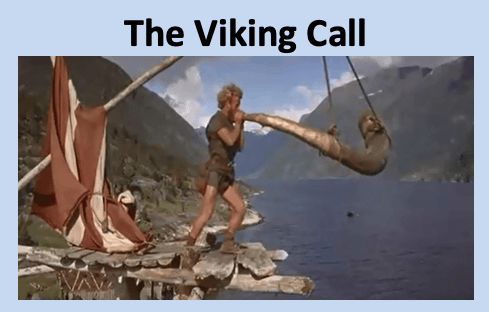
On this day (23 October) in 1976 Manchester City fans first did their ‘Viking Call’. The chant eventually evolved into ‘The best team in the land and all the world’ but for some time was basically City fans doing a C-iii-ttt-yy chant to the first part of the song. You can hear the song and find out its story in this talk I did earlier in 2022 (if you don’t want to watch the full talk, jump to about 23mins 40 seconds for the Viking Call story):
On this day (15 September) in 1976 Manchester City defeated Italian giants Juventus 1-0 at Maine Road in the UEFA Cup. A crowd of 36,955 watched Brian Kidd net the only goal. You can read about the game and watch highlights here:
Subscribe to get access – Monthly
This and all other content is available when you subscribe. It costs £3 per year to access everything posted since 1 October 2022 and everything to be posted during your subscription. Cancel anytime. Or there’s a special annual subscription (see below). Have a search and see what’s available.
This and all other content is available when you subscribe. You can subscriber for the special annual price of £20 a year (about £1.67 per month) to access everything on the site since it went live in December 2020.
Here it is online at last! On several occasions over the last decade myself & Will McTaggart have included a video profile of MCFC chairman Peter Swales in our Boys In Blue film show. each time those who missed it have asked if they could see a video of it. That’s never been possible until now! At long last you can now see the Swales profile here…
The BBC have included it in a series of films recently released. I would urge all MCFC fans and others to watch this in all its glory. Some of you may wish to jump to the David Brent-esque clip at 3 mins 20. Others may want to see the Ian Niven roof plan that was thwarted by signing Dave Watson at 1 min 45 secs. Then there’s the scene where Swales gives Watson financial advice (45 secs) and it ends with Swales telling us he was a bit like Kevin Keegan (4 mins).





 Gary James' Football Archive