On 30 October in 1973 The second round League Cup tie between Manchester City and Walsall went to a second replay. City won the game 4-0 with a hat-trick for Francis Lee, but a pitiful crowd of 13,646 witnessed the match at Old Trafford. City fans didn’t mind playing a 2nd replay, but they did object to it being played at United’s ground.
If you’d like to support my research then why not subscribe? Every subscription directly helps support my research and provides annual subscribers with access to everything posted on this site, including the entire Manchester A Football History and From Maine Men To Banana Citizens books, plus interviews, articles and more. I am not employed by anyone and all my research is self funded or comes from subscriptions to this site.
If you enjoy all the free material on my website and would like to support my research and keep this website going (but don’t want to subscribe) then why not make a one-time donation (or buy me a coffee). All support for my research is valued and welcome. It allows me to keep some free material available for all. Thanks.
New Manchester City manager John Bond’s first cup game was the fourth round tie against Second Division promotion hopefuls Notts County at Maine Road, played on 29 October in 1980 The game had the potential to end in defeat, especially as Bond would be unable to play any of his new signings (remember the struggles pre-Bond’s arrival earlier in the month and the impact he and his new arrivals Now, Hutchison and McDonald had?), nor would the expensive Steve Daley be able to play due to injury.
The match actually ended 5-1 to the Blues with Dave Bennett opening the scoring after 16 minutes. Dennis Tueart was in inspiring form that night scoring the other four City goals, but the result was prof that Bond’s whole approach had lifted the Club. Basically, Bond had taken Allison’s team and given them belief and confidence. Some of the younger players, like Bennett and Caton, may have been given their chance under Allison, but it was under Bond that they started to achieve their potential.
If you’d like to support my research then why not subscribe? Every subscription directly helps support my research and provides annual subscribers with access to everything posted on this site, including the entire Manchester A Football History and From Maine Men To Banana Citizens books, plus interviews, articles and more. I am not employed by anyone and all my research is self funded or comes from subscriptions to this site.
You can subscribe at either £20 per year (above) or at £3 per month here (cancel any time). For those subscribing £3 per month you will be able to access all content from October 2022 onwards for as long as you are a subscriber. Those subscribing £20 a year have access to everything posted since December 2020.
On 28 October in 1981 Manchester City faced their first competitive penalty shoot-out. The League Cup tie with Stoke ended 2-2 on aggregate but it took some considerable effort for either side to progress in the competition. With the penalty shoot-out reaching 8-8 goalkeeper Joe Corrigan saved. Norwegian Aage Hareide made it 9-8 for City and the Blues progressed. You can read what John Bond thought about penalties below.
Today’s the day (27 October) in 1965 when Malcolm Allison won a significant bet with Pat Crerand about attendances at Manchester City. The Blues had drawn 0-0 with Norwich at Maine Road, ensuring City were top of Division Two and looking like promotional hopefuls. A crowd of 34,091 watched the match and Allison was delighted with that figure. The attendance had won him ten pounds off Manchester United’s Paddy Crerand who had told the City coach that City were a ‘dying club’ and bet him the Blues would never get a crowd above 30,000 at Maine Road again! Later that season 63,034 watched City play Everton – an attendance greater than any domestic crowd at Old Trafford that season. Allison had the last laugh of course!
Allison For England
Subscribe to get access
If you’ve enjoyed this then why not subscribe? Every subscription directly helps support my research and provides each annual subscriber with access to everything posted on this site, including the entire Manchester A Football History and From Maine Men To Banana Citizens books, plus interviews, articles and more. I am not employed by anyone and all my research is self funded or comes from subscriptions to this site.
If you’re at the Manchester City game today and are lucky enough to read the match programme, my One Moment in Time feature includes a photo of the Kippax Stand taken about a hour before kick off of a City-Southampton match in November 1982. Here are highlights of that match for those who want to know more about the game:
If you enjoy all the free material on my website and would like to support my research and keep this website going (but don’t want to subscribe) then why not make a one-time donation (or buy me a coffee). All support for my research is valued and welcome. It allows me to keep some free material available for all. Thanks.
It’s City v Southampton today. My match programme feature remembers the Kippax Stand with a photo from a day when the two clubs met. I hope those who get to see it enjoy it. Also, there are plenty of stories connected with both clubs on my website and here’s a selection:
Thirty years ago today (25 October 1994) Manchester City faced QPR in the League Cup in what was an incredible game that kept fans on the edge of their seats. The Blues had already disposed of Barnet 5-2 on aggregate in the second round and clearly expected to put in a good performance at Loftus Road. Sadly, within a minute they conceded a goal just as they had in the earlier League Cup match at Barnet and Brian Horton’s side suffered for a while. By the 37th minute they managed to get their act together a little and Summerbee equalised with a 20 yard volley. A minute later Rangers took the lead again.
Fortunately, in the 46th minute Keith Curle netted a penalty to bring City level once again, followed eight minutes later by a magnificent Beagrie volley which made it 3-2 and brought a series of somersaults from the popular ex-Evertonian. Five minutes later, the same player headed through to Lomas who made it 4-2.
In the 87th minute Rangers pulled a goal back (4-3) to keep City on their toes, but the referee’s whistle signalled the start of a party for the fans while their QPR equivalents began to demonstrate against their chairman. Apparently, some unhappy QPR fans were keen to listen to the advice of a few experienced Mancunian demonstrators!
You can watch highlights of the game here:
The victory gave City a home tie against Kevin Keegan’s Newcastle United.
If you enjoy all the free material on my website and would like to support my research and keep this website going (but don’t want to subscribe) then why not make a one-time donation (or buy me a coffee). All support for my research is valued and welcome. It allows me to keep some free material available for all. Thanks.
At last night’s (23 October 2024) MCFC v Sparta Prague Champions League game a young boy and his mum were sat next to me. It was the lad’s first game and he was so excited before kick off. His enthusiasm was great to see and when the players started warming up near us he couldn’t believe it. It was a great reminder, in these days when social media and even some football commentary, talk of the negatives that football remains something to get excited about.
The first goal was enough for the boy next to me. Sure it was scored at the opposite end and he could hardly see it but he got so giddy. He’d seen a goal (note: where I sit at the back of North Stand Level 1 is one of the few places in the stadium where you cannot see any of the video scoreboards and so never get chance to see the repeats of the goal). It didn’t matter to him whether players are ‘overpaid’ or any of the other complaints that are thrown their way. Nor was the boy bothered about Premier League governance or rules that may or may not have been adapted to limit a club’s success. What the boy was bothered about was seeing Foden, Haaland, Stones & Co.
While some on social media and elsewhere were moaning about missed opportunities or whatever at half time the boy was still jumping up and down with excitement. He couldn’t wait to see his team attack the goal near him. Obviously, he loved every minute of that second half – but he’d loved every minute of the first too. That excitement is great to see and a wonderful reminder that football isn’t about boardroom activity or anything else, it’s about a game where teams try to score.
At one point I heard the boy’s mum suggest they should leave a little early to avoid the crowds but the little lad was adamant he wanted to stay. He was rewarded with the penalty and the anticipation of what that would bring. Again, it’s a nice reminder of how the excitement builds when you see a penalty live in the flesh for the first time.
At the final whistle I left but the boy was still there with his mum no doubt staying to watch every moment until the players disappeared.
How I wish we could all just watch and enjoy football for what it is. Some games/halves may appear dull to some but for others it’s the greatest spectacle they have seen. That boy will remember that game and how he felt for a very long time and, years after most of us have gone, he’ll be telling future generations of his first game; his first heroes; Haaland’s goals and more.
If you enjoy all the free material on my website and would like to support my research and keep this website going (but don’t want to subscribe) then why not make a one-time donation (or buy me a coffee). All support for my research is valued and welcome. It allows me to keep some free material available for all. Thanks.
Last night’s Champions League victory over Sparta Prague was not the first time the Czech side travelled to Manchester to face the Blues. Back on 11 December 1967 Sparta were at Maine Road ready to face City but the game was called off that evening as fans queued to enter the ground. The pitch had been frozen earlier but as the ground thawed it became waterlogged.
That night Sparta invited City to a friendly in Prague but that game never occurred either.
Of course the 1967-68 season ended with City as League champions.
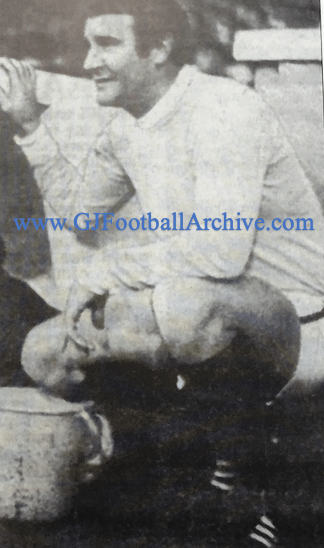
I’m always conscious that time moves quickly within football and that names of legendary players that your parents were familiar with may not be known by your children. Today, as it was 101 years since his birth yesterday (he was born on 22 October 1923) I’m publishing here a brief folklore piece I did on Manchester City goalkeeper Bert Trautmann. Hopefully, some newer/younger football fans may be familiar with the name. If not this may help…
It is one of City’s greatest stories involving a true Blue legend and a remarkable example of how Manchester has always been a welcoming city. Bernhard Trautmann was born in Germany in 1923 and, as a keen young athlete, he became a member of the Hitler Youth. He had high hopes of representing Germany in the decathlon at the 1940 Olympic Games and went to Berlin for several training camps. Sadly, war was to end all possibility of him becoming an Olympic hero.
Indoctrinated throughout his teenage and early adult life, Trautmann became a paratrooper during World War Two. The simple facts of what followed are astounding:
After being captured and escaping from the Russians and the Americans, Trautmann became a Prisoner of War held by the British.
He began playing as a goalkeeper while a prisoner.
He joined St Helen’s Town.
City’s goalkeeping crisis meant the Blues were desperate for a ‘keeper, any ‘keeper!
Trautmann given chance and joined City.
Protests and season tickets returned in disgust, but some including Rabbi Altmann spoke in support
Known as ‘Bert’, Trautmann soon became a hero to City fans.
In 1955 he became the first German to play in the FAC final.
1956 he helped City win the FA Cup.
In the 1956 final Trautmann was outstanding, diving brilliantly at times and bravely often. With a little over 15 minutes left to play the ‘keeper made a daring save at the feet of Birmingham’s Murphy. The collision left Bert in tremendous pain and film of the final shows that his head and neck were at an odd angle. The ‘keeper bravely played on, despite obvious pain. No one knew the full extent of the dramatic injury and then a second collision occurred a short while later. These were the days before substitutes and City had been down to ten men the previous year. Bert knew that it had cost them the final, but the pain was excruciating.
City won the FA Cup and in the days that followed the full extent of Bert’s injury was revealed. It was claimed he had ‘broken’ his neck and that a slight knock could have killed him.
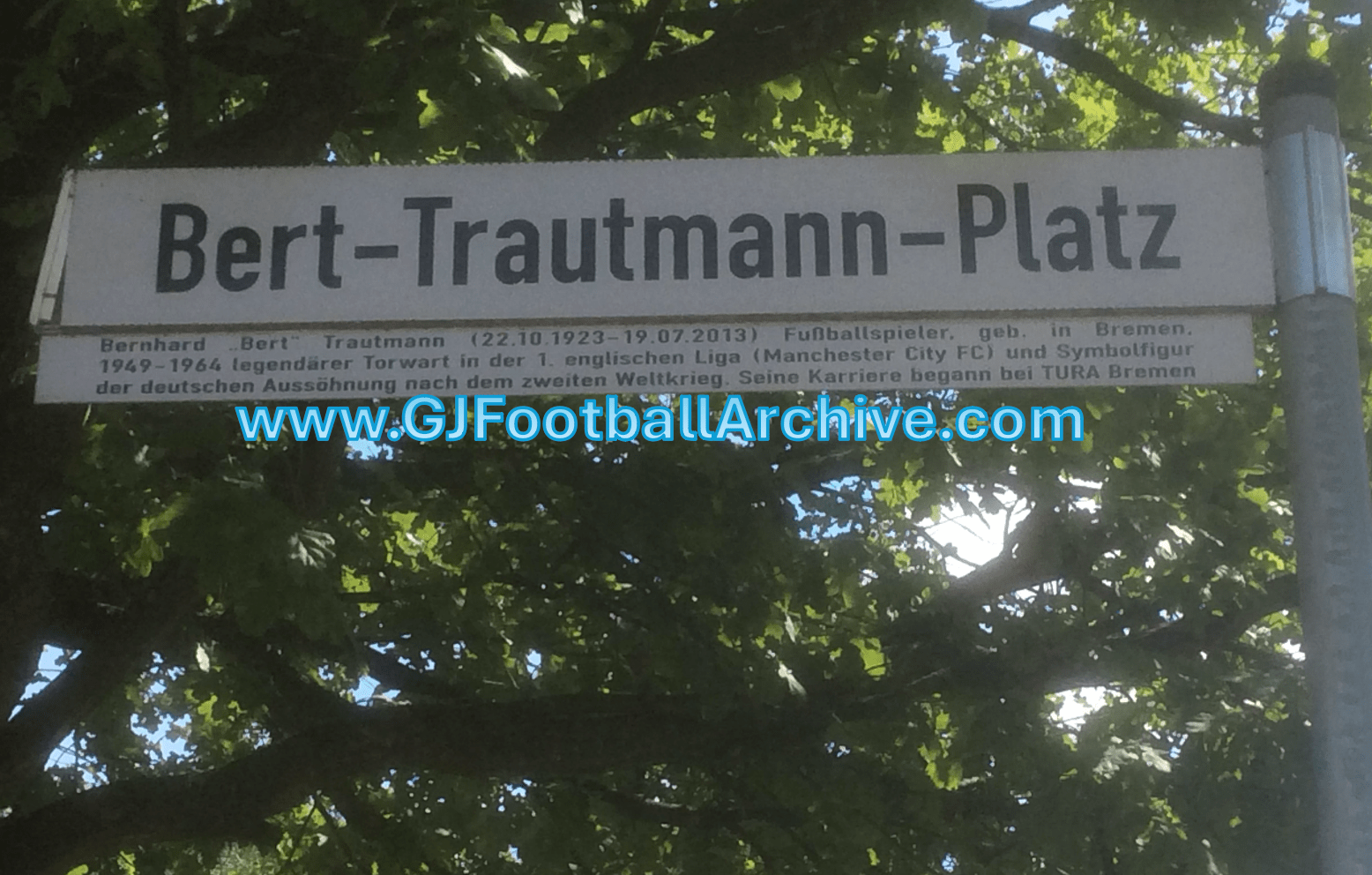
Bert’s home city of Bremen, Germany, is well worth a visit and his boyhood home is still standing. There is also a small square named after him, next to his first football club Tura Bremen – where he played as a midfielder! Significantly, the square uses the English version of his name, adding to the view that Trautmann did so much for Anglo-German relations.
Bert once told me “I was born in Germany but I grew up in Manchester”. Now his birth city recognises his significance to our city.






 Gary James' Football Archive