The new series on Manchester City in the 1920s continues today with a 3,000 word subscriber article on the 1923-24 season. If you subscribe (see below) I hope you enjoy it. If you are not currently a subscriber then why not try it for a month (£3 per month or sign up for a year at a discounted £20 per year)?
Here’s the article:
Subscribe to get access
Read more of this content when you subscribe today. It costs £3 a month (cancel anytime) or sign up for a year at £20 per year. Subscribers have access to the 1000s of articles, features, interviews etc. posted so far and all those posted during your subscription.
The new series on Manchester City in the 1920s continues today with a 1,500 word subscriber article on the 1922-23 season. If you subscribe (see below) I hope you enjoy it. If you are not currently a subscriber then why not try it for a month (£3 per month or sign up for a year at a discounted £20 per year)?
Here’s the article:
Subscribe to get access
Read more of this content when you subscribe today. It costs £3 a month (cancel anytime) or sign up for a year at £20 per year. Subscribers have access to the 1000s of articles, features, interviews etc. posted so far and all those posted during your subscription.
This is an interesting cutting from 1935 talking about the possibility of increasing Maine Road to cope with the huge crowds that wanted to watch Manchester City play. It may seem crazy today but wasn’t such an odd idea in the 1930s. You can find out more on the story here:
On this day (31 July) in 2008 Manchester City played a home game at Barnsley. This game made history as it was the first occasion the Blues had played a home European tie outside of Manchester. Previously City had played home European games at Maine Road and at the City Of Manchester Stadium, but work at Eastlands following a concert by Bon Jovi prevented the Club from staging the game at home. The decision was taken to stage the match at Barnsley. Subscribers can read about both legs of the European tie here:
It wasn’t the first game under floodlights for Ardwick (Manchester City’s predecessors) but it was a significant occasion when on Monday 10 March 1890 the club played Everton under lights at Hyde Road. This match report describes the game. Notice that not much is said about the lights themselves. That’s because it wasn’t the first occasion the club had played under lights in Manchester and those reading the report would be expected to know what Well’s patent lights were due to the features that had been written previously.
People often talk of the 1950s as being the birth of floodlit football but, of course, like many things in football’s history there had been firsts decades earlier.
On 14 October in 1953 the first game under floodlights at Maine Road took place, Manchester City 6 Hearts 3. Here’s an article about that period and City’s first formal floodlighting system, including a photo from the actual game and another report.
Subscribe to get access
If you’d like to read this article then why not subscribe? The £20 annual subscription works out about £1.67 per month. Every subscription directly helps support my research and provides annual subscribers with access to everything posted on this site, including the entire Manchester A Football History and From Maine Men To Banana Citizens books, plus interviews, articles and more. I am not employed by anyone and all my research is self funded or comes from subscriptions to this site.
On July 16 in 1986 Queen played Maine Road. This was often considered to be the first major concert at Manchester City’s old stadium. However, it wasn’t. The first was actually a concert by David Cassidy in May 1974. This feature takes a look at that concert and the one by Queen which set the tone for legendary music performances at Maine Road.
Subscribe to get access
If you would like to read this and all the in-depth articles on this site (including the entire Manchester A Football History book) then please subscribe. It works out about £1.67 a month if you take out an annual subscription (£20 per year). Each subscriber gets full access to everything posted so far and the hundreds of articles scheduled to be posted in the coming year.
It’s worth comparing this image from recent years, showing the housing and school now built on Maine Road, with this 1940s image of the Maine Road site. The boundary lines are visible, demonstrating how the site changed usage.
This 1971 aerial image shows the stadium from another angle, looking west.
Maine Road aerial 1971 from Farewell To Maine Road
If you’d like to read more on the history of Maine Road, take a look at Farewell To Maine Road, which can be downloaded from this page:
If you enjoy all the free material on my website and would like to support my research and keep this website going (but don’t want to subscribe) then why not make a one-time donation (or buy me a coffee). All support for my research is valued and welcome. It allows me to keep some free material available for all. Thanks.
It’s 1941 and there are air raids across Manchester… Have a look at this map. What does it signify? Well, the map shows Manchester City’s Maine Road Stadium as it looked between 1931 and 1934, before the main part of the Platt Lane Stand was built (and after the corner was erected). But that’s not why I’ve posted it. I’ve posted it because of those pen circles that appear on it.
This is actually a Manchester City Council plan of buildings hit by bombs in the area immediately east of the Maine Road stadium. As you can see a house in Thornton Road was hit but none of the Maine Road stadium itself was hit in those January 1941 raids on Manchester. The stadium had a lucky escape but sadly many residents and Mancunians did not.
1941 Bomb damage near Maine Road
Here’s an aerial photo of Maine Road from 1971 to give a feel for the site. The Platt Lane corner is number 3 and Thornton Road is the street that backs on to Maine Road near number 6.
Maine Road aerial 1971 from Farewell To Maine Road
If you’d like to read more on the history of Maine Road, take a look at Farewell To Maine Road, which can be downloaded from this page:
If you enjoy all the free material on my website and would like to support my research and keep this website going (but don’t want to subscribe) then why not make a one-time donation (or buy me a coffee). All support for my research is valued and welcome. It allows me to keep some free material available for all. Thanks.
As part if my Maine Rd 100 countdown in 2023 I posted this image of Manchester City fans demonstrating against chairman Peter Swales and his supporting board of directors. It’s always worth remembering those days as a reminder of how things change.
Of course fans still demonstrate and make their feelings known over various issues (as is their right) but these days it tends to be over specific issues. Back then it was about the direction of the full club. This image was from 1983 but protests against Swales and the board began in 1979 and continued until 1993-94. Here’s a photo of John Bond stood in front of the Main Entrance in 1983. The ‘cage’ protecting the entrance would often get locked to prevent fans forcing their way in during demonstrations.
John Bond, 1983
Here’s a 1995 image of Maine Road showing the forecourt in front of the Main Stand where most demonstrations occurred:
On this day (29 May) in 1961 thousands were able to sit on benches installed on the Kippax for the first ever time. But wait a minute, the Kippax wasn’t seated until 1994-95 or was it? So read on to find out what happened in 1961…
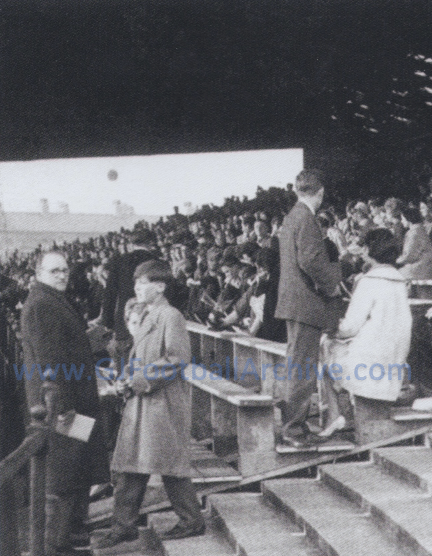
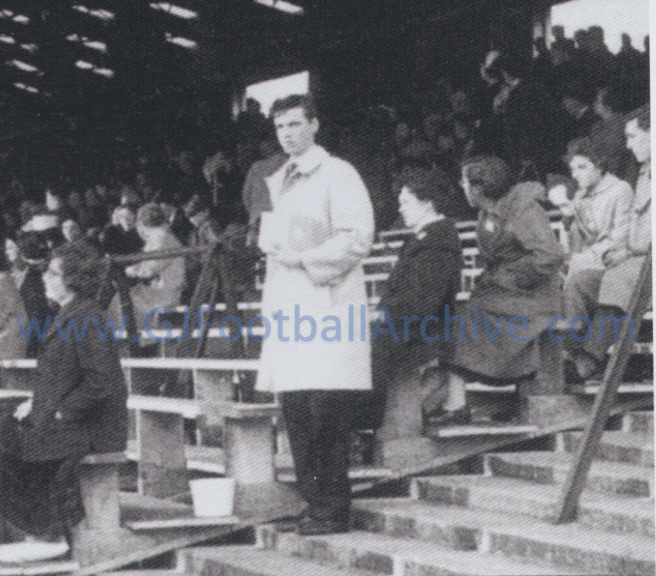
Maine Road staged one of the religious events where American evangelist Billy Graham came to preach to thousands in 1961. I cover the story in detail in Farewell To Maine Road but these images show that temporary seating was installed on the Kippax for the event, which took place between 29 May and 17 June 1961.
At this time there were no gates in the Kippax’ perimeter wall leading to the pitch and so special scaffolding steps were erected to allow attendees to climb over the wall and on to the pitch for blessings etc.
Were you at one of these religious events? If so leave your comments about the day below.
For those unfamiliar with Maine Road’s layout at the time, the above photo was taken from about a third of the way up the Kippax between number 6 and 8 on this photo.
Maine Road aerial 1971 from Farewell To Maine Road
If you’d like to read more on the history of Maine Road, take a look at Farewell To Maine Road, which can be downloaded from this page:
If you enjoy all the free material on my website and would like to support my research and keep this website going (but don’t want to subscribe) then why not make a one-time donation (or buy me a coffee). All support for my research is valued and welcome. It allows me to keep some free material available for all. Thanks.


 Gary James' Football Archive