Already this website tells the story of Manchester City with seasonal articles on every season from 1890-91 (Ardwick) through to 2009-10 and throughout February I’ll be adding the history of the Club prior to 1890. Starting with material from the 1850s and the establishment of an organisation that was to play a major part in the establishment of the Club, I’ll be telling via a series of articles the story of key individuals/origins/moments that contributed to the establishment of a football club. The series starts tomorrow with the first feature on the 1850s. Watch this space!
Subscribe to get access
These articles will be available to subscribers to this site. It costs £3 per month (cancel any time) or sign up for a year for the discounted price of £20 per year (works out about £1.67 a month to access every article on this site). To date in excess of 1,500 articles/features have been posted including interviews, talks and more.
If you enjoy all the free material on my website and would like to support my research and keep this website going (but don’t want to subscribe) then why not make a one-time donation (or buy me a coffee). All support for my research is valued and welcome. It allows me to keep some free material available for all. Thanks.
It’s now almost 40 years since I first started detailed research into the history of Manchester City and its origins, and it’s an area that is still fascinating. I still keep being asked about the origins of Manchester City, particularly the period prior to 1894 and I love the fact so many are interested in the steps that led to the establishment of what has become a major, global footballing power. I’ve posted much about those early years on this site but I know it’s often in a scattered style making it difficult to find, so here for those interested, are links to past articles on key figures and moments in the St Mark’s, West Gorton, Gorton AFC, Ardwick & associated clubs’ history. Tomorrow from noon for 24 hours I’ll be giving free access to a video I did a while back on the origins (details of the video lower down this page).
Firstly, the earliest known game (note: not necessarily the first game!):
Walter Chew, a man occasionally described as ‘The Father of Manchester City’ (though he himself tells a different story and in a 1920s interview told his eye witness story of who the actual founder was):
A man every Blue should know about, Lawrence Furniss. A player with Gorton, Ardwick secretary-manager, MCFC director, chairman responsible for move to Maine Road, Life President when City won the title in 1937. He saw it all and was involved from the 1880s through to 1940s when he died:
The facts not the fiction…. There are so many myths, assumptions, exaggerations etc. doing the rounds so hopefully this piece I wrote a few years back helps to explain:
On 1 February 2023 I performed an online talk on the latest research into the origins of City, focusing on the period prior to 1887 when the club was based in the West Gorton and Gorton areas. Tomorrow from noon I’ll post this for all to see for free for 24 hours, but if you can’t wait or miss it then it is already available here for subscribers to the site:
There are still many gaps in our knowledge even though material has been rediscovered in recent years. There are some things we won’t know but over the coming weeks I’ll post more on the early years. Some will be available to all, some to subscribers but I’m sure there’ll be lots out there to enjoy.
In the meantime why not search the website or use the tags to see articles on the period prior to 1894. Every season of the 1890s for example has a detailed article written about it while individual games, players and related stories are also included within the thousands of posts on this site. Here’s a link to the 1890-91 season for example:
The origins of Manchester City, like many other clubs, have been misunderstood or incorrectly reported over the years and there are many areas of ongoing research that will fill the gaps over the coming years. It takes time and effort to research at the level needed. When I first started researching there were some stories that had been passed down for years that have since been challenged and corrected but there are many other areas to reflect on. There are, of course, many other areas where further research is still needed.
For years I’ve worked with a variety of people on the origins of City (one of the key elements of my PhD research was on the origins of men’s and women’s football in Manchester and my research into this continues). In the 2010s MCFC set up a research group called Project Blue which I willingly helped and explained the myths that exist and what we still don’t know. The following slide was part of a lengthy presentation I performed on 14 December 2011 on that where I explained how we got where we were at the time and those who had worked together on uncovering the club’s early history.
One of my slides presented to the history research group Project Blue on research into Manchester City’s origins on 14 December 2011
I was always grateful to Dennis Chapman, John Maddocks and Ray Goble who welcomed me into their ‘club’ of research and others, such as Dave Masey who, like me, was a member of the Association of Football Statisticians. Dave continues to help my research. Thanks to these guys and others when I was starting out I have tried to ensure I help and support others researching. The more we research and share, the greater our collective knowledge.
There is still much to be done and sadly lots we will never know.
Whatever research is uncovered over the coming years one thing is clear and that is the history and origins of Manchester City are wrapped up in community initiatives and a desire by some to use football as a positive, community building enterprise. People like William Sumner, Walter & William Chew, Lawrence Furniss and Joshua Parlby should always be remembered for their part in the formative years of football in our city.
There is much research still to be done. If you’d like to support this research then please subscribe to the site and you’ll have access to hundreds of articles, interviews, talks etc. You could join for a month and see what you think.
Subscribe to get access – Annual
To support the site and have access to everything posted costs £20 a year (about £1.67 a month) or £3 to subscribe a month at a time (see below).
Monthly subscribers access everything posted since 1 October 2022 and can cancel anytime. All subscribers access everything posted during their subscription too.
If you enjoy all the free material on my website and would like to support my research and keep this website going (but don’t want to subscribe) then why not make a one-time donation (or buy me a coffee). All support for my research is valued and welcome. It allows me to keep some free material available for all. Thanks.
On this day (31 August) in 1948 the death was announced of Walter Chew, a man associated with the first known season of St Mark’s (though there are serious doubts on whether the 16 year old played in the earliest known game based on his own comments). St Mark’s is vital in the development of Manchester City. Chew was a key figure in the club’s formative years but there are some myths out there about him and that time. His obituary above is from August 1948 which says he was 84 at the time of his death. You can find out more about Chew and the latest research below:
Subscribe to get access – Annual
Read more of this content when you subscribe today. Annual subscribers can access all the articles, talks, books and interviews posted since December 2020 for an annual subscription of £20 (works out about £1.67 per month). There’s also a monthly subscription (see below).
Monthly subscribers can access all the articles, talks, books and interviews posted since 1 October 2022 for a monthly subscription of £3 (cancel any time).
It wasn’t the first game under floodlights for Ardwick (Manchester City’s predecessors) but it was a significant occasion when on Monday 10 March 1890 the club played Everton under lights at Hyde Road. This match report describes the game. Notice that not much is said about the lights themselves. That’s because it wasn’t the first occasion the club had played under lights in Manchester and those reading the report would be expected to know what Well’s patent lights were due to the features that had been written previously.
People often talk of the 1950s as being the birth of floodlit football but, of course, like many things in football’s history there had been firsts decades earlier.
On 14 October in 1953 the first game under floodlights at Maine Road took place, Manchester City 6 Hearts 3. Here’s an article about that period and City’s first formal floodlighting system, including a photo from the actual game and another report.
Subscribe to get access
If you’d like to read this article then why not subscribe? The £20 annual subscription works out about £1.67 per month. Every subscription directly helps support my research and provides annual subscribers with access to everything posted on this site, including the entire Manchester A Football History and From Maine Men To Banana Citizens books, plus interviews, articles and more. I am not employed by anyone and all my research is self funded or comes from subscriptions to this site.
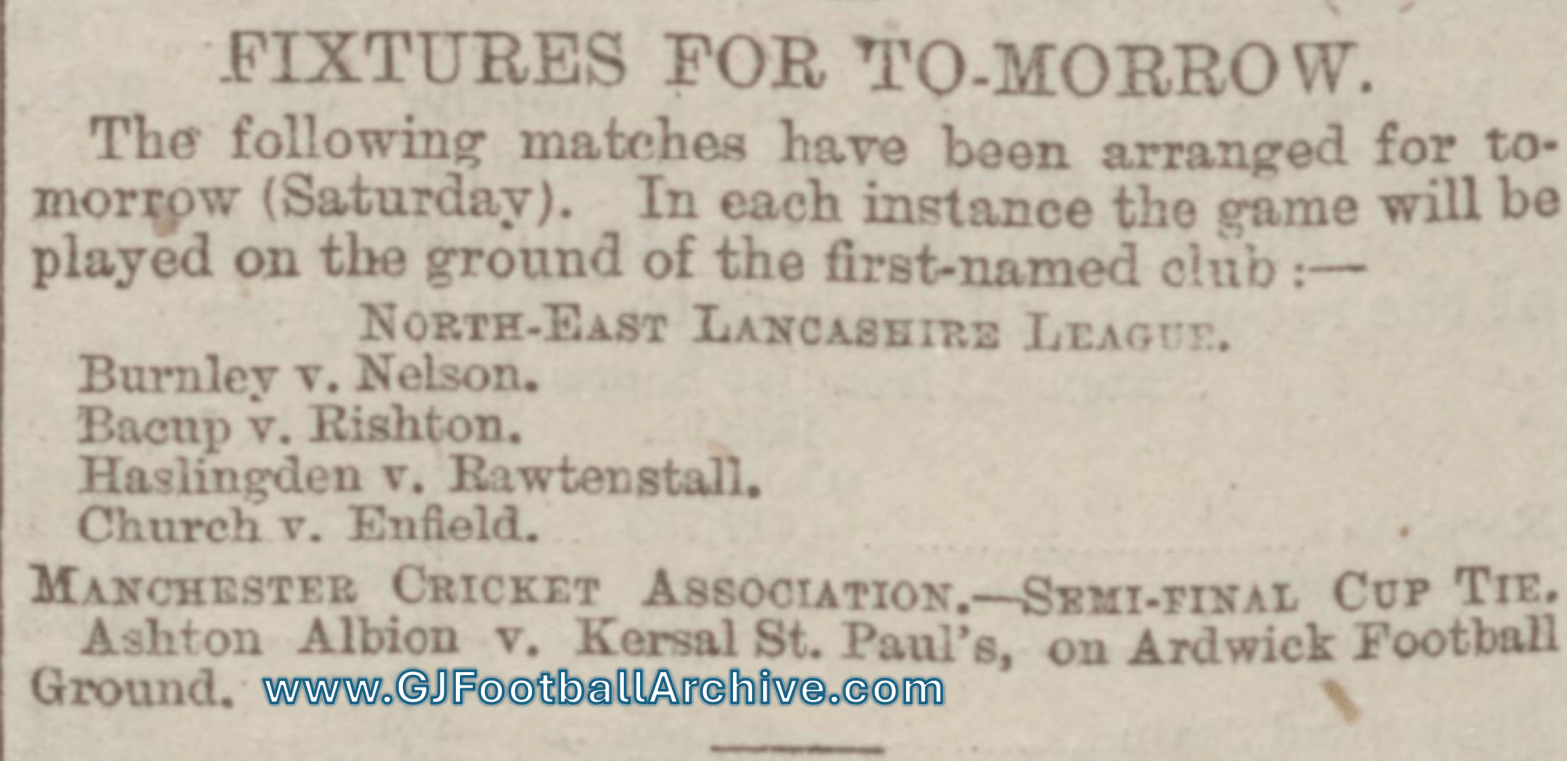
There have been games of cricket played by Manchester City over the years and there have been occasions when other sports, such as rugby and tennis, have been played at City’s grounds but it may surprise some to know that cricket has also been played at the club’s venues. Back on 24 July 1891 a Manchester newspaper listed this cricket fixture to be played at Hyde Road (at the time the ground of Ardwick AFC – City’s predecessor). It won’t have been the only cricket match there and the site had been known to stage bare knuckle boxing bouts years before the football ground was built there.
2025 marks the 140th anniversary of the first final of the Manchester Cup (later known as the Manchester Senior cup). The Manchester Cup was the first competition either Manchester United (as Newton Heath) or Manchester City (as Ardwick) won and was a hugely significant competition at the time of their first victories. In many ways it was more important locally than the FA Cup. The final was held on 25 April 1885 and you can read a match report of the game here and then my own words on the final:
The first season of the Manchester Cup proved to be very exciting with games involving Hurst and Newton Heath grabbing much attention in the local newspapers. In fact the two sides competed in the first Manchester Cup final. This was played at Manchester FC’s Whalley Range ground and had an attendance of approximately 3,500. The Ashton club won 3-0 and at the end of the match all the Hurst players were lifted shoulder high by their fans and there was tremendous excitement on the pitch. It was perhaps the first time a Manchester side had experienced success that actually meant something. Hurst could rightly claim to be the best in the area, and after the game finished the President of the Manchester FA, Mr. Colbert, presented the cup to J. Ingham, Hurst’s Captain. The Reporter newspaper then described the fantastic parade that took place all the way back to Ashton: ‘All the way from Whalley Range the victors kept cheering and the band playing, the cup being held up in front of one of the carriages in which the journey to Ashton was made. On arriving in town their cheers were redoubled and they received a great ovation in the streets.
‘The victors crowded into the Pitt & Nelson, and Mr. Joseph Fletcher, holding in his hand the cup which was filled with liquor, and addressing the captain of the club, said he had great pleasure in presenting to Mr. Ingham the cup on behalf of the Hurst Cricket & football Club.’
Joseph Fetcher was the landlord of the Pitt & Nelson and according to the Reporter he made a speech saying that he: ‘had lately been in Blackburn and he could assure them that the fame of the Hurst club was well known in that district and he was certain that the next season they would be called upon to play with teams from that district, the Mother of the Game.’
This was undoubtedly the finest moment for any of the Manchester clubs at this stage in history, and Hurst were worthy recipients of the praise. Hurst had done more than most to encourage the game to develop and, as well as entering the FA Cup, they also tried to arrange fixtures with teams beyond the Manchester boundaries. In March 1885 they had welcomed Welsh side Rhyl to Hurst and the Ashton side won 8-1 before 3,000 fans, then on Good Friday they played their return match and, according to reports from the period over 750 fans travelled from Ashton for the game which Hurst won 4-0. Considering the nature of travel, working conditions, and the state of the game at the time this was a major achievement.
You can find out more about the origins of football in Manchester in my book Manchester A Football History. The book is long out of print but PDFs of the entire 2010 edition is available to subscribers to this site.
This is the Introduction for the 2010 edition of the book Manchester A Football History (Gary James, published by James Ward). As with everything else on this site copyright laws apply. The book is published here for the personal use of subscribers to this site. For any other use please email the publishers at info@manchesterfootball.org
Subscribe to get access
Read more of this content when you subscribe today. You can subscribe for £20 a year (works out about £1.67 per month) or £3 per month (cancel any time). Why not try it for a month?
On 13 November 1880 the earliest known game played by St. Mark’s Church side took place in Gorton and ended in a 2-1 defeat by the Baptist Church from Macclesfield. Both sides fielded 12 players and the first St. Mark’s goalscorer was James Collinge. There are a lot of myths about the origins of the club (some are quite infuriating!) so a while back I performed an online talk on the latest research into the origins of City. I focused on the period prior to 1887 when the club was based in the West Gorton and Gorton areas. This was extremely well received and can be viewed by subscribers below. I’ve also written the following article to help explain all too.
By the summer of 1894 St. Mark’s had evolved into Manchester City.
For this article I’ve decided to go through some of the details of City’s birth and highlight some of the key themes from that talk.
Often it is assumed that there’s nothing else to learn about the history or origins of a football club but, with deep research and determination, we can uncover material and stories long forgotten. The origins of City, like most clubs, are often difficult to trace and I’m aware of some football clubs that present stories as if they are facts without the evidence to back them up. Fortunately, the current leaders of City have always been keen to ensure the club’s history is remembered and recorded correctly. Mistakes and assumptions have been made over the decades but, thanks to the efforts of several people, the club has a desire to record its history correctly.
I’ve spent decades researching the origins of our club – Back in 1986 I started to search for match reports from our earliest known season as St Mark’s in 1880.
Some of Gary James’ microfilm copying requests at libraries during the 1980s
However, there are still many gaps in our knowledge. New material has been found in recent years. As a slight diversion it’s worth talking about a frustrating day’s research I had which ultimately turned out to be hugely beneficial.
About four years ago while researching for the book The Emergence of Footballing Cultures: Manchester 1840-1919, I travelled to an archive to search through physical copies of a newspaper. It had been a long stressful journey and there were many issues obtaining the material I needed. With about thirty minutes to go before the archive closed they brought out a newspaper binder I needed to research but it was wrapped in plastic. The archivist said: ‘I don’t think I can let you look at this as it’s so badly damaged.’
I explained about travelling some distance; what I was doing; how important this material was and so on. The ‘paper had never been microfilmed or digitised and so the only option of reviewing this 100-year-old newspaper was to see this physical copy. The archivist inspected the newspaper and clearly took pity on me saying: ‘Go on then, you can look at it for the next half hour. After that it’s going back in storage and may not come out ever again.’
Frantically, I searched through the paper before spotting the treasure I’d been hoping for – a series of articles on early football figures talking about team’s origins in the 1880s. I spotted one on a Newton Heath (Manchester United) figure who spelt out that their first colours were red & white (not green & gold) and named the person who had introduced football there then, a few issues later, I found the real gold and that was an interview with Walter Chew. Chew has, for over a century, been described by some as the father of Manchester City. In this feature he formally named the club’s first ground ‘Farmer’s Field’ which backed entirely an assumption I’d made and wrote about in the mid 1990s which went against common thinking at the time. That was satisfying but then the article added an angle I had never expected. Walter claimed his brother William and his friends founded the St Mark’s football team while Walter founded another team, Belle Vue Rangers, which is also one of the roots of our club.
For decades we have assumed that the W Chew listed in the first St Mark’s match reports was Walter Chew because of his years of service to the club and Manchester football. Occasionally, both Walter and William played in the same St Mark’s team and when that occurred Wm Chew was sometimes written, but when only one brother played then he was listed as W Chew. This is an area of research that is still ongoing but if Walter’s own views are correct then it makes absolute sense that the W Chew in the earliest known game was William not Walter. Walter was only 16 at the time (his obituary in 1948 reveals he was 84 at the time of his death, which means he was 16 in November 1880 when the earliest recorded game took place – though of course there may have been earlier games!), while all the other players were 17-20 in that first team. William was 19.
Two years after St Mark’s earliest known game 17-year-old Walter bought a ball and set up Belle Vue Rangers with other local lads from the West Gorton area.
Walter’s claim that his brother William and friends created the St Mark’s team is sensible. We’ve always known that some of the boys who played cricket for St Mark’s set up the football team and one of those was 19-year-old engineering student William Sumner. I’ve written about William often over the years and have stated previously that I believe he may well have been the one with football expertise due to his schooling and experiences as a boy.
Sumner was the first captain and was lodging within the St Mark’s parish from 1879, while studying at Owens College (Manchester University). I believe he organised some football coaching sessions which occurred during 1880. The earliest known actual game of football came in November 1880 when St Mark’s played the Baptist Church from Macclesfield. There were 12 players on each team and almost every member of the St Mark’s team has been found in a St Mark’s cricket match report too. The cricket team, incidentally, first played in the 1860s and I’ve traced a match report from 1867.
Sumner was clearly a talented footballer and despite an injury which limited his playing involvement with the club, he joined the more significant (at the time) Manchester AFC andIn later years Sumner also played for Manchester FC. It has often been stated that he played for them in a FA Cup tie against Stoke in November 1883, however ongoing research (January 2023) suggests that was another player ‘A. Sumner’.
Genealogist Glen Midgley has researched William Sumner’s life extensively and he discovered that Sumner was born on 21 December 1860 in the Barton area. He died when he was only in his forties.
19-year-old Sumner seems the most likely person to have introduced football to St Mark’s. William Chew was also 19 and it’s possible the two men discussed the sport while playing for the cricket team, but we’ll never know for certain. As with so many football clubs it seems unlikely that the specific person who introduced football to St Mark’s will ever be conclusively identified. Perhaps that’s how it should be because the club succeeded because of many, many individuals.
There isn’t enough space here to go into everything we know but it is important to list a few key facts from those early years:
St. Mark’s Church was consecrated in 1865.
First rector was Irishman Arthur Connell and he played a leading ‘community’ role. He set up a savings bank, library, school, ragged school, soup kitchens and much more.
Arthur Connell
St Mark’s had a very active social scene and by the mid 1870s St. Mark’s Cricket Club existed (ongoing research shows it began in 1860s, shortly after church opened; reports have been found from 1867).
In November 1880 the earliest reported association football match was played by St. Mark’s BUT contemporary reports do not claim this to be the first. As the opposition were a team from Macclesfield it seems likely that earlier games against teams closer to West Gorton would have been staged. There were certainly clubs playing football within a few miles of St Mark’s.
The earliest reported St Mark’s rugby game was also played that same week.
The 12 players who appeared in the earliest known football game were: Charles Beastow; William Sumner, Frederick Hopkinson, W Chew (previously assumed to be Walter but probably elder brother William), Henry Heggs, William Downing, Richard Hopkinson, Edward Kitchen, ‘A MacDonald’, John Pilkington, John Beastow & James Collinge.
‘A MacDonald’ is unclear possibly Alexander McDonald (16, a cooper living in Ancoats), but more likely to be Archibald MacDonald (20, an iron moulder).
The first known goalscorer was James Collinge.
One of the umpires/referees was William Hardy, another member of the St Mark’s parish.
The first ground was Farmer’s Field off Thomas Street (1880-81).
In 1881-82 the club moved to Kirkmanshulme Cricket Club. That season also saw Walter Chew, together with a cousin, establish his own team ‘Belle Vue Rangers’. They also bought the first ball used by Belle Vue Rangers – it burst playing v Hurst!
St Mark’s become known as West Gorton by January 1883. They played at Queens Road (now Gorton Park and the only former ground of Manchester City that it is still possible to play a football game on).
West Gorton had playing issues and struggled to field a team at times.
Walter Chew and Edward Kitchen linked both the Belle Vue and West Gorton clubs and a merger between Belle Vue and West Gorton, re-established West Gorton AFC for 1883-84 season.
In 1884 the club split into two with Gorton AFC established, playing at Pink Bank Lane.
Around 1884-85 the earliest known photograph (below; rediscovered by Frank Borson in early 2000s) of Gorton AFC was taken.
Between 1885-87 Gorton AFC played at the Bull’s Head Hotel, Reddish Lane.
In 1887 a move to a new ground (Hyde Road) led to the club re-establishing itself as Ardwick AFC. The club also paid its first professional there.
Ardwick win the Manchester Cup in 1891 & 1892 and join the Football League in 1892.
In 1894 financial issues lead to the collapse of Ardwick (former Gorton player Lawrence Furniss (below image) paid off the club’s debts) and as the club was dying a new one was established called Manchester City Football Club with the aim of representing the whole of Manchester.
The move to Hyde Road in 1887 meant that the club was actually geographically closer to its St Mark’s roots than they had been for several years. Ardwick may have been a separate borough but in walking distance St Mark’s was only a short distance away.
The origins of our club, like many others, have been misunderstood or incorrectly reported over the years and there are many areas of ongoing research that will fill the gaps over the coming years. It takes time and effort to research at the level needed. When I first started researching there were some stories that had been passed down for years that have since been challenged and corrected but there are many other areas to reflect on. There are many other areas where further research is still needed.
For years I’ve worked with a variety of people on the origins of City (one of the key elements of my PhD research was on the origins of football in Manchester and my research into this continues). In the 2010s MCFC set up a research group called Project Blue which I willingly helped and explained the myths that exist and what we still don’t know. The following slide was part of a lengthy presentation I performed on 14 December 2011 on that where I explained how we got where we were at the time and those who had worked together on uncovering the club’s early history.
One of my slides presented to the history research group Project Blue on research into Manchester City’s origins on 14 December 2011
I was always grateful to Dennis Chapman, John Maddocks and Ray Goble who welcomed me into their ‘club’ of research and others, such as Dave Masey who, like me, was a member of the Association of Football Statisticians. Dave continues to help my research. Thanks to these guys and others when I was starting out I have tried to ensure I help and support others researching. The more we research and share, the greater our collective knowledge.
There is still much to be done and sadly lots we will never know.
Whatever research is uncovered over the coming years one thing is clear and that is the history and origins of Manchester City are wrapped up in community initiatives and a desire by some to use football as a positive, community building enterprise. People like William Sumner, Walter & William Chew, Lawrence Furniss and Joshua Parlby (who was the driving force behind the new club Manchester City in 1894) should always be remembered for their part in the formative years of football in our city.
I’ll be talking about Joshua Parlby on 1 March at 6pm and anyone can join this online talk for free (so long as you register in advance). Details here:
There is much research still to be done. If you’d like to support this research then please subscribe to the site and you’ll have access to hundreds of articles, interviews, talks etc. You could join for a month and see what you think.
Subscribe to get access – Annual
To support the site and have access to everything posted costs £20 a year (about £1.67 a month) or £3 to subscribe a month at a time (see below).
Monthly subscribers access everything posted since 1 October 2022 and can cancel anytime. All subscribers access everything posted during their subscription too.
If you enjoy all the free material on my website and would like to support my research and keep this website going (but don’t want to subscribe) then why not make a one-time donation (or buy me a coffee). All support for my research is valued and welcome. It allows me to keep some free material available for all. Thanks.
Continuing the series of features on Manchester City in the early 1900s! Today it’s a 1400 word article telling the story of 1902-03 when Celtic legend Tom Maley became City boss.
Ever wondered how Manchester found its first major trophy success or what the scandal that rocked City was all about? Then subscribe and read this series of articles.
Subscribe to get access
Read more of this content when you subscribe today. It costs £3 per month (cancel anytime) or sign up a year at a time for the discounted annual fee of £20. This gives access to everything on the site, including PDFs of 3 of my books and various other articles, interviews and audio material. Each subscriber has access to all content posted during their subscription period too. Why not sign up for a month and see what you think?
The series of features on Manchester City in the 1890s continues today with a 1800 word article on Manchester City in 1895-96. An interesting season and one which started to pave the way for everything that followed while reminding those who ran the club that fans’ feelings always had to be considered!
This series covers the final years of Ardwick, the birth of Manchester City and the Club’s first national success.
Subscribe to get access
Read more of this content when you subscribe today. It costs £3 per month (cancel anytime) or sign up a year at a time for the discounted annual fee of £20. This gives access to everything on the site, including PDFs of 3 of my books and various other articles, interviews and audio material. Each subscriber has access to all content posted during their subscription period too. Why not sign up for a month and see what you think?
The series of features on Manchester City in the 1890s continues today with a 2800 word article on Manchester City’s first season.
This series covers the final years of Ardwick, the birth of Manchester City and the Club’s first national success.
Subscribe to get access
Read more of this content when you subscribe today. It costs £3 per month (cancel anytime) or sign up a year at a time for the discounted annual fee of £20. This gives access to everything on the site, including PDFs of 3 of my books and various other articles, interviews and audio material. Each subscriber has access to all content posted during their subscription period too. Why not sign up for a month and see what you think?




 Gary James' Football Archive