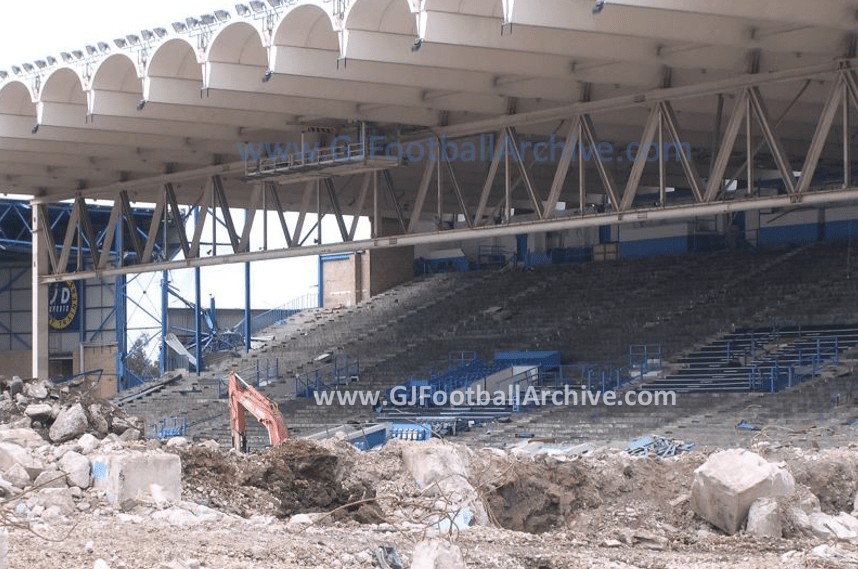
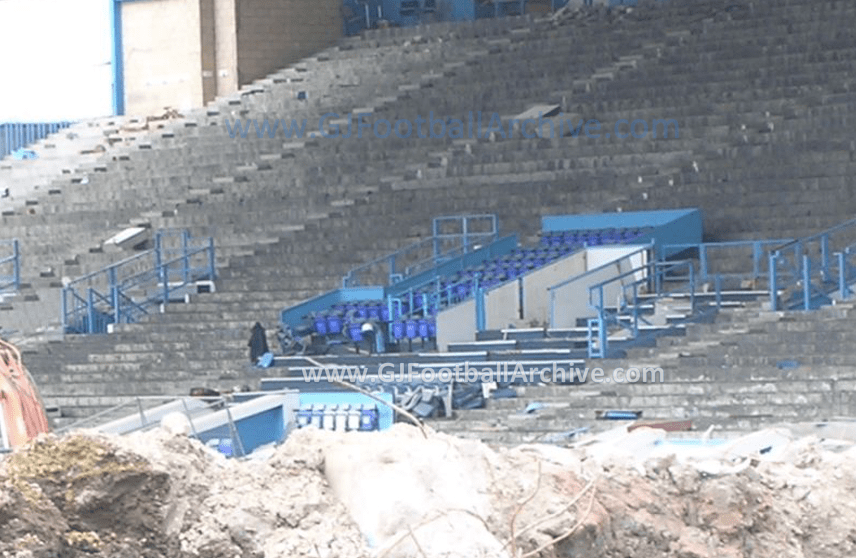
It’s day 38 of my posts counting down to the centenary of Maine Road’s opening game and today’s feature is of a sad scene: The demolition of the Main Stand during 2003-04. Apologies but it had to be shown one day.
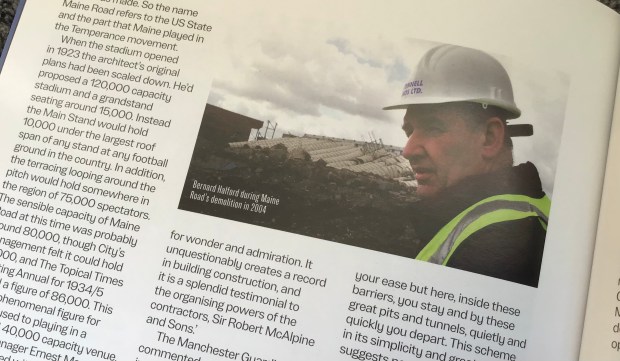
I went with club photographer Ed Garvey and secretary Bernard Halford to have a look at the old place in 2004 as it was being demolished. It was a sad sight.
Ed Garvey photographThe directors’ box during demolition 2004. Ed Garvey photograph
During the 2022-23 season I did a feature on Maine Road for the match programme at City and included a photo of Bernard Halford from our visit.
Ed Garvey photographEd Garvey photograph
Warning: tomorrow I’ll post another demolition image.
For those unfamiliar with Maine Road this photo may help locate the Main Stand. It’s number 1 on this image taken in 1971.
Maine Road aerial 1971 from Farewell To Maine Road
If you’d like to read more on the history of Maine Road, take a look at Farewell To Maine Road, which can be downloaded from this page:
If you enjoy all the free material on my website and would like to support my research and keep this website going (but don’t want to subscribe) then why not make a one-time donation (or buy me a coffee). All support for my research is valued and welcome. It allows me to keep some free material available for all. Thanks.
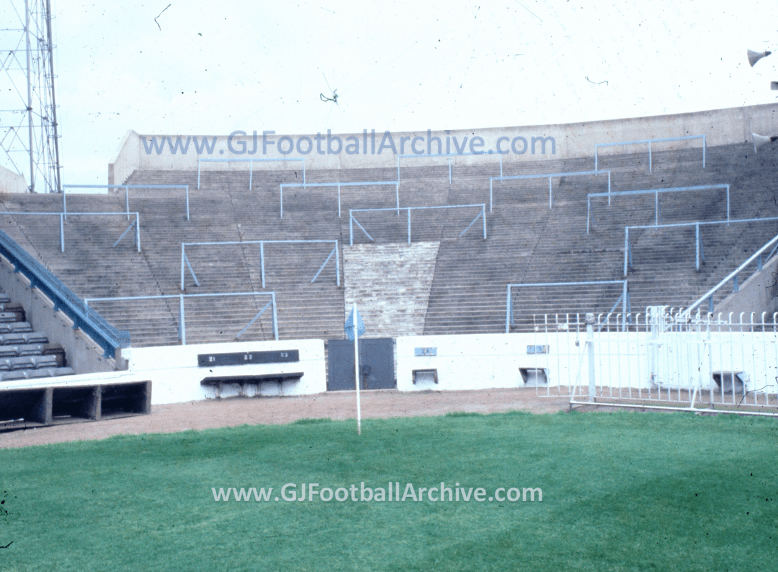
It’s day 37 of my posts counting down to the centenary of Maine Road’s opening game and today’s feature is – don’t get too excited – on this corner! I’ve said before that a photograph can say so much if you look closely at it and learn how to ‘read’ images like this. This is true for this simple photo of the corner between the North Stand (left) and Kippax (right). So what does this picture tell us? Well….
This was built as part of the North Stand development back in 1971 but it remained part of the Kippax. It was never roofed – meaning that this corner and the one on the other side of the Kippax were the only areas of Maine Road never to have a roof over them. If you’re counting the Main Stand had 3 roofs/roof developments during its life; the Platt Lane had 2; the North Stand one, and the Kippax two.
This corner was always accessed via Kippax turnstiles and it was always within the Kippax boundary walls. When the North Stand was built the exterior wall behind the stand was removed and turnstiles built into the stand but this corner never had any of that.
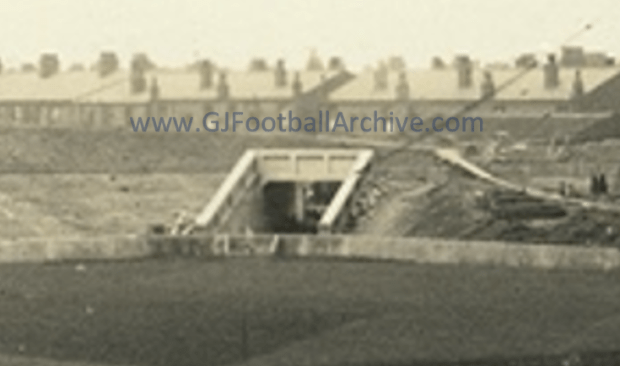
I’m not certain why the original corner terracing was ever demolished. Originally this corner had a large tunnel (like those in the other corners) and maybe they demolished that and built the new terracing because they felt it would increase capacity, but the corner is actually a little smaller than the one it replaced.
The rake of the steps is steeper than the rest of the Kippax and is the same as that in the North Stand. This suggests that there may have been plans to carry the North Stand around the corner. Former chairman Eric Alexander, who was primarily responsible for the new North Stand, had a vision of rebuilding the Kippax next but the arrival of Peter Swales as chairman killed that off. Maybe Eric was thinking ahead?
Strangely, there’s a concrete wedge in the middle which looks like newer concrete, roughly where the original tunnel would have been (though somewhat narrower).
Notice the loudspeaker (top right) pointing to this corner from the Kippax to ensure those standing here could hear the tannoy system. They used to test it in an empty stadium and never understood why fans couldn’t hear it in the Kippax on match day!
The floodlit pylon can be seen at the back, left. Also the blue fence on the left trying to stop fans climbing in to the North Stand – I do remember fans sneaking in occasionally.
There’s also the first pitch side fence on the right. This was positioned in front of the Kippax to stop fans getting on the pitch but all they needed to do was climb into this corner and go through the gate in the wall!
The white wall contains a gate where the old police/first aid dug outs used to be (see photo below of the same corner in the early 1960s) and the small seats built into the wall that the police and first aid people used to sit on at the time this photo was taken.
There’s also the corner flag visible.
The following is the Platt Lane/Main Stand corner when first built in 1923. It gives an impression of how the North Stand/Kippax corner would’ve looked at that time too.
1923 Platt Lane/Main Stand corner tunnel
The North Stand/Kippax corner was demolished in 1994 and later the ‘Gene Kelly’ temporary stand was located there.
For those unfamiliar with Maine Road this photo may help locate the terraced corner between the North Stand and Kippax. It’s number 9 on this image and you can see the Kippax wall behind it. Note the wall behind the North Stand has yet to be removed from this image, taken in 1971.
Maine Road aerial 1971 from Farewell To Maine Road
If you’d like to read more on the history of Maine Road, take a look at Farewell To Maine Road, which can be downloaded from this page:
If you enjoy all the free material on my website and would like to support my research and keep this website going (but don’t want to subscribe) then why not make a one-time donation (or buy me a coffee). All support for my research is valued and welcome. It allows me to keep some free material available for all. Thanks.
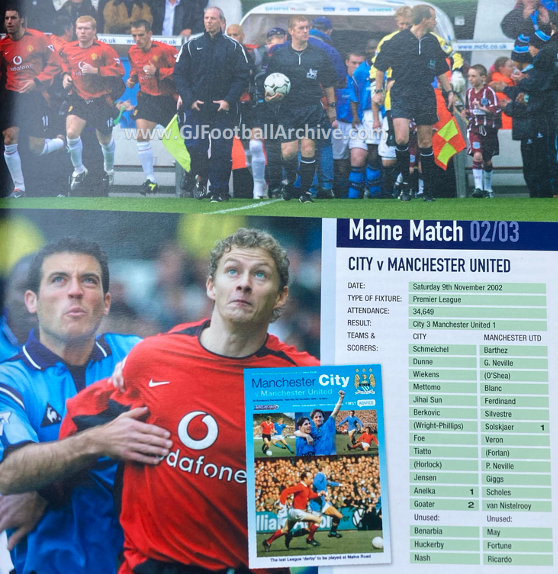
It’s day 36 of my posts counting down to the centenary of Maine Road’s opening game. Yesterday I featured Maine Road’s first derby match and today’s images are a reminder of the last Manchester derby played at Maine Road.
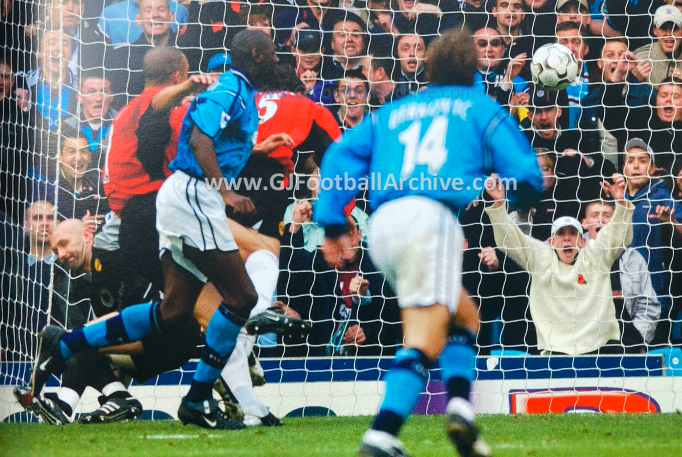
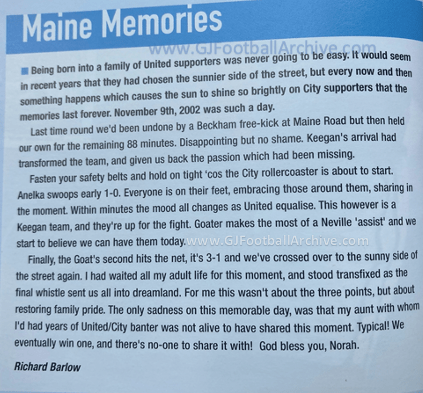
The game, played on 9 November 2002 saw City defeat United 3-1 with goals from Anelka and Goater (2). United’s historic last goal at Maine Road was scored by Solksjaer.
Fan memories of that day in Farewell To Maine Road
These images are taken from Farewell To Maine Road and subscribers can now download a PDF of that book. The feature on Maine Road’s last derby was in chapter one: End of an Era. See below for details of how to get that book.
Goater’s 100th goal, scored v MUFC in November 2002.
For those unfamiliar with Maine Road this photo may help locate the the tunnel image (number 1):
Maine Road aerial 1971 from Farewell To Maine Road
If you’d like to read more on the history of Maine Road, take a look at Farewell To Maine Road, which can be downloaded from this page:
If you enjoy all the free material on my website and would like to support my research and keep this website going (but don’t want to subscribe) then why not make a one-time donation (or buy me a coffee). All support for my research is valued and welcome. It allows me to keep some free material available for all. Thanks.
So far there have been 35 days in my 100 day Maine Road countdown series of free to read features. I know some have dipped in and out and not had chance to see them all so, to make life easy, here they are so far in one handy place. Enjoy following the links to read them all. It’s a monumental series of articles on the old stadium and I hope it gives those who attended a nice reminder of the old place and those that didn’t (and it was 20 years ago!) a feel for what it was like.
There are another 65 articles to come. Check my website every day for the next one. As well as these free articles subscribers to my website can download the entire Farewell To Maine Road book I wrote in 2003. It’s been out of print since 2004 and was originally priced at £25. Subscribers can pay £20 a year to get that and PDFs of my 2010 book Manchester A Football History and 1989 book From Maine Men To Banana Citizens. They also get access to exclusive articles, interviews and content. For details see:
If you enjoy all the free material on my website and would like to support my research and keep this website going (but don’t want to subscribe) then why not make a one-time donation (or buy me a coffee). All support for my research is valued and welcome. It allows me to keep some free material available for all. Thanks.
Tonight’s online talk and celebration of Manchester City’s 2023 Champions League success is completely sold out (it was free but you know what I mean!). If all goes to plan I will be posting it as a separate recording here on my website at some point. If you didn’t get tickets but would like to relive the Champions League final I have written several articles on this which you can read here:
If you enjoy all the free material on my website and would like to support my research and keep this website going (but don’t want to subscribe) then why not make a one-time donation (or buy me a coffee). All support for my research is valued and welcome. It allows me to keep some free material available for all. Thanks.
It’s day 35 of my posts counting down to the centenary of Maine Road’s opening game and today’s images are a reminder of the first Manchester derby played at Maine Road.
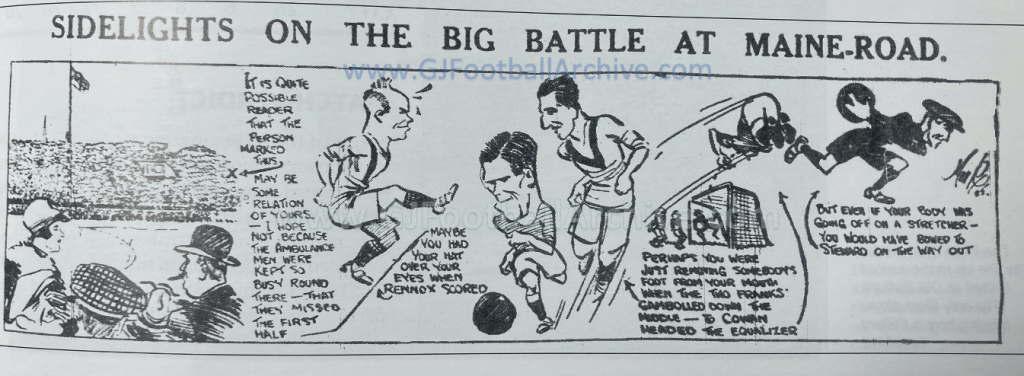
The game, played on 12 September 1925 (United had been in the Second Division when City first moved to Maine Road), saw City & United draw 1-1 before 66,000. This was at the time the highest Manchester derby crowd ever. It was later eclipsed with the record on a club ground being 78,000 (Maine Road). There have been higher at Wembley of course.
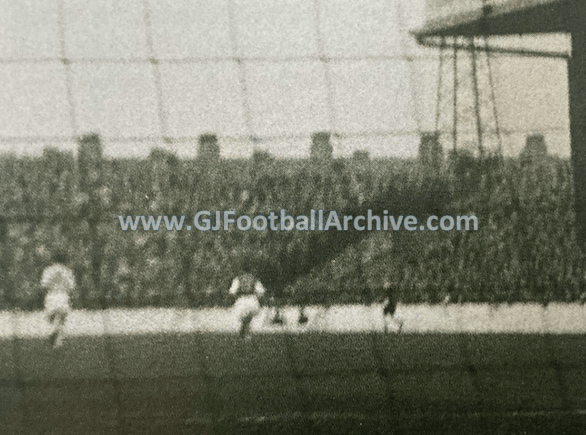
Sam Cowan scored for City and Clatworthy Rennox for United. Later this season the return derby at Old Trafford saw City win 6-1:
These images show Cowan’s goal and a drawing of the game’s highlights. Note the crowd references in the drawing.
Guess which game I’m going to cover tomorrow…. This was the first derby at Maine Road. Maybe it’s time to remember the last one?
For those unfamiliar with Maine Road this photo may help locate the end Cowan’s goal was scored at. In the days before the Popular Side (later Kippax) was roofed this was the goal mouth at the Platt Lane end (number 3/5) with the unroofed terracing beyond the players being located around number 8.
Maine Road aerial 1971 from Farewell To Maine Road
If you’d like to read more on the history of Maine Road, take a look at Farewell To Maine Road, which can be downloaded from this page:
If you enjoy all the free material on my website and would like to support my research and keep this website going (but don’t want to subscribe) then why not make a one-time donation (or buy me a coffee). All support for my research is valued and welcome. It allows me to keep some free material available for all. Thanks.
It’s day 34 of my posts counting down to the centenary of Maine Road’s opening game. Today – Bert Trautmann’s testimonial scenes.
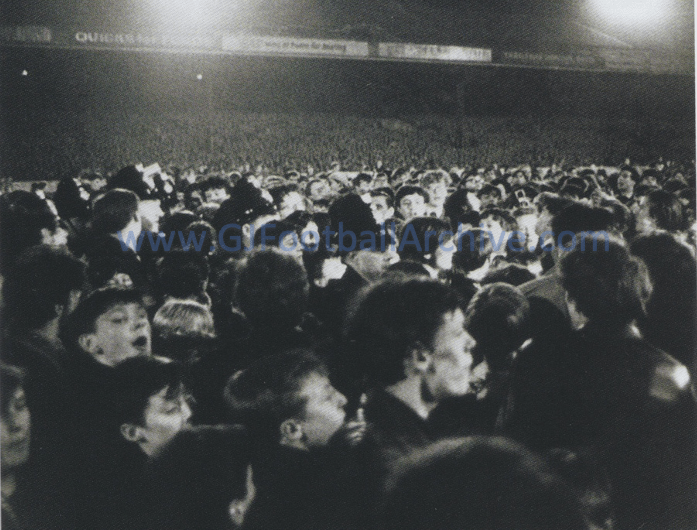
In 1964 Manchester City staged a testimonial game for legendary City goalkeeper Bert Trautmann. Officially there were less than 48,000 there (in a stadium that could hold in excess of 60,000) yet fans and others there that night know the attendance was much higher. My own dad told me last week how him & my mam were going to the game but when they arrived the turnstiles were closed and thousands were locked out a long time before kick off.
There are stories of some fans trying to climb walls to get in and others talk about the packed terraces and stands.
It was truly the biggest testimonial game ever at Maine Road in terms of numbers, even if officially it was short of capacity. In the 90s I often asked players and officials from that era about this attendance, including Bert. No one actually wanted to say much about the discrepancy between the numbers officially reported and the actual volume of people in attendance, so we can leave all of that to the imagination. What they did all agree on is that there must have been well over 60,000 there that night and that Bert deserved whatever was raised from the match.
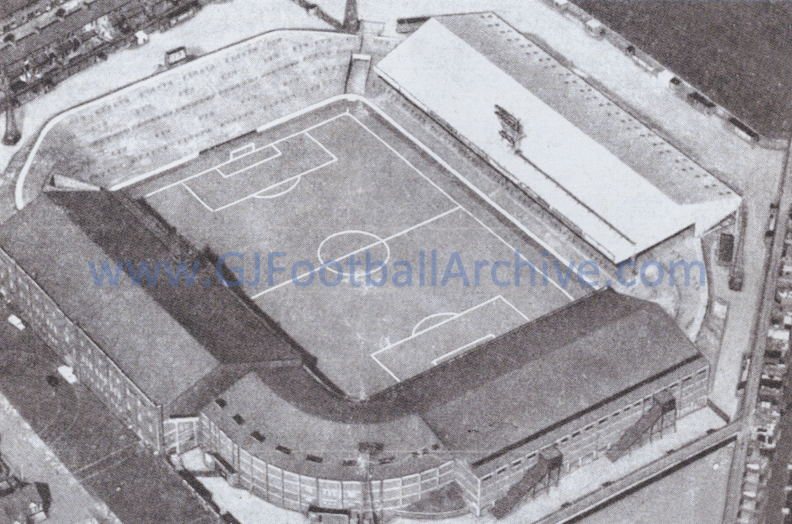
This image from 1961 shows how the stadium looked at the time of Trautmann’s testimonial.
Below is a view of Maine Road from 1971. The main image of fans on the pitch (above) is taken from near the Main Stand (number 2) looking across to the Kippax (7/8).
Maine Road aerial 1971 from Farewell To Maine Road
If you’d like to read more on the history of Maine Road, take a look at Farewell To Maine Road, which can be downloaded from this page:
If you enjoy all the free material on my website and would like to support my research and keep this website going (but don’t want to subscribe) then why not make a one-time donation (or buy me a coffee). All support for my research is valued and welcome. It allows me to keep some free material available for all. Thanks.
On Wednesday 21 June at 6pm (UK time) come and join me for one hour of discussion on Manchester City FC’s 2023 Champions League final. Let’s celebrate and remember the positives of this remarkable achievement. Lots have already reserved their place and there are only a few more places left, so register now if you want to attend.
As with previous Manchester City history talks I’ll spend a bit of time discussing the significance of the success and will then open the session up. I’m keen to hear your experiences of the night and what this meant to you as a City fan, whether you travelled to Istanbul or watched from home. Every Blue is welcome!
Come and celebrate this incredible and historic achievement.
Sign up to join this free online event where I will discuss the significance of this momentous night in Mancunian history. This hour will include the opportunity to share your stories and memories as I am keen to hear your thoughts.
Lots suffered horrendous conditions both before and after the match BUT this night won’t be discussing those (maybe we’ll do that another day?). You can add your comments/experiences here:
Instead the idea is to celebrate and remember the stuff that might get lost along the way. Make no mistake this was a truly significant occasion and one we should celebrate for the rest of our lives.
To ensure we have enough opportunity to hear from each other the capacity is restricted to the first 40 people who register. This is free to join but there’s also the opportunity to pay a donation if you’d like to support my website, work and research. No obligation though – this is about celebrating a wonderful event!
The event will be live on Zoom on 21/6/23 at 6pm and a link will be sent to all those who have registered for the event beforehand (probably earlier that day). THIS WILL BE EMAILED OUT SEPARATELY – NOT VIA EVENTBRITE.
The session will be recorded and a recording will appear on my website at a later date. There is the possibility that everyone who speaks will be recorded and included in the video.
It’s day 33 of my posts counting down to the centenary of Maine Road’s opening game. Today – Notice anything odd about this image? Look at the Main Stand roof….
This photo was taken shortly after World War Two at a time when the adverts and notices on the Main Stand roof had been blacked out to avoid being picked up by enemy bombers during the war.
We all know about Old Trafford being bombed and while the Maine Road stadium did not suffer major damage houses on Thornton Road and other streets around the ground were bombed during the war.
The semi-circular gable on the roof of the stand carried adverts for much of its existence, though initial plans had been to have the club’s name proudly displayed there. I’ve yet to find an image showing any MCFC wording painted on to it but I do believe it did have this early in the stadium’s life, before adverts took over.
This photo shows the gable from the back/air:
This 1971 view shows the second Main Stand roof (actually just the middle section was replaced) and the original gable would have appeared where number 1 is.
Maine Road aerial 1971 from Farewell To Maine Road
If you’d like to read more on the history of Maine Road, take a look at Farewell To Maine Road, which can be downloaded from this page:
If you enjoy all the free material on my website and would like to support my research and keep this website going (but don’t want to subscribe) then why not make a one-time donation (or buy me a coffee). All support for my research is valued and welcome. It allows me to keep some free material available for all. Thanks.
It’s day 32 of my posts counting down to the centenary of Maine Road’s opening game. Today – A behind the Kippax image from 1993. This photo has so much going on despite it looking fairly bland. I’ll explain:
When the Kippax was roofed in 1957 the original terracing had to be squared off and so, instead of reducing the terracing City decided to extend it where its started to curve. You can see in this image that the end of the stand is on stilts/stanchions over the original banking where it was extended.
At the time the stand was enlarged in 1957 local residents objected to it. Some claimed they’d lost TV signal and were no longer able to get Granada TV which had started broadcasting in May 1956.
When this photo was taken in 1993 that area was for away fans and if you look carefully you can see the segregation fence to the left of the tunnel and going up the banking.
The tunnel and steps in the foreground of the photo are the original 1923 construction but these steps were no longer in use as an entry point. They were blocked off at the top and tended to be used as a seating area by fans instead. They’d been blocked off after the Ibrox Stadium disaster in 1971 when steps like these had to be remodelled to prevent a build up of fans flowing down at speed. This staircase was not altered but others were and remained in use.
Notice also the paved slope. This had been a simple slope of grass and rubble (as can be seen on the 1971 image lower down this page) for most of the stand’s life but general crowd disorder at football had led to City deciding to pave this section to prevent fans from grabbing stones and lobbing them over the segregation fence at rival fans. When I spoke with Bernard Halford many years ago, he was quite proud of this ‘flagging’ of the slope and said it did prevent some significant issues which could have had repercussions for the club.
This image from 1961 shows this part of the extended/squared off Kippax to the right of the photo.
Here’s a view from 1971 showing the back of the Kippax as it looked. The away staircase is to the left of number 8 and to the left of that you can see the squared off part of the stand on stilts. The staircase that is on the 1993 image is the one between 7 and 8 below.
Maine Road aerial 1971 from Farewell To Maine Road
If you’d like to read more on the history of Maine Road, take a look at Farewell To Maine Road, which can be downloaded from this page:
If you enjoy all the free material on my website and would like to support my research and keep this website going (but don’t want to subscribe) then why not make a one-time donation (or buy me a coffee). All support for my research is valued and welcome. It allows me to keep some free material available for all. Thanks.







 Gary James' Football Archive