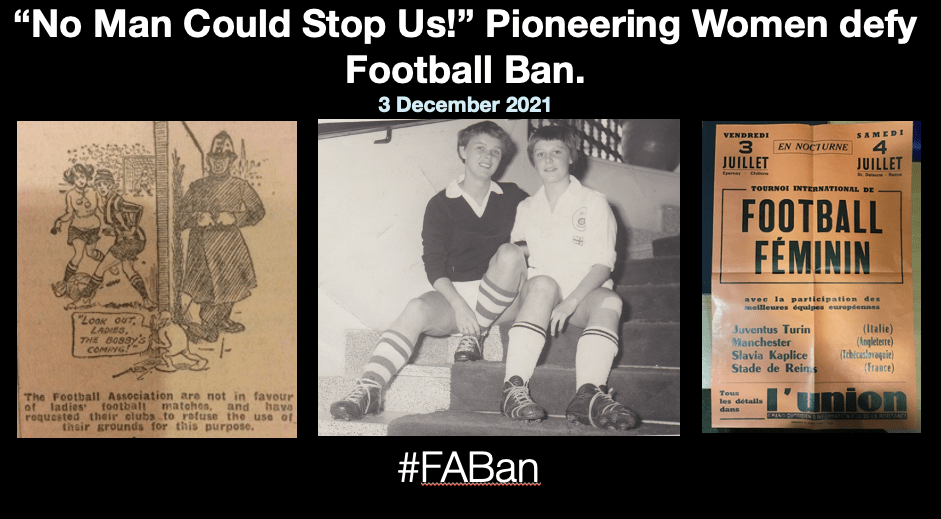
In December 2021 I staged a talk at Hebden Bridge on the FA ban of women’s football. The night was sponsored and supported by Geoff Matthews and his company Cansquared Ltd. It was a wonderful night and lots of attendees asked about the future and what they could do to help promote the stories of the women who played at a time when the FA tried to kill female participation in the sport. Well, after that night a lot has happened to recognise the Manchester Corinthians.
As part of my longstanding project into female participation and involvement in football in Manchester I have been researching and writing Manchester Corinthians: The Authorised History. The book will be of a similar scope to my Manchester City Women: An Oral History on City’s women’s team.
Margaret Shepherd and Margaret Whitworth with me prior to the Hebden Bridge event
A lot has been written on the Corinthians (see the section on women’s football on this site for a few examples) but not nearly enough, plus there are some inaccuracies out there that need to be corrected (even now there are some that keep on being repeated). Basically, this team possessed a talented group of players who toured Europe and South America promoting football, female endeavour and Manchester.
I talked quite a bit about Corinthians at Hebden Bridge and we were fortunate to have three Corinthians as guests that night. Margaret Whitworth, Margaret Shepherd and Lesley Wright between them covered every season of the club’s life from the 1950s through to its demise. Since that night I’ve also tracked down a player from the club’s very first season of 1948-49 who, together with detailed archival research, has helped me piece together for the first time several people who were instrumental in the birth of the club. Again, this is not something that has appeared in any of the articles or films connected with the club in recent years. This will be explained properly for the first time in my book.
I’m still trying to track down other Corinthians to include in the book. To date I’ve identified over 230 players. See:
After the Hebden Bridge night it was clear that we needed to recognise the Corinthian players further. On that night I mentioned my idea of having a plaque erected for the Corinthians in a significant/related location in Manchester. Several members of the audience thought this was a wonderful idea and asked if they could support the wider promotion of the Corinthians – one more or less suggested we should march on Downing Street to persuade them to do something about it!
In 2019 I’d written articles for a variety of publications suggesting the same and urging the FA and others to recognise the Corinthians. In the Manchester City men’s match programme as well I highlighted my desire to get a plaque erected about their achievements.
The talk at Hebden Bridge
Via Manchester Council I was put in contact with the Friends of Fog Lane Park and we ultimately set up a successful appeal in their name. The FA made a significant donation which funded the plaque and our fundraising efforts raised enough to allow the Friends to commission 2 murals and other tributes to the Corinthians as well.
Those present at Hebden Bridge in December 2021 helped raise the profile and that event was significant in highlighting the incredible achievements of its female footballers. Now, the authorised history of the Corinthians will tell the story of the club from its birth right through to the blue plaque appeal. It will use the voices of the women who represented Manchester and England in a positive manner and who won trophies in South America & Europe and who toured North Africa. They won a significant European competition before either Manchester men’s team yet their achievements were not recognised by the city until the blue plaque appeal started.
I am immensely proud of how this has all happened. The event at Hebden Bridge was free to attend and was made possible by the support of a locally based business, Cansquared (Geoff Matthews – who co-hosted the evening). We felt it was vital we made this free to attend to spread the word.
If anyone runs a key Manchester venue and would like a Corinthians celebration event then please get in touch. The more we can do to promote their story the better.
Thanks for reading this. If you would like to find out more about the Corinthians then follow the tabs on this site or use the search function. If you’d like to know more about the FA Ban then you can download for free an article I’ve recently co-written here:
Copies of my book on Manchester City Women are still available. This tells the history of City Women via the voices of the women (and some men) involved. The book has been heralded as a model for oral histories by the Oral History Society.
Here’s a link you can follow to order a signed copy of the City Women book:
Watch this space for more on the Corinthians and women’s football over the coming months. Thanks – now use the tabs and search to learn more on women’s football in Manchester. Ta!
Research into the pioneering women who played for Manchester Corinthians and its sister clubs is ongoing for the authorised history which will be published this summer. So far over 230 players have been identified for the club and their names will be included within the book. BUT I don’t want to leave anybody out so if you know of someone who played for the team or its sister clubs that I may have missed then please get in touch.
Ask your mam or your nan if she played – you never know what you’ll hear! I have had players talk to me during my years of research into the Corinthians who had kept it quiet from their own families, so granny may well have been one of the club’s pioneering figures but just hasn’t talked about it!
I really don’t want to leave anybody out.
As well as asking your mam or your nan, how about helping the book get published by subscribing to it? You will get a copy of the book (posted before it appears in the shops) and your name will be included in a special roll of honour published within the book if ordered by 31st March 2024 here:
Manchester Corinthians: The Authorised History
The story of a pioneering women’s club as told to Gary James by those who were there
£19.95
Opportunities to buy multiple copies, sponsor the book or donate to ensure it’s published to the size and standard the women who played deserve exist. Please email Gary@GJFootballArchive.com for more information on those opportunities.
This book is a must for anyone interested in Manchester or women’s football and will consist of over 300 pages. It will be fully illustrated throughout and subscribers can order it now for £19.95 (including UK postage and packaging). All orders received before 31st March 2024 will have the purchaser’s name included within the special roll of honour at the back of the book. You can order the book for someone else – all details will be checked and confirmed before publication.
The book will be published this summer.
If you live outside the UK then please contact for details of additional postage costs.
You do not need to have a PayPal account to order – use the ‘Pay with PayPal’ button above and it will give you the option to pay by credit/debit card without creating a PayPal account.
The book will include the story of the club as told by the women involved, alongside a significant amount of archive material. Myths will be corrected and the facts of this pioneering club will be told in an easy to read format.
Guided by founder Percy Ashley, the club went on to represent Manchester, football and female endeavour for decades, winning major international tournaments in Europe and South America. The Corinthians are, without doubt, one of the most important football clubs ever to come from Manchester and they were a prominent and pioneering club in so many ways.
As well as the interviews and dozens of archive trips there’s been a concerted effort to compile as comprehensive list as possible on women who played for the club. I’ve managed to compile a list of around 300 women who played for the club. Objects and trophies have also been rediscovered. This is the type of detailed research I enjoy. It’s time consuming, difficult and often frustrating but occasionally you find a little gem that adds significantly to our knowledge. There have been quite a few of those.
The Hebden Bridge talk when the campaign for a Blue Plaque and other tributes was publicly announced, December 2021
I’m still keen to hear from any former player who can add their voices to the history of the club, though the research and writing stage will be ending soon, so please get in touch as soon as possible. Please email Gary@GJFootballArchive.com with your name, rough dates you played and contact details.
Those subscribing to the book will receive a copy signed by author Gary James and posted out to subscribers before it appears in any shop or is distributed to any retailer. This is the ONLY way to guarantee your copy.
Manchester Corinthians: The Authorised History will include interviews with players from every era of the club from a founding player back in 1949 through to those playing for the club in its final days over 40 years later (yes, that’s right – over 40 years later!). The book will finally tell the story of the club from start to finish via the voices of the women who played. Via these voices the entire history of the club will be explained with the key figures identified and remembered. There’s a remarkable trail of women linking the first game with the last.
The book will be published to a similar style and quality to the acclaimed Manchester City Women: An Oral History and is destined to be another landmark publication on a major, pioneering women’s football club. Dozens of former players have been interviewed for this book and their remarkable stories and memories will be supported with an amazing array of photographs, newspaper articles, match programmes, trophies and other items of memorabilia from every era of the club’s existence.
Alongside chapters chronicling the history of the club there will also be features on founder Percy Ashley, who dedicated his life to promoting women’s football, and on Gladys Aikin (a key figure not only with the Corinthians but also with the early years of the Women’s Football Association) and George Aikin, who continued to take the Corinthians on tours into the 1980s. There will be special features on the major tours of the 1950s and 1960s when Percy Ashley led the Corinthians to major international success.
The cover of the book will be worked on by the designer over the coming months but following feedback from former players the maroon has been replaced with a darker blue, more reminiscent of the colour most frequently worn by the Corinthians (based on the reports, programmes and other material found so far and the majority of comments from players). This may still change of course (‘The Authorised History’ will probably change colour too). The back will contain later images and wording.
If you’d like to purchase my earlier book on women’s football then a limited number of copies, signed by me, are still available. You can order here:
Manchester City Women: An Oral History book
The first history of Manchester City’s women’s team, taking the story of the club from formation in 1988 until 2019-20 season.
£16.95 including UK postage (outside UK contact for additional postage costs)
You can help the authorised history of the Manchester Corinthians get published by subscribing now. You will get your name included in a special roll of honour published within the book if ordered by 31st March 2024 here:
Manchester Corinthians: The Authorised History
The story of a pioneering women’s club as told to Gary James by those who were there
£19.95
Opportunities to buy multiple copies, sponsor the book or donate to ensure it’s published to the size and standard the women who played deserve exist. Please email Gary@GJFootballArchive.com for more information on those opportunities.
This book is a must for anyone interested in Manchester or women’s football and will consist of over 300 pages. It will be fully illustrated throughout and subscribers can order it now for £19.95 (including UK postage and packaging). All orders received before 31st March 2024 will have the purchaser’s name included within the special roll of honour at the back of the book. You can order the book for someone else – all details will be checked and confirmed before publication.
The book will be published this summer.
If you live outside the UK then please contact for details of additional postage costs.
You do not need to have a PayPal account to order – use the ‘Pay with PayPal’ button above and it will give you the option to pay by credit/debit card without creating a PayPal account.
The book will include the story of the club as told by the women involved, alongside a significant amount of archive material. Myths will be corrected and the facts of this pioneering club will be told in an easy to read format.
Guided by founder Percy Ashley, the club went on to represent Manchester, football and female endeavour for decades, winning major international tournaments in Europe and South America. The Corinthians are, without doubt, one of the most important football clubs ever to come from Manchester and they were a prominent and pioneering club in so many ways.
As well as the interviews and dozens of archive trips there’s been a concerted effort to compile as comprehensive list as possible on women who played for the club. I’ve managed to compile a list of around 300 women who played for the club. Objects and trophies have also been rediscovered. This is the type of detailed research I enjoy. It’s time consuming, difficult and often frustrating but occasionally you find a little gem that adds significantly to our knowledge. There have been quite a few of those.
I’m still keen to hear from any former player who can add their voices to the history of the club, though the research and writing stage will be ending soon, so please get in touch as soon as possible. Please email Gary@GJFootballArchive.com with your name, rough dates you played and contact details.
Those subscribing to the book will receive a copy signed by author Gary James and posted out to subscribers before it appears in any shop or is distributed to any retailer. This is the ONLY way to guarantee your copy.
Manchester Corinthians: The Authorised History will include interviews with players from every era of the club from a founding player back in 1949 through to those playing for the club in its final days over 40 years later (yes, that’s right – over 40 years later!). The book will finally tell the story of the club from start to finish via the voices of the women who played. Via these voices the entire history of the club will be explained with the key figures identified and remembered. There’s a remarkable trail of women linking the first game with the last.
The book will be published to a similar style and quality to the acclaimed Manchester City Women: An Oral History and is destined to be another landmark publication on a major, pioneering women’s football club. Dozens of former players have been interviewed for this book and their remarkable stories and memories will be supported with an amazing array of photographs, newspaper articles, match programmes, trophies and other items of memorabilia from every era of the club’s existence.
Alongside chapters chronicling the history of the club there will also be features on founder Percy Ashley, who dedicated his life to promoting women’s football, and on Gladys Aikin (a key figure not only with the Corinthians but also with the early years of the Women’s Football Association) and George Aikin, who continued to take the Corinthians on tours into the 1980s. There will be special features on the major tours of the 1950s and 1960s when Percy Ashley led the Corinthians to major international success.
The cover of the book will be worked on by the designer over the coming months but following feedback from former players the maroon has been replaced with a darker blue, more reminiscent of the colour most frequently worn by the Corinthians (based on the reports, programmes and other material found so far and the majority of comments from players). This may still change of course (‘The Authorised History’ will probably change colour too). The back will contain later images and wording.
If you’d like to purchase my earlier book on women’s football then a limited number of copies, signed by me, are still available. You can order here:
Manchester City Women: An Oral History book
The first history of Manchester City’s women’s team, taking the story of the club from formation in 1988 until 2019-20 season.
£16.95 including UK postage (outside UK contact for additional postage costs)
I’ve been asked a few questions this last week about the origins of men’s football in Manchester. For those that don’t know I researched & wrote a detailed history on the topic for Manchester University Press a few years back. I don’t have copies available myself but the publisher does have paperback copies, retailing at £21 on their website:
Follow the link (above) and it will explain more on the book but it basically tells the stories of the pioneering men’s clubs in the 1860s/1870s; the development of Manchester’s main two men’s clubs (City & United; correcting many myths!); first trophy successes; the scandal at City and the match fixing at United; plus much more. It considers the types of people who went to watch the clubs during early 20th Century and, again, there may be some detail in there that surprises a few.
If you want to know more then feel free to ask. Thanks
It’s a great tribute with quotes from many Corinthians. Have a read if you can.
I’m writing the authorised history of the club. As well as all the great stuff about the women who played fans of Manchester City and Manchester United may be interested to learn of the role Matt Busby, Johnny Carey, Bert Trautmann & Dave Ewing played in the history of the Manchester Corinthians.
There’s some fascinating information about those four men and other Manchester footballing legends – including the Corinthians themselves of course! – getting involved with the club.
If you’re interested in the book then you can order it below.
This book is a must for anyone interested in Manchester or women’s football and will consist of over 300 pages. It will be fully illustrated throughout and subscribers can order it now for £19.95 (including UK postage and packaging). All orders received before 31st March 2024 will have the purchaser’s name included within the special roll of honour at the back of the book. You can order the book for someone else – all details will be checked and confirmed before publication.
The book will be published this summer.
If you live outside the UK then please contact for details of additional postage costs.
You do not need to have a PayPal account to order – use the ‘Pay with PayPal’ button above and it will give you the option to pay by credit/debit card without creating a PayPal account.
Manchester Corinthians: The Authorised History
The story of a pioneering women’s club as told to Gary James by those who were there
£19.95
The book will include the story of the club as told by the women involved, alongside a significant amount of archive material. Myths will be corrected and the facts of this pioneering club will be told in an easy to read format.
Guided by founder Percy Ashley, the club went on to represent Manchester, football and female endeavour for decades, winning major international tournaments in Europe and South America. The Corinthians are, without doubt, one of the most important football clubs ever to come from Manchester and they were a prominent and pioneering club in so many ways.
As well as the interviews and dozens of archive trips there’s been a concerted effort to compile as comprehensive list as possible on women who played for the club. I’ve managed to compile a list of around 300 women who played for the club. Objects and trophies have also been rediscovered. This is the type of detailed research I enjoy. It’s time consuming, difficult and often frustrating but occasionally you find a little gem that adds significantly to our knowledge. There have been quite a few of those.
I’m still keen to hear from any former player who can add their voices to the history of the club, though the research and writing stage will be ending soon, so please get in touch as soon as possible. Please email Gary@GJFootballArchive.com with your name, rough dates you played and contact details.
Those subscribing to the book will receive a copy signed by author Gary James and posted out to subscribers before it appears in any shop or is distributed to any retailer. This is the ONLY way to guarantee your copy.
Manchester Corinthians: The Authorised History will include interviews with players from every era of the club from a founding player back in 1949 through to those playing for the club in its final days over 40 years later (yes, that’s right – over 40 years later!). The book will finally tell the story of the club from start to finish via the voices of the women who played. Via these voices the entire history of the club will be explained with the key figures identified and remembered. There’s a remarkable trail of women linking the first game with the last.
The book will be published to a similar style and quality to the acclaimed Manchester City Women: An Oral History and is destined to be another landmark publication on a major, pioneering women’s football club. Dozens of former players have been interviewed for this book and their remarkable stories and memories will be supported with an amazing array of photographs, newspaper articles, match programmes, trophies and other items of memorabilia from every era of the club’s existence.
Alongside chapters chronicling the history of the club there will also be features on founder Percy Ashley, who dedicated his life to promoting women’s football, and on Gladys Aikin (a key figure not only with the Corinthians but also with the early years of the Women’s Football Association) and George Aikin, who continued to take the Corinthians on tours into the 1980s. There will be special features on the major tours of the 1950s and 1960s when Percy Ashley led the Corinthians to major international success.
The cover of the book will be worked on by the designer over the coming months but following feedback from former players the maroon has been replaced with a darker blue, more reminiscent of the colour most frequently worn by the Corinthians (based on the reports, programmes and other material found so far and the majority of comments from players). This may still change of course (‘The Authorised History’ will probably change colour too). The back will contain later images and wording.
If you’d like to purchase my earlier book on women’s football then a limited number of copies, signed by me, are still available. You can order here:
Manchester City Women: An Oral History book
The first history of Manchester City’s women’s team, taking the story of the club from formation in 1988 until 2019-20 season.
£16.95 including UK postage (outside UK contact for additional postage costs)
Ten years ago today (24 January 2014) Manchester City Ladies (founded in 1988) was relaunched as Manchester City Women. To mark this anniversary the following ‘long read’ article is an excerpt from Manchester City Women: An Oral History (my book published late in 2019 telling the story of the club).
Here’s the excerpt from the book on the club’s relaunch in 2014:
Despite initially being formed as part of Manchester City’s corporate structure in 1988 the women’s team became its own entity affiliated to the parent club by the end of the 1990s. It had its own committees and structure but progression up the leagues had resulted in a need to re-establish closer ties. By the early 2010s it became clear a formal coming together was needed. This surprised some of the players and staff from the 1980s and 1990s, especially when articles appeared claiming the club had been established in 2002. Jane Morley: “It upset Lesley (Wright) that the full history had been ignored. There were stories that the club had been founded by a group of City fans and it came across that it was fairly insignificant. But that wasn’t true. These were women who wanted to play football. Some were City fans but Rita Howard wasn’t, Bev Harrop was a United season ticket holder – So was I. I went to United games with Bev.”
Louise Wakefield: “I felt a bit like we’d been forgot and I thought ‘is it just me?’ but apparently a few of us were feeling left out. We’d done everything for the club. You know, turned up, swollen ankles, and had to play, you know? We felt a bit left out with it.”
Michelle Middleton felt: “aggrieved that the media seemed to think that City had suddenly decided to have a women’s team and didn’t take the time to look into the history but I was happy that the club was still backing the women and were planning to make them as important a part of the club as the men.”
Michelle had played at the formation of the club, with Lesley arriving that same season. Lesley stayed until 2002, with Louise joining the club in 1996, but it wasn’t only players that had been involved before the 2002 date that felt aggrieved at times. Gary Moores: “The waters got muddied around this time and I think some people got a bit upset. I understood fully that what went on in the past is in the past and that it had nothing to do with the relaunched club. I know that upset a few people because some were still tying up the back end of Manchester City Ladies. Since the transfer of the club, I haven’t been to games because it took so much time out of my life. I reached the point where I felt ‘it’s in safe hands now’ and I felt that our part of the transition had been handled well and so I felt I could move away. Previously it had been like the guy spinning the plates… you couldn’t stop because the plates would come crashing down but once City were handed control someone else was able to spin the plates and I could move on.
“I didn’t pay much attention to those who suggested City were a new club because half of it was from people who had only just learned about women’s football because of the birth of the Super League. They were speaking about something that they didn’t actually know much about. They’d dipped into it occasionally. Also, there was the negativity because of the position of Doncaster Belles. That was a shame because we know what Doncaster Belles have done but then there’s these people who see the money that Manchester City as an overall club was supposed to have and then it’s suggested that City had used that money to buy their place but they hadn’t. It was built on the back of years of commitment by players and volunteers. That first season after there were about half a dozen players who had been with us for years.
“I remember being on holiday about two years after the WSL place was given and there was a woman who was a big City Women fan there. We got chatting and I told her of my connection but she didn’t believe me. She got her laptop out and started to quiz me. ‘Okay, where did Krystal Johnson come from?’ I said ‘Manchester City Ladies’ and she said that she’d played for one of the Sheffield clubs not City but that was the season when there was the transition from winter to summer football and the club had no games. The players went off to play for other clubs to keep fit but even on City’s own website the previous club line gave the impression these had all arrived from other clubs. All of that added to this view that it was a new club. There were about six or seven players like this I think.”
Inevitably there were going to be issues to resolve as the transition took place. As with the period in 2002 when some long established players and committee members felt the club was being taken from them, some of the committee and players felt similar feelings. Transformations are always difficult but with the media choosing to promote the view that ‘new club’ City were in the process of obtaining a WSL place at the expense of Doncaster Belles, it was always going to be tough to satisfy all former players and committee members. The noise, particularly in the media, did not overshadow what was actually happening however. Many current and former players were delighted with the potential for a stronger relationship. Rowena Foxwell: I think got a bit excited when City Ladies became more professional and then they changed the name to Women. I think because women’s football was on the telly more, and it was great that our Club was getting a professional team. We all thought ‘if we were 20 years younger, we could have played in that’. So we got a bit giddy about it.”
Rowena had seen some of the incorrect details of the club’s birth and decided to be proactive: “I was clicking through and there was this piece on how City Ladies started in 2002 or whatever it was! So I emailed Vicky Kloss, the Head of Communication at City, and just said to her that I was part of the original team… still in touch with a lot of them… be great if we could get involved… do you know that some of the facts on there are wrong? I think the fact that we got angry about the fact that they’d got it wrong, just shows how passionate we were.”
Debbie Darbyshire: Vicky Kloss wanted it right. Vicky’s good like that. She’s always keen to make sure things are right. She called [Gary James] in and started the process of getting it all right.”
Rowena’s email was passed on to City’s Damaris Treasure, then Head of Public Affairs. She was heavily involved with the relaunch and wanted to get the facts correct. She immediately contacted Rowena and pushed to ensure the history of the team was properly recorded and that those involved felt valued for what they had achieved. Rowena Foxwell: “Many of us were invited to the relaunch. We obviously rocked up to the Etihad. There were a few people that we hadn’t seen probably since we played. So you know that was nice, and it was nice that the City acknowledged us as the original team.”
Damaris Treasure: I started working with Don Dransfield on the then City Ladies when we announced the formalisation of the relationship with the Club in 2012. I was then part of the core team who bid for the WSL license, and led the re-launch as City Women in 2014. The day of the re-launch as Manchester City Women will forever be a highlight for me. Thinking back on all that day and all the people in the room – the original City Ladies squad, the new City Women squad, more media than we thought possible, legends of the men’s game (Patrick Vieira, Claudio Reyna), City leadership – it’s actually quite incredible that all those people came together. But it’s also indicative of just how right that moment was and how ready people were to invest in it.”
Jane Boardman: “I think you know the club went some way to recognise that this was a relaunch and not a launch, which I think was very important. A number of us got invited to the relaunch event. I think it’s important that the club continues to stay community-focused and I think that they do achieve that.”
Heidi Ward: “I think I was really pleased that the relaunch got the press coverage that it did, because it lifted the women’s game. I knew that City were going to put money in to it and they were going to make the facilities and whatever. They are now absolutely brilliant. They wanted to give women the same opportunity as men and that’s just absolutely amazing. To be fair, I didn’t think it would get to the level where it is now, so that’s incredible really. If you look at the players now, they all look like athletes. They are all similar shapes and sizes and they are all really fit and healthy. Look at Steph Houghton – her physique has changed and she’s a complete athlete now. And the skills and the level of football has just raised in the last few years as well.
“I’m used to watching men’s football and I’ve never wanted to compare it to men’s football because it felt like a different game. I think there was a bit of a gap and now, at the highest level, I don’t see that. There’s different skills and there’s different strengths, but what City have done has changed things. I think it’s amazing.”
Kate Themen was delighted that City were investing but was unhappy with the media focus on the fate of Doncaster Belles: “I thought the FA could have handled it much better. I think that was a structural issue, because it was a shame that Doncaster had lost their place, but when the FA sets up a league structure, which is essentially a franchise structure then these things happen. It wasn’t City’s issue it was the FA’s for having a structure whereby it allowed teams to do that.”
Lesley Wright: “I remember Rowena Foxwell asking if we were going to the relaunch. It was very nice and it was great to be invited. I think most of us that went to the relaunch were City fans as well as players so it meant more in some ways. Manuel Pellegrini was there. I think it was good how it was done because it showed that City were taking it seriously. It was a major step forward. It wasn’t just about using the money that Sheikh Mansour provided. It was the same as with the men. They invested in the club. They took the core of the England women’s team and they’ve brought in others. The whole point of the WSL was to create a platform to develop English talent and so I’m pleased that City have focused on bringing in and developing English players. Along the way they’ve brought in people like Carli Lloyd to help of course, but they’re developing talent the right way. It costs a lot of money and it can be difficult to sustain that but, like the men, they know what they want and they’re developing the club to achieve that. Opening the Academy and creating that ground takes it to a different level again.”
Damaris: “It was a really interesting time when we re-launched City Women, because there were teams that had been doing great things for a long time, Arsenal being the most notably successful, but we had a strong sense, which is generally how we do things anyway, of doing things well and doing things right by the highest possible standards. So, in some ways we treated this as a blank slate. Also, the way that we generally work at City is that we are all responsible for both the men’s and the women’s teams. Everyone working on City Women at that time was working in Premier League football as well as with the WSL, so there was a great range of experience being shared between the teams.
Neil Mather: “I was chuffed to bits as I still am and I still get a huge buzz going to watch them. It was always my dream that there would be a women’s professional league and that they’d get the opportunities that the men got.”
Louise Wakefield: “I’m really pleased and I’m really pleased because of where we’ve come from, you know? I hope people understand that rags to riches story. The Arsenals have always had that structure but I think the rags to riches story that City have had over all those years is remarkable. The media should push that. There could be documentaries on it. I was about two seasons away from the change. I wasn’t far away at all. If it wasn’t for an incident I had at a turning point where I was starting to progress, I’d have been in that era. I’d have been in every progression from 1996, apart from the current first team. If you’ve got that money behind you and you’ve got that training and you go training every day… and you’re not playing on pitches that are up to here, you’re going to progress. If I was 17 playing now I’d have been a lot better player.”
Lindsay Savage was delighted when the relaunch occurred: “Brilliant, City is such a big club and it is great to see them challenging for everything. They are really inspiring young girls to follow their dream and are fantastic role models.”
Rita Howard: “I was happy with the relaunch…No, I was jealous. Definitely jealous that this has happened and that I have missed out because of time. But very happy for women now and for girls coming through. They’ve now got something to aspire to. It absolutely heartens me when I see girls coming here to my school who are already in teams and it’s a given that they are going to continue to play. When I first started teaching here I was like a frontrunner of the girls football. We might have a good five-a-side team but struggle beyond that. Since then we have had a team that won a tournament.”
The need for football lower down the pyramid to receive investment is there. Jane Morley, who is still involved in promoting the sport to young girls in the regions, hopes the wider public begin supporting community clubs financially: “It is important to remember that as great as it is what’s happened to City and the other clubs in the WSL for most women’s teams it is still as it has always been. You rent a grass pitch, a referee turns up, the opposition arrive and you play a game. The pitches vary, the conditions can be poor… it’s not changed. You can still find games that have no dressing rooms…. Changing in cars and so on. I still think the women’s game has to fit in with the men’s game. Playing at 2pm on a Sunday to fit in with men’s games in the morning.”
It will take some time for benefits at the highest level to trickle down the leagues but football as played in female competition is in a much better place now than it was only a few years ago. City remain determined to see football as football, without a differentiation. Damaris Treasure: “Bringing City Women in to Manchester City formally was only the beginning of City’s relationship with women’s football. I now work for City Football Group based in Australia, and the blueprint created in Manchester was replicated with our team in Melbourne (who have since gone on to win pretty much everything going). In the same way as Manchester, the women’s team are fully integrated with the men’s team, train at the same facilities, and have been credited with raising the bar for women’s football in Australia. We’ve got a girls academy at New York City FC, and long term we would love to see more women’s teams as part of CFG.
You can buy my history of the Manchester City Women’s team here:
I’m currently writing a history of the pioneering Manchester Corinthians women’s team that was founded 75 years ago this month (January 1949). You can find out more about that book here:
If you enjoy all the free material on my website and would like to support my research and keep this website going (but don’t want to subscribe) then why not make a one-time donation (or buy me a coffee). All support for my research is valued and welcome. It allows me to keep some free material available for all. Thanks.
I was recently interviewed for the Christie Scanlon podcast and the video has now been posted. I talk about origins of both City and United, City’s badge consultation, chants and much more. It lasts about one hour and you can watch it on Christie’s channel here:
I enjoyed doing this and Christie’s a good interviewer and host. It looks like Christie’s used an automated captioning software that has made a few typos with names etc. – that’ll be because of my accent – but listen and watch. I’m sure you’ll enjoy it.
This month (January) marks the 75th anniversary of the Manchester Corinthian Ladies Football Club and this year will see the publication of my authorised history of the club. As well as all the great stuff about the women who played fans of Manchester City and Manchester United may be interested to learn of the role Matt Busby, Johnny Carey, Bert Trautmann & Dave Ewing played in the history of the Manchester Corinthians.
There’s some fascinating information about those four men and other Manchester footballing legends – including the Corinthians themselves of course! – getting involved with the club.
If you’re interested in the book then you can order it below.
This book is a must for anyone interested in Manchester or women’s football and will consist of over 300 pages. It will be fully illustrated throughout and subscribers can order it now for £19.95 (including UK postage and packaging). All orders received before 31st March 2024 will have the purchaser’s name included within the special roll of honour at the back of the book. You can order the book for someone else – all details will be checked and confirmed before publication.
The book will be published this summer.
If you live outside the UK then please contact for details of additional postage costs.
You do not need to have a PayPal account to order – use the ‘Pay with PayPal’ button above and it will give you the option to pay by credit/debit card without creating a PayPal account.
Manchester Corinthians: The Authorised History
The story of a pioneering women’s club as told to Gary James by those who were there
£19.95
The book will include the story of the club as told by the women involved, alongside a significant amount of archive material. Myths will be corrected and the facts of this pioneering club will be told in an easy to read format.
Guided by founder Percy Ashley, the club went on to represent Manchester, football and female endeavour for decades, winning major international tournaments in Europe and South America. The Corinthians are, without doubt, one of the most important football clubs ever to come from Manchester and they were a prominent and pioneering club in so many ways.
As well as the interviews and dozens of archive trips there’s been a concerted effort to compile as comprehensive list as possible on women who played for the club. I’ve managed to compile a list of around 300 women who played for the club. Objects and trophies have also been rediscovered. This is the type of detailed research I enjoy. It’s time consuming, difficult and often frustrating but occasionally you find a little gem that adds significantly to our knowledge. There have been quite a few of those.
I’m still keen to hear from any former player who can add their voices to the history of the club, though the research and writing stage will be ending soon, so please get in touch as soon as possible. Please email Gary@GJFootballArchive.com with your name, rough dates you played and contact details.
Those subscribing to the book will receive a copy signed by author Gary James and posted out to subscribers before it appears in any shop or is distributed to any retailer. This is the ONLY way to guarantee your copy.
Manchester Corinthians: The Authorised History will include interviews with players from every era of the club from a founding player back in 1949 through to those playing for the club in its final days over 40 years later (yes, that’s right – over 40 years later!). The book will finally tell the story of the club from start to finish via the voices of the women who played. Via these voices the entire history of the club will be explained with the key figures identified and remembered. There’s a remarkable trail of women linking the first game with the last.
The book will be published to a similar style and quality to the acclaimed Manchester City Women: An Oral History and is destined to be another landmark publication on a major, pioneering women’s football club. Dozens of former players have been interviewed for this book and their remarkable stories and memories will be supported with an amazing array of photographs, newspaper articles, match programmes, trophies and other items of memorabilia from every era of the club’s existence.
Alongside chapters chronicling the history of the club there will also be features on founder Percy Ashley, who dedicated his life to promoting women’s football, and on Gladys Aikin (a key figure not only with the Corinthians but also with the early years of the Women’s Football Association) and George Aikin, who continued to take the Corinthians on tours into the 1980s. There will be special features on the major tours of the 1950s and 1960s when Percy Ashley led the Corinthians to major international success.
The cover of the book will be worked on by the designer over the coming months but following feedback from former players the maroon has been replaced with a darker blue, more reminiscent of the colour most frequently worn by the Corinthians (based on the reports, programmes and other material found so far and the majority of comments from players). This may still change of course (‘The Authorised History’ will probably change colour too). The back will contain later images and wording.
If you’d like to purchase my earlier book on women’s football then a limited number of copies, signed by me, are still available. You can order here:
Manchester City Women: An Oral History book
The first history of Manchester City’s women’s team, taking the story of the club from formation in 1988 until 2019-20 season.
£16.95 including UK postage (outside UK contact for additional postage costs)
This month (January) marks the 75th anniversary of the Manchester Corinthian Ladies Football Club. Over the last five years or so I’ve been planning to produce an authorised history of the club. Less than a week ago I opened up the opportunity for purchasers of the book to have their name included within a special roll of honour at the back of this authorised history. I’ve been delighted with the response. If you’re interested then you can order it below.
This book is a must for anyone interested in Manchester or women’s football and will consist of over 300 pages. It will be fully illustrated throughout and subscribers can order it now for £19.95 (including UK postage and packaging). All orders received before 31st March 2024 will have the purchaser’s name included within the special roll of honour at the back of the book. You can order the book for someone else – all details will be checked and confirmed before publication.
The book will be published this summer.
If you live outside the UK then please contact for details of additional postage costs.
You do not need to have a PayPal account to order – use the ‘Pay with PayPal’ button above and it will give you the option to pay by credit/debit card without creating a PayPal account.
Manchester Corinthians: The Authorised History
The story of a pioneering women’s club as told to Gary James by those who were there
£19.95
The book will include the story of the club as told by the women involved, alongside a significant amount of archive material. Myths will be corrected and the facts of this pioneering club will be told in an easy to read format.
Guided by founder Percy Ashley, the club went on to represent Manchester, football and female endeavour for decades, winning major international tournaments in Europe and South America. The Corinthians are, without doubt, one of the most important football clubs ever to come from Manchester and they were a prominent and pioneering club in so many ways.
As well as the interviews and dozens of archive trips there’s been a concerted effort to compile as comprehensive list as possible on women who played for the club. I’ve managed to compile a list of around 300 women who played for the club. Objects and trophies have also been rediscovered. This is the type of detailed research I enjoy. It’s time consuming, difficult and often frustrating but occasionally you find a little gem that adds significantly to our knowledge. There have been quite a few of those.
I’m still keen to hear from any former player who can add their voices to the history of the club, though the research and writing stage will be ending soon, so please get in touch as soon as possible. Please email Gary@GJFootballArchive.com with your name, rough dates you played and contact details.
Those subscribing to the book will receive a copy signed by author Gary James and posted out to subscribers before it appears in any shop or is distributed to any retailer. This is the ONLY way to guarantee your copy.
Manchester Corinthians: The Authorised History will include interviews with players from every era of the club from a founding player back in 1949 through to those playing for the club in its final days over 40 years later (yes, that’s right – over 40 years later!). The book will finally tell the story of the club from start to finish via the voices of the women who played. Via these voices the entire history of the club will be explained with the key figures identified and remembered. There’s a remarkable trail of women linking the first game with the last.
The book will be published to a similar style and quality to the acclaimed Manchester City Women: An Oral History and is destined to be another landmark publication on a major, pioneering women’s football club. Dozens of former players have been interviewed for this book and their remarkable stories and memories will be supported with an amazing array of photographs, newspaper articles, match programmes, trophies and other items of memorabilia from every era of the club’s existence.
Alongside chapters chronicling the history of the club there will also be features on founder Percy Ashley, who dedicated his life to promoting women’s football, and on Gladys Aikin (a key figure not only with the Corinthians but also with the early years of the Women’s Football Association) and George Aikin, who continued to take the Corinthians on tours into the 1980s. There will be special features on the major tours of the 1950s and 1960s when Percy Ashley led the Corinthians to major international success.
The cover of the book will be worked on by the designer over the coming months but following feedback from former players the maroon has been replaced with a darker blue, more reminiscent of the colour most frequently worn by the Corinthians (based on the reports, programmes and other material found so far and the majority of comments from players). This may still change of course (‘The Authorised History’ will probably change colour too). The back will contain later images and wording.
If you’d like to purchase my earlier book on women’s football then a limited number of copies, signed by me, are still available. You can order here:
Manchester City Women: An Oral History book
The first history of Manchester City’s women’s team, taking the story of the club from formation in 1988 until 2019-20 season.
£16.95 including UK postage (outside UK contact for additional postage costs)
75 years ago today (5 January 1949) the Manchester Corinthian Ladies Football Club was founded. Guided by founder Percy Ashley, the club went on to represent Manchester, football and female endeavour for decades, winning major international tournaments in Europe and South America. The Corinthians are, without doubt, one of the most important football clubs ever to come from Manchester and they were a prominent and pioneering club in so many ways.
Happy anniversary to all those who played for or were involved with the club from its formation through to its final days. What a wonderful club to have been a part of!
Over the last decade Dr Gary James has been researching, interviewing, writing about and promoting the Corinthians’ achievements and stories. In December his quest to have a permanent public tribute to the Corinthians reached its conclusion with the unveiling of a blue plaque and other tributes at Fog Lane Park (you can read more about this elsewhere on this site) and over the last five years or so Gary has been planning to produce an authorised history of the club.
The book will be published this summer but the opportunity for people to order and subscribe to the book is now possible. The research undertaken and the publication of the book will be funded entirely by Gary, with those subscribing to the book pre-publication helping to support this wonderful record of a remarkable football club.
Gary says: ‘As well as the interviews and archive trips there’s been a concerted effort to compile as comprehensive list as possible on women who played for the club. I’ve managed to compile a list of around 300 women who played for the club. Objects and trophies have also been rediscovered. This is the type of detailed research I enjoy. It’s time consuming, difficult and often frustrating but occasionally you find a little gem that adds significantly to our knowledge. There have been quite a few of those.
‘I’m still keen to hear from any former player who can add their voices to the history of the club, though the research and writing stage will be ending soon, so please get in touch as soon as possible. Please email Gary@GJFootballArchive.com with your name, rough dates you played and contact details.’
Those subscribing to the book will get their names included within a special roll of honour published within this authorised history. In addition the book will be signed by author Gary James and posted out to all subscribers before it appears in any shop or is distributed to any retailer. This is the ONLY way to guarantee your copy.
Manchester Corinthians: The Authorised History will include interviews with players from every era of the club from a founding player back in 1949 through to those playing for the club in its final days over 40 years later (yes, that’s right – over 40 years later!). The book will finally tell the story of the club from start to finish via the voices of the women who played. Via these voices the entire history of the club will be explained with the key figures identified and remembered. There’s a remarkable trail of women linking the first game with the last.
The book will be published to a similar style and quality to Gary’s acclaimed Manchester City Women: An Oral History and is destined to be another landmark publication on a major, pioneering women’s football club. See below for details of how to subscribe.
Dozens of former players have been interviewed for this book and their remarkable stories and memories will be supported with an amazing array of photographs, newspaper articles, match programmes, trophies and other items of memorabilia from every era of the club’s existence.
Alongside chapters chronicling the history of the club there will also be features on founder Percy Ashley, who dedicated his life to promoting women’s football, and on Gladys Aikin (a key figure not only with the Corinthians but also with the early years of the Women’s Football Association) and George Aikin, who continued to take the Corinthians on tours into the 1980s. There will be special features on the major tours of the 1950s and 1960s when Percy Ashley led the Corinthians to major international success.
This book is a must for anyone interested in Manchester or women’s football and will consist of over 300 pages. It will be fully illustrated throughout and subscribers can order it now for £19.95 (including UK postage and packaging). All orders received before 31st March 2024 will have the purchaser’s name included within the special roll of honour at the back of the book. You can order the book for someone else – all details will be checked and confirmed before publication.
If you live outside the UK then please contact for details of additional postage costs.
You do not need to have a PayPal account to order – use the ‘Pay with PayPal’ button above and it will give you the option to pay by credit/debit card without creating a PayPal account.
Manchester Corinthians: The Authorised History
The story of a pioneering women’s club as told to Gary James by those who were there
£19.95
The cover of the book will be worked on by the designer over the coming months but following feedback from former players the maroon has been replaced with a darker blue, more reminiscent of the colour most frequently worn by the Corinthians (based on the reports, programmes and other material found so far and the majority of comments from players). This may still change of course (‘The Authorised History’ will probably change colour too). The back will contain later images and wording.
If you’d like to purchase Gary James’ earlier book on women’s football then a limited number of copies, signed by Gary, are still available. You can order here:
Manchester City Women: An Oral History book
The first history of Manchester City’s women’s team, taking the story of the club from formation in 1988 until 2019-20 season.
£16.95 including UK postage (outside UK contact for additional postage costs)