Maine Road 100 – Day 47

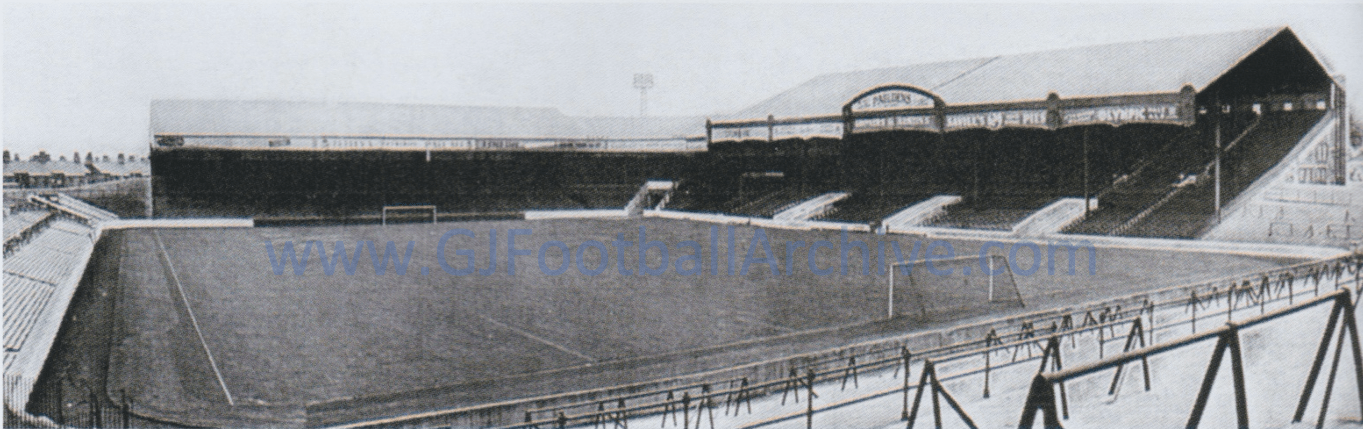
For day 47 of my posts counting down to the centenary of Maine Road’s opening game I’ve posted this photo from 1954. Lots changed at the stadium but a few things to look out for…

  • The original Main Stand roof has an advert where the architect Charles Swain had envisaged the club’s name (who says commercialisation of football is a new thing?).
  • The original floodlights can be seen (or at least one in the Platt lane corner). These were switched on for the first time in 1953
  • The Players’ tunnel is still its original size before the seating in the directors box was brought forward above the tunnel.

Here’s an aerial photo of Maine Road from 1971 to help with understanding of what’s what and to compare. So this was only taken 17 years after the main image but so much changed. The main image was taken from the old Scoreboard End (somewhere close to number 10 but obviously from the old terracing) looking towards the Platt Lane. The old floodlight was behind number 4 and you can see the second set of lights there in the image below. The Maine Stand roof had obviously changed between these images.

Maine Road aerial 1971 from Farewell To Maine Road

If you’d like to read more on the history of Maine Road, take a look at Farewell To Maine Road, which can be downloaded from this page:

If you enjoy all the free material on my website and would like to support my research and keep this website going (but don’t want to subscribe) then why not make a one-time donation (or buy me a coffee). All support for my research is valued and welcome. It allows me to keep some free material available for all. Thanks.

Choose an amount

£2.50
£5.00
£7.50

Or enter a custom amount

£

Your contribution is appreciated.

Donate
Maine Road 100 – Day 46

It’s 1941 and there are air raids across Manchester… For day 46 of my posts counting down to the centenary of Maine Road’s opening game I’ve posted this map. What does it signify? Well, the map shows Maine Road as it looked between 1931 and 1934, before the main part of the Platt Lane Stand was built (and after the corner was erected). But that’s not why I’ve posted it. I’ve posted it because of those pen circles that appear on it.

This is actually a Manchester City Council plan of buildings hit by bombs in the area immediately east of the Maine Road stadium. As you can see a house in Thornton Road was hit but none of the Maine Road stadium itself was hit in those January 1941 raids on Manchester. The stadium had a lucky escape but sadly many residents and Mancunians did not.

1941 Bomb damage near Maine Road

Here’s an aerial photo of Maine Road from 1971 to give a feel for the site. The Platt Lane corner is number 3 and Thornton Road is the street that backs on to Maine Road near number 6.

Maine Road aerial 1971 from Farewell To Maine Road

If you’d like to read more on the history of Maine Road, take a look at Farewell To Maine Road, which can be downloaded from this page:

If you enjoy all the free material on my website and would like to support my research and keep this website going (but don’t want to subscribe) then why not make a one-time donation (or buy me a coffee). All support for my research is valued and welcome. It allows me to keep some free material available for all. Thanks.

Choose an amount

£2.50
£5.00
£7.50

Or enter a custom amount

£

Your contribution is appreciated.

Donate
Maine Road 100 – Day 45

It’s a kind of magic! For day 45 of my posts counting down to the centenary of Maine Road’s opening game I’ve posted these images of Queen & the Rolling Stones at Maine Road. These images are the copyright of Garry Lippett who attended the Queen concert in July 1986.

Garry loaned his photos to me to be used in features about the concert and I’m eternally grateful. It’s quite often the fan photos that capture moments like these. In the days before mobile phones these type of photos are rare and the person taking the image has no idea how good or bad the image may be until it’s developed. Thankfully Garry managed to capture both acts on stage. Status Quo are on the left image and Queen on the right.

Status Quo (left) & Queen 1986 concert at Maine Road. Copyright Garry Lippett

Here’s an aerial photo of Maine Road from 1971. The Queen stage was placed in front of the Platt Lane Stand (numbers 3 to 5). If you look carefully at Garry Lippett’s images you can see the advertising boards at the front of the Platt Lane roof.

Maine Road aerial 1971 from Farewell To Maine Road

If you’d like to read more on the history of Maine Road, take a look at Farewell To Maine Road, which can be downloaded from this page:

If you enjoy all the free material on my website and would like to support my research and keep this website going (but don’t want to subscribe) then why not make a one-time donation (or buy me a coffee). All support for my research is valued and welcome. It allows me to keep some free material available for all. Thanks.

Choose an amount

£2.50
£5.00
£7.50

Or enter a custom amount

£

Your contribution is appreciated.

Donate

Maine Road 100 – Day 44

For the first time in my series of my posts counting down to the centenary of Maine Road’s opening game I’ve posted an image of a letter. This Day 44 feature is about the day Manchester United offered George Best to Manchester City.

Basically, Best was put on the transfer list by United and they sent a letter to every team in the top two tiers telling them he was available. In 1968 Best had said that he wanted to play for City as he felt they had the most attack-minded team in the League and he loved the thought of playing in a team that contained Colin Bell (below, seen in 1972-73), Mike Summerbee and Francis Lee.

Malcolm Allison did show interest in signing him but ultimately it never happened. Nevertheless this MCFC stamped letter is a rare item showing that United did offer the player to City and the other clubs in 1972.

Here’s an aerial photo of Maine Road from 1971, the year before Best was offered to City.

Maine Road aerial 1971 from Farewell To Maine Road

If you’d like to read more on the history of Maine Road, take a look at Farewell To Maine Road, which can be downloaded from this page:

If you enjoy all the free material on my website and would like to support my research and keep this website going (but don’t want to subscribe) then why not make a one-time donation (or buy me a coffee). All support for my research is valued and welcome. It allows me to keep some free material available for all. Thanks.

Choose an amount

£2.50
£5.00
£7.50

Or enter a custom amount

£

Your contribution is appreciated.

Donate
Maine Road 100 – Day 43

For day 43 of my posts counting down to the centenary of Maine Road’s opening game I’ve posted an unusual image of a screen on the Maine Road pitch. Can you work out what it was for?

This is a photo I took back in May 1999 of the Play Off semi-final away leg at Wigan. It was Springfield Park’s last competitive fixture and demand for tickets was high. I couldn’t get a ticket to be there but, because of the significance of the game, City decided to put a screen up at Maine Road and sell tickets for the Kippax.

Around 10,000 of us attended the game at Maine Road and we booed and cheered as you would if you were actually at the game. At one point Joe Royle appeared on the screen and we all chanted for him to ‘give us a wave’. Of course, Royle was at Springfield Park and couldn’t hear us but that didn’t stop us from booing when he seemingly ignored us! Football humour, hey?

Here’s an aerial photo of Maine Road from 1971. The Main Stand roof is different (as is the Platt Lane Stand and the Kippax Stand) but hopefully this will give an idea of where the screen was for those unfamiliar with Maine Road. It was positioned in front of the players’ tunnel (near 1 on the image) and I was sat in the new Kippax, roughly in between numbers 7 and 8 on this image.

Maine Road aerial 1971 from Farewell To Maine Road

If you’d like to read more on the history of Maine Road, take a look at Farewell To Maine Road, which can be downloaded from this page:

If you enjoy all the free material on my website and would like to support my research and keep this website going (but don’t want to subscribe) then why not make a one-time donation (or buy me a coffee). All support for my research is valued and welcome. It allows me to keep some free material available for all. Thanks.

Choose an amount

£2.50
£5.00
£7.50

Or enter a custom amount

£

Your contribution is appreciated.

Donate

Maine Road 100 – Day 42

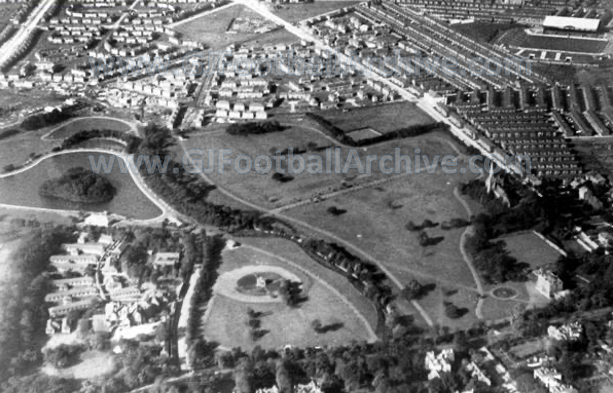
For day 42 of my posts counting down to the centenary of Maine Road’s opening game I’ve posted a then and now style feature on Maine Road from the air.

The angles are not quite the same but I hope the following gives you enough of a feel to recognise the differences between Maine Road c.1946 and Maine Road about a year or so ago.

There are a few obvious consistencies between the two photos – mostly the old terraced streets which predated the building of the stadium. Maine Road itself is on the right and Kippax Street is the street that heads towards the terracing (from the bottom/Claremont Road) in the older image. In the newer image it leads into part of the new housing estate. Note the centre spot/circle in the new image. It appears further north than in the older image but that’s mostly the angle (having said that I’m not entirely convinced it’s in exactly the right spot – I’ve not yet compared actual plans but I guess the architects and planners did).

It’s nice to see that the old directors car park (top right) is now a school playground/facility. This seems appropriate as the players often used that car park as a training area during the week. It’s nice to see some continuity. A passageway, known as ‘Pink Passage’ for many years, existed between the directors car park and the external wall of the Platt Lane Stand – you can just about see it on the old photo going from the back of Thornton Road around the Platt Lane to Maine Road.

Notice how the Kippax/Popular Side terracing in the old photo is narrower the closer it gets to Thornton Road (top)… In a previous post I’ve talked about how they had to square off this terracing when they put a roof on in 1957 and how residents objected because they lost the Granada TV signal! See:

Here’s another aerial photo of Maine Road. This is 1971. Notice the away section of the Kippax built on stilts (to left of number 8). The directors car park is the space behind the Platt Lane (numbers 4 & 5) with the Pink Passage between the two walls of the car park and the Platt Lane Stand. Kippax Street itself (the street not the stand) is just visible on the far right (to the right of number 9 on the edge of the photo).

Maine Road aerial 1971 from Farewell To Maine Road

If you’d like to read more on the history of Maine Road, take a look at Farewell To Maine Road, which can be downloaded from this page:

If you enjoy all the free material on my website and would like to support my research and keep this website going (but don’t want to subscribe) then why not make a one-time donation (or buy me a coffee). All support for my research is valued and welcome. It allows me to keep some free material available for all. Thanks.

Choose an amount

£2.50
£5.00
£7.50

Or enter a custom amount

£

Your contribution is appreciated.

Donate
Maine Road 100 – Day 41

Day 41 of my posts counting down to the centenary of Maine Road’s opening game follows on from yesterday’s feature. Today I cover ticket prices for Maine Road’s last season and provide a bit more on the additional temporary seating. This was of course a Premier League season, but the temporary seating had started to be added several years before, being used in 1998-99 as mentioned yesterday.

The most expensive seat was in the centre blocks B & C at £29 for the highest category game. The cheapest adult seat was £16 for the uncovered temporary stand UU, also known as the Gene Kelly Stand (see yesterday for naming details), and HH (dubbed the ‘Alan Ball Stand’ by one fanzine as it was small and didn’t make much noise!).

Other temporary stands were now in place in the tunnel between Platt Lane and the Main Stand (block G1 on the plan) and behind the security box (block H1 on the plan). As these were covered they were more expensive than the uncovered temporary stands.

You can see the temporary seating behind the stadium control box here – this would have been an empty space in previous years.

Photo by Ed Garvey

People often forget about these extra temporary stands, focusing only on the Gene Kelly and ‘Alan Ball’ (or Gene Kelly 2 as it was sometimes called). Even those two uncovered stands increased in size over the years. I typically sat in block Y of the Platt Lane this season but I did sit in the ‘Alan Ball’ for the Newcastle game early in the season. It poured down!

This image shows the ground before any temporary stands were built. This was 1995 (the Kippax is still being completed).

Compare the two plans from 2002 (above) and from 1998 (below) to see the additional temporary stands.:

If you’d like to read more on the history of Maine Road, take a look at Farewell To Maine Road, which can be downloaded from this page:

If you enjoy all the free material on my website and would like to support my research and keep this website going (but don’t want to subscribe) then why not make a one-time donation (or buy me a coffee). All support for my research is valued and welcome. It allows me to keep some free material available for all. Thanks.

Choose an amount

£2.50
£5.00
£7.50

Or enter a custom amount

£

Your contribution is appreciated.

Donate
Maine Road 100 – Day 40

It’s day 40 of my posts counting down to the centenary of Maine Road’s opening game and today’s feature concerns ticket prices for the 1998-99 season: The only season MCFC spent in the third tier.

Maine Road was all-seater by this point and the most expensive seat was in the centre blocks B & C at £18 for the highest category game. The cheapest adult seat was £9 for the uncovered temporary stand UU, also known as the Gene Kelly Stand as fans there were used to ‘singing in the rain’ – do an internet search on the reference if you’re baffled or think that Gene Kelly played in the 1937 title winning season. Actually, when I set up the original museum in 2003-04 a Manchester tourist using our ‘Virtual Tour of Maine Road’ interactive asked if Gene Kelly had played international football for Scotland!).

Other temporary stands were erected over the next couple of years as Maine Road struggled to cope with demand. This ticket price plan shows that there isn’t yet an uncovered stand between the Kippax and the Platt Lane for example. It also shows where away fans were housed – this had varied over the years but for most of Maine Road’s last 25 years they had been housed in the Kippax away section of the old stand with some seats in either the Main Stand or in block J (there’s a whole series of possible articles on where the away fans were placed game after game – it did vary and I do remember arriving one day and being surprised at a group segregated in a section of the Main Stand that was normally home fans only).

To help with the flashback to 1998 here’s a newspaper cutting on Ian Bishop’s return in 1997-98:

The Manchester Metro News highlights the return of Ian Bishop

Of course the 1998-99 season ended with promotion at Wembley – a stadium that had been built by the same builders as Maine Road and in the same year.

If you’d like to read more on the history of Maine Road, take a look at Farewell To Maine Road, which can be downloaded from this page:

If you enjoy all the free material on my website and would like to support my research and keep this website going (but don’t want to subscribe) then why not make a one-time donation (or buy me a coffee). All support for my research is valued and welcome. It allows me to keep some free material available for all. Thanks.

Choose an amount

£2.50
£5.00
£7.50

Or enter a custom amount

£

Your contribution is appreciated.

Donate

Maine Road 100 – Day 39

It’s day 39 of my posts counting down to the centenary of Maine Road’s opening game and today’s feature follows on from yesterday’s. It’s the demolition of the Platt Lane Stand during 2003-04.

Here are some images of that end at other times. This was the 1935 version of the stand:

The Main Stand’s benches with the Platt Lane Stand’s maroon and yellow benches in the background
The Platt Lane Stand, 1991

Here’s the 1930s stand during demolition in 1992:

I went with club photographer Ed Garvey and secretary Bernard Halford to have a look at the old place in 2004 as it was being demolished. It was a sad sight.

During the 2022-23 season I did a feature on Maine Road for the match programme at City and included a photo of Bernard Halford from our visit.

For those unfamiliar with Maine Road this photo may help locate the Platt Lane Stand. The 1930s stand is number 4 & 5 on this image taken in 1971.

Maine Road aerial 1971 from Farewell To Maine Road

If you’d like to read more on the history of Maine Road, take a look at Farewell To Maine Road, which can be downloaded from this page:

If you enjoy all the free material on my website and would like to support my research and keep this website going (but don’t want to subscribe) then why not make a one-time donation (or buy me a coffee). All support for my research is valued and welcome. It allows me to keep some free material available for all. Thanks.

Choose an amount

£2.50
£5.00
£7.50

Or enter a custom amount

£

Your contribution is appreciated.

Donate

Maine Road 100 – Day 38

It’s day 38 of my posts counting down to the centenary of Maine Road’s opening game and today’s feature is of a sad scene: The demolition of the Main Stand during 2003-04. Apologies but it had to be shown one day.

I went with club photographer Ed Garvey and secretary Bernard Halford to have a look at the old place in 2004 as it was being demolished. It was a sad sight.

Ed Garvey photograph
The directors’ box during demolition 2004. Ed Garvey photograph

During the 2022-23 season I did a feature on Maine Road for the match programme at City and included a photo of Bernard Halford from our visit.

Ed Garvey photograph

Warning: tomorrow I’ll post another demolition image.

For those unfamiliar with Maine Road this photo may help locate the Main Stand. It’s number 1 on this image taken in 1971.

Maine Road aerial 1971 from Farewell To Maine Road

If you’d like to read more on the history of Maine Road, take a look at Farewell To Maine Road, which can be downloaded from this page:

If you enjoy all the free material on my website and would like to support my research and keep this website going (but don’t want to subscribe) then why not make a one-time donation (or buy me a coffee). All support for my research is valued and welcome. It allows me to keep some free material available for all. Thanks.

Choose an amount

£2.50
£5.00
£7.50

Or enter a custom amount

£

Your contribution is appreciated.

Donate