It’s day 89 of my posts counting down to the centenary of Maine Road’s opening game. Today – Pitch invasions! There were lots of celebratory (and some not so celebratory!) pitch invasions at Maine Road over the years. The League title in 1937 saw one, as did promotion games and other matches, such as the 1970 ECWC semi-final victory over Schalke.
The photographs on this post are all from City’s promotion match with Birmingham in 2000 and were taken by me from the Platt Lane Stand.
Promotion pitch invasion v Birmingham 2000Promotion pitch invasion v Birmingham 2000Promotion pitch invasion v Birmingham 2000, looking towards the players in the Main Stand
If you’d like to read more on the history of Maine Road, take a look at Farewell To Maine Road, which can be downloaded from this page:
If you enjoy all the free material on my website and would like to support my research and keep this website going (but don’t want to subscribe) then why not make a one-time donation (or buy me a coffee). All support for my research is valued and welcome. It allows me to keep some free material available for all. Thanks.
It’s day 88 in my 100 day countdown to the centenary of Maine Road. For today here’s an image that needs you to take a good look at. Is this Maine Road or is this a stadium inspired by City’s old ground?
This is an image from the 1920s but it’s not Maine Rd, so why have I included it in a Maine Road centenary piece and where is it?
Well, the answer is…
This is Murrayfield Stadium and believe it or not the stadium was modelled on Manchester City’s Maine Rd stadium. Maine Rd was opened in 1923 and the architects of Murrayfield visited Maine Rd while designing their new stadium, which opened in 1925.
Obviously, there are differences but the general look and style of the place is similar – one huge main stand which didn’t quite go the full length of the pitch (both stands ran about 3/4 of the length of the pitch with a terraced section from stand to corners); a huge, banked terracing opposite which curves down to the corners and two similar sized terraces behind the ends. Have a look at these images from inside Murrayfield in 1925 and see:
Here’s a Maine Rd image from that year too.
1925 Aerial photo of Maine Road and Platt Fields Park
Roberto Mancini has left his role as Italy’s men’s football manager. Hopefully, he’ll be back in club management soon and maybe in the Premier League too. His contribution to Manchester City’s history is huge and so I think it’s worth reposting this audio special I did a couple of years ago. It’s a special audio recording talking about the years building up to the 2011 FA Cup success brought to City by Mancini. It includes some audio I did with him back in 2011 too. Enjoy this reminder of a time when Mancini helped transform City’s fortunes.
Restored 2011: The All-Manchester FA Cup Semi Final is a special 1 hour audio recording looks at the game and the years between the 1976 League Cup success and the FA Cup glory of 2011. The 2011 semi-final was a crucial step in City’s journey since the 2008 takeover and I felt it was vital to do a special marking this.
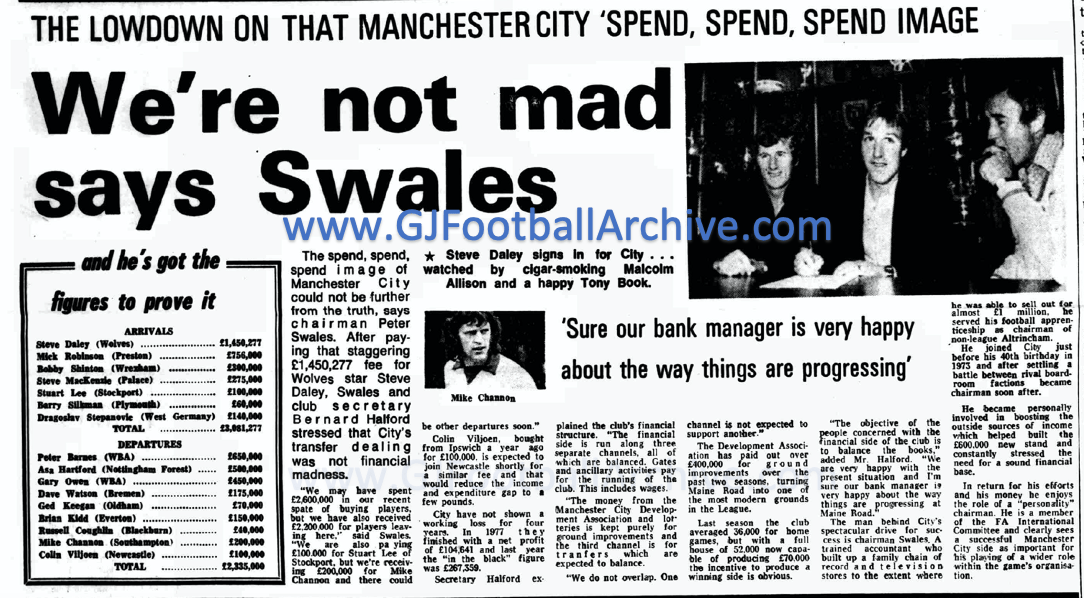
So what’s in this special recording? Well, I’ve included exclusive material from interviews and recordings I’ve done over the years with Garry Cook, Brian Marwood, Roberto Mancini, Peter Barnes and Peter Swales. Why Swales? Well, have a listen and you’ll hear why. Basically though I’m trying to set the tone for why the 2011 FA Cup semi final victory and overcoming Manchester United was so significant.
On Mancini… I include a few words from him recorded in 2011 and at one point he talks about the view that was then being expressed that City were ‘trying’ to buy success (now they say City ‘have’ bought success!). His words are a reminder that City have been having that particular criticism thrown at them for over a decade! Oh well, I wonder how long those criticisms were laid at other clubs who had seen major investment which propelled them forward?
Anyway, get yourself a brew and be prepared to be transported back in time. Here’s the recording:
If you enjoy the recording then please let me know, comment or subscribe to the site. I’ve produced videos/talks like this highlighting key points in Manchester City’s footballing history which subscribers can watch.
Subscribe to get access – Annual
Read more of this content when you subscribe today. It costs £20 a year to subscribe (it works out £1.67 a month) or £3 if you’d like to sign up a month at a time. Annual subscribers get full access for as long as you subscribe (you can always try it for a month). It’s worth bearing in mind that the 2010 Manchester A Football History cost £24.95 and all subscribers will be able to access all of that for as long as they are a subscriber (plus all the other stuff of course).
It costs £3 a month to subscribe a month at a time. Why not give it a try! Monthly subscribers get access to everything posted since 1 October 2022 for as long as you subscribe.
If you enjoy all the free material on my website and would like to support my research and keep this website going (but don’t want to subscribe) then why not make a one-time donation (or buy me a coffee). All support for my research is valued and welcome. It allows me to keep some free material available for all. Thanks.
It’s time for post 87 of my Maine Rd 100 countdown and this is a reminder of the day (4 January) in 1975 when Manchester City played ‘away’ at Maine Road against Newcastle United in the FA Cup. The tie should have been played at Newcastle but the FA ordered that the match be played at Maine Road following crowd disorder at St. James’ Park the previous season. City lost the match 2-0.
Were you at this match? If so why not leave your memory as a comment or email it to me for possible future use on this website?
You can read a 1500 article on the 1974-75 season here:
Today’s game with Burnley provides a great opportunity to remember some key games and stories from years gone by featuring the two clubs. I’ve written a lot about City & Burnley games over the years so sit back and get yourself in the mood for tonight’s game by having a look at these articles:
One of my quests to find missing objects involves the 1904 FA Cup final ball. I know it was in Burnley for over 40 years and was still there in the 1950s but where is it today? Can you help find it? Have a read of this:
Post 81 of the Maine Road 100 countdown is this image of City’s coach Malcolm Allison in 1968 preparing to come on during a City game at Maine Road. So what was the story? Read on…
The story starts on the final day of the 1967-68 season:
As it had still been possible for either Manchester City or Manchester United to win the League on the final day of the 1967-68 season, the Championship trophy was left at the home of the reigning champions United.
City won the League at Newcastle while United lost 2-1 to struggling Sunderland.
You can read about that final day of the season here:
At United the Championship trophy vanished at some point during that day. The Daily Express reporter Alan Thompson set off on a mission to track it down. He started questioning the Old Trafford staff: “Secretary Les Olive was under the impression that a League official had taken it earlier in the week, Matt Busby was not at all sure what had happened to it, and for a minute or two it was lost until a member of the female staff admitted that it had been locked up ‘in the vault’. You are at liberty to allow full rein to your imaginations in concluding exactly where the ‘vault’ is at Old Trafford. But the centre of the boardroom table, where the League Championship Cup has stood proudly for the last 12 months was occupied by five shillings worth of flowers. Sit down the City fan who says symbolic.”
City still needed the trophy to be presented (Joe Mercer had offered to walk all the way from the Newcastle game to Old Trafford to collect it if he had to!) and so a friendly against Bury was hastily arranged for the Tuesday (May 14 1968) following the Newcastle game to enable the Championship trophy to be presented.
If the destination of the title was not obvious during the season, the trophy would be presented at the League’s annual dinner but as City would be on tour in America, the League agreed to present it at Maine Road. The presentation took place before the Bury game with Tony Book and the rest of the players going on a lap of honour before Mercer was handed the trophy to lift above his head. The crowd roared with delight and then witnessed a 4-2 victory.
Bury’s two goals were scored by Bobby Owen who, two months later signed for the Blues.
The game was noteworthy for it also included an appearance by Malcolm Allison. For much of the game he’d sat, wearing his familiar red tracksuit then, with about ten minutes left he took the tracksuit off and this image was taken.
Allison then substituted George Heslop and entered the field himself wearing the number 8 shirt. This caused a little confusion as Colin Bell remained on the pitch with the same number but nobody complained, after all it was a night to enjoy especially when Allison threw himself into the game. He forced a great save from Neil Ramsbottom, the Bury ‘keeper, and had a goal disallowed. The City supporters chanted ‘Allison for England’, and even called for Mercer to take to the field.
For post 74 of my Maine Rd 100 countdown I’m posting this image of the original Scoreboard End being built at the old ground. The Scoreboard End lasted from 1923 until 1970 when it was demolished and replaced by the North Stand. Here’s an aerial photo from almost 40 years later showing the Scoreboard End as the last remaining uncovered stand.
A couple of years ago (and going on for the following 35 weeks) I posted the Scoreboard End being built image as part of my Name That Historic Ground series. Every Monday I challenged readers to see if they could recognise a different ground each week from an old photo. Some were easy, others not so. If you missed them you can now go through each week’s ground and the answers. You can start here:
While you’re here why not subscribe to my site and you can then access every article, interview, audio recording etc. already posted and those that will be posted during your subscription. It costs £20 per year (about £1.67 a month). You can subscribe below:
Subscribe to get access
Read more of this content when you subscribe today.
For post 72 in my Maine Road 100 countdown and today I wanted to show this image of the old ground photographed during the summer of 1982 when the Main Stand roof was being replaced. The white barrelled roof was about to be erected but first the old roof, part of which was the original 1923 structure, had to be removed.
This 1971 image shows the roof being removed (number 1) and the new roof would then stretch over the uncovered section (2).
Maine Road aerial 1971 from Farewell To Maine Road
While you’re here why not subscribe to my site and you can then access every article, interview, audio recording etc. already posted and those that will be posted during your subscription. It costs £20 per year (about £1.67 a month) or you can sign up on a monthly basis at £3 per month (you can cancel at any time, so you could sign sign up for a month, access everything you want and then cancel). You can subscribe below:
Subscribe to get access – Annual
Read more of this content when you subscribe today.
Here’s post 70 in my Maine Road 100 countdown. Today I’m talking about the old stadium’s final Manchester City victory. During 2002-03 the focus for many City fans was Maine Road’s final season, especially the final month or so of the season. With every game at the stadium a sell-out – only the size of the away support varied – supporters were desperate for the final season to see the old venue at its best. They also wanted a few memorable results in those final weeks.
Ultimately, the best Maine Road match of the final weeks came on April 21 2003 when a goal from Robbie Fowler and two from Marc-Vivien Foe brought a 3-0 win over Sunderland. The game became significant as it was to be the last City victory at the old stadium and Foe’s 80th minute goal was the last scored there by a City man. Sadly, Foe was also to die a few weeks later, adding to the poignancy of this day.
Pre-match Sunderland presented the Blues with a rose bowl commemorating their final visit to the stadium. Significantly, the time span between their first appearance at Maine Road and their last was greater than any other visiting club. Co-incidentally City’s last victory at Hyde Road was also against Sunderland in April. You can read about that game here:
Post 69 in the 100 Maine Rd countdown is this image from a game played on 5 March 1934. It shows Eric Brook scoring what some believed was the greatest goal ever netted at Maine Road (see post 68 for a later contender). What else makes this image special is that it’s from the 84,569 game v Stoke when City attracted a record English crowd on a club ground that still stands today.
Subscribers can read more on why this day, game and image is so special here: