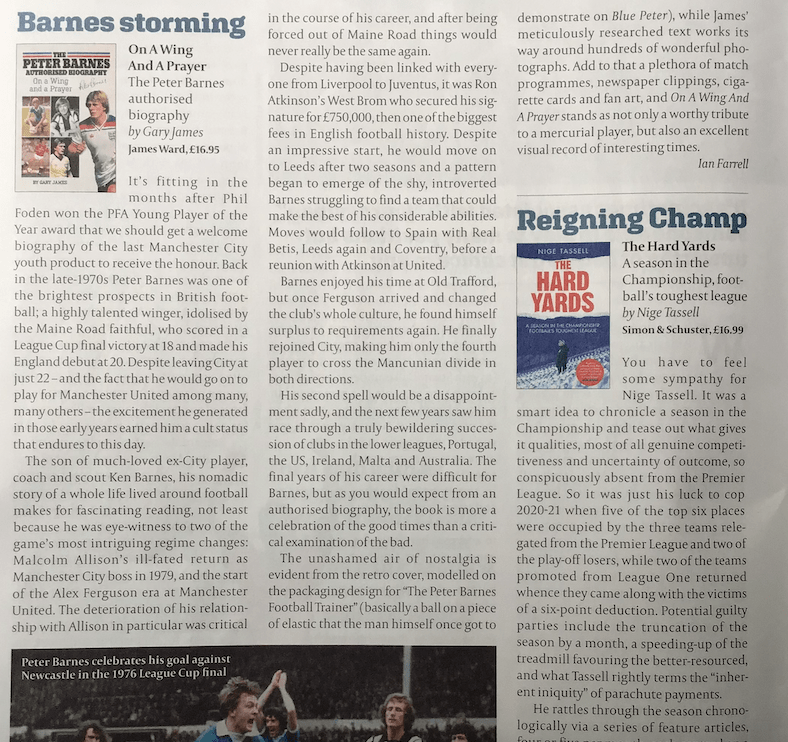
November 1920 and A Controversial Offer by MUFC

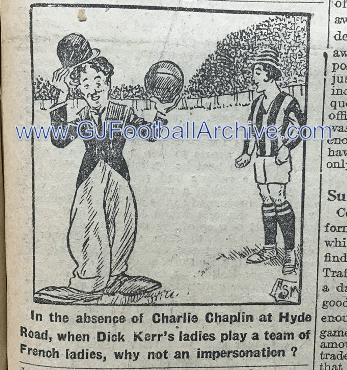
Back in November 1920 Manchester City’s main stand at Hyde Road was destroyed by fire. City asked United if they could move to Old Trafford but their terms were prohibitive according to the media of the day. This report was typical of the reaction. You can read the full story in Manchester A Football History which subscribers to GJFootballArchive.com get as part of their subscription. For more details see: https://gjfootballarchive.com/2021/01/09/manchester-a-football-history-part-one/

Collecting Shirts – Mark McCarthy Guest Blog

Here’s a guest blog written by Mark McCarthy, who collects match worn Manchester City shirts. Mark has recently brought out a book on his collection (see below) and has written this blog to explain how his collection and interest started.

A visit to my Grandfather’s house on a Sunday evening was something I always looked forward to as a child, but on this particular afternoon in December 1983 it was to change the course of my then 9 year old life forever. He would always have a story to tell but that afternoon’s tale was by far the best yet as he informed me that my cousin (Mick McCarthy) would be joining Manchester City.

I knew nothing about football at this stage  nor did I follow a team or OWN A FOOTBALL SHIRT but I was simply hooked. As the years ticked by it was always my goal or dream really to own a shirt from Mick’s time at City. That dream became a reality when I finally sourced a shirt of his from a dealer who was selling up his City collection.

It was only ever my intention to own just the one shirt, at the time of writing this my City match worn shirt collection now stands at 410 original match worn or issued shirts dating back to the 1926 FA Cup Final, where I have George Hicks’ shirt from the final v Bolton, by far the oldest in the collection.

There was simply something about receiving Mick’s shirt that day which kicked off my passion for collecting City match shirts. The smell and feel of the shirt, coupled with me simply being lost in time reminiscing about the dressing rooms that shirt had been in or battles that took place while being worn during the two seasons it was used by City from 1985 to 1987. It is of course very different these days with the players having so many shirts a season. I recall Mick telling me once that the shirts were virtually counted on and off the players’ backs. A similar story to the one the great Mike Summerbee told me that if shirts were torn back in the day the players would have to get them repaired themselves before the next game. This was still the case in 1996 when Georgi Kinkladze’s shirt was torn and simply sewn up for the next fixture

When you eventually find or trace a shirt from of a player whose poster would don your bedroom wall as a kid kind of keeps the kindred child spirit alive  in the collector. Players from days gone by are far more approachable and will always have time for the fans of the clubs they played for.  

Now City weren’t exactly setting the world alight in 1983 and after declaring myself a blue I immediately received some serious abuse from school mates who just couldn’t get the heads round why I’d chosen Manchester City, and equally wouldn’t believe I had a relative that had played for the club. 

I was totally obsessed with City which virtually took over my life. Unfortunately there was hardly any, in fact NO media coverage of City at this time, and even more so as we were in the old Second Division so I’d often have to get the latest news by scrolling through teletext or by ringing the City ClubCall line.

One day I returned home from school to find that the TV and video were missing from my bedroom as my Mum had sold them off to pay for the massive phone bill that I’d run up! 

I first got my chance to see City play live in November 1985 as were due at Luton Town, which is only half hour from our home in Milton Keynes. Manchester to me in those days was just a place I dreamt of going and Maine Road seemed a world away. After many months of badgering my parents to take me and with no chance of a fixture change in those days they finally gave in. My Mum kitted me out from head to toe in blue and white City colours and I couldn’t have been prouder on my way to watch the Blues. 

The walk to the ground felt amazing and we entered the first turnstile we saw. Off came the coat to reveal my pride but after a few minutes and constant dirty looks, we realised something wasn’t right and we appeared to be on show. As the chants of ‘City….City’ went up from the opposite end of the ground it dawned on us that we were in the wrong end of the ground and needed to moved quickly. 

This was 1985 and was certainly an experience for a then ten year old. The stewards promptly threw us out and my dad was seething as we headed back to the van to go home, I was distraught but he finally saw sense and we headed back to the ground where he had to pay again at the right turnstile and again I was hooked. The atmosphere in that tiny away end was electric and I couldn’t help but watch the many characters I was surrounded by. Everyone seemed to know each other and I wanted a part of it. 

For the record we lost 2-1 – Typical City !! 

One of the most enjoyable aspects of collecting for me is the groundwork that goes into finding a shirt or the buzz of the unearthing a shirt. Always look for a shirt in the least expected places you’d think of finding one as you just never know who may have collected a shirt along the way or how. If you don’t ask then you don’t get is the number one rule.   

I’m sure I speak for all collectors when I say that opening a random online message that start’s with the words “I have this shirt if you are interested in it.” Then the shirt turning out to be one of the most difficult shirts to find is a buzz only a collector will understand. I was contacted recently with that exact message asking did I think the shirt was genuine. It turned out to be Mick McCarthy’s issued long sleeve chequered style away shirt from the 1986-87 season which was used just seven times in that campaign, not by Mick though as he refused to wear long sleeved shirts.

The shirt had been given to a young City fan by his next door neighbour who used to work in the Maine Road laundry  room!  Always believe the shirts are out there as 9 out of 10 times they are.   

A question I’m often asked, as I’m sure all collectors are, is what’s the favourite shirt in my collection. This is a difficult question considering the numbers to choose from but at the moment it would be a 1967/68 Colin Bell Umbro home shirt worn by arguably City’s greatest ever player, during a title winning season. One that runs it close is a more modern day shirt but equally as great a player in David Silva,  from City’s fixture v Watford on 21st September 2019, during City’s 125 anniversary celebration. 

The shirt was a gift from City as a thank you for displaying 11 shirts from the collection in a mock up dressing room at City Square before the match as part of the 125  anniversary celebrations. I was asked to drop off the shirts at reception for the City Square team to display but duly explained that although I was more than happy to bring the shirts…. I  wouldn’t be leaving their side.  

My lad and I spent a fantastic couple of hours meeting & chatting to fellow Blues while giving them a bit a history behind each of the 11 shirts I’d brought to display (at the same time also keeping a very close eye on the kids with burgers and drinks in hand approaching  them!). 

I was asked if we’d like our seats upgraded to the legends lounge as a thank you but of course declined as I had a much better idea in mind, cheekily asking for a shirt of the greatest City player I’ve seen play live in my time watching the Blues. Although the City Square match day manager, a lovely lady, said she’d ask but said it would be very unlikely…. but if you don’t ask then you don’t get as they say. 

Once the display was finished and the shirts were safely packed we sat back and enjoyed a stunning 8-0 City win, captained by Silva who would just happen to open the scoring in under the first minute of the match. I’d completely forgotten I’d even asked ‘that’ shirt question as we made our way back to Piccadilly for the train journey home after the game. I was interrupted by a phone call half way there from the lady at City Square to inform me my request had been granted and could I make my way back to collect the shirt which was waiting at the City@Home office for me……….. I’m pretty sure it was the quickest walk I’d ever made to collect said shirt, fresh from Merlin’s back and still completely wet through…. First thing I did was…….Yes you’ve guessed it…….Sniff the shirt!   

As far as the future is concerned for my collection I certainly don’t see any signs of it slowing down as yet. I have a target in mind for a number of shirts to reach……….. Well a man does need a hobby!

You can buy Mark’s book direct from the publisher here:

https://www.conkereditions.co.uk/shop/

Joe Mercer OBE

On Thursday a PFA plaque will be unveiled to honour a footballing legend. Joe Mercer was a hugely successful player with Everton, Arsenal and England and a trophy winning manager with Aston Villa and Manchester City. He also managed Sheffield United and Coventry City. He was acclaimed as a man who had put the fun back into English football during a spell as the England boss. He fully deserves this tribute and, if you can make it, please come along to the plaque unveiling. Back in 2004 I wrote the following piece for the Manchester City match programme which, for those Blues wondering why Joe was significant, may help to explain his importance to the club. Enjoy… it starts with the original introduction (and all references to Joe’s family etc, are from 2004 of course).

***

In Search of The Blues considers the life and career of a former City great who sadly is no longer with us, Joe Mercer OBE.  The reason we have decided to reflect on Joe’s life today is that last Monday (9th August 2004) marked the 90th anniversary of the birth of the former City & England manager.  Sadly Joe passed away on the same date in 1990 – his 76th birthday. Joe was City’s manager during the Club’s most successful period, and Gary James, author of “Football With A Smile: The Authorised Biography of Joe Mercer, OBE”, provides a commentary on Joe’s lifetime of achievements.

Why is Joe Mercer so important to this Club?

Joe breathed new life into a club that was struggling to survive.  During the early sixties City had reached a critical level – one director actually suggested the Blues should merge with United! – and Joe’s appointment was one which had to succeed.  Joe brought in a highly enthusiastic Malcolm Allison as his number two and between them they transformed City from a struggling sleeping giant into League Champions, FA Cup winners, League Cup victors and European Cup Winners’ Cup winners. 

The Blues became renowned for their positive approach and swashbuckling style and Joe encouraged everyone to enjoy life at Maine Road.

Without Joe’s arrival in July 1965 it’s very difficult to see how City’s fortunes could be resurrected.

How did his partnership with Malcolm Allison work?

There have been many theories over the years of how the two men worked together.  Many people focus on their contrasting styles – Malcolm the flamboyant one; Joe the fatherly figure – but during the 1990s Malcolm answered a similar question by stating:  “we made it work because we told each other the truth, and we never really fell out.  We had a great relationship.  I enjoyed it all and I think, like Joe, those first five years were the best ever for me.  I think that fortune favours the brave, and I think that sometimes you have to be fortunate where you work and who you work with.  I was very lucky when Joe got the City job, and took me there.  And we started right from the grass roots, right from the bottom and took them to the top.  That is real achievement!”

How does Joe compare to football’s other great managers?

In 1990 Bobby Charlton said he was one of football’s most important figures and added:  “Joe was a great, great person and we don’t say that about many people.  They don’t produce people like him very often.  He was a true great, along with the likes of Bill Shankly.”

Joe’s period as City manager coincided with a number of famous managerial careers – Shankly (Liverpool), Busby (United), Revie (Leeds), Nicholson (Spurs), Stein (Celtic) – and so comparisons should be easy, however each Club was at a different phase in development and it would be foolish to directly compare.  However, it is clear however that during 1967-8 City swept aside the great sides created by his contemporaries and that the Mercer-Allison side won many admirers across the Country because of the style of play and positive attitude.  

In addition to Joe’s time at City he did have some success away from Maine Road and, of course, he managed England for a brief but entertaining spell.

Why did Joe Leave?

Initially, because of Joe’s health problems at Villa, he had anticipated being at City for only a few years.  Naturally, Malcolm was keen to manage the Club in his own right but that didn’t seem possible while Joe was still at the Club.  In 1971 Malcolm was given the role of Team Manager but Joe’s position was less clear.  Power struggles in the Boardroom and various other issues placed Joe and Malcolm in different camps and, when an offer from Coventry came in 1972, Joe felt it was time to move on.  

What was Joe’s managerial record away from Maine Road like?

His first League management role was at Sheffield United.  The Blades were struggling when he arrived mid season and were relegated (1956), however during the course of the next couple of seasons he developed a good cup-fighting side and was offered the Arsenal manager’s job at one point. 

In December 1958 he became the Aston Villa manager and again created a good cup fighting side and brought the Villa Park club the Second Division Championship in 1960.  He also guided them to success in the 1961 League Cup and took them to the final again in 1963.

Sadly, problems at Villa during 1964 caused Joe health problems.  He went to see a doctor and according to Joe some years later:  “He told me ‘It’s either polio or a stroke.’ And as I was leaving the room he called me back and said ‘What about the fee?’  I turned and said ‘well, I must be a bloody bad risk then!”

At the time Joe was also managing the England under-23s and had even been tipped as England manager (August 1962) – that proves how highly Joe was thought of as a manager prior to his phenomenal success at City.

After City, Joe won a manager of the month award at Coventry and took on the role as England caretaker manager during 1974 for 7 games.  His first game in charge saw Kevin Keegan and Stan Bowles – a former player under Mercer at City – both score in a victory over Wales.  Joe was offered the job on a permanent basis but turned it down for health reasons:  “I had the most terrible sciatica.  I was almost a cripple with it.  I was offered the job but I didn’t feel fit enough.  It was as simple as that.”

Why did he join City in the first place?

After his health problems at Villa Joe missed the daily involvement with the game.  He started to report on games for newspapers but reporting was a poor substitute for management.  In 1965 when the City approach came it was a major gamble for all concerned.  Joe was not really fit enough to take on the role immediately and the Club had to think carefully about the appointment.  Joe didn’t think about it for long.  He was desperate to get back into the game and was determined to take on the job.  He recognised the potential at the Club – a year earlier he had stressed he wanted only to take on a job at a progressive, positive club.

His family was not as enthusiastic at first but his wife Norah knew he had to take it on:  “I married a footballer.  I realised he had to go back – it would have killed him hot to.”

Who was his first signing at City?

Ralph Brand, a Scottish international who had scored 128 goals in 207 games for Rangers, was the first signing but it was not a success.  Joe’s second signing was considerably more successful however, that was Mike Summerbee.

What did Joe achieve as a player?

As a player he had enormous success.  With his first club Everton he won the League Championship in 1939 – who knows what else Everton and Joe would have won had war not intervened – while his time at Arsenal saw him win two further Championships (one as captain) and the FA Cup.  He also captained the Gunners to the 1952 final where they were reduced to ten men for a significant part of their defeat by a strong Newcastle side. 

In 1986 when Arsenal celebrated their centenary they introduced many significant and famous players from their history on to the pitch.  According to Arsenal author Keith Fisher Joe Mercer received the biggest ovation of them all.

Joe also had a great England career, and captained the international side during crucial wartime morale boosting internationals.

His popularity was so high he even appeared on magazine covers.  

How is Joe remembered outside of Manchester?

Joe is remembered as a truly great player at both Everton and Arsenal.  Both sides recognise that his contribution to their history is immense while at a national level Joe is remembered as one of the Football League’s 100 legends.  

As a manager, Joe’s record at Aston Villa is not perhaps viewed as positively as it should be, however his time at Coventry (1972-1974) is remembered fondly.  As is his period as England manager.

In 1976 he was awarded the OBE for services to football.

Which team did he support as a boy?

As a boy growing up in Ellesmere Port, Joe was an Evertonian.  However he also had a soft spot for Nottingham Forest and, in particular, Tranmere Rovers as his father, Joe Mercer Snr, had played League football for both sides.  Sadly, he passed away while Joe was still a young boy, but Joe always retained a strong feeling for Tranmere.  In later life he became a regular attendee at Prenton Park.

Did he achieve any notable milestones during his playing and managerial career?

At the age of 35 in 1950 he was presented with the Football Writers’ Player of the Year trophy and continued to play top class football until injury forced him to retire at 39.  Naturally, there were all his trophy successes as a player.

By managing City to the FA Cup in 1969 he became the first man to win both the FA Cup and the League as a player and as a manager.  The first man to surpass this achievement was Arsenal’s George Graham who had actually been brought to England by Joe when he was Aston Villa manager.

In 1970, Joe managed City to the League Cup and ECWC double – this is recognised as the first major English/European trophy double although Leeds did win the Fairs Cup and League Cup (but some leading sides still boycotted this competition at the time) in 1968.

Since Joe passed away have his family retained their love of the Blues?

Definitely, Joe’s 84 year old widow Norah is a regular attendee – she came to the Lazio game last week and is determined to be here today.  She loves the Club and is a very popular presence on match day.  She has also been to the stadium for various other activities including last season’s Hall of Fame dinner and the official opening of the Manchester City Experience in April.

Norah has been part of City life since her husband first accepted the City job.  She is also a keen member of the Merseyside CSA.

Finally, how did Joe view the game during his later life?  Did he still love it with the passion he had as a boy?

Joe tried to keep focus on the game rather than activity off it.  During the 1980s, towards the end of his life, he was asked his views on the problems of the ‘modern game’ and gave a comment which is as relevant today as it was then:

“Football is a great game.  It is all about goals, goalmouth incidents, and end-to-end attacking football.  There is nothing wrong with the game; plenty wrong with managers, players, directors, legislators, and the media.  Football has been very kind to me and I really mustn’t complain so can I leave you with this thought – The object of playing any game is for enjoyment.  If you have enjoyed it and done your best you have won no matter what the result!”

The First ‘Manchester Derbies’

Back in 1881-82 the two teams that would eventually become Manchester City and Manchester United met for the first time with the first fixture occurring on this sate (12th November 1881). To mark this anniversary here’s a free article on the first two derby matches. Both were friendlies of course!

The First Time

Back in 1881-82 the two teams that would eventually become Manchester City and Manchester United met for the first time. This was only a year after the first reported games played by the clubs, then known as St Mark’s (MCFC) and Newton Heath (MUFC). The first St Mark’s game to make it into print was against Macclesfield Baptists on 12th November 1880 while Newton Heath’s earliest known game came seven days later against Bolton Wanderers’ 2nd team.

On the anniversary weekend of St. Mark’s first reported game, 12th November 1881, Newton Heath and West Gorton (St Mark’s) met for the first time.  The game, played at North Road, Newton Heath, attracted an attendance of around 3,000 (according to details recorded many years later – I’m dubious about the number but we have nothing contemporary that’s accurate so we’ll go with that).  

The ‘Heathens’, who went on to become Manchester United in 1902, defeated West Gorton (St. Mark’s) 3-0 in what was described as a ‘pleasant game’.  I wonder what the reporter would make of 21st Century derby matches!  Two goals were scored in the first half, one being an own goal by one of West Gorton’s ‘backs’.  It is not reported who scored the goal, all the ‘Ashton Reporter’ match report says is that the player was “attempting to stop a shot by E. Thomas”.  

One of the significant aspects of the way this game was reported which has created some confusion over the years concerns the St. Mark’s name.  It was recorded as West Gorton (St. Mark’s) as opposed to St.Mark’s (West Gorton) and that change has caused some to suggest that the church were unhappy in some way with the club.  There was a suggestion that the club was attracting players from outside of the parish and that was an issue, but none of this now appears to be correct.  The church appeared to be happy with the way the side was developing and, if anything, the selection of Kirkmanshulme Cricket ground actually meant the team were playing fairly close to the St. Mark’s rectory.  The move potentially increased the opportunity for spreading the church’s work and that may be why the person sending in the match reports to the local newspaper changed the emphasis.

The Return Match

The return match took place at the Kirkmanshulme Cricket ground (West Gorton’s home) on 4th March 1882. On the image above this is the cricket ground to the right of Tank Row (and left of Belle Vue Zoo).  

West Gorton (St Mark’s) gained revenge for the 3-0 defeat in their first encounter, as they overturned Newton Heath 2-1. The Gortonians had managed to take the lead, via Charles Beastow, as early as the eighth minute, and then had to hold off the Heathens who had been awarded a couple of consecutive corners.  The second actually lead to West Gorton’s second goal.  James Collinge obtained possession in front of the West Gorton goal then proceeded to run the full length of the pitch, before sending the ball flying between the Heathens’ posts amid loud cheering.  

The score remained 2-0 until late in the game when, according to reports, the Heathens baffled the home ‘keeper Edward Kitchen by performing several good passes before the ball entered the goal.  Exactly how baffled Kitchen was we don’t know, but we do know that this game was well attended.

Years later the attendance that day was reported as ‘around 5,000’, although it would be unfair and ridiculous to suggest that this was the actual attendance.  It seems incredible that around a sixth of Gorton’s population would have been able to attend a game which, at that point, was not regarded as a ‘derby’ or an important fixture whatsoever.  Nevertheless. it does provide an indication that football in West Gorton was becoming popular.

Subscribe to access everything else

This has been a sample of the material on http://www.GJFootballArchive.com If you would like to read all the in-depth articles (including the entire Manchester A Football History book and the audio interview with John Bond) then please subscribe. It works out about £1.67 a month if you take out an annual subscription (£20 per year) or £3 a month if you’d like to sign up for a month at a time. Each subscriber gets full access to the hundreds of articles posted so far and the hundreds scheduled to be posted in the coming weeks.

Dismal Days AFTER the MCFC Takeover

Here’s a flashback to a difficult period on this day in 2008…

City conceded twice in three consecutive League games during this period, dropping to 13th after a 2-1 defeat to Spurs on 9thNovember. It was a difficult time, especially as manager Mark Hughes felt aggrieved with some refereeing decisions. Most notably, Hughes was unhappy that Middlesbrough on 29th October had been awarded a highly debateable penalty by referee Lee Mason. Replays showed that there had been minimal contact between City’s Sturridge and Boro’s Wheater as the player went down outside the area. That goal switched control in the game. Hughes: “Wheater was not in full control of the ball, he was outside the box and the linesman did not give it. The shape of the game changed… All night the referee took it upon himself to make decisions that were quite frankly disappointing.”

After defeats at Bolton and at home to Spurs the media began to speculate that Mark Hughes’ position was in doubt. City, a point above the relegation zone, had suffered seven defeats in 12 League games causing journalist Daniel Taylor to comment: “Hughes is now at a club where the high expectation levels make him vulnerable…[Hughes] did not sound entirely convincing as he tried to pass some of the blame for this defeat to the referee Mike Dean for ‘not taking into account the [rainy] conditions’.”

It should be noted that City had ended the Spurs game with only nine players following the dismissals of Fernandes (26 min) & Dunne (83) and that Tottenham also had a man sent off. 

Match Stats:

2008-09

29 Oct  Middlesbrough (A)                    L 0-2                                        25,731

2 Nov   Bolton Wanderers (A)               L 0-2                                        21,095

9 Nov   Tottenham Hotspur (H)              L 1-2 Robinho                          41,893

#ManchesterDerby – Utd 0 City 2

Here’s a brief clip I took today of City fans at the end of the Manchester Derby at Old Trafford. A dominant day for Manchester’s Blues.

Historic Name That Ground – Week 20 Answer

On Monday I asked ‘can you name the ground featured in the image above? Believe it or not this image is from the 1960s. I’ve had to obliterate something from above the door that would’ve given the ground away.’ The answer is…

Everton’s Goodison Park photographed in 1966. Did you get it?

Next ground on Monday.

While you’re here why not subscribe to my site and you can then access every article, interview, audio recording etc. already posted and those that will be posted during your subscription. It costs £20 per year (about £1.67 a month) or you can sign up on a monthly basis at £3 per month (you can cancel at any time, so you could sign sign up for a month, access everything you want and then cancel). You can subscribe below:

Subscribe to get access

Read more of this content when you subscribe today.
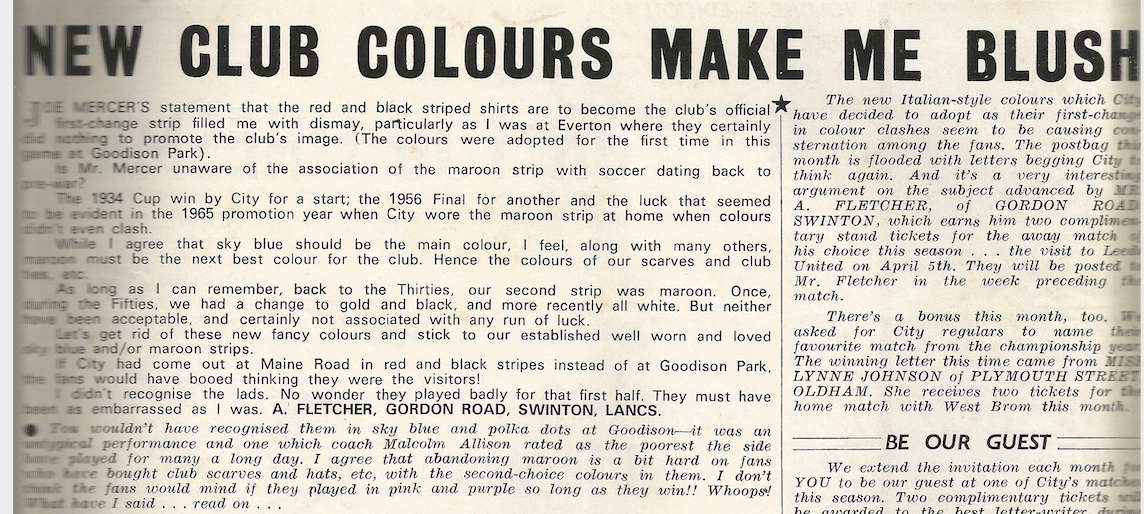
I had planned to run ‘Historic Name That Ground’ only during the close season as in previous years, but it’s proving of interest so I’ll keep it going for a little while yet. If you have an old image of a ground that you think it’d be worth including in this weekly quiz then please get in touch. They don’t have to be from the 1900s to 1960s – even ground images from the 70s and 80s may prove a challenge to identify these days. You can email me at gary@GJFootballArchive.com Thanks.

Joe Mercer Plaque Unveiling – 18 November 1.30pm

Great news for those who, like me, like to see Joe Mercer recognised for his enormous contribution. There will be a blue plaque unveiled for Joe at Ellesmere Port (a town that meant so much to him throughout his life). I’ll be talking as will Susan Lea (Joe’s granddaughter), Graeme Sharp, Mike Summerbee and others. Peter Reid will do the formal unveiling. Further details below…

The unveiling will take place at 1.30pm on Thursday 18th November at Ellesmere Port Civic Centre, Civic Way, Ellesmere Port, CH65 0AZ. It will be great to see as many people there as possible. Please come along and help celebrate this wonderful player and manager.

Ellesmere Port was such an important place for Joe. He was born there; went to school there and continued to live there for years, even when he was a professional footballer and England international. He spent most of his life living on The Wirral and continued to visit the schools, clubs, and people of Ellesmere Port throughout. He even took the FA Cup back there when he won it at Arsenal and at Manchester City AND the European Cup Winners’ Cup when he managed to City to that success in 1970.

This unveiling deserves to be well attended because Joe achieved so much for the teams he was involved with. Ellesmere Port mattered to him and he mattered to us, so let’s celebrate his life.

Foreword to my first book. Thanks Joe for all you’ve done.

Norwich Suffer

A flashback to a high scoring win for Manchester’s Blues on this day in 2013…

After the 2-1 last gasp defeat at Chelsea in their previous League game, manager Manuel Pellegrini took the decision to drop goalkeeper Joe Hart for this important match with Norwich. The decision brought much scrutiny City’s way but Hart’s replacement Pantilimon had little to do as the Blues thrashed Norwich 7-0.  The win lifted City to fourth in the League but more significantly demonstrated the fire power the Blues possessed and demonstrated to all that Pellegrini’s men were determined to mount a serious challenge for the title. Seven separate scorers – including an own goal – made this City’s largest top flight win since 1968. Afterwards Pellegrini was delighted that his side kept striving for more: “Normally a team 4-0 ahead finishes working.”

City had a 100% home record in the Premier League but away from home life was not so easy. At Sunderland in the next League game the Blues were unfortunate to lose 1-0. The BBC’s Sam Sheringham explained: “Referee Mike Dean’s leniency was on display once again in the build-up to the opening goal. The official opted not to penalise Bardsley when he appeared to bundle over Milner, allowing the full-back to race on to Brown’s long pass and curl a precise finish past Costel Pantilimon.”

The Blues were back down to eighth in what seemed likely to be a tight title race.

Match Stats:

2013-14

2 Nov   Norwich City (H)                        W 7-0 Silva, Nastasic, Negredo, Toure, Aguero, Dzeko & Johnson (OG)              47,066

10 Nov Sunderland (A)                         L 0-1                                        40,137

League Cup

30 Oct  Newcastle United (A)                 W 2-0 Negredo, Dzeko             33,846

Gary James and Peter Barnes Talks – Nov & Dec

Over the coming weeks Peter Barnes and I will be talking at various locations about the biography I have written on Peter. Here’s a brief rundown of the locations and dates, starting with tomorrow night (Tuesday 2nd November 2021):

Tuesday 2nd November – West Yorkshire MCFC Supporters Club (8pm; Morley Cricket Club, Scatcherd Lane Morley, Leeds LS27 0JJ)

Thursday 4th November – Castleton MCFC Supporters Club (7pm; Royle Bowling Club, 958 Manchester Road, Castleton, OL11 2TL)

Monday 8th November – Denton, plus Haughton Green, branches of the MCFC Supporters Club (Denton Conservative Club, 45 Manchester Rd, Denton, M34 2AF)

Thursday 11th November – Abbey Hey MCFC Supporters Club

Tuesday 16th November – Orrell MCFC Supporters Club (7.30pm)

Friday 19th November – Ashton under Lyne MCFC Supporters Club

Friday 26th November – Stretford & Urmston MCFC Supporters Club

Thursday 2nd December – Warrington MCFC Supporters Club

Monday 13th December – Wilmslow MCFC Supporters Club

Monday 20th December – Irlam MCFC Supporters Club

At each talk/evening we’ll be selling the book at a discounted price of £15 (cash only) and we will, of course, sign copies for those in attendance. Obviously, our diaries are pretty full with events and other activities but if you are interested in myself and where possible Peter talking about the book at your event then please contact me with details and we’ll see what we can do: gary@GJFootballArchive.com

This 372 page, colour paperback book is £16.95 (including UK postage). For those interested in buying the book but unable to attend you can order it here:

The Peter Barnes Authorised Biography – UNITED KINGDOM

Order today for £16.95 (incl UK Postage and Packaging).

£16.95

UK postage included; outside UK contact me for additional postage costs. You do not need to have a PayPal account to order – use the ‘Pay with PayPal’ button above and it will give you the option to pay by credit/debit card without creating a PayPal account.