The new series of features on Manchester City in the 1910s continues today with a 2800 word article on the 1912-13 season – A season which saw United’s most successful manager (at the time) walk out on the Reds to become City’s manager (he believed that City, with the larger pulling power, was a more ambitious club). If you’re a subscriber you can read all about that and the rest of the season below. If you’re not a subscriber then why not sign up for a month and see what you think?
Subscribe to get access
Read more of this content when you subscribe today. It costs £3 per month (cancel anytime) or sign up a year at a time for the discounted annual fee of £20. This gives access to everything on the site, including PDFs of 3 of my books and various other articles, interviews and audio material. Each subscriber has access to all content posted during their subscription period too. Why not sign up for a month and see what you think?
On this day (2 October) in 1920 Bolton Wanderers were defeated by Manchester City 3-1 with goals from Tommy Browell, Fred Fayers and Wilf Woodcock. A crowd recorded as 40,000 at the time watched the match at Hyde Road.
For more on this season why not read the following 2,350 word subscriber article. If you subscribe (see below) I hope you enjoy it. If you are not currently a subscriber then why not try it for a month (£3 per month or sign up for a year at a discounted £20 per year)?
Here’s the article:
Subscribe to get access
Read more of this content when you subscribe today. It costs £3 a month (cancel anytime) or sign up for a year at £20 per year. Subscribers have access to the 1000s of articles, features, interviews etc. posted so far and all those posted during your subscription.
On this day (14 September 1929) Manchester City defeated Bolton 2-0 with both goals coming from Eric Brook (photographed) at Maine Road, watched by a crowd of 36,972. You can find out more on the 1929-30 season below in this piece for subscribers (see below). I hope you enjoy it. If you don’t subscribe then why not try it for a month (£3 per month or sign up for a year at a discounted £20 per year)?
Here’s the article:
Subscribe to get access
Read more of this content when you subscribe today. It costs £3 a month (cancel anytime) or sign up for a year at £20 per year. Subscribers have access to the 1000s of articles, features, interviews etc. posted so far and all those posted during your subscription.
Continuing the series on Manchester City in the 1920s here’s a free to read 1300 word article on 1920s City (and 1900s United) manager Ernest Mangnall. Enjoy!
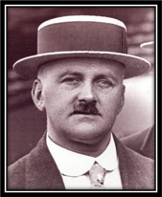
Although JAMES ERNEST MANGNALL is usually remembered as the first man to bring Manchester United trophy success – with a side containing the key members of City’s 1904 FA Cup triumph – he actually spent more years managing the Blues and saw City as the bigger club with more potential.
People tend to focus on his successes at United but his commitment to the Blue cause and determination to move City to the best stadium in English football, are perhaps the most interesting aspects of his life. His United successes are clearly significant moments in Manchester football, however City fans prefer to remember his Blue achievements.
He joined City in 1912 but the most interesting aspect of his arrival is the way it was carried out. Mangnall had been United’s leader since 1903 and had achieved so much that no one could ever have expected him to move. As well as the trophy successes (promotion, two League titles and the FA Cup) he was also credited with being instrumental in United’s move from Clayton (where the Velodrome’s BMX track is today, close to the Etihad Stadium) to Old Trafford.
City were still regarded as the region’s number one club despite the problems they had faced in the period 1905-1912, and they stunned the football world when they lured Mangnall away from the Reds. Never before had a manager left a major club for its biggest rivals after so much success, but what made the story more of a sensation was the fact Mangnall had agreed to become City manager while still in office at Old Trafford, and that he had watched the Blues’ opening game at Notts County when he was supposed to be with United at Arsenal. He actually remained in charge of United for the Manchester derby of 7th September 1912 at Old Trafford.
Occasionally United historians dispute that Mangnall was officially their manager on the day of the derby but leading newspapers of the period, most notably the Umpire and the Daily Dispatch, are perfectly clear that he was officially in charge. City won the Old Trafford match 1-0 despite being down to ten men for most of the game. Mangnall, according to one report, was delighted with the City win despite, officially at least, still being a Red. “United speeded their manager rejoicing with two points to his new club” read one article.
The following Monday Mangnall moved into his Hyde Road office, and within a few weeks his side were looking like Championship contenders: “Manchester City stand out boldly as the only first class team in the two divisions of the League, the Southern and the Scottish Leagues, with the highest possible points to their credit. The Citizens of Manchester have earned every point in September. Other clubs have remained undefeated, but they have not annexed the maximum marks. Nine years have passed since Manchester City commenced a campaign in this stimulating style.”
The title didn’t arrive, however Mangnall did develop a decent-looking side by the time of the First World War – they missed the 1914-15 title by three points. City were also proving a highly popular side to watch, so much so that the ground could hardly cope. A notorious cup match with Sunderland in February 1913 had to be abandoned due to overcrowding. Incredibly – and this is difficult to appreciate today – the team manager was also responsible for the management of the ground at this time, and so Mangnall was held responsible for all matters concerning safety and crowd control as well as picking the team and buying the players. A reporter named Veteran accused Mangnall of spending too much time with the team and said: “I am rather surprised at Mr. Mangnall being caught napping, but it may be that he has been away with the team and had had little to do with the home management.”
During the hostilities Mangnall kept the Club alive and brought some trophy success in the wartime tournaments that replaced the League.
After the war, Mangnall’s side became very popular and he had to focus on ground issues as well as team matters. With the Blues filling the 40,000 capacity on a regular basis, Mangnall regular had to face the press, the FA, the Football League, Manchester City Council, and the police to explain why chaotic scenes were being experienced game after game in the streets around the ground.
In 1920 fire destroyed the Main Stand and exacerbated the problems Mangnall faced. He approached his former club United about using Old Trafford, the ground he had been primarily responsible for, but they met his request with exorbitant terms that were ridiculed in the press. Perhaps they still felt a little aggrieved about his departure almost a decade earlier?
Mangnall’s view was that City had to move from Hyde Road. Its forty thousand capacity was far too small, and the manager worked with club officials, most notably another former City manager Lawrence Furniss, to plan the development of a new ground. One with potential.
At the same time as the ground debates, Mangnall guided the Blues to second place in the League and their popularity increased further.
By the start of 1921-22 far too many people were missing out on watching Manchester’s favourite team. That season he created plans for an “English Hampden” on the Moss Side/Rusholme border.
In 1923 City moved to the 85,000 capacity Maine Road, and in Mangnall’s final season (1923-24) he almost managed to guide the Blues to the FA Cup Final. With the 49 year old Billy Meredith back in Mangnall’s side, City were defeated by Newcastle. That run was important as it perhaps demonstrated the reason why Mangnall had been determined to join the Blues back in 1912 for his City side attracted a few magnificent attendances including over 76,000 for a cup tie with Cardiff. At the time this was the largest crowd for any footballing fixture played in Manchester including three FA Cup finals (1893, 1911 replay & 1915). Mangnall knew all about City’s popularity and he must have felt a great deal of satisfaction at seeing such a large crowd in the stadium he had pushed for.
The following May his contract was not renewed, although It seems likely he chose to step down feeling that there was little more he could achieve at Maine Road. After leaving the Blues he became a director of his home town team, Bolton, and was a significant figure within the PFA. He died of a cerebral embolism in 1932 at St. Annes.
In addition to his roles at Burnley – his first club as secretary, United, City, and Bolton, he was also recorded as the man responsible for founding the Central League and the Football Managers’ Association.
Modern day football rarely remembers men like Mangnall, however his place in the history of Manchester must always remain a significant one. He restored pride and passion to the Blues and was the key figure in City’s move to Maine Road. That move enabled City to rediscover their ambition, drive, and natural position as one of England’s elite.
Football historians tend to focus on Mangnall’s United career but that does the man a great disservice. He may have won trophies at Old Trafford but his entire career was packed with achievements.
Mangnall should always be remembered as the catalyst for City’s regeneration during a difficult period. The fact that he walked out on United to take on the City challenge adds an angle that Blues love. Mangnall was a great Blue.
If you enjoy all the free material on my website and would like to support my research and keep this website going (but don’t want to subscribe) then why not make a one-time donation (or buy me a coffee). All support for my research is valued and welcome. It allows me to keep some free material available for all. Thanks.
Read more of this content when you subscribe today. It costs £20 a year to subscribe (it works out £1.67 a month) or £3 if you’d like to sign up a month at a time. Annual subscribers get full access for as long as you subscribe (you can always try it for a month). It’s worth bearing in mind that the 2010 Manchester A Football History cost £24.95 and all subscribers will be able to access all of that for as long as they are a subscriber (plus all the other stuff of course).
It costs £3 a month to subscribe a month at a time. Why not give it a try! Monthly subscribers get access to everything posted since 1 October 2022 for as long as you subscribe.
The new series on Manchester City in the 1920s continues today with a 4,900 word subscriber article on the 1925-26 season. If you subscribe (see below) I hope you enjoy it. If you are not currently a subscriber then why not try it for a month (£3 per month or sign up for a year at a discounted £20 per year)?
Here’s the article:
Subscribe to get access
Read more of this content when you subscribe today. It costs £3 a month (cancel anytime) or sign up for a year at £20 per year. Subscribers have access to the 1000s of articles, features, interviews etc. posted so far and all those posted during your subscription.
Sorry to hear the news of the death of former Bolton, City, United and Stockport forward Wyn Davies. At Bolton he had a good attacking partnership with Francis Lee and it was Lee who suggested to Malcolm Allison (first and then manager Joe Mercer) to sign the player for City in 1971. Coincidentally it was this week in 1971 when Newcastle (Davies’ club at the time) agreed a fee with City.
Screenshot
Davies made his City debut on 14 August 1971 at Maine Rd v Leeds. His last City game on 9 September the following year, shortly before he became one of a relatively small group of players to transfer directly between the Manchester clubs.
At City and, presumably his other clubs, the chant ‘you ain’t seen nothing like the mighty Wyn’ was frequently sung. Years later the same chant was resurrected for Niall ‘the mighty’ Quinn.
My series on Manchester City in the 1930s continues today with a 1600 word subscriber article on the 1932-33 season. If you subscribe (see below) I hope you enjoy it. If you don’t subscribe then why not try it for a month (£3 per month or sign up for a year at a discounted £20 per year)?
Here’s the article:
Subscribe to get access
Read more of this content when you subscribe today. It costs £3 a month (cancel anytime) or sign up for a year at £20 per year. Subscribers have access to the 1000s of articles, features, interviews etc. posted so far and all those posted during your subscription.
On this day (4 May) in 1940 the return match between Manchester City and Tranmere ended in a 6-1 City win away from home. This was a Western Regional League (a first team competition played during wartime) game. A restricted crowd of 2,500 watched goals from City’s Herd, Currier (4), and Doherty. Jim Currier was actually a Bolton Wanderers player (living in Manchester) guesting for City – he scored 94 goals in 113 wartime games for City! You can read more on this wartime season below. It’s a 1,400 word article on Manchester City’s 1939-40 season. The season started as any other but then world events intervened!
This is a subscriber article and you can read it by subscribing below.
Subscribe to get access
Read more of this content when you subscribe today. It costs £3 per month or you can subscriber for the discounted annual rate of £20 per year. Each subscriber gets access to everything posted so far, including PDFs of a couple of my books.
On this day (5 April) in 1969 Jimmy Mundy came on as substitute, replacing Tony Book, to make his Manchester City debut. The Manchester born player’s first appearance saw the reigning champions defeated 1-0 at Elland Road. Mundy was spotted playing for Ashland Rovers just before his 18th birthday, and after trials signed for the Blues.
His reserve debut came in December 1967 at left-half against Bolton Wanderers, and he went on City’s tour to the USA the following summer. Unfortunately, Mundy only managed a further two league appearances. After a loan spell at Oldham, Jimmy moved to non-League Bangor City on a free transfer.
You can read more on Manchester City during the 1968-69 season (another trophy winning season!) below. If you’d like to read this 6,000 word article, plus all other articles on the site, then please subscribe (see below). As with most of the other features in this series it includes words from interviews I have performed with those who were there.
Subscribe to get access
Read more of this content when you subscribe today. It costs £3 per month (cancel anytime) or sign up for a year at the discounted price of £20 per year (works out £1.67 per month). Subscribers access the 1000+ articles posted so far and the others scheduled during the life of your subscription.
On this day (16 March) in 1955 Manchester City defeated Bolton Wanderers 4-2 with goals from Joe Hayes (3) and Fionan Fagan (photographed).
This series on Manchester City in the 1950s includes free items and items only available to subscribers. If you’d like to find out more on the 1954-55 season then subscribe and read the following 3,400 word article on it. It’s a season when City reached the FA Cup final and Don Revie was FWA Footballer of the Year.
This is a subscriber article and you can read it by subscribing below.
Subscribe to get access
Read more of this content when you subscribe today. It costs £3 per month or you can subscriber for the discounted annual rate of £20 per year. Each subscriber gets access to everything posted so far, including PDFs of a couple of my books.


 Gary James' Football Archive