The 2000s: Wanchope Double

On 15 May 2004 Paulo Wanchope netted twice as Manchester City defeated Everton 5-1 on the last day of the 2003-04 season. The other goals were netted by Antoine Sibierski and Shaun Wright-Phillips.

If you want to read all about that season then here’s a 4,200 word article on it (below). This was City’s first at the City of Manchester Stadium (now Etihad).

Subscribe to get access – Annual

This article is for subscribers to my website. It costs £20 a year to access everything on the site since creation in December 2020. That includes articles, history talks, videos, interviews & more. There’s also a monthly option below.

Subscribe to get access – Monthly

Monthly subscription costs £3 per month to access everything on the site since 1 October 2022 (cancel anytime). All subscribers access all new material until their subscription ends. Why not give it a try for a month?

League Dominance?

Lots of tosh has been spoken recently about teams dominating English league football with some claiming that there’s ‘never’ been a time when a team has dominated as much as Manchester City do today. Ignoring the fact that the League campaign is not over yet and will go to the final day (so that’s a nonsense for a start) I decided to pull together a few facts that may be useful. They’re certainly relevant.

So, first of all, the question of whether Manchester City is the first to dominate in a way no other has before (again the season isn’t over and it could go either way yet, so ‘dominate’ is not something I believe anyway!)… City have currently won 3 League titles in a row. A feat that has been done several times before, most recently (before City) by Manchester United in 2006-09.

Ah, but City have won 5 out of 6 titles they say… Yes, but United won 7 out of the first 9 Premier Leagues and were runners up in the other 2. Liverpool achieved the same 7 out of 9 League titles in the 1970s and early 80s. We can’t predict the future of course but City have never managed seven titles in 9 seasons. In fact if City do win the League the stats will show it’s 7 in 11 seasons and at present it’s 7 titles in 12 seasons. So that means two other clubs have had longer spells as ‘dominant’ clubs using the language and phraseology that those criticising the reigning Champions usually use.

One of the other criticisms that’s thrown City’s way is about the Premier League being ‘boring’ because it’s a ‘foregone conclusion’ and ‘other teams have to be perfect’ to finish above City. Well, to be the best you have to beat the best but in terms of the League being ‘boring’ and a ‘foregone conclusion’ then the stats in terms of points gaps say otherwise.

Sure, City’s incredible 2017-18 season when they amassed 100 points was one in which the Blues ran away with the title, but it was also a rarity. City won the League by bettering second place by an astounding 19 points but, wait a minute, that amazing gap is only 1 point  more than the (18 point) gap between 2020 champions Liverpool and second placed City (at a time when City are supposed to be the dominant team!). Not only that but United had an 18 point gap between them and second placed Arsenal in 2000.

Worth noting too that in the 31 season history of the Premier League 14 runners-up teams bettered 2nd placed United’s points tally in 2017-18 when City achieved their 100 points. Surely, no title winning team can be blamed if the runners-up have worse results than in more than 45% of the competition’s seasonal history?

What about the ‘foregone conclusion’ and ‘boring’ line? Well, I suppose it can be argued it’s boring if the League is won many, many weeks before the end of the season. Using that logic it should also be ‘not boring’ if it goes down to the last game (like this season) or the last week (could be 2 or 3 games depending on fixture congestion). So I’ve had a look at how many seasons have finished with 3 points or less separating the top two teams. This shows that there have been 9 seasons when this has been the case. Guess what? 4 of those were seasons when City have won the Premier League (2 United, 1 Arsenal, Blackburn & Chelsea).

This means that 57% of all City’s Premier League title wins have been by less than 3 points! For United (13 PL titles) the figure is 15%; Arsenal (3 PL) it’s 33% and Chelsea (5 PL) is 20%.  Four of United’s PL titles have been won by 10 points or more.

Of course, title races can be exciting when teams win the League by ten points or more, but the argument many put across is that it’s boring when one team walks away with it. Surely there’s less chance of that happening when a team wins the title by less than 3 points?

There are lots of statistics that could be posted and, to be frank, they never actually tell the story of a season. How many times do we see possession stats that are in one club’s favour but the other team is actually winning? Nevertheless, when people try to suggest a season is boring because a club (any club) is running away with it then the stats can help show that something is not true. Similarly, when it comes to dominant football clubs – yes, there are eras of dominance by certain clubs and Manchester City certainly are a dominant club at the moment – we must not be fooled into thinking that a situation has NEVER happened before when it so obviously has (and other clubs may actually have been more dominant!).

Ah well! Football, hey? If only people actually looked at history more before jumping to conclusions.

If you enjoy all the free material on my website and would like to support my research and keep this website going (but don’t want to subscribe) then why not make a one-time donation (or buy me a coffee). All support for my research is valued and welcome. It allows me to keep some free material available for all. Thanks.

Choose an amount

£2.50
£5.00
£7.50

Or enter a custom amount

£

Your contribution is appreciated.

Donate

What a Day That Was: The Final Whistle from MCFC v QPR, 13 May 2012

On this day (13 May) in 2012…

I’m sure it gets boring to some but for those of us there that day the drama and the emotion can never be forgotten. Here’s my own personal film of the moment the final whistle went on that incredible day when MCFC won the Premier League title in 2012.

I know the camera’s all over the place (I was jumping up and down like everybody else) and the sound isn’t great but I hope it helps to show what it was like to all those who couldn’t be there that day.

https://gjfootballarchive.com/wp-content/uploads/2021/02/2012-aguerooooooooo-sd-480p.mov

You can also read this 3,400 article about the day:

Subscribe to get access to the entire site

If you would like to view the other in-depth articles on this site then please subscribe. It works out about £1.67 a month if you take out an annual subscription (£20 per year) or £3 a month if you’d like to sign up for a month at a time. Each subscriber gets full access to the hundreds of articles posted so far and the hundreds scheduled to be posted in the coming weeks.

Women’s FA Cup Final: The Original Manchester United Ladies

My research into women’s football in Manchester has highlighted the stories of many players and clubs over the years. I think people tend to think my research is only about City and the Corinthians but it aims to cover all teams. This includes Manchester United, whose history as a women’s team, I’ve been researching for many years. They have a fascinating story and were pioneers in many ways.

The original Manchester United Ladies team was established via the United Supporters’ Club and played its first game in October 1977, against a team from Ireland. In 1986, while looking back on this period, manager Anne Smith joked: ‘Our standard of football was not very high. It couldn’t have been as I was playing!’

Over the course of the next two years, the club played a number of friendlies until, in 1979, the team joined the long-established Three Counties League and the Women’s Football Association (FA). Anne Smith was one of the leading figures within the club, and became manager around this time. Anne was a driving force behind the club for many years and deserves to be recognised as a pioneer of women’s football, helping to establish competitions in the 1970s and 1980s.

Publicity in the men’s United match programme during the late 1970s encouraged other women to join United and in their first season of league football they finished sixth. The Three Counties League covered a large geographic area and travel to games was difficult, so Anne and the United committee worked with others to create a local league. The Women’s FA gave permission to establish the Greater Manchester Women’s Football League with its first season of operation being 1982-83 (if you have information and seasonal records of the Three Counties League then please get in touch as this will help some of my current projects – Gary@GJFootballArchive.com Thanks).

United Ladies won the competition in its first three seasons and the club remained a leading team in the region for many years. Jane Morley, who is currently the secretary of Stockport County Ladies, was a player for many years:

‘As a United men’s supporter it was great to play for the original women’s team. Wearing the red of United and training at the Cliff was really great and we were a strong team too. We were very successful in the Greater Manchester Women’s League. The two strongest clubs were ourselves and Wythenshawe and games between the two were real tests. Wythenshawe were our main rivals.’

During her time with the team Jane remembers playing at the Old Trafford stadium once: ‘There was a men’s testimonial game and we were asked to play on the pitch as part of the day’s events. That was something special for us all.’

The club continued to develop during the 1980s and 1990s, officially forming part of Manchester United by 2001. However, the club disbanded in 2005, not long after the Glazers takeover of the Reds.

In 2018, a new Manchester United women’s team was established and this team went on to win the Championship in 2019. United women have been a formidable challenger in the FA Women’s Super League ever since and reached the Women’s FA Cup final in 2023 for the first time. They’re in the final again today against Tottenham. Will this be their first major trophy success since the resurrection of the team?

Many former United players also played for the Manchester Corinthians during the 1960s, 1970s and 1980s (if you did then please get in touch). The influence of that club, established in 1949, played its part in the development of Manchester’s footballing life. This year to mark the Corinthians 75th anniversary I’m self funding a book on the club: Manchester Corinthians: The Authorised History will be published late summer and tells the story of the club via the voices of women who played from its first ever game in 1949 right the way through until its final game over 40 years later. Players from every season have been interviewed and anyone ordering the book pre-publication will be able to have their name printed in a special roll of honour at the back.

The Corinthians’ legacy is still felt strongly and their influence on both United’s and City’s women’s teams remain. You can find out more on the book here:

As for Jane Morley… she stayed with the original Manchester United women’s team for six successful years. In 1985, together with other United players, she established FC Redstar and took the team into the North West Women’s Regional Football League where they achieved promotion in 1987 to the top division – at the time the highest league competition available. Playing in Stretford, FC Redstar impressed but player recruitment issues brought a premature end to the club in 1990.

Once her playing days were over Jane coached and managed at various levels with Manchester City Ladies for many years. Always keen to promote football to young girls Jane enjoyed developing an array of talent with the club. She also brought success to the club and managed the first team for a spell when they were based in Urmston, Trafford.

After leaving City Jane continued to develop opportunities for girls and young women within both Greater Manchester and in Cheshire and is secretary of Stockport County’s women’s team, dedicating her adult life to promoting football for women and girls.

You can watch a brief interview, captured as part of a project I did for the Women’s Euros, with Jane here:

Champions City!

On 11 May 1968 Manchester City won the League title and on that same day in 2021 the Blues became Premier League champions. In 2021 City won the League after nearest rivals Manchester United lost 2-1 at home to Leicester City.

It was the Blues seventh League title with their first coming in 1937.

It was an astonishing season with City already winning the League Cup that season, plus they also reached the Champions League final where they were defeated in Porto by Chelsea. Manchester’s Blues also appeared in the FA Cup semi-final season but sadly lost to Chelsea.

The League and League Cup double meant that City had won six major trophies in three seasons.

City’s trophy success in 2021 meant that domestically counting the League, FA Cup and League Cup only United, Liverpool and Arsenal have won more English major trophies. Similarly, only United, Liverpool, Arsenal and Everton havd won more League titles than Manchester’s Blues.

2020-21 was an odd season because of Covid (as was 2019-20) and no fans in the stadium (though some clubs, including those on Merseyside, were allowed a limited number of fans in earlier this season), but the football City played was breathtaking.

Apart from a difficult opening period and a few odd results along the way, City delivered week after week (or should that be weekend after midweek after weekend after midweek – it was a busy season!). They thoroughly deserved the title.

So, by the end of the 2020-21 season City had won the following major honours:

European Cup Winners’ Cup (1)

1970

League/Premier League (7)

1937, 1968, 2012, 2014, 2018, 2019 & 2021

(runners up: 1904, 1921, 1977, 2013, 2015 & 2020)

FA Cup (6)

1904, 1934, 1956, 1969, 2011 & 2019 

(runners up: 1926, 1933, 1955, 1981 & 2013)

League Cup (8)

1970, 1976, 2014, 2016, 2018, 2019, 2020 & 2021

(runners up: 1974)

In 2019 the Blues became the first English men’s team to win a domestic treble. In 2020-21 City achieved a domestic double of the League Cup and the League (a feat they also achieved in 2014 & 2018). Back in 1970 they achieved a European and domestic cup double when they won the League Cup and the European Cup Winners’ Cup.

City’s trophy haul made them the fifth most successful English club of all time based on major domestic and European trophies won (United, Liverpool, Arsenal and Chelsea are ahead of the Blues). In addition only Liverpool and Blackburn had a greater span between their first English trophy and their most recent.

Since 2020-21 so many other trophies have come of course, including in 2023 when City became the first team ever to win the FIFA Club World Cup, UEFA Super Cup, UEFA Champions League, the Premier League and the FA Cup in a calendar year.

If you enjoy all the free material on my website and would like to support my research and keep this website going (but don’t want to subscribe) then why not make a one-time donation (or buy me a coffee). All support for my research is valued and welcome. It allows me to keep some free material available for all. Thanks.

Choose an amount

£2.50
£5.00
£7.50

Or enter a custom amount

£

Your contribution is appreciated.

Donate
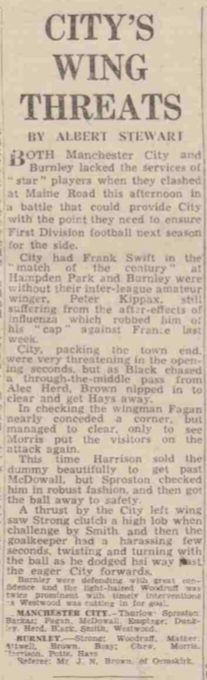
69,463 watch MCFC and Burnley in Division Two But Attendances Understated

On 10 May in 1947 a solitary goal from Alec Herd against Burnley was enough to give Manchester City promotion.  The attendance for this Second Division game was recorded by the media at the time as 67,672 but official records reviewed almost sixty years later showed that City actually recorded the attendance as 69,463.

Typically, the attendance figures City used to give the media for League games through to the 1960s tended to exclude season tickets. So the Blues’ management would give the figure of tickets or pay on the gate admission for the game but exclude season ticket holders. Back in 1946-47 City had around 1,800 season ticket holders and almost every League attendance back then is understated by that amount.

FA Cup games were the actual attendances as these were always sold game by game.

As this practice of excluding all season ticket holders continued for many, many decades at Maine Road attendance figures for League games are usually understated (they were often understated in the 1970s & 1980s as well but for different reasons and back then Peter Swales, Bernard Halford and the others involved in calculating attendances would deny any discrepancy despite many fans, fanzines and others challenging them often).

For comparison purposes it’s worth looking at the attendances of the Division One champions in 1947 to see how the Blues compared. This attendance against Burnley was almost 17,000 higher than Division One champions Liverpool’s highest crowd that season (52,512 v Wolves in December) and the Merseyside Reds nearest home game to City’s Burnley match was watched by 48,800 and that was Liverpool v Manchester United (May 3). Liverpool did average 45,732 that season, whereas City averaged 39,283 but they were a Second Division club.

The City-Burnley crowd was the Second Division’s record at the time and it was higher than every First Division crowd since the 1937-38 season (The Second Division record is now held by Tottenham v Southampton which had 70,302 in 1949-50).

Film of City v Burnley does exist but it’s in a most unlikely place. It was actually filmed as part of a Mancunian Films drama called Cup Tie Honeymoon. The company was run by a Manchester City fan who made this film, which starred Sandy Powell and Pat Phoenix (under her original name of Pilkington). A football game is crucial to the plot and scenes were filmed at Maine Road and interspersed with real action from the City-Burnley game to add credibility.

Myself and Will McTaggart have shown these scenes in our Boys In Blue film shows which have been staged at the Dancehouse and Cornerhouse in Manchester over the last decade. Maybe I’ll explain more about the film and those talks another day.

Subscribe to get access

You can access all of the content on this site, including the in-depth articles, audio recordings/interviews and entire content of my Manchester A Football History book by subscribing. It costs £20 a year (about £1.67 a month) and you have full access throughout your subscription. You can also give it a try by signing up for £3 a month (again full access throughout your membership). Thanks Gary.

The 1981 FA Cup Final

On this day (May 9) in 1981 the 100th FA Cup Final took place between Manchester City and Tottenham. Below is a long read on the final but before details of that, there are also profiles of City’s starting 11 on the site. Here’s a link to the one on Tommy Hutchison published 3 years ago (it’s a free read). Enjoy:

Here for subscribers is a long read on the build up, the final and the post-final scenes. It contains material from interviews I have performed over the years with Dennis Tueart, John Bond and Joe Corrigan. There are also a few quotes that may surprise readers of what discussions took place after the final.

Here goes….

Subscribe to get access

Read more of this content when you subscribe today.

The First PL Season Ends

The 1992-93 season ended on May 8 with a 5-2 defeat for Manchester City at home to Everton. The Blues finished ninth in the inaugural Premier League campaign – not a particularly depressing position but this had been a strange season. There had been protests throughout the season. 

Here for subscribers is some explanation of what happened:

Subscribe to get access

Read more of this content when you subscribe today.

City on the Hill

On this day (7th May) in 2000 Manchester City achieved promotion by beating Blackburn 4-1 on the last day of the season. A large group of fans gathered on the hill above Ewood Park to watch as much of the game as possible (were you one of those fans – please get in touch with your story if you were).

As with most things City did back then, the journey to promotion had not been as straightforward as fans hoped it would be.

“We will not be going to Blackburn to defend or looking for just one point, that would be inviting disaster.  We will be playing to take three points.  Legends are born in games like this and particularly at a massive club like City with the fan base we have.  Someone can be a hero, not just for a day but for a long time.”  

These were the words Joe Royle used in the build up to City’s crucial match with Blackburn on the final day of the 1999-2000 season.  He wanted to send a strong message to the rest of football that City were determined to return to the Premier League, and return they did.  The game with Blackburn was extremely tense at times, and there were a number of occasions when everyone connected with the club felt that Blackburn would be added to the names of Luton and Liverpool in the City cock-up list.  However Royle’s City showed resilience and success followed.

Here is my review of that game and the 1999-2000 season. To read the rest of this piece then please subscribe below:

Subscribe to get access

To read this and access all other content please subscribe. It works out about £1.67 a month if you take out an annual subscription (£20 per year) or £3 a month if you’d like to sign up for a month at a time. Each subscriber gets full access to the 1000s of articles posted so far (including audio interviews with John Bond, Malcolm Allison, George Graham and the entire Manchester A Football History book) and the hundreds scheduled to be posted in the coming months.

Yaya Delivers

On this day (6 May) in 2012 the Premier League title race saw Manchester City travel to Newcastle. The Blues had two games left to play – away at Newcastle and at home to QPR – and inevitably the focus on both Manchester sides was high as United were also challenging for the title. The global audience for the Manchester derby had been huge and that game had swung the advantage City’s way (the Blues had been 8 points behind the Reds only a brief while earlier). Both Manchester sides had the same number of points but the Blues had the better goal difference.

City felt they could do win their first top flight title since 1968 with captain Vincent Kompany leading the way on the pitch:  “If we in at Newcastle we will win the title.  Sir Alex said that, so it must be right.  He has far more experience than me.”

Here for subscribers to the site is the story of what happened at Newcastle:

Subscribe to get access – Annual

Read more of this content and everything else on the site when you subscribe. It costs £20 a year (about £1.67 a month) or £3 to pay a month at a time (below). You get access to all content posted so far including the entire Manchester A Football History.

Subscribe to get access – Monthly

Read more of this content and everything else on the site when you subscribe. It costs £3 to pay a month at a time (cancel anytime).