These days most football clubs have community and charity connections with staff determining whether a worthy cause fits with the club’s plans. If letters are sent to players asking for support then these quite often are handled by other personnel. Back in the 1970s things were different.
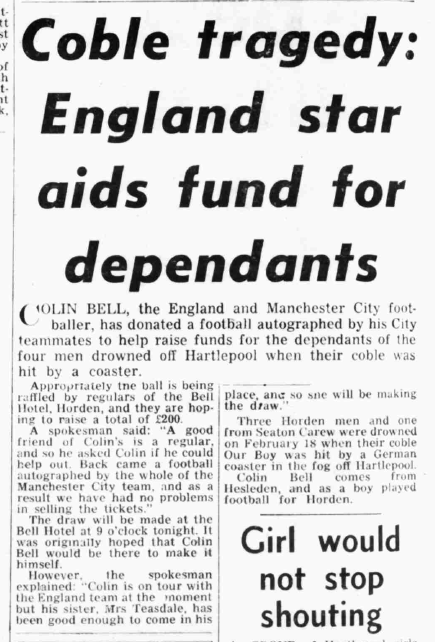
On 31 May 1974 this article appeared in a newspaper in the north east following a tragedy at sea. A letter had been sent to Colin Bell asking if he could help raise funds for the dependents of four men drowned in the tragedy. Not only did Colin reply, but he sent a signed football and arranged for his sister to attend the fundraising draw. He had hoped to be there himself but he was on international duty.
For Colin, replying to supporter or charity letters like this was something that mattered.
Today (30 May 2024) is the 25th anniversary of Manchester City’s play off final victory over Gillingham. Rightly, Paul Dickov’s goal in the 1999 Play Off final has often been described as the most important Manchester City goal of all time. However some also forget about the penalty shoot-out and, before either that or the all-important Dickov goal, came the opening City goal scored by Kevin Horlock.
The late 1990s had been a very difficult period for City and Horlock’s goal came at a moment when all hope that the Club could resurrect itself seemed to have vanished. This goal was obviously important as it gave City hope and ultimately that transferred into achievement.
The following article, covering Horlock’s goal and the story of that day, is available for subscribers to the website. It costs £20 a year (it works out £1.67 per month) or £3 per month (cancel anytime) and you get full access to all articles posted, including PDFs of the out of print Manchester A Football History and my first ever book about Manchester City. There are also audio interviews & more. Do a few searches on past content to see what’s available. Why not try subscribe on a monthly basis and try it out?
Subscribe to get access
Read more of this content when you subscribe today.
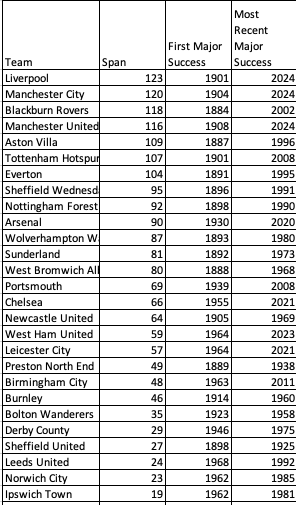
As usual, once the domestic season ends I update the table showing the English clubs’ span of success – i.e. the number of years between a club’s first major success (FA Cup, League, League Cup, European trophy) and their most recent. There’s actually not much difference between last year’s final table and this:
Okay, the span of success does not show how many trophies each club has won or how frequently that club has experienced great eras of success, but it does demonstrate how wrong those people are who believe certain clubs were unsuccessful until recent years, or those who think certain clubs have always been giants. The column on first major success helps to show when some clubs first became trophy-winning significant (often after transformational investment too!).
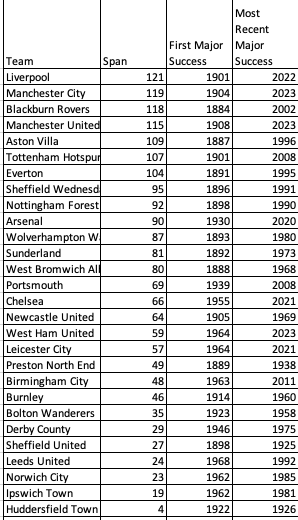
There’s not much difference between 2023 and 2024 – numbers have changed but not positions. In 2023 West Ham proved that if you’re a club that hasn’t won a major trophy for a while putting your focus on achieving trophy success ahead of the odd Premier League position can bring significant reward. In future decades no one will remember who finished seventh, tenth or fifteenth but they will remember the trophies. Here’s last year’s table for comparison purposes:
I know clubs focus on their financials but winning a trophy has longevity, gaining the odd Premier League place provides a bit of extra cash now but no long term kudos. Winning a trophy attracts new fans and brings money-spinning opportunities too.
If I was a supporter of any of the major clubs who have not found significant success in recent decades then I would absolutely want my team to go for whichever cup competition seems the most likely to win. That’s what I always wanted from City before they were able to compete for the League again. Winning the FA Cup in 2011 helped everything that followed happen – it gave confidence and a trophy winning mentality.
While you’re here why not take a look at the wide range of articles available on this site? Such as last summer’s 100 day series of features on Maine Road:
For well over a century football has been a crucial and popular aspect of Mancunian life. It’s been part of the city’s identity. So for today’s piece I’m taking a look at football’s early years. Here is a 1800 word overview of the major Manchester clubs that existed before today’s giants, followed by the origins of Newton Heath and St. Mark’s, who both played their earliest known games in November 1880.
This article is available to subscribers to my site.
Subscribe to get access
Read more of this content when you subscribe today. It costs £20 a year (or £3 per month if signing up a month at a time). Throughout your membership you have full access to everything on this site including interviews, recordings and PDFs of a couple of my books that have been long out of print. Why not sign up for a month and see what you think? I commit to 4 new lengthy articles per month, though in practice it’s been much more than that.
On 27 May 1986 Billy McNeill’s Manchester City defeated Seattle Storm 1-0 as part of their post season North American tour. The City scorer was Mark Lillis and that season’s FA Youth Cup winners David White, Steve Redmond and Andy Hinchcliffe were in the starting 11. Other FA Youth Cup winners such as Ian Brightwell were also part of the official touring party. Here’s the starting 11 from my ledgers:
Here’s a team photo of Seattle Storm soccer team in 1987:
Subscribers can read more on 1985-86 in this 2,500 word feature below:
Subscribe to get access – Monthly
Read more of this content when you subscribe today. It costs £3 per month (cancel anytime) to access everything posted since 1 October 2022 or there’s a special annual rate below which gives greater access and works out much cheaper.
Read more of this content when you subscribe today. It costs £3 per month (above) or £20 a year (here) to access everything posted since the site was created in December 2020. This special rate works out about £1.67 a week and gives access to everything posted, including PDFs of 3 of my books.
On 26 May 1964 Mancunian Mike Doyle signed professional forms for Manchester City. He embodied a spirit and determination as a player that brought great success and the loyal support of City fans. He was a vital member of two successful periods at Maine Road, and had managed to bridge the gap between Mercer and Allison’s great team of the late 60s and Book’s mid-70s entertainers. In fact he was also there for the miserable period that predated Mercer’s arrival!
Doyle joined the City groundstaff in May 1962 and made his debut in the 2-2 draw at Cardiff on 12 March 1965 and appeared in 6 games during the latter end of a traumatic season. That summer Mercer & Allison arrived and transformed the Blues with Doyle playing a leading role in every City triumph of the period. In fact, until recent years he shared the distinction with Tommy Booth of appearing in more finals than any other City player. He appeared in ECWC, FA Cup and 3 League Cup finals but also played his part in the League title success in 1968 and Second Division title in 1966. He even captained City to their 1976 League Cup triumph and scored in the 1970 victory.
Ever the determined player City fans loved his fighting spirit and never say die attitude. Significantly, in an era of major talent and success, Doyle was voted City’s player of the year twice (1971 & 1974). After making five appearances for England and over 550 competitive first team appearances for the Blues he moved to Stoke in 1978, where he was voted their player of the year in 1979, and later had spells at Bolton and Rochdale.
Mike Doyle was a tremendous City player who played in a determined manner. He won many admirers with his total dedication to the Blue cause. He died on 27 June 2011.
On this day (25 May) in 1971 defender Howard White signed professional forms for Manchester City. White had a very unlucky career at Maine Road. He had alread made his debut on 24 April 1971 in a controversial League game with Liverpool.
Basically, Liverpool were enjoying a busy, competitive season and decided to rest several key players. This was against League rules and as City had also fielded a side that seemed to be relatively inexperienced, the League investigated.
The game ended 2-2 and the League eventually fined Liverpool for fielding a weakened side, but judged that City had managed to field their strongest side considering injuries etc. For White the game was a low point as he suffered a broken ankle shortly before half time and was never again able to make a first team appearance.
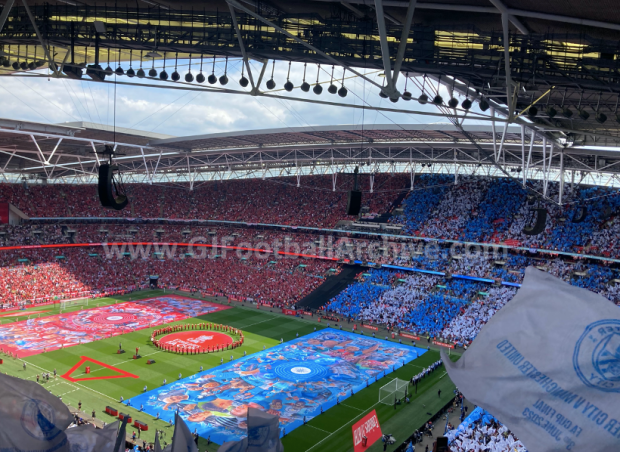
Good luck to all those interested in, attending and watching the second all-Manchester FA Cup final today. Let’s make sure it’s another that makes the world see the quality of Manchester’s football and fans.
Tomorrow will see Manchester City and Manchester United face each other in the second All-Manchester FA Cup final. This promises to be another dramatic day in the history of Manchester football (we are so blessed being able to see days like these).
Obviously, the game could go either way and I don’t want to make predictions as derby days are often difficult to predict. I well remember arriving at Maine Road in September 1989 when Alex Ferguson’s United were most expensive squad ever assembled in British football at the time. That day City fans feared the worst and by full-time the Blues had defeated the Reds 5-1 with chants of Fergie Out coming from the fans left in the away section of the Platt Lane Stand. Who would have thought that night that he would keep his job and bring so much success to the Reds?
Whatever happens enjoy the day and game. Clearly, if United win then that will help their development and if City win then that will mean four major trophies have been won this season – the other three are of course the Premier League, the UEFA Super Cup and the FIFA Club World Cup. Not bad hey? Add to that the FA Youth Cup and it’s been another great season.
Thanks to everyone who has subscribed to Manchester Corinthians: The Authorised History. Research and interviews have been continuing for the book, which will be published later this year. I’ll keep subscribers posted with details over the coming month.
I can state with real accuracy that I have captured voices from every season of the club’s history from 1948-49 through to its final game. I’m really pleased with that and, together with the deepest research ever into the club’s history, this promises to be a fairly definitive story of the club. I say ‘fairly’ because it’s impossible for anything to be definitive but this will contain more information than any other source.
Thanks to all those who have subscribed to the book – it helps enormously as the book and the years of research that have gone into this is all self-funded.
For those who haven’t subscribed or would like to know more on what the book will entail, here’s the latest information:
The book will tell the story via the voices of those involved from beginning to end (and beyond!), backed up with detailed archival research.
Myths, including some connected with the formation of the club, persist and still get promoted. For the first time, this Authorised History will highlight the key steps and people involved with the formation of the club, dispelling myths and properly acknowledging those who ensured the team had a life.
Hundreds of games have been identified with official – and unofficial – match reports adding flavour and supporting the words of the women who played.
Rare objects, cuttings, match programmes, trophies and more have been located for this book, with many of the players lending their collections to help ensure this is a wonderful record of the club’s full life.
The Manchester Corinthians’ tours across the globe will be featured extensively within the book, while the key managers (especially the club’s manager and guiding figure from 1948-49 until his death in 1967, Percy Ashley) and other personalities will be profiled.
Dozens of interviews have been performed for the book and include women who played in the club’s first ever game in 1948-49 and others who played in the last ever game, decades later. It’s a wonderful period of football history.
Voices from every season of the club’s existence have been captured. There are some truly remarkable stories gathered in interviews performed across the country. These wonderful women have provided their memories of every period of the club’s development. Every season is covered.
Over 300 players have been identified as playing for the Corinthians to date. These women come from every era of the club’s existence (but the search continues for other names – please get in touch: Gary@GJFootballArchive.com). Every player identified will be listed within the book.
Every person ordering the book before publication will not only have the book posted to them before it appears in any shop, but they will also have their name (or another name of their choosing) published within a special roll of honour at the back of the book.
The book will consist of over 320 pages and will include hundreds of images from every era of the Corinthians, alongside the story of the club and its players.
As with Gary’s book on Manchester City Women this book is destined to be a landmark history on a true Manchester institution and pioneering football club. In some ways this new Corinthians’ history will be a prequel to the City Women book.
This book is being self funded by Gary and so every pre-publication order helps the research enormously. Thanks for your support. It is appreciated.
UK readers can subscribe to the book here (If you live outside the UK then please contact for details of additional postage costs):
Manchester Corinthians: The Authorised History
The story of a pioneering women’s club as told to Gary James by those who were there
£19.95
You do not need to have a PayPal account to order – use the ‘Pay with PayPal’ button above and it will give you the option to pay by credit/debit card without creating a PayPal account.
Here’s one of the TV reports that covered our plaque unveiling back in October. This is from ITV National News:
Here are a few words from a review of the Manchester City Women book the Corinthians will be based on (this is from a review by Fiona Cosson, for the Oral History Society):
ABOUT THE AUTHOR
Manchester football historian Dr Gary James has been researching and writing about football for around forty years, with his first book published in 1989. By that time Gary was a regular at women’s football games in the region and already knew several Corinthians featured in the Corinthians’ book. His connections with the team go way back, in fact his sister was taught PE in the 1980s by a prominent player with the club, while his mum once told him about an older girl being brought to the front in her school assembly during the 1950s to talk about travelling abroad as a Manchester Corinthian.
Gary was on the steering committee for the National Football Museum project Unlocking the Hidden History of Women’s Football and was the Trafford lead for the UEFA/FA project on the history of women’s football for the Women’s Euros in 2022. He has performed various talks and written many significant articles on the Manchester Corinthians throughout the last six years. He established the campaign to create a blue plaque and other tributes for the women who played for the club, working tirelessly to ensure the Corinthians’ receive the accolades they so richly deserve.
Gary’s research and writing is recognised for his quality and depth, and he has written several landmark publications on Manchester football (both men’s and women’s), as well as being historical consultant with films, such as The Keeper, and TV (including researching and producing a 6 part TV series). Gary is the founder of the International Football History Conference and in 2023 was appointed Visiting Research Professor at New York University. He is also an Honorary Research Fellow at De Montfort University.
You can watch a one hour talk Gary did at the National Football Museum on the history of women’s football in the Manchester region here:
The cover is still in development but the two cover images are draft proposals which will be worked up further. If you’d like to purchase Gary James’ earlier book on Manchester City Women’s team then a limited number of copies, signed by me, are still available. You can order here:




 Gary James' Football Archive