It’s a murky night in Manchester today. Getting ready for City v Spurs. If you want something to do before the game why not check out some of the features on the two clubs on this site. Here’s a link to everything tagged Tottenham:
Tag Archives: Tottenham
Dismal Days AFTER the MCFC Takeover
Here’s a flashback to a difficult period on this day (9 November) in 2008…
City conceded twice in three consecutive League games during this period, dropping to 13th after a 2-1 defeat to Spurs on 9 November. It was a difficult time, especially as manager Mark Hughes felt aggrieved with some refereeing decisions. Most notably, Hughes was unhappy that Middlesbrough on 29 October had been awarded a highly debateable penalty by referee Lee Mason. Replays showed that there had been minimal contact between City’s Sturridge and Boro’s Wheater as the player went down outside the area. That goal switched control in the game. Hughes: “Wheater was not in full control of the ball, he was outside the box and the linesman did not give it. The shape of the game changed… All night the referee took it upon himself to make decisions that were quite frankly disappointing.”
After defeats at Bolton and at home to Spurs the media began to speculate that Mark Hughes’ position was in doubt. City, a point above the relegation zone, had suffered seven defeats in 12 League games causing journalist Daniel Taylor to comment: ‘Hughes is now at a club where the high expectation levels make him vulnerable…[Hughes] did not sound entirely convincing as he tried to pass some of the blame for this defeat to the referee Mike Dean for “not taking into account the [rainy] conditions”.’
It should be noted that City had ended the Spurs game with only nine players following the dismissals of Fernandes (26 min) & Dunne (83) and that Tottenham also had a man sent off.
Match Stats:
2008-09
29 Oct Middlesbrough (A) L 0-2 25,731
2 Nov Bolton Wanderers (A) L 0-2 21,095
9 Nov Tottenham Hotspur (H) L 1-2 Robinho 41,893
IN SEARCH OF THE BLUES – Joe Corrigan (interviewed in November 2004)
Back in November twenty years ago I interviewed the former England international goalkeeper Joe Corrigan. He made 592 League, Cup and European appearances with Manchester City between 1967 and 1983. I caught up with him at Stockport’s training ground in November 2004 and this article was first published that month. Enjoy!
Let’s start with your school days. I believe you went to a rugby playing school?
I went to Sale Grammar School and there was no football at all. I played rugby union for the school and for Cheshire, and I guess that helped my ball control, catching ability etc. Despite this, I always wanted to be a ‘keeper and I played football at any opportunity really. When I started as an apprentice at AEI in Trafford Park the chance came to play for the works side and I played at centre-half. I had no choice about that – I wanted to play ‘keeper. I guess my size made me a defender.
Then one day I had to go in nets at half time and I suppose I must have looked all right because I was encouraged to go for a trial. Both City and United were contacted, and a reply came from Maine Road within a fortnight. After the trial Harry Godwin, City’s Chief Scout, asked me to sign and I joined a youth set up that included Tommy Booth and Ray Hatton – Boxer Ricky Hatton’s dad.
United offered me a trial as well, but once City showed the interest they did I turned them down. I wanted to be loyal and City had faith in me. That mattered a great deal.
You mentioned you’d always wanted to be a ‘keeper, who were your early heroes?
There were two – Harry Gregg and Bert Trautmann. I was fortunate enough to go on loan to Shrewsbury when Gregg was there and he taught me so much. He really helped. Trautmann of course was a phenomenal ‘keeper and a wonderful man. Being a City legend he was the type of ‘keeper I aspired to. He offered me good advice as well.
I remember one day after West Ham had beaten us 5-1 – it was Jimmy Greaves’ debut (21/3/70) – I felt awful. It was my first proper season and I felt I’d ruined my chance. This was the game when my clearance went straight to Ronnie Boyce and he sent it straight back over my head. When something like that happens, being a goalkeeper is the loneliest job in the world.
Anyway, I was told that Bert was at the game. He took me to one side and told me not to worry about that result or that goal. He pointed out that these things can happen to any ‘keeper and that he’d had some awful individual moments. I felt much better after that and, I guess, because he had said it, it meant more than if the manager or anyone else had said it. Bert had been one of football’s greatest ‘keepers and so he knew more than most about how I was feeling. Mind you, it didn’t stop the BBC showing the goal whenever they had the opportunity!
One of my strongest early City memories is of you watching Bert play in Johnny Hart’s testimonial in 1974. How did that feel?
Bert was such a great player that I thought it’d be good to crouch on the touchline and just watch. Even at that age – he must have been 51 – he was fit and agile and someone you could learn from. The only problem was that I had to tell him he was coming off! I went over to him and a bloke in the stand shouted, “leave him in nets, he’s still better than you!”
Thinking about your early City days, you made a couple of League Cup appearances in 1967/8 and then 1969/70 saw you make your League debut. You made 34 League appearances and also played in the ECWC Cup run. Did winning the ECWC make you feel as if you’d ‘made it’ as a player?
Never! I never felt that. Even when I was playing for England I didn’t take anything for granted. Playing in the ECWC final was awesome. It was a terribly wet night and the crowd was low, but that didn’t detract from the importance at all. To play in such a great side and at that level is a tremendous feeling but you have to keep your feet on the ground. I’m glad I did, because it wasn’t long before it looked as if my City career was over.
You remained first choice for most of the period up to the signing of Keith MacRae in October 1973, did his arrival feel like the end for you?
Definitely! They paid an incredible amount – I think it was a world record fee for a ‘keeper – so you know that he has to be first choice. You don’t pay that and leave him in the reserves. Plus he was a great ‘keeper. No question.
I was on my way out and this was a very difficult time. The Club was also going through a few managerial changes, so it wasn’t easy. Then in 1975 Keith was injured shortly before the transfer deadline. I thought I’d get back in, but I bought the Evening News and saw photos and names of a whole host of ‘keepers that the Club were supposed to be interested in. It seemed to me at the time that anybody but Corrigan would do. This was a tormenting time. I couldn’t bear it. Every night it was the same.
Fortunately for me transfer day came and went and no one was bought. I don’t know if time ran out or what, but I know I was relieved.
You got back into the side and retained your place when MacRae was fit. What was the turning point?
I’d been working hard when I was in the Reserves. I’d tried to develop and I was determined not to lose whatever opportunity came my way. Having said that, we had mixed results and I was worried. Then we played at Wolves and they were all over us. I remember Dougan and Richards both came up for a cross and I was whacked. The ball ended up in the net and I felt awful. Then the ref blew for a foul on me and from that moment on the luck was on my side. I truly believe that a lot of football is about luck and opportunity and that day everything switched to my favour. We beat Chelsea and Burnley in the weeks that followed and I only missed 1 League game in the following 5 seasons.
You became a major hero over those seasons, how do you think the fans treated you throughout your City career?
There were two definite spells. The early years when received a lot of criticism – I accept that because if you pay your money you are entitled to say what you think, but it was difficult to take at times. Then there were the later years when I had matured and developed, and the fans gave me incredible support. I loved going to events like the Junior Blues and meeting real fans. I think we had it drummed into us when we first arrived at the Club by Joe Mercer that supporters are the most important people – they pay your wages and you must never forget that! Once the Junior Blues were created it was stressed that these children would in the future pay your wages. They are not simply here for a party, they are here because you are an important part of their lives. Every player should always make the effort.
I had it drummed into me by Mercer that you should visit hospitals and kids homes and the like. It’s all great PR for the Club and the player. Actually, when I was playing in the States at Seattle a local policeman was shot. I was appalled and told the team I was going to see him in hospital. They all thought I was out of my mind. “Why do it? What is he to you?” I went to see him, invited him to a game, and he loved it, but I was stunned to find that I made the news. The headlines read “Do Gooder Joe Corrigan” – they made out I was a saint, but all I was doing was the PR that was the norm at City.
Thinking of fans, Helen Turner (the lady with the bell) must hold special memories for you?
She always sat behind me in the North Stand and before every game she would give me a sprig of heather for good luck. At away games she wasn’t always near me, so sometimes it was difficult for her to get the heather to me. If I hadn’t received it by kick off time I’d be worried. Partly I’d wonder if she was all right, but I also used to worry about my luck. If ever we lost and I’d not seen Helen I’d believe that was the reason. She’s a marvellous, devoted fan, and I know she’s done a tremendous amount of work for good causes.
Your career spanned several managerial reigns, is there one manager who stands out as the best for you?
Because the goalkeeper’s role is so specialised, I gained most from other goalies such as Trautmann and Gregg, but Joe Mercer was the greatest City manager of all time. He was such a warm, nice man. He knew how to tell you off as well, of course, but his enthusiasm and love of football was clear. Malcolm Allison, as coach, was tremendous. He was doing stuff in 1969 that coaches are only just introducing now and often they claim it’s a new idea! He tried to make sure the ‘keepers received their own coaching and specialist time, and when Tony Book became manager he tried to ensure this developed further. Coaches Bill Taylor and Ian McFarlane worked hard with me and I used to come in on the morning of a game to do additional training. The view was that I would get used to the actual conditions of the day and this definitely worked.
If we were playing away I’d train in the hotel grounds, or in a park. On the morning of the 1981 FA Cup final I was training in a public park.
Thinking of the 1981 final, one of my key memories is of you immediately going over to Tommy Hutchison when he scored the own goal. You lifted him up, patted him on the back and whispered something to him. What encouragement did you give?
My view was that we still had a few minutes left. We’d still been on top for most of the game. We could still win. I also knew that what had happened to him could have happened to any one of us. So I just told him to “get up, get on with it. It’s only 1-1 and we are still going to win!” He was devastated to be fair, but we did almost win it in the dying minutes. Personally, I believe the game should have been played to a conclusion on that night. The FA Cup is all about the Saturday and I know we would have won had it gone to a conclusion. I never liked facing penalties – I think I only saved two – but that night we’d have won. No question. The Saturday was our day, after that it all switched.
Tottenham had no travelling to do; their fans could buy tickets from either Spurs or directly from Wembley’s allocation; and our fans were simply outnumbered in the replay even though we were by far a better supported team.
Despite our eventual defeat, you were made ‘man of the final’ for your performance. That must have felt like a great achievement.
Obviously, it does mean a lot to me, but I’d rather have won the final. After the second match I was presented with it by the Spurs manager Keith Burkenshaw. I remember thanking him and then saying something like “Good luck in Europe next season” and at that very moment it hit home to me what had happened. I suddenly realised that we’d lost and that we wouldn’t be playing in Europe. I was devastated. It was an awful feeling. I missed out in another way because the game went to a replay. England were playing Brazil at Wembley on the Wednesday after the final and, although there was nothing official, I understand I was due to play, but the replay (played the following night) meant I couldn’t play.
You played during many great seasons, what were your own highlights?
There were two great sides – the one I joined in the 60s that had already achieved so much and the mid to late 70s. Both sides were tremendous and the players really knew how to entertain. Colin Bell was a truly great player and I’m certain he would have gone on to captain England had it not been for that horrific injury. Losing him was the biggest blow this club has had to face. He bridged the two great sides and had he been fully fit he would have helped that late 70s side achieve the League title. People often forget how good that late 70s side was – Dave Watson, Dennis Tueart, Joe Royle, Willie Donachie and the rest.
The John Bond transformation was great as well. Steve Mackenzie’s goal in the 81 replay has to be one of the greatest Cup Final goals of all time. The problem with that replay was that Hutchison and Gow had given so much in the first game that they must have been drained for the second match. They still did well, but they didn’t have enough time to recover in between games. Kevin Reeves was injured early on and that was a major blow – he is one of City’s most underrated players. Reeves was a very, very good player.
Let’s talk about England. You were unfortunate to play when there were so many great English ‘keepers. Do you ever wish you’d played at another time?
No. I enjoyed playing when I did. It was good that there were so many great ‘keepers around because that pushed you more. Sadly, for me it meant I’d have to try and reach a level above Shilton, Clemence, Parkes, and Rimmer. If I’d been an outfield player, it may have been easier because with a goalie there is only one place to fill. When I did play for England it meant more than anything else – in football playing for the national side is the highest honour you can have. One of my favourite performances was when I played against Brazil – the best team in the world at the time by a long way – and we managed a 1-1 draw. I was under pressure the whole time and remember a couple of saves I am particularly proud of.
Did you enjoy being under pressure more than trouble free games?
Sometimes ‘trouble-free’ games are the worst because you have to be more alert. It would be easy to sit back and focus on other things, but then if you’re tested you could fail. I remember one game I had no saves to make at all, but I acme off the pitch totally drained. Everyone said ‘what’s up with you, you’ve done nothing?’ I would much have preferred to be under pressure for 90 minutes.
Eventually you left City. First for Seattle Sounders and later for Brighton, why did you move on?
I think I should have left a little earlier. I love City but it got to the stage where I knew I wasn’t really wanted here. The fans were marvellous; the players were great; but maybe it wasn’t really my time any more. I was approached by Spurs, shortly after the Cup Final, and then Liverpool after we’d beat them 3-1 (Boxing Day 1981) but both moves were blocked, so that made it clear someone still wanted me, but then when Seattle made their approach in 1983 I was told I could go. Something had changed.
At Seattle I had a great time and the pressures were completely different. It was a wonderful time. Sadly, City were relegated while I was away and I felt awful. It really hit me. I know I wouldn’t have changed things – Alex Williams did an excellent job – but I felt the same pain I would have felt had I been here. I worried about the fans. Funnily enough when I was in the States I played a game at New York and I wasn’t happy with our performance and tactics and I shouted a bit of abuse at the bench. My own supporters started booing me and telling me I shouldn’t swear at a football match – in my early days at City I was given abuse for being too quiet! It was all so different.
You eventually moved into coaching – something you still do today. Presumably, you enjoy putting something back in to the game.
That day when Bert Trautmann came to offer advice and reassure me in 1969 meant so much to me that I guess I’ve always felt I should do the same. Bert and the other ‘keepers taught me more than other coaches could because they had been there. They had experience what I was experiencing, and I feel that I need to do the same. I’ve coached all over the UK and, at one point, I was flying to Scotland, driving to Yorkshire and the north-east the next day… every day I was on the road. Then I had ten very enjoyable years at Liverpool, and now there’s Stockport and Chester as well. It’s great to put something back.
Finally, you were one of the inaugural entrants in to City’s Hall Of Fame. You received the 3rd highest number of votes after Trautmann and then Bell. How does it feel to still be remembered by fans in this way?
The Hall of Fame is such a wonderful honour. On the night I had no idea. I was interviewed by TV and thought I was making up the numbers but then I was the first one up. I was choked, truly choked, and couldn’t get the right words in to my head. Can I take this opportunity to pass on my thoughts to Norah Mercer – Joe Mercer was a fantastic man and he made such a big impression on me when I was first starting out. Also, I’d like to thank all the players who have worked with me, and of course the supporters. I was deeply touched by the award.

If you enjoy all the free material on my website and would like to support my research and keep this website going (but don’t want to subscribe) then why not make a one-time donation (or buy me a coffee). All support for my research is valued and welcome. It allows me to keep some free material available for all. Thanks.
Choose an amount
Or enter a custom amount
Your contribution is appreciated.
DonateSubscribe to get access
Read more content like this when you subscribe today.
A Shock Transfer From Spurs
Today (5 November) marks the anniversary of a shock transfer of an England international from Tottenham to Manchester City only a few days before an England game. The player even travelled on the Tottenham coach to Manchester as the two teams were about to play each other. You can read the story and match reports here:
Subscribe to get access
Read more of this content when you subscribe today. If you’d like to support my research then why not subscribe? Every subscription directly helps support my research and provides annual subscribers with access to everything posted on this site, including the entire Manchester A Football History and From Maine Men To Banana Citizens books, plus interviews, articles and more. I am not employed by anyone and all my research is self funded or comes from subscriptions to this site. £20 per year or £3 per month.
Imagine United Moving In With City…
Here’s an interesting article from fifty years ago today (18 October 1974). Back then the Mirror’s Frank McGhee thought he had a solution to the problem of debt at leading football clubs. His solution was for clubs to move in together. He talked of City and United sharing. His best line though – and typical of the period (which demonstrates how we should never assume today’s ‘giants’ have always been giants nor should we assume they always will be) – was about Spurs not being able to fill their own ground but Frank Sinatra would.
Well worth reading.
If you enjoy all the free material on my website and would like to support my research and keep this website going (but don’t want to subscribe) then why not make a one-time donation (or buy me a coffee). All support for my research is valued and welcome. It allows me to keep some free material available for all. Thanks.
Choose an amount
Or enter a custom amount
Your contribution is appreciated.
DonateThe 1900s: 1908-1909 Inconsistency
Continuing the series of features on Manchester City in the early 1900s! Today it’s an article on the 1908-09 season. If you’re a subscriber you can read this below.
If you’re not a subscriber then why not sign up for a month and see what you think?
Subscribe to get access
Read more of this content when you subscribe today. It costs £3 per month (cancel anytime) or sign up a year at a time for the discounted annual fee of £20. This gives access to everything on the site, including PDFs of 3 of my books and various other articles, interviews and audio material. Each subscriber has access to all content posted during their subscription period too. Why not sign up for a month and see what you think?
More on the 1900s soon. Why not subscribe and read this and all the other subscriber features?
The Span of Success: Updated for 2024
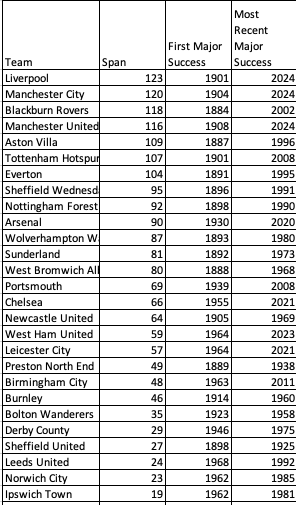
As usual, once the domestic season ends I update the table showing the English clubs’ span of success – i.e. the number of years between a club’s first major success (FA Cup, League, League Cup, European trophy) and their most recent. There’s actually not much difference between last year’s final table and this:

Okay, the span of success does not show how many trophies each club has won or how frequently that club has experienced great eras of success, but it does demonstrate how wrong those people are who believe certain clubs were unsuccessful until recent years, or those who think certain clubs have always been giants. The column on first major success helps to show when some clubs first became trophy-winning significant (often after transformational investment too!).
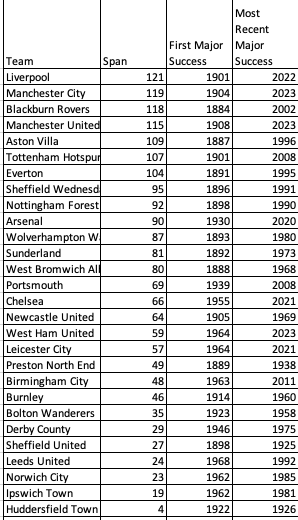
There’s not much difference between 2023 and 2024 – numbers have changed but not positions. In 2023 West Ham proved that if you’re a club that hasn’t won a major trophy for a while putting your focus on achieving trophy success ahead of the odd Premier League position can bring significant reward. In future decades no one will remember who finished seventh, tenth or fifteenth but they will remember the trophies. Here’s last year’s table for comparison purposes:

I know clubs focus on their financials but winning a trophy has longevity, gaining the odd Premier League place provides a bit of extra cash now but no long term kudos. Winning a trophy attracts new fans and brings money-spinning opportunities too.
If I was a supporter of any of the major clubs who have not found significant success in recent decades then I would absolutely want my team to go for whichever cup competition seems the most likely to win. That’s what I always wanted from City before they were able to compete for the League again. Winning the FA Cup in 2011 helped everything that followed happen – it gave confidence and a trophy winning mentality.
While you’re here why not take a look at the wide range of articles available on this site? Such as last summer’s 100 day series of features on Maine Road:
The 1981 FA Cup Final
On this day (May 9) in 1981 the 100th FA Cup Final took place between Manchester City and Tottenham. Below is a long read on the final but before details of that, there are also profiles of City’s starting 11 on the site. Here’s a link to the one on Tommy Hutchison published 3 years ago (it’s a free read). Enjoy:
Here for subscribers is a long read on the build up, the final and the post-final scenes. It contains material from interviews I have performed over the years with Dennis Tueart, John Bond and Joe Corrigan. There are also a few quotes that may surprise readers of what discussions took place after the final.
Here goes….
Subscribe to get access
Read more of this content when you subscribe today.
City 1 Leicester 0, the FA Cup Final
On this day (April 26) in 1969 Manchester City defeated Leicester City in the FA Cup final. It is worth pausing to consider how the Blues compared to football’s other successful sides in the competition at this time in football history. City’s four FA Cup successes placed them 7th in the all-time list of FA Cup winners – can you guess the clubs they were behind? Liverpool? No! MUFC? No! Arsenal? No! Keep going…
They were behind Aston Villa (7), Blackburn Rovers (6), Newcastle United (6), Tottenham Hotspur (5), The Wanderers (5) and West Bromwich Albion (5). Bolton, Sheffield United and Wolves had, like City, each won four FA Cups, while Manchester United and Arsenal had only won three, Liverpool one and Chelsea had not yet won the trophy. In fact Chelsea had only won one major trophy (the League Championship) at this point in their history.
Here for subscribers is a long read on that final and the events surrounding it:
Subscribe to get access
Read more of this content when you subscribe today.
Covid and the 2021 League Cup Final
How time flies! Today marks the anniversary (April 25) of the 2021 League Cup Final between Manchester City and Tottenham. It was the first (and only) League Cup Final played during any form of Covid lockdown in England. The 2020 final had been the last major final played in the country before the pandemic led to various lockdowns and then the continuation of football without fans.
Some football clubs, including Tottenham, had been allowed to have a limited number of supporters at their home games during the early stages of the 2020-21 Premier League season, but Manchester City had not as they were in a regional tier that prevented crowds. So, for many of us, the last physical game we attended was the 2020 League Cup final (some City fans did of course attend the 1-0 FA Cup victory at Sheffield Wednesday on March 4 and the Old Trafford derby of March 8 2020).
In the period between our last ‘live’ match and the 2021 League Cup final we had to sit at home watching City’s games played in empty stadia or, occasionally, at grounds with a small number of fans in but never with any ordinary City fans in. Former City star Mike Summerbee, the club’s ambassador, would often be seen, masked-up, at games when TV camera crews recognised him and it was always nice to know there was at least one person steeped in MCFC history there.
When the announcement came that the delayed League Cup Final (it was postponed until April in the hope that fans could attend) was to have up to 8,000 fans at Wembley there were then several dilemmas for fans. This was to be a test event and almost 2,000 tickets were to be issued to each competing club, which fans would have to pay for, and 4,000 would be given away to residents around Wembley and some NHS staff.
Many fans felt it was unfair that Wembley residents would be given tickets (each could apply to bring a guest too) while fans paid and there were the usual concerns about balance of support – would the fact that tickets were to be given to local residents benefit Spurs for example?
Most fans had no issue with NHS staff being given tickets with some Blues suggesting that NHS staff (and other key workers) who were season ticket holders of the two clubs should be offered the tickets. Lots of other suggestions were made plus, of course, some fans felt it would only be appropriate to attend a major game like this when ALL fans would be allowed back, though that still seemed some way off in April 2021.
To attend the final Manchester City used their loyalty points system and cup scheme as usual but then there was an added layer where fans had to live in certain postcodes: M, SK, BL, OL, WA, WN, PR, FY, BB, LA, CH, CW, BD, HD and HX and Greater London. In addition we had to have covid tests in the build-up to the final, including a lateral flow test that had to be performed at a test centre after 1.30pm on the Saturday before Sunday’s final.
This was difficult for many to arrange as, for example, some of the councils within the postcodes allowed did not have test sites available at weekend. Some booked to have tests close to Wembley, which caused some logistical issues on cup final day, and others had to travel in to Manchester on the Saturday. Inevitably, some did not get negative tests back in time and missed out.
Those lucky enough to get hold of tickets also had to state their method of travel with a limited number of car parking spaces meaning that option simply was not available for some fans. Specific coach and train travel was set up but the costs were prohibitive for some. Others pointed out their concern that once the trains arrived at Euston (or Watford) there would still be a need to travel to the stadium itself. To some this negated the need for travel on specific trains or coaches, but of course the conditions had been imposed by the Government and footballing authorities, not by the competing clubs.
At the stadium on match day the surrounding area seemed full of shoppers trying to pick up a bargain at the retail store but fans seemed few and far between. The photo above (Wembley Way looking towards the stadium) was taken about one hour before kick off. This would normally be packed at this time.
Close to the stadium the Wembley Way ramps that used to carry people up to the stadium have been demolished and a series of steps have been erected instead. Fans had to show their lateral flow test results, tickets, and photographic ID before being allowed up the steps to the stadium. They had to queue at these checkpoints and then, once they’d been allowed through they could make their way up to the stadium turnstiles. They were discouraged from waiting outside the stadium and were encouraged to go to the turnstile.
In previous years drinks had been allowed into the stadium if they were in plastic bottles and the lids were removed. This year no drinks, not even water, were allowed in the stadium, but staff did allow fans to carry in plastic bottles (without lids) as there were water fountains inside (typically positioned near the disabled toilets) and these could be filled up there. This is well worth remembering if you need to have drinks for medical purposes but do not want to pay Wembley’s expensive prices.
In the stadium bars and catering outlets were open as usual and while there was a considerably smaller number of fans within the concourse area, social distancing was not particularly in evidence. Having said that all fans had been tested but supporters were unclear whether Wembley staff, security, stewards and so on had been tested.
In the bowl of the stadium all fans had been positioned in the same stand plus the corners. This was the stand containing the Royal Box and directly opposite the TV cameras. The cynic would suggest that this demonstrated, as always, that some think the TV spectacle is more important than those in the stadium. Surely congestion in the toilets and other areas could have been eased had fans been spaced out in a wider area, or even if they’d have chosen blocks around the stadium with perhaps Spurs fans on one side or end and City in the opposite stand? If it’s pure safety then that would be the logical thing to do.
In the seats we were positioned predominantly in alternate seats with the row behind and in front of us following a pattern which was supposed to mean that there would be no one directly in front or behind of you. As some fans were in groups/families who had travelled together they sometimes moved next to others in their group on the same row – officially we were told that wasn’t allowed but inevitably it happened (we all wanted to be next to the people we’d gone to the game with and didn’t want the seat gap) and no one tried to stop it.
During the game stewards regularly reminded fans that they had to wear face masks throughout – from the moment we had shown our test results and tickets through to leaving the stadium after the presentations we had to be masked up. Of course, when eating or drinking masks were lowered.
Throughout our time in the bowl of the stadium fans would be moving along the rows to their places, and so social distancing was not possible at those times.
After the game we were free to leave en masse if we wanted. As City won the cup most City fans stayed for the presentations and left at various points during the celebrations, meaning there wasn’t a crush to get out. Spurs fans seemed more keen to leave of course, but whether this caused any issues I do not know. Presumably, social distancing is impossible to manage when an entire section chooses to leave at the same time.
If you were one of the lucky ones who had managed to get a car parking space it was refreshing to travel away from Wembley without the huge traffic jams we normally experience. There were roadworks and a few problems on the motorway but nothing like normal.
So, that was the general experience of attending as a Manchester City fan at the first game we’ve been allowed to attend as City fans in over a year. It’s not the story of the game but I hope it gives an idea as to how the crowd management happened.
Several years on this experience now seems alien again but back then it was refreshing to be able to actually attend a game.