On this day (April 8) in 1977 two goals from Brian Kidd gave Manchester City a 2-1 victory over Leeds at Maine Road. A crowd of 47,727 witnessed the game as the Blues challenged for the League title. This result saw City move a point behind the League leaders Ipswich Town, managed by Bobby Robson.
It had not been a convincing City performance but there had been injury issues with Mike Doyle and Brian Kidd playing in an unorthodox midfield – my biography of Peter Barnes goes in to a lot of detail about these easter 1977 games. You can order that here:
Leeds had taken the lead with Joe Jordan heading home after 17 minutes. Kidd equalised in the 38th minute after Joe Royle’s pass bounced off Leeds’ Trevor Cherry. Kidd’s second came when he flicked in the winner after Paul Madeley had seemingly headed clear a Peter Barnes corner in the 64th minute.
This is a small free taster of the material on this site. If you’d like to find out more about the site then have a search on what’s available or take a look at this:
Forty years ago today (22 March 1986) Manchester United hosted Manchester City in the 108th League derby between the teams. The fixture was the first of two high profile games for the Blues in consecutive days with the other game coming on Sunday at Wembley. See this story for news of that Wembley final:
Here for subscribers are the match stats, background, match report, film and other details from the 1986 Old Trafford derby:
Subscribe to get access
To access this please subscribe. It works out about £1.67 a month if you take out an annual subscription (£20 per year) or £3 a month if you’d like to sign up for a month at a time. Each subscriber gets full access to everything posted so far and those scheduled during your subscription.
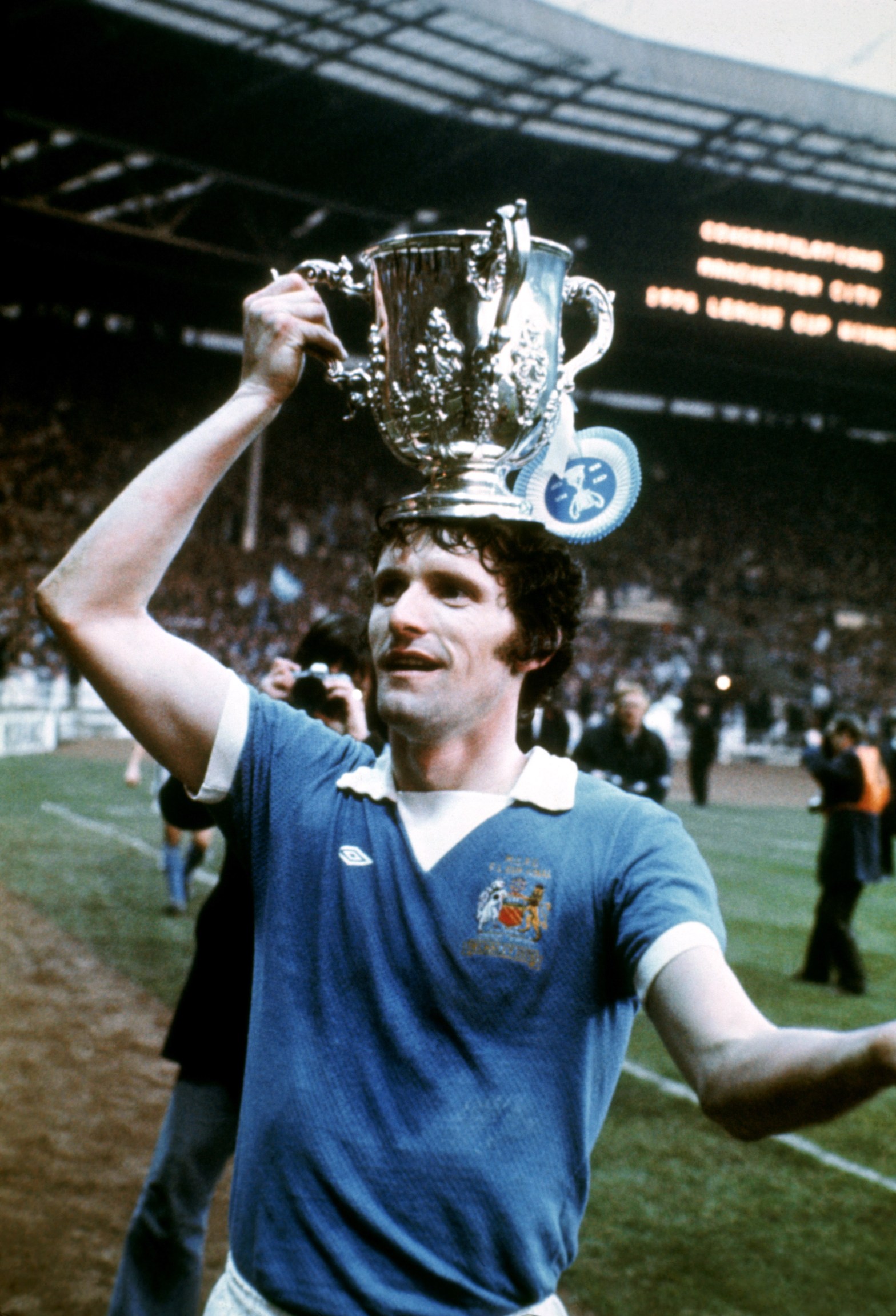
Manchester City travelled to Wembley for the League Cup final on this day (28 February) in 1976. Here’s a story of that day…
The huge demand for tickets had seen City secretary Bernard Halford take the unusual step of writing to all the other League clubs, apart from Newcastle of course, asking for any spare tickets from their allocations for the final. Many clubs obliged but still thousands of Blues were denied tickets.
Reaching Wembley was an extraordinary achievement considering the injuries (most notably Colin Bell) and suspensions, and demonstrated a wonderful team spirit that had been galvanised by manager Tony Book and captain Mike Doyle following the controversy surrounding former captain Rodney Marsh earlier in the season. Doyle told the media: ‘The success of this City is the complete team work – and individuals don’t count. I’m sorry Colin [Bell] hasn’t made it, but I’m damned sure it hasn’t weakened our chances, because we’ve proved it. We’ve been without him for three months and still reached Wembley.’
Significantly, every member of the side had already played at Wembley except youngsters Peter Barnes and Ged Keegan. When questioned whether those players would be the weak links Doyle said: ‘Peter is not only a tremendously talented player – he’s got his head screwed on the right way. He just isn’t the sort to get all worked up. In fact, I’ll bet that he could prove the biggest success of the whole match. He’s a natural. He does things superbly without having to think or worry. Keegan is in the same mould. He’ll feel at home, because he’s already one of the City first team pool. If he wasn’t something special, he wouldn’t be in it!’
The final began with both teams playing attractive football. Newcastle seemed to have the edge for a while, but a foul by Newcastle’s Keeley on Joe Royle brought an important free-kick. Hartford sent the ball to Royle, who headed the ball across the face of the goal. Barnes stormed in to fire a half-volley into the net to give City an eleventh minute lead.
Barnes, who would be announced as the PFA Young player of the Year that weekend, immediately ran off the pitch towards the stands in celebration.
Twenty-four minutes later Newcastle’s Macdonald sent in a low centre. Watson and Corrigan raced for it, but Newcastle’s Gowling managed to get to it first and stab home the equaliser.
The second half started with City determined to get an early goal – and they did! Years later Dennis Tueart explained: ‘The goal itself… [Donachie’s] going, I’ve gone to the far post, then come away from the far post because Tommy [Booth’s] gone there. But as I’ve checked back into the centre, I’d gone in too far, the ball’s gone over to Tommy. Tommy’s got half a head on it and knocked it back. It just went a wee bit behind me. Well, I’d always been fairly good at volleying right from an early age, and I’d scored a goal, probably it was the first or second game of the season, against Norwich. Which I think was technically a better goal, it flew in the net, overhead kick. I’d scored overhead kicks at school, I’d side volleyed which is slightly different, but timing and volleying had always been a strength, and it just came… Any balls that come to you as a forward, no matter which way they come to you, you just try and twist your body and get some kind of contact onto it. Because you know the general area where the goal is, and I connected pretty well, it went across and bounced in.
‘It was important because it was the 46th minute, just after half time, when we got ourselves back in front.’
Manchester City’s Mike Doyle celebrates with the League Cup (PAPhotos/Alamy)
Manager Tony Book, who became the first man to win the trophy as a player and as a manager, was delighted with City’s 2-1 win: ‘This was my greatest moment. It was a tremendous final and Tueart’s goal was something special… quite out of this world.’
On the Sunday, City returned home to an incredible tour of Manchester. It was a great day of celebration, and the final would be shown on ITV later that day. In the days before the League Cup was shown live on television, this gave those unable to get a ticket the chance to see the game for the first time.
Match Stats
28 February 1976
Manchester City 2 (Barnes & Tueart)) Newcastle United 1 (Gowling)
Attendance 100,000
If you enjoy all the free material on my website and would like to support my research and keep this website going (but don’t want to subscribe) then why not make a one-time donation (or buy me a coffee). All support for my research is valued and welcome. It allows me to keep some free material available for all. Thanks.
You can read more on the 1975-76 season with this 5,320 word article – a season which saw Tony Book guide the club to major success. If you want to know more on this incredible decade for Manchester City Football Club then why not subscribe and read it all? You could even subscribe for a month and see what you think. The following 5,320 word article is on the 1975-76 season and is available to subscribers below. Enjoy!
Subscribe to get access – Monthly
Read more of this content when you subscribe today. It costs £3 per month (cancel anytime) to access everything posted since 1 October 2022 or there’s a special annual rate below which gives greater access and works out much cheaper.
Read more of this content when you subscribe today. It costs £3 per month (above) or £20 a year (here) to access everything posted since the site was created in December 2020. This special rate works out about £1.67 a week and gives access to everything posted, including PDFs of 3 of my books.
If you enjoy all the free material on my website and would like to support my research and keep this website going (but don’t want to subscribe) then why not make a one-time donation (or buy me a coffee). All support for my research is valued and welcome. It allows me to keep some free material available for all. Thanks.
Jack Charlton’s Middlesbrough arrived at Maine Road on this day (21 January) in 1976 for the second leg of the League Cup Semi final 1-0 up after a tense first leg match. The majority of the first leg had been played out in midfield with Alan Oakes, Asa Hartford and the emerging Paul Power putting up a good fight on City’s behalf. Boro had found it difficult to break through City’s powerful defence until John Hickton (I had previously said David Armstrong had scored but he’d netted for them in the 1-0 League meeting 3 days earlier) gave them the lead in the 66th minute. Despite the advantage Middlesbrough’s Evening Gazette predicted a difficult return game.
At Maine Road a youthful City side destroyed Boro. As early as the 5th minute 19 year old Peter Barnes – now working for GMR – crossed the ball to 20 year old Ged Keegan, who headed home his first senior goal. Six minutes later Keegan laid the ball off for Oakes to fire a left foot shot past ‘keeper Jim Platt. A minute into the 2nd half Barnes made it 3-1 on aggregate. Shortly before the end Joe Royle made it 4-1 and maintained his record of scoring in every round.
Stats: League Cup semi-final 2nd leg. 21st January 1976.
While you’re here why not subscribe and read a 5,320 word article on the entire 1975-76 season – a season which saw Tony Book guide the club to major success. You can read this below.
Subscribe to get access – Monthly
Read more of this content when you subscribe today. It costs £3 per month (cancel anytime) to access everything posted since 1 October 2022 or there’s a special annual rate below which gives greater access and works out much cheaper.
Read more of this content when you subscribe today. It costs £3 per month (above) or £20 a year (here) to access everything posted since the site was created in December 2020. This special rate works out about £1.67 a week and gives access to everything posted, including PDFs of 3 of my books.
If you enjoy all the free material on my website and would like to support my research and keep this website going (but don’t want to subscribe) then why not make a one-time donation (or buy me a coffee). All support for my research is valued and welcome. It allows me to keep some free material available for all. Thanks.
Fifty years ago today (3 December 1975) Manchester City defeated Mansfield Town 4-2 in the League Cup. Subscribers can read all about the game below.
Subscribe to get access
Read more of this content when you subscribe today. It costs £3 per week (cancel anytime) or sign up on a yearly basis for the discounted price of £20 per year. Subscribers access every article, interview, feature etc. on the site throughout their subscription.
You’ve got to watch this film of Manchester City v Wolves from today (29 November) in 1975. City win the game but there’s a deliberate handball that prevents a goal but doesn’t end up with a dismissal; a missed penalty; the referee taking out Mike Doyle and much more. Enjoy:
You can also read more on the game below if you subscribe to my site.
Subscribe to get access
You can read more of this content when you subscribe today. It costs £3 per week (cancel anytime) or sign up for a year at the discounted rate of £20 per year. Subscribers get access to everything on the site, including being able to download the book Manchester A Football History and much more.
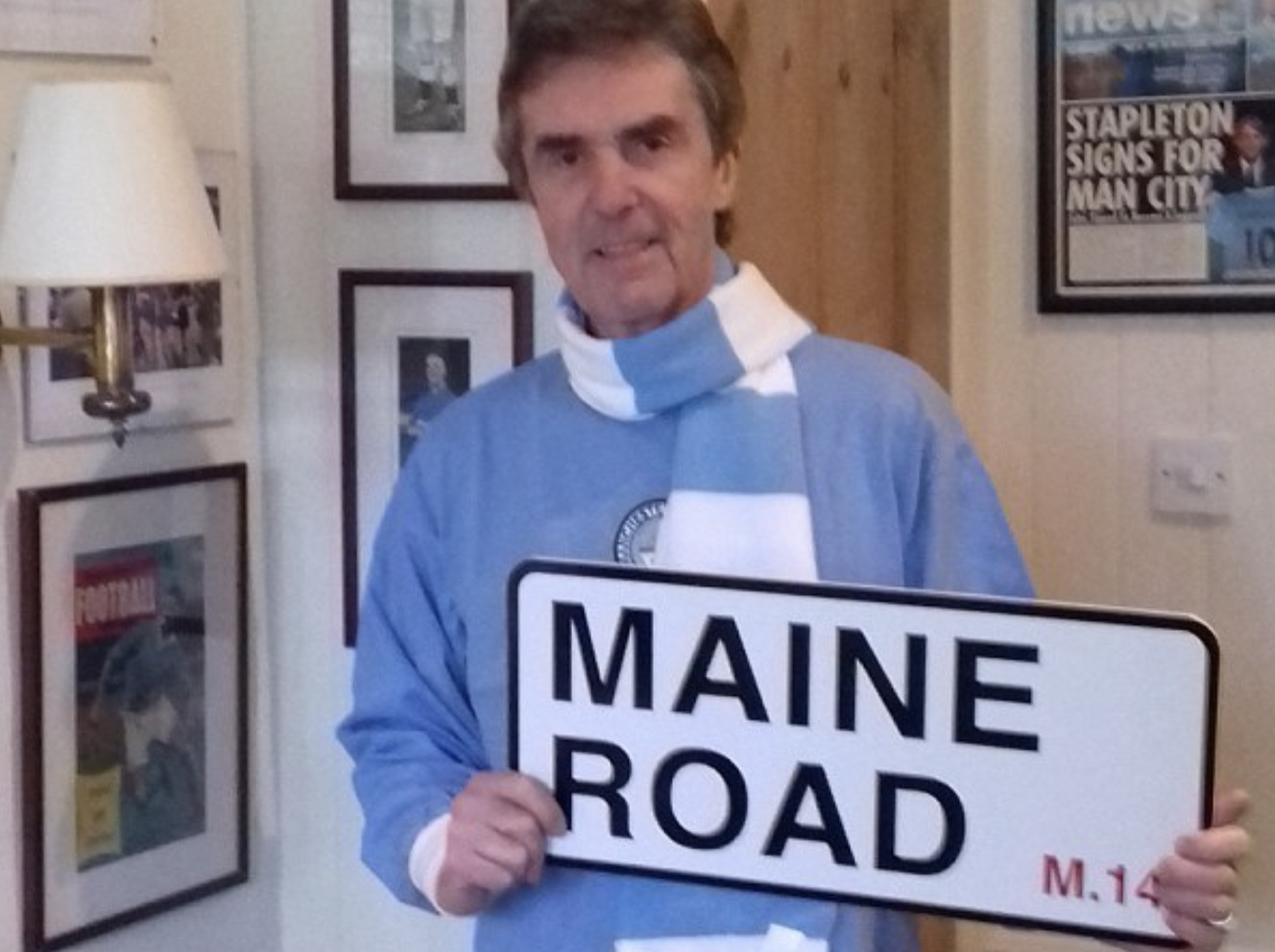
Back in August 2014 I interviewed John Stapleton on his career and support of Manchester City. As part of my tribute to him, I’m posting it here as it was published eleven years ago. Hopefully it adds to the positive stories of him that have been appearing over the last few days. I always enjoyed meeting and chatting with John. Here’s the feature as published in August 2014:
John, you’re known today for ITV’s Good Morning Britain but your career started in local newspapers, with your early TV work coming on This Is Your Life. It was your idea to make Joe Mercer a subject for one show wasn’t it?
Yes it was. I did it purely for the benefit of me and my dad. Eamon Andrews, the presenter, had of course a great interest in sport and I put the idea to him and the rest of the production team. Together with Norah, Joe’s wife who in recent years I often sat with at games sharing her boiled sweets, we concocted a situation where Joe and Malcolm were in a London hotel before a trip to watch a European game in 1970. Malcolm disappeared – deliberately as part of the show though Joe didn’t know this – and Joe was called to reception urgently. Eamon leaped out to do the big ‘This Is Your Life’ reveal and Joe had no idea whatsoever. It was a great day for us all and Joe was thoroughly deserving of it as well.
My grandfather, who lived in Denton, was at the first game at Maine Road and attended matches at Hyde Road and now my son Nick is a regular, so we’ve had a good four generations of Blues so far. When I was about 7 I was taken to watch City play Blackpool, in the days when Stanley Matthews played for them of course, and I loved simply being at the ground. It felt like home and that was it really. I was hooked. We used to have to go on two buses and a tram to get there from where we lived in Saddleworth – it seemed such a long journey at the time, but it was always worth it. No matter what the result.
Can you remember who your first heroes were?
Well, my dad went to the 1955 FA Cup final and then the year after we watched the final against Birmingham on our television. So exciting, because televisions were new to most of us back then and to be able to live the drama of the game, and of course Bert Trautmann’s injury, live in your own home was amazing really. The world’s moved on so much, but the black & white set felt so modern at the time. It was then that my first real hero emerged – Dave Ewing. A wonderful, uncompromising defender and I remember him protecting Bert in those final minutes as best he could.
Did you ever meet Dave?
Sadly, no, but I did meet his son. I left Manchester when I was 21 to work in Fleet Street and so opportunities to bump into your heroes were few. I was also less able to get back to Manchester as often as I do now, and so I watched City in the south and travelled back as often as work and finance allowed. I have since met quite a few of my heroes from that period, people like Ken Barnes and of course his son Peter. Two great City legends. Ken was a wonderful rascal and very funny and Peter is a really nice guy. I’ve also got to know Mike Summerbee quite well – and bought several of his shirts over the years and they weren’t cheap! He came to our house a few years back and charmed my parents. For my father it was great to be in his company and I think we all cherished that day. Even my lawyer was talked in to buying some of Summerbee’s shirts.
How do you feel about attending games today?
It’s an absolute joy and the fan in me never goes away. For my son, living in London and under so much pressure from his peers to support Arsenal, the years before the takeover were difficult. Those that had experienced the glories of the fifties to seventies had good memories of success, but the younger generation who had never seen us lift a major trophy must have found it tough. But it was all character building and fortunately he can now experience the success that this club deserves. It means more if you’ve been through the thick and thin – and he certainly experienced the thin alongside me!
Alongside the Mercer-Allison era, today is the best we’ve ever known and, hopefully, will keep on getting better. We’ve waited a long time but it’s been worth it. I’ve no complaints about any aspect of City today and the club is as friendly as ever, if not more so in some respects. It gives me a real buzz every time I walk into the stadium, or meet a former player, or chat to a fellow Blue like you Gary. We all have a shared bond and recognise that what we’re experiencing now is truly exceptional – long may it last!
In the mid 1970s you came in to contact with City professionally via the Junior Blues rally. What do you remember of it?
It was held at Belle Vue and there were thousands of Junior Blues there. It was a great event and we had the full team on the stage, giving fans the chance to ask questions to the team and the management. Peter Swales had asked me to present it – for free I might add but it was a major honour to do it – and it was probably the first time any club had opened up in such a way. City were quite forward thinking in terms of the media and fan relations at the time. I was also involved with the BBC Nationwide series on City.
That was another landmark moment in football’s relationship with the media. What was your involvement?
I was a Nationwide presenter and we’d managed to get City to open their doors for the cameras. Reporter Kevin Cosgrove did most of the progress reports and I came in at the end of the series to do a big outside broadcast on the last day of the season. I did some pre-recorded interviews, including one with Franny Lee, and then I did all the links at the ground. It went out to the full BBC network and was very good for the club and, of course, the BBC.
There’s a chant “City Are Back!” we’ve been singing for years, but I now feel that the club I first supported is back. Is this true for you?
In many ways yes. I’ve been a good friend of present day FA boss Greg Dyke for years as we’ve worked together in TV. He was given a tour of the club and the new facilities by Brian Marwood and he told me that this really is a friendly and forward looking club. He was very impressed and it’s satisfying to know others are now recognising how special this club is.
Those facilities will help City develop talented young players in future years. It’s ironic really that people have been urging certain other clubs to spend, spend, spend recently, but we’ve been the ones tagged as the big spenders.
That’s going away now I believe. The evidence is clear and we had to spend to catch up, just like other teams have throughout history. We should never forget either that two of our greatest and most consistent players – Vincent Kompany and Pablo Zabaleta – arrived before the takeover. Kompany is a truly great leader and I’ve been fortunate to meet him and he is also a wonderful man. He is the perfect captain for this club, but we’re so fortunate to have so many brilliant players. Just think of David Silva… outstanding quality!
You’ve worked with Manchester United supporter Eamon Holmes in the past, did the two of you ever discuss football?
We’ve had some good banter over the years. Good craic! In fact I took him to two games. The first was when Beckham scored from a free kick at Maine Road. Eamon jumped up in the directors’ box and you can imagine how that went down. The second time he was booed into the ground by City fans!
Your own personal greatest game?
Obviously, the last game v QPR in 2011-12, but also the 6-1 against United at Old Trafford. I turned to Nick my son and said ‘savour this moment. No matter how long you live you’re unlikely to experience this feeling again.’ And of course, there’s the 1999 play-off final without which we may never have come back at all. What a transformation in 15 years – hopefully, there’s more to come.
This is something I wrote a few years back about Ian Brightwell. I hope you enjoy it… Of all the players to appear in City’s 1986 FA Youth Cup winning side, Ian Brightwell is the one who ended up having the longest playing career with the Blues. He remained at Maine Road until 1998. By that time he had played for a total of ten permanent managers and numerous caretakers in a 12 year first team career. It’s a wonder any player could cope with so much change.
He made his debut against Wimbledon on 23rd August 1986 (their first game in Division One), around four months after the Youth Cup success over Manchester United: “Billy McNeill gave me my debut in the opening game of the following season against Wimbledon. He told me a few days before that I’d be playing. He came up to me and told me, and I couldn’t believe it. I’d only just turned 18, but I had a few days to prepare. We won the game 3-1 and it helped me that Steve Redmond was already in the side. Of that Youth side Reddo was first in and then it was me, and I remember us watching to see who would be next. My second game was at Anfield and that was a great experience. We drew the game 0-0 but how we got away with that I’ll never know. We were battered.”
Brightwell made 12 League appearances plus four as substitute that season, but it was not a great time for the Blues as City were relegated at the end of the campaign. Billy McNeill had left early in the season: “I had great respect for him and was really disappointed when he left. He was a real legend – first man to lift the European Cup for a British side. Jimmy Frizzell took over, so that helped as it was more of a continuation. But for me it became the norm that managers would be changed. I don’t think Billy should have left when he did. I’ve still got great respect for him as a person and of course as a football manager. I’ll always be thankful to him.”
Under Mel Machin the following season Brightwell became an established member of the promotion seeking side before the arrival of Gary Megson limited his chances for a while: “It was a strange season because it was the first time as a group those of us from the youth side weren’t winning. I know we’d been relegated the previous season, but by 1987-88 a few of us were regulars in the first team. We were disappointed and felt we should have done better. I missed the 10-1 against Huddersfield, but I appeared in the 6-2 against Plymouth a few days later. Those games did bring a lot of attention our way, but I’d rather City be consistent. We weren’t good enough overall, but the following year that experience helped push us on. But it was difficult in 1988-89 as well. It’s a tough division to get out of.”
Promotion was achieved on the last day of the 1988-89 season in a nerve-wracking match at Bradford: “The pitch invasion followed. I was carried off on fans’ shoulders and had half my kit ripped off me. In the dressing room I remember thinking how close we’d been to missing out.”
The following season there was yet another managerial change and Howard Kendall was brought in. Under his guidance Brightwell was given an extended run in the team and, on 3rd February 1990, he scored his most memorable goal. It was a marvellous 25 yarder against Manchester United at Old Trafford: “I remember that the ball was out on the right and Mark Ward sort of half-crossed it. It came to me and I’ll never forget this – I heard Steve Redmond on the half way line shout: ‘Bob…’ I’d best not say his exact words, but let’s just say he wanted me to have a go in his strong scouse accent! It was on my left foot, which isn’t my strongest, but I did what Reddo said. It went in the top corner!
“I ran off and jumped about twenty feet in the air – or at least that’s how it looks on the photos. I remember the noise because back then the away fans used to get about 10,000 tickets at Old Trafford and it was phenomenal.”
Afterwards an excited Brightwell, when asked to explain how he’d scored, told the media: “I just wellied it!” It became the expression of the season and seemed to match everybody’s impression of a boyhood dream come true.
In the years that followed Brightwell performed consistently and was loyal to the City cause. Many of his former youth team colleagues were transferred or, in the case of Paul Lake, suffered serious injury, but Brightwell remained: “It was odd once the others went. They didn’t all go at once and of course Lakey was injured, but it did feel different. We’d known each other as a group for about 15 years, so a big loss. But my incentive was always to stay in spite of everything else. I actually think that if we’d have had continuity of management during that time that we’d have all stayed. If that had happened… well just look at United. They had a crop of talented youngsters about ten years after us like Butt, Scholes, Neville, and so on and they grew as a team. We never got that chance.”
There were some bright moments for the Blues in the early Nineties, however the second half of the decade saw City plummet through the divisions. In 1998, after relegation to the third level of football, Brightwell moved on: “It broke my heart to see City fall so low but I still didn’t want to leave. It was a difficult decision but Joe Royle had explained that the Club couldn’t offer me a contract at the level I was on. In the end I had to go and I moved to Coventry who were still in the Premier League, but my first impression was that this was such a small club in comparison with City. They may have been two divisions higher but in my mind there was no comparison.
“It didn’t work out at Coventry and I became injured. I kept going back to Manchester to watch City whenever I could.”
After Coventry Brightwell played for Walsall (including an emotional return trip to Maine Road), Stoke and Port Vale, before moving into coaching. In 2004 he was caretaker manager of Port Vale and, in 2006, he performed a similar role at Macclesfield. In 2007 he became Macclesfield’s manager on a permanent basis, but was dismissed in February 2008. He admitted in 2010 that Tony Book and Glyn Pardoe, who had been City’s youth coaches during the Eighties, remained influential figures throughout his career: “It’s difficult to stress how important Book and Pardoe and some of the others were. When I moved into coaching and, of course, management at Macclesfield, I used a lot of the things they said. They were so influential and if you think about where they got it from – well that was Malcolm Allison and Joe Mercer. You can’t get any better. Tony Book used to always say ‘control and play’. It sounds simple but in essence that’s what the game is all about and I still use that. Tony and Glyn used to drum it into you in the A team.”
To the wider world Ian Brightwell may not be the most well-known player from City’s 1986 FA Youth Cup winning team, but in terms of commitment to the Blue cause and longevity he was certainly one of the most dedicated. He was also a passionate Blue from childhood: “It was the team I supported and I used to go down to Maine Road. Colin Bell was nearing the end of his career when I went but there were people like Asa Hartford, Peter Barnes and Gary Owen. City were still a major side at that time. I remember the year we missed out on the title by a point to Liverpool (1977) – we should have done it. Tony Book was manager and the players were a different class. It was great to watch.”
During his career it was often highlighted that Brightwell came from a family with a great sporting pedigree. His brother David also played for City, while his parents were successful British Olympic athletes: “I couldn’t ask for a better sporting pedigree. My mum (Ann Brightwell nee Packer) won a gold and a silver in Tokyo and my dad (Robbie) won a silver.”
On this day (9 May) in 1987 Manchester City were relegated after a 2-0 defeat at West Ham (see match report). At the end of the game City supporters and West Ham fans climbed over the fences and onto the pitch. Some thought that the two sets of supporters were about to confront each other, but the fans knew differently. The Hammers began chanting “You’ll be back” and both groups swapped scarves and souvenirs on the pitch. It was the kind of moment that should have been widely reported in the media but at the time focus tended to be on hooliganism and confrontation rather than the positives of football support. City had been relegated, but their supporters did not seek revenge. The West Ham fans could have ridiculed, but they didn’t. If only those condemning football fans at the time could have seen the two sets of loyal supporters genuinely appreciating and understanding each other.
The relationship between the fans of the two clubs is not something that is widely discussed or promoted but it is something that has endured. City fans have never forgotten the ‘You’ll be back’ game and in recent years, as others have unfairly mocked both sets of fans, the supporters of both the Blues and the Hammers seem to understand and respect each other. Inevitably, there will always be banter during a game but outside of the match the mutual recognition and respect always seems to win through.
To many West Ham are the City of the South – a proud football club with a great history and heritage, combined with a loyal and passionate fanbase.
You can read more on Ian’s debut season of 1986-87 below. This is a 2,500 word feature on the entire season and is available to subscribers.
Subscribe to get access
Read more of this content when you subscribe today. It costs £3 per month (cancel anytime) to access everything posted since 1 October 2022 or £20 a year to access everything posted since the site was created in December 2020. This special rate works out about £1.67 a week and gives access to everything posted, including PDFs of 3 of my books.
On 3 June 2023 Ilkay Gundogan City secured his place in national football history with the quickest goal in a FA Cup final. It was a stunning volley after only 12 seconds. That day Gundogan scored two and helped City to 2-1 FA Cup final victory over Manchester United.
As well as the speed of the first goal, Gundogan’s goals gave him another MCFC record. Dave Masey, who has been collecting stats and historical information on Manchester City for years contacted me to tell me about one of his spreadsheets which holds details of City scorers in trophy winning games.
His records capture those who have scored in major cup finals, but besides Cup Finals he also records other trophy-winning games. These include the deciding League games from 1937 onwards against Sheffield Wednesday (1937), Newcastle, QPR, West Ham, Brighton and Villa (2022), but nothing from three recent title successes where the Blues clinched the title when they were not playing. Got that? Good, now….
Dave tells me that the FA Cup success saw Gundogan move to the top of the list with 5 goals, overtaking Neil Young and Sergio Aguero. So he has scored more goals in trophy-winning games than any other Blue.
The list of scorers in trophy winning games reads:
1904
Meredith
1934/7
Tilson (3), Brook (2), Doherty
1956
Hayes, Dyson, Johnstone
1968/70
Young (4), Lee (2), Summerbee, Doyle, Pardoe
1976
P Barnes, Tueart
2011-(former)
Aguero (4), Y Toure (2), Nasri (2), Kompany (2), D Silva (2),Jesus (2), Sterling (2), Dzeko, Zabaleta, Navas, Fernandinho
2016-(current)
Gundogan (5), Laporte (2), Rodri (2), Mahrez, De Bruyne
Dave also tells me that in the three seasons where somebody else’s defeat clinched the title for City, the scorers in the club’s last game before the title confirmation were:
Gundogan (3), Sterling (2), Jesus, Haaland.
As Dave says, Ilkay gets a remarkable number of important goals, particularly for somebody who is ‘just’ a 1 goal in 5/6 games player (63 in 357 for City by June 2025).
Looking forward to this weekend’s men’s FA Cup final. Back in 2011 Manchester City won their first FA Cup since 1969. The success became the first major trophy win of the current City ownership. To reach the final in 2011 City defeated Manchester United in that season’s FA Cup semi final. A few years back I produced Restored 2011: The All-Manchester FA Cup Semi Final and as we build up to this year’s FA Cup final it’s well worth reminding ourselves of this time when fans hoped for success. It’s a nice reminder of how significant the FA Cup has been to City’s modern success.
This special 1 hour audio recording looks at the years between City’s 1976 League Cup success and the FA Cup glory of 2011. 2011 was a crucial step in City’s journey since the 2008 takeover and I felt it was vital to do a special marking this.
So what’s in this special recording? Well, I’ve included exclusive material from interviews and recordings I’ve done over the years with Garry Cook, Brian Marwood, Roberto Mancini, Peter Barnes and Peter Swales. Why Swales? Well, have a listen and you’ll hear why. Basically though I’m trying to set the tone for why the 2011 FA Cup semi final victory and overcoming Manchester United was so significant.
On Mancini… I include a few words from him recorded in 2011 and at one point he talks about the view that was then being expressed that City were ‘trying’ to buy success (now they say City ‘have’ bought success!). His words are a reminder that City have been having that particular criticism thrown at them for over a decade! Oh well, I wonder how long those criticisms were laid at other clubs who had seen major investment which propelled them forward?
Anyway, get yourself a brew and be prepared to be transported back in time. Here’s the recording:
If you enjoy the recording then please let me know, comment or subscribe to the site. If it’s of interest then, over the coming months and years, I’ll produce others like this highlighting key points in Manchester City – and Manchester’s – footballing history. It costs £20 a year to subscribe (it works out £1.67 a month) or £3 if you’d like to sign up a month at a time to get full access for as long as you subscribe (you can always try it for a month). It’s worth bearing in mind that the 2010 Manchester A Football History cost £24.95 and all subscribers will be able to access all of that for as long as they are a subscriber (plus all the other stuff of course). You can subscribe below.






 Gary James' Football Archive