Maine Road 100 – Day 30

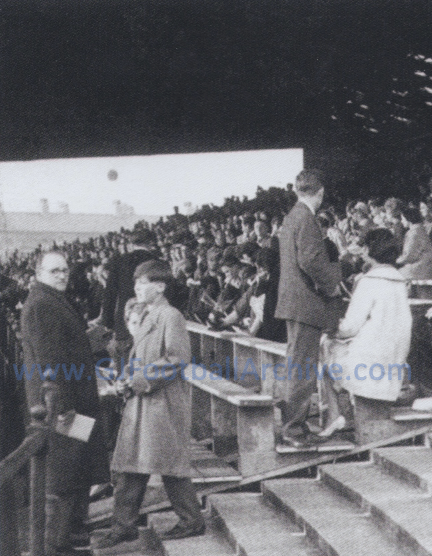
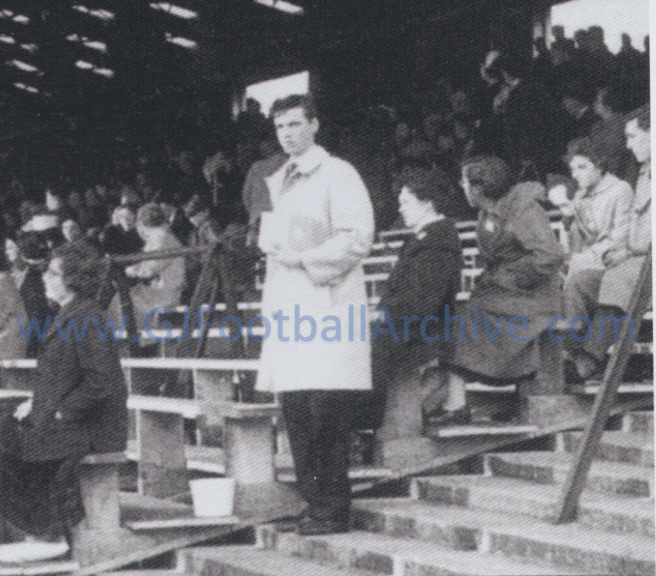
It’s day 30 of my posts counting down to the centenary of Maine Road’s opening game. Today – The first time seats were installed on the Kippax. Anyone want to guess when this was? This was actually 62 years ago this week!

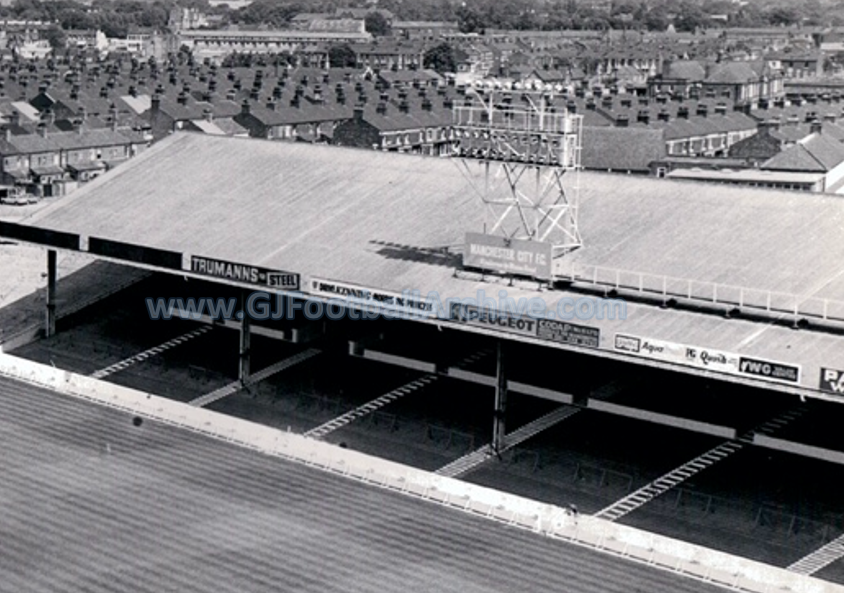
Maine Road staged one of the religious events where American evangelist Billy Graham came to preach to thousands in 1961. I cover the story in detail in Farewell To Maine Road but these images show that temporary seating was installed on the Kippax for the event, which took place between 29 May and 17 June 1961.

At this time there were no gates in the Kippax’ perimeter wall leading to the pitch and so special scaffolding steps were erected to allow attendees to climb over the wall and on to the pitch for blessings etc.

Were you at one of these religious events? If so leave your comments about the day below.

For those unfamiliar with Maine Road’s layout at the time, the photo was taken from about a third of the way up the Kippax between number & and 8 on this photo.

Maine Road aerial 1971 from Farewell To Maine Road

If you’d like to read more on the history of Maine Road, take a look at Farewell To Maine Road, which can be downloaded from this page:

If you enjoy all the free material on my website and would like to support my research and keep this website going (but don’t want to subscribe) then why not make a one-time donation (or buy me a coffee). All support for my research is valued and welcome. It allows me to keep some free material available for all. Thanks.

Choose an amount

£2.50
£5.00
£7.50

Or enter a custom amount

£

Your contribution is appreciated.

Donate

Maine Road 100 – Day 22

For day 22 of my posts counting down to the centenary of Maine Road’s opening game I want to talk about the photographs of Iain SP Reid who captured this image of the burger sellers at Maine Road during the 1970s.

This photo and others in Iain’s collection were taken circa 1977. Iain believed that photography could improve lives. His work is full of joy. Sadly he died in 2000, leaving his fabulous archive of photographs filed away in boxes unseen until his family rediscovered them. He tried to capture images around Maine Road and at Old Trafford too, but he wasn’t interested particularly in match action. Instead he focused on the crowd, creating a wonderful collection.

“It was the way in which the football supporters of Manchester United and Manchester City used to dress and treat the whole match as if it were a carnival”
– Iain S. P. Reid

In August 1977 Iain was featured in a local newspaper and gave his views on what the project was. This makes interesting reading and for those who have seen any of his images it is worth pausing to have a read and a think about what he captured. This was for a Trafford based newspaper and so they focused on Old Trafford at times, but his comments about the Stretford End are as significant and would have been replicated by his thoughts on the Kippax etc.

If you appeared in this photo or in any of the others Iain took during this period then please get in touch with Paul Sorene and all involved at info@flashbak.com who are hoping to trace as many of the people on Iain’s photos as possible. You can look through this Facebook page of Iain’s work at:

https://www.facebook.com/media/set/?vanity=IainSPReidu0026amp;set=a.2606932862855473

I’m always passionate about the capturing and preservation of footballing images and stories. For me football simply isn’t about the players on the pitch but the thousands who dedicate significant time – and money – to supporting their club. If you’re a Blue or a Red who attended games around 1976-77 then take a look at Iain’s collection at

https://www.facebook.com/IainSPReid

For those unfamiliar with Maine Road the photo was taken from the street corner above and to the right of number two, looking towards the Development Association built into the external wall of the North Stand to the right of number 2.

Maine Road aerial 1971 from Farewell To Maine Road

If you’d like to read more on the history of Maine Road, take a look at Farewell To Maine Road, which can be downloaded from this page:

If you enjoy all the free material on my website and would like to support my research and keep this website going (but don’t want to subscribe) then why not make a one-time donation (or buy me a coffee). All support for my research is valued and welcome. It allows me to keep some free material available for all. Thanks.

Choose an amount

£2.50
£5.00
£7.50

Or enter a custom amount

£

Your contribution is appreciated.

Donate

Maine Road 100 – Day 19

Welcome to Maine Road… It’s day 19 of my posts counting down to the centenary of Maine Road’s opening game. A photograph can bring back so many memories. Today’s is of a simple sign but it welcomed many to Manchester City’s ground for decades.

This was replaced by another version of the sign, which was then removed in 1994 when the Kippax Stand was demolished, but for much of the 1970s & 1980s this original sign was a popular part of Maine Road for many fans.

Kippax Stand c.1980

It sat proudly on a metal floodlight gantry on the roof of the Kippax in front of the original central lighting. In later years it was swamped by advertising and extensive roof lighting, once the corner pylons had gone.

Anyone running out from the players’ tunnel would see it straight in front of them. Like the This Is Anfield sign at Liverpool this was a recognisable feature proudly saying Manchester City and Welcome to Maine Road.

For those unfamiliar with Maine Road this photo may help locate where the sign was. You can see the Kippax roof central lighting tower above number 7. The sign was attached to that, opposite the players’ tunnel (number 1).

Maine Road aerial 1971 from Farewell To Maine Road

If you’d like to read more on the history of Maine Road, take a look at Farewell To Maine Road, which can be downloaded from this page:

If you enjoy all the free material on my website and would like to support my research and keep this website going (but don’t want to subscribe) then why not make a one-time donation (or buy me a coffee). All support for my research is valued and welcome. It allows me to keep some free material available for all. Thanks.

Choose an amount

£2.50
£5.00
£7.50

Or enter a custom amount

£

Your contribution is appreciated.

Donate

Maine Road 100 – Day 9

Day 9 of my posts counting down to the centenary of Maine Road’s opening game. Today this grainy image highlights something that was, until the end of the Kippax in 1994, a regular part of the Maine Road match experience. If you look carefully you can see the tea urn being pushed around the ground. It’s currently in front of the Platt Lane Stand and I remember being in that stand as a young boy in the 1970s and desperately wanting something from the vendor. Chipmunk crisps, Waggon Wheels & TipTop orange drinks were three of the items I remember them selling.

Usually, we brought a flask to games (often broken in the excitement of a goal) and occasionally Dad would have enough money to let us go and get some crisps or something. For those who never experienced Maine Road or the tea urns, basically a couple of young matchday staff, usually lads, but sometimes girls, would push a tea urn around in front of the white wall that surrounded the pitch. Presumably they had filled the tea urn at some point early into the game and I guess older fans knew how long it took the tea urn to get from one end to the other. If you were at the wrong end of the Platt Lane Stand your brew may not have been as hot as you’d want.

The Platt Lane tea urn, early 1970s

I never had a hot drink from it, so I don’t know if the urn had hot water in so that they could add a tea bag, Nescafe or bit of Bovril to it or whether it was already made up. If it was maybe there were different drinks in multiple urns that I didn’t spot? Anyone here ever work one or know more about that? If you did please leave your comments, or if you’ve any other memories of Maine Road that you’d like to share.

If you’d like to read more on the history of Maine Road, take a look at Farewell To Maine Road, which can be downloaded from this page:

To help those unfamiliar with Maine Road locate the specific location of this post, the Platt Lane tea urn photographed is heading towards the number 3 on this plan.

Maine Road aerial 1971 from Farewell To Maine Road

If you enjoy all the free material on my website and would like to support my research and keep this website going (but don’t want to subscribe) then why not make a one-time donation (or buy me a coffee). All support for my research is valued and welcome. It allows me to keep some free material available for all. Thanks.

Choose an amount

£2.50
£5.00
£7.50

Or enter a custom amount

£

Your contribution is appreciated.

Donate

Maine Road 100 – Day 6 Answer

Day 6 of my posts counting down to the centenary of Maine Road’s opening game asked you to name the year this aerial photo was taken. I gave a few clues which may help date this:

  • None of the temporary stands have yet been constructed in the corners
  • The MCFC lettering appears at the bottom section of the North Stand
  • The Souvenir Shop still appears to be operational and doesn’t look like it’s been turned into offices yet
  • Both the Platt Lane Stand and the Kippax have been replaced BUT what about the end panelling of the Kippax? Is that complete?

The answer is 1995.

If you’d like to read more on the history of Maine Road, take a look at Farewell To Maine Road, which can be downloaded from this page:

If you enjoy all the free material on my website and would like to support my research and keep this website going (but don’t want to subscribe) then why not make a one-time donation (or buy me a coffee). All support for my research is valued and welcome. It allows me to keep some free material available for all. Thanks.

Choose an amount

£2.50
£5.00
£7.50

Or enter a custom amount

£

Your contribution is appreciated.

Donate

Maine Road 100 – Day 6

Day 6 of my posts counting down to the centenary of Maine Road’s opening game. Today it’s an aerial shot of Maine Road. Can you guess the year?

I’m a bit of a ground obsessive (as you may have guessed) and I spend much of my time seeking out images of football grounds (not just City’s) and trying to date them. It drives me crazy when I see something misdated…. Anyway, before I waffle on can you work out which year this was taken?

I’ll give the answer tomorrow but I always look for clues, so I’ll give you a few which may help date this:

  • None of the temporary stands have yet been constructed in the corners
  • The MCFC lettering appears at the bottom section of the North Stand
  • The Souvenir Shop still appears to be operational and doesn’t look like it’s been turned into offices yet
  • Both the Platt Lane Stand and the Kippax have been replaced BUT what about the end panelling of the Kippax? Is that complete?

I’ll give you the answer tomorrow.

If you’d like to read more on the history of Maine Road, take a look at Farewell To Maine Road, which can be downloaded from this page:

Maine Road 100 – Day 3

The third of my posts counting down to the centenary of Maine Road’s opening game. Today I’d like to talk about exploring the back rooms and cupboards of the old ground.

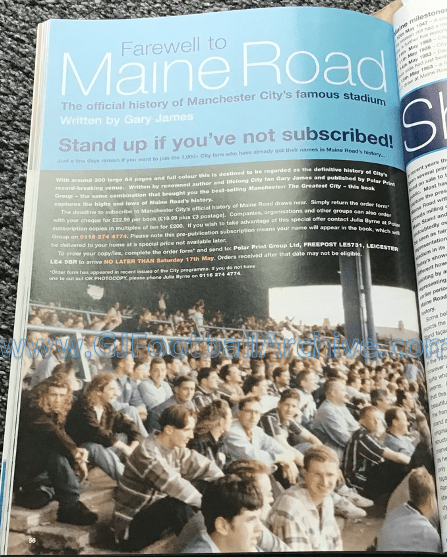
During the 2002-03 season while I was researching and writing Farewell To Maine Road, the official history of City’s grounds, I was allowed to wander around the old place for my research. Club photographer Ed Garvey often accompanied me and we’d open doors, look under seats and generally try to see things that would not always be immediately obvious on match day.

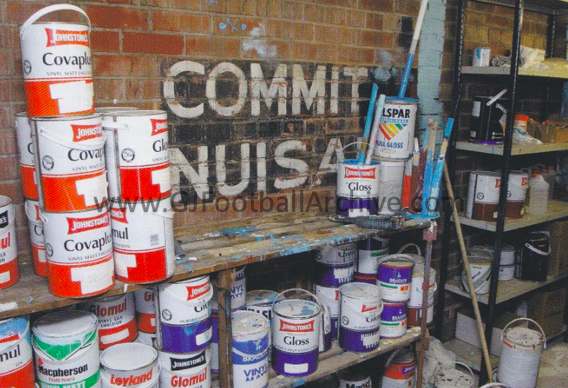
One day we were helped on to the ‘new’ Kippax roof – a scary experience! Other teams we explored the nooks and crannies of the stands. Then there was the time when a paint store room door was open. We popped our heads in and found this gem. This old ‘ghost sign’ saying ‘Commit No Nuisance’ had originally been on public view. That wall was the internal side of the large external wall that surrounded the Kippax terracing. Fans would congregate on the side we were on and the painted notice would warn them to ‘commit no nuisance’.

A few of these used to be positioned around the ground but by 2002-03 we’d assumed they’d all gone. This one survived because, at some point the club built a series of storerooms and additional toilets against this wall, trapping this specific sign for ever.

I wish we could have dismantled it and taken it for good to be re-erected at the new stadium but sadly that wasn’t possible for various reasons. At least we managed to take a photo of it and ensure a permanent record of it was kept for ever.

2023 marks the 100th anniversary of Maine Road’s first game and to commemorate this landmark moment I will be posting a different image or feature on the old stadium each day for 100 days. Day 100 will be the actual centenary of that historic first game.

If you’d like to read more on the history of Maine Road, take a look at Farewell To Maine Road, which can be downloaded from this page:

Commit No Nuisance. Photo by Ed Garvey

Sit Down Protest

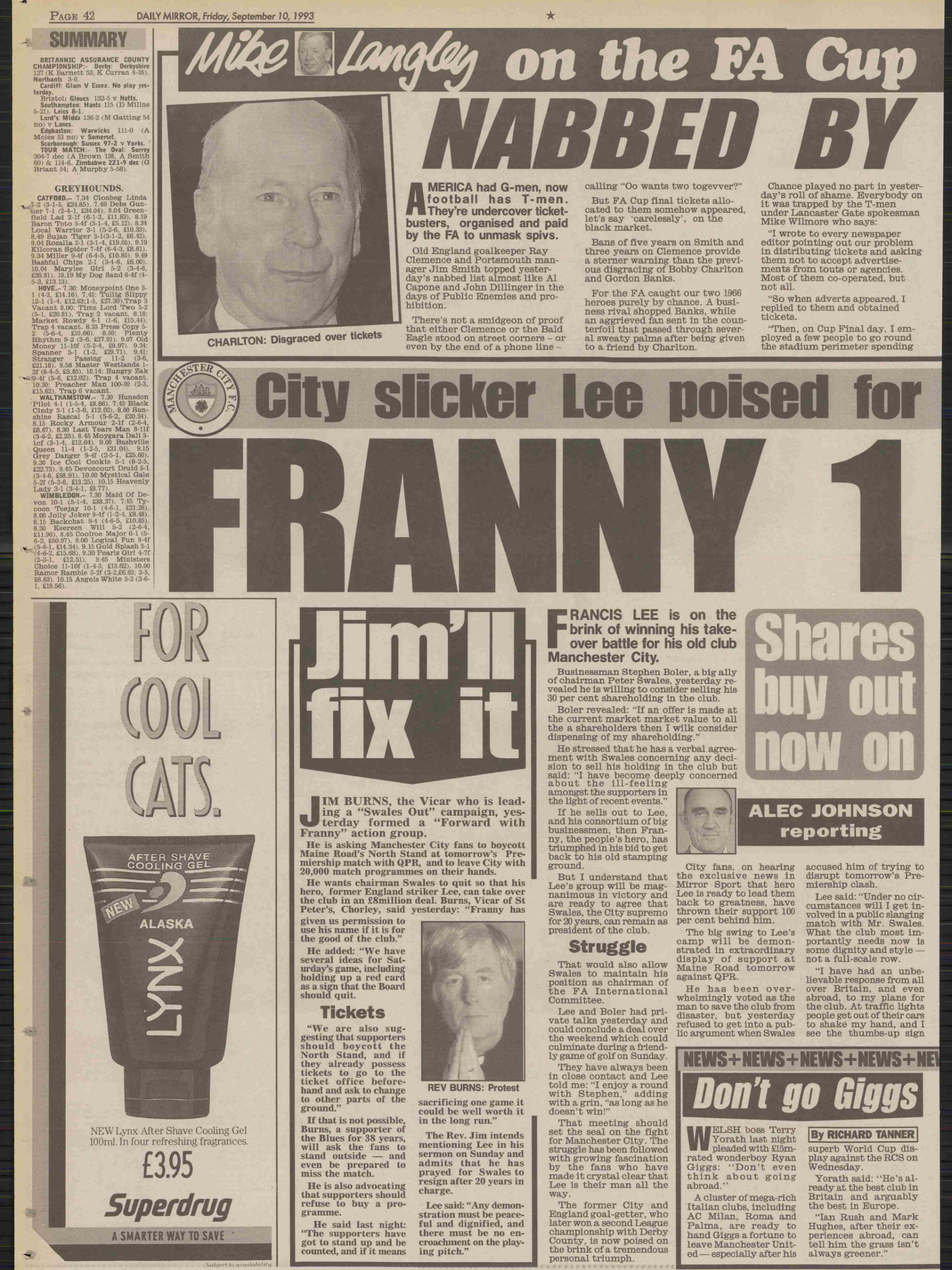
I was reminded earlier about the sit down protest against chairman Peter Swales by Manchester City fans in September 1993. Back then we used to protest a lot against Swales – in fact some of my recent research has shown that the earliest Swales Out demonstration I’ve found so far took place in 1979. They intensified over the years with 1993 being the peak. In September 1993 City’s hopes of replacing Swales as chairman increased with the news that Francis Lee was prepared to mount a takeover.

I’ll write more on this whole period soon but for the moment I wanted to highlight that one of the protests that took place during 1993-94 was a sit down protest on the Kippax. Emma Tamara Taylor took the photo of the protest and she kindly allowed me to use it alongside other great Maine Road images she’d taken in my book Farewell To Maine Road. Emma, of course, retains copyright for her photo and it cannot be reproduced without her permission.

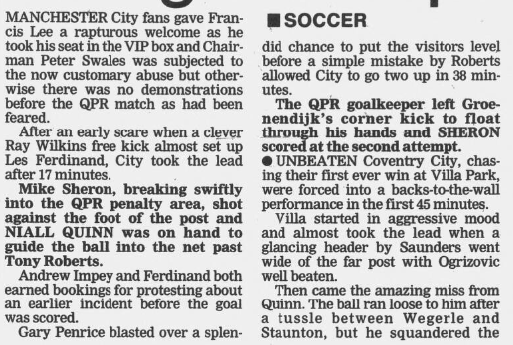
The photo was dated 11 September 1993 and I do remember well that this was a number of protests we staged though at the moment I can’t remember if this was against all-seater stadia or Peter Swales (I’ll go through my research notes over the coming weeks and will check it all out). There was also the candlelight protest on the Kippax too. The idea of these protests was that fans wanted to show their displeasure. Unfortunately protests on 11 September 1993 seemed to have passed the media by as this brief report shows:

Here’s a preview article from the Mirror which highlighted the role of the man who became known as the ‘Blue Vicar’, Jim Burns.

More on the protests, Swales out and so on in a few weeks time. Watch this space!

Subscribe to support this site

The idea of this website is to find a place for my 35 years + research into Manchester City and football across the region. By February 2023 over 800 posts (articles, interviews, talks, videos & 2 books) have been made that can be accessed by subscribers. Annual subscribers access everything posted; everything to be posted during your subscription and support my ongoing research into Manchester City and Manchester football. I am immensely grateful for that support. It costs £20 per year (about 5p a day) or there’s also a £3 per month option – see below. Thanks

Monthly Subscription

£3 per month (cancel anytime) and you get access to everything posted since 1 October 2022.

If you enjoy all the free material on my website and would like to support my research and keep this website going (but don’t want to subscribe) then why not make a one-time donation (or buy me a coffee). All support for my research is valued and welcome. It allows me to keep some free material available for all. Thanks.

Choose an amount

£2.50
£5.00
£7.50

Or enter a custom amount

£

Your contribution is appreciated.

Donate

Manchester City versus Chelsea – The story so far…

Tomorrow (5 January 2023) Manchester City play Chelsea at Stamford Bridge in the Premier League and so I thought I’d post a few connections, historical moments and memorable game details here. So here goes…

All-time Record (all first team competitions)

City wins 62, Chelsea wins 71, 39 drawn.

League – 154 played, 53 City wins, 62 Chelsea wins, 39 drawn.

FA Cup – Played 7 (there’ll be another this coming weekend!), 4 City wins, 3 Chelsea wins

League Cup – Played 4, 3 City wins, 1 Chelsea win.

Champions League – Played 1, 1 Chelsea win. You can read about that one here:

ECWC – Played 2, 2 Chelsea wins.

Full Members Cup – Played 2, 2 Chelsea wins.

Community Shield – Played 2, 2 City wins.

Game One

The first match between the sides was on 7 December 1907 in Division One.  Chelsea had been promoted the previous season, and the match ended 2-2 before a 40,000 crowd at Stamford Bridge.

Debuts

City debutants in this fixture include Rodney Marsh, whose first game was the 1-0 victory over Chelsea on 18 March 1972.  Local hero Tommy Booth netted the winner in front of 53,322.

Marsh was a high profile and expensive signing back in 1972. He was signed shortly before the transfer deadline back then. Another major signing who made his league debut v Chelsea was Robinho who joined the Blues on transfer deadline day back in 2008, marking his league debut v Chelsea with a goal that September.

On 14 November 1959 in a 1-1 draw, Alan Oakes made the first of an incredible 665 (plus 3 as substitute) appearances for the Blues – sadly he gave away a last minute penalty, but Bert Trautmann saved it!  You can read more on that game here:

A little over 30 years later Howard Kendall signing Niall Quinn marked his debut with a goal in another 1-1 draw.

Others to have made their debuts include Tosin Adarabioya, Aleix Garcia & David Faupala (scored on his debut). Those players all made their debuts in the FA Cup game on 21 February 2016. 

Television

The first City-Chelsea game to be shown on BBC TV was on 1 October 1955 at Stamford Bridge when Chelsea beat City 2-1. The commentator was Kenneth Wolstenholme. 

The first meeting of the sides to be shown on the BBC’s Match of the Day was 1 October 1966, when Tommy Docherty’s Chelsea beat City 4-1.  Chelsea’s scorers were Tambling, Baldwin, Kirkup and Osgood, while the dependable Neil Young netted for City.

The first live match was on Friday 4 May 1984 with a 7.15pm kick-off, again on BBC.  This Division Two match ended in a 2-0 victory for 2nd placed Chelsea, and the result ended City’s dreams of an immediate return to the top flight.  Chelsea clinched the title that season on goal difference from Sheffield Wednesday and the live game became noteworthy as it was the first Second Division match shown live on television.  Interestingly, the BBC recruited Bobby Charlton as their City ‘expert’ for this game.

Connections

Kevin De Bruyne (made three League appearances for Chelsea), Willy Caballero, Frank Lampard, Scott Sinclair, George Weah, Shaun Wright-Phillips, Nicolas Anelka, Wayne Bridge, Danny Granville, David Rocastle, Gordon Davies, Clive Allen, Clive Wilson, Terry Phelan, and Colin Viljoen are some of the players to have appeared for both clubs.  Further back amateur Max Woosnam had appeared for first Chelsea then City.  He was City’s captain for a while, and was given the honour of captaining the Blues in their first match at Maine Road.  A good all-round sportsman, Woosnam was a Wimbledon doubles champion, and Olympic gold medallist.  He also captained England.

Highest Attendances

The top five attendances for this fixture are:

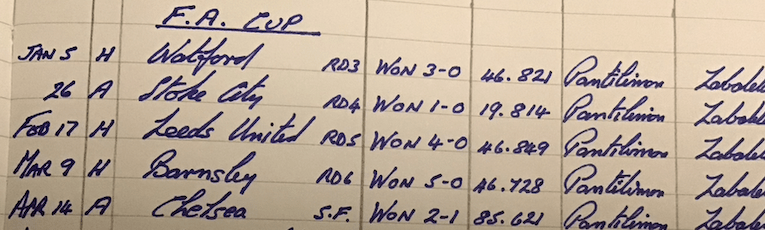
85,621 – FA Cup semi final, 14 April 2013, City 2 Chelsea 1 

81,775 – 2019 League Cup final, 0-0 City won 4-3 on penalties

72,724 – 2018 Community Shield, City 2 Chelsea 0

68,000 – The highest crowd for this fixture at the old Wembley; the 1986 Full Members’ Cup Final.  

64,396 – 26 March 1948 meeting at Stamford Bridge; a 2-2- draw.

The top five attendances for City V Chelsea at the Etihad are: 54,486 on 23 November 2019; 54,457 on 3 December 2016; 54,452 on 10 February 2019; 54,331 on 16 August 2015 and 54,328 on 4 March 2018. A reduction in capacity at the Etihad means that games from 2021 onwards cannot better these figures.

The highest attendance for City V Chelsea at Maine Road was 53,322 on 18th March 1972. 

Wembley ‘86

The only game between the two sides at the old Wembley Stadium was the inaugural Full Members’ Cup Final in 1986.  Despite taking the lead in the eighth minute, City were losing 5-1 with only five minutes left.  A Mark Lillis inspired fightback followed and he helped City achieve a 5-4 scoreline, before time ran out.  It was a thrilling match and it also helped David Speedie enter the record books.  His hat-trick was the first in a senior domestic final at Wembley since Stan Mortensen in 1953.

You can read about that one here:

Kippax First and Last

City’s first & last games in front of the Kippax Stand were both against Chelsea. The first came on 5 September 1957. City won that game 5-2 (goals from Colin Barlow 2, Fionan ‘Paddy’ Fagan 2 and Billy McAdams), attendance 27,943. The second was on 20 April 1994 – a 2-2 draw (City goals from Uwe Rosler and Paul Walsh), attendance 33,594.

Did You Know?

The two Second Division matches between the sides in 1927-8 were watched by a total of 104,643.  That season City, despite being a Second Division club, had the highest average attendance of all the clubs in the Football League.

Well I Never!

The last match of the 1993-4 season was the last played in front of the old Kippax Stand.  At the time, the Kippax was the largest capacity terraced stand in the country, and Chelsea supporters (dressed as Blues Brothers) laid a wreath in front of the famous old stand.  It was a gesture much appreciated by City fans.  The game ended 2-2 and afterwards supporters hacked off pieces of the old terracing.  Even the old “Colin Bell Bar” Sign was seen being taken towards the city centre after the match!

Feature Match

My feature match is noteworthy as it was played at a time when the Blues were suffering heavy fixture congestion, and squad rotation was still something for the future.

The match is the first leg of the 1970-1 ECWC semi-final.  City were cup holders, while Chelsea had qualified after beating Leeds in the FA Cup Final replay at Old Trafford played on the same night as City’s ECWC final in April 1970.

Malcolm Allison was banned from all football activity by the FA, leaving Joe Mercer in total control.  Joe always believed the strongest team possible should play.  He didn’t hold with the view that players should be saved for the important matches and, although his belief that every team should always field their strongest side was fair and just, in 1971 it was to cost the Blues dearly.  During a relatively meaningless 4 League fixtures over the Easter period injuries piled up.  By the time of the ECWC game Summerbee, Pardoe, Oakes, Heslop, Bell, and Doyle – all crucial players – were on the injury list, causing Joe to play a team of inexperience in the most crucial match of the season.  Shortly before kick off at Stamford Bridge he solemnly told the press his team and then said:  “And may God bless this ship and all who sail in her.”

Despite their naivety, Mercer’s Minors put in a good performance.  Goalkeeper Joe Corrigan, who played the game with his left eye half-closed through injury, was in exceptional form.  Dave Sexton’s Chelsea surged forward in the opening minutes, but Corrigan kept them at bay.  Gradually, the confidence of City’s inexperienced side increased, and at half-time they entered the dressing room still level.

Sadly, a minute into the second half Tony Towers was unable to intercept a cross from Chelsea’s Keith Weller to David Webb, and a mistake by Tommy Booth allowed Derek Smethurst to score for the home side.  It was the only mistake City made all night, and the game ended 1-0.  Joe was proud of his players, and looked forward to the return.

Sadly, others (Booth and Corrigan) were missing for the second match – played only 48 hours after a gruelling 2-2 draw against Liverpool.  Again Chelsea won 1-0, this time the replacement ‘keeper, Ron Healey, turned an inswinging free kick from Weller into his own net.

City’s dream of becoming the first side to retain the trophy ended – a feat no club ever managed to do – while Chelsea went on to beat Real Madrid in the final.

The 1970-1 season had also seen a ferocious boardroom battle tear the club apart, and for the first time had caused friction between Mercer and Allison.  A year later the partnership ended for good.

Stats:  ECWC Semi-Final first leg 14 April 1971

Chelsea 1 City 0

Scorers – Chelsea: Smethurst

City: Corrigan, Book, Connor, Towers, Booth, Donachie, Johnson, Hill, Lee, Young, Mann

Attendance: 45,955 

If you have enjoyed this article then feel free to use the search field or Category selection below to find other articles. Some content is free to read while others are for subscribers only.

Subscribe to get access

If you have enjoyed this free post and would like to support my research and writing then please subscribe. Annual subscribers (£20 per year, sign up here) get access to everything posted on the site including PDFs of 2 of my out of print books and archived content like my exclusive audio interviews with John Bond, Malcolm Allison etc. Not only that but you’ll be helping to support this site’s development.

Subscribe to get access

If you have enjoyed this free post and would like to support my research and writing then please subscribe. Monthly subscribers (£3 per month, sign up here) get access to everything posted on the site since 1 October 2022. Not only that but you’ll be helping to support this site’s development.
Manchester City in the Early 1990s

We hear so much about the Premier League era and how the game has changed, so for today’s feature I’ve decided to take a look at the early 1990s and the birth of the Premier League. It’s almost thirty years since the structure of league football changed forever and during that time some clubs have benefitted from the new structure and others have found life difficult. City have experienced both extremes of course.

The narrative that we often hear about the Blues’ journey over the last thirty years is that they’ve gone from a struggling club to a hugely successful one and, while it is true City are highly successful today and that the Blues entered their lowest ever point in the late 1990s, it is wrong to assume that the position the club found itself in by 1999 was typical of the club’s full history. 

So, here for subscribers, I’m taking a look back at the early 1990s and remind ourselves where the Blues were; who their rivals were; and the state of football at that time:

Subscribe to get access

Read more of this content when you subscribe today. It costs £3 per month (cancel anytime) or £20 a year. Throughout your subscription you can access ALL content on this site. Have a search to see what’s included.