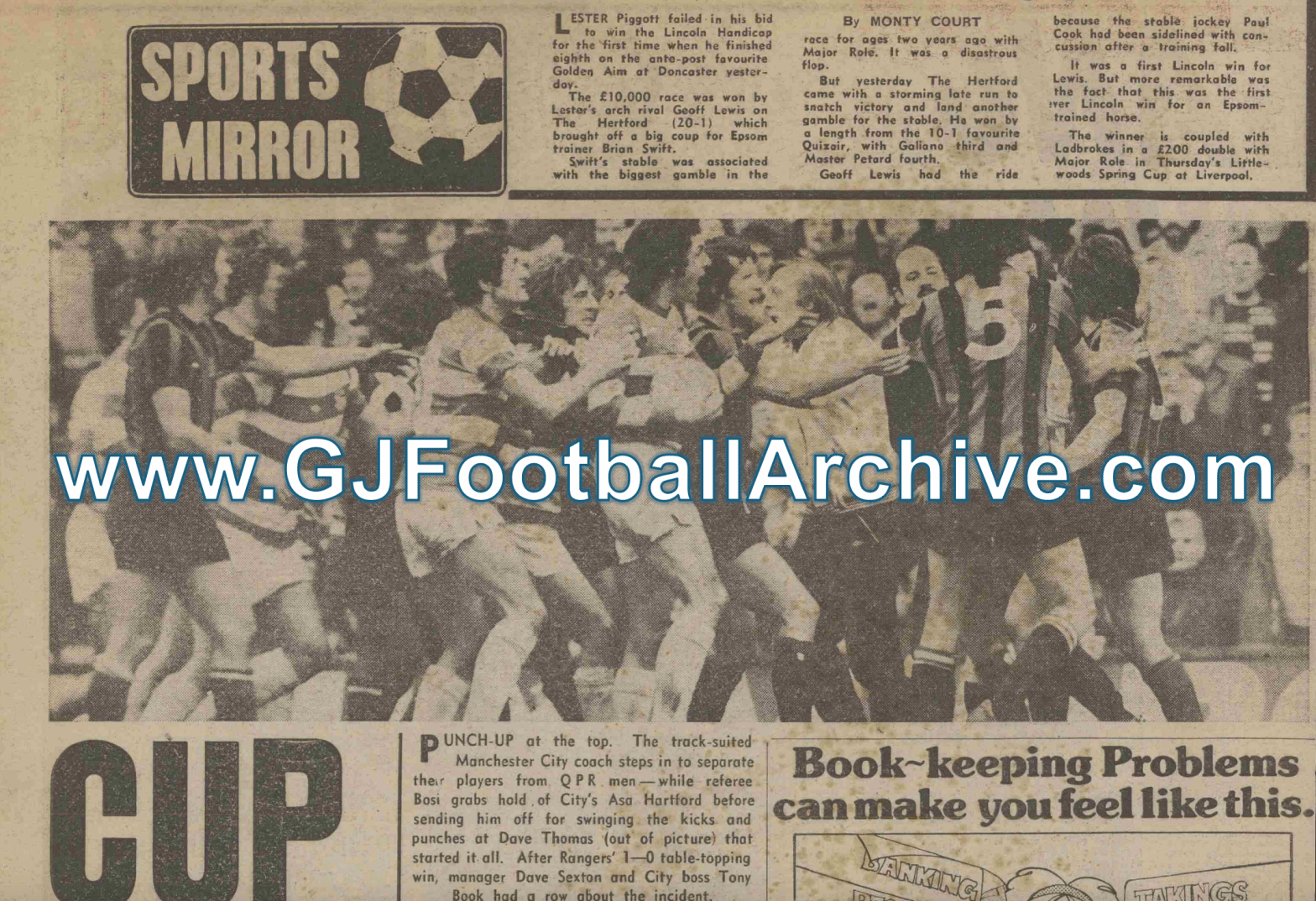
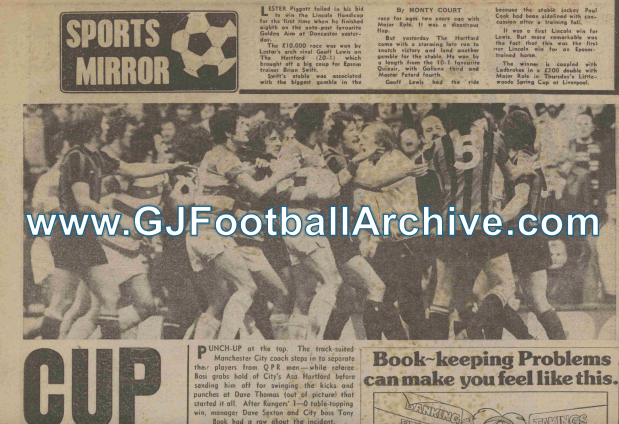
A hugely controversial away game at QPR on this day (27 March) in 1976 brought unsavoury headlines. Manchester City lost 1-0 to an 81st minute goal to the League leaders but that wasn’t the real issue this day, it was the extremely negative way the London club played. This all led to a controversial incident following an Asa Hartford tackle. The Belfast Newsletter reported: ‘The already tattered disciplinary reputation of the League leaders took another knock in the game with Manchester City at Loftus Road… In the 75th minute City’s Asa Hartford went in to tackle with foot held high, and Wolverhampton referee Terry Bosi immediately whistled for a foul. He was talking to Hartford when Thomas, not concerned in the original incident, ran a dozen yards to attack the City player from behind and pull his hair. Hartford retaliated with a blow, and within seconds other players were involved.’
Hartford was sent off much to the dismay of City fans, staff and most neutral journalists. The Sunday Express reported: ‘Don Masson kicked Hartford and Dave Thomas aimed a punch… the Rangers pair were lucky to escape without even a booking.’
After the game the rival managers, Tony Book and Dave Sexton, publicly argued in front of journalists about the physical nature of QPR and Hartford’s sending off.
The suspension of Hartford and an injury to Dave Watson led to selection issues for the away game at Stoke the following Friday. In the end a magnificent performance from youngster Paul Power was rightly praised in a goalless draw seen as a positive result in the circumstances.
Five days later a third successive away game saw City lose 2-1 to Bobby Robson’s Ipswich Town. Ipswich opened the scoring four minutes before half time, with Ged Keegan equalising in the 47th minute. Eleven minutes later Ipswich scored their winner and their pressure from then on disrupted every opportunity City had to search for an equaliser.
One point from three games led to Tony Book taking a decision that would excite the Maine Road faithful: Colin Bell was to return for the following game.
You can read more on the 1975-76 season with this 5,320 word article – a season which saw Tony Book guide the club to major success. If you want to know more on this incredible decade for Manchester City Football Club then why not subscribe and read it all? You could even subscribe for a month and see what you think. The following 5,320 word article is on the 1975-76 season and is available to subscribers below. Enjoy!
Subscribe to get access – Monthly
Read more of this content when you subscribe today. It costs £3 per month (cancel anytime) to access everything posted since 1 October 2022 or there’s a special annual rate below which gives greater access and works out much cheaper.
Read more of this content when you subscribe today. It costs £3 per month (above) or £20 a year (here) to access everything posted since the site was created in December 2020. This special rate works out about £1.67 a week and gives access to everything posted, including PDFs of 3 of my books.
If you enjoy all the free material on my website and would like to support my research and keep this website going (but don’t want to subscribe) then why not make a one-time donation (or buy me a coffee). All support for my research is valued and welcome. It allows me to keep some free material available for all. Thanks.
If you enjoy all the free material on my website and would like to support my research and keep this website going (but don’t want to subscribe) then why not make a one-time donation (or buy me a coffee). All support for my research is valued and welcome. It allows me to keep some free material available for all. Thanks.
On 27 January 2002 Manchester City’s fourth round FA Cup tie at Ipswich saw Kevin Keegan’s side thrill live on TV. City impressed the nation with their spectacular 4-1 fourth round cup demolition of Premier League side Ipswich Town. It is worth remembering that City were in the second tier at the time, hoping for promotion. Many of us felt that the Blues were not only good enough to find success in the League but also stood a genuine chance of FA Cup success (mind you, some of us felt that every season – nine years later it finally happened!).
The City scorers against Ipswich were Eyal Berkovic, Shaun Goater (2) and Darren Huckerby.
After the Ipswich match Keegan said: “Our fans know we can play but I think we showed the rest of the country that we are a good team. I believe the FA Cup needed a game like our tie with Ipswich where the atmosphere was tremendous and both sides picked their strongest available sides and really set out to win.”
In the fifth round, Keegan’s Blues travelled to Newcastle for another thrilling performance against the manager’s old club. The media hype focused on Keegan, but the match ended with national recognition that the Blues were clearly a force. Although City lost the match 1-0 after Richard Dunne had been sent off, the general view was that ten-man City were more than a match for the Geordies. City impressed the nation once again.
The Newcastle tie, like the Ipswich game, came at a time when many were questioning the status of the FA Cup. City’s performance in both ties were seen as major boosts for the competition. According to Henry Winter of the Daily Telegraph: “Keegan returned with his magnificent Manchester City side whose spirited, defiant football sent the heart rate soaring among Newcastle’s nervy support. Making light of Richard Dunne’s dismissal and Nolberto Solano’s goal, City scared the black-and-white life out of those who still cherish Keegan’s name. Shaun Wright-Phillips was marvellous, Eyal Berkovic and Kevin Horlock not far behind with outstanding displays as City narrowly lost a Cup-tie but won countless admirers. If they build on this, they will surely keep the Blue Moon rising and head back to the Premiership, where their noisy supporters belong.”
Manchester City’s owner Sheikh Mansour has bought the oldest surviving FA Cup trophy at auction. The trophy, which was the first major trophy won by Bury, City and United, will be on display at the National Football Museum. To understand more of that trophy’s significance to Manchester check out my earlier posts:
It’s Tony Book’s funeral today and, all being well, I intend being there. Tony was one of the most important figures in the entire history of Manchester City and deserves to be remembered for ever more. Please spare a moment today to think of him. Over the years I met and interviewed Tony on many occasions. I last spoke with him at the MCFC Former Players Dinner earlier this season. As a tribute to him I’m posting here an interview I did with him back in May 2015 (I’ve posted this before but think it’s an appropriate moment to post it again). It wasn’t the first interview I did with him (that was in 1992 about Joe Mercer), but it is a reflective piece with Tony talking about his career.
I always think it’s important when someone passes away to use their words where possible to talk about their career. You can read it below. I’ve posted this exactly as it was written and published in 2015 so, obviously, references are to that era and before.
TALKING CITY WITH GARY JAMES
Tony Book joined City in 1966 and went on to become manager, winning the League Cup in 1976.
Let’s start with your birth certificate and the story that this was altered to give the impression you were a bit younger when signing. Is this true?
Ah, it’s true, but I didn’t actually alter it. My birth certificate had been folded with a heavy crease down it, and I needed it when I was moving from Bath to join Plymouth where Malcolm Allison was the manager. He told them I was 28 but I was 30. Luckily, when I opened out my birth certificate the fold had meant that the final number in the year wasn’t clear, so they just took Malcolm’s word for it! When I came here in 1966 I was 32 – for real – and we never hid my age.
It’s a good job, otherwise you’d have been celebrating your 80th two years late! When you signed for City Malcolm had to persuade Joe Mercer to ignore your age didn’t he?
Yes. Joe was a similar age when he joined Arsenal, as you know Gary, and Malcolm said “look at what you did at Arsenal Joe” – he captained them to a couple of League titles and the FA Cup. Little did we realise that something similar would happen to me at City. I always wanted to be a full time professional footballer and Malcolm gave me the chance. I went playing in Toronto – it was the first time I’d trained in the day because I was a bricklayer by trade and had to train at night back home – before Plymouth and Malcolm came and talked with me after I’d played against a team of Italians over there. He told me how much he liked my play and, well, after that he signed me for Plymouth and then City. I was always grateful to Malcolm, but joining City was perfect. The club under Joe and Malcolm was about to take off and I recognised as soon as I got here that there was a good nucleus of young lads who were ready. Doyle, Pardoe, Oakes, Dowd, Young… the list goes on. I came in just after they’d got promoted and everything felt right. I made my debut at Southampton on 20 August 1966 and, although that match ended goalless, it was clear those lads were enjoying their football. Of course, Summerbee and Bell had been added and then Francis came in October 1967. That’s when we really took off.
Tony Book 1969
How did it feel to be made captain of this team?
When Johnny Crossan left I was made captain because of my experience in football, not because of experience at the highest level because I didn’t have that. But what I did know was football and the way a team operates. I came to professional football late, but back then non-league teams did have quite a few former League players. Some actually gave up League careers because, in the end, they could earn more in non-League and regular employment. I always felt I had something to offer the younger guys because of that experience.
Being totally honest, what did you feel you’d do at City? Did you think you’d be there for as long as you were?
I hoped I’d get a couple of years. That’s all I felt I could get and I would have been very happy with two years at Manchester City, of course. Back then City owned some club houses and I went in one – paying about £2.50 a week! Because of what happened and the way the success came in my second year, Gary, I felt I could go on again. Winning the League in 1968 was like a spark and I wanted to keep the flame going.
Thinking about the title winning season of 1967-68, there were quite a few standout games. What are your memories of those?
There was the Spurs game at Christmas when we sharpened our studs to keep a grip on the surface and we really played a graceful, stylish game. There was the derby at Old Trafford when I made a mistake. I was playing the sweeper role, I let the ball bounce, and George Best went through and stuck it right in the net in the first minute! I couldn’t believe it and the lads lifted me and, Gary, we went on to play a brilliant game. We won 3-1 and that set us on course, but we still had nine games to play. None of us had ever won a major trophy, but Malcolm and Joe were brilliant during that period. Malcolm was great at relaxing us and there was never a doubt in his mind, and then in our minds, that we wouldn’t win it. We believed in ourselves and with Colin Bell, Mike Summerbee and Francis Lee we knew we had that something special that champions need. I always felt that if we went behind one of those three would get us out of trouble. We had a great team throughout of course, and we complimented each other well across the park. We all knew our roles.
After winning the League you suffered an Achilles injury, did you think that was the end?
No, but I was desperate to get back. I tried everything. My leg was in plaster and as soon as they took it off I tried. I played in a reserve game and Sidney Rose, the doctor who was also a director, saw me struggle. I felt it go again. He stuck a needle in me and I had to rest. In the end I went to Christie’s, had a shot of radium, and that seemed to take the sting out of it all. I don’t know whether that was the right treatment or not, but I began training and came back to the first team in January.
Clearly, losing your influential captain for such a large period of the season had its effect on City in the League and in their first European Cup campaign, but once you returned you guided City to FA Cup success. Was this another fairytale season for you?
I guess it was because winning the FA Cup was amazing. It was important for us to keep our success going and the FA Cup was viewed as something special, but I have to tell you Gary, that now, when I look back, I realise that we were not consistent in our challenge for the League. We consistently challenged for trophies, but not in the League. Today, we have such a wonderful team that has been able to challenge for the League season after season, but back then we were more inconsistent. We had good days and bad days, but almost any team in the division could challenge back then. There were no easy games. In 1969 I also shared the FWA player of the year with Dave Mackay, so it was a good season. People had suggested I’d win it the year before because I’d played every game and we’d won the League. I was getting a lot of praise but George Best won it that year. So, the year I won it, it was a surprise. A great feeling and I remember being at the award dinner. For me though, it was an achievement for the entire team. You need a good team around you to win awards like these, and we certainly had a great team.
What are your memories of City in Europe during that time?
There was Malcolm’s boast about scaring Europe which set us up, but then in the ECWC 1969-70 we did. The final is the strongest memory but mostly because of the rain. We had a great following of fans, but few locals and Gornik fans were there, and they were all drenched. I felt so sorry for them. We won the cup, of course, and that season we’d also won the League Cup. I wanted to go on forever by that time. I was enjoying it and those two years became four and I was 36. I couldn’t wait for the next season. I was like an 18 year old who had just been given his chance.
1971 ECWC v Chelsea. Tony Book and mascot Paul Todd. Photo by Alan Jubb
Is there anything from your playing career that you would change if you could?
Ah, yes. I gave the referee an elbow at Ipswich! He’d disallowed a goal. At Ipswich, you had to go down a corridor as you went in at half time and as I turned I deliberately elbowed him. He went down. I was called to an FA disciplinary meeting and the first question they asked was “would you like your past record to be taken into consideration?” Well, I’d only been a pro for a couple of years so I said yes, thinking it’ll be great. They then brought out information going years back from my non-league days and it all worked against me!
When it came time to retire from playing, was that your choice?
No. Johnny Hart had been manager but was ill and Peter Swales asked me to take over on a temporary basis in October 1973. I managed the team for about five weeks until Ron Saunders came in and he had a chat with me suggesting I was needed more as a coach/assistant than a player. I wish now I’d said I wanted to finish playing at the end of the season because I think that would have helped him more. There were issues between him and some of the playing squad and I think I could have helped him, had I been a player. He was insistent though.
Ron Saunders, Peter Swales and Tony Book at Saunders appointment in November 1973
It’s a shame because we got to the League Cup final (1974) and with you in that team, maybe things would have gone differently. Saunders didn’t last as manager and was gone in April that year. How did you feel?
You see things happening but are unable to change it. It was tough. I ended up being given the manager’s job and it was a strange period because we’d had turmoil over that season. I also had to start looking at my pals, the players I had won trophies with, and explain that they needed to move on. I didn’t want to do that and I found it very hard. Awful!
As a manager I was proud that in the five years that followed we won the League Cup, finished runners up by a point to Liverpool, and we were in Europe for three consecutive seasons. I had some good players that came in – Dave Watson, Brian Kidd, Asa Hartford – and did an excellent job for me. I felt we were on our way.
From the moment you took on the job it was progress all the way through and, just before Malcolm returned as ‘coaching overlord’ in January 1979, we had reached the UEFA Cup quarter finals. What was it that made you a success in that role?
The players. It’s always about the players you manage to sign and what they do for you. I was more like Joe Mercer as a manager and had good coaches working with me. Bill Taylor was recommended to me by Don Revie and he was a great coach.
Tony Book, Peter Swales and Kaziu Deyna at Deyna’s signing for Manchester City
City may not have won many trophies during your spell as manager, but we came close, had some great players and, significantly, this was an exciting period to watch. Then Malcolm came back. Did you welcome the return?
Malcolm is such an important figure in my life that I cannot say anything but positives about him as a man. I will always be indebted to him. But I knew that it couldn’t work when he came back. I knew the chairman, I knew Malcolm, and I knew how they both worked. There was no way they would have been able to work together. It was as simple as that. That’s what the main difference was between the 60s and 1979. In the 60s we had Albert Alexander as chairman who worked wonderfully with Joe and Malcolm, but it was different in 1979. It was such a shame, because I thought we were going somewhere.
Silkman, Allison & Book after Peter Barnes scored v Tottenham 3 February 1979
On a day to day basis, what was it like working during that period?
It varied but there were players like Gary Owen and Peter Barnes who I felt had a lot to offer, but they were moved on. It’s difficult to go through it all, but as we know it failed and we were dismissed in October 1980. I stayed briefly and then became Cardiff manager. I missed Manchester but was delighted that under John Bond that season ended with the FA Cup final against Spurs. I got a phone call from John Bond asking me back to City to look after the youth team and I said I’d think about it. In the meantime there was the FA Cup final and as it was the 100th final they invited all surviving captains of cup winning sides. Myself, Roy Paul, and Joe Mercer (Arsenal) were on the pitch with the others and all of a sudden they announced my name and the City fans erupted into song. It really got to me, emotionally, and I knew I had to come back. It was one of the best feelings I ever had. Returning to City was the right thing and I had a wonderful time working with Ken Barnes, Glyn Pardoe and all those talented young lads. We won the Youth Cup in 1986 and it was a real pleasure being there at the start of so many careers.
This year I’ve interviewed quite a few of the players who had progressed through the youth team while you were there. Every one of them has talked with affection about your approach, driving them on. I think it’s amazing really that your influence has been there at City year after year since 1966. How does it make you feel to have had three great distinct careers at the club?
I love this club and am grateful to all those who brought me here and involved me for so long. Whenever I’ve been given a job to do I’ve always tried to give my best. When it all came to an end in the 90s it hit me hard and there were issues that were well documented, but since then Francis Lee and I have resolved our differences. Actually, I think it says something that so many of our former players come to games these days, and all of those players from that Mercer-Allison team are so proud of how this club is challenging once more. We’re enjoying the success and the consistency season after season. Having said that I loved my days as a player and would never swap them… I would have loved us to have these pitches though. They’re perfect. How great would the likes of Colin Bell have been on these surfaces?
If you enjoy all the free material on my website and would like to support my research and keep this website going (but don’t want to subscribe) then why not make a one-time donation (or buy me a coffee). All support for my research is valued and welcome. It allows me to keep some free material available for all. Thanks.
The February 1994 (on this day in 1994) meeting between the two clubs made the headlines as it heralded the dawn of the Francis Lee era at Maine Road and, not for the first time that season, much of the focus was on off-field activities. Nevertheless the game itself was an extremely pleasing from a City perspective. It commenced in typical City big match style – Garry Flitcroft’s attempted back pass ended up gifting Ian Marshall, the former Oldham player, a rather simple opportunity to score!
Fortunately, City didn’t give up. David Rocastle, who had joined City from Leeds in a £1 million exchange for the out of form David White in December, had quickly established himself as an important member of Brian Horton’s side. Many saw him as a great addition to the Blue cause, and this match proved to be his greatest as he clearly helped City attack Ipswich. At one point he cut through two defenders, charged to the goal-line and sent over a superb cross for Carl Griffiths to flick in a great goal. Afterwards the new Chairman claimed Rocastle possessed Brazilian-style skill and few argued.
The goal brought more confidence and with Michel Vonk defending superbly, and Steve Lomas controlling midfield, the Blues dominated. Terry Phelan attempted an overhead shot, before a foul on Lomas brought a free kick. Keith Curle took it and Vonk knocked it down for Garry Flitcroft to touch in the winning goal.
That night City fans celebrated their first League victory since 8th December. They ended the season in16th place while Ipswich finished 19th (one point above the relegation zone).
If you enjoy all the free material on my website and would like to support my research and keep this website going (but don’t want to subscribe) then why not make a one-time donation (or buy me a coffee). All support for my research is valued and welcome. It allows me to keep some free material available for all. Thanks.
Over the years I met and interviewed Tony Book on many occasions. I last spoke with him at the MCFC Former Players Dinner earlier this season. As a tribute to him I’m posting here an interview I did with him back in May 2015. It wasn’t the first interview I did with him (that was in 1992 about Joe Mercer), but it is a reflective piece with Tony talking about his career. I always think it’s important when someone passes away to use their words where possible to talk about their career. You can read it below.
I’ve posted this exactly as it was written and published in 2015 so, obviously, references are to that era and before.
TALKING CITY WITH GARY JAMES
Tony Book joined City in 1966 and went on to become manager, winning the League Cup in 1976.
Let’s start with your birth certificate and the story that this was altered to give the impression you were a bit younger when signing. Is this true?
Ah, it’s true, but I didn’t actually alter it. My birth certificate had been folded with a heavy crease down it, and I needed it when I was moving from Bath to join Plymouth where Malcolm Allison was the manager. He told them I was 28 but I was 30. Luckily, when I opened out my birth certificate the fold had meant that the final number in the year wasn’t clear, so they just took Malcolm’s word for it! When I came here in 1966 I was 32 – for real – and we never hid my age.
It’s a good job, otherwise you’d have been celebrating your 80th two years late! When you signed for City Malcolm had to persuade Joe Mercer to ignore your age didn’t he?
Yes. Joe was a similar age when he joined Arsenal, as you know Gary, and Malcolm said “look at what you did at Arsenal Joe” – he captained them to a couple of League titles and the FA Cup. Little did we realise that something similar would happen to me at City. I always wanted to be a full time professional footballer and Malcolm gave me the chance. I went playing in Toronto – it was the first time I’d trained in the day because I was a bricklayer by trade and had to train at night back home – before Plymouth and Malcolm came and talked with me after I’d played against a team of Italians over there. He told me how much he liked my play and, well, after that he signed me for Plymouth and then City. I was always grateful to Malcolm, but joining City was perfect. The club under Joe and Malcolm was about to take off and I recognised as soon as I got here that there was a good nucleus of young lads who were ready. Doyle, Pardoe, Oakes, Dowd, Young… the list goes on. I came in just after they’d got promoted and everything felt right. I made my debut at Southampton on 20 August 1966 and, although that match ended goalless, it was clear those lads were enjoying their football. Of course, Summerbee and Bell had been added and then Francis came in October 1967. That’s when we really took off.
Tony Book 1969
How did it feel to be made captain of this team?
When Johnny Crossan left I was made captain because of my experience in football, not because of experience at the highest level because I didn’t have that. But what I did know was football and the way a team operates. I came to professional football late, but back then non-league teams did have quite a few former League players. Some actually gave up League careers because, in the end, they could earn more in non-League and regular employment. I always felt I had something to offer the younger guys because of that experience.
Being totally honest, what did you feel you’d do at City? Did you think you’d be there for as long as you were?
I hoped I’d get a couple of years. That’s all I felt I could get and I would have been very happy with two years at Manchester City, of course. Back then City owned some club houses and I went in one – paying about £2.50 a week! Because of what happened and the way the success came in my second year, Gary, I felt I could go on again. Winning the League in 1968 was like a spark and I wanted to keep the flame going.
Thinking about the title winning season of 1967-68, there were quite a few standout games. What are your memories of those?
There was the Spurs game at Christmas when we sharpened our studs to keep a grip on the surface and we really played a graceful, stylish game. There was the derby at Old Trafford when I made a mistake. I was playing the sweeper role, I let the ball bounce, and George Best went through and stuck it right in the net in the first minute! I couldn’t believe it and the lads lifted me and, Gary, we went on to play a brilliant game. We won 3-1 and that set us on course, but we still had nine games to play. None of us had ever won a major trophy, but Malcolm and Joe were brilliant during that period. Malcolm was great at relaxing us and there was never a doubt in his mind, and then in our minds, that we wouldn’t win it. We believed in ourselves and with Colin Bell, Mike Summerbee and Francis Lee we knew we had that something special that champions need. I always felt that if we went behind one of those three would get us out of trouble. We had a great team throughout of course, and we complimented each other well across the park. We all knew our roles.
After winning the League you suffered an Achilles injury, did you think that was the end?
No, but I was desperate to get back. I tried everything. My leg was in plaster and as soon as they took it off I tried. I played in a reserve game and Sidney Rose, the doctor who was also a director, saw me struggle. I felt it go again. He stuck a needle in me and I had to rest. In the end I went to Christie’s, had a shot of radium, and that seemed to take the sting out of it all. I don’t know whether that was the right treatment or not, but I began training and came back to the first team in January.
Clearly, losing your influential captain for such a large period of the season had its effect on City in the League and in their first European Cup campaign, but once you returned you guided City to FA Cup success. Was this another fairytale season for you?
I guess it was because winning the FA Cup was amazing. It was important for us to keep our success going and the FA Cup was viewed as something special, but I have to tell you Gary, that now, when I look back, I realise that we were not consistent in our challenge for the League. We consistently challenged for trophies, but not in the League. Today, we have such a wonderful team that has been able to challenge for the League season after season, but back then we were more inconsistent. We had good days and bad days, but almost any team in the division could challenge back then. There were no easy games. In 1969 I also shared the FWA player of the year with Dave Mackay, so it was a good season. People had suggested I’d win it the year before because I’d played every game and we’d won the League. I was getting a lot of praise but George Best won it that year. So, the year I won it, it was a surprise. A great feeling and I remember being at the award dinner. For me though, it was an achievement for the entire team. You need a good team around you to win awards like these, and we certainly had a great team.
What are your memories of City in Europe during that time?
There was Malcolm’s boast about scaring Europe which set us up, but then in the ECWC 1969-70 we did. The final is the strongest memory but mostly because of the rain. We had a great following of fans, but few locals and Gornik fans were there, and they were all drenched. I felt so sorry for them. We won the cup, of course, and that season we’d also won the League Cup. I wanted to go on forever by that time. I was enjoying it and those two years became four and I was 36. I couldn’t wait for the next season. I was like an 18 year old who had just been given his chance.
1971 ECWC v Chelsea. Tony Book and mascot Paul Todd. Photo by Alan Jubb
Is there anything from your playing career that you would change if you could?
Ah, yes. I gave the referee an elbow at Ipswich! He’d disallowed a goal. At Ipswich, you had to go down a corridor as you went in at half time and as I turned I deliberately elbowed him. He went down. I was called to an FA disciplinary meeting and the first question they asked was “would you like your past record to be taken into consideration?” Well, I’d only been a pro for a couple of years so I said yes, thinking it’ll be great. They then brought out information going years back from my non-league days and it all worked against me!
When it came time to retire from playing, was that your choice?
No. Johnny Hart had been manager but was ill and Peter Swales asked me to take over on a temporary basis in October 1973. I managed the team for about five weeks until Ron Saunders came in and he had a chat with me suggesting I was needed more as a coach/assistant than a player. I wish now I’d said I wanted to finish playing at the end of the season because I think that would have helped him more. There were issues between him and some of the playing squad and I think I could have helped him, had I been a player. He was insistent though.
Ron Saunders, Peter Swales and Tony Book at Saunders appointment in November 1973
It’s a shame because we got to the League Cup final (1974) and with you in that team, maybe things would have gone differently. Saunders didn’t last as manager and was gone in April that year. How did you feel?
You see things happening but are unable to change it. It was tough. I ended up being given the manager’s job and it was a strange period because we’d had turmoil over that season. I also had to start looking at my pals, the players I had won trophies with, and explain that they needed to move on. I didn’t want to do that and I found it very hard. Awful!
As a manager I was proud that in the five years that followed we won the League Cup, finished runners up by a point to Liverpool, and we were in Europe for three consecutive seasons. I had some good players that came in – Dave Watson, Brian Kidd, Asa Hartford – and did an excellent job for me. I felt we were on our way.
From the moment you took on the job it was progress all the way through and, just before Malcolm returned as ‘coaching overlord’ in January 1979, we had reached the UEFA Cup quarter finals. What was it that made you a success in that role?
The players. It’s always about the players you manage to sign and what they do for you. I was more like Joe Mercer as a manager and had good coaches working with me. Bill Taylor was recommended to me by Don Revie and he was a great coach.
Tony Book, Peter Swales and Kaziu Deyna at Deyna’s signing for Manchester City
City may not have won many trophies during your spell as manager, but we came close, had some great players and, significantly, this was an exciting period to watch. Then Malcolm came back. Did you welcome the return?
Malcolm is such an important figure in my life that I cannot say anything but positives about him as a man. I will always be indebted to him. But I knew that it couldn’t work when he came back. I knew the chairman, I knew Malcolm, and I knew how they both worked. There was no way they would have been able to work together. It was as simple as that. That’s what the main difference was between the 60s and 1979. In the 60s we had Albert Alexander as chairman who worked wonderfully with Joe and Malcolm, but it was different in 1979. It was such a shame, because I thought we were going somewhere.
Silkman, Allison & Book after Peter Barnes scored v Tottenham 3 February 1979
On a day to day basis, what was it like working during that period?
It varied but there were players like Gary Owen and Peter Barnes who I felt had a lot to offer, but they were moved on. It’s difficult to go through it all, but as we know it failed and we were dismissed in October 1980. I stayed briefly and then became Cardiff manager. I missed Manchester but was delighted that under John Bond that season ended with the FA Cup final against Spurs. I got a phone call from John Bond asking me back to City to look after the youth team and I said I’d think about it. In the meantime there was the FA Cup final and as it was the 100th final they invited all surviving captains of cup winning sides. Myself, Roy Paul, and Joe Mercer (Arsenal) were on the pitch with the others and all of a sudden they announced my name and the City fans erupted into song. It really got to me, emotionally, and I knew I had to come back. It was one of the best feelings I ever had. Returning to City was the right thing and I had a wonderful time working with Ken Barnes, Glyn Pardoe and all those talented young lads. We won the Youth Cup in 1986 and it was a real pleasure being there at the start of so many careers.
This year I’ve interviewed quite a few of the players who had progressed through the youth team while you were there. Every one of them has talked with affection about your approach, driving them on. I think it’s amazing really that your influence has been there at City year after year since 1966. How does it make you feel to have had three great distinct careers at the club?
I love this club and am grateful to all those who brought me here and involved me for so long. Whenever I’ve been given a job to do I’ve always tried to give my best. When it all came to an end in the 90s it hit me hard and there were issues that were well documented, but since then Francis Lee and I have resolved our differences. Actually, I think it says something that so many of our former players come to games these days, and all of those players from that Mercer-Allison team are so proud of how this club is challenging once more. We’re enjoying the success and the consistency season after season. Having said that I loved my days as a player and would never swap them… I would have loved us to have these pitches though. They’re perfect. How great would the likes of Colin Bell have been on these surfaces?
If you enjoy all the free material on my website and would like to support my research and keep this website going (but don’t want to subscribe) then why not make a one-time donation (or buy me a coffee). All support for my research is valued and welcome. It allows me to keep some free material available for all. Thanks.
For those who haven’t seen Manchester City’s match programme yet this season I’d just like to take a few moments to talk about my article this season. This year I’m doing a two page feature called ‘One Moment in Time’ where I select an image from a game, usually connecting the two clubs playing that day, and provide some information or tell a story.
For Ipswich I selected a classic 1981 FA Cup semi final image of fans on the Holte End while for Brentford I dug out an old glass plate image of City at Brentford in 1937 when the two teams challenged for the title.
I’ve already selected the photos and written my articles for tonight’s game with Inter, as well as the Arsenal and Watford games. You’ll have to buy the programmes to see what they are but I’m sure most City fans could guess that the Inter Milan feature will come from a certain major game between the two clubs in recent seasons.
I’m looking for ideas for future games of course, so if there’s a memorable image that you are aware of from a game between City and their opponents throughout this season then get in touch and remind me. It may be an image I’ve forgotten about. I’m trying to ensure these are not always the standard images people have seen. Where possible I want to select photos that are either capturing a moment that typifies City’s long history and great players or is a rare incident that was caught on camera.
Read the City programme throughout the season to see if your favourite City images are there.
The first League Cup game between Manchester City and Ipswich was on 11 September 1961 at Portman Road. The crowd of 14,926 watched City lose 4-2 to an Ipswich side destined to win the League Championship that season.
On this day (April 11) in 1981 John Bond’s Manchester City faced Bobby Robson’s Ipswich in the FA Cup semi-final. Here’s a piece I wrote for the Times a few years back on the significance of the game for both teams.
Subscribers can view the article and all others on here (including the entire Manchester A Football History and a PDF of my first book). It costs £20 a year (works out about £1.67 a month) or join up a month at a time for £3 and you can sign up below. Thanks.
Subscribe to get access
Read more of this content when you subscribe today.
On 27 January 2002 Manchester City’s fourth round FA Cup tie at Ipswich saw Kevin Keegan’s side thrill live on TV. City impressed the nation with their spectacular 4-1 fourth round cup demolition of Premier League side Ipswich Town. It is worth remembering that City were in the second tier at the time, hoping for promotion. Many of us felt that the Blues were not only good enough to find success in the League but also stood a genuine chance of FA Cup success (mind you, some of us felt that every season – nine years later it finally happened!).
The City scorers against Ipswich were Eyal Berkovic, Shaun Goater (2) and Darren Huckerby.
After the Ipswich match Keegan said: “Our fans know we can play but I think we showed the rest of the country that we are a good team. I believe the FA Cup needed a game like our tie with Ipswich where the atmosphere was tremendous and both sides picked their strongest available sides and really set out to win.”
In the fifth round, Keegan’s Blues travelled to Newcastle for another thrilling performance against the manager’s old club. The media hype focused on Keegan, but the match ended with national recognition that the Blues were clearly a force. Although City lost the match 1-0 after Richard Dunne had been sent off, the general view was that ten-man City were more than a match for the Geordies. City impressed the nation once again.
The Newcastle tie, like the Ipswich game, came at a time when many were questioning the status of the FA Cup. City’s performance in both ties were seen as major boosts for the competition. According to Henry Winter of the Daily Telegraph: “Keegan returned with his magnificent Manchester City side whose spirited, defiant football sent the heart rate soaring among Newcastle’s nervy support. Making light of Richard Dunne’s dismissal and Nolberto Solano’s goal, City scared the black-and-white life out of those who still cherish Keegan’s name. Shaun Wright-Phillips was marvellous, Eyal Berkovic and Kevin Horlock not far behind with outstanding displays as City narrowly lost a Cup-tie but won countless admirers. If they build on this, they will surely keep the Blue Moon rising and head back to the Premiership, where their noisy supporters belong.”
Here are highlights of the Ipswich tie:
Manchester City’s owner Sheikh Mansour has bought the oldest surviving FA Cup trophy at auction. The trophy, which was the first major trophy won by Bury, City and United, will be on display at the National Football Museum. To understand more of that trophy’s significance to Manchester check out my earlier posts:
This was a brief sample of the content available on GJFootballArchive.com. If you would like to view the much longer articles and everything else on this site then please subscribe. It works out about £1.67 a month if you take out an annual subscription (£20 per year, here) or £3 a month (below) if you’d like to sign up for a month at a time.
This was a brief sample of the content available on GJFootballArchive.com. If you would like to view the much longer articles and everything else on this site then please subscribe. It works out about £1.67 a month if you take out an annual subscription (£20 per year, above) or £3 a month (here) if you’d like to sign up for a month at a time. Why not sign up for a month, see what’s here and then cancel if you don’t think it’s appropriate for you?
On this day (April 11) in 1981 John Bond’s Manchester City faced Bobby Robson’s Ipswich in the FA Cup semi-final. Here’s a piece I wrote for the Times a few years back on the significance of the game for both teams.
Subscribers can view the article and all others on here (including the entire Manchester A Football History and a PDF of my first book). It costs £20 a year (works out about £1.67 a month) or join up a month at a time for £3 and you can sign up below. Thanks.
Subscribe to get access
Read more of this content when you subscribe today.




 Gary James' Football Archive