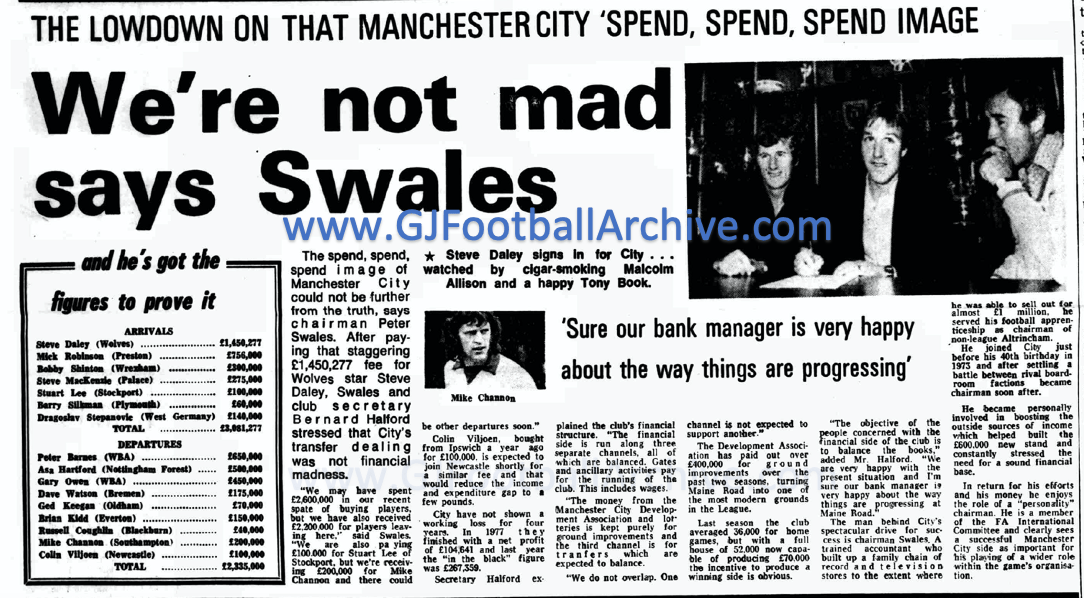
Well, it seems the norm today to talk about the cost of Manchester City’s squad with TV commentators frequently talking about the price of City’s bench. It gets tiring. However, this is not the first time the media talked of City as a ‘spend, spend, spend’ club. Today marks the anniversary of one day in particular when City’s spending caught the media’s attention. That day was on 6 September 1979 when Steve Daley signed for the Blues at a cost of £1,450,277.
City had to defend this spending which – and I know it’s difficult to understand in the modern world of £100m+ footballers – absolutely stunned football. This transfer was the British record but it was perceived as huge.
Chairman Peter Swales’ defence for the spending was that City was a profitable club (see the article) and this is true. City were a hugely profitable club in the 1970s but that all changed over the coming years with Swales, his supporting directors and managers getting giddy trying to buy success. As we all know it takes more than money to generate success and this period of City’s history is the one that actually created the club’s fall from grace, leading to some to believe in the 2010s & 2020s that the club had ‘no history’ and was not a ‘giant’. All that is balderdash. City were a giant who fell unlucky through poor management by a board of directors who did not plan for long term development.
Anyway, lots to say on this but read the article here from 1979 and hopefully that will show the position of strength the club was in (but soon messed up!).
While you’re here why not listen to one of my interviews with Malcolm Allison. You can hear a taster here:
It’s day 23 of my posts counting down to the centenary of Maine Road’s opening game and today’s feature is on the building of the North Stand. As Manchester City are about to appear in the 2023 Champions League final I thought I’d post images from a much earlier European game. This image of Neil Young comes from the 1971 ECWC semi-final v Chelsea. Notice Young is wearing City’s away colours. People often assume that City rarely wore away colours at Maine Road, but the truth is somewhat different.
Often when there was a clash of colours in a cup game City would wear their away strip. Games in the 1920s right through to 1970s saw the Blues don maroon, red/black and even scarlet at times at Maine Road.
The main image shows that North Stand being constructed in the background. You can see that the roof is not yet complete but that the terracing is in use for this ECWC semi final. The terracing was new concrete and the stand housed bars underneath. It was a terraced stand until summer 1972 when the decision was taken to make it a seated stand.
City chairman Eric Alexander was the main man responsible for the stand’s development and he was a passionate believer in giving fans the best facilities possible. He also had ambitious plans to redevelop the Kippax, however Peter Swales became the chairman soon after and he put Ian Niven in charge of ground developments. From then on, until 1993, the only major development was the erection of a new Main Stand roof in 1982. In the 1990s the club was forced to build – or condemn – the Platt Lane Stand.
Maine Road was a major ground for most of its existence and, even with little investment during from 1973 onwards, it was still selected as a cup semi-final venue. BUT I often wonder how spectacular the stadium would have been had Eric Alexander been left in charge of stadium developments. Instead of penny-pinching and devaluing the ground maybe it would have eclipsed Old Trafford as it had for the first 40 years of its existence?
People always focus on Swales as the cause of all the problems and it is true that he was the chairman and the man ultimately responsible, but he was not the major shareholder. In fact he often talked of how he only had a small number of shares until 1983 (when he made a major purchase following City’s relegation he often said). He was supported by directors who often held many more shares than he did. They could’ve ousted him, but instead supported him. Each director had responsibilities for different elements of the club – Swales often talked of this and the match programme frequently told us who was responsible and what they did – yet once Swales did stand down and Franny Lee took over some of those who had worked with Swales swapped sides and retained their positions. I know, from my own interviews with Swales, Alexander and others, that Swales felt let down and betrayed. Every issue was suddenly made to be ‘his’ fault. He accepted this, saying that he was the main man, but others needed to hold their hands up for the lack of investment in Maine Road etc.
1971 ECWC v Chelsea. Francis Lee. Photo by Alan Jubb
The above image shows Francis Lee at this same game and to the right you can see more of the North Stand under construction.
For those unfamiliar with Maine Road this photo may help. The North Stand can be seen with a completed roof on this image (number 10). This was later in 1971 and the stand is still a terraced one.
Maine Road aerial 1971 from Farewell To Maine Road
If you’d like to read more on the history of Maine Road, take a look at Farewell To Maine Road, which can be downloaded from this page:
If you enjoy all the free material on my website and would like to support my research and keep this website going (but don’t want to subscribe) then why not make a one-time donation (or buy me a coffee). All support for my research is valued and welcome. It allows me to keep some free material available for all. Thanks.
On this day (7 January) in 1977 the BBC in the northwest showed this incredible profile. On several occasions over the last decade myself & Will McTaggart have included this video profile of MCFC chairman Peter Swales in our Boys In Blue film show. Each time those who missed it have asked if they could see a video of it. That wasn’t possible until a few months ago. You can see the Swales profile here…
I would urge all MCFC fans and others to watch this in all its glory. Some of you may wish to jump to the David Brent-esque clip at 3 mins 20. Others may want to see the Ian Niven roof plan that was thwarted by signing Dave Watson at 1 min 45 secs. Then there’s the scene where Swales gives Watson financial advice (45 secs) and it ends with Swales telling us he was a bit like Kevin Keegan (4 mins).
Here it is online at last! On several occasions over the last decade myself & Will McTaggart have included a video profile of MCFC chairman Peter Swales in our Boys In Blue film show. each time those who missed it have asked if they could see a video of it. That’s never been possible until now! At long last you can now see the Swales profile here…
The BBC have included it in a series of films recently released. I would urge all MCFC fans and others to watch this in all its glory. Some of you may wish to jump to the David Brent-esque clip at 3 mins 20. Others may want to see the Ian Niven roof plan that was thwarted by signing Dave Watson at 1 min 45 secs. Then there’s the scene where Swales gives Watson financial advice (45 secs) and it ends with Swales telling us he was a bit like Kevin Keegan (4 mins).


 Gary James' Football Archive