The First League Manchester Derby

With the latest League Manchester Derby occurring this weekend it seems appropriate to remember the first ever Manchester derby played in the Football League. The match between Manchester City and Newton Heath was played at City’s Hyde Road ground today in November 1894. You can read the story of the game (with all the stats, background etc.) here:

Manchester City Break-In

On this day (28 April) in 1903 it was reported that the Manchester City offices had been broken in to. Season tickets, stamps, keys and other articles were stolen (had this been the 1980s I’m sure some comedian would’ve claimed ‘thieves broke into MCFC and stole everything of value… police are looking for a sky blue carpet!’).

Here’s a brief cutting from the period. The punishment? The boys received six strokes each from the birch! In the 1970s Manchester United boss Tommy Docherty (and he wasn’t alone – City’s secretary Bernard Halford agreed with him) suggested that football hooligans should be brought on to the pitch at half time and birched in front of fans!

129 Years Ago: The First League Manchester Derby

Today (3 November) is the anniversary of the first ever Manchester derby played in the Football League. The match between Manchester City and Newton Heath was played at City’s Hyde Road ground today in 1894. You can read the story of the game (with all the stats, background etc.) here:

The Latest Technology

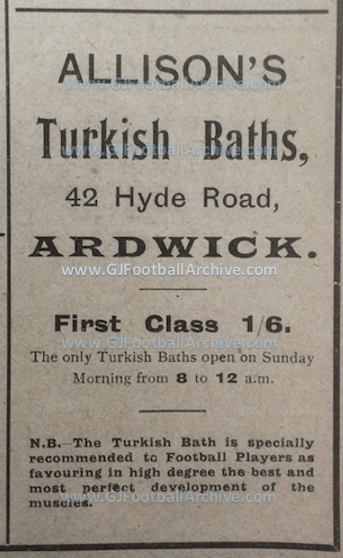
Today (27 October) in 1900 the Manchester Official Programme, a combined effort for Manchester City & Newton Heath, included an advert for City director John Allison’s hydro therapy baths. Allison was perceived as the leading figure in the sports hydrotherapy business back then.

You can find out more about Allison (a key figure at City, Celtic and Salford Harriers) here:

Nice Old Team Photo

Here’s a team photo of Manchester City, taken at Hyde Road, in 1900. It’s a typical squad pose in front of the old Hyde Road main stand which was destroyed by fire twenty years later. Notice the way the wooden wall of the stand was painted in City blue and white. People often talk about Hyde Road as if it was this dull, dismal ground but the stand here had only been erected a few years earlier and Joshua Parlby, Lawrence Furniss and the others behind the club made sure it was frequently painted blue and white (plus green) wherever possible.

Over the following twenty years City continued to invest in the ground but the site restricted the club’s growth and 40,000 crowds could not be accommodated particularly well. Often gates would be closed some way off capacity under the orders of the local police who tried to keep crowds back. Bennett Street and even Hyde Road itself were often overcrowded with fans hoping to get in.

There’s lots more on here about Hyde Road and City’s other grounds. Do a few searches and see what you find. Some is only for subscribers but much is available freely. It takes a lot of time, effort and money to research Manchester’s football history so if you want to support this work and get something back then please subscribe. Thanks.

If you enjoy all the free material on my website and would like to support my research and keep this website going (but don’t want to subscribe) then why not make a one-time donation (or buy me a coffee). All support for my research is valued and welcome. It allows me to keep some free material available for all. Thanks.

Choose an amount

£2.50
£5.00
£7.50

Or enter a custom amount

£

Your contribution is appreciated.

Donate

BBC & MCFC Interviews

Busy day today talking about the history of Manchester City, in particular the story of City’s stadia. It’s 100 years on Friday since Maine Road’s first game and we’ve just had the 20th anniversary of the Etihad’s (then known as City of Manchester Stadium) first game. Time flies!

The interviews today started with Mike Sweeney interviewing me about Maine Rd and the Etihad for BBC Radio Manchester – that will be played on Friday assuming all is okay – and then it was off to Manchester City for the next set of interviews about the club’s grounds and other stuff.

Later I’m chatting elsewhere about football, sorry soccer, in the USA. A busy day.

Mediacity BBC

Where Were You?

On this day (January 20) in 1900 the attendance stats (see image) seen here were published in various newspapers. Of course, as a historian who researches these sorts of things it does not surprise me at all that Manchester City were the best supported club at this stage. However, I can understand why some may have been surprised back then. City had only just been promoted for the first time the previous season.

In the end Manchester’s Blues ended the season as the third best supported club with an average of 16,000 (League champions Aston Villa attracted 19,825 and 5th placed Newcastle 16,725). City ended the season 7th in the top division.

For those wondering Newton Heath (Manchester United) averaged 6,225 and were the 16th best supported club. Liverpool averaged 11,325 and were 5th best supported club.