With Manchester City facing Arsenal in the Community Shield tomorrow it seems appropriate to remember a time when City, like Arsenal this year, we’re given a place in the Charity Shield (now Community Shield). Coincidentally, on this day (August 5) in 1972 City faced another team who had been given a place in the Shield match (though this team had actually won something) and that was the Third Division Champions Aston Villa. This was the first time the Blues had played a Charity Shield match at Villa Park (but not the last). Here’s a feature on it and a match report from the game.
Subscribers can view the article and all others on here (including the entire Manchester A Football History and a PDF of my first book). It costs £20 a year (works out about £1.67 a month) and you can sign up below. Thanks.
Subscribe to get access
Read more of this content when you subscribe today.
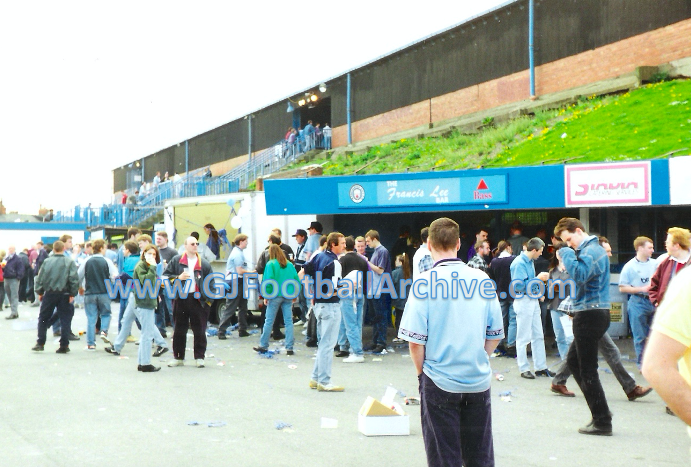
Day 64 of my posts counting down to the centenary of Maine Road’s opening game is this image taken by Steve Worthington from behind the old Kippax Stand during its final season. Notice the player named bar – this one after Francis Lee – and if you look carefully the second staircase visible (left) is the staircase to nowhere which was blocked off in the early 1970s following the safety legislation (that followed the Ibrox disaster) that outlawed the original style of staircase. The one closest to the camera was remodelled but the other was blocked off (see previous Maine Road 100 posts for details).
Steve Worthington’s photo was taken from the area behind the kippax, slightky 1971 aerial image shows the 1957 roof over the Kippax (7 & 8) which was demolished in 1994:
Maine Road aerial 1971 from Farewell To Maine Road
If you’d like to read more on the history of Maine Road, take a look at Farewell To Maine Road, which can be downloaded from this page:
If you enjoy all the free material on my website and would like to support my research and keep this website going (but don’t want to subscribe) then why not make a one-time donation (or buy me a coffee). All support for my research is valued and welcome. It allows me to keep some free material available for all. Thanks.
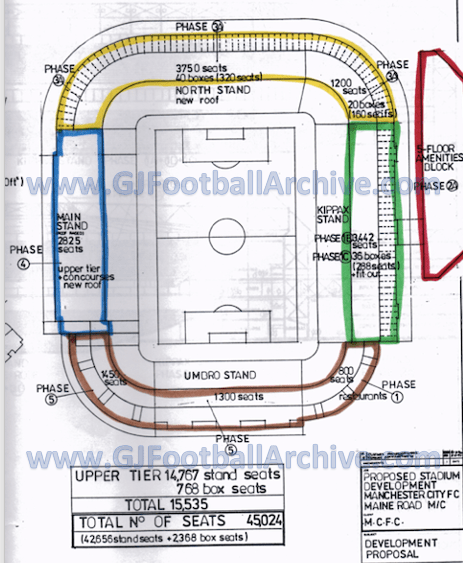
Day 55 of my posts counting down to the centenary of Maine Road’s opening game is a follow on from one from a few days ago. I posted a 1994 plan of what might have been in terms of Maine Road’s development and here’s more on that plan.
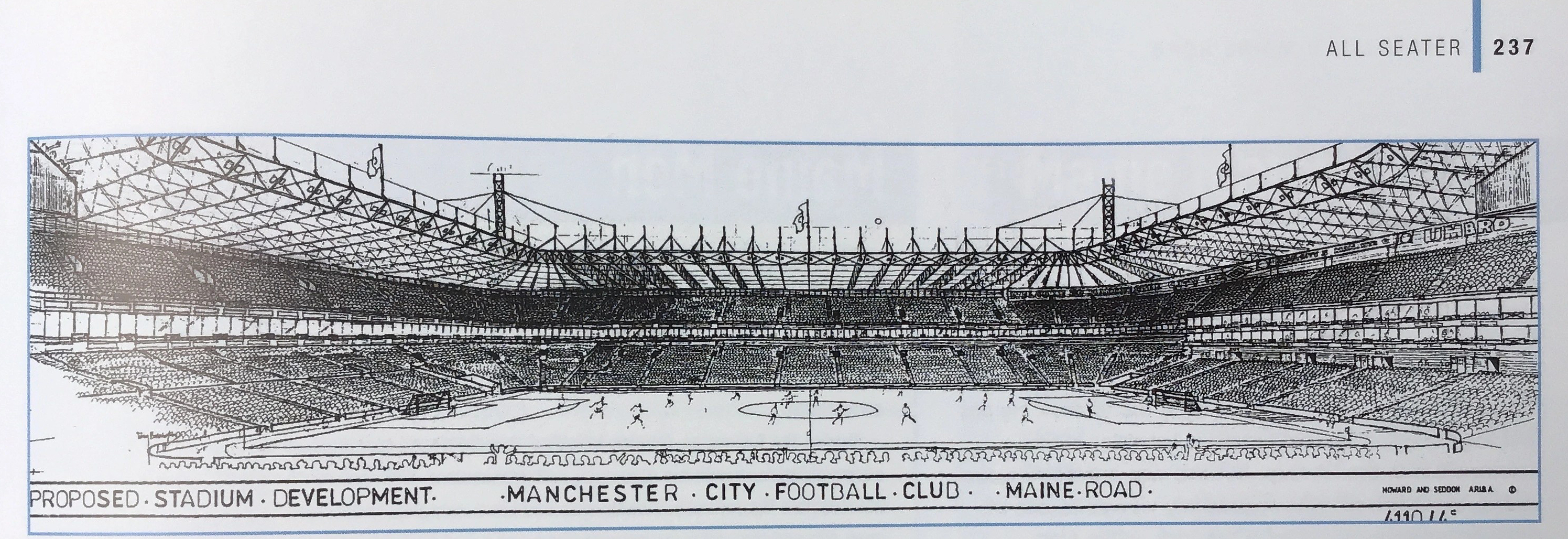
This image is of how the entire stadium was supposed to look. To explain the colour image looks towards the stadium from above the Kippax car park. The North Stand is on the right and the Platt Lane on the left. The black and white image is from the other side of the ground, looking towards the Kippax from the Main Stand.
1990s Maine Rd redevelopment plans as seen in Farewell To Maine Road
You can see from the black and white image that the plan was to replicate the general look of the new Kippax (being planned at this stage – this was January 1994 and the old Kippax was still standing) around the ground. The North Stand was to have a second tier added and hospitality boxes between the levels, like the new Kippax. The Platt Lane was to have a second tier added above the two lines of existing hospitality boxes.
The Main Stand would have part of the seating chopped away and a new second tier added.
To facilitate all of this some houses were to be bought and demolished on the streets immediately behind the North Stand and the Kippax/Platt Lane corner.
The new Kippax was the first phase of the development but Manchester’s bids for the Olympics changed thinking. Couple that with relegation in 1996 and the wholesale redevelopment of Maine Road was postponed after the Kippax opened and then dropped completely.
As mentioned previously, Lee’s plans would have seen the new Kippax followed by a phased development of each of the other three stands. These images might give an indication of how it would have progressed.
This 1971 aerial image shows the proximity of the housing on Thornton Road (bottom left, near number 6) and behind the North Stand (number 10). They were planned to be demolished in Lee’s 1994 plan.
Maine Road aerial 1971 from Farewell To Maine Road
If you’d like to read more on the history of Maine Road, take a look at Farewell To Maine Road, which can be downloaded from this page:
If you enjoy all the free material on my website and would like to support my research and keep this website going (but don’t want to subscribe) then why not make a one-time donation (or buy me a coffee). All support for my research is valued and welcome. It allows me to keep some free material available for all. Thanks.
For day 49 of my posts counting down to the centenary of Maine Road’s opening game I’ve posted this plan of what might have been. These were developed in January 1994 shortly after Francis Lee became chairman.
The Kippax needed to be replaced and the plans by former chairman Peter Swales and his supporting directors had been to bolt plastic seats on to the lower part of the original Kippax terracing with a reprofiled second tier behind. Lee ripped up those plans and within days had created a plan which would see the entire ground extended, not simply the building of a new Kippax.
The new Kippax was the first phase of that development but Manchester’s bids for the Olympics changed thinking. Couple that with relegation in 1996 and the wholesale redevelopment of Maine Road was postponed and then dropped completely.
Lee’s plans would have seen the new Kippax followed by a phased development of each of the other three stands. I haven’t got chance to work through every step here but these images might give an indication of how it would have progressed.
1990s Maine Rd redevelopment plans as seen in Farewell To Maine Road
Here’s an aerial photo of the ground in 1995 with the Kippax nearing completion:
If you’d like to read more on the history of Maine Road, take a look at Farewell To Maine Road, which can be downloaded from this page:
If you enjoy all the free material on my website and would like to support my research and keep this website going (but don’t want to subscribe) then why not make a one-time donation (or buy me a coffee). All support for my research is valued and welcome. It allows me to keep some free material available for all. Thanks.
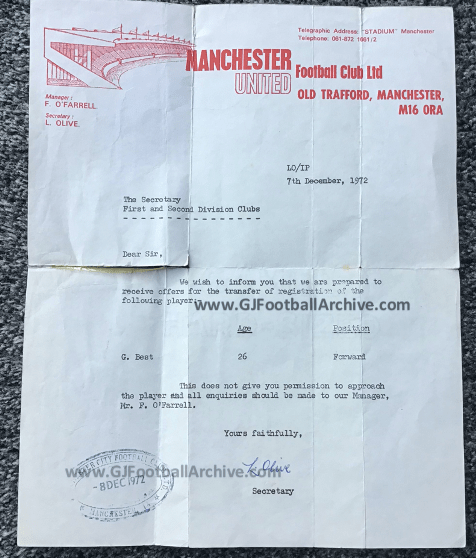
For the first time in my series of my posts counting down to the centenary of Maine Road’s opening game I’ve posted an image of a letter. This Day 44 feature is about the day Manchester United offered George Best to Manchester City.
Basically, Best was put on the transfer list by United and they sent a letter to every team in the top two tiers telling them he was available. In 1968 Best had said that he wanted to play for City as he felt they had the most attack-minded team in the League and he loved the thought of playing in a team that contained Colin Bell (below, seen in 1972-73), Mike Summerbee and Francis Lee.
Malcolm Allison did show interest in signing him but ultimately it never happened. Nevertheless this MCFC stamped letter is a rare item showing that United did offer the player to City and the other clubs in 1972.
Here’s an aerial photo of Maine Road from 1971, the year before Best was offered to City.
Maine Road aerial 1971 from Farewell To Maine Road
If you’d like to read more on the history of Maine Road, take a look at Farewell To Maine Road, which can be downloaded from this page:
If you enjoy all the free material on my website and would like to support my research and keep this website going (but don’t want to subscribe) then why not make a one-time donation (or buy me a coffee). All support for my research is valued and welcome. It allows me to keep some free material available for all. Thanks.
On 29 April 1970 Manchester City won the European Cup Winners’ Cup beating Gornik Zabrze from Poland 2-1 at the Prater Stadium in Vienna. Here are a few comments and feelings from supporters, players, and others affected by the game. These were gathered as part of a project I organised to commemorate the 30th anniversary of the final. As we’ve now past the 51st anniversary they have become an even greater historical record.
Subscribe to get access – Annual
Read more of this content when you subscribe today.
It’s day 23 of my posts counting down to the centenary of Maine Road’s opening game and today’s feature is on the building of the North Stand. As Manchester City are about to appear in the 2023 Champions League final I thought I’d post images from a much earlier European game. This image of Neil Young comes from the 1971 ECWC semi-final v Chelsea. Notice Young is wearing City’s away colours. People often assume that City rarely wore away colours at Maine Road, but the truth is somewhat different.
Often when there was a clash of colours in a cup game City would wear their away strip. Games in the 1920s right through to 1970s saw the Blues don maroon, red/black and even scarlet at times at Maine Road.
The main image shows that North Stand being constructed in the background. You can see that the roof is not yet complete but that the terracing is in use for this ECWC semi final. The terracing was new concrete and the stand housed bars underneath. It was a terraced stand until summer 1972 when the decision was taken to make it a seated stand.
City chairman Eric Alexander was the main man responsible for the stand’s development and he was a passionate believer in giving fans the best facilities possible. He also had ambitious plans to redevelop the Kippax, however Peter Swales became the chairman soon after and he put Ian Niven in charge of ground developments. From then on, until 1993, the only major development was the erection of a new Main Stand roof in 1982. In the 1990s the club was forced to build – or condemn – the Platt Lane Stand.
Maine Road was a major ground for most of its existence and, even with little investment during from 1973 onwards, it was still selected as a cup semi-final venue. BUT I often wonder how spectacular the stadium would have been had Eric Alexander been left in charge of stadium developments. Instead of penny-pinching and devaluing the ground maybe it would have eclipsed Old Trafford as it had for the first 40 years of its existence?
People always focus on Swales as the cause of all the problems and it is true that he was the chairman and the man ultimately responsible, but he was not the major shareholder. In fact he often talked of how he only had a small number of shares until 1983 (when he made a major purchase following City’s relegation he often said). He was supported by directors who often held many more shares than he did. They could’ve ousted him, but instead supported him. Each director had responsibilities for different elements of the club – Swales often talked of this and the match programme frequently told us who was responsible and what they did – yet once Swales did stand down and Franny Lee took over some of those who had worked with Swales swapped sides and retained their positions. I know, from my own interviews with Swales, Alexander and others, that Swales felt let down and betrayed. Every issue was suddenly made to be ‘his’ fault. He accepted this, saying that he was the main man, but others needed to hold their hands up for the lack of investment in Maine Road etc.
1971 ECWC v Chelsea. Francis Lee. Photo by Alan Jubb
The above image shows Francis Lee at this same game and to the right you can see more of the North Stand under construction.
For those unfamiliar with Maine Road this photo may help. The North Stand can be seen with a completed roof on this image (number 10). This was later in 1971 and the stand is still a terraced one.
Maine Road aerial 1971 from Farewell To Maine Road
If you’d like to read more on the history of Maine Road, take a look at Farewell To Maine Road, which can be downloaded from this page:
If you enjoy all the free material on my website and would like to support my research and keep this website going (but don’t want to subscribe) then why not make a one-time donation (or buy me a coffee). All support for my research is valued and welcome. It allows me to keep some free material available for all. Thanks.
For many, many years Dave Masey has been collecting stats and historical information on Manchester City. Like me he was a member of the Association of Football Statisticians and he has helped me often over the years. Following Saturday’s FA Cup final he got in touch with me to tell me about one of his spreadsheets which holds details of City scorers in trophy winning games.
His records capture those who have scored in major cup finals, but besides Cup Finals he also records other trophy-winning games. These include the deciding League games from 1937 onwards against Sheffield Wednesday (1937), Newcastle, QPR, West Ham, Brighton and Villa (2022), but nothing from three recent title successes where the Blues clinched the title when they were not playing. Got that? Good, now….
Dave tells me that Gundogan is now at the top of the list with 5 goals, overtaking Neil Young and Sergio Aguero. So he has scored more goals in trophy-winning games than any other Blue.
The list of scorers in trophy winning games reads:
1904
Meredith
1934/7
Tilson (3), Brook (2), Doherty
1956
Hayes, Dyson, Johnstone
1968/70
Young (4), Lee (2), Summerbee, Doyle, Pardoe
1976
P Barnes, Tueart
2011-(former)
Aguero (4), Y Toure (2), Nasri (2), Kompany (2), D Silva (2),Jesus (2), Sterling (2), Dzeko, Zabaleta, Navas, Fernandinho
2016-(current)
Gundogan (5), Laporte (2), Rodri (2), Mahrez, De Bruyne
Dave also tells me that in the three seasons where somebody else’s defeat clinched the title for City, the scorers in the club’s last game before the title confirmation were:
Gundogan (3), Sterling (2), Jesus, Haaland.
As Dave says, Ilkay gets a remarkable number of important goals, particularly for somebody who is ‘just’ a 1 goal in 5 games player (60 in 303 for City). Certainly this season he has played a true leader’s role and, looking at his place in this table, he is clearly a man for all trophy-winning seasons.
It’s day 21 of my posts counting down to the centenary of Maine Road’s opening game and today’s image is a reminder of a European night that was hugely significant. It was the most important European game played by Manchester City at Maine Road.
The game, played on 15 April 1970, saw German side Schalke 04 defeated 5-1 in the ECWC semi-final second leg at Maine Road by City. Subscribers can read the story of that game (and watch video highlights) here:
The image shows Francis Lee in action during that game with the Main Stand and Platt Lane corner in the background. This game led to City playing in their first European final and it seems appropriate to remember that night this week. Joe Mercer’s team went on to win the ECWC (at the time the 2nd most important UEFA club competition).
As well as that image here’s another from the night. This was the celebratory post match pitch invasion. I’d love to hear from any Blues who were there that night. Please use the contact page or leave a comment below. Thanks.
For those unfamiliar with Maine Road this photo may help locate the scene. Number 1 is the Main Stand. Number 4 is the Platt Lane Corner. The pitch invasion image shows one of the corner tunnels but I can’t make out whether it’s the one that used to be position near number 9 or the one shown below at number 6.
Maine Road aerial 1971 from Farewell To Maine Road
If you’d like to read more on the history of Maine Road, take a look at Farewell To Maine Road, which can be downloaded from this page:
If you enjoy all the free material on my website and would like to support my research and keep this website going (but don’t want to subscribe) then why not make a one-time donation (or buy me a coffee). All support for my research is valued and welcome. It allows me to keep some free material available for all. Thanks.
Tomorrow Manchester City face Arsenal in the League and there’s the possibility that national goalscoring records could be broken once again. A few weeks back I calculated that if Erling Haaland maintained a goal a game ratio in the remaining League fixtures for Manchester City he would better Tommy Johnson’s 38 goal tally by a goal. Since then Haaland, who is already City’s seasonal record scorer in all competitions, has indeed kept up that ratio – in fact he has surpassed it – and has now broken another barrier: 30 League goals in a season.
To celebrate this I’ve put together a feature comparing every player who has scored 30 goals or more for City, plus those Premier League goalscorers whose achievements could be bettered by Haaland this season. Here goes….
Subscribe to get access – Monthly
This article is available for subscribers. It costs £3 a month (here) or £20 a year (below) to access this and other articles on the site, including books, videos and 100s of articles. Why not try it for a month?
This article is available for subscribers. It costs £20 a year (here) to access this and everything else on the site, including books, videos and 100s of articles.






 Gary James' Football Archive