Continuing the weekly series of ‘True Blue’ figures associated with the early years of Manchester City, here’s an article on the City chairman John Chapman who died in office. You can find out why this man was such an important figure in Manchester City history below:
Subscribe to get access – Annual
Read more of this content when you subscribe today. Annual subscribers can access all the articles, talks, books and interviews posted since December 2020 for an annual subscription of £20 (works out about £1.67 per month). There’s also a monthly subscription (see below).
Monthly subscribers can access all the articles, talks, books and interviews posted since 1 October 2022 for a monthly subscription of £3 (cancel any time).
Continuing the weekly series of ‘True Blue’ figures associated with the early years of Manchester City, here’s an article on Billy Meredith who was the captain and goalscorer for Manchester’s first major trophy success. You can find out why this man was such an important figure in Manchester City history below:
Subscribe to get access – Annual
Read more of this content when you subscribe today. Annual subscribers can access all the articles, talks, books and interviews posted since December 2020 for an annual subscription of £20 (works out about £1.67 per month). There’s also a monthly subscription (see below).
Monthly subscribers can access all the articles, talks, books and interviews posted since 1 October 2022 for a monthly subscription of £3 (cancel any time).
As a trained historian I am always wary about saying that something is the first or that something’s an absolute fact unless I can properly prove it. It’s important to not jump to assumptions and to act responsibly. The quest to uncover football’s history and ensure the facts not the fiction are recorded drives me on. In addition, I am keen to locate items that can link us directly with a particular moment or achievement. So I’d just like to talk about a few items that I’ve been desperate to locate for several years…
There are many items from Manchester City’s long history that I have been searching for over many, many years. I could write a book about them but here’s the story of a few objects connected with the 1904 FA Cup final and one item I’m after tracking down survived for years and I’ve discovered that it was housed in Burnley for at least 40 years.
Many objects connected with Manchester’s first major trophy success still exist including the original-style FA Cup (housed at the National Football Museum – go and take a look when you can); a watch presented to manager Tom Maley (and some of the others presented to the players); a banner made by members of the Alexander Family (club officials and directors from 1894 through to the modern day; the flag is in City’s archive); players’ medals and various newspaper cuttings and photographs. However, there are three important items that I know existed that have vanished.
I am going to start with the 1904 FA Cup final ball, which was stored in Burnley into the 1950s.
Hillman’s Ball
At the end of the 1904 FA Cup final goalkeeper Jack Hillman charged past an opponent to pick up the ball and claim it as his own. The 1904 FA Cup final became the possession of City’s Hillman and he kept hold of it throughout his life. For many years he had it on display in his sweet shop on Thurston Street, Burnley and it is believed it was still in that building at the time of Hillman’s death in 1952.
According to reports the ball was painted in City’s colours – Cambridge Blue and White was worn for the 1904 final – and was inscribed as the 1904 English Cup winning ball. Back then the FA Cup was more commonly known as the English Cup.
Following Hillman’s death there is uncertainty over what happened to the ball. It seems it stayed in Burnley, so if there’s anyone reading with information please get in touch. If the ball managed to survive into the 1950s then it is possible it is still around somewhere.
I managed to get a Burnley newspaper to do a piece on this a few years back but sadly no one came forward with any information.
Film of the Final
The 1904 FA Cup final was filmed and shown in pubs and exhibition halls for at least a month after the final. Several copies of the film must have existed as it was shown in multiple locations at similar times but, to date, none of these copies have been found. Many photos from the 1904 final (including this one of Meredith scoring) are believed to have been taken from the original footage. In recent years older football films have been located in the north-west and I live in hope that one day a metal film cannister will be found with the words ‘1904 English final’ scrawled across will be identified.
The Players’ Shirts
Not one of the 1904 FA Cup final shirts has ever been found despite many of the players saving other equally important shirts. The 1904 shirt carried no badge and as City played a League game only 2 days after the final and travelled straight to Everton from London, it’s possible the same kit was worn again. Players such as Billy Meredith and Sandy Turnbull did save other important shirts and it’s possible the kits may have stayed within family circles but not recognised for their significance due to the lack of a badge. Frank Booth, a prominent member of the team, died in 1919 and is buried in Denton – maybe his family retained the shirt and it still resides in the region?
If you know of any of these items and can help locate them then please do. The film is probably the one that appeals most to me, but both the ball and a shirt would be great finds too.
As promised, here for subscribers is my presentation on Joshua Parlby and the launch of Manchester City FC. It lasts about 58 minutes and was recorded on 1 March 2023. There are lots of myths out there, but I focused on the facts and my latest research.
The presentation is all about the visionary who promoted a new club to represent Manchester, Manchester City and about the steps taken in 1894. This talk is now only available to subscribers (see below for details of how to subscribe).
Subscribers can also see the previous history talk on St Mark’s and City’s development in the Gorton area during the 1870s and 1880s below.
Subscribe to get access – Annual
Annual subscribers get access to everything posted since December 2020 (interviews, history talks, articles, PDFs of books etc.) and everything to be posted during your subscription. It costs £20 a year (about 5p a day).
Monthly subscribers get access to everything posted since 1 October 2022 and everything to be posted during your subscription. It costs £3 a month (cancel any time).
If you enjoy all the free material on my website and would like to support my research and keep this website going (but don’t want to subscribe) then why not make a one-time donation (or buy me a coffee). All support for my research is valued and welcome. It allows me to keep some free material available for all. Thanks.
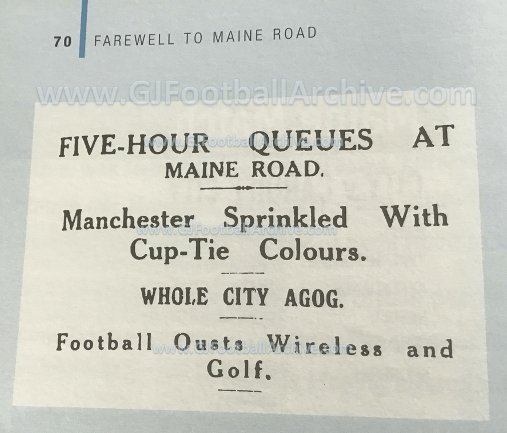
A record Manchester City have held for 99 years was set on this day (8 March) in 1924 – the record is the highest attendance on a club ground! Happy anniversary! The record set in 1924 saw 76,166 attend City v Cardiff. City had moved to their new Maine Road stadium in August 1923. The capacity of the venue was estimated at around 90,000 but was actually approximately 83,000 when the stadium opened (it was enlarged in 1931 and 1935).
In its first season the capacity was tested and, on this day (8 March) in 1924 the largest attendance for any footballing fixture (including three FA Cup Finals) in Manchester gathered to watch the Blues. This was also, at the time, the record crowd for any game played on an English club ground. It was beaten ten years later when 84,569 watched City v Stoke. You can read about the remarkable day in 1924 below:
Subscribe to get access
Read more of this content when you subscribe today. It costs £20 a year (access to everything) or £3 per month (see below).
Read more of this content when you subscribe today. It costs £20 a year (see above) or £3 per month (cancel anytime; access to everything posted since 1 October 2022).
This has been a sample of the material on http://www.GJFootballArchive.com If you would like to read all the in-depth articles (including the entire Manchester A Football History book and the audio interview with John Bond) then please subscribe. It works out about £1.67 a month if you take out an annual subscription (£20 per year) or £3 a month if you’d like to sign up for a month at a time. Each subscriber gets full access to the 260+ articles posted so far and the hundreds scheduled to be posted in the coming weeks.
Continuing the weekly series of ‘True Blue’ figures associated with the early years of Manchester City, here’s an article on the first manager to bring major trophy success to Manchester – Tom Maley. You can find out why this man was such an important figure in Manchester City history below:
Subscribe to get access – Annual
Read more of this content when you subscribe today. Annual subscribers can access all the articles, talks, books and interviews posted since December 2020 for an annual subscription of £20 (works out about £1.67 per month). There’s also a monthly subscription (see below).
Monthly subscribers can access all the articles, talks, books and interviews posted since 1 October 2022 for a monthly subscription of £3 (cancel any time).
There will be another ‘True Blue’ featured next Monday. Use the tag ‘True Blues’ to find other profiles in this series.
The full series of True Blue profiles will feature:
Lawrence Furniss, John Allison, Joshua Parlby, Walter Chew, William Sumner, Tom Maley, St Mark’s community leaders, Billy Meredith, John Chapman, William Beastow and James Moores.
Here’s my presentation on Joshua Parlby and the launch of Manchester City FC. It lasts about 58 minutes and was recorded on 1 March 2023. There are lots of myths out there, but I focused on the facts and my latest research.
The presentation is all about the visionary who promoted a new club to represent Manchester, Manchester City and about the steps taken in 1894. This talk was free to download until this morning (9 March). Now it is available to subscribers (see below for details of how to subscribe).
Subscribers can also see the previous history talk on St Mark’s and City’s development in the Gorton area during the 1870s and 1880s below.
Subscribe to get access – Annual
Annual subscribers get access to everything posted since December 2020 (interviews, history talks, articles, PDFs of books etc.) and everything to be posted during your subscription. It costs £20 a year (about 5p a day).
Monthly subscribers get access to everything posted since 1 October 2022 and everything to be posted during your subscription. It costs £3 a month (cancel any time).
If you enjoy all the free material on my website and would like to support my research and keep this website going (but don’t want to subscribe) then why not make a one-time donation (or buy me a coffee). All support for my research is valued and welcome. It allows me to keep some free material available for all. Thanks.
Lots said these days about using football as a means of ‘sportswashing’. The basic idea being that politicians and state leaders use football to sell a better image of themselves. The suggestion often made in the media is that this is a recent phenomenon but of course, like so many other things in life, it’s far from new. In fact, as far as football goes there are plenty of examples of politicians or businessmen pushing a particular idea to fans of certain clubs. As Manchester City are often highlighted today by those who are critical of the club’s owners, I thought it would be worth posting this image of a postcard created to promote a Manchester City director’s Conservative campaign.
Chapman was the first chairman for City back in 1894 and years later he died in office during his second spell as City’s chair. As part of his political campaigns he often linked the club’s successes to help present a positive image of success to potential voters. City’s captain Billy Meredith even campaigned for him at times.
City chairman John Chapman used City’s success as part of his political campaign.
Chapman was a decent guy it seems and both his political career and City chairmanship seemed on the whole to be positive for the people of Ardwick, though of course there were critics.
Regardless of how he was viewed it is clear that he did use City’s successes as part of his political campaigns. Nowadays someone would call this sportswashing no doubt, but it does show how people have used their sporting connections to further other ambitions. There’s nothing new in football!
My True Blue profile of Chapman will appear on 27 March 2023. You can read other True Blue profiles of City’s earliest figures by using the True Blue tab below. Thanks.
Continuing the series of ‘True Blue’ figures associated with the early years of Manchester City, here’s an article on John Allison who was a key figure with Ardwick AFC, Manchester City, Salford Harriers and also at Celtic. You can find out why this man was such an important figure in Manchester City history below:
Subscribe to get access – Annual
Read more of this content when you subscribe today. Annual subscribers can access all the articles, talks, books and interviews posted since December 2020 for an annual subscription of £20 (works out about £1.67 per month). There’s also a monthly subscription (see below).
Monthly subscribers can access all the articles, talks, books and interviews posted since 1 October 2022 for a monthly subscription of £3 (cancel any time).
The full series of True Blue profiles will feature:
Lawrence Furniss, John Allison, Joshua Parlby, Walter Chew, William Sumner, Tom Maley, St Mark’s community leaders, Billy Meredith, John Chapman, William Beastow and James Moores.
It’s Manchester City v Arsenal on Friday. The first FA Cup tie between these clubs came in 1904 and was part of Manchester’s first major trophy winning campaign. The two sides met at Arsenal in the second round of the competition. Back then City were a top flight team while Woolwich Arsenal were in the Second Division and some reports talked of the Gunners being envious of Manchester City and their status (how often do modern interpretations of a club’s status forget the game’s full history hey?). Arsenal had defeated Fulham 1-0 in the previous round.
The Blues defeated the Gunners 2-0 with goals from Sandy Turnbull and Frank Booth, prompting the Manchester Evening News to print a cartoon of Billy Meredith leapfrogging over the Gunners while Tom Maley, dressed in kilt, watches.
Outside-left Frank Booth, one of the scorers, had joined City in April 1902 making his first appearance for the Club in a friendly with Celtic on 1 September 1902. That friendly appearance brought a little bad luck to the player as fairly early on in the match he accidentally collided with Celtic’s Right-back Hugh Watson causing him to leave the field for twenty minutes or so. When he returned however he seemed more determined than ever to prove what he was capable of and, when a chance came his way, he scored what was described as a “very fine” goal to give City a 1-0 victory.
Throughout Booth’s career prior to the Arsenal game he had been rather unlucky with injuries and, at times, must have seriously considered concentrating on a life outside of the sport. He was a hatter by trade, coming from the local hatting areas surrounding the towns of Hyde and Denton, and had only completed his apprenticeship in 1903. Nevertheless a career in football had to be more appealing than life in one of the large hatting factories of east Manchester.
Here’s a brief cutting mentioning the game. Note also the difficulties being experienced by Second Division Manchester United (again, how often do modern day commentators on the game’s history forget the full history?).
After the tie with Arsenal at Plumstead, George Robey, a very famous Music Hall comedian with a love of football, took the City team to visit the capital’s top Music Halls. Such light relief was needed in the City camp as the realisation was now dawning that the Blues might seriously be contenders for the League and Cup double that at this point in history had only been achieved by Preston (1889) and Aston Villa (1897).
For a side (indeed a city) whose only national success so far had been to win the Second Division, this must have felt like an impossible dream but, as the season progressed it became increasingly possible.
Since 1932 the sides have met in the competition on 17/2/1971 at Maine Road (a 2-1 Arsenal win); the 2017 semi-final (2-1 aet for Arsenal); and again in the 2020 semi played on 18 July 2020 (a 2-0 Arsenal win).




 Gary James' Football Archive