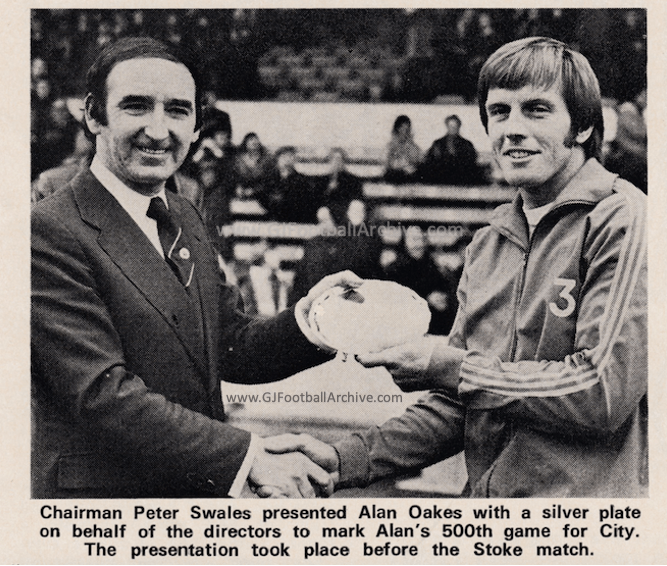
Today (9 November) in 1974 Manchester City presented longserving player Alan Oakes with a silver plate to commemorate his 500th League appearance. He’d actually made his 500th League appearance the previous week when City faced Everton at Goodison.
At Maine Road on 9 November City chairman Peter Swales presented him with the award before the game with Stoke (Oakes made his 501st League appearance that day). City won that match 1-0 with a goal from Rodney Marsh. You can see Marsh’s goal here:
Today was an emotional day but it was also a perfect sendoff for Francis Lee. I was at Manchester Cathedral to pay my respects and it was great hearing the tributes to Francis today, particularly the one from Will Perry and Francis’s son Jonny. They did him proud. Great to see many Blues & former players there, plus Barry ‘look at his face’ Davies. The former players from City included Mike Summerbee of course, Tony Book, Micah Richards, Peter Barnes, Tommy Booth, Asa Hartford, Joe Royle and Alan Oakes. Former physio Roy Bailey was there, as was Fred Eyre, and playing representatives of Bolton and Derby. Colin Bell’s son Jon was also present which was fantastic to see.
One of the things that came across well from Jonny’s eulogy was his dad’s sense of humour. Jonny revealed how Franny often told interviewers fake facts like how he could play the piano to classical concert standard and some of these jokes have made it into obituaries. Brilliant – it also means I now need to go back through my interviews with him to see if I can spot any Franny wind ups!
Franny’s mate John Gildersleeve also revealed how the two of them were travelling back from a holiday in Dubai when Franny (MCFC chairman at the time) received a phone call from BBC Radio Manchester. The interviewer knew that Franny had been out of the country but didn’t know where and asked if he’d been trying to sign a player. Franny said he had and that the Blues were in negotiation to buy a strong relatively unknown defender. He said that he couldn’t say much but he could reveal the player’s name. He then gave the BBC a Dutch sounding version of John Gildersleeve’s name – and according to the tale we heard the BBC fell for it!
The service included Blue Moon played on the cathedral organ (quite emotional) and recordings of What a Wonderful Life (Louis Armstrong) and You Got It (Roy Orbison), plus hymns Dear Lord and Father of Mankind and, of course, Abide With Me. As well as family and friends, City’s Danny Wilson added to the eulogies with an appropriate and appreciated contribution about what Franny meant to City.
In addition to family, friends, colleagues and former players there were many, many fans there paying their respects. I think Francis would’ve loved that.
After the service at the Cathedral there was a private family cremation and other commemorations marking Franny’s life.
Franny was a wonderful player, businessman and man. Today Manchester and the world recognised that.
If you missed reading my interview with Francis from 2010 you can read it below. For those who wonder why Francis was so significant hopefully this will give an indication. This is one of many interviews I did with Francis over the decades and I want to include this one today as it was written up as a Q&A style piece with Francis’ own words documented. I hope it captures the spirit of the legendary Bolton, City, Derby and England player.
IN SEARCH OF THE BLUES – Francis Lee
For today’s feature author Gary James met up with former Bolton, City and England star Francis Lee. In a glittering career Francis won two League Championships, the ECWC, League Cup and the FA Cup.
Francis, let’s begin with your early career at Bolton. Can you explain how that started?
I was a member of the groundstaff and I set myself a target that I had to get into the first team by the time I was 17 or 18 and if I didn’t I was going to go back to college and train as a draughtsman. That was my plan, but I managed to get into the first team at 16 and I made my debut against City (5/11/60). We won 3-1 and I scored a header at 3.15 against Bert Trautmann – I think Bert must have thought he was getting over the hill for me to score a header past him! It was a great day and there were some very good players on both sides – Nat Lofthouse of course. Ken Barnes and Denis Law were playing for City.
I kept my place for about six games and then the following season I had 5 games, then in 1962-63 I was top scorer with 12 goals from 23 League games.
You were playing out on the wing those days and topped the goalscoring charts each season at Bolton from 1962 until you left. Was that your preferred position?
I think my best position was as support striker to a big fella. I only played in that role twice really – at Bolton with Wyn Davies when I scored 23 League goals one season and then at City with Wyn again when I scored 33 League goals in 1971-72. A lot of my career was spent at centre-forward at City and at Derby which is a bit of a difficult position to play if you’re only 5ft 7. When I played for England I was support to Geoff Hurst and that suited me. When I played at centre-forward I had my back to the ball but when I was support striker – the free player – that suited me fine. I could pick up the ball going forward and that was great.
At Bolton you scored 106 goals in 210 appearances. A great record, but when you left the club the stories were that you were in dispute. Is that true?
Well, what happened is that Bolton had got relegated in 1964 and, despite a near-miss in 1965 when we finished third, it didn’t feel as if we were going forward. My ambition was still to see how far I could develop in the game and in the back of my mind I had the ambition to play for England, but I wasn’t even selected for the under 23s. The story was going around that I was difficult to handle – which is funny because Joe Mercer said that I was the easiest player to handle at one point.
At one point I remember asking the manager why I wasn’t earning as much as Wyn Davies who had been brought in to score goals. I was top goalscorer but Wyn was paid more and the manager said: “you’re too young!” but Wyn was only about a year older than me.
Were you difficult to handle at Bolton?
I was opinionated and ambitious, but not difficult. I think that message was going around because I was on a weekly contract at that time and the club knew that it would be difficult for them to stop me moving on if another club came in. So any player with a reputation for being difficult would not be on anyone else’s shopping list, would they? Bolton offered me a new contract worth something like £150 a week but before that I was on £35. That actually upset me more and I said: “if you now think I’m worth £150 a week what about all those years you’ve been underpaying me?” It wasn’t the money that was an issue it was the way they handled it. What they were doing was trying to get me on that contract and then my value would increase if someone came in to buy me. Once they saw how dissatisfied I was with the way they were handling it, they said that it’d be best if we made a clean break, and so I said I’d pack the game in. I had my business by then and so I said: “give me my employment cards and I’ll pack it in.” They thought I was bluffing.
It’d been a decent season so far – I’d scored 9 goals in 11 games including when we beat the great Liverpool side in the League Cup – but then it all stopped in September 1967. They gave me my cards and that was it.
Were you absolutely certain you’d pack it all in at that point?
I kept myself fit but I was working on my business. I was driving my lorry around, collecting the waste paper and so on. The business was growing and I felt that if I wasn’t wanted then I’d concentrate on that. It was always my fallback. It was only a small business really.
I know how stories can get exaggerated over the years, but is it true that in between games you were going around collecting the waste paper?
I used to drive my lorry during the week and even on the Thursday or Friday before a game I’d be collecting waste paper. I used to put on a flat cap and muffler so that nobody would recognise me! In summer I worked long hours and I was earning more in the summer months than I was playing football in Division One. I also played cricket. At one point it looked like I was going to be a footballer and cricketer but the season overlap meant I had to concentrate on football.
In the end I was driving articulated lorries and it was getting to be a very good business. My last job was the day before I signed for City! I roped and sheeted about 15 ton of paper and cardboard from a spinning mill in Bolton. Took it to the Sun Paper Mill in Blackburn and when I got back about 5pm I got a call from Joe Mercer. He didn’t give his name at first but I recognised him and he said: “Where’ve you been?” I told him I’d been playing golf – I couldn’t play the game at all then but I couldn’t tell him what I had been doing! I asked him: “who is that?” He said: “Tom Jones.” I said: “It doesn’t sound like Tom Jones, sounds more like a man called Mercer!”
Did you immediately want to sign for City?
Other teams had shown interest in signing me. Liverpool offered £100,000 I understand but then when I wasn’t playing it affected my price. In later years Shanks often used to grab me and say in that strong Scottish accent: “Son, I should’ve signed ya the night I saw ya!”
City was just right of course. It meant the business could carry on. I don’t know if Bolton had told Joe about my contract or the £150 offer but the first thing he said to me before we talked it through was: “I’ll be honest with you son. We’ve no money. We’re skint!” I said: “It doesn’t matter. I’ll just be delighted to start playing again.”
I signed for City for £60 a week – remember I’d turned down £150 at Bolton – and in the end it was well worth it. The way the team developed and, of course, when I realised my ambition and played for England.
City paid £60,000 – actually they paid £40,000 down and £20,000 on the drip! I was told I should get about 5% of the fee but then the League wouldn’t allow it because I’d left under strained circumstances or something.
I left a lot of friends of mine at Bolton – Freddie Hill, a great friend, Tommy Banks, Roy Hartle, Gordon Taylor – and we had some great times. Those of us who had come through the ranks were poorly paid for the job we were doing at the time, but we enjoyed ourselves. I never had any argument with the players, fans or people at Bolton, it was just those that ran it. I loved my time at Bolton.
When you joined City the Blues were ninth in Division One after losing 5 of the 11 games played. But the side was transformed from the moment you came. Unbeaten in your first 11 League games. Were you the difference?
The team just clicked and I was only part of a good group of players. We had that great run up to Christmas, then a bit of a blip, but in the New Year we just rattled on. It was a terrific period. Mike Summerbee was playing at centre-forward and our culture at the time was to play with five forwards. It was very unusual for the time. The only system we played was that we all played we had ten players who went up together, and ten who defended together. When we won the League at Newcastle at the end of the season it was wonderful and particularly special because none of us had ever won anything significant. This was our first major success and that’s why the following season the ordeal of playing a European Cup tie was so tough.
Was it just inexperience that caused City to lose the Fenerbahce European Cup tie 2-1 on aggregate?
None of us had played in Europe before. Mike Summerbee had only made his England debut against Scotland in February 1968. Colin Bell had played in two England friendlies, but apart from that none of us had any concept of what it could be like in Turkey. Had we played the first leg in Istanbul and the second at Maine Road I think we’d have gone through, but the goalless 1st leg at Maine Road killed us really. We worked hard in Istanbul and it was a creditable result over there but we were out and it was because we were inexperienced. It was a culture shock.
Despite the Fenerbahce setback did it feel as if City could find further success?
No confidence was at a real low after that game. We’d had a bad run and only had a small squad so we struggled. But that was the way it was. Most clubs had small squads but what Shankly used to do at Liverpool was sign a couple of players each season just to ensure that those who were first choice felt the pressure and remained hungry for the game. Back then the motivation for all of us was to be in the team and to keep your place. The money was significantly different if you lost your place – City used to have this thing where we’d get a bonus depending on the size of the attendance as well as goals, wins and so on. That motivated you to ensure you did all you could to entertain as well as win – you wanted the crowds to grow.
Effectively you could double your wage by simply being in the team. That’s a big incentive.
Francis Lee (left) and Mike Summberbee (right) threaten the Fenerbahce goal in City’s first European Cup tie in 1968.
You mentioned about squad size, I think younger readers may be surprised to read that City tried to keep the same eleven players game after game, competition after competition. Would you have enjoyed a squad rotation policy when you played?
The aim of a footballer is to play. Why would anyone want to be rested? If a manager had said to me ten minutes before full time that he wanted to bring me off even though I was playing well, I’d have told him “no way! I’m enjoying myself. This is what you bought me for, now let me do it!” It wouldn’t matter what the manager says I’d want to stay on. That’s what the game is about – enjoyment! Every player wanted to play. None of us wanted to be on the bench.
People talk about the number of games played today but in 1969-70, ignoring domestic friendlies and the Charity Shield, you played 71 competitive games for England and City. Would squad rotation have helped?
No. Playing is always better than being on the training pitch and I used to love playing, so I tried not to miss a game. It didn’t matter whether it was an England friendly, Anglo-Italian cup or whatever, I wanted to play and represent my club and my country. I think it’s best for all players. Look at Tevez. He’s improved his fitness and form by playing, and I think a lot of players are like that. He needs to play, and that’s what I always wanted.
Some of the other players from the 1969-70 season have talked about Franny’s Grand Slam. Your aim to win four trophies in one season inspired them. What do you remember of that?
Well, we wanted to win every game so it seemed natural to me that we should go for all four. We won the League Cup and Cup Winners’ Cup, so that wasn’t bad. In the FA Cup we were odds on to win at Old Trafford because we’d beaten them so many times. We ended up suffering a rare defeat at United, but it was one of those we should really have won based on form and everything. We were doing okay in the League then we had a few injuries – Mike, Colin Bell and Neil Young were injured at key times – otherwise I think we would have won three trophies. But the thing about the ‘Grand Slam’ was that it was the ambition of the place. I remember we were going to London on the train and could see Wembley, and I shouted to the lads to take a look because two of our ‘Grand Slam’ games would be played there!
1971 ECWC v Chelsea. Francis Lee. Photo by Alan Jubb
Moving forward a couple of years, the success started to disappear. There had been the takeover that ultimately led to Peter Swales being Chairman, and of course we missed the title by a point in 1972. What had changed?
Rodney Marsh has told you himself that his signing made a difference. Malcolm played Rodney and disrupted a team that I’m convinced would have won the League that year. Derby won it when they were in Majorca or somewhere! I don’t blame Rodney… that season our luck changed and everything went against us. There was one game near the end where we should have had a couple of penalties for hand ball but because this was the season when we got that record number of penalties they weren’t given.
Thinking about the penalties, a lot has been made about you ‘diving’ but the factual evidence is that the majority of penalties were given for things like handball or fouls on other players. Nevertheless, the myths survive. So, big question, did you ever dive?
I couldn’t say that I always stayed on my feet unless I was absolutely knocked down. In those days you used to get some horrendous treatment by the defenders, but I will tell you that the season before those penalties we only had a couple, and before that I think it was one. The reason we got so many in 1971-72 is that they had changed the law, plus we were going for the title so we were putting sides under a lot of pressure and they reacted. I was fouled only 5 times out of the 13 league penalties we got.
When I was attacking I used to play the odds. If a defender was coming towards me I’d carry on, or I’d run towards the defender because there were only three things that could happen – he pulls me down, he gets the ball of me – well done, or I get a cracking shot at goal. So the odds were in my favour. You have to play them.
I think the reason people go on about penalties with me is because I was the one taking them. It didn’t seem to matter what they were given for, the headlines were that I had scored from a penalty. The season after I think we only got one penalty and by the time I moved to Derby they already had a penalty taker so that was it. I would say that for every dubious penalty that was awarded there were another twenty that we should have had.
Francis Lee’s first penalty for City January 1968 v Sheffield UnitedFrancis Lee scoring penalty v Manchester United 1971-72 season
Was the move to Derby something you really wanted?
No. By that time my business was substantial so going to Derby was going to cause problems. Derby offered City more than anyone else and so I went there. We won the title in my first season – I’d only signed a contract for a year – and they were a very good side, so I stayed with them for another season. The pitch was awful – even Maine Road’s pitch was better – but we could have won the European Cup that second season. We won the first leg of a tie with Real Madrid 4-1 but I missed the return because I’d been sent off in the Hunter incident against Leeds. We lost 5-1.
They actually changed the rule after that saying it was unfair to automatically ban a player from a European game after a domestic match when the player had yet to be proved to be guilty or not guilty. There wasn’t much chance of me being ‘not guilty’ – the footage was there for everyone to see!
There was that memorable game when you came back to Maine Road and scored for Derby at the Platt Lane end of the ground. I was in the stand that day and I remember a surreal moment when City fans cheered your goal. Did that happen or is it just my memory?
Yes, it did happen. Then I think they thought: “What have we done, he’s playing for them!”
I enjoyed my football and I loved scoring so when I scored and the film shows me smiling it was because I’d scored what I thought was a good goal. I picked it up with my back to the line, went through two people and on to score the goal. I loved the goal and it is true that everyone applauded. It had nothing to do with City or revenge or anything like that. I think I enjoyed about 95% of every game I ever played. It was fun. A great way to earn a living, so on that day I was happy.
People often suggest that City sold you too soon and that had you stayed a couple of seasons longer we might have won the title ourselves. Do you hold this view?
I think if I’d have stayed and Mike Summerbee – remember he was sold a year after me – then I do think we’d have mounted a serious challenge for the title. Mike had more to offer.
After two seasons at Derby you retired, but you were still relatively young. Why?
I had about 110 people working for me and my business was taking over. I was travelling all over the country for my business and was trying to fit the football training in as well. I needed to concentrate on the business. Had I been playing in Manchester or Bolton then I may have carried on. I was only 32. Derby wanted me to stay on, and I made a promise to Dave Mackay that if I was to return to football then I’d do it for him. Tommy Docherty tried to persuade me to join United but I’d made that promise and wouldn’t do it.
You developed your business interests and horse racing over the following twenty years, but then suddenly you were back, mounting takeover of City. Why?
I wasn’t really looking to get back into the game at all during those years. I had a good and successful career outside of the game and was happy. But the takeover was one of those things that happened. I should have known that it wouldn’t work. The biggest problem we faced at the start was having to build the new Kippax Stand. We ended up spending about £16m in the end – even removing the waste from underneath the old terracing should have cost only £80,000 but ended up costing about £1.8m. I thought then that I’d always been lucky in life and then suddenly my luck had changed. Everything we tried to do became an issue and the Kippax was a bit of a millstone.
It’s extraordinary when you think that at that time Jack Walker had put some money into Blackburn and Everton had had some money put into it, and we put money into City, but prior to that no one ever put money into a football club. They bought shares but never invested, we did invest. But the financial state of the club was appalling.
It strikes me that off the pitch things did improve significantly, but on the pitch we struggled. What’s your view?
People like John Dunkerley worked very hard during that spell and the training facilities were improved and so on. Then, just when we finished the Kippax Manchester Council started to talk to me about becoming tenants of the new stadium – now that turned out to be the best thing that happened to City during the decade that followed. We spent a lot of time working with them and talking with various people to make it happen. Full marks must go to the Council for having the foresight and it became very important for City to become anchor tenants. I think I had a lot of bad luck as Chairman and things certainly didn’t work on the pitch, but I do think that was one thing that the club got right.
Why did it fail on the field?
I don’t know. Maybe the footballers didn’t enjoy playing as much as they ought to have done. We also had a few problems with managers but I’d better not get into that.
Finally, many people claim the 1970 League Cup Final was your greatest City game, do you feel that?
I don’t view it like that. I don’t think of individual games in that way. My job was to score goals and win games, and so I look at my career and see what goals I’ve scored. You have to look at the club during your time there and see what that club won and what you contributed to the overall success of the club, not necessarily individual games.
My role was to make things happen, and if I was making things happen, especially if it was causing some aggravation for the opposition, then I was happy. When you hear the opposition players shouting things like: “don’t let him turn!” that’s a real pat on the back. You know you’re getting to them.
In terms of individual games or goals… I don’t see it in those terms. In the championship season I think one of the goals I scored at West Ham (18/11/67) was the best goal I’ve ever scored. I was playing against Bobby Moore and I think I had a fantastic game but, because they are trophy winning games in their own right, cup finals tend to be remembered mostly by others.
I always think that a top class player should go on to the pitch and have enough confidence in his own ability to know that it is very rare for him to have a bad game. It’s not arrogance or anything, but it is the mark of a top class player. If you go onto the pitch feeling that then more often than not you will have a good game. The next step is to take it up the levels until you walk on to the pitch believing you’ll have a great game and score a couple of goals. At City most of us developed that confidence and on some days, when the entire team was at that level, we had some tremendous games. That Newcastle title decider was like that.
On this day (18 September) in 1968 Manchester City’s first European Cup fixture against Fenerbahce ended goalless at Maine Road. This was the first time two British clubs from the same city had competed in the European Cup. Here’s a match report of the City game:
Francis Lee (left) and Mike Summberbee (right) threaten the Fenerbahce goal in City’s first European Cup tie in 1968.
Subscribers can read a feature about that game here:
Subscribe to get access – Monthly
This article is available to subscribers. It costs £3 per year (cancel anytime) to subscribe and monthly subscriver get full access to all the articles, interviews and books published since 1 October 2022. There’s also a special annual option (see below).
This article is available to subscribers. It costs £20 a year (£1.67 per month) to subscribe and for that you get full access to all the articles, interviews and books already published since the site was created in December 2020 and throughout your subscription.
It’s Day 94 of my Maine Road 100 countdown (not long to go now!) to the centenary of Maine Road’s first game. Recently I’ve been asked if I know who played most games at City’s old stadium and the answer is that Alan Oakes made more appearances in City’s first team at Maine Road than any other player. Alan made 340 plus one as sub appearances at Maine Road in a City first team shirt.
Alan is also City’s record appearance holder of course. He’s often overlooked these days when people talk about truly great City players but Alan was a model professional, loved by Blues, teammates and opponents alike. Here’s an interview I did with Alan a few years back.
This interview occurred in February 2005 and we discussed his life and career.This appears here as it was originally published.
Alan Oakes joined the Blues at the age of 15 in 1958 and made his first team debut in November 1959 when he was 17 years and 2 months. He stayed at Maine Road until July 1976 by which time he had made a staggering 564 League appearances. In February 2005 he was inducted into City’s Hall of Fame, and author Gary James met up with him to discuss his career.
To begin with let’s talk about your childhood, did you come from a sporting background?
We were all very sporty and my father and others played local football – nothing professional – and as a boy I’d play cricket in the summer and football in the winter. The usual sort of thing – coats as goalposts – and I loved playing. I progressed into the Mid-Cheshire Boys side and then one day I got the shock of my life when City’s scout Albert Kavanagh knocked on the door and asked me to join the groundstaff. He’d watched me play at Broughton, Salford, and seemed to like what he saw. I was astounded and delighted at the same time. This was a dream moment.
Coming from a Cheshire village like Winsford in the 50s to a big city like Manchester must have been a bit daunting, how did you and your family feel about the move?
It was an opportunity I couldn’t miss. Other teams showed interest but City meant so much to me. I’d been to Maine Road a few times – I stood on the old Kippax before it had a roof – and loved the Club. I wasn’t blinkered though because I also went to Maine Road to watch some of United’s first games in Europe. Remember they used City’s ground because they didn’t have floodlights and a lot of Blues went to watch the European sides.
Clearly, you saw a wealth of talent during this period, but who were your heroes?
Ken Barnes was a brilliant player and by far the best in his position, and Bobby Johnstone had an amazing footballing brain. They were great players to watch and later I was fortunate to play with Ken, but my boyhood hero was always Billy Wright from Wolves. There was something special about Wolves. They brought over several top European sides for friendlies – I guess they paved the way for the European Cup – and they won so many fans. They were a great, entertaining side and Billy Wright was their star. I was still a City fan, but I recognised the quality of Wright and Wolves.
Still only 17 you made your debut in a 1-1 draw with Chelsea, how did you feel about your performance?
I felt okay, but I gave away a penalty! Fortunately for me Bert Trautmann – the greatest ever keeper – was in nets and he saved the day. As a member of the groundstaff I’d clean Bert’s boots and even that felt like a great honour, so you can imagine how grateful I felt when he saved the penalty. The Chelsea game was a one off – I think Ken Barnes was injured – and so it was a few weeks before my chance came again. I felt a lot of satisfaction that I was in the reckoning though. When I arrived at City there were 55 professionals and about five teams to progress through to reach the first team.
How did you find the management and coaching staff in those days?
They were all ex-City players and so that was important. Fred Tilson and Laurie Barnett had played in the 30s finals and coached us, and manager Les McDowall had been a good player in his day. Clearly the coaching techniques they used were not a patch on Malcolm Allison, but they did what was right for the period. They also treated me well and looked after me. I found it difficult adjusting to life in a big city. I lived in digs for a while, and then moved back home and travelled by train and, eventually, car.
By 1963 you were a regular but City were entering a difficult period, did that come across to you?
We had a lot of quality in the side but seemed to be conceding too many goals. We knew we were struggling but we always gave it our best. After we were relegated in ’63 Derek Kevan and Jimmy Murray arrived. We were doing really well, then Jimmy did his cartilage in – that was a major blow – and we tailed off. We missed promotion (6th place) and we couldn’t get it going again until Joe and Malcolm arrived in ’65.
Although you were still relatively young, you were one of the more experienced players, how did the arrival of Mercer & Allison go down?
It was a great lift of course, but I know we were wary of Malcolm at first. He had all these ideas and it seemed so different to what we were used to, but within a week or so he’d won everybody over. The transformation by the two men was so fast – before we’d completed our pre-season games we were convinced we would win promotion. We couldn’t wait to get started. The confidence flowed and then Malcolm tackled our fitness. Of course we won promotion easily, and then held our own in 1966-7. Don’t forget we had faced a couple of big tests in those first two seasons – We took a strong Everton side to 2 replays in the FA Cup while we were still in Division Two and narrowly lost to Revie’s Leeds the following year. We lost 1-0 to Leeds with a Jack Charlton goal that should have been disallowed. So we came away from those games confident we could face any side. There was nothing for us to fear.
Of course, the Championship followed in ’68 and all the other successes of that great period, which one means most to you?
The Championship and European successes were both very important. This is a difficult one really, but because I was there during the dark days, I think the most important one had to be the promotion in 1966. My reason is that without that none of the rest would have followed. Joe and Malcolm didn’t just get us promoted, they first stopped the rot. We were going downhill fast and they stopped that, changed gear and pushed us forward quickly, and it wasn’t done with negative play. A lot of teams pack the defence and try to ensure they don’t lose, we always went out to win and never contemplated holding out for a point.
Throughout your City career people commented that you were a quiet, unassuming, perhaps shy player, was that fair?
I think I was a good professional. I used to simply get on with it. I was dedicated and tried to give everything for the Club. I believe I was a good, honest pro. If I was asked to do an interview, I’d do it, but I never sought the headlines. Media coverage was not as it is today, so it was easier in many ways, but I would do it when needed. More than anything I wanted to make sure my role on the pitch spoke for me.
By 1973 the Mercer-Allison partnership had ended and some of the other players started to move on, did you contemplate leaving?
Never. You were worried that you’d be dropped or the next one out, but I never thought about choosing to leave. Why would anyone want to leave the best club in the country? I remember thinking that somebody would take my place and that I had to keep performing at the highest level. In some ways I liked to push myself by thinking of all the people who could take my place, but I never, ever thought about leaving until after the League Cup final of 1976.
The team had changed significantly by 1976, and you were clearly one of the elder statesmen of the team, how did you find that period?
I enjoyed it all, and I remember playing a few games with Peter Barnes in front of me. I loved that. He was such a gifted player and it was great for me to play behind someone that exciting at that stage in my career and in his. I know this came a couple of years after I’d moved on, but it irritated me when Peter Barnes was sold because I believe he could have helped City to real success. He was the sort of player you built a team around.
While I’m thinking about this, I also believe Mike Summerbee and Francis Lee were sold far too early. Francis had so much more left in him – he proved that at Derby – and so the break up of the Mercer-Allison team came too rapid.
In July 1976 you moved to Chester, why did you make the move?
I’d had a great season. I’d played 39 League games and won the League Cup and so there was no pressure to leave, but I did think that I may have blocked some other gifted players coming through. I was also aware that I’d be 34 when the new season starts and that I may not be up to it in the way I would normally expect. Chester City were just up the road and for me it was a nice move. I do remember thinking ‘what have I done?’ because I’d gone from a First Division palace to play at Third Division grounds, but the move was a good one. Looking back though I was perhaps wrong to leave when I did. My advice to any player now is to remain playing at the highest level for as long as you physically can. Those days are precious and should not be cut short.
I also missed Maine Road a lot when I left and I miss it even more now. I regret the fact City have left that ground.
At Chester you moved into management, was this something you’d always wanted?
It was part of the attraction of joining Chester that I could become player-manager and I think in the six years I was there we had a great time. Success is different for a team like Chester, it’s all about survival and so I had to do a lot of work in the transfer market. I had another ex-City star, Cliff Sear, with me and we worked well together, and I loved every minute at Sealand Road. Often I’d be trying to negotiate good transfer fees and working hard to sell a couple of players to keep us afloat, and so I got satisfaction from that when it all came right. I still got a lot of satisfaction from playing as well, so it was a perfect role.
Ian Rush was one of your players. Is it true he almost came to City?
Yes it is. Whenever anybody with talent was due to leave Chester I would want them to move to a bigger, better club. I still love City and so I wanted Rushie to go to Maine Road. We were having a great cup run and Tony Book and Malcolm Allison came to watch him. Rush scored twice and I met up with Tony and Malcolm afterwards. Tony was keen to sign him but Malcolm didn’t rate him for some reason and it all collapsed. He later went to Liverpool and the rest is history, but I wanted him to go to Maine Road and I wish that deal had occurred. Of course, you never know how these things would have worked out.
Did you ever consider moving into a higher division as a manager?
Definitely – with City! It must have been 1983 because I know Billy McNeill was given the job in the end, but I applied for the City job. I desperately wanted the role because I loved the Club and because I believed I knew exactly what the Club needed. I’d also served what I thought was a good apprenticeship – six years at Chester taught me a great deal about survival and transfer negotiations. I knew City had financial problems and that someone with the right experience was needed – the last thing the Club could cope with was someone who needed to spend – and so I felt I was ideal for the role. Don’t forget what I’d experienced as a player at Maine Road as well. Most importantly, I understood the Club and all about Manchester football fans and their expectations and needs. This remains the greatest club in my eyes.
I got an interview at Peter Swales’ house. A few directors were there and I thought I gave a very good interview. Unfortunately, I didn’t get the job. I still wonder what might have happened.
Moving on to today, your son Michael has become a Premier League goalkeeper, is this something you’ve encouraged?
I didn’t push him but I did encourage him. It’s a great game to be a part of and I love the fact he’s involved. Joe Corrigan helped him a lot when he was young and so I’m grateful for that, and when he joined Aston Villa I was delighted. Now he’s at Wolves and I do try to watch him but I find it very difficult. I’m always in two minds as to whether I want the ball to be at his end of the field or not. If Wolves are attacking I know he’s safe, but I also know he can’t demonstrate his abilities. If Wolves are on the defensive I want him to have to make a great save but I’m also worried he’s going to be caught out. I think he’s doing really well though.
I once replaced Bert Trautmann in nets – it was against West Ham and he was sent off, so I deputised. I can’t remember much about it now, but I don’t think Michael would have learnt much if he’d seen it!
Finally, you have made a total of 672 first team appearances for City (including 3 Charity Shield games), how did you feel when you first broke Bert Trautmann’s appearance record?
I was a little bit sad that I took the record off Bert because to me there was no finer ‘keeper and player for the Club, but obviously I felt pleased to have the record. Personally, I’m looking forward to the day when the record’s beaten. I know it will take a lot to beat but I hope somebody does it, and if the person who beats it has the same sort of career and enjoyment at City that I have had then he will have had a fantastic career. This is a great club with terrific fans and I have enjoyed every minute of my time with the Club.
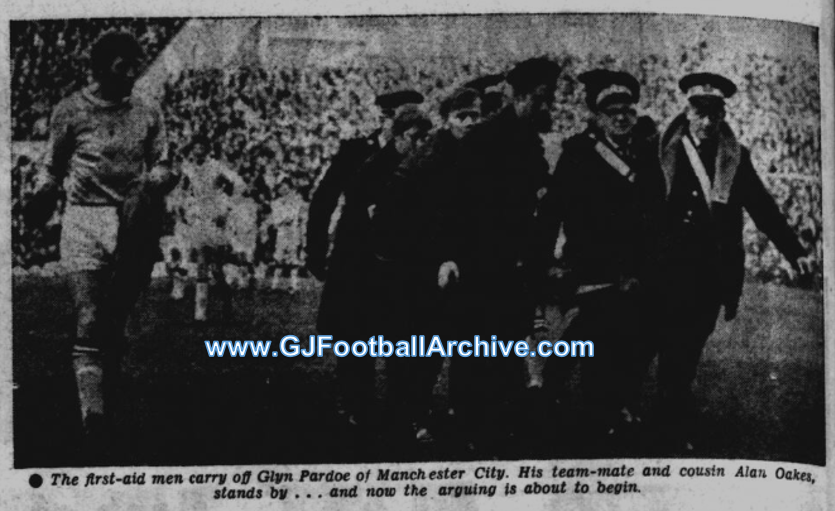
Glyn Pardoe came close to having his leg amputated on this day (12 December) in 1970 following a foul by George Best in the Manchester derby at Old Trafford. I interviewed Pardoe about his career in 2004 and here for subscribers are his views of the tackle and subsequent injury, together with a few contemporary articles from 1970. It became one of the most controversial derby moments of all time and arguments raged for years on whether it had been a deliberate act or not. You can be the judge by reading Pardoe’s views and the contemporary media.
Subscribe to get access – Annual
Read more of this content when you subscribe today. Annual subscribers pay £20 per year to access all material posted since December 2020 and all articles throughout the life of their subscription. Monthly subscribers pay £3 per month (see below).
Read more of this content when you subscribe today. Monthly subscribers pay £3 per month to access all material posted since 1st October 2022 and all articles throughout the life of their subscription. Annual subscribers pay £20 per year (see above).
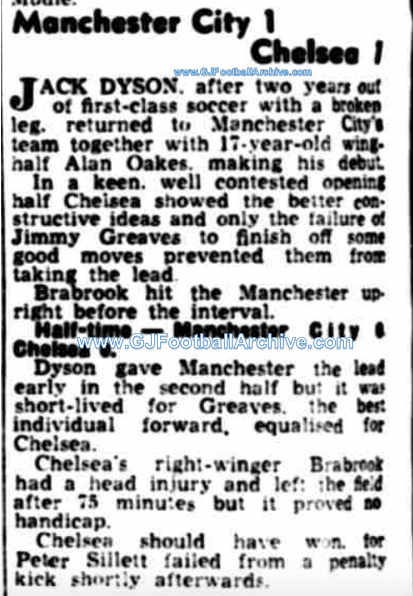
On this day (14 November) in 1959 Manchester City’s record appearance holder Alan Oakes made the first of 564 League appearances. The game ended in a 1-1 draw with Chelsea with the away team missing a penalty. Jack Dyson returned to the City team after two years out with a damaged leg. Here’s a contemporary match report from the game:
There are lots of other features on my website about Alan Oakes, why not have a read while you’re here?
On this day (1 October) in 1969 Manchester City’s first home tie in the ECWC ended 3-0 (6-3 on aggregate) as the Blues defeated Athletic Bilbao. City scorers were Alan Oakes, Colin Bell and Ian Bowyer. Attendance 49,665. You can read more (and watch a video) about the game here:
Subscribe to get access
Read more of this content and everything else on the site when you subscribe today for £20 a year here (works out about £1.67 per month).
Read more of this content when you subscribe today. You can subscribe at either £20 per year (above) or at £3 per month here (cancel any time). For those subscribing £3 per month you will be able to access all content from October 2022 onwards for as long as you are a subscriber. Those subscribing £20 a year have access to everything posted since December 2020.
On this day (18 September) in 1968 Manchester City’s first European Cup fixture against Fenerbahce ended goalless at Maine Road. You can read about that game here:
Subscribe to get access – Monthly
This article is available to subscribers. It costs £3 per year (cancel anytime) to subscribe and monthly subscriver get full access to all the articles, interviews and books published since 1 October 2022. There’s also a special annual option (see below).
This article is available to subscribers. It costs £20 a year (£1.67 per month) to subscribe and for that you get full access to all the articles, interviews and books already published since the site was created in December 2020 and throughout your subscription.
Happy 80th birthday Alan Oakes. Alan has made more appearances for Manchester City than any other player but more significantly he’s an absolute gent. Here to commemorate his birthday is an interview I did with Alan.
This interview occurred in February 2005 and we discussed his life and career. This appears here as it was originally published.
Alan Oakes joined the Blues at the age of 15 in 1958 and made his first team debut in November 1959 when he was 17 years and 2 months. He stayed at Maine Road until July 1976 by which time he had made a staggering 564 League appearances. In February 2005 he was inducted into City’s Hall of Fame, and author Gary James met up with him to discuss his career.
To begin with let’s talk about your childhood, did you come from a sporting background?
We were all very sporty and my father and others played local football – nothing professional – and as a boy I’d play cricket in the summer and football in the winter. The usual sort of thing – coats as goalposts – and I loved playing. I progressed into the Mid-Cheshire Boys side and then one day I got the shock of my life when City’s scout Albert Kavanagh knocked on the door and asked me to join the groundstaff. He’d watched me play at Broughton, Salford, and seemed to like what he saw. I was astounded and delighted at the same time. This was a dream moment.
Coming from a Cheshire village like Winsford in the 50s to a big city like Manchester must have been a bit daunting, how did you and your family feel about the move?
It was an opportunity I couldn’t miss. Other teams showed interest but City meant so much to me. I’d been to Maine Road a few times – I stood on the old Kippax before it had a roof – and loved the Club. I wasn’t blinkered though because I also went to Maine Road to watch some of United’s first games in Europe. Remember they used City’s ground because they didn’t have floodlights and a lot of Blues went to watch the European sides.
Clearly, you saw a wealth of talent during this period, but who were your heroes?
Ken Barnes was a brilliant player and by far the best in his position, and Bobby Johnstone had an amazing footballing brain. They were great players to watch and later I was fortunate to play with Ken, but my boyhood hero was always Billy Wright from Wolves. There was something special about Wolves. They brought over several top European sides for friendlies – I guess they paved the way for the European Cup – and they won so many fans. They were a great, entertaining side and Billy Wright was their star. I was still a City fan, but I recognised the quality of Wright and Wolves.
Still only 17 you made your debut in a 1-1 draw with Chelsea, how did you feel about your performance?
I felt okay, but I gave away a penalty! Fortunately for me Bert Trautmann – the greatest ever keeper – was in nets and he saved the day. As a member of the groundstaff I’d clean Bert’s boots and even that felt like a great honour, so you can imagine how grateful I felt when he saved the penalty. The Chelsea game was a one off – I think Ken Barnes was injured – and so it was a few weeks before my chance came again. I felt a lot of satisfaction that I was in the reckoning though. When I arrived at City there were 55 professionals and about five teams to progress through to reach the first team.
How did you find the management and coaching staff in those days?
They were all ex-City players and so that was important. Fred Tilson and Laurie Barnett had played in the 30s finals and coached us, and manager Les McDowall had been a good player in his day. Clearly the coaching techniques they used were not a patch on Malcolm Allison, but they did what was right for the period. They also treated me well and looked after me. I found it difficult adjusting to life in a big city. I lived in digs for a while, and then moved back home and travelled by train and, eventually, car.
By 1963 you were a regular but City were entering a difficult period, did that come across to you?
We had a lot of quality in the side but seemed to be conceding too many goals. We knew we were struggling but we always gave it our best. After we were relegated in ’63 Derek Kevan and Jimmy Murray arrived. We were doing really well, then Jimmy did his cartilage in – that was a major blow – and we tailed off. We missed promotion (6th place) and we couldn’t get it going again until Joe and Malcolm arrived in ’65.
Although you were still relatively young, you were one of the more experienced players, how did the arrival of Mercer & Allison go down?
It was a great lift of course, but I know we were wary of Malcolm at first. He had all these ideas and it seemed so different to what we were used to, but within a week or so he’d won everybody over. The transformation by the two men was so fast – before we’d completed our pre-season games we were convinced we would win promotion. We couldn’t wait to get started. The confidence flowed and then Malcolm tackled our fitness. Of course we won promotion easily, and then held our own in 1966-7. Don’t forget we had faced a couple of big tests in those first two seasons – We took a strong Everton side to 2 replays in the FA Cup while we were still in Division Two and narrowly lost to Revie’s Leeds the following year. We lost 1-0 to Leeds with a Jack Charlton goal that should have been disallowed. So we came away from those games confident we could face any side. There was nothing for us to fear.
Of course, the Championship followed in ’68 and all the other successes of that great period, which one means most to you?
The Championship and European successes were both very important. This is a difficult one really, but because I was there during the dark days, I think the most important one had to be the promotion in 1966. My reason is that without that none of the rest would have followed. Joe and Malcolm didn’t just get us promoted, they first stopped the rot. We were going downhill fast and they stopped that, changed gear and pushed us forward quickly, and it wasn’t done with negative play. A lot of teams pack the defence and try to ensure they don’t lose, we always went out to win and never contemplated holding out for a point.
Throughout your City career people commented that you were a quiet, unassuming, perhaps shy player, was that fair?
I think I was a good professional. I used to simply get on with it. I was dedicated and tried to give everything for the Club. I believe I was a good, honest pro. If I was asked to do an interview, I’d do it, but I never sought the headlines. Media coverage was not as it is today, so it was easier in many ways, but I would do it when needed. More than anything I wanted to make sure my role on the pitch spoke for me.
By 1973 the Mercer-Allison partnership had ended and some of the other players started to move on, did you contemplate leaving?
Never. You were worried that you’d be dropped or the next one out, but I never thought about choosing to leave. Why would anyone want to leave the best club in the country? I remember thinking that somebody would take my place and that I had to keep performing at the highest level. In some ways I liked to push myself by thinking of all the people who could take my place, but I never, ever thought about leaving until after the League Cup final of 1976.
The team had changed significantly by 1976, and you were clearly one of the elder statesmen of the team, how did you find that period?
I enjoyed it all, and I remember playing a few games with Peter Barnes in front of me. I loved that. He was such a gifted player and it was great for me to play behind someone that exciting at that stage in my career and in his. I know this came a couple of years after I’d moved on, but it irritated me when Peter Barnes was sold because I believe he could have helped City to real success. He was the sort of player you built a team around.
While I’m thinking about this, I also believe Mike Summerbee and Francis Lee were sold far too early. Francis had so much more left in him – he proved that at Derby – and so the break up of the Mercer-Allison team came too rapid.
In July 1976 you moved to Chester, why did you make the move?
I’d had a great season. I’d played 39 League games and won the League Cup and so there was no pressure to leave, but I did think that I may have blocked some other gifted players coming through. I was also aware that I’d be 34 when the new season starts and that I may not be up to it in the way I would normally expect. Chester City were just up the road and for me it was a nice move. I do remember thinking ‘what have I done?’ because I’d gone from a First Division palace to play at Third Division grounds, but the move was a good one. Looking back though I was perhaps wrong to leave when I did. My advice to any player now is to remain playing at the highest level for as long as you physically can. Those days are precious and should not be cut short.
I also missed Maine Road a lot when I left and I miss it even more now. I regret the fact City have left that ground.
At Chester you moved into management, was this something you’d always wanted?
It was part of the attraction of joining Chester that I could become player-manager and I think in the six years I was there we had a great time. Success is different for a team like Chester, it’s all about survival and so I had to do a lot of work in the transfer market. I had another ex-City star, Cliff Sear, with me and we worked well together, and I loved every minute at Sealand Road. Often I’d be trying to negotiate good transfer fees and working hard to sell a couple of players to keep us afloat, and so I got satisfaction from that when it all came right. I still got a lot of satisfaction from playing as well, so it was a perfect role.
Ian Rush was one of your players. Is it true he almost came to City?
Yes it is. Whenever anybody with talent was due to leave Chester I would want them to move to a bigger, better club. I still love City and so I wanted Rushie to go to Maine Road. We were having a great cup run and Tony Book and Malcolm Allison came to watch him. Rush scored twice and I met up with Tony and Malcolm afterwards. Tony was keen to sign him but Malcolm didn’t rate him for some reason and it all collapsed. He later went to Liverpool and the rest is history, but I wanted him to go to Maine Road and I wish that deal had occurred. Of course, you never know how these things would have worked out.
Did you ever consider moving into a higher division as a manager?
Definitely – with City! It must have been 1983 because I know Billy McNeill was given the job in the end, but I applied for the City job. I desperately wanted the role because I loved the Club and because I believed I knew exactly what the Club needed. I’d also served what I thought was a good apprenticeship – six years at Chester taught me a great deal about survival and transfer negotiations. I knew City had financial problems and that someone with the right experience was needed – the last thing the Club could cope with was someone who needed to spend – and so I felt I was ideal for the role. Don’t forget what I’d experienced as a player at Maine Road as well. Most importantly, I understood the Club and all about Manchester football fans and their expectations and needs. This remains the greatest club in my eyes.
I got an interview at Peter Swales’ house. A few directors were there and I thought I gave a very good interview. Unfortunately, I didn’t get the job. I still wonder what might have happened.
Moving on to today, your son Michael has become a Premier League goalkeeper, is this something you’ve encouraged?
I didn’t push him but I did encourage him. It’s a great game to be a part of and I love the fact he’s involved. Joe Corrigan helped him a lot when he was young and so I’m grateful for that, and when he joined Aston Villa I was delighted. Now he’s at Wolves and I do try to watch him but I find it very difficult. I’m always in two minds as to whether I want the ball to be at his end of the field or not. If Wolves are attacking I know he’s safe, but I also know he can’t demonstrate his abilities. If Wolves are on the defensive I want him to have to make a great save but I’m also worried he’s going to be caught out. I think he’s doing really well though.
I once replaced Bert Trautmann in nets – it was against West Ham and he was sent off, so I deputised. I can’t remember much about it now, but I don’t think Michael would have learnt much if he’d seen it!
Finally, you have made a total of 672 first team appearances for City (including 3 Charity Shield games), how did you feel when you first broke Bert Trautmann’s appearance record?
I was a little bit sad that I took the record off Bert because to me there was no finer ‘keeper and player for the Club, but obviously I felt pleased to have the record. Personally, I’m looking forward to the day when the record’s beaten. I know it will take a lot to beat but I hope somebody does it, and if the person who beats it has the same sort of career and enjoyment at City that I have had then he will have had a fantastic career. This is a great club with terrific fans and I have enjoyed every minute of my time with the Club.
On this day (21st January) in 1976 goals from Peter Barnes, Ged Keegan, Alan Oakes and Joe Royle in the semi-final second leg against Jack Charlton’s Middlesbrough guaranteed Manchester City an appearance in the League Cup final. The Blues had lost the first leg 1-0 to a Boro side that included Graeme Souness. The aggregate score was 4-1.
Here’s the story of that game and the situation around MCFC at the time with quotes from interviews I have performed with Alan Oakes and Rodney Marsh.
Subscribe to get access
Read more of this content when you subscribe today.



 Gary James' Football Archive