Ron Healey made his goalkeeping debut for City in 1971 at the age of 18. This was a mixed period for goalkeepers at City and Healey’s opportunities became limited. He did manage to appear in 36 League, cup and European games for the Blues and gained a great deal of positive coverage, however he moved on to Cardiff City in 1974. Gary James met up with him at City’s museum in November 2004. Here’s that interview:
Subscribe to get access
Read more of this content when you subscribe today. You can subscribe at either £20 per year (above) or at £3 per month here (cancel any time). If you’d like to support my research then why not subscribe? Every subscription directly helps support my research and provides annual subscribers with access to everything posted on this site, including the entire Manchester A Football History and From Maine Men To Banana Citizens books, plus interviews, articles and more. I am not employed by anyone and all my research is self funded or comes from subscriptions to this site.
You can subscribe at either £20 per year (above) or at £3 per month here (cancel any time). For those subscribing £3 per month you will be able to access all content from October 2022 onwards for as long as you are a subscriber. Those subscribing £20 a year have access to everything posted since December 2020.
The Manchester City FC annual report is out. Record profits of £41.7m as the club continues to find trophy success and improve its financial position. That investment seems to be paying off a bit now, hey? You can read all the details here:
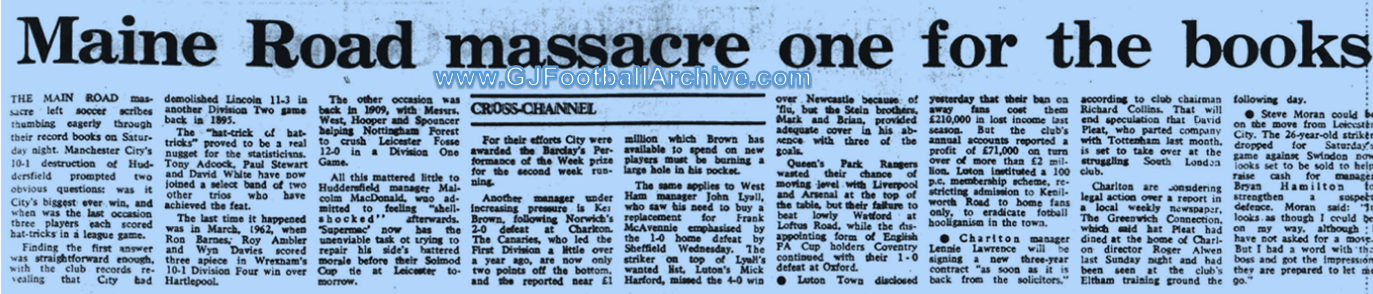
On this day (7 November) in 1987 Manchester City defeated Huddersfield Town 10-1. Paul Stewart, Tony Adcock, and David White each scored a hat-trick while the goal spree was started by Neil McNab. You can read the full story of the game; watch highlights and more here….
Subscribe to get access
Read more of this content when you subscribe today. If you’d like to support my research then why not subscribe? Every subscription directly helps support my research and provides annual subscribers with access to everything posted on this site, including the entire Manchester A Football History and From Maine Men To Banana Citizens books, plus interviews, articles and more. I am not employed by anyone and all my research is self funded or comes from subscriptions to this site.
Read more of this content when you subscribe today. You can subscribe at either £20 per year (above) or at £3 per month here (cancel any time). For those subscribing £3 per month you will be able to access all content from October 2022 onwards for as long as you are a subscriber. Those subscribing £20 a year have access to everything posted since December 2020.
In one of the great derbies more than 63,000 fans thrill to an all-action display of attack that epitomises all that is good about Manchester football. United take a two goal lead but the Blues keep fighting back. In the final minute Summerbee makes it 3-3 to end a classic match.
Today (5 November) marks the anniversary of a shock transfer of an England international from Tottenham to Manchester City only a few days before an England game. The player even travelled on the Tottenham coach to Manchester as the two teams were about to play each other. You can read the story and match reports here:
Subscribe to get access
Read more of this content when you subscribe today. If you’d like to support my research then why not subscribe? Every subscription directly helps support my research and provides annual subscribers with access to everything posted on this site, including the entire Manchester A Football History and From Maine Men To Banana Citizens books, plus interviews, articles and more. I am not employed by anyone and all my research is self funded or comes from subscriptions to this site. £20 per year or £3 per month.
Read more of this content when you subscribe today. You can subscribe at either £20 per year (above) or at £3 per month here (cancel any time). For those subscribing £3 per month you will be able to access all content from October 2022 onwards for as long as you are a subscriber. Those subscribing £20 a year have access to everything posted since December 2020.
Identity is important to any aspiring football team and the fledgling Gorton Association Football Club chose to wear a distinctive kit consisting of black shirts with a white cross pattée emblazoned across the left breast. The smart new kit set the tone for what the players hoped would be a successful period in the club’s development and from the moment it was first worn in 1884 the club progressed and grew, becoming Ardwick in 1887, before re-launching as Manchester City in 1894.
Subscribe to get access
Read more of this content when you subscribe today. If you’d like to support my research then why not subscribe? Every subscription directly helps support my research and provides annual subscribers with access to everything posted on this site, including the entire Manchester A Football History and From Maine Men To Banana Citizens books, plus interviews, articles and more. I am not employed by anyone and all my research is self funded or comes from subscriptions to this site.
You can subscribe at either £20 per year (above) or at £3 per month here (cancel any time). For those subscribing £3 per month you will be able to access all content from October 2022 onwards for as long as you are a subscriber. Those subscribing £20 a year have access to everything posted since December 2020.
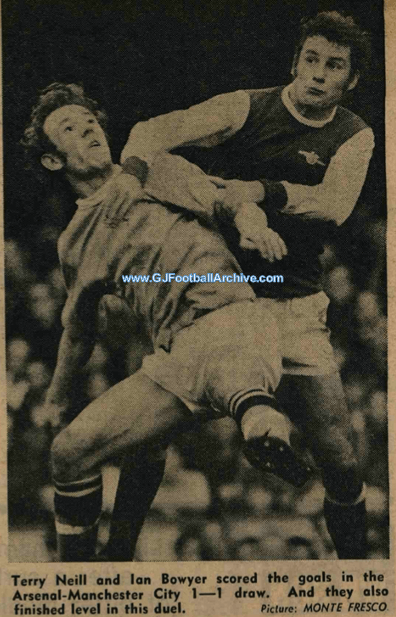
Back in 2010 one of my interviews with Ian Bowyer was published. Bowyer won European trophies at both Manchester City and Nottingham Forest. The interview ended with Bowyer talking about modern day football (this was 2010 before City rediscovered their trophy winning ways) and he commented: ‘Can I add that I really want to see City re-establish themselves as a successful side? I know what this Club can achieve and I hope success – real success – comes soon.’ Subscribers can now read this 3,000 word article here as it was first published:
Subscribe to get access – Annual
Read more of this content when you subscribe today. £20 per year (access to everything posted since Dec 2020) or £3 per month (see below).
Read more of this content when you subscribe today. £20 per year (see above) or £3 per month here. The monthly subscription provides access to everything posted since 1st October and the subscription can be cancelled any time. Why not sign up for a month and see how it goes?
Manchester City: George HUTCHINSON, Harry SMITH, John WALKER, George MANN, Joseph NASH, Fred DYER, Billy MEREDITH, Pat FINNERHAN, Sandy ROWAN, James SHARPLES, Bob MILARVIE. Manager: Joshua Parlby
Newton Heath: William DOUGLAS, John McCARTNEY, Fred ERENTZ, George PERRINS, James McNAUGHT, William DAVIDSON, John CLARKIN, Robert DONALDSON, James DOW, Richard SMITH, James PETERS. Manager: Alf Albut
BACKGROUND
Both sides had joined the Football League in 1892 when Ardwick (Manchester City) entered the newly formed Second Division and Newton Heath (Manchester United) joined the enlarged First Division. At the end of this first season Newton Heath finished bottom of the First Division and Ardwick in fifth place in Division Two. Newton Heath survived in the top flight by succeeding in the Test matches that were used to decide promotion and relegation in the early years of the League. The 1893-94 season saw Ardwick finish 13th out of 15 teams in the Second Division, whereas Newton Heath were again bottom of the First Division. This time the Heathens were unsuccessful in the Test matches and were relegated, joining Ardwick in Division Two. During the close season Ardwick had been reformed as Manchester City and were determined to make an impact. A number of new players had been signed by City secretary Joshua Parlby, including William ‘Billy’ Meredith. The derby was to be Meredith’s home debut. Prior to the derby, City had won only four games out of eleven in the League, although they had scored thirty goals including four in their previous game – a 5-4 defeat at Newcastle United! Newton Heath had lost only once in the League at Burton, and so entered the match as very much the team in form.
BEFORE THE GAME
P W D L F A Pts
NH 7 3 3 1 17 11 9
CITY 11 4 1 6 30 30 9
MATCH VERDICT
This was the first ever League match between the Manchester clubs. It proved to be an exciting game of end to end attacking football leading to a conclusive victory for Newton Heath. Smith, Newton’s inside left was in irresistible form and set up derby history by scoring most goals in a single match. City were well beaten on the day, finding the Heathens’ defence and McNaught in particular, difficult to break down. Some consolation came from the goalscoring home debut of the legendary Billy Meredith, who was to give both clubs such wonderful service. For goal hero Smith this match marked the high point of a splendid first season for the club. His record four goals were part of 17 strikes in 29 games. During this season and the next, he remained a consistent marksman for the Heathens, but thereafter, lost form and his team place, before leaving the club in 1900. “The Umpire” sports newspaper of the day described the build-up to the first ever League derby and recorded the first derby goal as follows: “This League match was looked upon as the local Derby in Association football, and in spite of the dull and threatening weather the much-improved ground at Hyde Road presented an animated spectacle. When play started the weather was still dull, but the crowd rolled in fast, until probably over 10,000 were present. The City played towards the hotel end, and the sun coming out strongly was much against them early on. The excitement was intense as Meredith raced away and centred finely but the defence was equal to it and sternly repelled. At the other end the home side were not equally fortunate, as after Hutchinson had placed a beauty over the bar, Smith headed past him and opened the scoring for Newton after thirteen minutes play”.“The Umpire” then summarised the first ever League derby in the following terms: ”Although some allowance must be made on account of Smith (Harry) being hurt, it must be admitted that on the day the winners were the better team. Their combination was excellent and hardly a fault could be found with any of the players. Douglas made amends for his somewhat poor form of the previous week and, judging by the cheers with which he was greeted, he is still a great favourite on the Ardwick ground. All the backs played finely, but the highly finished display of McNaught is deserving of special mention. Dow played about his best game so far this season, one good feature being his unselfishness. Donaldson played as hard as ever, although he is not quite so unselfish as he might be. On the City side Hutchinson had little chance with any of the goals scored against him, albeit he gave one the appearance of being far from safe. Walker however, played very finely, but Dyer was by no means brilliant at half, in which position Mann was about the most conspicuous. The winning half-backs were clearly too good for the opposing forwards, but the play of the young Welsh player, Meredith and Finnerhan, was far superior to that of any other”.
Subscribe to get access
If you have enjoyed this piece then why not subscribe to gjfootballarchive.com? It costs £20 per year (about £1.67 per month). For that you get access to all existing content (over 600 articles and hundreds more to be posted over coming months) and a guaranteed minimum of 4 new articles exclusive for subscribers each month. You’ll also be supporting my research and writing. Thanks
You can subscribe at either £20 per year (above) or at £3 per month here (cancel any time). For those subscribing £3 per month you will be able to access all content from October 2022 onwards for as long as you are a subscriber. Those subscribing £20 a year have access to everything posted since December 2020.
“I don’t know what to say, I know he’d be very proud. I’m proud, and I know he was delighted to play with so many great footballers. When he won the record for most goals in a season, he never said it was his record because he felt it belonged to the entire team. Whenever they talked about it he always said that it was shared between 25 blokes. He said ‘they all helped me to score, I only finished it’. I’m so pleased with this recognition for him. Thank you.” Alan Johnson, son of Tommy receiving the Hall of Fame award in January 2004
Subscribe to get access
Read more of this content when you subscribe today. If you’d like to support my research then why not subscribe? Every subscription directly helps support my research and provides annual subscribers with access to everything posted on this site, including the entire Manchester A Football History and From Maine Men To Banana Citizens books, plus interviews, articles and more. I am not employed by anyone and all my research is self funded or comes from subscriptions to this site.
Read more of this content when you subscribe today. You can subscribe at either £20 per year (above) or at £3 per month here (cancel any time). For those subscribing £3 per month you will be able to access all content from October 2022 onwards for as long as you are a subscriber. Those subscribing £20 a year have access to everything posted since December 2020.
Midfielder Frank Carrodus joined Manchester City in November 1969. Over the course of the following five years Frank made a total of 37 appearances plus ten as substitute before joining Aston Villa in July 1974. Gary James caught up with him at the City Social in September 2004 to discuss his career. Here for subscribers is that interview.
Subscribe to get access
Read more of this content when you subscribe today. If you’d like to support my research then why not subscribe? Every subscription directly helps support my research and provides annual subscribers with access to everything posted on this site, including the entire Manchester A Football History and From Maine Men To Banana Citizens books, plus interviews, articles and more. I am not employed by anyone and all my research is self funded or comes from subscriptions to this site.
Read more of this content when you subscribe today. You can subscribe at either £20 per year (above) or at £3 per month here (cancel any time). For those subscribing £3 per month you will be able to access all content from October 2022 onwards for as long as you are a subscriber. Those subscribing £20 a year have access to everything posted since December 2020.






 Gary James' Football Archive