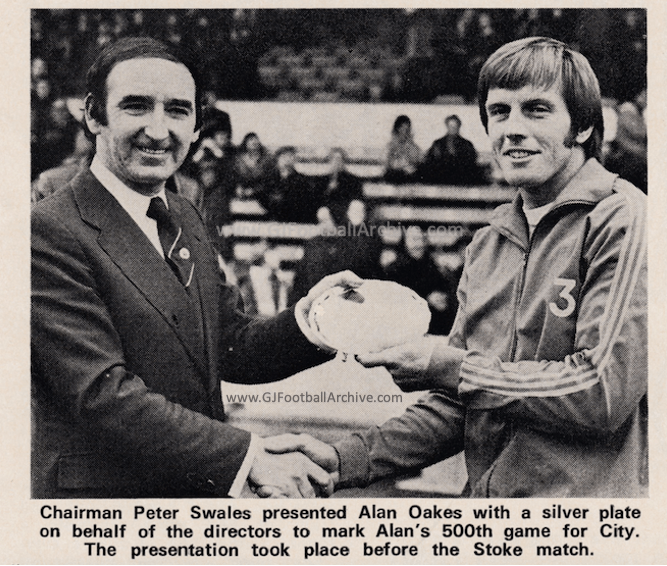
Today (9 November) in 1974 Manchester City presented longserving player Alan Oakes with a silver plate to commemorate his 500th League appearance. He’d actually made his 500th League appearance the previous week when City faced Everton at Goodison.
At Maine Road on 9 November City chairman Peter Swales presented him with the award before the game with Stoke (Oakes made his 501st League appearance that day). City won that match 1-0 with a goal from Rodney Marsh. You can see Marsh’s goal here:
On this day (8 November) in 1996 Manchester City manager Steve Coppell resigned after only 33 days in the job. This contemporary article explains that he was suffering with stress:
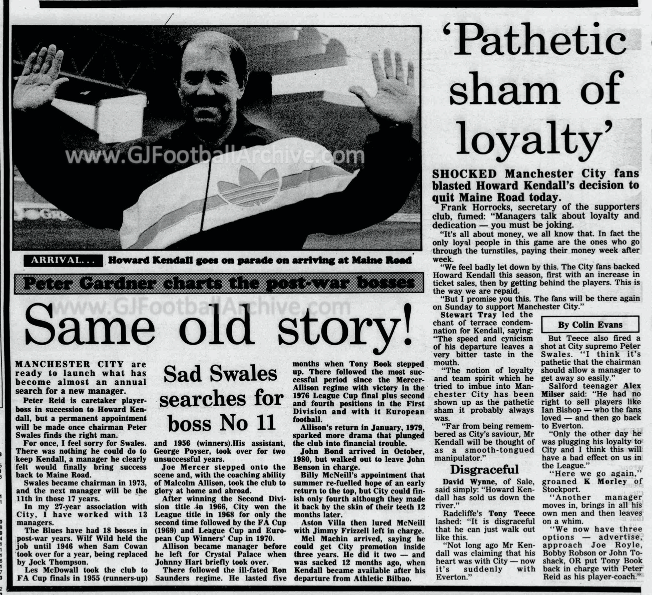
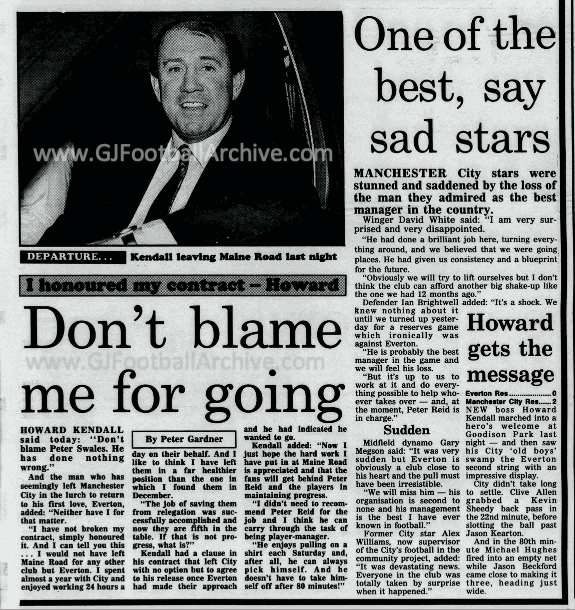
On this day (7 November) newspapers were full of the previous day’s news that had stunned Manchester City and that was the resignation of manager Howard Kendall. Kendall had decided to return to his former club Everton.
The move absolutely stunned City fans (though we did get the blame in some newspapers who claimed we’d never actually taken to him – absolute rubbish and demonstrates the typical attitude of the period which was if anything went wrong blame the fans!). Fans had voiced concern over Kendall’s signing of many, many former Evertonians but overall they were satisfied (more than satisfied) with the manager’s approach at City.
The bottom line with Kendall leaving is that chairman Peter Swales and his supporting directors had given him a contract that allowed him to walk out on the job whenever he chose. It was a strange situation and the belief at the time was that the City board had believed the ONLY job Kendall would be tempted to leave City for was the England job and, with Peter Swales in charge of the international selection committee, the chance of that happening was extremely slim.
Ah well! Here are some newspaper articles from this day back in 1990.
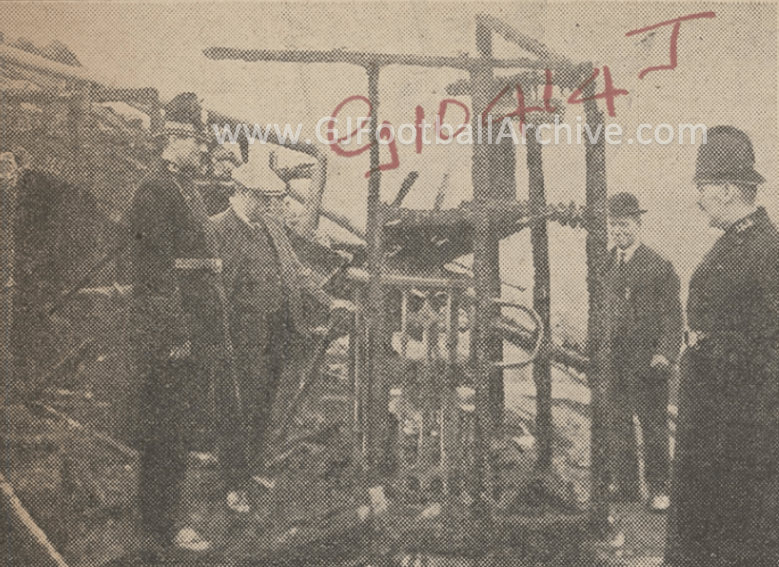
Only a few months after the King had visited Manchester City suffered a major blow when their Main Stand was destroyed by fire (6 November) 1920. Subscribers can read the story of this below (including the story of how City asked United if they could use Old Trafford temporarily which resulted in significant criticism of the Reds in national newspapers) but here’s a rare image that hasn’t been published in any Manchester City publication over the last century or so. It did appear in a contemporary newspaper. Notice the Ellison’s Rush Preventive turnstile that seems to have just about survived.
When City moved to Maine Road quite a few of these turnstiles were taken from Hyde Road and re-erected at Maine Road. In 2003 6 Ellisons turnstiles from the 1890s were still in place and in use during Maine Road’s final season.
In the years that followed the Hyde Rd fire there was a story that developed that the fire was the result of a Irish republican terrorist attack and that both Hyde Rd and Old Trafford were targets. The Old Trafford planned attack was foiled and has been written about in contemporary sources but Hyde Rd’s story cam much later. It doesn’t seem to be the case that the Hyde Rd fire was the result of terrorist activity – if there’s interest then maybe I’ll write the latest research on this in the coming months?
Subscribe to get access: Monthly
Read more of this content when you subscribe today. It costs £3 per month (cancel anytime) and monthly subscribers get access to everything posted since 1 October 2022 and throughout their subscription. Why not try for a month? There’s a special annual subscription for a discounted price and greater access (see below).
Read more of this content when you subscribe today. It costs £20 per year (about £1.67) for this special, discounted annual rate. Annual subscribers get access to everything posted since December 2020 and throughout their subscription.
Today (5 November) last year Manchester City defeated Fulham 2-1 but the victory had not been as straightforward as some had predited. Julian Alvarez opened the scoring after 17 minutes and the Blues looked comfortable but then Cancelo was sent off ten minutes later (a straight red) and City conceded the resulting penalty too.
The Blues seemed up against it and as the game entered added time it felt like it was going to be one of those days. Then De Bruyne was judged to have been fouled when he went down for a penalty deep into added time and Erling Haaland made it 2-1 from the spot kick. The following highlights are worth watching to see what you think of it all but, most significantly, listen to Alistair Mann’s commentary. His final words say in effect that this is the moment that swings the advantage to City in the title race and should be remembered in May as the day City won it. There’s often hyperbole in commentary but those words, recorded in November 2022, do seem to predict the future somewhat:
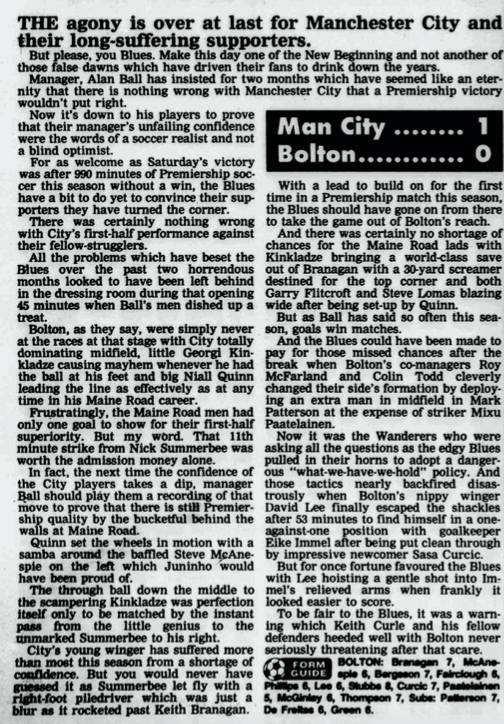
It took a long time to come but on this day (4 November) in 1995 Manchester City won their first League game of the 1995-96 season. Look we could dwell on all those miserable days under manager Alan Ball for months but instead of that let’s just read this Paul Hince match report and remind ourselves that on this day we did think there was a bit of hope. I know it was soon dashed but let’s read this and think ‘yes, City have turned the corner’…
Today (3 November) is the anniversary of the first ever Manchester derby played in the Football League. The match between Manchester City and Newton Heath was played at City’s Hyde Road ground today in 1894. You can read the story of the game (with all the stats, background etc.) here:
On this day (2 November) in 1988 Paul Moulden scored a hat trick for Manchester City in the League Cup third round tie with Sheffield United. The Blues won 4-2 with Trevor Morley netting City’s other goal.
On this day twenty years ago (1 November 2003) Robbie Fowler and Paulo Wanchope both scored as City won 2-0 at Southampton and moved into 5th place in the Premier League. The attendance was 31,952.
On this day (30 October) in 1916 the death of Manchester City defender Pat McGuire was reported in the Manchester Evening News (image) and the Athletic News. McGuire’s story is a tragic one as he was killed in battle but his wife had previously been told of his death several months earlier. Understandably there was a lot of confusion on the battle field but imagine being told your husband had been killed and then a short while later told he’s alive and then only a few weeks after that being told for the second time that he has been killed.
The report in the Athletic News read:
‘It was with very deep regret that news was received at Grimsby on Saturday of the death in action in France of Lance-Corporal P. M’Guire [sic], of the Manchester Regiment, the brilliant young full-back of the Manchester City club, who played for Grimsby Town throughout last season. Last winter he played better football than at any period of his career, and Grimsby regarded him as the best defender who had worn their livery for a decade. He was clear-headed, resourceful, and a master of defensive tactics. Now he has given his life in the greatest of all causes. That something had befallen him had been feared for three weeks past, as Mr. Hickson did not receive any acknowledgement of the letters and parcels of comfort which he and his wife make a practice of dispatching regularly to the “boys” at the front. On Saturday came the sad official news that M’Guire was no more.‘
McGuire joined City from Hurst on 18 Aug 1912 and made his debut v Chelsea (a) 1.3.1913
Former City historian John Maddocks wrote this about him:
Pat McGuire was a full-back who was used mainly as an understudy to the regular backs in the years immediately before WW1, Bill Henry and Eli Fletcher, and as these two were consistent players Pat rarely got a look in. He joined the armed forces for the duration and guested for Grimsby Town, making 31 appearances and scoring six goals. Sadly he was killed in action in October 1916.
Appearances: 15 in the League (plus at least 85 in the reserves)
The story is an incredible one and the following website tells it much better than I can here:





 Gary James' Football Archive