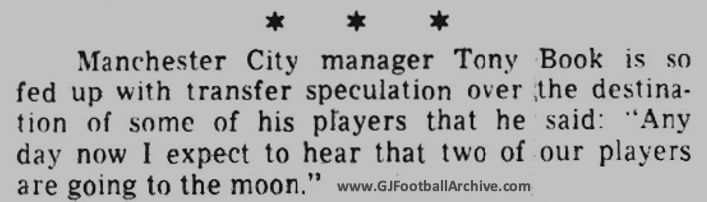
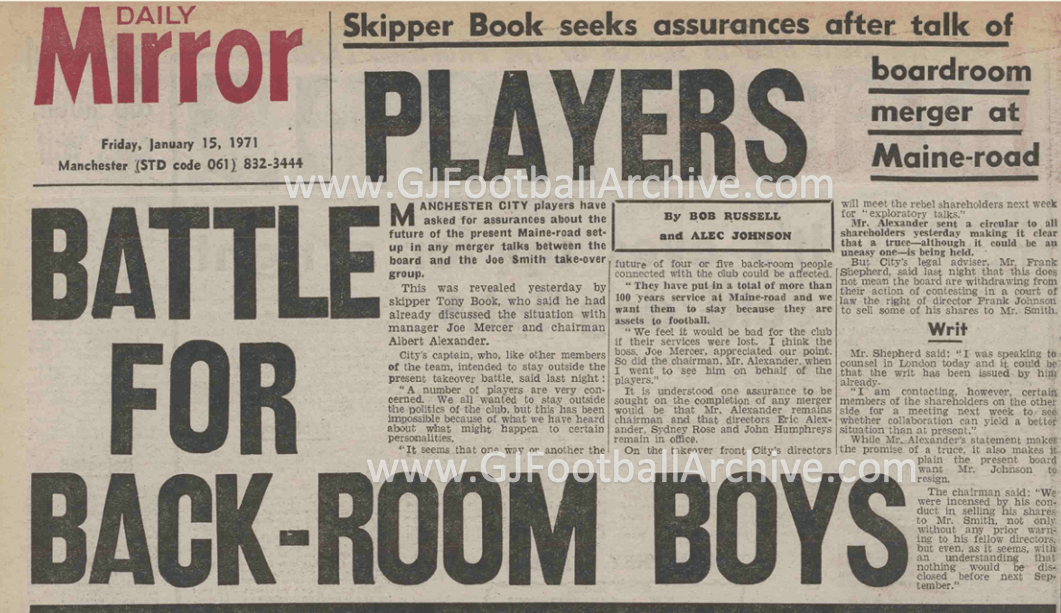
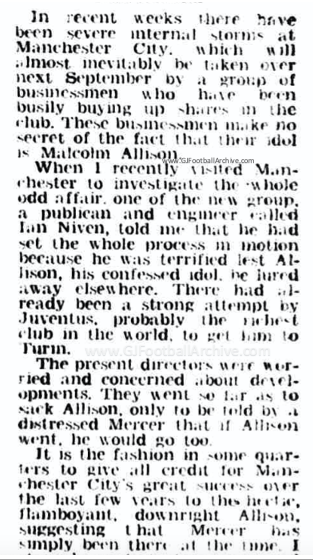
Continuing the series of articles covering the 1980s. Today’s is an on this day (8 December) from 1980. It’s a newspaper story about Joe Corrigan and Steve Daley potentially moving from Maine Road to other clubs. Have a read of the piece. Ultimately Corrigan stayed but Daley never did play for Manchester City again. If you want to know more about the trials and tribulations of this period then why not subscribe and read the following ten thousand word long read on the 1980-81 season. Enjoy!
Subscribe to get access – Monthly
Read more of this content when you subscribe today. It costs £3 per month (cancel anytime) to access everything posted since 1 October 2022 or there’s a special annual rate below which gives greater access and works out much cheaper.
Read more of this content when you subscribe today. It costs £3 per month (above) or £20 a year (here) to access everything posted since the site was created in December 2020. This special rate works out about £1.67 a week and gives access to everything posted, including PDFs of 3 of my books.
Continuing the series of articles covering Manchester City in the 1980s. Today is this brief cutting from today (7 December) in 1986 and concerns City midfielder Tony Grealish. The brief newspaper article talks of the player’s travel plans each day and says that he’s continuing to do this as his contract is only short term. The journey was around 90 miles each way.
Grealish joined City on 23 October 1986 from West Bromwich Albion and did only stay with the Blues until the following close season. He moved to Rotherham in August 1987. His City debut was against Manchester United on 26 October 1986 and ultimately played 11 League and 1 FA Cup game for City (plus 14 reserves and 5 other apps).
This was a time when manager Jimmy Frizzell brought in several experienced players, including John Gidman, to help City’s 1986 FA Youth Cup winning squad develop. If you want to know more about this season then there is a 2,500 word feature below available to subscribers. Enjoy!
Subscribe to get access – Monthly
Read more of this content when you subscribe today. It costs £3 per month (cancel anytime) to access everything posted since 1 October 2022 or there’s a special annual rate below which gives greater access and works out much cheaper.
Read more of this content when you subscribe today. It costs £3 per month (above) or £20 a year (here) to access everything posted since the site was created in December 2020. This special rate works out about £1.67 a week and gives access to everything posted, including PDFs of 3 of my books.
Continuing the series of articles covering the 1980s. Today’s is an on this day (6 December) from 1980. It’s a photo of tenacious Gerry Gow scoring for Manchester City against Bobby Robson’s Ipswich Town at Maine Road.
City were losing 1-0 and then in the 76th minute a scramble in the visitors penalty area saw Phil Boyer (centre of this photo) battling for the ball close to future City ‘keeper Paul Cooper. In the end it’s Gerry Gow, on the right being challenged by John Wark, who digs out the ball and sends it goalwards to make it 1-1.
This was a season of classic games against Ipswich, who were chasing a potential treble trophy success. You can read about the others if you’re a subscriber. Subscribers can read the following ten thousand word long read on the 1980-81 season. Enjoy!
Subscribe to get access – Monthly
Read more of this content when you subscribe today. It costs £3 per month (cancel anytime) to access everything posted since 1 October 2022 or there’s a special annual rate below which gives greater access and works out much cheaper.
Read more of this content when you subscribe today. It costs £3 per month (above) or £20 a year (here) to access everything posted since the site was created in December 2020. This special rate works out about £1.67 a week and gives access to everything posted, including PDFs of 3 of my books.
Today’s feature in the series covering Manchester City in the 1980s is a reminder of the day when Dennis Tueart headed home to give City a home victory over champions Aston Villa. The game was played on this day (5 December) in 1981 and had lots of angles to it. One of which was the return of former City boss Ron Saunders. You can watch the highlights here:
If you want to find out more on this period then why not subscribe. As well as lots of other features, subscribers can read a 2,500 word feature on the 1981-82 season for the Blues below. Enjoy!
Subscribe to get access – Monthly
Read more of this content when you subscribe today. It costs £3 per month (cancel anytime) to access everything posted since 1 October 2022 or there’s a special annual rate below which gives greater access and works out much cheaper.
Read more of this content when you subscribe today. It costs £3 per month (above) or £20 a year (here) to access everything posted since the site was created in December 2020. This special rate works out about £1.67 a week and gives access to everything posted, including PDFs of 3 of my books.
Continuing the series of articles covering Manchester City in the 1980s. Here’s a nice article from this day (5 December) in 1987. It was a piece praising Manchester city’s youth players with quotes from Nobby Stiles, the legendary Manchester United and England star. High praise indeed and these players deserved the focus.
Subscribers can find out more about the 1987-88 season by reading my 4,000 word feature on it below. Enjoy!
Subscribe to get access – Monthly
Read more of this content when you subscribe today. It costs £3 per month (cancel anytime) to access everything posted since 1 October 2022 or there’s a special annual rate below which gives greater access and works out much cheaper.
Read more of this content when you subscribe today. It costs £3 per month (above) or £20 a year (here) to access everything posted since the site was created in December 2020. This special rate works out about £1.67 a week and gives access to everything posted, including PDFs of 3 of my books.
Continuing the series focusing on Manchester City in the 1980s here’s a brief reminder of Tommy Caton and a day (4 December) in 1982 when he scored twice to give City a 2-1 victory over his future club.
The photo shows central defender Caton sending a 52nd minute header past Arsenal ‘keeper George Wood, following an Asa Hartford corner. This gave City the lead at Maine Road but then five minutes from time the away team equalised. In the last minute another corner (this time from Paul Power) led to Caton leaping to send the ball home and give the Blues a 2-1 victory.
Two days later Caton was called up to the full England squad for a European Championship qualifier. Caton was a gifted defender who should have played regularly for England. Sadly, it was not to be.
If you want to know more about this period then why not subscribe? As well as all the other benefits you could read the following 3,500 word feature on the 1982-83 season. Enjoy (well, if you know the outcome of this season you can enjoy this memory refresh while reflecting on the modern day successes of the Blues!).
Subscribe to get access – Monthly
Read more of this content when you subscribe today. It costs £3 per month (cancel anytime) to access everything posted since 1 October 2022 or there’s a special annual rate below which gives greater access and works out much cheaper.
Read more of this content when you subscribe today. It costs £3 per month (above) or £20 a year (here) to access everything posted since the site was created in December 2020. This special rate works out about £1.67 a week and gives access to everything posted, including PDFs of 3 of my books.
The series of articles covering Manchester City in the 1980s continues today with a reminder of the day Brian Horton damaged the Maine Road away team dressing room door. Future City boss Horton was then the manager of Oxford United. This article from this day (3 December) in 1988 explains how he was unhappy following his team’s dramatic 2-1 defeat the previous Saturday. City had been losing 1-0 with only a few minutes to go and then two dramatic late goals gave the Blues the victory. You can watch highlights here:
I think we can all understand Horton’s frustration. As part of his anger Horton left the door hanging on just one hinge! Rumours had suggested the Blues would make him pay for the damage but Peter Swales, the City chairman, said that there’d be no charge afterall.
It’s all a story about nothing really but is a nice reminder that in the days before social media these things still happened, they were just reported differently. Now this would be a major incident with apologies demanded and who knows what but back then it’s simply filling a space in the Manchester Evening News.
If you want to know more of the 1988-89 season for Manchester City Football Club then why not subscribe and read the following 4,100 word feature on the 1988-89 season. Enjoy!
Subscribe to get access – Monthly
Read more of this content when you subscribe today. It costs £3 per month (cancel anytime) to access everything posted since 1 October 2022 or there’s a special annual rate below which gives greater access and works out much cheaper.
Read more of this content when you subscribe today. It costs £3 per month (above) or £20 a year (here) to access everything posted since the site was created in December 2020. This special rate works out about £1.67 a week and gives access to everything posted, including PDFs of 3 of my books.
The series of features covering the 1980s for Manchester City continues with a reminder of a day when City chairman Peter Swales made a huge mistake. This cutting is from this day (2 December) in 1989 and refers to the Blues’ attempts to appoint Joe Royle as manager. However, by the time this article was published Swales had already messed things up.
He’d appeared on Granada TV’s Kick Off programme on the Friday night saying how he wanted Oldham boss Royle to replace Mel Machin. Unfortunately, Oldham had a game that night and Swales’ comments on TV helped inspire a series of emotional pleas and chants for Joe Royle not to leave Boundary Park. Their game basically became a Joe Royle tribute night and the emption of that night meant City did not get their man. At the time City fans would call days like this ‘Typical City!’ as cock-ups by the chairman and his supporting directors dogged the club’s development.
Note the comment about Tony Book in the image. These were the days when he often was dragged into managing the team on a temporary basis.
If you want to know more about that weekend and the entire 1989-90 season then become a subscriber and read the following 8,000 word article on that season. Enjoy!
Subscribe to get access – Monthly
Read more of this content when you subscribe today. It costs £3 per month (cancel anytime) to access everything posted since 1 October 2022 or there’s a special annual rate below which gives greater access and works out much cheaper.
Read more of this content when you subscribe today. It costs £3 per month (above) or £20 a year (here) to access everything posted since the site was created in December 2020. This special rate works out about £1.67 a week and gives access to everything posted, including PDFs of 3 of my books.
Following the unveiling of the Bell, Lee and Summerbee statue earlier this week I’ve decided to re-publish here interviews I did with each player at some point over the last decade or so. These interviews are written in a question and answer style and I hope they help give a flavour of each man. For older fans it’s a chance to remember them in their pomp. Today it’s the turn of Mike Summerbee. I’ve never posted this before on here – It’s an interview I did with him City in April 2005. This was published in the City match programme back then and you can read Mike’s views on his career here as published at the time. Enjoy!
Mike Summerbee was the second player, after Ralph Brand to join Joe Mercer’s City in 1965. Over the following decade he became a major star and played a significant role throughout the Mercer-Allison glory years. Always the entertainer, Mike featured in the classic footballing wartime adventure film “Escape To Victory” and today assists the Club’s commercial activities. Last week author Gary James caught up with him at the Manchester City Experience.
Let’s start with “Escape To Victory”. How did you get involved in the filming of that movie?
It was Bobby Moore who got me involved. We’d known each other since I was 16, and we both had a similar outlook. The makers of the film had got several Ipswich Town players involved, plus Pele and of course Bobby. They needed another familiar British player and Bobby suggested me. He called me and said: “How do you fancy being in a movie with Michael Caine?” And that was it. Within three weeks I was on my way to Budapest for filming. I had no idea at the time that this would become one of those films still being shown and talked about twenty odd years later, but it has become a cult movie with websites dedicated to it. It’s the sort of film that many other people would have wanted to be in. I know for a fact that Rod Stewart wanted to be in it.
Why do you think the film is remembered so affectionately?
I don’t want to give too much away – everyone should come to our special showing and see the movie and hear my reasons then – but the film is like a Boys’ Own adventure. It’s got drama, excitement, and is a traditional film. It doesn’t rely on bad language, sex, or extreme violence, and it really does appeal to everyone. Don’t forget it also contains some great actors – everyone remembers Stallone and Caine but look at the other cast members as well – and then there are some very well known footballers including Pele.
I loved making the film and one of the great aspects for me was that when we came to the football scenes we were told to go out and play the game. John Huston – a great director – wanted it to look as realistic as possible and so we played a real game. Inevitably we had spells concentrating on tackling or shooting but much of the game came from real play. Pele’s wonderful overhead kick goal was natural and was done only once. We didn’t take ages setting up, re-shooting etc. It was done for real and only in one take. John Huston had cameras everywhere and tried to make sure everything that took place on the pitch was filmed from every angle. That makes it so much more real.
You have a speaking part in the film, did you know about that before you accepted?
We were told to let the actors act and they were told to let the footballers play. That way we all did what we were good at. Then when it came to the dressing room scenes Michael Caine said to Huston that it didn’t feel right for only the actors to talk and he said that a couple of us should speak. When it came to half time, I congratulated a couple of players on their play – that was natural not planned – and that stayed in, and then other lines were given to us. It felt strange, but when you watch the film it makes much more sense to have us speaking. I loved making the film and there are so many different aspects to talk about, but we’ll save that for the 5th May event.
Moving back to your playing career, we all know that you came from a footballing family, but did that mean it was something you had to do?
My dad played professionally and so from an early age it seemed natural to play. All boys loved playing back then anyway, so there was nothing strange about that, but I suppose when you are young whatever your father does has a greater importance. My brother was a better player than I, although he stopped playing when my Dad died, and we used to play whenever and wherever we could. I’d get to school as early as possible – not for the lessons, I was a dunce! – but for the kickabout. We’d have a tennis ball and play until we had to go in. I also played cricket, athletics and other sports, but football was my best.
Your progression into professional football seems rapid – you were a key feature of the Swindon team in your teens – were there any setbacks?
I’d had a spell at Bristol City when I was 15, but I was so homesick I had to give up on it. My mother worried about me and suggested I kept out of the game. She knew about the problems and difficulties a footballer could have because of my father’s career, and then the opportunity came with Swindon and everything started going right for me. I joined them at a time when they were ready to give youth a chance and I made my debut at 17.
Was life relatively easy for you then?
The life of a footballer was not as glamorous or financially rewarding as it is today. I loved playing and I loved the camaraderie of it all, but we all had to have other jobs to keep us going outside of the season. I used to end up working for the Corporation cutting grass, painting, oddjobs, and digging graves! It kept you in touch with the fans – both the living and the dead! – and I actually loved all of that time. We didn’t have flash cars or anything then. In fact Ernie Hunt and I had a tandem, and we used to cycle together on our tandem to the ground. It was a great, fun time, and I have very fond memories of it all.
One of the significant angles is that Joe Mercer was interested in signing you from fairly early in your career, were you aware of his interest?
To some extent yes. Joe had played with my father at Aldershot, and then Swindon played Joe’s Aston Villa in a testimonial game. We won and I scored a couple, and Joe even played wing-half for Villa. After that I was told he wanted to sign me for Villa and that he’d made a bid but nothing further happened. I don’t know if it was problems at Villa or what but some time after that Joe moved on, and then in 1965 he got the City job. I was in Torquay and I gave him a call – I thought it was time to make the move and chance my arm a little. Joe said he’d be in touch. Then serious interest came from City and I was off.
Did City mean much to you as a boy?
Because of where I lived I’d travel to Birmingham to watch games and whenever City played Villa I used to enjoy seeing Bobby Johnstone, Ken Barnes, Bert Trautmann and the rest. They were such a great and in many ways glamorous side to watch, and the pale blue shirt – a colour I still don’t believe we’ve managed to recreate properly – was so memorable. No other side could match that colour and City were unique. All of those great memories were in my head and I was desperate to play for City when Joe came here. Although they were in Division Two when I arrived they were a major, major side with a great stadium. I loved Swindon, but City were something else.
Everyone talks about the atmosphere around the place, how did you find it?
Joe lifted the spirits of everybody, that was clear, and Malcolm Allison was so ahead of his time and knew all about psychology. He knew what players needed, and he always knew the best way of getting more out of me was by winding me up. I think I was a consistent player, and at half time in one game we’d had a bit of a bad spell. I’d played well, but one or two players had struggled and we all knew it, but in the dressing room Mal went up to the two players and told them they were doing well and that they just had to keep plugging away. He was boosting their confidence I guess and they certainly were more confident in the second half. When he came to me he said I was playing the worst game ever and that I was letting everybody down! It wound me up so much I had a go back at him, and then when we got on the pitch I pushed and fought for everything to prove how wrong he was and I gave 120% – his trick had worked!
During your first year at City (1965-66) England manager Alf Ramsey came to watch you play, and eventually you became the first City man since Don Revie in 1956 to play for England. Were you aware of the attention?
When Ramsey came to watch me the attention was good and, considering Alf concentrated on his ‘wingless wonders’, it was great for me a winger to be considered. I’d been included in the squad from almost immediately after the World Cup win, then I made my England debut against Scotland at Hampden (February 1968) in front of about 150,000, alongside the likes of Moore & Charlton. I was very nervous but they helped to calm me and at half time both Bobbys told me I was doing well, so that helped. In the end every one of my England appearances came at centre-forward, so I guess the style of play limited my opportunities, but I loved playing for England.
What was Alf Ramsey like as a manager?
He was definitely a ‘player’s manager’. He handled us well, and I believe that he was, in the end, treated appallingly be the FA. He treated us exceptionally well and he was a great man to play for – I don’t believe that England have ever managed to find a permanent manager who can match him. He had the same sort of authority as Joe Mercer, but they were different characters. Joe was wonderful with the media and the public, while Alf was primarily a players’ man. There was one time, we’d lost 2-0 at Katowice (1973) and I’d been on the bench. We were pretty down. Alf knew how low we were but because we were playing in Moscow a couple of days later he told everybody to get to bed early, no drinking or anything.
We all sneaked into Bobby Moore’s room and had a few gins. Sir Alf caught us and we thought he was going to have a go. He said: “I thought I’d told you not to drink! But in the circumstances I’ll have a large gin and tonic please.”
Throughout the Sixties and Seventies, City never seemed to fear any opposition, is that something that came from the players?
Obviously, Joe and Malcolm bred a certain atmosphere which boosted confidence. Whenever we played United we’d get to Trafford at 12.30 simply to soak up the atmosphere and to be ready. Mal would swagger to the Stretford End before the game to tell them how many we’d win by, and we’d go out there and match his score, although we used to encourage him to keep the expectation down a little! For us it didn’t matter whether we played Shankly’s Liverpool, Busby’s United, or any other team because we knew we were more than a match for any of them. Some of these teams possessed better individual players but, particularly at Old Trafford, we were always the better side. We had a great team spirit. People always talk about Lee, Bell and Summerbee like Charlton, Law and Best, but our side wasn’t about three players, it was about the whole team. Oakes, Pardoe, Young…. You know all the players. Unfortunately the 3 player line is a good one for the media to focus on, but for the players it was always about the team. I always think it’s wrong to talk about Lee, Bell, & Summerbee. We were part of a great, strong side and, although the 3 of us were well known, we needed that entire side to bring City success.
Finally, you’ve always been known as an entertainer, and always had a great rapport with fans and the media, presumably this is a very important aspect to your life?
As a player I used to meet the fans as often as possible – we all would. We’d have lunch in the old Social Club all mixed together, we’d attend supporters & Junior Blues meetings; take part in the pantomime every year; and generally be out and about. We also used to get on well with the media. The journalists were always good honest judges back then – people like Frank McGhee and Richard Bott always talked truthfully about your performance. If they said I’d had a bad game, I knew I had. They weren’t out to knock you, or to build you up. They spoke honestly and so I enjoyed talking with them.
Mike Summerbee receiving his OBE from Prince William March 2023
For me football is entertainment and the game itself is sometimes less important than everything that surrounds it. I don’t miss playing, but I do miss the camaraderie we had. I miss the team spirit we had with City, England, and even during the filming of Escape To Victory. It’s the same camaraderie fans feel on the terraces. That’s why I enjoy my involvement with the Club today because it’s all about the fans, the City spirit, and the wonderful life that surrounds the game.
Subscribe to access great content and support Gary’s research
If you’ve enjoyed this piece then why not subscribe and read the rest of the great material on here. At the same time you’ll be supporting my research and writing (I’m not employed by anyone and my research/writing is self-funded). It costs £3 per month (here; access everything posted since 1 October 2022) or £20 per year (below; access everything posted since December 2020). You’ll also get to read all content posted during your subscription. Thanks.
Subscribe to access great content and support Gary’s research
If you’ve enjoyed this piece then why not subscribe and read the rest of the great material on here. At the same time you’ll be supporting my research and writing (I’m not employed by anyone and my research/writing is self-funded). It costs £3 per month (above) or £20 per year (here; access everything posted since December 2020). You’ll also get to read all content posted during your subscription. Thanks.
Continuing the series of articles covering the 1980s. Today’s is an on this day (1 December) from 1980. It’s a newspaper story about former boss Malcolm Allison and his comments about Manchester City. Allison claimed he was responsible for the form of City AFTER they’d sacked him. Joe Corrigan was angry by the comments and so was John Bond, but Bond did admit that Allison was 90% responsible for Bond’s achievements at West Ham as a player. Have a read of the piece but if you want to know more about the trials and tribulations of this period then why not subscriber and read the following ten thousand word long read on the 1980-81 season. Enjoy!
Subscribe to get access – Monthly
Read more of this content when you subscribe today. It costs £3 per month (cancel anytime) to access everything posted since 1 October 2022 or there’s a special annual rate below which gives greater access and works out much cheaper.
Read more of this content when you subscribe today. It costs £3 per month (above) or £20 a year (here) to access everything posted since the site was created in December 2020. This special rate works out about £1.67 a week and gives access to everything posted, including PDFs of 3 of my books.