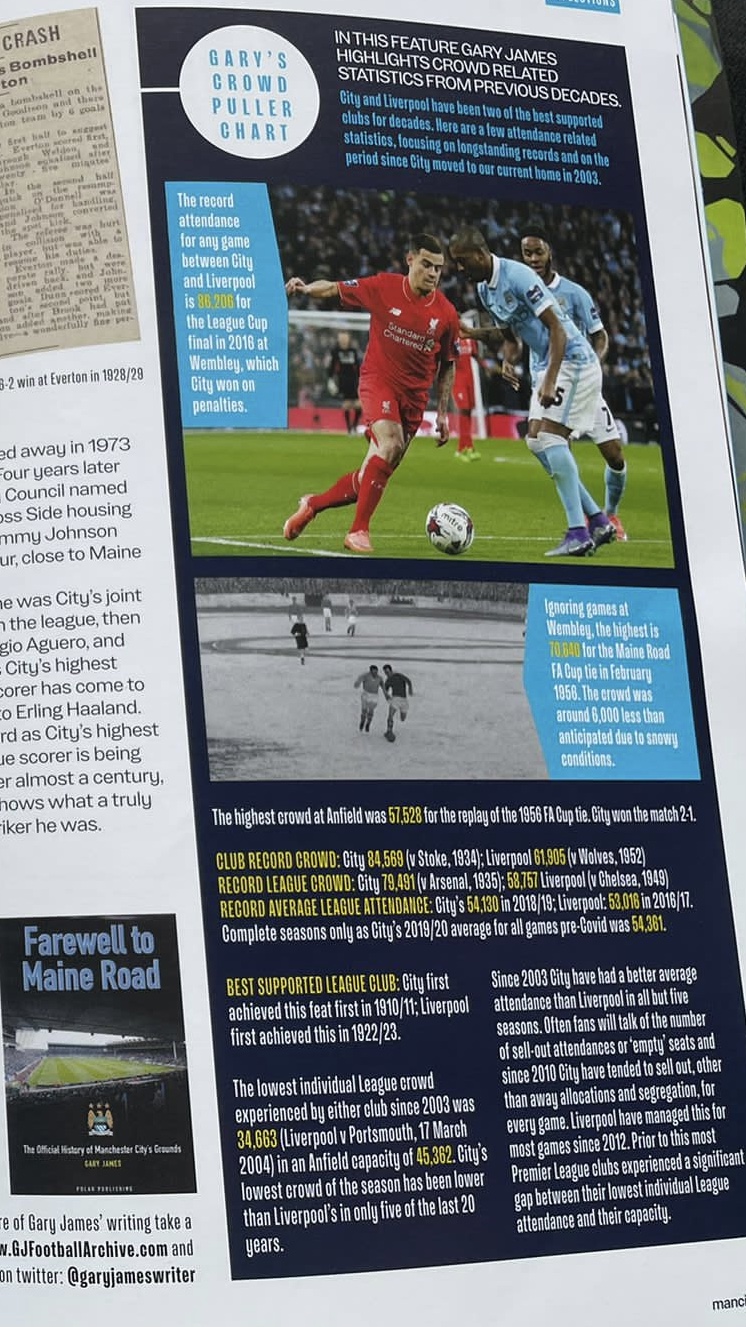
Today’s the latest in a long line of meetings between Manchester’s Blues and Liverpool’s Reds. The first competitive meeting was on 16/9/1893 (as Ardwick)) with the first meeting as Manchester City coming on New Year’s Day 1896.
In total there have been 180 League games and many of these have been featured on this site over the years, such as this meeting at Anfield:
If you enjoy all the free material on my website and would like to support my research and keep this website going (but don’t want to subscribe) then why not make a one-time donation (or buy me a coffee). All support for my research is valued and welcome. It allows me to keep some free material available for all. Thanks.
It’s now almost 40 years since I first started detailed research into the history of Manchester City and its origins, and it’s an area that is still fascinating. I still keep being asked about the origins of Manchester City, particularly the period prior to 1894 and I love the fact so many are interested in the steps that led to the establishment of what has become a major, global footballing power. I’ve posted much about those early years on this site but I know it’s often in a scattered style making it difficult to find, so here for those interested, are links to past articles on key figures and moments in the St Mark’s, West Gorton, Gorton AFC, Ardwick & associated clubs’ history. Tomorrow from noon for 24 hours I’ll be giving free access to a video I did a while back on the origins (details of the video lower down this page).
Firstly, the earliest known game (note: not necessarily the first game!):
Walter Chew, a man occasionally described as ‘The Father of Manchester City’ (though he himself tells a different story and in a 1920s interview told his eye witness story of who the actual founder was):
A man every Blue should know about, Lawrence Furniss. A player with Gorton, Ardwick secretary-manager, MCFC director, chairman responsible for move to Maine Road, Life President when City won the title in 1937. He saw it all and was involved from the 1880s through to 1940s when he died:
The facts not the fiction…. There are so many myths, assumptions, exaggerations etc. doing the rounds so hopefully this piece I wrote a few years back helps to explain:
On 1 February 2023 I performed an online talk on the latest research into the origins of City, focusing on the period prior to 1887 when the club was based in the West Gorton and Gorton areas. Tomorrow from noon I’ll post this for all to see for free for 24 hours, but if you can’t wait or miss it then it is already available here for subscribers to the site:
There are still many gaps in our knowledge even though material has been rediscovered in recent years. There are some things we won’t know but over the coming weeks I’ll post more on the early years. Some will be available to all, some to subscribers but I’m sure there’ll be lots out there to enjoy.
In the meantime why not search the website or use the tags to see articles on the period prior to 1894. Every season of the 1890s for example has a detailed article written about it while individual games, players and related stories are also included within the thousands of posts on this site. Here’s a link to the 1890-91 season for example:
The origins of Manchester City, like many other clubs, have been misunderstood or incorrectly reported over the years and there are many areas of ongoing research that will fill the gaps over the coming years. It takes time and effort to research at the level needed. When I first started researching there were some stories that had been passed down for years that have since been challenged and corrected but there are many other areas to reflect on. There are, of course, many other areas where further research is still needed.
For years I’ve worked with a variety of people on the origins of City (one of the key elements of my PhD research was on the origins of men’s and women’s football in Manchester and my research into this continues). In the 2010s MCFC set up a research group called Project Blue which I willingly helped and explained the myths that exist and what we still don’t know. The following slide was part of a lengthy presentation I performed on 14 December 2011 on that where I explained how we got where we were at the time and those who had worked together on uncovering the club’s early history.
One of my slides presented to the history research group Project Blue on research into Manchester City’s origins on 14 December 2011
I was always grateful to Dennis Chapman, John Maddocks and Ray Goble who welcomed me into their ‘club’ of research and others, such as Dave Masey who, like me, was a member of the Association of Football Statisticians. Dave continues to help my research. Thanks to these guys and others when I was starting out I have tried to ensure I help and support others researching. The more we research and share, the greater our collective knowledge.
There is still much to be done and sadly lots we will never know.
Whatever research is uncovered over the coming years one thing is clear and that is the history and origins of Manchester City are wrapped up in community initiatives and a desire by some to use football as a positive, community building enterprise. People like William Sumner, Walter & William Chew, Lawrence Furniss and Joshua Parlby should always be remembered for their part in the formative years of football in our city.
There is much research still to be done. If you’d like to support this research then please subscribe to the site and you’ll have access to hundreds of articles, interviews, talks etc. You could join for a month and see what you think.
Subscribe to get access – Annual
To support the site and have access to everything posted costs £20 a year (about £1.67 a month) or £3 to subscribe a month at a time (see below).
Monthly subscribers access everything posted since 1 October 2022 and can cancel anytime. All subscribers access everything posted during their subscription too.
If you enjoy all the free material on my website and would like to support my research and keep this website going (but don’t want to subscribe) then why not make a one-time donation (or buy me a coffee). All support for my research is valued and welcome. It allows me to keep some free material available for all. Thanks.
Manchester City’s meeting with Liverpool on this day (7 February) in 2021 was considered by some as the day the Blues’ run of great results would end. Playing at Anfield against the reigning champions was expected to be tough and, indeed, the first half was tight with little between the sides. In the 37th minute a great opportunity to take the lead was missed when a penalty, given for a foul on Sterling, was fired over by Gundogan. City fans watching at home due to Covid restrictions felt fate was working against them.
However, the second half started positively when, in the 49th minute, Gundogan lashed in a rebound after Liverpool ‘keeper Alisson had parried a Phil Foden shot. The lead didn’t last though as Mo Salah scored from the penalty spot in the 63rd minute. Ten minutes later Gundogan was played in by Foden to convert from close range after a defensive mix-up to make it 2-1. Three minutes later (76th minute) Sterling’s diving header from a clever cross by Bernardo Silva made the score 3-1.
Man of the match Phil Foden completed the scoring in style with a sizzling strike (83rd minute). It was thoroughly deserved as Foden had been outstanding throughout the game.
The 4-1 victory lifted City five points clear of second-placed United and with a game in hand. This was also Pep Guardiola’s first win as a manager at Anfield. He summed up the game well: ‘I have a lot of emotions, many things happening in the game. Gundogan missed a penalty – it’s like a routine against them – but we started really, really well, doing what we want to do. In the second half, the way we reacted to the goal, the way we played with quality, made the difference.’
When asked about the destination of the League title he responded: ‘It is an important win, but it is February. Of course, the gap to fifth is big right now and [qualifying] for the Champions League next season is important – but 10 [League] wins in a row in this period is something exceptional.’
Match Stats
7 February 2021
Liverpool 1 (Salah) City 4 (Gundogan 2, Sterling & Foden)
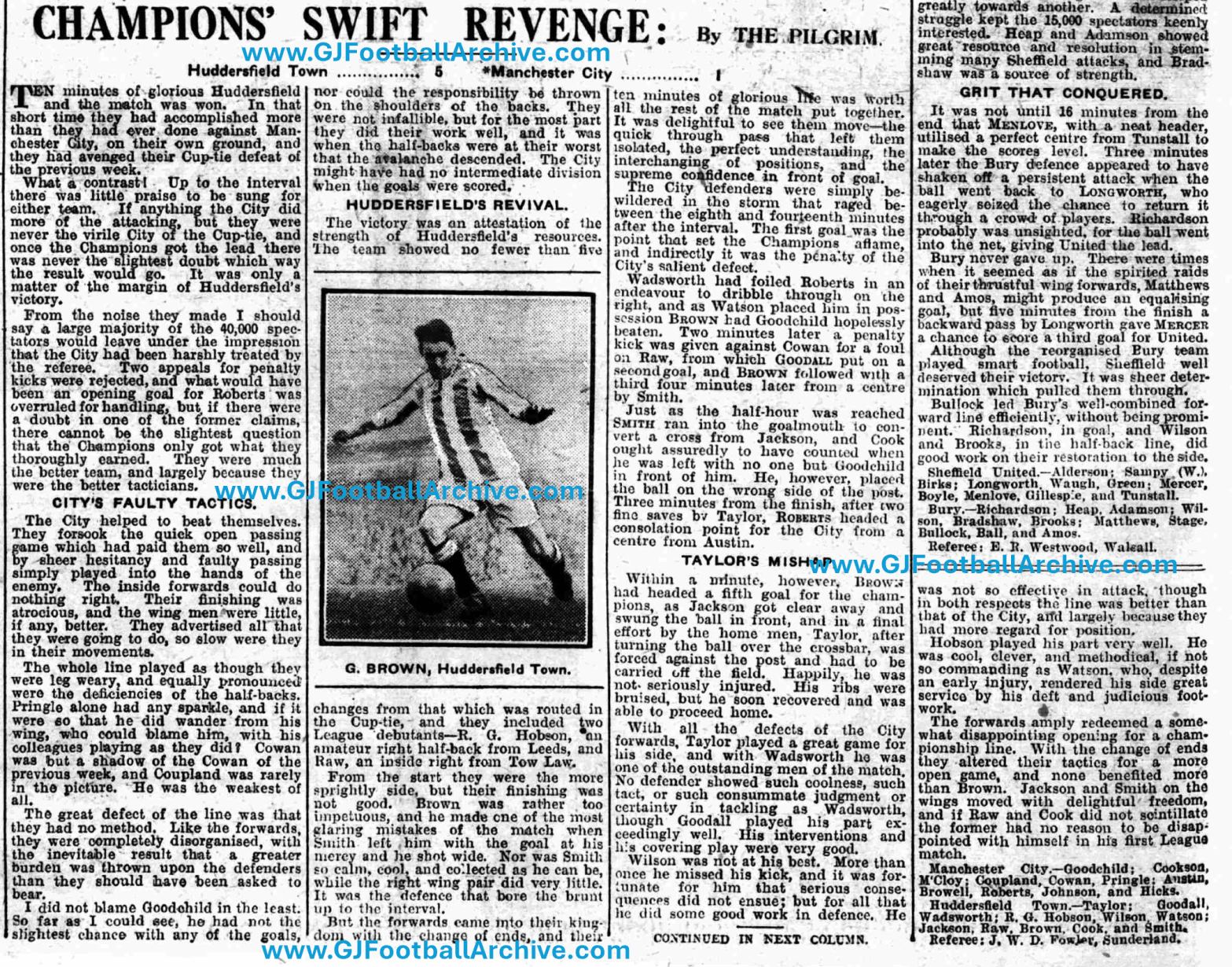
100 years ago today (6 February 1926) and only a week after 74,799 had watched Manchester City defeat reigning League champions Huddersfield Town 4-0 in the FA Cup at Maine Road the two teams met again. This time the visitors to Maine Road gained revenge for their humiliation by defeating City 5-1. This newspaper report explains all and shows how, despite City ultimately reaching the FA Cup final, the two clubs were heading in opposite directions. Huddersfield would retain the title (their third in a row; only one club has ever achieved four in a row) but City would be relegated at the season’s end.
The City scorer in the League game with Huddersfield was Frank Roberts.
If you’d like to know more about this season for Manchester City why not read the following 4,900 word subscriber article on the 1925-26 season. If you subscribe (see below) I hope you enjoy it. If you are not currently a subscriber then why not try it for a month (£3 per month or sign up for a year at a discounted £20 per year)?
Here’s the article:
Subscribe to get access
Read more of this content when you subscribe today. It costs £3 a month (cancel anytime) or sign up for a year at £20 per year. Subscribers have access to the 1000s of articles, features, interviews etc. posted so far and all those posted during your subscription.
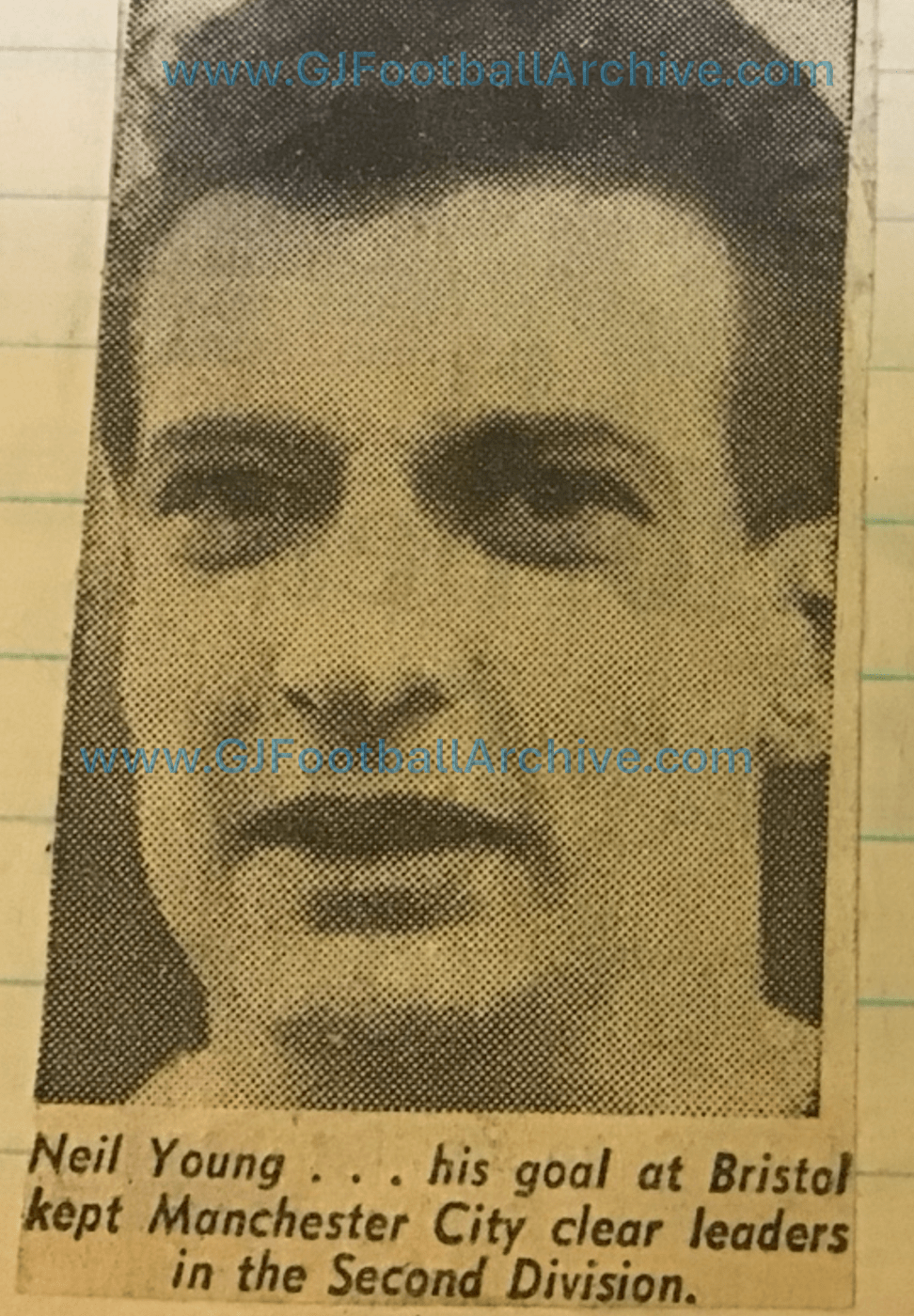
Today (5 February) in 1966 a goal from Neil Young brought City a 1-1 draw at promotion chasing Bristol City. League leaders Manchester City saw this as a point gained rather than one dropped and the wider media coverage talked positively of Manchester’s side. Were you at Bristol that day? If you were please feel free to add your comments.
Here for subscribers are match reports from this game:
Subscribe to get access
Read more of this content when you subscribe today. It costs £3 per month (cancel anytime) or sign up for a year at a time at a discounted price of £20 per year. This gives access to every article, book, interview etc. posted to the site so far. Why not sign up for a month and see what you think?
You can find out more on Manchester City during the 1965-66 season by reading the following 4100 word article. As with most of the other features in this series it includes words from interviews I have performed with those who were there. This is a subscriber article (see below).
Subscribe to get access
Read more of this content when you subscribe today. It costs £3 per month (cancel anytime) or sign up for a year at the discounted price of £20 per year (works out £1.67 per month). Subscribers access the 1000+ articles posted so far and the others scheduled during the life of your subscription.
If you enjoy all the free material on my website and would like to support my research and keep this website going (but don’t want to subscribe) then why not make a one-time donation (or buy me a coffee). All support for my research is valued and welcome. It allows me to keep some free material available for all. Thanks.
The entertainer Norman Wisdom was born on this day (4 feb) in 1915 so a good excuse to remember the day when he larked around on the Maine Rd pitch (and some claimed they thought it was Peter Reid). It’s always worth reminding ourselves of the days when he’d come out on to the pitch, fall over while taking a penalty and similar antics. Often supported by musician Rick Wakeman too! On one of the days in the 90many of us stood on the Kippax saw the elderly entertainer take to the field but didn’t recognise him at first. In fact many of us thought it was Peter Reid wearing a flat cap!
There were lots of odd prematch activities over the decades and you can read about them in this 2000 word article on the history of pre-match entertainment at Manchester City. There are mentions of the St Joseph’s Industrial School and Beswick Prize Bands, various DJs, athletic challenges, Norman Wisdom, Frank Sidebottom & more. Enjoy:
Subscribe to get access – Annual
Read more of this content when you subscribe today. It costs £20 a year (less than 6p a day) to access everything posted since the site went live in December 2020 (books, interviews, videos, history talks etc.) and throughout your period of subscription. Or you can subscribe a month at a time for £3 (cancel anytime; see below)
Monthly subscribers have access to everything posted since 1 October 2022 (books, interviews, videos, history talks etc.) and throughout your period of subscription. It costs £3 per month (cancel anytime)
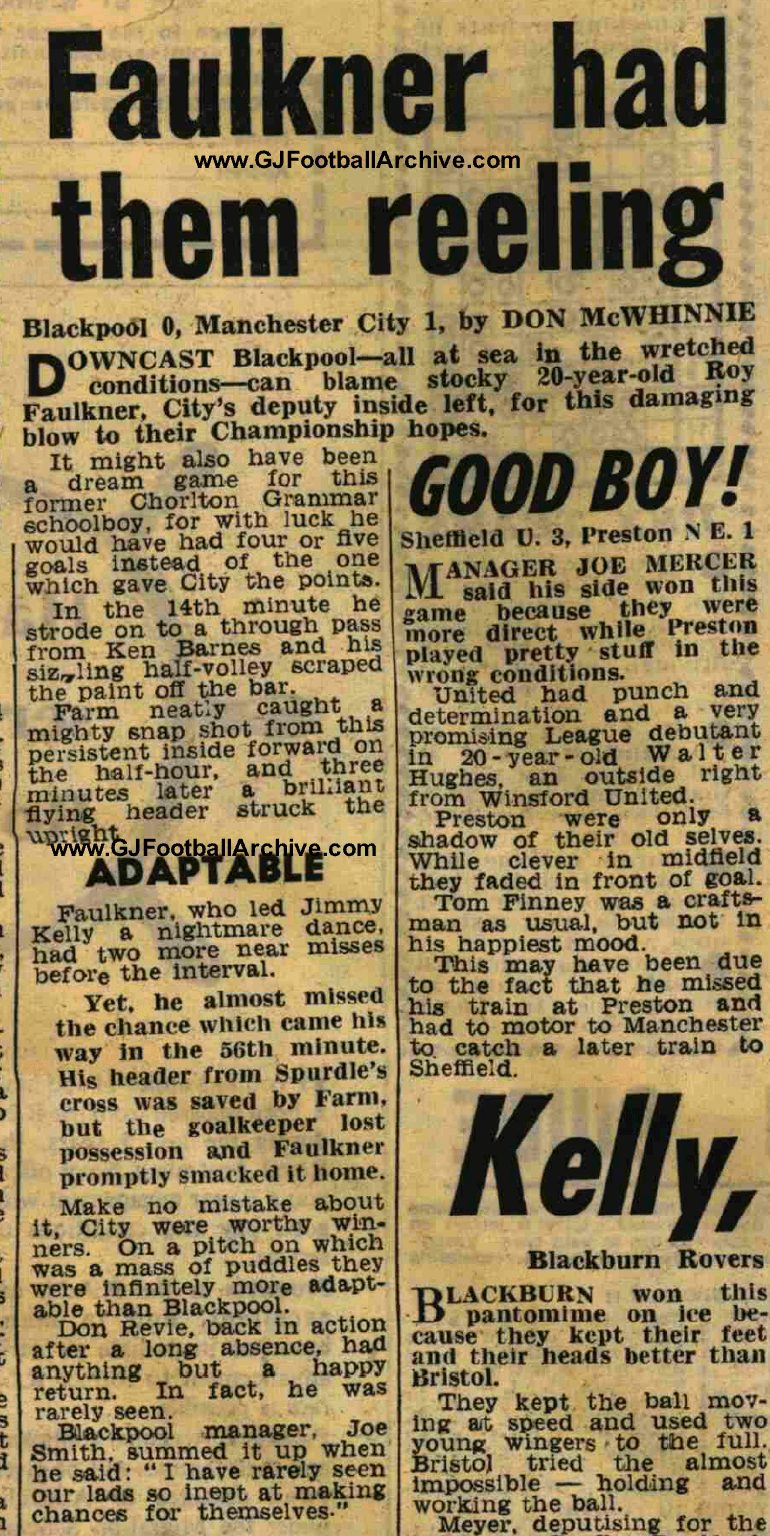
Seventy years ago today (4 February 1956) Stanley Matthews made his 250th league appearance for Blackpool on a snow covered Bloomfield Road ground. In treacherous conditions Manchester City defeated the home team 1-0 with a goal from Roy Faulkner. Interestingly Faulkner only ever made 7 first team appearances for City but scored 4 goals. This match report highlights Faulkner’s contribution. Notice also the mention of Joe Mercer’s early managerial career (Sheffield United match report).
You can read more on Manchester City in the 1950s with this 3,900 word article on the 1955-56 season when City won the FA Cup final (nowadays known as the Trautmann Final) and Bert Trautmann was FWA Footballer of the Year (presented in the days before the final). Enjoy!
This is a subscriber article and you can read it by subscribing below.
Subscribe to get access
Read more of this content when you subscribe today. It costs £3 per month or you can subscriber for the discounted annual rate of £20 per year. Each subscriber gets access to everything posted so far, including PDFs of a couple of my books.
Manchester City’s winning streak was extended to 13 games following a comfortable victory at Burnley on this day (3 February) in 2021. Not only that but the win placed Pep Guardiola’s side top of the League, three points ahead of rivals Manchester United, and this was City’s sixth consecutive clean sheet. Here’s a Mini-report and highlights of the game…
The game started wonderfully for City when a stinging shot by Bernardo Silva was parried straight to Gabriel Jesus by Burnley ‘keeper Nick Pope. Jesus headed in from a couple of yards out after only three minutes.
In the 38th minute the lead was doubled when an Ilkay Gundogan pass found its way to Raheem Sterling who scored his tenth goal of the season to date. There were other chances and City were always in control, but the game ended 2-0. Afterwards Burnley boss Sean Dyche admitted: ‘City were very good. They’re on a good run of form. They are really sharp in transition and attack… They play with three and a half [at the back]. The right-back or left-back goes into midfield when they have the ball.’
An odd stat was highlighted after this game recording that City had become the first team ever to win 12 consecutive Premier League games played on a Wednesday. By this time of Pep’s reign so many longstanding records had been broken that the statisticians began looking for something new to highlight!
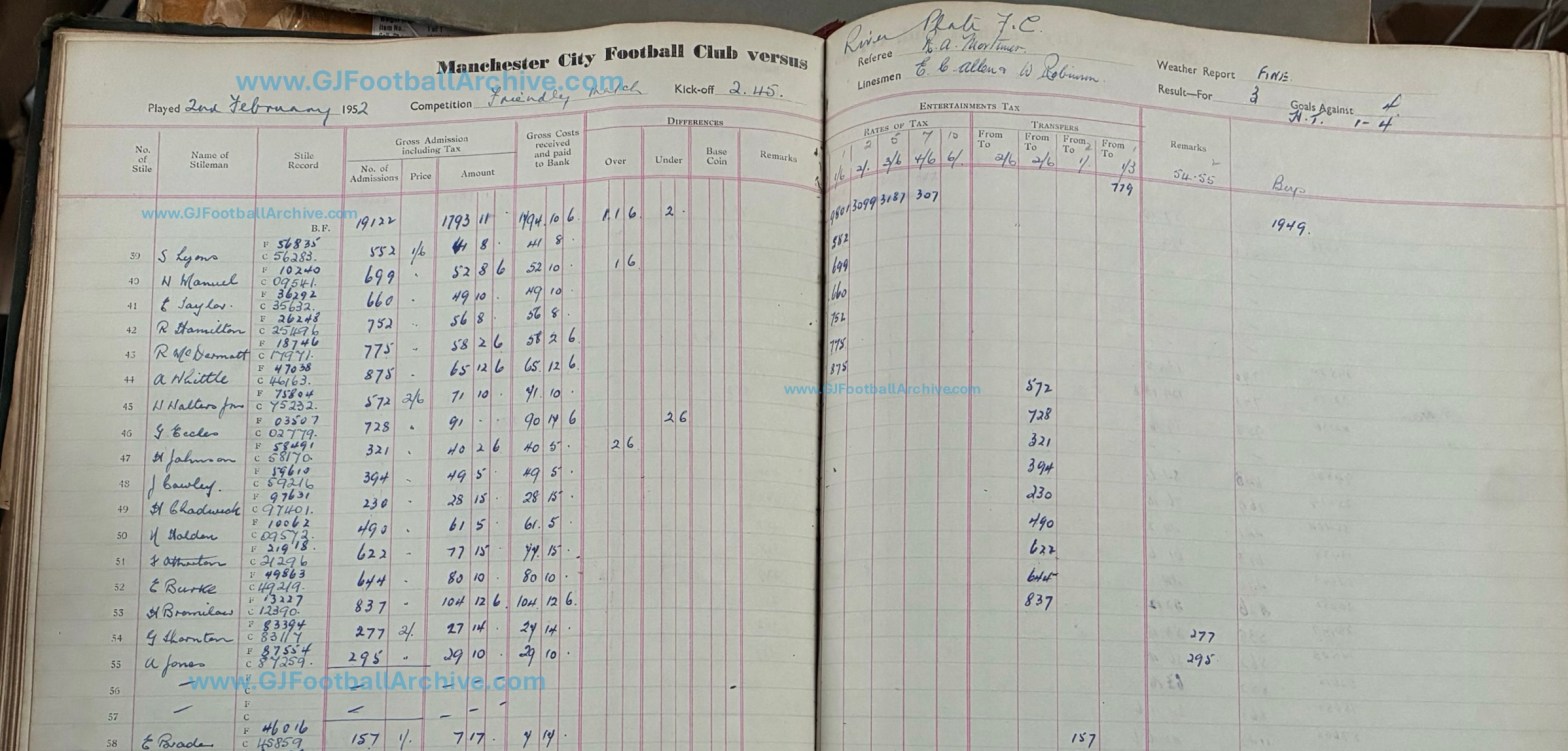
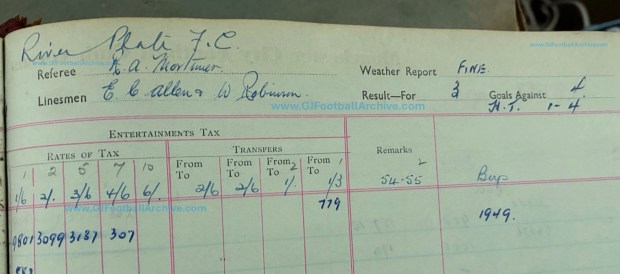
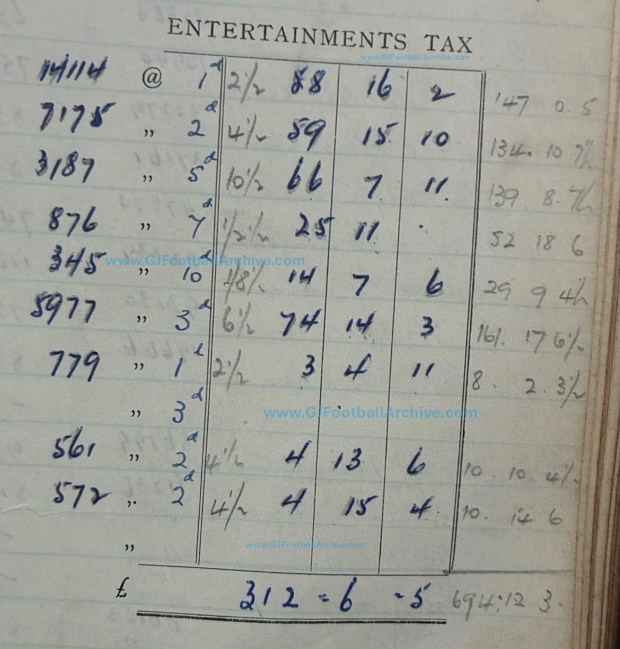
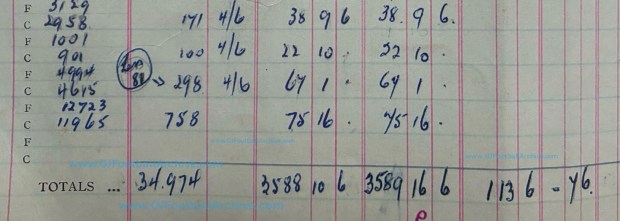
On 2 February 1952 Manchester City were defeated 4-3 by Argentinian football club River Plate in a friendly at Maine Road, watched by a crowd of 34,974. Here are some interesting images from an official record book showing details of entertainment tax paid by City and turnstile records. I’m not certain if anyone has ever researched how much money football clubs paid in entertainment tax over the years but if anyone’s interested then hopefully the following will help.
You can see from the above photo a few match details such as HT/FT scores, weather and referee details. In addition the various admission prices can be seen (not all shown on this image) and the record book also includes details of how many fans attended within these prices per turnstile. A summary of the attendance per price and the amount of tax paid can be seen in the next image:
For the record City’s goals were scored by Don Revie, Jimmy Meadows and Roy Clarke. The two images below show the name of the turnstile operator and the admissions via that turnstile and the second image shows the total attendance and income details.
The series on the 1950s includes some free articles and some subscriber only features. If you’d like to know more on this period then why not subscriber and enjoy the following article on the 1951-52 season.
This is a subscriber article and you can read it by subscribing below.
Subscribe to get access
Read more of this content when you subscribe today. It costs £3 per month or you can subscriber for the discounted annual rate of £20 per year. Each subscriber gets access to everything posted so far, including PDFs of a couple of my books.
It’s Tottenham v City today, so an appropriate time to look back at other meetings. The two clubs first met in a FA Cup tie in January 1909 with the first League game coming at White Hart Lane on 27 December 1910. City’s first scorer in a League match with Spurs was John Smith, who netted in that first League game (a 1-1 draw). Smith played in only 18 League games (scoring 6) for City.
There are plenty of articles on my website concerning games between City and Tottenham, and here’s a link to the heatwave game played on 27 September 1913:





 Gary James' Football Archive