Stadium Opener

On this day (14 August) in 2003 the City of Manchester Stadium (now Etihad Stadium) staged its first competitive game as City defeated TNS 5-0 in the UEFA Cup. Relive that night (and Granada TV!) with this video of the game:

https://www.youtube.com/watch?v=WnjvVF99Fnk

The report above talks of the UEFA Cup draw with TNS.

130,000 Capacity Stadium for Manchester City

This is an interesting cutting from 1935 talking about the possibility of increasing Maine Road to cope with the huge crowds that wanted to watch Manchester City play. It may seem crazy today but wasn’t such an odd idea in the 1930s. You can find out more on the story here:

Guess Manchester City’s FA Cup Final Shirts: The Answer And More

Yesterday I posted images of early Manchester City FA Cup final shirts and asked ‘which shirts are from which finals’ with a bonus question of ‘can anyone work out the players’ who wore these (no searching on t’internet for matching player numbers please!).’ So here are the answers and further details on these players/shirts.

The shirts and players who wore them are:

4, pale blue, top right – Ken Barnes 1955 FA Cup Final

Unnumbered maroon, top middle – Ernie Toseland 1934 FA Cup Final

5, shiny blue, top right – Paul Power 1981 FA Cup Final

4, maroon & white, bottom left – Ken Barnes 1956 FA Cup Final

Cornflower blue, bottom middle – Sam Cookson 1926 FA Cup Final

8, red/black, bottom right – Colin Bell 1969 FA Cup Final

Notice the two balls on the photographs? They are the 1956 FAC Final ball and the 1969 FAC final ball. All shirts and balls were on loan to the Manchester City Experience (the original club museum set up in 2003) as part of our exhibition.

I’ve got further images and more information on these shirts below but first it’s worth talking about the only City FA Cup final shirts missing when we did this exhibition in the mid 2000s (obviously City have reached multiple FA Cup finals since that time) being 1904 and 1933. We simply could not track down shirts from either final, though we kept getting close to borrowing a scarlet shirt from the 1933 final. We put the shirts together and I took these photos of them.

Here’s a contemporary photo of the 1904 FA Cup final shirt. The player here is James McMahon.

James McMahon wearing his 1904 FA Cup final shirt

The 1933 FA Cup final was the first final to feature numbered shirts (Everton wore 1-11, City 12-22) and City’s shirts were usually described as being scarlet. City had word what they called ‘Lucky Scarlet’ a few times in the previous decade, though it never quite seemed that lucky! Here’s a contemporary image of the 1933 FA Cup final shirt back, worn by Matt Busby, showing the numbering used.

Matt Busby in the 1933 FA Cup Final

The oldest shirt we had on display was Sam Cookson’s 1926 FA Cup final shirt and here’s a close up of the Manchester coat of arms worn on that shirt. This was the first time City had worn the coat of arms in a final (City didn’t wear any emblem in 1904):

Notice the shade of blue too. It’s a darker blue than City were known to wear and was known as cornflower blue at the time. It was a special colour for the final against Bolton. Someone at City must have remembered (or maybe it was the FA) that there had been some comments in 1904 that City’s blue and Bolton’s white were too close in colour. I’ve always found that a bit odd but I guess City didn’t want to take any chances when the two sides met again in 1926.

The 1933 final was scarlet as mentioned earlier and the players wore numbers for the first time but in 1934 numbers were not worn. Personally I’d have thought they’d keep up the idea but maybe someone somewhere moaned about these new fangled ideas like wearing numbers in a similar way to how some moaned when squad numbers were introduced and player names were added. Here’s a close up of Ernie Toseland’s 1934 shirt badge. The shirt was described as maroon and the shorts were revolutionary…. We had an expert from Umbro come to visit and he looked at the shorts (we had Toseland’s full kit on display) and was delighted to see an exclusive design. They contained a diamond shaped piece of fabric stitched in and he told me that this was a pair of Umbro’s ‘crotch resistant’ shorts. He explained more, but whether they gave benefit is open to question.

Here’s Ken Barnes’ 1955 emblem. A more traditional blue but it’s interesting that the away colour of maroon makes its way on to the emblem. I wonder if they thought City would wear maroon at some point when the sew on patch was created?

In 1956 the emblem colour was red with yellow edging (to match the numbers on the back). People often try to suggest yellow is not a traditional City colour but it has been used on plenty of kits, including the numbering in 1956 and as the main colour of the away shirt in 1959-60.

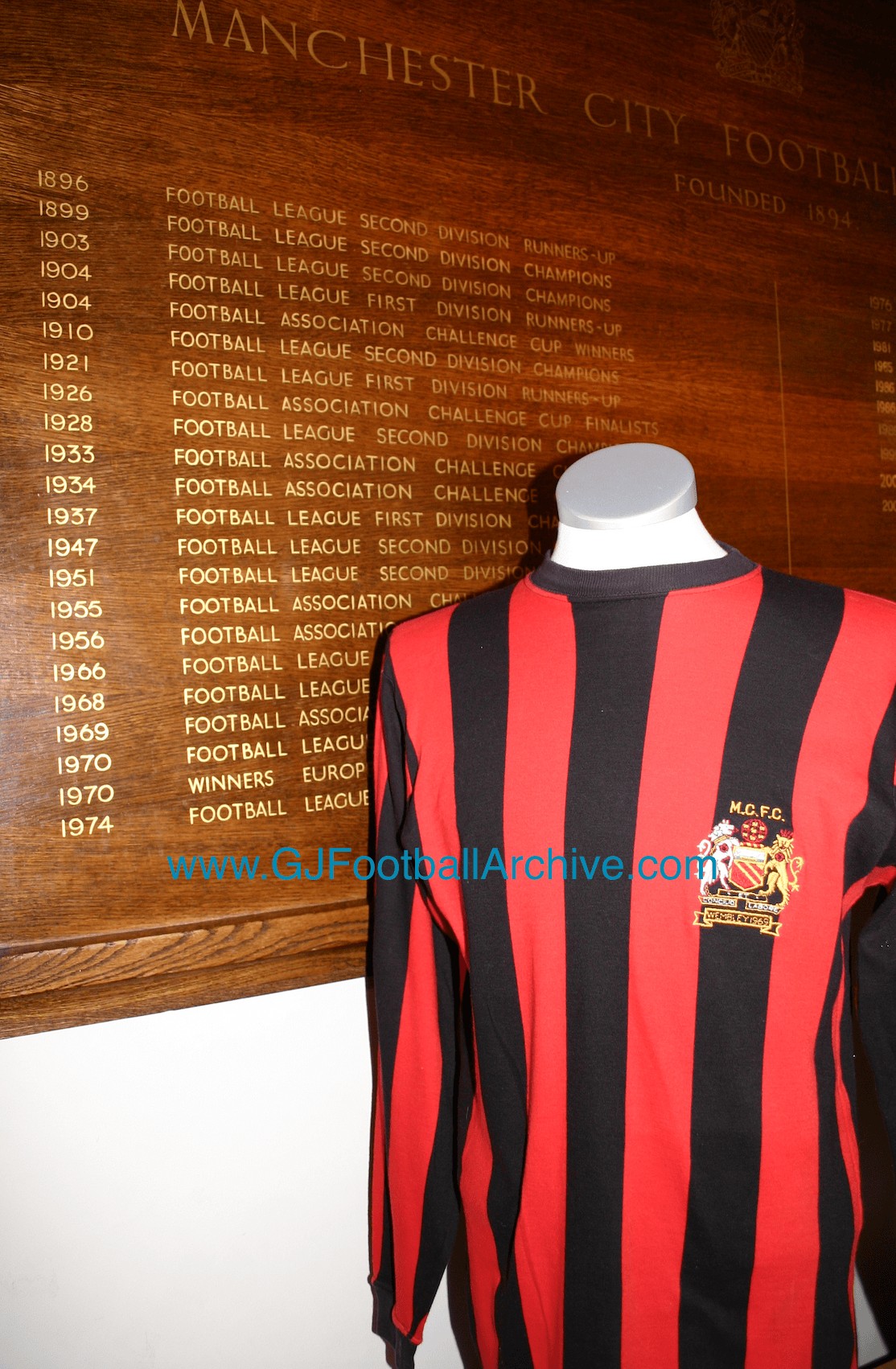
Here’s Colin Bell’s 1969 FA Cup final shirt in front of the old honours board. I believe this honours board is still held in City’s archive somewhere. Maybe we should dig it out and update it. I may post another feature on the board itself another day – people think it’s as old as Maine Road but Bernard Halford had it made in the mid 1970s, just after the League Cup win if my memory is working today!

Here’s the special emblem to mark the 100th FA Cup Final. People get confused about this cup final with some saying it was the Centenary Cup Final (as the emblem does!) or the 100th FA Cup Final. The FA were quite clear at the time – the 1972 FA Cup Final was the Centenary Cup Final (marking 100 years since the FA Cup was established) and 1981 was the 100th FA Cup Final. So City or Umbro got this wrong and if you look at the First Day Cover (below) or any of the match programmes, souvenirs etc. you’ll see they created a special 100th cup final emblem.

I’ve done a lot of research on City’s kits over the decades. There’s lots of comments on them in my books, especially Manchester The Greatest City, Farewell To Maine Road and my City Folklore book. There are also other features across this website. Some only for subscribers and some for all. Why not subscribe (see below) and read all the content on this site? You can subscribe for a month at £3 per month or sign up for a year at £20. Why not try it for a month?

Guess Manchester City’s FA Cup Final Shirts

In the mid 2000s we set up a FA Cup final display as part of a special exhibition at the Manchester City Experience (the original club museum set up in 2003). We managed to borrow shirts from several star players and their families with the only City FA Cup finals missing being 1904 and 1933. We simply could not track down shirts from either final, though we kept getting close to borrowing a scarlet shirt from the 1933 final.

We put the shirts together and I took these photos of them. So which shirts are from which finals and can anyone work out the players’ who wore these (no searching on t’internet for matching player numbers please!).

I’ll post the answer tomorrow along with a lot more detail about these shirts and the other missing kits.

Sam Cowan’s Often Incorrectly Reported Quote

Manchester City’s 1930s captain Sam Cowan is often reported to have said something like ‘We’ll be back next year’ to the King when City lost the 1933 FA Cup final to Everton BUT this cannot have been true. So, here to spell it all out is the story… City reached the FA Cup final in 1926 (losing 1-0 to Bolton), and again in 1933 (losing 3-0 to Everton).  Sam Cowan had played in both these games and felt bitterly disappointed with each defeat.  By the time of the 1933 final Cowan was City’s captain and that defeat had hurt him more than the 1926 final.  He hated being runner up and was determined to see the Blues triumph.  He vowed to guide the Blues to glory and promised supporters that City would be back in 1934 to win the trophy.  His promise became a reality and over the years Sam’s promise has become part of City folklore with various publications, including official City magazines and other works, claiming that Sam had told King George V at the 1933 final that the Blues would be back in 1934 to win the trophy.  Sadly, the story has become corrupted and Sam never did make a promise to the King.

So what did Sam say and why did everyone believe he had made a promise to the King?  The Guest of Honour at the 1933 final was the Duke Of York, the present King’s grandfather and the future King George VI.  He attended because King George V was too ill to make the final, and so that simple fact proves Sam could not have made a promise to the King.  

Lawrence Furniss, the City President, told journalists immediately after the 1934 final that Sam had predicted that the Blues would be back twelve months earlier, and he also suggested that Sam had mentioned this to the Duke Of York.  So it’s possible this comment is the one which later became adapted by journalists looking for an even better story.

As an aside here’s a photo of the King at City’s Hyde Road ground in 1920 and Lawrence Furniss is the man stood immediately behind the King:

The King with the Mayor in Hyde Road’s ‘Royal Box’. Notice Lawrence Furniss stood, behind the King. Furniss was a major figure from the 1880s to the 1940s at City.

What is known is that Sam appeared on a newsreel shortly after the 1933 final with Everton’s Dixie Dean where both men toasted each other for the future and Sam stated that he hoped his team, Manchester City, would win the Cup in 1934.  This film was shown across the country and made it clear that Sam wanted to return to Wembley.

In 1934 Sam guided City to a 2-1 victory over Portsmouth.  Apart from Furniss’s comments nothing was said of a prediction by Sam to the King or Duke of York, it was only years later when it was mentioned.  In fact the first time the story was quoted appears to be in 1955 when City’s fifties captain Roy Paul talked of emulating Sam Cowan by guiding City back to Wembley the following year. Books and articles from the period then made the claim that Sam had told the King in 1933 the Blues would return.  Clearly, this was a corruption of the truth, but the story sounded great and future generations accepted this as fact.

Clearly, reaching Wembley in successive seasons was a major achievement for Sam and his team.  Likewise any losing captain is likely to make a statement saying ‘We’ll be back’.  As Sam was not a boastful character it is unlikely he would have said anything more than he was determined to guide his side back to Wembley for what he hoped would be a successful trip.

Regardless of the validity of Sam’s prediction it is clear that Sam was a major influence with the Blues, and he became the first City man to appear in three FA Cup finals while with the club.

Manchester City’s First Overseas Born Player

Although most Mancunians were unaware at the time, one of the players with Ardwick AFC (Manchester City’s predecessors) was actually the first overseas international to play in the Football League.  Walter Bowman was born in Canada during 1862, and arrived in the British Isles in August 1888 as a Canadian international.  

The Canadians were playing a number of friendly fixtures against sides in Ireland, Scotland and England, and they even faced Newton Heath winning 2-0 with Bowman scoring.  Whether this appearance was witnessed by any of the Ardwick officials at the time isn’t known, but Bowman returned to Canada with his team mates shortly afterwards.

A second tour followed in 1891 – including a 3-1 Ardwick victory on 12th December 1891 – and Bowman remained behind after the rest of the Canadians had returned home.  He joined Accrington, making his debut in January 1892.  That match made him the first overseas international to play in the League and on 25 August 1892 he signed for Ardwick.  He didn’t manage to make his Ardwick debut until 18 February 1893 when he scored as Crewe were defeated 3-1.

Bowman became a Manchester City player when the Club was re-established and he remained with the Blues until the close season of 1900, with one of his most significant matches being the 11-3 record victory over Lincoln on 23rd March 1895, although Bowman failed to make the scoresheet.

After City little is known of Bowman’s life.  An article in April 1929 talked of a reunion in Toronto of the touring side but Bowman did not attend.  It was believed he was living in the USA in a copper mining city in western Montana called Butte, but he was never traced.  No matter what the final resting place of Bowman, his place as the Football League’s first overseas player means his name will never be forgotten.

Weaver

On this day (8 August) in 1998 Nicky Weaver made his Manchester City debut at home to Blackpool.  City won their first match in the third tier of English football 3-0.  The attendance was 32,134.

Subscribe to get access

Read more of this content when you subscribe today.

Ardwick and the Manchester Cup

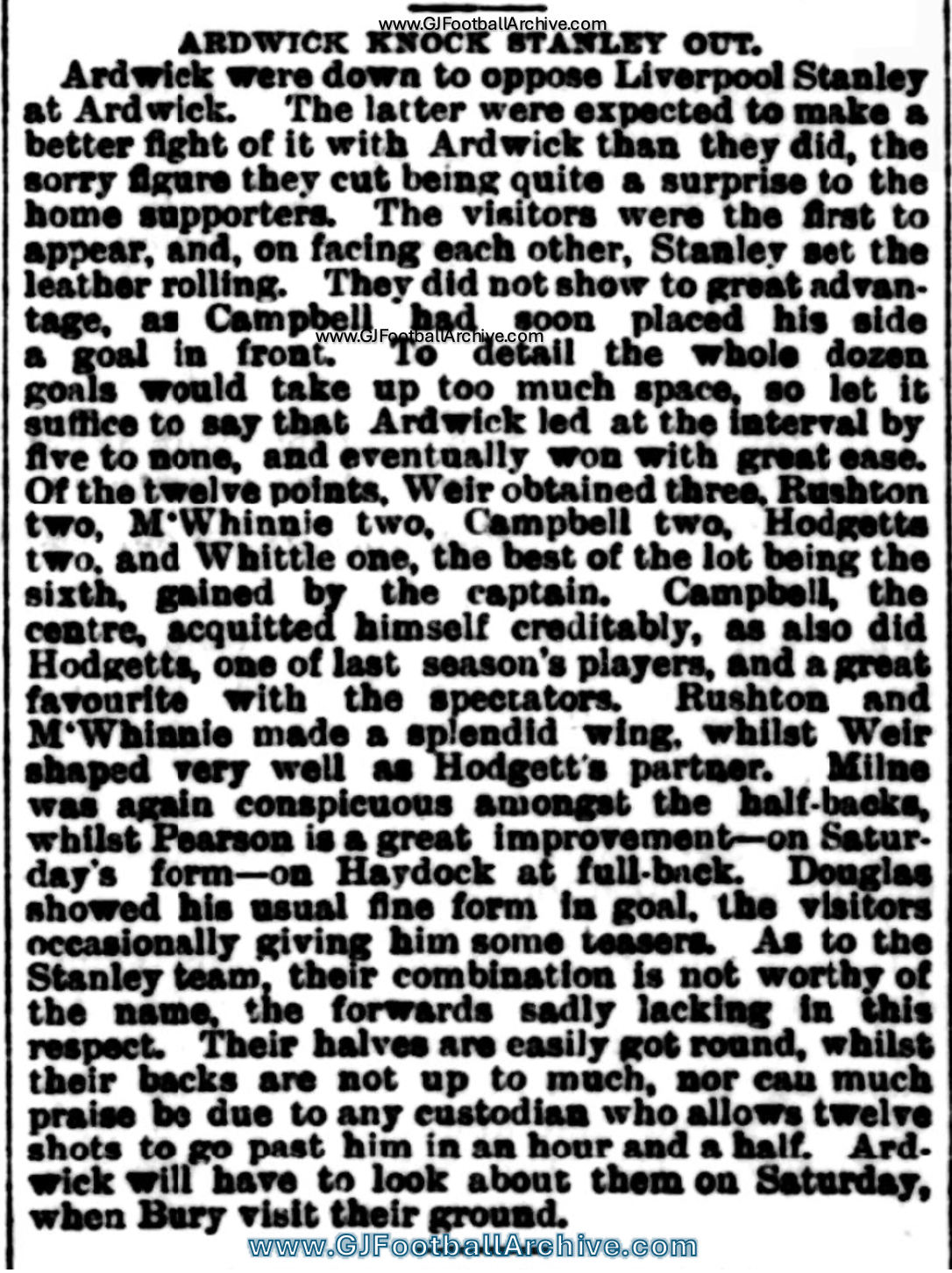
Following on from yesterday’s Ardwick AFC feature, here’s another one. This focuses on the Manchester Cup… As football in Manchester developed, so did Ardwick’s desire to become one of the regions elite clubs.  The Manchester Cup had been established in 1884-5 and this was quickly perceived by the majority of Mancunians as the most prestigious competition around.  The Football League was not in existence until 1888 and even then Manchester failed to have any representatives, while the FA Cup had been established since the 1860s but was not seen in a positive light by Manchester’s sides.  Entry into the Cup required great expense as games could be played anywhere in the United Kingdom – during the 1880s sides from Ireland competed in the FA Cup, while Scottish sides had been amongst the earliest supporters of the competition.  The cost of travel clearly limited Ardwick’s ability to play beyond the Manchester region.

In April 1891 Ardwick reached the Manchester Cup final for the first time in their history.  This was a major landmark and it was also the first major meeting with Newton Heath, present day Manchester United.  Newton Heath had previously played in every final of the competition since it was created in 1884-5 and so this was seen as a real test for the Ardwick players.

Despite the fact that Newton Heath were the more experienced side, Ardwick took the lead thanks to a seventh minute goal from the influential captain Davie Weir.  Reports simply stated that “Weir scored with a long shot”, however they did give a little information before that to suggest that the goal owed much to the earlier persistence of Bob Milarvie.  Milarvie had challenged the Newton Heath goal a couple of times and had clearly surprised the Heathens.  Then, after gaining the ball following a Newton Heath attack, Milarvie “got on a splendid run but was badly fouled.”  From the resulting free kick Ardwick attacked and Weir netted the goal.

Ardwick did actually have another goal disallowed – they were awarded an indirect free kick and the taker blasted the ball straight into the Heathens goal without any other player touching it – but the trophy was won by the Hyde Road side for the first time.

Success in the trophy perhaps went a little to their heads when at the 1891 Football League AGM Ardwick – along with Darwen, Newton Heath, Nottingham Forest, Stoke, and Sunderland Albion – applied to join the newly expanded Football League.  All the applicants, with the exception of Ardwick, were members of the Football Alliance – a league originally set up to rival the Football League.  Not surprisingly, Ardwick failed to gain admittance, with the new places were filled by Stoke, who had won the Alliance, and Darwen.  There was a consolation prize however and Ardwick were admitted to the Alliance League for the 1891-2 season.  

The Manchester Cup had proved to be the Club’s major breakthrough and it had also proved the Ardwick were already perceived as Manchester’s club.  Although Newton Heath had been the more successful club so far, Ardwick were perhaps seen as being more progressive and were already the better supported of the two.  The Hyde Road derby in the Alliance League attracted a crowd of over 10,000, whereas the Heathens home game at North Road was watched by around 4,000.  Even the Hyde Road derby attendance was bettered by Ardwick on two other occasions in the Alliance that season.  

As well as their large support, Ardwick managed to prove their ability to live with the best when they won the Manchester Cup again.  This time they convincingly defeated Football League side Bolton Wanderers 4-1.  The dream of playing League football was getting closer and the Manchester Cup successes had helped that dream.  One man who was proud of this achievement was Walter Chew (image below), who was with St. Mark’s in their first season of 1880-81.  In 1888 he joined the Manchester FA Committee and remained an influential figure there until his death in 1949.  

Ardwick Association Football Club

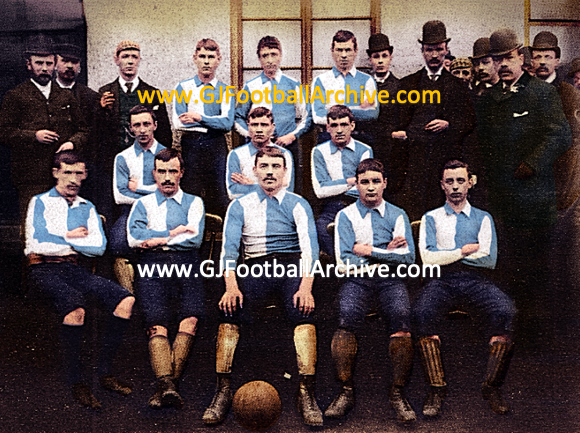
The other week I posted this card from John Baines (he used to produce these cards in Bradford, West Yorkshire) featuring Ardwick AFC’s captain Davie Weir. It made me realise that perhaps I should post more on the Ardwick years of City and so here’s a small piece on the birth of Ardwick in 1887. That year was to prove perhaps the most important year of the decade as far as the club was concerned. Gorton AFC’s leaders decided in which direction the Club should go after spending a couple of seasons playing at the Bull’s Head in Reddish Lane, on the very edge of Gorton.  This was really as far away from the Club’s Clowes Street origins as the side could go while remaining in Gorton. The Club’s identity was in danger of disappearing.  

Association Football was becoming more popular in the area and sides, such as Newton Heath, were beginning to progress, winning trophies such as the Manchester Cup.  Professionalism was beginning to develop and Gorton had to decide on whether their future was to be as a good local side, such as a modern day pub team, or as a professional outfit.

The decision was taken to become a progressive and professional outfit.  The committee also wanted Gorton to return to their Clowes Street roots.  They recognised that this was not entirely possible – Clowes Street remained one of Manchester’s most densely populated areas – but they did manage to find an area of wasteland not too far away.  Legend tells us that Club Captain Kenneth McKenzie lived in Bennett Street, Ardwick, and every lunchtime he would take a short cut from Bennett’s Timber Yard, off Hyde Road, through the L&NWR railway arches, and across the wasteland to Bennett St.  He believed that with a little effort this land could become Gorton’s home.

After a great deal of effort and negotiation with the railway company which owned the land the pitch was ready for its first match by the end of August 1887.  In addition, steps were taken to relaunch the Club.  The name of Ardwick AFC was chosen as the new ground was just within the boundaries of Ardwick and not Gorton, although it has to be stressed that this ground was closer to Clowes Street than any other Gorton venue used by the Club after its first season.

The nearby Hyde Road Hotel became Ardwick’s headquarters.  Stones from this building, demolished in 2002, formed part of the Club’s Memorial Garden at the City Of Manchester Stadium when it was opened.

Gradually Ardwick increased their support and it’s fair to say that by the summer of 1888 Ardwick were Manchester’s most popular club, or at least on a par with Newton Heath.  In 1889 Ardwick built a grandstand capable of holding 1,000 spectators, and for the sum of £5 15s the club’s first pay box – turnstile was not an appropriate name – was erected.  

From that point on the side grew at a rapid rate and managed to recruit several good quality and well known players.  Perhaps the best known at the time was Davie Weir (seen on the card at the top of this page) who joined Ardwick in May 1890.  Often described as individualistic, Weir was an England international when he arrived at Hyde Road after playing in the 6-1 victory over Ireland in March 1889 and a 3-2 defeat by Scotland the following April.  Against Scotland he was credited with scoring England’s second goal, although there remains some dispute as to who got the final touch.

At City Weir played as a forward, but he had previously been known for fulfilling a variety of roles most notably centre-half.  Football was still developing of course, but the key point concerning Weir’s pre-Ardwick days is that he was known as a great goalscorer whatever position he played at Bolton.  He’d only missed one match during Bolton’s first two seasons of League football, and had netted a 21 goals in 43 League games.  During 1889-90 season he scored an incredible 10 goals in only 4 FA Cup ties.  Clearly for Weir – a player only in his late twenties – to leave League side Bolton to join a side that had yet to compete in any formal league says a great deal about the ambition of Ardwick.

At Hyde Road Weir was immediately popular and he netted two hat-tricks in his first four games.  He also scored the first Ardwick goal in the FA Cup, and was a key member of the side that competed in the Alliance League in 1891-2.  His career also saw him feature in the Club’s first season in the Football League where he became Ardwick’s top goalscorer, despite returning to Bolton midway through the season in January 1893.

In later life he became the Glossop manager in 1909 and remained with the Division Two side until April 1911 when he was approached by Stuttgart to become their coach.  He passed away in November 1933 at the age of 70.