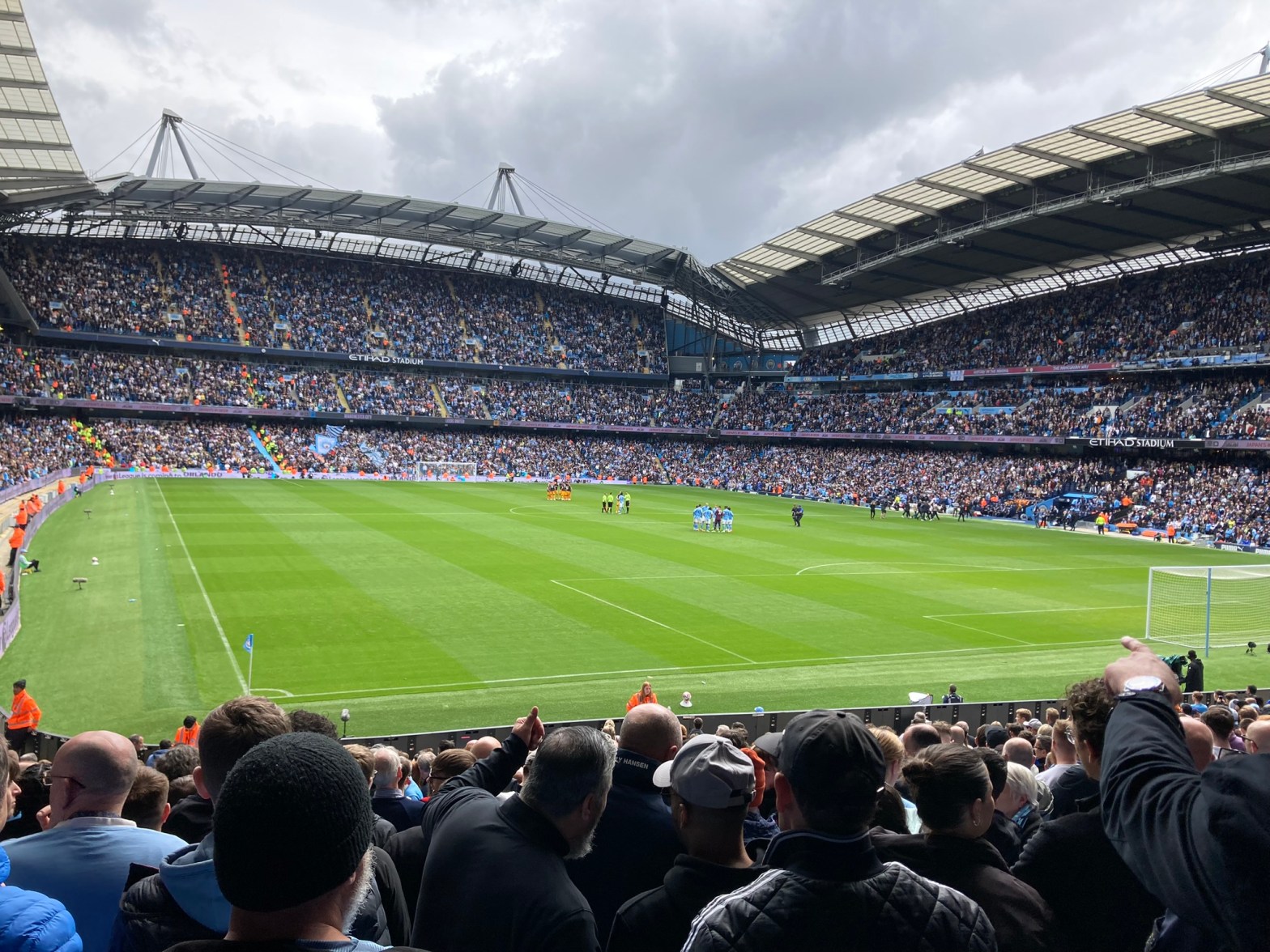
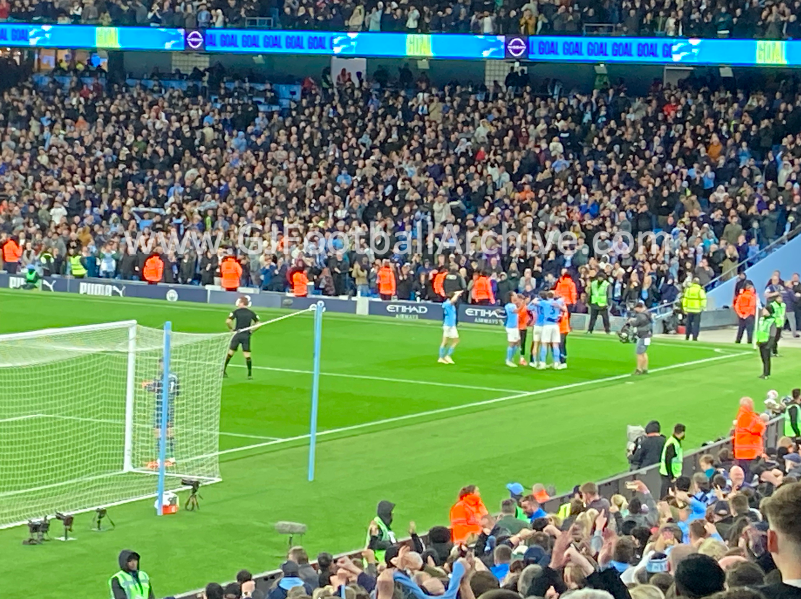
An easy first half for Manchester City today, going 2-0 up thanks to Gundogan v Leeds at the Etihad. It could so easily have been more with shots hitting the bar and the post, plus a penalty which Haaland insisted Gundogan take that was saved. In the end Leeds pulled one back to make it 2-1 but it was a relatively easy game for the Blues and the score flattered Sam Allardyce’s new team.
There was an interesting moment when City fans chanted ‘you’re getting sacked in the morning.’
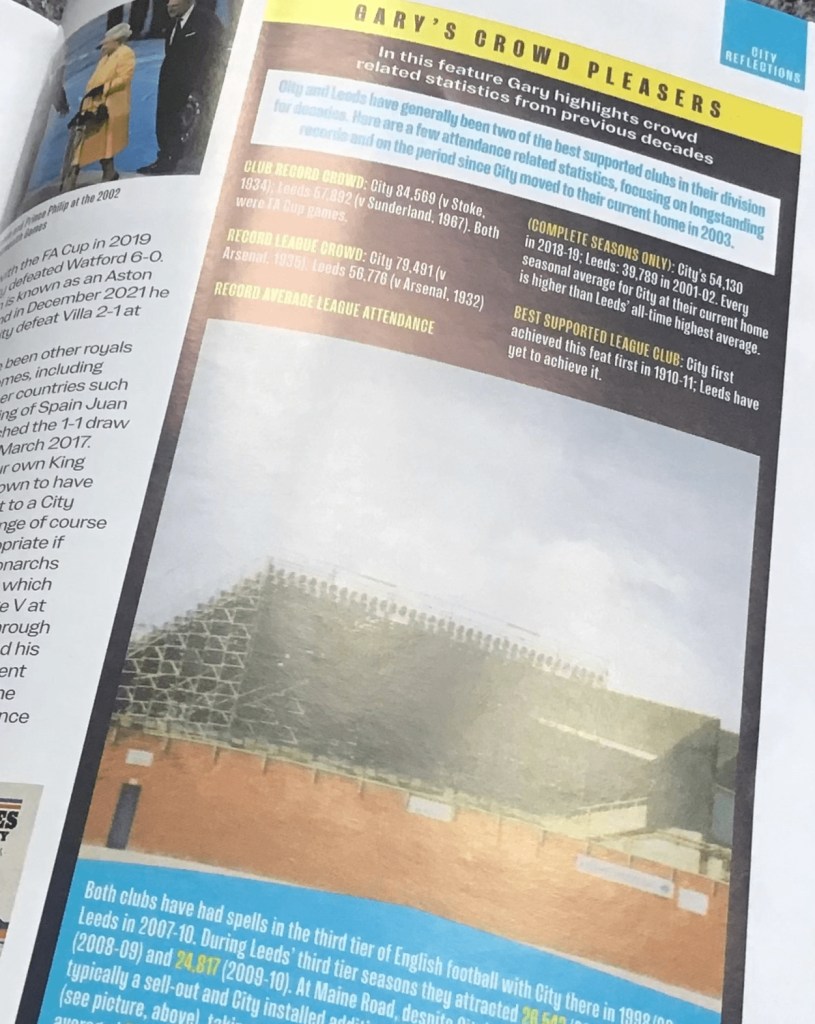
As seems to be customary these days the away fans chanted the ‘Where Were You’ chant. Surprisingly. It was within the first five minutes of the start. If only those fans chanting had read my programme articles today. One of them was my comparison of City & Leeds crowds. Reproduced below you can see how City actually increased the stadium’s capacity to cope with crowds when they dropped to their lowest point. The other attendance comparisons all work in City’s favour too.
Today (6 May) in 2019 Manchester City captain Vincent Kompany scored a wonder strike to give City a 1-0 victory over Leicester City at the Etihad. The goal scored in the 70th minute meant that City knew they would retain the Premier League title if they won on the final day of the season at Brighton.
Kompany’s strike from 25 yards out arrowed into the top corner of the net.
I was quite pleased with my MCFC V WHU programme article the other night (3 May). The article challenged the perception that City’s triumphs in recent years are somehow less significant than others as City have ‘bought success’. I feel quite strongly about that, so the article compares past decades to see if the last decade or so has been more competitive at the top of the League. Subscribers can see the full article below but here’s a taster:
Subscribe to get access – Monthly
Read more of this content when you subscribe today. It costs £3 a month (cancel anytime) or £20 a year (below)
Read more of this content when you subscribe today. Annual subscribers access everything (books, articles, videos, talks, interviews etc) since the site was created in December 2020. Monthly
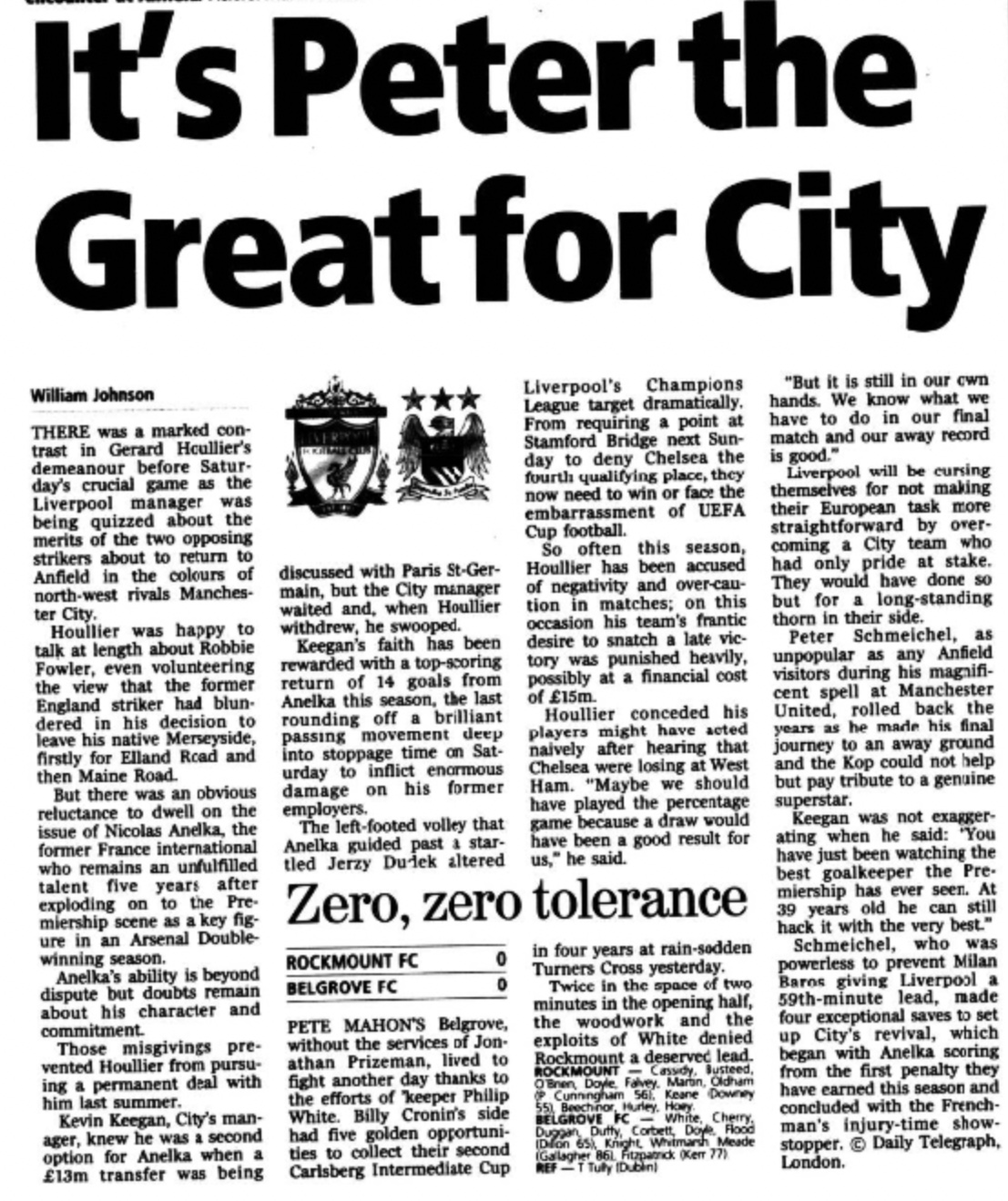
Twenty years ago today (5 May 2003) newspaper reports reflected on Manchester City’s 2-1 victory at Liverpool two days earlier. They tended to praise City ‘keeper Peter Schmeichel most, even though Nicolas Anelka had scored both goals for the Blues. It was a hugely popular City win of course in Manchester but this was a strange and emotional period for all connected with the Blues. The following game would be City’s last first team match at Maine Road and while fans celebrated a rare win at Anfield there were many emotions as the club now looked ahead to Maine Road’s farewell.
On 4 May 2021 Manchester City reached the final of the Champions League for the first time in their history when they defeated Paris St Germain 2-0 with both goals from Mahrez. The first leg had ended with a 2-1 City win. This meant Manchester became only the second non-capital city to have had two teams reach a European Cup final. Manchester was of course the first British city to have two teams competing in the European Cup in the same season (1968-69).
Manager Pep Guardiola was somewhat pleased to say the least: ‘I’m incredibly proud and my first thoughts are with the players who didn’t play today. They all deserved to play, everyone has made a contribution and now it is time to enjoy it. We have to win the league and we have two or three weeks to prepare for the final.
‘They put a lot of players in the middle and we struggled a lot in the first half to high press and we changed at half-time. We recovered the ball better in the second half and we were much better in the way we played and 4-1 on aggregate against a team that beat Barcelona and Bayern Munich means a lot to us.
‘People believe it’s easy to arrive in the final of the Champions League. Getting to the final now makes sense of what we have done in the past four or five years.’
The game was played in unseasonal snow but the brilliant Riyad Mahrez was able to adapt well, scoring from a move started by goalkeeper Ederson’s 60-yard pass.
There had been a bit of a scare for City when a penalty was awarded to PSG for a handball by Oleksandr Zinchenko but it was correctly overturned. Phew!
Mahrez netted his second of the night just after the hour when he turned in Phil Foden’s cross at the far post to effectively end the tie.
PSG once again lost their discipline (Idrissa Gueye was sent off late in the first leg) and former United man Angel di Maria was shown a red card for a senseless stamp on Fernandinho.
City were in full control and you can watch highlights here:
That night was remarkable and several records were established:
City broke the record for longest winning run by an English club in European Cup history (7)
They became the first English side to win 11 games in a single European Cup/Champions League campaign (they are one off equalling Real Madrid’s record of 12 games)
If you have enjoyed this then why not support the website, my research and the recording of Manchester’s football history? You can do this by either subscribing or, if you don’t fancy that, then why not make a donation to keep the site running? See below for details.
Subscribe to get access – Annual
It costs £20 a year to subscribe on an annual basis. Annual subscribers get access to everything posted (books, videos, interviews & articles) since the site was launched in December 2020.
It costs £3 a month (cancel anytime) to subscribe on a monthly basis. Monthly subscribers get access to everything posted since 1 October 2022. All subscribers get access to new content throughout their subscription.
If you enjoy all the free material on my website and would like to support my research and keep this website going (but don’t want to subscribe) then why not make a one-time donation (or buy me a coffee). All support for my research is valued and welcome. It allows me to keep some free material available for all. Thanks.
Today (4 May) in 1929 the legendary Tommy Johnson netted his 38th League goal of the season at Anfield when City drew 1-1 with Liverpool. This is at the moment (4 May 2023) Manchester City’s record number of goals by a player in a League season. His 38th goal came in the 22nd minute of the final game. Here for subscribers is a detailed look at Tommy’s record (while it stands!) and his life.
Subscribe to get access – Monthly
Read more of this content when you subscribe today. It costs £3 per month or £20 a year.
Annual subscribers get access to all the books, articles, videos, interviews and talks posted since the site was created in December 2020. Monthly subscribers get access to everything since 1 October 2022. All subscribers access everything new during their subscription too.
This is beginning to feel like the season Aguero started to break the Manchester City goalscoring records that had stood for decades. Each week there seemed to be a new one. Well, last night it was a privilege being at the Etihad to see Erling Haaland break the Premier League’s seasonal goalscoring record with City’s second in their 3-0 victory over West Ham United. He netted his 35th Premier League goal of the season and then Phil Foden scored the 1000th goal of Pep’s City reign.
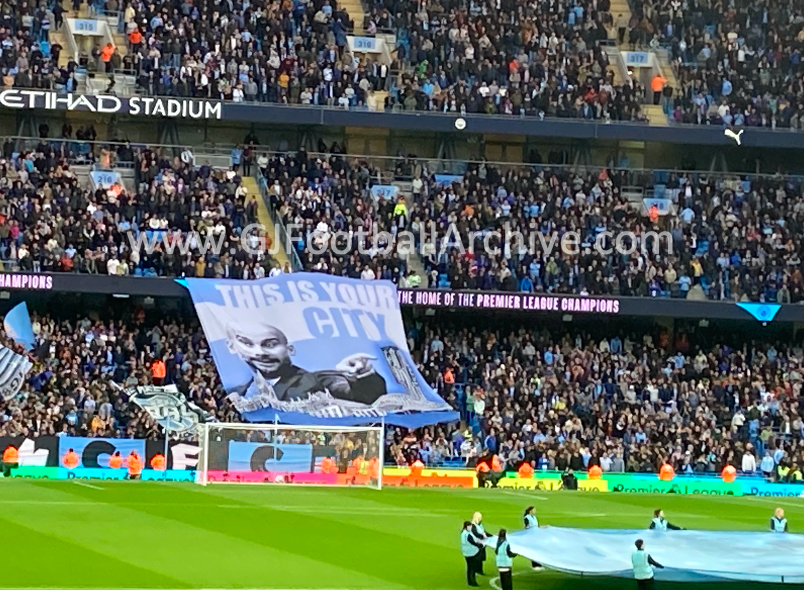
Ths South Stand pre-match, City v West Ham 3 May 2023. The new Pep flag.
It is also worth highlighting that only 47 players have scored more competitive goals for City than Haaland has in the club’s entire history – that’s in their entire careers, not in most of one season!
The Norwegian is now on 51 in all competitions, 12 behind Dixie Dean’s all-time English record. Obviously, we’re nearing the end of the season and games are running out but it’s a target I’d love to see challenged further.
Haaland’s already City’s highest goalscorer in all competitions but there’s still one other major seasonal club record to aim for. There is only Tommy Johnson ahead of him as City’s greatest seasonal League scorer of all time. Johnson’s stats are:
Tommy Johnson
38 goals in 39 appearances during 1928-29 (City finished 8th)
Goals per game ratio: 0.9744
Most goals in a single game: 5 v Everton (6-2)
Number of games he scored in: 24
Years at City: 1920 to 1930
Here’s hoping that record goes soon. It’s always great for a historian to experience history being made. Nice work City!
Haaland was given a guard of honour by the City players, boss Pep Guardiola and the club’s backroom staff after the final whistle. Afterwards the player commented: ‘It was a nice feeling scoring that goal, it always is… It was painful when everyone hit me on the back in the guard of honour.’
Manager Pep commented: ‘He’s just 22… and still has five games left. How many games I made the substitution after a hat-trick in 60 minutes, maybe he’d have scored more. But maybe he’d have got injured. He’s special. Congratulations to him.
‘We expected him to score goals but to break Cole and Shearer records… I’m pretty sure what he wants is to win the Premier League.’
‘It’s unbelievable. How many important goals he’s scored to win games, we are so satisfied. He’s a unique person and he’s so special. He deserved the guard of honour because it’s an incredible milestone. Another day he might break his own record. He’s scored a lot of goals!’
Looking towards the South Stand pre-match, City v West Ham 3 May 2023 (West Ham fans unusually did not sell out their allocation)
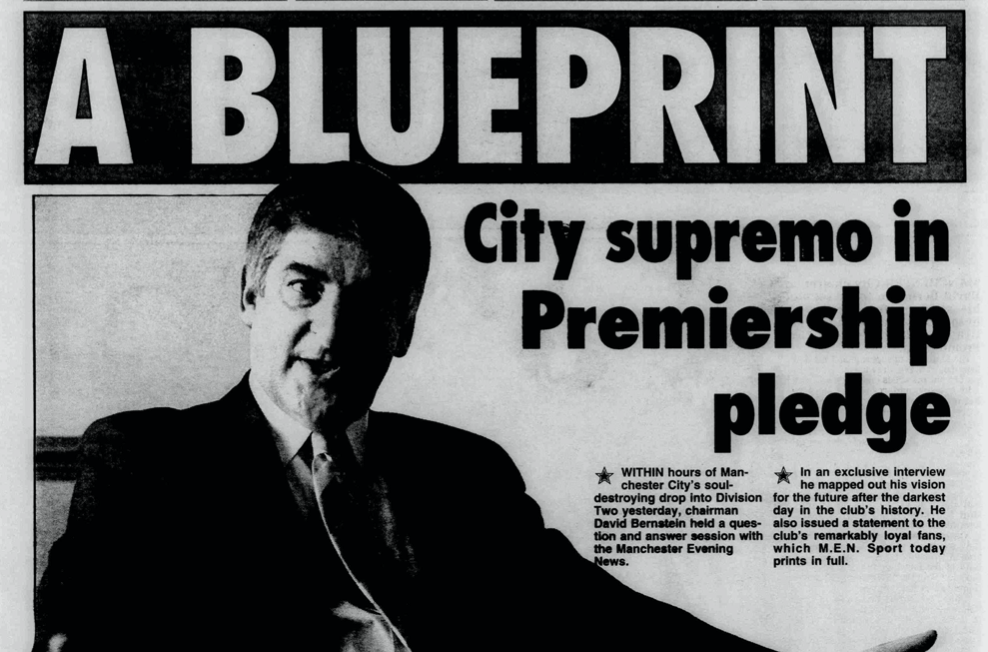
Warning! The following 600 word article is the story of Manchester City’s final game of the 1997-98 season. It was against Stoke on 3 May and, well, let’s just say it was a 5-2 easy victory but the consequences were grave for the club. If you have no idea what I’m on about then have a read – or if you want to relive a painful memory then carry on. Fortunately, I’ve made this article available to subscribers only so people won’t just catch site of our misery just by passing! If you can then enjoy looking back and remembering those days!
Subscribe to get access – Monthly
Read more of this content when you subscribe today. It costs £3 per month or £20 for an annual subscription.
Annual subscribers get access to everything (all the books, articles, videos, interviews etc.) posted since the site was created in December 2020. Monthly subscribers get access to everything since 1 October 2022. All subscribers access everything posted throughout their subscription. Why not give it a try for a month and see what you think?
On 2 May 1992 Manchester City defeated Oldham 5-2 in the last League fixture before the birth of the Premier League. The win gave City a fifth place finish (for the second year running), 12 points behind champions Leeds and six points ahead of 6th placed Liverpool. David White scored a hat trick but this had been a disappointing final placing overall as the Blues had been hoping to mount a serious challenge for honours.
The launch of the Premier League and the actions of the following year or so would have major repercussions for City and the Blues would ultimately lose pace with those clubs they had matched or bettered in recent seasons.
Maybe I’ll do a detailed analysis of how football changed one day but for the time being it’s worth remembering that no one team dominated English football at the beginning of the 1990s but by the end of that decade one did and the financial gap meant traditional giants, like City, Leeds, Newcastle, Everton, Villa and others were unlikely to find League success. It also meant that teams like Oldham would be unable to keep pace with the ‘next’ pack and ultimately they became the first Premier League title to be relegated out of the entire League in 2022.
Continuing the weekly series on Manchester City’s seasons from 1999-2000 through to 2008-09. Each week I’ll be publishing here the story of a different season of that remarkable ten-year period. Today we have a 6,300 word article on the 2002-03 season (below) which was City’s last at Maine Road.
Subscribe to get access – Annual
This article is for subscribers to my website. It costs £20 a year to access everything on the site since creation in December 2020. That includes articles, history talks, videos, interviews & more. There’s also a monthly option below.
Monthly subscription costs £3 per month to access everything on the site since 1 October 2022 (cancel anytime). All subscribers access all new material until their subscription ends. Why not give it a try for a month?






 Gary James' Football Archive