Following on from my piece the other day about League domination where I challenged a few myths that have developed about Premier League domination. It continues to be said that the Premier League is not as competitive as in the past and that teams at the bottom have no chance. This is of course concerning and there are definitely issues between the haves and have nots in football but is this a recent phenomenon? Is this caused by one club in particular?
Each season there are often one or two clubs who have an extremely low points total and, to be frank, I’m not certain whether the champions (whoever they are and whenever they succeed) can be blamed for the results of games not involving them.
Surely, even if City, Liverpool, Arsenal, Chelsea, United etc. win the League every season by a record amount of points the results between all other 19 clubs have zero to do with that club’s dominance? If you’re a supporter of a relegated club can you honestly say that you’d stand a chance of winning the League if City or another team did not exist? You’d need possibly the top ten to disappear before it had a major impact on your chance of League success (I’m not saying that’s acceptable – I’m just stating that it can never be the fault of one club).
Those finishing second may blame the dominant club but surely not anyone outside of those challenging. Blame all the elite maybe. These things never happen over night and because one club wins the League.
So, how do we calculate the gap between the champions and those struggling? Where do we start?
One method is to look at the team that wins the League and see how big a gap is between them and the relegated clubs. There are often one or two teams that gather few points and so I’ve looked at the difference between the champions and the team finishing 17th (safe from relegation). I’ve taken the lowest points accumulated by the 17th placed team and compared that to the Champions.
This makes interesting reading and shows that the lowest points gathered by the 17th placed ‘safe’ team was almost two decades ago! That’s right, it’s not the current era – it’s all those years ago!
Chelsea were the champions when the lowest points total was accrued by the 17th placed club in 2004-05 (in fact the three lowest were all in the 2000s not the last decade). The five lowest points accumulated by a team in 17th place are (note: 5 of these are 2010 or earlier):
1: 2004-05 Champions Chelsea earned 61 points more than 17th placed WBA (34)
2: 2009-10 Chelsea earned 51 points more than 17th placed West Ham (35)
2: 2008-09 United earned 55 points more than 17thplaced Hull (35)
2: 2019-20 Liverpool earned 64 points more than 17th placed Aston Villa (35)
5th: 1999-00 United earned 55 points more than 17th placed Bradford (36)
5th: 2007-08 United earned 51 points more than 17th placed Fulham (36)
5th: 2013-14 City earned 50 points more than 17th placed WBA (36)
5th: 2017-18 City earned 64 points more than 17th placed Southampton (36)
5th: 2018-19 City earned 62 points more than 17th placed Brighton (36)
5th: 2022-23 City earned 53 points more than 17th placed Everton (36)
Ignoring the first few seasons when there were more than 20 clubs in the Premier League, the highest points total ever gathered by the club in 17th place was 44 (Bolton) in 2002-03 – only two seasons before the lowest points total, showing how these things can vary.
Okay but what about teams actually relegated? Here are the five lowest points accumulated by a team finishing 20th and the difference with the champions that season. Again the lowest points gathered was in the 2000s, not 2020s (Only 2 of these are since 2015 and none are from the 2020s!):
1: 2007-08 Champions United gathered 76 points more than 20th Derby (11 points)
2: 2005-06 Chelsea gathered 76 more than Sunderland (15)
3: 2018-19 City gathered 82 more than Huddersfield (16)
4: 2015-16 Leicester gathered 64 more than Aston Villa (17)
5: 2002-03 United gathered 64 more than Sunderland (19)
5: 2009-10 Liverpool gathered 78 more than Portsmouth (19)
Okay, so what about the actual points gap between the champions and the 20th placed club? Again analysis of every Premier League season shows some interesting information. The five biggest points differences between top and bottom are (again two of these are from the 2000s):
1st: 2018-19 City 82 points over Huddersfield
2nd: 2019-20 Liverpool 78 points over Norwich
3rd: 2005-06 Chelsea 76 points over Sunderland
3rd: 2007-08 United 76 points over Derby
5th: 2021-22 City 71 points over Norwich
For the next analysis I’ve calculated the difference between the champions and the club finishing in 18th place (usually a relegated place, but not in the first couple of years of the Premier League). The idea being that the bottom two could be way off the pace.
This shows that City’s record 100 points season was the biggest gap between them and the 18th place relegated club. That’s significant, however that was an incredible record breaking season of wins for City. Interestingly though, for a team that’s supposed to be creating barriers between the top and the bottom City only hold two of the top five biggest gaps (Chelsea also hold 2) and one of those top 5 champions is actually Chelsea in 2004-05 – 19 years ago!
If we look beyond the top five there are 3 clubs in joint 6th place including Manchester United in 1998-99 – 25 years ago! Yet it’s supposed to be only now that the gap between top and relegation is vast.
For those wondering here are the highest 10 or so gaps between top and relegated clubs (18th place):
1st: 2017-18 City (the record 100 points season) 67 points over Swansea
2nd: 2019-20 Liverpool 65 points over Bournemouth
3rd: 2018-19 City 64 points over Cardiff
4th: 2004-05 Chelsea 62 points over Crystal Palace
5th: 2016-17 Chelsea 59 points over Hull
6th: 1999-00 United 58 points over Wimbledon
6th: 2020-21 City 58 points over Fulham
6th: 2021-22 City 58 points over Burnley
9th: 2003-04 Arsenal 57 points over Leicester
9th: 2005-06 Chelsea 57 points over Birmingham
11th: 2008-09 United 56 points over Newcastle
11th: 2009-10 Chelsea 56 points over Burnley
What does all this statistical information prove? Well there doesn’t appear to be much difference between the 2000s and the last decade. Some seasons in each decade there were huge gaps.
We all know that the elite are some way ahead of those that struggle and there is an imbalance. That’s concerning for football and the introduction of Financial Fair Play and similar has, so far, strengthened the position of the elite and limited the opportunity for investment at lower clubs.
If you enjoy all the free material on my website and would like to support my research and keep this website going (but don’t want to subscribe) then why not make a one-time donation (or buy me a coffee). All support for my research is valued and welcome. It allows me to keep some free material available for all. Thanks.
Lots of tosh has been spoken recently about teams dominating English league football with some claiming that there’s ‘never’ been a time when a team has dominated as much as Manchester City do today. Ignoring the fact that the League campaign is not over yet and will go to the final day (so that’s a nonsense for a start) I decided to pull together a few facts that may be useful. They’re certainly relevant.
So, first of all, the question of whether Manchester City is the first to dominate in a way no other has before (again the season isn’t over and it could go either way yet, so ‘dominate’ is not something I believe anyway!)… City have currently won 3 League titles in a row. A feat that has been done several times before, most recently (before City) by Manchester United in 2006-09.
Ah, but City have won 5 out of 6 titles they say… Yes, but United won 7 out of the first 9 Premier Leagues and were runners up in the other 2. Liverpool achieved the same 7 out of 9 League titles in the 1970s and early 80s. We can’t predict the future of course but City have never managed seven titles in 9 seasons. In fact if City do win the League the stats will show it’s 7 in 11 seasons and at present it’s 7 titles in 12 seasons. So that means two other clubs have had longer spells as ‘dominant’ clubs using the language and phraseology that those criticising the reigning Champions usually use.
One of the other criticisms that’s thrown City’s way is about the Premier League being ‘boring’ because it’s a ‘foregone conclusion’ and ‘other teams have to be perfect’ to finish above City. Well, to be the best you have to beat the best but in terms of the League being ‘boring’ and a ‘foregone conclusion’ then the stats in terms of points gaps say otherwise.
Sure, City’s incredible 2017-18 season when they amassed 100 points was one in which the Blues ran away with the title, but it was also a rarity. City won the League by bettering second place by an astounding 19 points but, wait a minute, that amazing gap is only 1 point more than the (18 point) gap between 2020 champions Liverpool and second placed City (at a time when City are supposed to be the dominant team!). Not only that but United had an 18 point gap between them and second placed Arsenal in 2000.
Worth noting too that in the 31 season history of the Premier League 14 runners-up teams bettered 2nd placed United’s points tally in 2017-18 when City achieved their 100 points. Surely, no title winning team can be blamed if the runners-up have worse results than in more than 45% of the competition’s seasonal history?
What about the ‘foregone conclusion’ and ‘boring’ line? Well, I suppose it can be argued it’s boring if the League is won many, many weeks before the end of the season. Using that logic it should also be ‘not boring’ if it goes down to the last game (like this season) or the last week (could be 2 or 3 games depending on fixture congestion). So I’ve had a look at how many seasons have finished with 3 points or less separating the top two teams. This shows that there have been 9 seasons when this has been the case. Guess what? 4 of those were seasons when City have won the Premier League (2 United, 1 Arsenal, Blackburn & Chelsea).
This means that 57% of all City’s Premier League title wins have been by less than 3 points! For United (13 PL titles) the figure is 15%; Arsenal (3 PL) it’s 33% and Chelsea (5 PL) is 20%. Four of United’s PL titles have been won by 10 points or more.
Of course, title races can be exciting when teams win the League by ten points or more, but the argument many put across is that it’s boring when one team walks away with it. Surely there’s less chance of that happening when a team wins the title by less than 3 points?
There are lots of statistics that could be posted and, to be frank, they never actually tell the story of a season. How many times do we see possession stats that are in one club’s favour but the other team is actually winning? Nevertheless, when people try to suggest a season is boring because a club (any club) is running away with it then the stats can help show that something is not true. Similarly, when it comes to dominant football clubs – yes, there are eras of dominance by certain clubs and Manchester City certainly are a dominant club at the moment – we must not be fooled into thinking that a situation has NEVER happened before when it so obviously has (and other clubs may actually have been more dominant!).
Ah well! Football, hey? If only people actually looked at history more before jumping to conclusions.
If you enjoy all the free material on my website and would like to support my research and keep this website going (but don’t want to subscribe) then why not make a one-time donation (or buy me a coffee). All support for my research is valued and welcome. It allows me to keep some free material available for all. Thanks.
I’ve posted a lot on this in the past but it’s always worth revisiting, especially as recent years have seen dozens of new chants established at Manchester City. Successful eras often bring new chants – and that’s definitely happened recently – but failing periods can also generate new supporter songs.
Chanting at football games is rarely documented correctly with many myths, rumours and stories developing over the years. This feature is designed to give a potted overview of the development of singing at City.
I explained about some of the chants in this talk I did a couple of years ago. If you’ve got time watch it:
Now, for subscribers is an 1800 word article on the history and development of chants at Manchester City:
Subscribe to get access
Read more of this content and everything on the site when you subscribe today.
Phil Foden and Khadija ‘Bunny’ Shaw have been named Men’s and Women’s Footballers of the Year by the Football Writers’ Association. It’s an incredible double and adds to an interesting record: Manchester City remain the only club to ever win both accolades during the same season, with Raheem Sterling and Nikita Parris achieving the same feat in 2018-19.
City academy graduate Foden’s outstanding performances saw him receive 42% of the vote while Jamaican international Shaw secured the most votes in the history of the women’s award, during a remarkable season in which her goals have helped lead City to the top of the Women’s Super League.
Foden has scored 24 goals and made 10 assists in all competitions as Pep Guardiola’s side hope to become the first men’s team in English football history to secure fourth consecutive top-flight titles and also record consecutive Premier League and FA Cup doubles.
Foden commented: “Being named the Football Writers’ Association Footballer of the Year is a huge honour. I’m very, very happy to receive this award but I could not have done it without the help of my team-mates. We have a very special squad of players at City, and I’m privileged to be a part of that group. I want to thank all my team-mates as well as Pep and the coaches for all the support and advice they have given me.
“I strive to be the best that I can be every single day and that is all down to the way the manager and my colleagues always seek to improve and get better. I would also like to take this opportunity to thank everyone who voted for me as well as my fellow nominees.”
Shaw secured 53% of nominations to be named FWA Women’s Footballer of the Year ahead of Chelsea’s Lauren James and City teammate Alex Greenwood. The Jamaican international has scored 22 goals in all competitions this season, with 21 of those leading her to the top of the Women’s Super League scoring charts and her team to the top of the league, during a season in which she also became the Club’s all-time top scorer.
Shaw said: “I am very proud and privileged to have received this award and to be recognised in this way is a special honour. I want to also thank all of my team-mates. They provide me with the chances to score goals and I could not have won this award without them.
“I also owe such a lot to Gareth, the rest of the coaching team and everyone else here at City. It’s a pleasure to be part of such a special group. Many thanks to all who voted for me and to my fellow nominees. It means such a lot to have won this award. Hopefully the side can now finish off the season in style and give everyone special cause to celebrate.
Today (29 April 2024) marks the 80th anniversary of Francis Lee’s birth. I met Francis a lot over they years and interviewed him frequently. So, to mark this anniversary, here’s an interview I did with him at his home in February 2010. This was published in the City match programme back then and you can read Franny’s views on his career here as published at the time. Enjoy!
In a glittering career Francis won two League Championships, the ECWC, League Cup and the FA Cup.
Francis, let’s begin with your early career at Bolton. Is it true you started on the groundstaff?
That’s right. I set myself a target that I had to get into the first team by the time I was 17 or 18. If I didn’t I was going to go back to college and train as a draughtsman. That was my plan, but I managed to get into the first team at 16 and I made my debut against City (5/11/60). We won 3-1 and I scored a header at 3.15 against Bert Trautmann – I think Bert must have thought he was getting over the hill for me to score a header past him!
I had about a dozen games over two seasons, then in 1962-63 I was top scorer with 12 goals from 23 League games.
You topped the goalscoring charts each season at Bolton from 1962 until you left. You were playing on the wing. Was that your preferred position?
I think my best position was as support striker to a big fella. I only played in that role twice really – at Bolton with Wyn Davies when I scored 23 League goals one season and then at City with Wyn again when I scored 33 League goals in 1971-72. A lot of my career was spent at centre-forward which is a bit of a difficult position to play if you’re only 5ft 7. When I played for England I was support to Geoff Hurst and that suited me. At centre-forward I had my back to the ball but when I was support striker – the free player – that suited me fine. I could pick up the ball going forward and that was great.
At Bolton you scored 106 goals in 210 appearances. A great record, but when you left the club the stories were that you were in dispute. Is that true?
Well, what happened is that we were relegated in 1964 and, despite a near-miss in 1965 when we finished third, it didn’t feel as if we were going forward. My ambition was still to see how far I could develop in the game and in the back of my mind I had the ambition to play for England, but I wasn’t even selected for the under 23s. The story was going around that I was difficult to handle – which is funny because Joe Mercer said that I was the easiest player to handle at one point.
Were you difficult to handle at Bolton?
I was opinionated and ambitious, but not difficult. I think that message was going around because I was on a weekly contract at that time. The club knew that it would be difficult for them to stop me moving on if another club came in. So any player with a reputation for being difficult would not be on anyone else’s shopping list, would they? Bolton offered me a new contract worth something like £150 a week but my wage was only £35. That actually upset me and I said: “if you now think I’m worth £150 a week what about all those years you’ve been underpaying me?” It wasn’t the money that was an issue it was the way they handled it. What they were doing was trying to get me on that contract and then my value would increase if someone came in to buy me. Once they saw how dissatisfied I was with the way they were handling it, they said that it’d be best if we made a clean break, and so I said I’d pack the game in. I had my business by then and so I said: “give me my employment cards and I’ll pack it in.” They thought I was bluffing.
It’d been a decent season – I’d scored 9 goals in 11 games including when we beat the great Liverpool side in the League Cup – but then it ended in September 1967. They gave me my cards and that was it.
Were you absolutely certain you’d pack it all in at that point?
I kept myself fit but I was working on my business. I was driving my lorry around, collecting the waste paper and so on. The business was growing and I felt that if I wasn’t wanted then I’d concentrate on that. It was always my fallback.
I know how stories can get exaggerated over the years, but is it true that in between games you were going around collecting the waste paper?
I used to drive my lorry during the week and even on the Thursday or Friday before a game I’d be collecting waste paper. I used to put on a flat cap and muffler so that nobody would recognise me! In the end I was driving articulated lorries and it was getting to be a very good business. My last pick up was the day before I signed for City! I roped and sheeted about 15 ton of paper and cardboard from a spinning mill in Bolton. Took it to the Sun Paper Mill in Blackburn and when I got back about 5pm I got a call from Joe Mercer. He didn’t give his name at first but I recognised him. “Who is that?” He said: “Tom Jones.” I said: “It doesn’t sound like Tom Jones, sounds more like a man called Mercer!” and he asked: “Where’ve you been?” I told him I’d been playing golf – I couldn’t play the game at all then but I couldn’t tell him what I had been doing!
This is Your Life Joe Mercer 1970 MCFC squad
Did you immediately want to sign for City?
Other teams had shown interest in signing me. Liverpool offered £100,000 I understand but then when I wasn’t playing it affected my price. In later years Shanks often used to grab me and say in that strong Scottish accent: “Son, I should’ve signed ya the night I saw ya!”
City was just right of course. It meant the business could carry on. I don’t know if Bolton had told Joe about my contract or the £150 offer but the first thing he said to me before we talked it through was: “I’ll be honest with you son. We’ve no money. We’re skint!” I said: “It doesn’t matter. I’ll just be delighted to start playing again.” I meant it as well.
I signed for City for £60 a week – remember I’d turned down £150 at Bolton! But it was well worth it. The way the team developed and, of course, when I realised my ambition and played for England.
I left a lot of friends of mine at Bolton – Freddie Hill, Tommy Banks, Roy Hartle, Gordon Taylor – and we had some great times. Those of us who had come through the ranks were poorly paid for the job we were doing at the time, but we enjoyed ourselves. I never had any argument with the players, fans or people at Bolton, it was just those that ran it. I loved my time at Bolton.
When you joined City the Blues were ninth in Division One after losing 5 of the 11 games played. But the side was transformed from the moment you came. Unbeaten in your first 11 League games. Were you the difference?
The team just clicked and I was only part of a good group of players. We had that great run up to Christmas, then a bit of a blip, but in the New Year we just rattled on. It was a terrific period. Mike Summerbee was playing at centre-forward and our culture at the time was to play with five forwards. It was very unusual for the time. The only system we played was that we all played – we had ten players who went up together, and ten who defended together. When we won the League at Newcastle at the end of the season it was wonderful and particularly special because none of us had ever won anything significant. This was our first major success and that’s why the following season the ordeal of playing a European Cup tie was so tough.
Francis Lee after scoring at Newcastle
Was it just inexperience that caused City to lose the Fenerbahce European Cup tie 2-1 on aggregate?
None of us had played in Europe before. Mike Summerbee had only made his England debut against Scotland in February 1968. Colin Bell had played in two England friendlies, but apart from that none of us had any concept of what it could be like in Turkey. Had we played the first leg in Istanbul and the second at Maine Road I think we’d have gone through, but the goalless 1st leg at Maine Road killed us really. We worked hard in Istanbul and it was a creditable result over there but we were out and it was because we were inexperienced. It was a culture shock.
Confidence was at a real low after that game. We’d had a bad run and only had a small squad so we struggled. But that was the way it was. Back then the motivation for all of us was to be in the team and to keep your place.
I think younger readers may be surprised to read that City tried to keep the same eleven players game after game, competition after competition. Would you have enjoyed a squad rotation policy when you played?
The aim of a footballer is to play. Why would anyone want to be rested? If a manager had said to me ten minutes before full time that he wanted to bring me off even though I was playing well, I’d have told him “no way! I’m enjoying myself. This is what you bought me for, now let me do it!” It wouldn’t matter what the manager says I’d want to stay on. That’s what the game is about – enjoyment! Every player wanted to play. None of us wanted to be on the bench.
People talk about the number of games played today but in 1969-70, ignoring friendlies, you played 72 competitive games for England and City. Would squad rotation have helped?
No. Playing is always better than being on the training pitch and I used to love playing, so I tried not to miss a game. It didn’t matter whether it was an England friendly, Anglo-Italian cup or whatever, I wanted to play and represent my club and my country. I think it’s best for all players. Look at Tevez. He’s improved his fitness and form by playing, and I think a lot of players are like that. He needs to play, and that’s what I always wanted.
Some of the other players from the 1969-70 season have talked about Franny’s Grand Slam. Your aim to win four trophies in one season inspired them. What do you remember of that?
Well, we wanted to win every game so it seemed natural to me that we should go for all four. We won the League Cup and Cup Winners’ Cup, so that wasn’t bad. In the FA Cup we ended up suffering a rare defeat at United. We were doing okay in the League then we had a few injuries – Mike, Colin Bell and Neil Young were injured at key times – otherwise I think we would have won three trophies. But the thing about the ‘Grand Slam’ was that it was the ambition of the place. I remember we were going to London on the train and could see Wembley, and I shouted to the lads to take a look because two of our ‘Grand Slam’ games would be played there!
1970 ECWC
Moving forward a couple of years, we missed the title by a point in 1972. Why?
Rodney Marsh has told you himself that his signing affected the 1971-72 season. Malcolm played Rodney and disrupted a team that I’m convinced would have won the League that year. I don’t blame Rodney. There was one game near the end where we should have had a couple of penalties for hand ball but, because this was the season when we got that record number of penalties, they weren’t given. That season our luck changed and everything went against us.
A lot has been made about you ‘diving’ but the factual evidence is that the majority of those penalties were given for things like handball or fouls on other players. Nevertheless, the myths survive. So, big question, did you ever dive?
I couldn’t say that I always stayed on my feet unless I was absolutely knocked down. In those days you used to get some horrendous treatment by the defenders, but I will tell you that the season before those penalties we only had a couple, and before that I think it was one. The reason we got so many in 1971-72 is that they had changed the law, plus we were going for the title so we were putting sides under a lot of pressure and they reacted. I was fouled only 5 times out of the 13 league penalties we got.
When I was attacking I used to play the odds. If a defender was coming towards me I’d carry on, or I’d run towards the defender because there were only three things that could happen – he pulls me down, he gets the ball off me – well done, or I get a cracking shot at goal. So the odds were in my favour. You have to play them.
I think the reason people go on about penalties with me is because I was the one taking them. It didn’t seem to matter what they were given for, the headlines were that I had scored from a penalty. The season after I think we only got one penalty. I would say that for every dubious penalty that was awarded there were another twenty that we should have had.
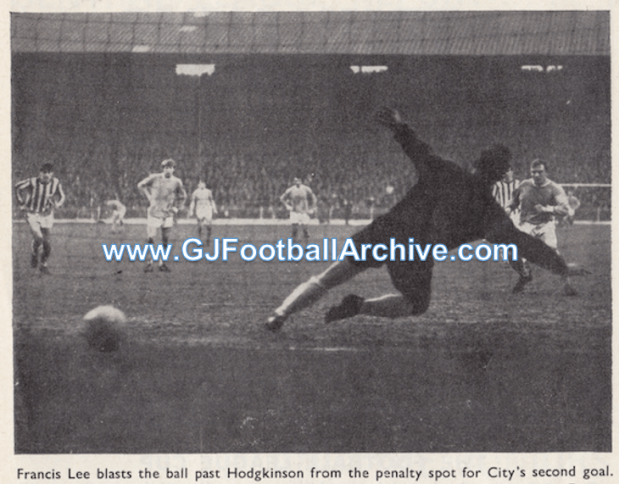
Francis Lee’s first penalty for City January 1968 v Sheffield United
Was the move to Derby something you really wanted?
By that time my business was substantial so going to Derby was going to cause problems. Derby offered City more than anyone else and that was that. We won the title in my first season – I’d only signed a contract for a year – and they were a very good side, so I stayed with them for another season. The pitch was awful – even Maine Road’s pitch was better – but I felt we could have won the European Cup that second season. We beat Real Madrid 4-1 but I missed the return game because I’d been sent off in the Hunter incident against Leeds. We lost 5-1.
They actually changed the rule after that saying it was unfair to automatically ban a player from a European game after a domestic match when the player had yet to be proved to be guilty. There wasn’t much chance of me being ‘not guilty’ – the footage was there for everyone to see!
People often suggest that City sold you too soon and that had you stayed a couple of seasons longer we might have won the title again. Do you hold this view?
I think if I’d have stayed and Mike Summerbee – remember he was sold a year after me – then I do think we’d have mounted a serious challenge for the title. Mike had plenty to offer and should not have been sold.
You came back to Maine Road and scored for Derby (28/12/74). I was in Platt Lane that day and I remember a surreal moment when City fans cheered your goal. Did that actually happen?
Yes, it did. Then I think they thought: “What have we done, he’s playing for them!”
I enjoyed my football and I loved scoring. I loved that goal. I picked it up with my back to the line, went through two people and on to score the goal. The film shows me smiling because I’d scored what I thought was a good goal. It had nothing to do with City or revenge or anything like that. I think I enjoyed about 95% of every game I ever played. It was fun. A great way to earn a living, so on that day I was happy.
Why did you retire in 1976 only a few weeks after your 32nd birthday?
My business was taking over. I had about 110 people working for me and was travelling all over the country. Had I been playing closer to Bolton then I may have carried on. Derby wanted me to stay on, and I made a promise to Dave Mackay that if I was to play again then I’d do it for him. Tommy Docherty tried to persuade me to join United but I wouldn’t break my promise to Derby.
Your business and horse racing interests grew, but then in 1993 you were back, mounting a takeover of City. Why?
I wasn’t looking to get back into the game at all during those years. I had a successful career and was happy. But City were in a desperate state and I genuinely felt that I could not let a club I cared passionately for struggle like that.
When we finally gained control there were so many issues. So many skeletons coming out of the cupboards. The financial state of the club was appalling. I should have known then that it wouldn’t work!
The biggest problem at the start was having to build the new Kippax Stand –there really wasn’t a workable plan in place before we arrived and yet the stand had to be replaced within months of us arriving. We ended up spending about £16m in the end – even removing the waste from underneath the old terracing cost £1.8m because it was contaminated. I thought then that my luck had changed. Everything we tried to do became an issue and the Kippax was a millstone.
1994-95 the new Kippax takes shape
It’s extraordinary when you think that prior to us, Blackburn and Everton, no one ever put money into a football club. People bought shares but never invested, we did invest.
Off the pitch things did improve significantly, but on the pitch we struggled. What’s your view?
People like John Dunkerley worked very hard during that spell and the training facilities were improved and so on. Then, just when we finished the Kippax, Manchester Council started to talk to me about becoming tenants of the new stadium – now that turned out to be the best thing that happened to City during the decade that followed. We spent a lot of time working with them and talking with various people to make it happen. Full marks must go to the Council for having the foresight and it became very important for City to become anchor tenants. I think I had a lot of bad luck as Chairman and things certainly didn’t work on the pitch, but I do think that was one thing that the club got right.
Finally, thinking of your time as a player, many people claim the 1970 League Cup Final was your greatest City game, do you feel that?
I don’t think of individual games in that way. You have to look at the club during your time there and see what that club won and what you contributed to the overall success of the club, not necessarily individual games.
1970 League Cup final. Francis Lee facing ball and Glyn Pardoe
My role was to make things happen, and if I was making things happen, especially if it was causing some aggravation for the opposition, then I was happy. When you hear the opposition players shouting things like: “don’t let him turn!” that’s a real pat on the back. You know you’re getting to them.
In terms of individual games or goals… I think one of the goals I scored at West Ham (18/11/67) was the best goal I’ve ever scored. I was playing against Bobby Moore and I think I had a fantastic game.
I always think that a top class player should go on to the pitch and have enough confidence in his own ability to know that it is very rare for him to have a bad game. It’s not arrogance or anything, but it is the mark of a top class player. If you go onto the pitch feeling that then more often than not you will have a good game. The next step is to take it up the levels until you walk on to the pitch believing you’ll have a great game and score a couple of goals.
At City most of us developed that confidence and on some days, when the entire team was at that level, we had some tremendous games. There are signs that the current side are heading in that same direction.
You can read more on Francis throughout the website. Use the Francis Lee tab lower down on this page or search using his name. As an example, here’s a detailed profile of him I wrote a few years back:
Subscribe to access great content and support Gary’s research
If you’ve enjoyed this piece then why not subscribe and read the rest of the great material on here. At the same time you’ll be supporting my research and writing (I’m not employed by anyone and my research/writing is self-funded). It costs £3 per month (here; access everything posted since 1 October 2022) or £20 per year (below; access everything posted since December 2020). You’ll also get to read all content posted during your subscription. Thanks.
Subscribe to access great content and support Gary’s research
If you’ve enjoyed this piece then why not subscribe and read the rest of the great material on here. At the same time you’ll be supporting my research and writing (I’m not employed by anyone and my research/writing is self-funded). It costs £3 per month (above) or £20 per year (here; access everything posted since December 2020). You’ll also get to read all content posted during your subscription. Thanks.
I’ve just heard the news that Steph Houghton will be retiring from professional football at the end of this current season (2023-24). It’s a major loss to football. Steph has been a wonderful ambassador for football and has been the perfect role model for many, many years.
I was fortunate enough to interview her about 5 years ago when I was researching and writing my history of Manchester City’s women’s team. That day she was wonderful and her love of the game was contagious. I’ve interviewed a lot of footballers over the years and, considering Steph was Manchester City and England captain at the time, she had no airs or graces or tried to act in a particular way. She seemed genuine and I was impressed.
Her arrival at City was hugely significant for the Club and in my interviews with her colleagues and City’s management it was clear that her commitment to the City cause back in 2014 was so important. It helped convince others of how special City’s plans were and over the years that followed her commitment was rewarded with significant success.
I could go on for some time about Steph’s significance and maybe later in the season I’ll post more, but for the time being let’s celebrate every minute she plays over these final weeks. Let’s also ensure the youngest fans get to see her play while they can. In future decades they’ll remember and be able to say they saw her play.
While you’re here why not find out more on earlier generations of women’s footballers:
The latest City in the 1990s flashback feature is about the women’s Manchester derby. This weekend marks the latest Manchester derby in the Women’s Super League and it will be played at the Etihad Stadium (City currently hold the record attendance for a women’s club game in Manchester – you can find details of that elsewhere on the website). There’s a long history of competition between teams representing the women of Manchester City and Manchester United.
City’s team has been in existence continually since November 1988 when Donna Haynes and Heidi Ward both scored two goals in their first game (v Oldham Athletic at Boundary Park).
I was at the City Ladies (as they were then known) first game and I was also at their first league derby in September 1990 when City defeated United 4-3. It was a fantastic day, watched by around 150 people.
City’s goals came from Rhoda Taylor (8 min), Rachel O’Shaughnessy (43 mins), Jenny Newton (50 mins) and Lesley Peters. City’s manager Neil Mather told me as part of my research for the Manchester City Women book: ‘United were the top side, you know, and beating them was so good for morale. The men’s team were a good side in the early 90s when City Ladies carried on developing, you know. This was the Howard Kendall era, and City had top five finishes. City were one of the top five or six teams in the country at the time, so it was fabulous for women’s football to have Man City, you know.’
Helen Hempenstall played for City that day and she described her memory of the day for my book: I remember when we played United (30/9/90) and Neil (Helen’s boyfriend, now husband) and all his mates came to watch us. There were a lot of people there that day. United had a decent team then. It was always a difficult game against United. They had a right-winger… We never got on. Every time we played each other we were at each other all the way through the game. Me and Carol Woodall were having a go at her. The referee told Lesley Wright “Tell both your full backs to shut their mouths otherwise they’ll both be off!” We just didn’t get along and before every game I thought I’ll get in their first. ‘I’m having her.’ Neil Mather still talks about it.
‘I think Lesley Wright kept the team together. She kept it all tight at the back. I played at the back with her and I learnt a lot from her. Because I was next to her I knew how important she was. If I missed something she always got it. She always encouraged me and kept shouting ‘different class, different class’. You learn from the people around you and I listened to her. Before every game she came to speak to me. She’d put her arm around me and reassure me. She’d tell me not to worry about anything. Most of the time travelling to away games I’d go with Lesley in the car. We used to have a laugh. I remember one day we were travelling to an away game some distance away and we stopped for petrol and all got out. I lit up a fag and everyone else jumped back in the car screaming! I didn’t even think! When we got to the ground they all told Neil Mather and I think he worried that he could’ve lost half his team. At another game I was sat in the middle and as we got out the person before me slammed the door back. It hit my head and I had a big lump for the game.’
Lesley Wright was one of several women who had first played for the pioneering Manchester Corinthians team. I’ve been researching their remarkable story for years and this summer (2024) my work will be published. It will tell the story of the Corinthians from its formation in 1949 through to its final days forty years later. For more information on that club and the book see:
The story of the first women’s League derby and of the first 30 years or so of City Women’s existence can be read in my book on the club. It’s called Manchester City Women: An Oral History and is basically the women telling their stories of playing for the club and how they got into football, plus statistics covering the journey from friendlies in 1988-89 through to competition and the modern day successes.
You can buy the book via this link (every copy is signed by me):
Manchester City Football Club can today announced that Gareth Taylor has signed a new three-year contract.
The 51-year-old was appointed Head Coach of the women’s first team in May 2020, and has overseen 97 wins from 131 games in all competitions to date.
Having won both the FA Cup and Continental Cup during his tenure so far, City’s continued push for silverware this campaign has seen them reach the FA Cup quarter-finals and Continental Cup semi-final.
Taylor’s side currently boast the best defensive record in the Women’s Super League, and a 12-match winning run in all competitions – which has included statement victories on the road against title rivals Arsenal and Chelsea, dealing the latter a first defeat at Kingsmeadow in more than three years.
Speaking about his new contract, Taylor said: “I’m very happy to be able to commit to City for another three seasons. I think what we’re doing here and trying to achieve is a build and a long-term project of sustainability and success.
“Our ambition was always to be right at the top and we’ve done that. It’s taken a lot of hard work from a lot of people behind-the-scenes. The players have really bought in to what we’re trying to do and achieve.”
Highlighting the importance of both Women’s Managing Director Charlotte O’Neill and Director of Football Nils Nielsen in City’s strong season so far, Taylor added: “Nils has helped in a number of ways. His experience of having been a head coach previously in the women’s game is really helpful as well because you’re not talking to someone who has not been there.
“Charlotte I’ve worked with previously in the Academy. What she’ll do is be really clear in our objectives and really clear in what we are capable of doing.”
Director of Football Nils Nielsen added: “I am very pleased that Gareth has agreed to continue his great work in our programme for the coming years.
“We have a clear strategy on how we want to move forward, and securing Gareth to lead the team is a key factor in this.
“Now we can all focus on finishing this season in style and prepare for the next few seasons by following the plan.”
Manchester City Women Managing Director, Charlotte O’Neill, added: “We’re very pleased to have Gareth continue his journey with City for another three years.
“Gareth is someone who has embraced the City Football Group approach from day one and shares our ambition to push the envelope in the women’s game and build a squad full of talented and ambitious players.
“Nils and I are very much looking forward to continuing our work with him for the rest of this season and beyond alongside this amazing group of players. I’m confident the future is very bright at this Club.”
The photo is of Nils Nielsen and Gareth Taylor of Manchester City signing a contract extension at Manchester City Football Academy on February 29, 2024 in Manchester. Photo by Declan Lloyd/Manchester City FC.
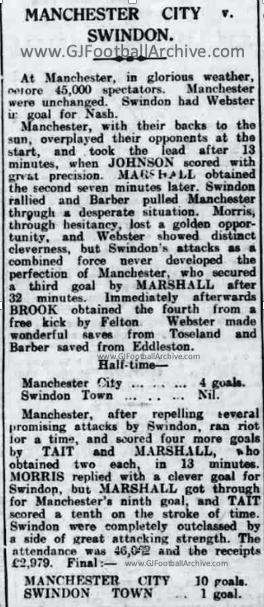
Last night (27 February 2024) Erling Haaland became the third Manchester City player to score five goals in a FA Cup game when he faced Luton. The two previous players to achieve this feat were Frank Roberts (see link below for video of the game he scored 5 in) and Bobby Marshall. Marshall’s five came in a FA Cup replay at Swindon on 29 January 1930 when City won 10-1. The attendance for this Tuesday afternoon match was 46,082 – a remarkable figure for an afternoon game in the days before floodlit competition.
Here are a couple of reports of that game (the second contains the goalscoring times/sequence):
For Haaland there were a few records/points to note:
He is regarded as the first player to score five or more in the FA Cup (1st round onwards) since Duane Darby scored 6 for Hull v Whitby in 1996-97.
He is the first to score five or more for a top-flight club in the FA Cup since George Best scored 6 for United v Northampton in 1970.
He is the first to score five against Luton for City since Denis Law in 1961 when Law scored 6 but all were wiped from the records as the game was abandoned.
This is the second time Haaland has scored five goals in a game in his senior career, previously doing so for City against RB Leipzig in the Champions League in March 2023.
Since his debut for City in July 2022, Haaland has scored 79 goals in 83 games in all comps, 30 more than any other Premier League player in the that time (Salah 49).
It’s Luton v Manchester City in the FA Cup tonight. The two sides have met on 7 previous occasions in the competition with City winning 4, drawing 1 and 2 ending in defeat. There was also the famous expunged game where Denis Law netted six. ‘Expunged’ – what a great word! For anyone wondering, it means wiped from the records. So none of those six count in either Law’s goals record or City’s, but it is a game that often gets remembered.
Both sides pay their respects following the death of a monarch (interesting to note that that weekend’s FA Cup games went ahead as scheduled. Over 65,000 watched City defeat Luton 2-1 at Maine Road).
Of course, Luton played their part in one of the most infamous end of season games in 1983. I won’t put a link here to that but do a search if you’re interested as there’s plenty on my website about that day!
The full record for Manchester City against Luton prior to tonight’s game is:










 Gary James' Football Archive