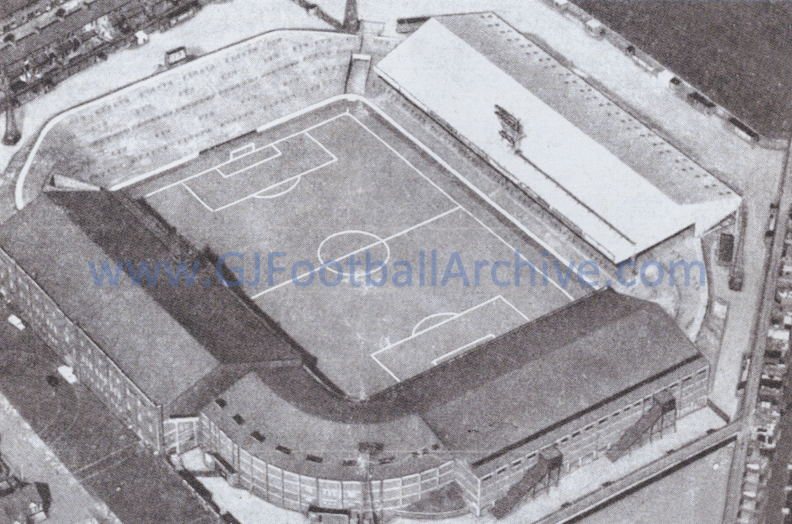
It’s day 33 of my posts counting down to the centenary of Maine Road’s opening game. Today – Notice anything odd about this image? Look at the Main Stand roof….
This photo was taken shortly after World War Two at a time when the adverts and notices on the Main Stand roof had been blacked out to avoid being picked up by enemy bombers during the war.
We all know about Old Trafford being bombed and while the Maine Road stadium did not suffer major damage houses on Thornton Road and other streets around the ground were bombed during the war.
The semi-circular gable on the roof of the stand carried adverts for much of its existence, though initial plans had been to have the club’s name proudly displayed there. I’ve yet to find an image showing any MCFC wording painted on to it but I do believe it did have this early in the stadium’s life, before adverts took over.
This photo shows the gable from the back/air:
This 1971 view shows the second Main Stand roof (actually just the middle section was replaced) and the original gable would have appeared where number 1 is.
Maine Road aerial 1971 from Farewell To Maine Road
If you’d like to read more on the history of Maine Road, take a look at Farewell To Maine Road, which can be downloaded from this page:
If you enjoy all the free material on my website and would like to support my research and keep this website going (but don’t want to subscribe) then why not make a one-time donation (or buy me a coffee). All support for my research is valued and welcome. It allows me to keep some free material available for all. Thanks.
It’s day 32 of my posts counting down to the centenary of Maine Road’s opening game. Today – A behind the Kippax image from 1993. This photo has so much going on despite it looking fairly bland. I’ll explain:
When the Kippax was roofed in 1957 the original terracing had to be squared off and so, instead of reducing the terracing City decided to extend it where its started to curve. You can see in this image that the end of the stand is on stilts/stanchions over the original banking where it was extended.
At the time the stand was enlarged in 1957 local residents objected to it. Some claimed they’d lost TV signal and were no longer able to get Granada TV which had started broadcasting in May 1956.
When this photo was taken in 1993 that area was for away fans and if you look carefully you can see the segregation fence to the left of the tunnel and going up the banking.
The tunnel and steps in the foreground of the photo are the original 1923 construction but these steps were no longer in use as an entry point. They were blocked off at the top and tended to be used as a seating area by fans instead. They’d been blocked off after the Ibrox Stadium disaster in 1971 when steps like these had to be remodelled to prevent a build up of fans flowing down at speed. This staircase was not altered but others were and remained in use.
Notice also the paved slope. This had been a simple slope of grass and rubble (as can be seen on the 1971 image lower down this page) for most of the stand’s life but general crowd disorder at football had led to City deciding to pave this section to prevent fans from grabbing stones and lobbing them over the segregation fence at rival fans. When I spoke with Bernard Halford many years ago, he was quite proud of this ‘flagging’ of the slope and said it did prevent some significant issues which could have had repercussions for the club.
This image from 1961 shows this part of the extended/squared off Kippax to the right of the photo.
Here’s a view from 1971 showing the back of the Kippax as it looked. The away staircase is to the left of number 8 and to the left of that you can see the squared off part of the stand on stilts. The staircase that is on the 1993 image is the one between 7 and 8 below.
Maine Road aerial 1971 from Farewell To Maine Road
If you’d like to read more on the history of Maine Road, take a look at Farewell To Maine Road, which can be downloaded from this page:
If you enjoy all the free material on my website and would like to support my research and keep this website going (but don’t want to subscribe) then why not make a one-time donation (or buy me a coffee). All support for my research is valued and welcome. It allows me to keep some free material available for all. Thanks.
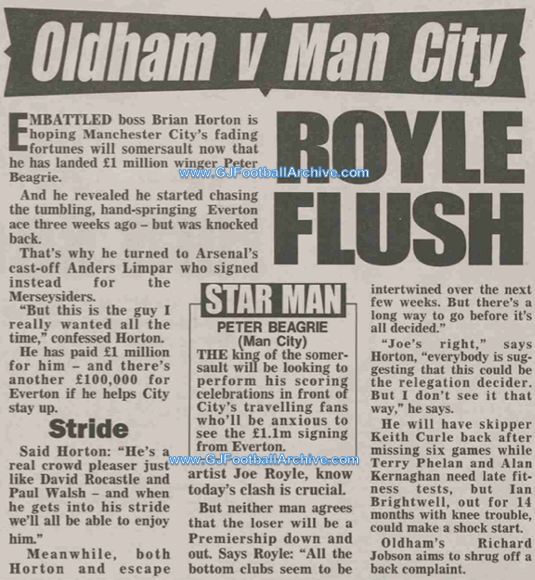
On this day (24 March) in 1994 Peter Beagrie signed for Manchester City from Everton and soon established himself as a hero. With his trademark somersaulting goal celebrations Beagrie scored 5 goals in 58 (plus 7 as substitute) appearances, but his contribution to the exciting style of play enjoyed under Brian Horton was much more impressive than those statistics suggest.
Beagrie’s debut came in a goalless game v Oldham the following Saturday.
Prior to this weekend’s game with Spurs, Manchester City have had players from 41 different nations score for the Blues in the Premier League. Can you remember them all? The following 1200 word article tells the story…
Subscribe to get access
Read this content when you subscribe today. It costs £20 a year or £3 per month (see below). Annual subscribers access everything posted to the site including interviews, talks, books and hundreds of articles plus everything posted during your subscription.
Monthly subscribers (£3, cancel anytime) get access to everything posted to the site since 1 October 2022 plus everything posted during your subscription.
Today (3 January) in 1994: After 39 minutes Manchester City’s game with Ipswich Town was abandoned with the Blues winning 2-0. The scorers were Vonk and Ingebrigtsen – his only League goal for the Blues was expunged from the records as a result!
The referee David Elleray angered the City players, especially Tony Coton, by abandoning the tie due to a waterlogged pitch. The pitch had been appalling at the kick-off and perhaps the game should not have commenced. Naturally, it was a big disappointment at the time.
I was at this abandoned game in the ‘new’ Platt Lane Stand. Were you also at Maine Road that day? If so why not leave your memory as a comment or email it to me for possible future use on this website?
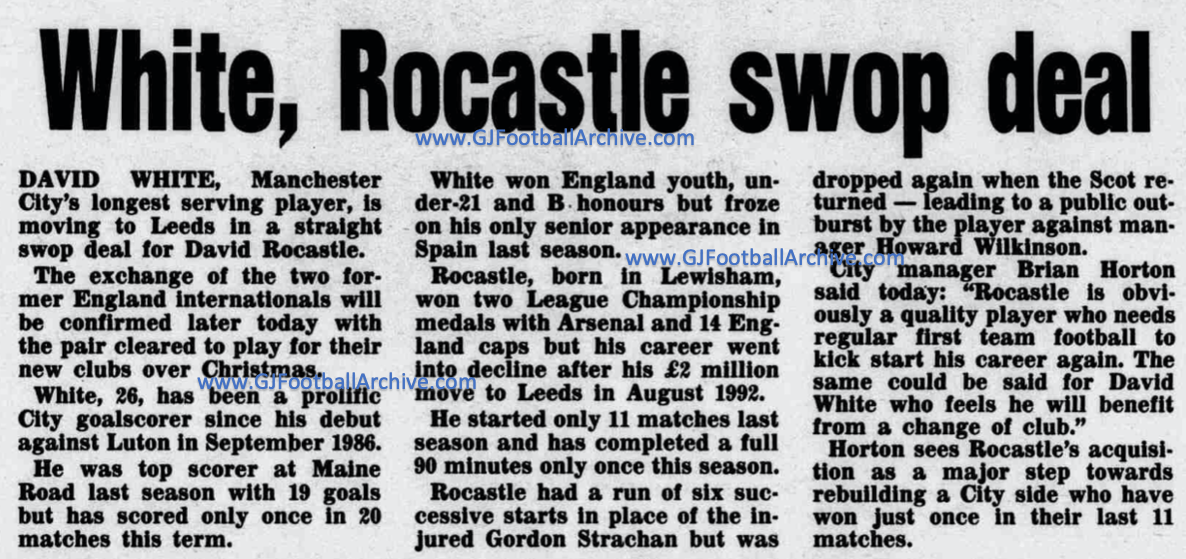
On this day (22 December) in 1993 David White left Manchester City after years of dedication to the Blue cause. He was transferred to Leeds United in a swap deal for David Rocastle. It was a sad loss for the Blues but it was also a new beginning for Rocastle.
On this day (8 December) in 1993 Brian Horton’s Manchester City defeated Everton 1-0 with a goal from Carl Griffiths. You can read more on the 1993-94 season here:
On this day (April 29) in 1933 Manchester City and Everton became the first teams to wear numbered shirts in the FA Cup final. To mark this occasion here is an article on the history of numbered shirts…
This 1700 word article is available to subscribers to my website.
Subscribe to get access
Read more of this content when you subscribe today. It costs £20 a year of £3 per month and you then can access everything on the site. Have a search around and see the volume of content on here or try for a month.
The news that Manchester City will be installing rail seats at the Etihad this summer (2021) means that for the first time since 1994 the stadium will possess a section that is designed to allow people to stand. Whether officially they’ll be allowed to depends on the legislation in place at the time but, whichever way you look at it, this is good news for those who like to stand at football matches.
It is now almost 27 years since we said goodbye to terracing in Manchester and for those of us old enough to remember those days at Maine Road there was one standing area which, above all else, represented the passion fans had for their club – The Kippax.
Unlike most other grounds City’s main terracing ran the full length of the pitch and wasn’t tucked away behind a goal. Because of its positioning the Kippax breathed life into every area of the stadium and was huge. Originally, it held in excess of 35,000, but even in its final days it still gave the impression of power and passion.
The Kippax was originally known as the Popular Side, matching a similarly dominant feature of the Blues’ Hyde Road ground, when it opened in 1923. That first season it held an estimated 35,000 in a crowd of 76,166 – then a national record attendance for a club ground. In 1934 when 84,569 packed into the stadium City’s vast stand may well have held almost 40,000. Incidentally, that 84,569 became the new national record attendance for a club ground (a record that still stands as Wembley is a national stadium, not officially a club ground). You can read about that crowd and game here:
Incidentally, I know City fans get a lot of abuse these days from fans of certain other clubs about filling stadia etc. Well, if you need any ammunition that 84,569 record crowd is over 22,000 higher than Liverpool’s record crowd (61,905 – a figure which wouldn’t get anywhere near City’s top ten crowds!).
Throughout the period up to the mid-50s the Popular Side developed its reputation but it was when it was roofed in 1957 that it became the true heart of the club. Back then it was extended slightly, although legislative changes had reduced terracing capacities by this time. The club announced it would be known as The Kippax Street Stand and that is what it officially remained until 1994 although most of us knew it simply as The Kippax. Its capacity by this time was about 32,000, reducing to 26,155 by the end of the 1970s.
The Kippax accommodated fans of every age and gender and, although it was a formidable place for opposition supporters, it was a welcoming stand for Manchester’s Blues. Young children would sit on the walls and railings, while older fans would find their own preferred viewing spot. Here’s a few snippets about the old stand:
Originally four vast tunnels (one in each corner and two built into the stand) and two significant stairways allowed fans to move onto the Popular Side.
A flag pole, positioned at the back of the terracing up to 1957, allowed a blue and white flag emblazoned with the words City FC to proudly fly. The flag was then re-positioned until it disappeared for good in the 1960s.
Chanters Corner, also known as The Sways, was the area where the more vocal members of City’s support gathered. Packed above a tunnel and next to the segregation fence, fans here often generated the main chants.
The 1960s saw The Kippax’s reputation grow. Fans sang their way through success after success as Joe Mercer’s Aces won the European Cup Winners’ Cup and every domestic trophy possible. The Kippax would begin every game with the chant “Bring on the Champions!” and then follow up with a song for every player as they warmed up.
The final capacity of The Kippax was 18,300 – making this the largest terraced area at a League ground on its final day (The Kop held its final game on the same day but had a smaller capacity).
The Kippax was used for the last time on 30 April 1994 for the visit of Chelsea.
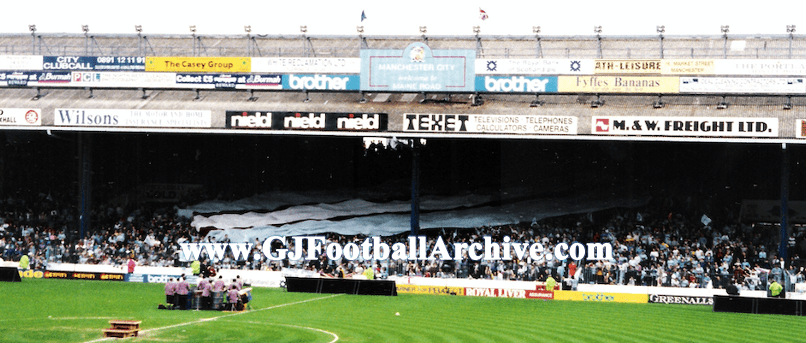
The Blue Print flag was a popular presence on many match days from the late 1980s until 1994, making its last appearance at The Kippax’s final game. The flag had been reduced in size by then. But it still covered much of the terracing. Blue Print was a City fanzine and they had paid for the flag.
Segregation was unnecessary for most of the stand’s existence, but by the end of the 1960s a rope would often be used to separate City and United fans on derby day. This was replaced by permanent barriers in the mid-70s which were increased over the years to keep home and away fans apart. Away fans were positioned at the Platt Lane end of the stand by this time.
It says much about the passion of the place that in the late 1970s the BBC came to film The Kippax chanting and in full flow.
In 1985 when City defeated Charlton 5-1 in a promotion decider on the final day of the season the Kippax was so packed that supporters remain convinced that its official capacity of 26,155 was significantly exceeded. Those of us on the terraces that day will never forget the shock we all experienced when the official crowd of 47,285 was announced – some 5,000 short of capacity!
The Kippax is no more, but those of us who experienced the stand will never forget its power, passion and presence. Its spirit lives on with thousands of Blues who stood there now bringing their own children and grandchildren to the Etihad who, if legislation allows, will soon be able to stand in a section specifically created for that purpose.
If you’re interested you can read how Maine Road got its name here:
While you’re here I’d like to thank you for taking the time and trouble to visit my website. I am not employed by anyone and no one pays me to do research or interviews. I do not have sponsorship or advertising either. I’ve set up this website to help share my 32 years plus writing and research. The intention is to develop the archive and to provide access to as much of my material as possible over the coming weeks, months & years. Subscribers can already access over 280 articles/posts including the entire Manchester A Football History book and audio interviews with former City bosses Malcolm Allison and John Bond.
It costs £20 a year (it works out £1.67 a month) or £3 if you’d like to sign up a month at a time to get full access for as long as you subscribe (see below). Thanks for the support, Gary.
Subscribe to get access
This has been a sample of the material on http://www.GJFootballArchive.com If you would like to read all the in-depth articles and listen to the audio interviews then please subscribe. It works out about £1.67 a month if you take out an annual subscription (£20 per year). Each subscriber gets full access to the 280+ articles posted so far and the hundreds scheduled to be posted in the coming weeks.





 Gary James' Football Archive