When Manchester City defeated title chasing Ipswich 2-1 on 2 April 1977 their manager Bobby Robson told Tony Book: “If we don’t win it, I hope you do.” In the end City finished second – one point behind Liverpool – and Ipswich finished third.
The match had been a thrilling one with both sides level at 1-1 until Dave Watson thundered forward to powerfully head home a corner from Peter Barnes four minutes from time. Highlights here:
If you enjoy all the free material on my website and would like to support my research and keep this website going (but don’t want to subscribe) then why not make a one-time donation (or buy me a coffee). All support for my research is valued and welcome. It allows me to keep some free material available for all. Thanks.
It’s Tony Book’s funeral today and, all being well, I intend being there. Tony was one of the most important figures in the entire history of Manchester City and deserves to be remembered for ever more. Please spare a moment today to think of him. Over the years I met and interviewed Tony on many occasions. I last spoke with him at the MCFC Former Players Dinner earlier this season. As a tribute to him I’m posting here an interview I did with him back in May 2015 (I’ve posted this before but think it’s an appropriate moment to post it again). It wasn’t the first interview I did with him (that was in 1992 about Joe Mercer), but it is a reflective piece with Tony talking about his career.
I always think it’s important when someone passes away to use their words where possible to talk about their career. You can read it below. I’ve posted this exactly as it was written and published in 2015 so, obviously, references are to that era and before.
TALKING CITY WITH GARY JAMES
Tony Book joined City in 1966 and went on to become manager, winning the League Cup in 1976.
Let’s start with your birth certificate and the story that this was altered to give the impression you were a bit younger when signing. Is this true?
Ah, it’s true, but I didn’t actually alter it. My birth certificate had been folded with a heavy crease down it, and I needed it when I was moving from Bath to join Plymouth where Malcolm Allison was the manager. He told them I was 28 but I was 30. Luckily, when I opened out my birth certificate the fold had meant that the final number in the year wasn’t clear, so they just took Malcolm’s word for it! When I came here in 1966 I was 32 – for real – and we never hid my age.
It’s a good job, otherwise you’d have been celebrating your 80th two years late! When you signed for City Malcolm had to persuade Joe Mercer to ignore your age didn’t he?
Yes. Joe was a similar age when he joined Arsenal, as you know Gary, and Malcolm said “look at what you did at Arsenal Joe” – he captained them to a couple of League titles and the FA Cup. Little did we realise that something similar would happen to me at City. I always wanted to be a full time professional footballer and Malcolm gave me the chance. I went playing in Toronto – it was the first time I’d trained in the day because I was a bricklayer by trade and had to train at night back home – before Plymouth and Malcolm came and talked with me after I’d played against a team of Italians over there. He told me how much he liked my play and, well, after that he signed me for Plymouth and then City. I was always grateful to Malcolm, but joining City was perfect. The club under Joe and Malcolm was about to take off and I recognised as soon as I got here that there was a good nucleus of young lads who were ready. Doyle, Pardoe, Oakes, Dowd, Young… the list goes on. I came in just after they’d got promoted and everything felt right. I made my debut at Southampton on 20 August 1966 and, although that match ended goalless, it was clear those lads were enjoying their football. Of course, Summerbee and Bell had been added and then Francis came in October 1967. That’s when we really took off.
Tony Book 1969
How did it feel to be made captain of this team?
When Johnny Crossan left I was made captain because of my experience in football, not because of experience at the highest level because I didn’t have that. But what I did know was football and the way a team operates. I came to professional football late, but back then non-league teams did have quite a few former League players. Some actually gave up League careers because, in the end, they could earn more in non-League and regular employment. I always felt I had something to offer the younger guys because of that experience.
Being totally honest, what did you feel you’d do at City? Did you think you’d be there for as long as you were?
I hoped I’d get a couple of years. That’s all I felt I could get and I would have been very happy with two years at Manchester City, of course. Back then City owned some club houses and I went in one – paying about £2.50 a week! Because of what happened and the way the success came in my second year, Gary, I felt I could go on again. Winning the League in 1968 was like a spark and I wanted to keep the flame going.
Thinking about the title winning season of 1967-68, there were quite a few standout games. What are your memories of those?
There was the Spurs game at Christmas when we sharpened our studs to keep a grip on the surface and we really played a graceful, stylish game. There was the derby at Old Trafford when I made a mistake. I was playing the sweeper role, I let the ball bounce, and George Best went through and stuck it right in the net in the first minute! I couldn’t believe it and the lads lifted me and, Gary, we went on to play a brilliant game. We won 3-1 and that set us on course, but we still had nine games to play. None of us had ever won a major trophy, but Malcolm and Joe were brilliant during that period. Malcolm was great at relaxing us and there was never a doubt in his mind, and then in our minds, that we wouldn’t win it. We believed in ourselves and with Colin Bell, Mike Summerbee and Francis Lee we knew we had that something special that champions need. I always felt that if we went behind one of those three would get us out of trouble. We had a great team throughout of course, and we complimented each other well across the park. We all knew our roles.
After winning the League you suffered an Achilles injury, did you think that was the end?
No, but I was desperate to get back. I tried everything. My leg was in plaster and as soon as they took it off I tried. I played in a reserve game and Sidney Rose, the doctor who was also a director, saw me struggle. I felt it go again. He stuck a needle in me and I had to rest. In the end I went to Christie’s, had a shot of radium, and that seemed to take the sting out of it all. I don’t know whether that was the right treatment or not, but I began training and came back to the first team in January.
Clearly, losing your influential captain for such a large period of the season had its effect on City in the League and in their first European Cup campaign, but once you returned you guided City to FA Cup success. Was this another fairytale season for you?
I guess it was because winning the FA Cup was amazing. It was important for us to keep our success going and the FA Cup was viewed as something special, but I have to tell you Gary, that now, when I look back, I realise that we were not consistent in our challenge for the League. We consistently challenged for trophies, but not in the League. Today, we have such a wonderful team that has been able to challenge for the League season after season, but back then we were more inconsistent. We had good days and bad days, but almost any team in the division could challenge back then. There were no easy games. In 1969 I also shared the FWA player of the year with Dave Mackay, so it was a good season. People had suggested I’d win it the year before because I’d played every game and we’d won the League. I was getting a lot of praise but George Best won it that year. So, the year I won it, it was a surprise. A great feeling and I remember being at the award dinner. For me though, it was an achievement for the entire team. You need a good team around you to win awards like these, and we certainly had a great team.
What are your memories of City in Europe during that time?
There was Malcolm’s boast about scaring Europe which set us up, but then in the ECWC 1969-70 we did. The final is the strongest memory but mostly because of the rain. We had a great following of fans, but few locals and Gornik fans were there, and they were all drenched. I felt so sorry for them. We won the cup, of course, and that season we’d also won the League Cup. I wanted to go on forever by that time. I was enjoying it and those two years became four and I was 36. I couldn’t wait for the next season. I was like an 18 year old who had just been given his chance.
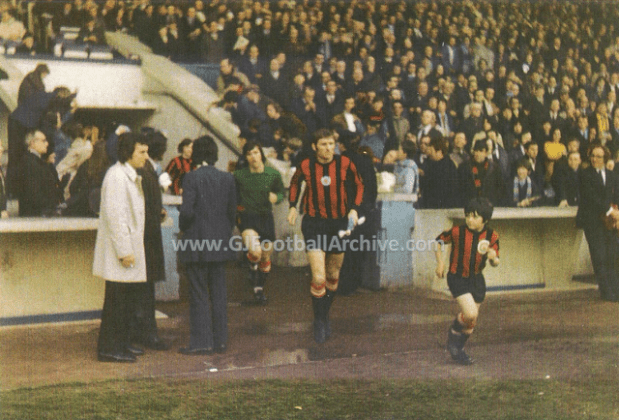
1971 ECWC v Chelsea. Tony Book and mascot Paul Todd. Photo by Alan Jubb
Is there anything from your playing career that you would change if you could?
Ah, yes. I gave the referee an elbow at Ipswich! He’d disallowed a goal. At Ipswich, you had to go down a corridor as you went in at half time and as I turned I deliberately elbowed him. He went down. I was called to an FA disciplinary meeting and the first question they asked was “would you like your past record to be taken into consideration?” Well, I’d only been a pro for a couple of years so I said yes, thinking it’ll be great. They then brought out information going years back from my non-league days and it all worked against me!
When it came time to retire from playing, was that your choice?
No. Johnny Hart had been manager but was ill and Peter Swales asked me to take over on a temporary basis in October 1973. I managed the team for about five weeks until Ron Saunders came in and he had a chat with me suggesting I was needed more as a coach/assistant than a player. I wish now I’d said I wanted to finish playing at the end of the season because I think that would have helped him more. There were issues between him and some of the playing squad and I think I could have helped him, had I been a player. He was insistent though.
Ron Saunders, Peter Swales and Tony Book at Saunders appointment in November 1973
It’s a shame because we got to the League Cup final (1974) and with you in that team, maybe things would have gone differently. Saunders didn’t last as manager and was gone in April that year. How did you feel?
You see things happening but are unable to change it. It was tough. I ended up being given the manager’s job and it was a strange period because we’d had turmoil over that season. I also had to start looking at my pals, the players I had won trophies with, and explain that they needed to move on. I didn’t want to do that and I found it very hard. Awful!
As a manager I was proud that in the five years that followed we won the League Cup, finished runners up by a point to Liverpool, and we were in Europe for three consecutive seasons. I had some good players that came in – Dave Watson, Brian Kidd, Asa Hartford – and did an excellent job for me. I felt we were on our way.
From the moment you took on the job it was progress all the way through and, just before Malcolm returned as ‘coaching overlord’ in January 1979, we had reached the UEFA Cup quarter finals. What was it that made you a success in that role?
The players. It’s always about the players you manage to sign and what they do for you. I was more like Joe Mercer as a manager and had good coaches working with me. Bill Taylor was recommended to me by Don Revie and he was a great coach.
Tony Book, Peter Swales and Kaziu Deyna at Deyna’s signing for Manchester City
City may not have won many trophies during your spell as manager, but we came close, had some great players and, significantly, this was an exciting period to watch. Then Malcolm came back. Did you welcome the return?
Malcolm is such an important figure in my life that I cannot say anything but positives about him as a man. I will always be indebted to him. But I knew that it couldn’t work when he came back. I knew the chairman, I knew Malcolm, and I knew how they both worked. There was no way they would have been able to work together. It was as simple as that. That’s what the main difference was between the 60s and 1979. In the 60s we had Albert Alexander as chairman who worked wonderfully with Joe and Malcolm, but it was different in 1979. It was such a shame, because I thought we were going somewhere.
Silkman, Allison & Book after Peter Barnes scored v Tottenham 3 February 1979
On a day to day basis, what was it like working during that period?
It varied but there were players like Gary Owen and Peter Barnes who I felt had a lot to offer, but they were moved on. It’s difficult to go through it all, but as we know it failed and we were dismissed in October 1980. I stayed briefly and then became Cardiff manager. I missed Manchester but was delighted that under John Bond that season ended with the FA Cup final against Spurs. I got a phone call from John Bond asking me back to City to look after the youth team and I said I’d think about it. In the meantime there was the FA Cup final and as it was the 100th final they invited all surviving captains of cup winning sides. Myself, Roy Paul, and Joe Mercer (Arsenal) were on the pitch with the others and all of a sudden they announced my name and the City fans erupted into song. It really got to me, emotionally, and I knew I had to come back. It was one of the best feelings I ever had. Returning to City was the right thing and I had a wonderful time working with Ken Barnes, Glyn Pardoe and all those talented young lads. We won the Youth Cup in 1986 and it was a real pleasure being there at the start of so many careers.
This year I’ve interviewed quite a few of the players who had progressed through the youth team while you were there. Every one of them has talked with affection about your approach, driving them on. I think it’s amazing really that your influence has been there at City year after year since 1966. How does it make you feel to have had three great distinct careers at the club?
I love this club and am grateful to all those who brought me here and involved me for so long. Whenever I’ve been given a job to do I’ve always tried to give my best. When it all came to an end in the 90s it hit me hard and there were issues that were well documented, but since then Francis Lee and I have resolved our differences. Actually, I think it says something that so many of our former players come to games these days, and all of those players from that Mercer-Allison team are so proud of how this club is challenging once more. We’re enjoying the success and the consistency season after season. Having said that I loved my days as a player and would never swap them… I would have loved us to have these pitches though. They’re perfect. How great would the likes of Colin Bell have been on these surfaces?
If you enjoy all the free material on my website and would like to support my research and keep this website going (but don’t want to subscribe) then why not make a one-time donation (or buy me a coffee). All support for my research is valued and welcome. It allows me to keep some free material available for all. Thanks.
Over the years I met and interviewed Tony Book on many occasions. I last spoke with him at the MCFC Former Players Dinner earlier this season. As a tribute to him I’m posting here an interview I did with him back in May 2015. It wasn’t the first interview I did with him (that was in 1992 about Joe Mercer), but it is a reflective piece with Tony talking about his career. I always think it’s important when someone passes away to use their words where possible to talk about their career. You can read it below.
I’ve posted this exactly as it was written and published in 2015 so, obviously, references are to that era and before.
TALKING CITY WITH GARY JAMES
Tony Book joined City in 1966 and went on to become manager, winning the League Cup in 1976.
Let’s start with your birth certificate and the story that this was altered to give the impression you were a bit younger when signing. Is this true?
Ah, it’s true, but I didn’t actually alter it. My birth certificate had been folded with a heavy crease down it, and I needed it when I was moving from Bath to join Plymouth where Malcolm Allison was the manager. He told them I was 28 but I was 30. Luckily, when I opened out my birth certificate the fold had meant that the final number in the year wasn’t clear, so they just took Malcolm’s word for it! When I came here in 1966 I was 32 – for real – and we never hid my age.
It’s a good job, otherwise you’d have been celebrating your 80th two years late! When you signed for City Malcolm had to persuade Joe Mercer to ignore your age didn’t he?
Yes. Joe was a similar age when he joined Arsenal, as you know Gary, and Malcolm said “look at what you did at Arsenal Joe” – he captained them to a couple of League titles and the FA Cup. Little did we realise that something similar would happen to me at City. I always wanted to be a full time professional footballer and Malcolm gave me the chance. I went playing in Toronto – it was the first time I’d trained in the day because I was a bricklayer by trade and had to train at night back home – before Plymouth and Malcolm came and talked with me after I’d played against a team of Italians over there. He told me how much he liked my play and, well, after that he signed me for Plymouth and then City. I was always grateful to Malcolm, but joining City was perfect. The club under Joe and Malcolm was about to take off and I recognised as soon as I got here that there was a good nucleus of young lads who were ready. Doyle, Pardoe, Oakes, Dowd, Young… the list goes on. I came in just after they’d got promoted and everything felt right. I made my debut at Southampton on 20 August 1966 and, although that match ended goalless, it was clear those lads were enjoying their football. Of course, Summerbee and Bell had been added and then Francis came in October 1967. That’s when we really took off.
Tony Book 1969
How did it feel to be made captain of this team?
When Johnny Crossan left I was made captain because of my experience in football, not because of experience at the highest level because I didn’t have that. But what I did know was football and the way a team operates. I came to professional football late, but back then non-league teams did have quite a few former League players. Some actually gave up League careers because, in the end, they could earn more in non-League and regular employment. I always felt I had something to offer the younger guys because of that experience.
Being totally honest, what did you feel you’d do at City? Did you think you’d be there for as long as you were?
I hoped I’d get a couple of years. That’s all I felt I could get and I would have been very happy with two years at Manchester City, of course. Back then City owned some club houses and I went in one – paying about £2.50 a week! Because of what happened and the way the success came in my second year, Gary, I felt I could go on again. Winning the League in 1968 was like a spark and I wanted to keep the flame going.
Thinking about the title winning season of 1967-68, there were quite a few standout games. What are your memories of those?
There was the Spurs game at Christmas when we sharpened our studs to keep a grip on the surface and we really played a graceful, stylish game. There was the derby at Old Trafford when I made a mistake. I was playing the sweeper role, I let the ball bounce, and George Best went through and stuck it right in the net in the first minute! I couldn’t believe it and the lads lifted me and, Gary, we went on to play a brilliant game. We won 3-1 and that set us on course, but we still had nine games to play. None of us had ever won a major trophy, but Malcolm and Joe were brilliant during that period. Malcolm was great at relaxing us and there was never a doubt in his mind, and then in our minds, that we wouldn’t win it. We believed in ourselves and with Colin Bell, Mike Summerbee and Francis Lee we knew we had that something special that champions need. I always felt that if we went behind one of those three would get us out of trouble. We had a great team throughout of course, and we complimented each other well across the park. We all knew our roles.
After winning the League you suffered an Achilles injury, did you think that was the end?
No, but I was desperate to get back. I tried everything. My leg was in plaster and as soon as they took it off I tried. I played in a reserve game and Sidney Rose, the doctor who was also a director, saw me struggle. I felt it go again. He stuck a needle in me and I had to rest. In the end I went to Christie’s, had a shot of radium, and that seemed to take the sting out of it all. I don’t know whether that was the right treatment or not, but I began training and came back to the first team in January.
Clearly, losing your influential captain for such a large period of the season had its effect on City in the League and in their first European Cup campaign, but once you returned you guided City to FA Cup success. Was this another fairytale season for you?
I guess it was because winning the FA Cup was amazing. It was important for us to keep our success going and the FA Cup was viewed as something special, but I have to tell you Gary, that now, when I look back, I realise that we were not consistent in our challenge for the League. We consistently challenged for trophies, but not in the League. Today, we have such a wonderful team that has been able to challenge for the League season after season, but back then we were more inconsistent. We had good days and bad days, but almost any team in the division could challenge back then. There were no easy games. In 1969 I also shared the FWA player of the year with Dave Mackay, so it was a good season. People had suggested I’d win it the year before because I’d played every game and we’d won the League. I was getting a lot of praise but George Best won it that year. So, the year I won it, it was a surprise. A great feeling and I remember being at the award dinner. For me though, it was an achievement for the entire team. You need a good team around you to win awards like these, and we certainly had a great team.
What are your memories of City in Europe during that time?
There was Malcolm’s boast about scaring Europe which set us up, but then in the ECWC 1969-70 we did. The final is the strongest memory but mostly because of the rain. We had a great following of fans, but few locals and Gornik fans were there, and they were all drenched. I felt so sorry for them. We won the cup, of course, and that season we’d also won the League Cup. I wanted to go on forever by that time. I was enjoying it and those two years became four and I was 36. I couldn’t wait for the next season. I was like an 18 year old who had just been given his chance.
1971 ECWC v Chelsea. Tony Book and mascot Paul Todd. Photo by Alan Jubb
Is there anything from your playing career that you would change if you could?
Ah, yes. I gave the referee an elbow at Ipswich! He’d disallowed a goal. At Ipswich, you had to go down a corridor as you went in at half time and as I turned I deliberately elbowed him. He went down. I was called to an FA disciplinary meeting and the first question they asked was “would you like your past record to be taken into consideration?” Well, I’d only been a pro for a couple of years so I said yes, thinking it’ll be great. They then brought out information going years back from my non-league days and it all worked against me!
When it came time to retire from playing, was that your choice?
No. Johnny Hart had been manager but was ill and Peter Swales asked me to take over on a temporary basis in October 1973. I managed the team for about five weeks until Ron Saunders came in and he had a chat with me suggesting I was needed more as a coach/assistant than a player. I wish now I’d said I wanted to finish playing at the end of the season because I think that would have helped him more. There were issues between him and some of the playing squad and I think I could have helped him, had I been a player. He was insistent though.
Ron Saunders, Peter Swales and Tony Book at Saunders appointment in November 1973
It’s a shame because we got to the League Cup final (1974) and with you in that team, maybe things would have gone differently. Saunders didn’t last as manager and was gone in April that year. How did you feel?
You see things happening but are unable to change it. It was tough. I ended up being given the manager’s job and it was a strange period because we’d had turmoil over that season. I also had to start looking at my pals, the players I had won trophies with, and explain that they needed to move on. I didn’t want to do that and I found it very hard. Awful!
As a manager I was proud that in the five years that followed we won the League Cup, finished runners up by a point to Liverpool, and we were in Europe for three consecutive seasons. I had some good players that came in – Dave Watson, Brian Kidd, Asa Hartford – and did an excellent job for me. I felt we were on our way.
From the moment you took on the job it was progress all the way through and, just before Malcolm returned as ‘coaching overlord’ in January 1979, we had reached the UEFA Cup quarter finals. What was it that made you a success in that role?
The players. It’s always about the players you manage to sign and what they do for you. I was more like Joe Mercer as a manager and had good coaches working with me. Bill Taylor was recommended to me by Don Revie and he was a great coach.
Tony Book, Peter Swales and Kaziu Deyna at Deyna’s signing for Manchester City
City may not have won many trophies during your spell as manager, but we came close, had some great players and, significantly, this was an exciting period to watch. Then Malcolm came back. Did you welcome the return?
Malcolm is such an important figure in my life that I cannot say anything but positives about him as a man. I will always be indebted to him. But I knew that it couldn’t work when he came back. I knew the chairman, I knew Malcolm, and I knew how they both worked. There was no way they would have been able to work together. It was as simple as that. That’s what the main difference was between the 60s and 1979. In the 60s we had Albert Alexander as chairman who worked wonderfully with Joe and Malcolm, but it was different in 1979. It was such a shame, because I thought we were going somewhere.
Silkman, Allison & Book after Peter Barnes scored v Tottenham 3 February 1979
On a day to day basis, what was it like working during that period?
It varied but there were players like Gary Owen and Peter Barnes who I felt had a lot to offer, but they were moved on. It’s difficult to go through it all, but as we know it failed and we were dismissed in October 1980. I stayed briefly and then became Cardiff manager. I missed Manchester but was delighted that under John Bond that season ended with the FA Cup final against Spurs. I got a phone call from John Bond asking me back to City to look after the youth team and I said I’d think about it. In the meantime there was the FA Cup final and as it was the 100th final they invited all surviving captains of cup winning sides. Myself, Roy Paul, and Joe Mercer (Arsenal) were on the pitch with the others and all of a sudden they announced my name and the City fans erupted into song. It really got to me, emotionally, and I knew I had to come back. It was one of the best feelings I ever had. Returning to City was the right thing and I had a wonderful time working with Ken Barnes, Glyn Pardoe and all those talented young lads. We won the Youth Cup in 1986 and it was a real pleasure being there at the start of so many careers.
This year I’ve interviewed quite a few of the players who had progressed through the youth team while you were there. Every one of them has talked with affection about your approach, driving them on. I think it’s amazing really that your influence has been there at City year after year since 1966. How does it make you feel to have had three great distinct careers at the club?
I love this club and am grateful to all those who brought me here and involved me for so long. Whenever I’ve been given a job to do I’ve always tried to give my best. When it all came to an end in the 90s it hit me hard and there were issues that were well documented, but since then Francis Lee and I have resolved our differences. Actually, I think it says something that so many of our former players come to games these days, and all of those players from that Mercer-Allison team are so proud of how this club is challenging once more. We’re enjoying the success and the consistency season after season. Having said that I loved my days as a player and would never swap them… I would have loved us to have these pitches though. They’re perfect. How great would the likes of Colin Bell have been on these surfaces?
If you enjoy all the free material on my website and would like to support my research and keep this website going (but don’t want to subscribe) then why not make a one-time donation (or buy me a coffee). All support for my research is valued and welcome. It allows me to keep some free material available for all. Thanks.
I’ve just heard the news that Manchester City’s legendary captain and manager Tony Book has died. I’ve met Tony many times over the decades and it’s difficult to put into words how significant he remains in City’s history. My thoughts are with his family and close friends. I last saw Tony at the former players dinner a few months back. To commemorate his life here’s a profile of him I wrote only a few months ago.
Tony was of course a major footballing star of the 60s and early 70s. It seems appropriate today to highlight some of his achievements with quotes here from interviews I’ve performed over the years.
Tony arrived at Maine Road in 1966 and captained Manchester City to phenomenal success. When he arrived at City Book he was in his thirties: “I hoped I’d get a couple of years and I would have been very happy with two years at City, of course. Because of what happened and the way the success came in my second year, I felt I could go on again. Winning the League in 1968 was like a spark and I wanted to keep the flame going.”
Book lifted more trophies as captain than any other Blue, until the incredible success experienced during Vincent Kompany’s time. Back in 2015-16 as Kompany was nearing Book’s record, Book told me: “Next time he lifts a major trophy he’ll have matched my record as captain. I hope that success comes soon, and that he then goes on to pass my record this season.”
His time as captain and player was incredible and this was a golden era for City. What is often overlooked though is Tony’s contribution as a manager. In 1973-74 he became manager of City for the final month of the season – a spell that was noteworthy for the infamous Manchester derby when Denis Law netted against United in the Reds’ relegation match. In the years that followed, Book developed a squad of real talent, blending well-regarded internationals with enthusiastic youth to create a flamboyant and entertaining team.
Book’s second full season saw his team of entertainers annihilate United 4-0 in the 4th round of the League Cup – on a night remembered more for the devastating injury to Colin Bell – and progress to the competition’s final where they defeated Newcastle 2-1. The victory meant Book was the first man to win the trophy as a player and as a manager. He said at the time: “Two weeks ago I met Gordon Lee (Newcastle manager) and we agreed that whoever won, it was more important for us to provide a good final. I think we have done that. This was my greatest moment. It was a tremendous final and Tueart’s goal was something special… quite out of this world.”
Looking back on 1976 Book believes the key to the success lay in City’s preparation: “We wanted everything to be low key and travelled down early in the week. We did simple training and tried to build an environment around us that was positive. It worked well and by the day of the final we were ready.”
City were missing Kenny Clements, and Colin Bell was still out of action, causing Book to bring youngster Ged Keegan in. There had been media talk that Keegan and another youngster, Peter Barnes, would feel the pressure but Book felt differently: “I had total faith in my lads. Barnes scored the first – in a move that we’d worked on in training – and Keegan more than justified his place. I never had a doubt.”
Book managed City through one of the club’s most exciting periods: “As a manager I was proud that in five years we won the League Cup; finished runners up by a point to Liverpool; we were in Europe for three consecutive seasons; and we reached the quarter-finals of the UEFA Cup. I had some good players that came in – Dave Watson, Brian Kidd, Joe Royle, Asa Hartford – and did an excellent job for me.”
City fans loved what he had brought the club and at the 1976 League Cup homecoming they chanted ‘Tony, Tony’ repeatedly for some time. At various film shows over the last decade I’ve shown (together with Will McTaggart from the North West Film Archive) a rediscovered film of the homecoming parade which shows exactly what the success meant to the City boss: “I wanted to win the League Cup for them and I remember looking out over the crowd in Albert Square. They were celebrating and singing. Everything we did was for the fans. These fans have been so loyal over the years and they had made me so welcome when I arrived in 1966. Such a special club and wonderful fans. They deserved that success – and so many more for the way they stood by this club during the painful years that came later.”
Almost sixty years after he first arrived at City, Tony Book remained a regular and popular presence around the club: “I love this club and am grateful to all those who brought me here and involved me for so long. Whenever I’ve been given a job to do I’ve always tried to give my best.”
Book certainly represents all that is good about football and he is a powerful reminder of the successes Manchester City achieved during his captaincy and as manager.
Tonight it’s Juventus v Manchester City and here’s a report (& film) of Manchester City beating Juventus in their first competitive meeting. It was played on 15 September 1976. That day Brian Kidd scored the only goal (a header) and you can see that goal here:
The match report expresses the disappointment City felt at only taking a 1-0 lead to Italy for the 2nd leg.
Here’s a photo from the game. Notice anything odd? Follow the link after the photo for the story.
On this day (27 November) in 1976 a goalless game at Birmingham caused Manchester City to drop to fifth place but, with only two defeats coming in the side’s opening 15 games (and conceding only one goal in 6 games), there was still a great deal of optimism about the place. In fact consistency was perhaps the side’s greatest strength.
On the pitch there had been few changes with Corrigan (1), Donachie (3), Doyle (4), Watson (5), Royle (9), Hartford (10), and Tueart (11) being everpresents at this stage in the season in every competition – League, UEFA Cup, and League Cup.
Off the pitch, the mid 70s was a difficult one for supporter behaviour nationally. Although the Blues took the lead with their great work with young fans and supporters clubs, nationally hooliganism was strong. The 1975-76 season had seen British Rail cancel all soccer specials following a number of high profile acts of hooliganism, although City’s supporters’ club took a lead in keeping fans on the move during 1976-77 as they managed to keep rail specials for members of the City travel club going. In fact they continued to run rail specials until the 1990s.
Supporter behaviour was a major issue and there was the first call, by the Daily Mail, to introduce ID cards for fans. The previous season the supporters of Manchester United and Chelsea had rioted in an attempt to get games in which they were losing abandoned and so City’s great work with the Junior Blues and Supporters’ Club was trying to buck the trend. Throughout the 1976-77 season the Blues devoted a two page feature (out of 24) each programme to a different supporters branch.
Sadly, there were still instances of trouble at City games and the Birmingham match was no exception. Young supporter Ian Hodgkinson (aged 16) was particularly upset at the situation at St. Andrew’s: “The City fans in the Tilton Road End were attacked by Birmingham supporters. This caused the City fans to run to the entrance. The Birmingham police then informed us that it was safe to return, but when we got back, the police vanished and once more we were attacked. Two of my mates had their scarves stolen and were punched many times.”
Ian’s comments were typical of many that were sent to City and the local media, but sadly despite the strength of City’s relationship with supporters at this time, there was little being done elsewhere in football, other than caging fans in (something the Blues tried to avoid at Maine Road).
Results
27 Nov 1976 Birmingham City (A) 0-0, Attendance 29,722
Subscribers can read a 2,100 word article on the entire 1976-77 season below – a season which saw City come close to League success. You can read this below. Enjoy!
Subscribe to get access – Monthly
Read more of this content when you subscribe today. It costs £3 per month (cancel anytime) to access everything posted since 1 October 2022 or there’s a special annual rate below which gives greater access and works out much cheaper.
Read more of this content when you subscribe today. It costs £3 per month (above) or £20 a year (here) to access everything posted since the site was created in December 2020. This special rate works out about £1.67 a week and gives access to everything posted, including PDFs of 3 of my books.
If you enjoy all the free material on my website and would like to support my research and keep this website going (but don’t want to subscribe) then why not make a one-time donation (or buy me a coffee). All support for my research is valued and welcome. It allows me to keep some free material available for all. Thanks.
On 20 November 1976 Dennis Tueart scored the only goal as Manchester City defeated West Bromwich Albion at Maine Road. Here’s a video of an interview I did with Dennis last year. In this we focus on him leaving Manchester City for the NASL and New York Cosmos; his experiences there and his return to City. Dennis is always a great talker and there are some wonderful moments in this as he talks about this significant time in the changing Manchester City and in the excitement of New York soccer.
The conversation links Tony Book, Leonard Rossiter, Pele, Carlos Alberto, John Cleese, Dave Sexton, Malcolm Allison and Franz Beckenbauer amongst others.
It lasts about 50 minutes so get your self a brew and sit down to watch:
Dennis’s biography is still available (see link below).
If you have enjoyed this interview then why not subscribe to access other interviews in the archive, plus over 1000 articles/features. See below for details.
If you enjoy all the free material on my website and would like to support my research and keep this website going (but don’t want to subscribe) then why not make a one-time donation (or buy me a coffee). All support for my research is valued and welcome. It allows me to keep some free material available for all. Thanks.
On this day (5 October) in 1973 Peter Swales became Manchester City’s chairman. There was an initial positive blip but after that it was more or less downhill all the way for City. Bad times!
In 1977 the BBC in the northwest showed the following incredible profile of him. On several occasions over the last decade or so myself & Will McTaggart have included this video profile of MCFC chairman Peter Swales in our Boys In Blue film show. Each time those who missed it have asked if they could see a video of it. That wasn’t possible for years but now it is. You can see the Swales profile here…
I would urge all MCFC fans and others to watch this. Some of you may wish to jump to the David Brent-esque clip at 3 mins 20. Others may want to see the Ian Niven roof plan that was thwarted by signing Dave Watson at 1 min 45 secs. Then there’s the scene where Swales gives Watson financial advice (45 secs) and it ends with Swales telling us he was a bit like Kevin Keegan (4 mins).
On this day (4 September) in 1934 Tony Book was born. Happy 90th birthday Tony! Tony was of course a major footballing star of the 60s and early 70s. It seems appropriate today to highlight some of his achievements with quotes here from interviews I’ve performed over the years. Enjoy!
Tony arrived at Maine Road in 1966 and captained Manchester City to phenomenal success. When he arrived at City Book he was in his thirties: “I hoped I’d get a couple of years and I would have been very happy with two years at City, of course. Because of what happened and the way the success came in my second year, I felt I could go on again. Winning the League in 1968 was like a spark and I wanted to keep the flame going.”
Book lifted more trophies as captain than any other Blue, until the incredible success experienced during Vincent Kompany’s time. Back in 2015-16 as Kompany was nearing Book’s record, Book told me: “Next time he lifts a major trophy he’ll have matched my record as captain. I hope that success comes soon, and that he then goes on to pass my record this season.”
His time as captain and player was incredible and this was a golden era for City. What is often overlooked though is Tony’s contribution as a manager. In 1973-74 he became manager of City for the final month of the season – a spell that was noteworthy for the infamous Manchester derby when Denis Law netted against United in the Reds’ relegation match. In the years that followed, Book developed a squad of real talent, blending well-regarded internationals with enthusiastic youth to create a flamboyant and entertaining team.
Book’s second full season saw his team of entertainers annihilate United 4-0 in the 4th round of the League Cup – on a night remembered more for the devastating injury to Colin Bell – and progress to the competition’s final where they defeated Newcastle 2-1. The victory meant Book was the first man to win the trophy as a player and as a manager. He said at the time: “Two weeks ago I met Gordon Lee (Newcastle manager) and we agreed that whoever won, it was more important for us to provide a good final. I think we have done that. This was my greatest moment. It was a tremendous final and Tueart’s goal was something special… quite out of this world.”
Looking back on 1976 Book believes the key to the success lay in City’s preparation: “We wanted everything to be low key and travelled down early in the week. We did simple training and tried to build an environment around us that was positive. It worked well and by the day of the final we were ready.”
City were missing Kenny Clements, and Colin Bell was still out of action, causing Book to bring youngster Ged Keegan in. There had been media talk that Keegan and another youngster, Peter Barnes, would feel the pressure but Book felt differently: “I had total faith in my lads. Barnes scored the first – in a move that we’d worked on in training – and Keegan more than justified his place. I never had a doubt.”
Book managed City through one of the club’s most exciting periods: “As a manager I was proud that in five years we won the League Cup; finished runners up by a point to Liverpool; we were in Europe for three consecutive seasons; and we reached the quarter-finals of the UEFA Cup. I had some good players that came in – Dave Watson, Brian Kidd, Joe Royle, Asa Hartford – and did an excellent job for me.”
City fans loved what he had brought the club and at the 1976 League Cup homecoming they chanted ‘Tony, Tony’ repeatedly for some time. At various film shows over the last decade I’ve shown (together with Will McTaggart from the North West Film Archive) a rediscovered film of the homecoming parade which shows exactly what the success meant to the City boss: “I wanted to win the League Cup for them and I remember looking out over the crowd in Albert Square. They were celebrating and singing. Everything we did was for the fans. These fans have been so loyal over the years and they had made me so welcome when I arrived in 1966. Such a special club and wonderful fans. They deserved that success – and so many more for the way they stood by this club during the painful years that came later.”
Almost sixty years after he first arrived at City, Tony Book is still a regular and popular presence around the club: “I love this club and am grateful to all those who brought me here and involved me for so long. Whenever I’ve been given a job to do I’ve always tried to give my best.”
Book certainly represents all that is good about football and he is a powerful reminder of the successes Manchester City achieved during his captaincy and as manager.
While you’re here why not read other content. There are plenty of free articles here but also there are many, many more only available to subscribers. Subscribers have access to everything. You could even subscribe for a month and see what you think. The following 1,700 word article is on the 1973-74 season and is available to subscribers below. Enjoy!
Subscribe to get access – Monthly
Read more of this content when you subscribe today. It costs £3 per month (cancel anytime) to access everything posted since 1 October 2022 or there’s a special annual rate below which gives greater access and works out much cheaper.
Read more of this content when you subscribe today. It costs £3 per month (above) or £20 a year (here) to access everything posted since the site was created in December 2020. This special rate works out about £1.67 a week and gives access to everything posted, including PDFs of 3 of my books.
If you enjoy all the free material on my website and would like to support my research and keep this website going (but don’t want to subscribe) then why not make a one-time donation (or buy me a coffee). All support for my research is valued and welcome. It allows me to keep some free material available for all. Thanks.
Despite drawing 2-2 at Newcastle on this day (16 February) in 1977 and Ipswich heading the table, Norwich’s Ken Brown believed Manchester City were the most likely team to win the title. City were certainly the team with all the flair this season and perhaps deserved success but ultimately it was the grim, more negative football played by Liverpool that was to find trophy success.
You can read a 2,100 word article on the entire 1976-77 season – a season which saw City miss the title by a point – below. This series of articles and features on Manchester City in the 1970s has been running throughout January & February with indepth articles some days and smaller ‘on this day’ style posts on others.
Subscribers can access everything. If you want to know more on this incredible decade for Manchester City Football Club then why not subscribe and read it all? You could even subscribe for a month and see what you think. The following 2,100 word article is on the 1976-77 season and is available to subscribers below. Enjoy!
Subscribe to get access – Monthly
Read more of this content when you subscribe today. It costs £3 per month (cancel anytime) to access everything posted since 1 October 2022 or there’s a special annual rate below which gives greater access and works out much cheaper.
Read more of this content when you subscribe today. It costs £3 per month (above) or £20 a year (here) to access everything posted since the site was created in December 2020. This special rate works out about £1.67 a week and gives access to everything posted, including PDFs of 3 of my books.
If you enjoy all the free material on my website and would like to support my research and keep this website going (but don’t want to subscribe) then why not make a one-time donation (or buy me a coffee). All support for my research is valued and welcome. It allows me to keep some free material available for all. Thanks.






 Gary James' Football Archive