Maine Road 100 – Day 75

For post 75 of my Maine Road 100 countdown I’ve posted this image of entertainer Norman Wisdom doing some prematch stuff at Maine Rd in the 90s. That day many of us stood on the Kippax saw the elderly entertainer take to the field but didn’t recognise him at first. In fact many of us thought it was Peter Reid wearing a flat cap!

There were lots of odd prematch activities over the decades and you can read about them in this 2000 word article on the history of pre-match entertainment at Manchester City. There are mentions of the St Joseph’s Industrial School and Beswick Prize Bands, various DJs, athletic challenges, Norman Wisdom, Frank Sidebottom & more. Enjoy:

Subscribe to get access – Annual

Read more of this content when you subscribe today. It costs £20 a year (less than 6p a day) to access everything posted since the site went live in December 2020 (books, interviews, videos, history talks etc.) and throughout your period of subscription. Or you can subscribe a month at a time for £3 (cancel anytime; see below)

Subscribe to get access – Monthly

Monthly subscribers have access to everything posted since 1 October 2022 (books, interviews, videos, history talks etc.) and throughout your period of subscription. It costs £3 per month (cancel anytime)

The Span of Success 2023: Updated

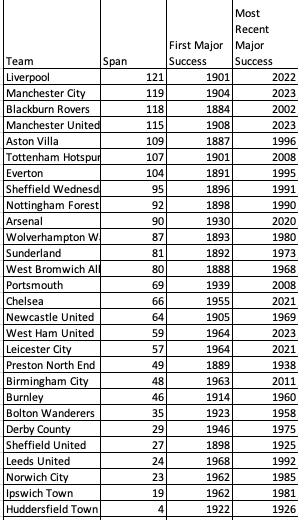
Congratulations to West Ham on your success in last night’s Europa Conference League. Great news for your club and for those clubs who wonder whether competitions like this are a drain or something to aim for. I’ve now updated the table showing the span of success – i.e. the number of years between a club’s first major success (FA Cup, League, League Cup, European trophy) and their most recent. West Ham have jumped some way up that list.

Okay, the span of success does not show how many trophies each club has won or how frequently that club has experienced great eras of success, but it does demonstrate how wrong those people are who believe certain clubs were unsuccessful until recent years, or those who think certain clubs have always been giants. The column on first major success helps to show when some clubs first became trophy-winning significant (often after transformational investment).

West Ham have proved that if you’re a club that hasn’t won a major trophy for a while putting your focus on achieving trophy success ahead of the odd Premier League position can bring significant reward. In future decades no one will remember who finished seventh, tenth or fifteenth but they will remember the trophies.

I know clubs focus on their financials but winning a trophy has longevity, gaining the odd Premier League place provides a bit of extra cash now but no long term kudos. Winning a trophy attracts new fans and brings money-spinning opportunities too.

If I was a supporter of Everton, Aston Villa or any of the other major clubs who have not found significant success in recent decades then I would absolutely want my team to go for whichever cup competition seems most likely to win. That’s what I always wanted from City before they were able to compete for the League again. Winning the FA Cup in 2011 helped everything that followed happen.

While you’re here… why not take a look at the free to read daily Maine Road features counting down to the old stadium’s 100th anniversary of its first game? Here are a sample couple of features (follow the Maine Road tag or search for more):

The Span of Success 2023

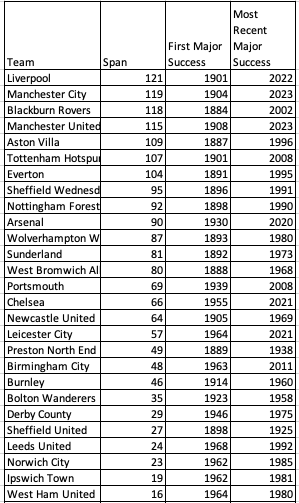
Ahead of West Ham’s European final tomorrow night (7 June) I thought I’d post the latest update to the table showing the span of success – i.e. the number of years between a club’s first major success (FA Cup, League, League Cup, European trophy) and their most recent. If West Ham win tomorrow they will leap ahead of Leicester City.

This season has seen City overtake Blackburn Rovers and they are now second to Liverpool.

Okay, the span of success does not show how many trophies each club has won or how frequently that club has experienced great eras of success, but it does demonstrate how wrong those people are who believe certain clubs were unsuccessful until recent years, or those who think certain clubs have always been giants. The column on first major success helps to show when some clubs first became trophy-winning significant (often after transformational investment).

While you’re here… why not take a look at the free to read daily Maine Road features counting down to the old stadium’s 100th anniversary of its first game? Here are a sample couple of features (follow the Maine Road tag or search for more):

Manchester’s First FA Cup

As part of their All-Manchester FA Cup features the Athletic have asked their writers about the most important FA Cup final. Well, as it’s a City-Utd final then it makes sense to highlight the first ever FA Cup final featuring one of the teams. In 1904 Manchester found its first major trophy success and that led to Manchester being established as a footballing city. It’s part of the reason Manchester City retained a special place in the hearts and minds of Mancunians, even when the success faded.

The captain and goalscorer was the great Billy Meredith. The other year, following the purchase of the oldest surviving FA Cup by Sheikh Mansour (to loan to the National Football Museum) I helped Manchester City with the story of the cup and its significance to Manchester. They’ve produced a video telling the story and it can be viewed here:

https://www.mancity.com/citytv/mens/manchesters-first-trophy-1904-fa-cup-documentary-63745781

For more on the significance of this FA Cup trophy check out the category 1903-04 in the drop down list below.

Wembley Finals

The FA Cup helped establish Manchester’s footballing identity – more on that in a minute. On this day in 1948 Manchester United appeared at Wembley for the first time to win the FA Cup. Manchester’s 1st FAC success came in 1904 (City). Before 1948 the Blues had appeared in 3 Wembley finals. Utd’s 1948 success meant 2 FA Cups each.

More on 1904 here:

United beat Blackpool 4-2 in the 1948 final wearing blue.

True Blues – John Chapman

Continuing the weekly series of ‘True Blue’ figures associated with the early years of Manchester City, here’s an article on the City chairman John Chapman who died in office. You can find out why this man was such an important figure in Manchester City history below:

Subscribe to get access – Annual

Read more of this content when you subscribe today. Annual subscribers can access all the articles, talks, books and interviews posted since December 2020 for an annual subscription of £20 (works out about £1.67 per month). There’s also a monthly subscription (see below).

Subscribe to get access – Monthly

Monthly subscribers can access all the articles, talks, books and interviews posted since 1 October 2022 for a monthly subscription of £3 (cancel any time).

There will be another ‘True Blue’ featured next Monday. Use the tag ‘True Blues’ to find other profiles in this series.

True Blues – Billy Meredith

Continuing the weekly series of ‘True Blue’ figures associated with the early years of Manchester City, here’s an article on Billy Meredith who was the captain and goalscorer for Manchester’s first major trophy success. You can find out why this man was such an important figure in Manchester City history below:

Subscribe to get access – Annual

Read more of this content when you subscribe today. Annual subscribers can access all the articles, talks, books and interviews posted since December 2020 for an annual subscription of £20 (works out about £1.67 per month). There’s also a monthly subscription (see below).

Subscribe to get access – Monthly

Monthly subscribers can access all the articles, talks, books and interviews posted since 1 October 2022 for a monthly subscription of £3 (cancel any time).

There will be another ‘True Blue’ featured next Monday. Use the tag ‘True Blues’ to find other profiles in this series.

Finding 1904 Objects

As a trained historian I am always wary about saying that something is the first or that something’s an absolute fact unless I can properly prove it. It’s important to not jump to assumptions and to act responsibly. The quest to uncover football’s history and ensure the facts not the fiction are recorded drives me on. In addition, I am keen to locate items that can link us directly with a particular moment or achievement. So I’d just like to talk about a few items that I’ve been desperate to locate for several years…

There are many items from Manchester City’s long history that I have been searching for over many, many years. I could write a book about them but here’s the story of a few objects connected with the 1904 FA Cup final and one item I’m after tracking down survived for years and I’ve discovered that it was housed in Burnley for at least 40 years.

Many objects connected with Manchester’s first major trophy success still exist including the original-style FA Cup (housed at the National Football Museum – go and take a look when you can); a watch presented to manager Tom Maley (and some of the others presented to the players); a banner made by members of the Alexander Family (club officials and directors from 1894 through to the modern day; the flag is in City’s archive); players’ medals and various newspaper cuttings and photographs. However, there are three important items that I know existed that have vanished.

I am going to start with the 1904 FA Cup final ball, which was stored in Burnley into the 1950s.

Hillman’s Ball

At the end of the 1904 FA Cup final goalkeeper Jack Hillman charged past an opponent to pick up the ball and claim it as his own. The 1904 FA Cup final became the possession of City’s Hillman and he kept hold of it throughout his life. For many years he had it on display in his sweet shop on Thurston Street, Burnley and it is believed it was still in that building at the time of Hillman’s death in 1952.

According to reports the ball was painted in City’s colours – Cambridge Blue and White was worn for the 1904 final – and was inscribed as the 1904 English Cup winning ball. Back then the FA Cup was more commonly known as the English Cup.

Following Hillman’s death there is uncertainty over what happened to the ball. It seems it stayed in Burnley, so if there’s anyone reading with information please get in touch. If the ball managed to survive into the 1950s then it is possible it is still around somewhere.

I managed to get a Burnley newspaper to do a piece on this a few years back but sadly no one came forward with any information.

Film of the Final

The 1904 FA Cup final was filmed and shown in pubs and exhibition halls for at least a month after the final. Several copies of the film must have existed as it was shown in multiple locations at similar times but, to date, none of these copies have been found. Many photos from the 1904 final (including this one of Meredith scoring) are believed to have been taken from the original footage. In recent years older football films have been located in the north-west and I live in hope that one day a metal film cannister will be found with the words ‘1904 English final’ scrawled across will be identified.

The Players’ Shirts

Not one of the 1904 FA Cup final shirts has ever been found despite many of the players saving other equally important shirts. The 1904 shirt carried no badge and as City played a League game only 2 days after the final and travelled straight to Everton from London, it’s possible the same kit was worn again. Players such as Billy Meredith and Sandy Turnbull did save other important shirts and it’s possible the kits may have stayed within family circles but not recognised for their significance due to the lack of a badge. Frank Booth, a prominent member of the team, died in 1919 and is buried in Denton – maybe his family retained the shirt and it still resides in the region?

If you know of any of these items and can help locate them then please do. The film is probably the one that appeals most to me, but both the ball and a shirt would be great finds too.

You can find out more about 1904 here:

FA Cup Progression

On this day (9 March) in 1904 Manchester City took a major step forward in their quest for their first major trophy when they won 3-1 at Middlesbrough in the FAC quarter-final replay. The goalscorers were Billy Gillespie, George Livingstone and Sandy Turnbull.

Subscribers can read all about Tom Maley, City’s manager at the time, here:

History Video: Joshua Parlby and the Launch of MCFC

As promised, here for subscribers is my presentation on Joshua Parlby and the launch of Manchester City FC. It lasts about 58 minutes and was recorded on 1 March 2023. There are lots of myths out there, but I focused on the facts and my latest research. 

The presentation is all about the visionary who promoted a new club to represent Manchester, Manchester City and about the steps taken in 1894. This talk is now only available to subscribers (see below for details of how to subscribe).

Subscribers can also see the previous history talk on St Mark’s and City’s development in the Gorton area during the 1870s and 1880s below.

Subscribe to get access – Annual

Annual subscribers get access to everything posted since December 2020 (interviews, history talks, articles, PDFs of books etc.) and everything to be posted during your subscription. It costs £20 a year (about 5p a day).

Subscribe to get access – Monthly

Monthly subscribers get access to everything posted since 1 October 2022 and everything to be posted during your subscription. It costs £3 a month (cancel any time).

If you enjoy all the free material on my website and would like to support my research and keep this website going (but don’t want to subscribe) then why not make a one-time donation (or buy me a coffee). All support for my research is valued and welcome. It allows me to keep some free material available for all. Thanks.

Choose an amount

£2.50
£5.00
£7.50

Or enter a custom amount

£

Your contribution is appreciated.

Donate