Thirty years ago, while researching for my biography of Joe Mercer, I interviewed Malcolm Allison in his flat at Yarm. Here’s the second part of the interview (I am serialising it over five days for subscribers).
I’ve often talked at supporters’ meetings and other events about this first time I met Malcolm. There are several funny aspects to it and I may post the story of the interview at some point.
In the full interview Malcolm talks about the relationship with Joe Mercer; the signing of key players; the major successes; the set-up of Manchester City at the time and much more.
Obviously, this was recorded on an old cassette recorder so, at times, the quality is not the best, plus every so often you can hear Malcolm’s young (I think she was two) daughter in the background. Despite the background noise I’m sure you’ll agree that this exclusive interview is worth listening to.
Each section lasts between ten and twenty minutes so get yourself a brew and have a listen.
Subscribe to get listen
To listen please subscribe. It works out about £1.67 a month if you take out an annual subscription (£20 per year) or £3 a month if you’d like to sign up for a month at a time. Each subscriber gets full access to the 280+ articles posted so far and the hundreds scheduled to be posted in the coming weeks.
While you’re here I’d like to thank you for taking the time and trouble to visit my website. I have been researching and writing about Manchester football for a long time (no wonder I’m going grey!) with my first book published in 1989. I am not employed by anyone and I do not have sponsorship either and so I’ve set up this website to help share my 32 years plus writing and research. The intention is to develop the archive and to provide access to as much of my material as possible over the coming weeks, months & years. Subscribers can already access over 280 articles/posts including the entire Manchester A Football History book and an audio interview with former City boss John Bond I performed in 1995.
Thirty years ago, while researching for my biography of Joe Mercer, I interviewed Malcolm Allison in his flat at Yarm. Starting today (Wednesday 17th March) I am serialising that interview over five days for subscribers.
I’ve often talked at supporters’ meetings and other events about this first time I met Malcolm. There are several funny aspects to it and I may post the story of the interview at some point.
In the interview over the following five days Malcolm talks about him meeting Joe Mercer for the first time; joining Manchester City; the relationship with Joe; the signing of the players; the major successes; the set-up of Manchester City at the time and much more.
Obviously, this was recorded on an old cassette recorder so, at times, the quality is not the best, plus every so often you can hear Malcolm’s young (I think she was two) daughter in the background. Despite the background noise I’m sure you’ll agree that this exclusive interview is worth listening to.
Each section lasts between ten and twenty minutes so get yourself a brew and have a listen.
Subscribe to listen
To listen please subscribe. It works out about £1.67 a month if you take out an annual subscription (£20 per year) or £3 a month if you’d like to sign up for a month at a time. Each subscriber gets full access to the 280+ articles posted so far and the hundreds scheduled to be posted in the coming weeks.
While you’re here I’d like to thank you for taking the time and trouble to visit my website. I have been researching and writing about Manchester football for a long time (no wonder I’m going grey!) with my first book published in 1989. I am not employed by anyone and I do not have sponsorship either and so I’ve set up this website to help share my 32 years plus writing and research. The intention is to develop the archive and to provide access to as much of my material as possible over the coming weeks, months & years. Subscribers can already access over 280 articles/posts including the entire Manchester A Football History book and an audio interview with former City boss John Bond I performed in 1995.
Thirty years ago, while researching for my biography of Joe Mercer, I interviewed Malcolm Allison in his flat at Yarm. Starting on Wednesday 17th March I will be serialising the interview over five days for subscribers to this site.
In the interview Malcolm talks about meeting Joe Mercer for the first time; joining Manchester City; the relationship with Joe; the signing the players; the major successes; the set-up of Manchester City at the time and much more.
Here’s a brief section of audio from our chat:
Obviously, this was recorded on an old cassette recorder so, at times, the quality is not the best, but I’m sure you’ll agree that this exclusive interview is worth listening to. To hear the entire interview please subscribe and from Wednesday the interview will be posted a section at a time over five days (it’s over 1 hour in total).
While you’re here I’d like to thank you for taking the time and trouble to visit my website. I have been researching and writing about Manchester football for a long time (no wonder I’m going grey!) with my first book published in 1989. I am not employed by anyone and I do not have sponsorship either and so I’ve set up this website to help share my 32 years plus writing and research. The intention is to develop the archive and to provide access to as much of my material as possible over the coming weeks, months & years. Subscribers can already access over 280 articles/posts including the entire Manchester A Football History book and an audio interview with former City boss John Bond I performed in 1995.
It costs £20 a year (it works out £1.67 a month) or £3 if you’d like to sign up a month at a time to get full access for as long as you subscribe (see below). Thanks for the support, Gary.
For those who haven’t listened to my John Bond interview yet, here’s a snippet from one of the sections. All 7 parts to Bondy’s interview will be posted by the end of next week for subscribers. He was frank throughout and this is a taste of what he had to say:
If you would like to listen to the rest then the details and so on can be read here:
I was interviewed on 17th February 2021 about the great Joe Mercer for the ‘esk podcast’ – an Everton podcast. I talk about meeting Joe; about writing his biography; about Joe’s time at Everton, Arsenal, Manchester City and so on. I also tell the story of Norah Mercer insisting that Bobby Charlton phones me to apologize (it was somewhat of a shock at the time)! We also discussed Everton and City in preparation for their game that night (17th February 2021). No matter who you support it’s well worth listening to.
If you would like to read all the in-depth articles (including the entire Manchester A Football History book) then please subscribe below. It works out about £1.67 a month if you take out an annual subscription (£20 per year) or £3 a month if you’d like to sign up for a month at a time. Each subscriber gets full access to the 230+ articles posted so far and the hundreds scheduled to be posted in the coming weeks.
On September 25 2012 former City manager and West Ham FA Cup winner John Bond died at the age of 79. Bond followed Malcolm Allison as manager of the Blues in October 1980 and within his first seven months he turned a struggling side into one that reached the FA Cup final and the League Cup semi-final. I wrote an obituary to John in the days that followed.
Here, for the benefit of subscribers to my blog, is that obituary.
Subscribe to get access – Annual
If you would like to listen to read this and the other in-depth articles on this site (including the entire Manchester A Football History book) then please subscribe. It works out about £1.67 a month if you take out an annual subscription (£20 per year) or £3 a month (see below) if you’d like to sign up for a month at a time.
If you would like to listen to read this and the other in-depth articles on this site (including the entire Manchester A Football History book) then please subscribe. It costs £3 a month (cancel anytime) if you’d like to sign up for a month at a time or there’s the special price of £20 a year (see above).
Back in November 1995 I interviewed the former Manchester City manager John Bond. At the time I was researching my in-depth history of the club called Manchester The Greatest City (later updated as Manchester The City Years).
I met John at his home and spent a good few hours with him chatting about the Blues and his career. I loved doing this interview and was always grateful for the time he gave me. He was quite frank, open and honest – which delighted me because he was a great talker. He was also happy for me to quote everything he said in the interview. I did end up quoting him extensively in the book (and in others I’ve produced) but, until now, none of the interview has ever been heard by the wider public.
Now, for the first time ever you can hear the opening 17 minutes of the interview. Here he talks about the steps taken by City to appoint him; the interview (and the directors involved in that notorious filmed interview for the City documentary in 1980-81); the signing of Tommy Hutchison, Bobby McDonald and Gerry Gow. As I said earlier, he is quite frank in his comments and that may surprise a few.
This audio recording of the first 17 minutes of the interview is available to subscribers of my blog until 19th February 2021. If you want to hear it then please subscribe below. If subscribers enjoy this piece then please let me know and, if you do, I will release other sections of the interview over the coming weeks.
Of course as this interview was recorded on my old cassette recorder the quality isn’t the best but I’m working on improving that for future pieces.
Subscribe to get access
If you would like to listen to this frank interview and read the in-depth articles on this site (including the entire Manchester A Football History book) then please subscribe. It works out about £1.67 a month if you take out an annual subscription (£20 per year) or £3 a month if you’d like to sign up for a month at a time. Each subscriber gets full access to the 220+ articles posted so far and the hundreds scheduled to be posted in the coming weeks.
I’ve posted 199 separate articles to this website so far and so, for my 200th post, I felt it was about time I paid tribute to the former Manchester City and England manager Joe Mercer for his influence on my writing.
Joe, as most reading this will be aware, was the most successful City manager of all time prior to the recent successes of Pep Guardiola. He remains the only City manager to bring a major European trophy to the club (though hopefully that will change soon!).
When I began writing my first book in 1987 my co-author told me he had been helped during his research into Nottingham Forest by Joe (Joe’s father played for Forest) and he felt that, if the book progressed as planned, Joe would possibly agree to write the foreword to our book. Sadly my co-author Keith Mellor died during the research phase of the book and the entire project looked in jeopardy.
After a while, Keith’s wife contacted me to urge me to continue with the book and she also gave me Joe Mercer’s address, suggesting I should write to him about the book.
I wrote to Joe and told him about the book Keith and I had been compiling (it was a pictorial history of City) and asked if Joe would be interested. I received a phone call from Norah, Joe’s wife, and she invited me over to meet Joe.
At that time I was about 19 and did not have a car and so I asked Norah if I could bring my dad – a passionate City fan. She of course said yes and we made arrangements.
Unfortunately, on the day of our visit, my dad’s car broke down and, knowing we could not let the Mercers down, we quickly arranged to borrow the only vehicle available to us – a white battered and bruised transit-style van. We drove to the Wirral and arrived at the Mercers’ street about 45 minutes early, so we parked up around the corner about 100 yards from their home. We had decided that we could not pull up outside a former England manager’s house in a white works van, and we believed we were hidden.
When we were due to arrive, we climbed out of the van, walked the 100 yards or so and knocked on the door. Immediately Joe, with that huge great grin of his, was in front of us. His Cheshire smile welcomed us in. He did not ask our names, he just asked us in. Within seconds Norah popped out of the kitchen and said: ‘You’ve been very naughty, haven’t you? You’ve been hiding in that van for the last 45 minutes!’ We all laughed and, as we were guided into their house, my dad and I explained about the breakdown and so on. Joe, being Joe, asked if he could do anything. Could he arrange a lift for us, or help get the car repaired. It was immediately clear to me that Joe Mercer was a wonderful man and his wife Norah was a terrific woman.
Can you imagine if we’d have said yes to Joe helping us? What would our neighbours back in Manchester say if we’d have turned up with Joe Mercer in the hope the footballing legend could get dad’s car fixed?
We spent a good couple of hours with Joe and Norah that day and Joe even offered to let us stay to watch the football on television. We had to return to Manchester, but it had been a wonderful afternoon.
The highlight in many ways was Joe taking us in to a room where he kept his scrapbooks and memorabilia. The ball from the 1950 FAC final was there and he brought it over to show us. It was an incredible experience and Joe was so interested in my book plans. He agreed to write the foreword – an incredible gesture – and his words in my first ever book remain by far the best part of that publication.
I saw Joe several times after that, with perhaps my fondest meeting coming the day after Arsenal had defeated Liverpool in 1989 to win the League title. The former Arsenal man was particularly lively that day and spent some time talking about the Gunners, George Graham, and even his own time training at Anfield. It was superb and I remember Norah telling us: ‘George has been on the ‘phone.’ It felt like we were part of something special and when Norah talked of George she just assumed we’d know straight away it was the Arsenal manager and not another George from down the road.
It’s worth pointing out here that George Graham had been brought to England by Joe when he was the Aston Villa manager and so that 1989 Arsenal title success meant a great deal to Joe. A success for his former club and by a former pupil of his. Of course, the fact Joe was a proud Evertonian helped too! I was delighted for Joe and, while at this time in my football supporting life I would ordinarily have preferred Liverpool to have beaten Arsenal that all changed that weekend. The joy and excitement the Mercers demonstrated for Arsenal was clear and I realised just how much the Gunners meant to Joe.
After the delays and various other issues, my first book came out in April 1989 (why we didn’t wait until June I don’t know!) and the trip in May to the Mercers had been to give Joe a couple of copies. They offered to pay – I couldn’t believe it.
Foreword to From Maine Men To Banana Citizens (Published April 1989)
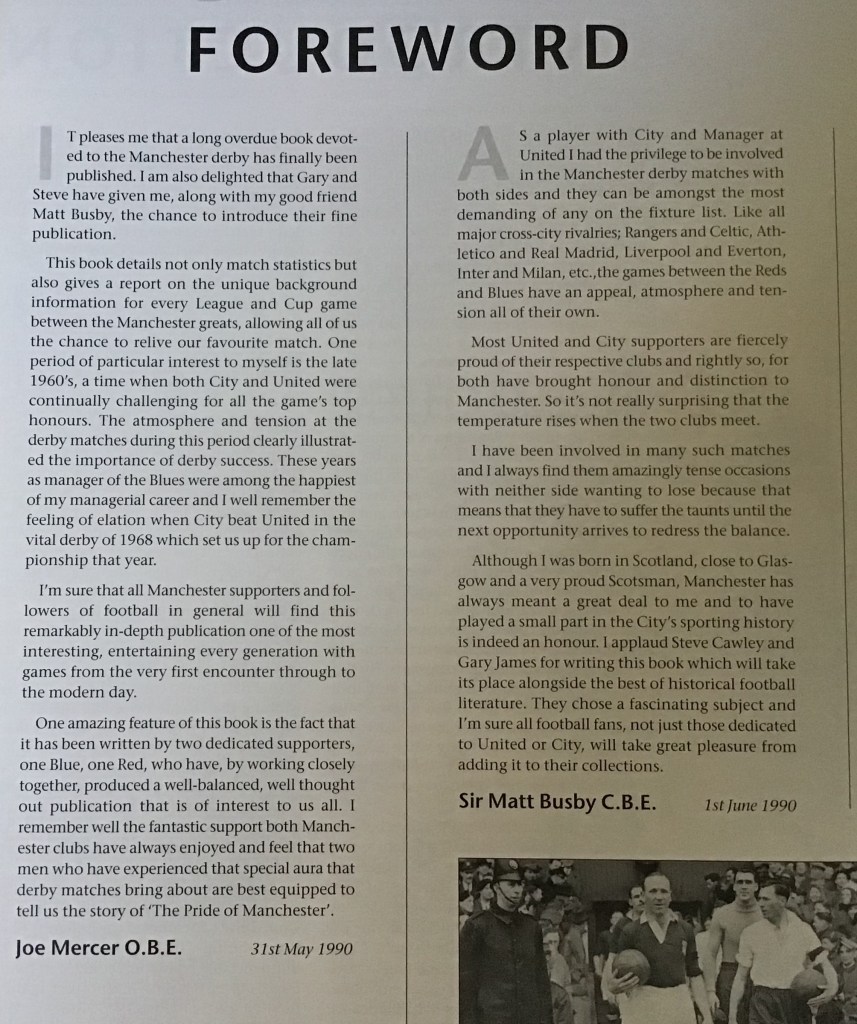
By that time I had already started work on my second book and I also knew that I wanted to write something specifically about Joe. I reasoned with myself that Joe’s book would wait until after my second book The Pride of Manchester was complete. The Pride of Manchester was a history of the Manchester derby co-written with Steve Cawley. Steve & I were quite fortunate in that, thanks to the connection with Joe, we also managed to ask Matt Busby to write a foreword too. To have the two men who were, by some way, at that time the two most successful managers of the Manchester clubs write our foreword and introduction was incredible. We were eternally grateful.
Foreword to The Pride Of Manchester (published September 1991)
The Pride of Manchester was due out in August 1990 and then I planned to get working on a book on Joe Mercer’s years at Manchester City. Unfortunately, technical issues meant that the Pride of Manchester was to be delayed by a few months and, as the new football season would mean at least one derby match would be played before the book came out, we decided to delay it a full year and include the 1990-91 season. That would also mean my Joe Mercer idea would have to wait.
Sadly, the last time I last saw Joe was on 31 May 1990 when I went through the wording of his contribution to The Pride Of Manchester. Joe had been suffering with Alzheimer’s for sometime and by this stage it had clearly developed significantly. I realised that day that Norah must have been under tremendous pressure, yet somehow she got on with looking after Joe. It must have been extremely difficult for her but, as she had proved throughout her life with Joe, Joe’s happiness was vitally important to her.
On Thursday 9 August 1990 the suffering ended. Joe was celebrating his seventy-sixth birthday with his family. He relaxed in his armchair after an enjoyable day and then passed away peacefully.
Over the months and years that followed I continued to visit Norah as often as I could. My idea of writing a book on his time at City still floated around in my head but I was disappointed that I hadn’t managed to publish it before his death. The delay to The Pride Of Manchester really upset me but I knew that it couldn’t have been helped.
When the time was right I visited Norah and mentioned the book idea. Norah, being as wonderful as ever, said: ‘Only do it if you want to. Don’t do it for me or for Joe. Don’t go to all that trouble unless you want to for you.’ She was pleased that I wanted to do it but genuinely did not want me to go to any trouble. I told her it would be a honour and she told me she would help however she could.
Over the next couple of years I spent a lot of time at Norah’s. Often Joe & Norah’s son David would arrive – another wonderful member of the family – and he used to laugh about ‘the old fella’ while Norah would tell me wonderful stories of how she met ‘Cheeky face Mercer!’
It was a wonderful period and Norah used to always bring out the sandwiches or a bowl of Scouse for me and my girlfriend. One day I arrived at her house and she insisted on pouring me a beer. As she brought it in she whispered to my girlfriend ‘watch his reaction’ and then she handed me a silver tankard. I looked at it and it was the 1961 League Cup Final tankard Joe had been given for guiding Villa to success. Inside was my beer! I tried to persuade her to put the beer into a regular glass but she insisted. It was the first (and so far only) time I have drunk from a major footballing award.
Early into my research for the book I realised that a book simply on Joe’s time at City wouldn’t do him justice. No matter how significant that period was for City or in my life as a fan, it was still only a small fraction of what he had achieved in his life. I soon decided that if I was to write a book on Joe it had to be his full biography. My publisher Julian Baskcomb – always keen on creating quality books – encouraged me to write the full story no matter how many words.
In the end the book was published in December 1993 and contained approximately 110,000 words (almost double the standard biography size at that time) and hundred of photographs from every stage of Joe’s life. A few weeks before it was published I gave David Mercer a full copy of the text to read. I’d agreed with him and Norah that they’d see the text shortly before it was published and, if there was anything significant, I’d change it.
David phoned me within 24 hours of receiving the text and had read every word. He phoned me and told me that I had captured his father perfectly. He became somewhat emotional when we discussed the book and, for the first time ever, I felt my writing mattered. I knew that I’d been fortunate in being able to write about a truly wonderful and marvellous man, and that the support of Norah & David had made this a great experience for me.
All these years on Joe Mercer, OBE: Football With A Smile remains the book I am most proud of; the book I enjoyed writing the most; and the book that I always want to aspire to with my new material. I remain ever grateful to Joe, Norah, David and the family for allowing me the opportunity to first meet Joe and then to write the book. I updated it in 2010, adding material from various parts of his life.
I continued to meet Norah over the years. David would usually pop in while I was there and we’d chat about ordinary things. Occasionally, Norah would say things like: ‘I told Jimmy about the book last week’ and I’d be thinking ‘Jimmy?’ then she’d say something else and it’d be obvious it was Jimmy Hill. Once during my research I arrived at her house and she told me ‘I phoned George and told him he must talk to you about Joe. Here’s his number.’ I was handed a piece of paper with Norah’s writing on reading: ‘George Graham’ and then his direct office number at Highbury. I contacted George and he set up an interview for me in his office.
The week before we launched Joe’s biography I was sat at home one evening when my telephone rang. I answered it. The voice on the other end said: ‘Hello Gary? It’s Bobby Charlton here. I’m sorry I can’t come to the launch. I’ll be in Kuala Lumpur then. I called Norah to tell her but she told me I must call you to apologise, so I’m really sorry I can’t make it. Is that okay?’
Me: ‘Er, yes. Thanks for letting me know.’
I came off the ‘phone and couldn’t get it out of my head that Norah had ‘told’ Bobby Charlton to call me and apologise. Even more impressive is the fact that he did! Norah was brilliant but if she told you to do something you did it, no matter who you were!
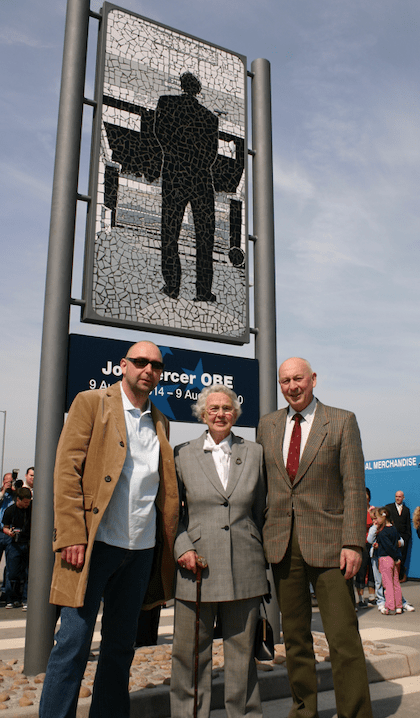
Around the time of City’s move to their current stadium I became involved in a few projects at the club on a freelance basis. One was setting up the initial museum and another was the erection of the Mercer mosaics on Joe Mercer Way. I won’t go into all the discussions and stories connected with that here, but one of the areas that I contributed to was the selection of the images for mosaic artist Mark Kennedy to recreate as mosaics. I spoke with Norah about the options and showed her a few I’d shortlisted that I’d used in the book.
We agreed that one had to show Joe lifting a trophy at City – the League Championship was chosen – and the other ended up a view of Joe from the back looking out towards the Kippax from the Maine Road tunnel. Although I loved that photo (it came from Norah’s collection and became a major image in my book) I wasn’t certain Norah would like a back view of Joe. I was wrong. As soon as she saw it she said ‘That’s it! That’s Joe! Look at his bandy legs! There’s no mistaking those legs.’
When we did the reveal Norah and David came of course and Norah thanked Mark Kennedy for capturing Joe so superbly, although she did say to him ‘That one with the trophy is okay; but this one with his bandy legs… that’s Joe!’
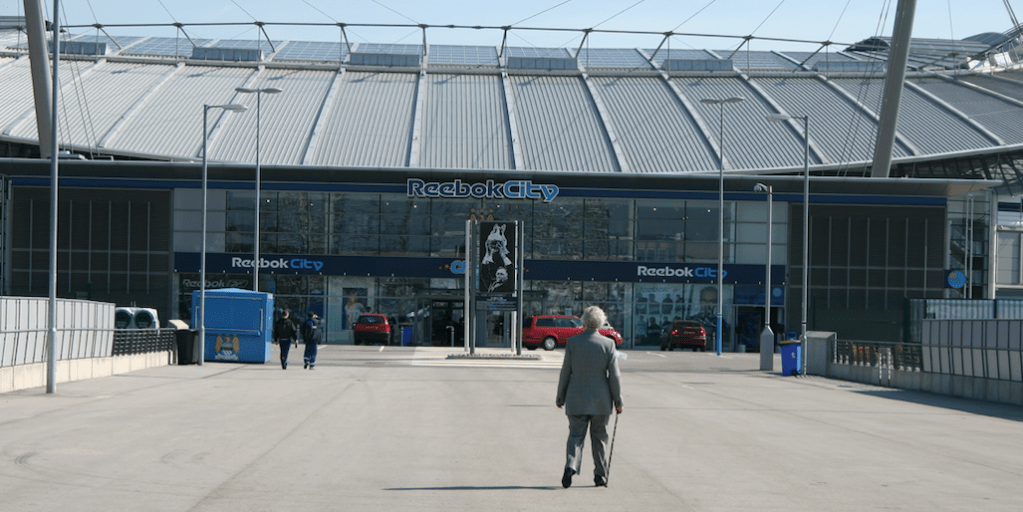
Mark Kennedy, Norah & David Mercer with ‘bandy legs’ Mercer mosaicWhen everybody else had gone, Norah asked me if she could see the mosaic from a distance, as the fans would on match day walking down Joe Mercer Way
Sadly, in the years that followed first David and then Norah have died. Both were wonderful people who supported my work and trusted me to tell Joe’s story. They demonstrated what a wonderful family they were and – to me this is extremely significant – their warmth matched Joe’s. I don’t think it’s any coincidence that throughout Joe’s time at City and for the following decades City were often described as ‘the friendliest club’. Joe set the tone and direction for the club. He was a great ambassador for Manchester City (and the other clubs he was involved with).
Joe helped establish the Manchester City that many City fans fell in love with.
Fancy Reading More Like This?
If you would like to read everything else on this site then please subscribe. I’m not employed by anyone and do not take advertising on this site, so every subscription directly helps my research and writing. It works out about £1.67 a month if you take out an annual subscription (£20 per year) or £3 a month if you’d like to sign up for a month at a time. Why not sign up for a month, see what’s here and then cancel if you don’t think it’s appropriate for you? Each subscriber gets full access to the 200+ articles posted so far and the hundreds scheduled to be posted in the coming weeks. The entire Manchester A Football History is being posted by the end of February 2021, so subscribers will get all of that too!
First published shortly after Mark Hughes was dismissed as MCFC manager in 2009-10
With the ‘trajectory of results’ hailed as a reason, the December dismissal of Mark Hughes as Manchester City manager prompted many to claim that the sacking was a symptom of new owners coming in without a care for the history and traditions of the game. The appointment of Roberto Mancini means that during the Noughties, awful phrase I know, City had six managers – Joe Royle (dismissed), Kevin Keegan (resigned), Stuart Pearce (fired), Sven Goran Ericsson (dismissed), Mark Hughes (fired) and Roberto Mancini (at the time of going to press – survived).
Subscribe to get access
Read more of this content when you subscribe today.
Brian Horton became City manager in 1993 – his first game in charge was a 3-1 victory over Swindon on 1st September – and remained in charge for two Premiership seasons. Supporters remember this period for the excitement Horton’s side brought to Maine Road. Gary James discussed his career with him in the Manchester City Experience, in October 2004
Subscribe to get access
Read more of this content when you subscribe today.





 Gary James' Football Archive