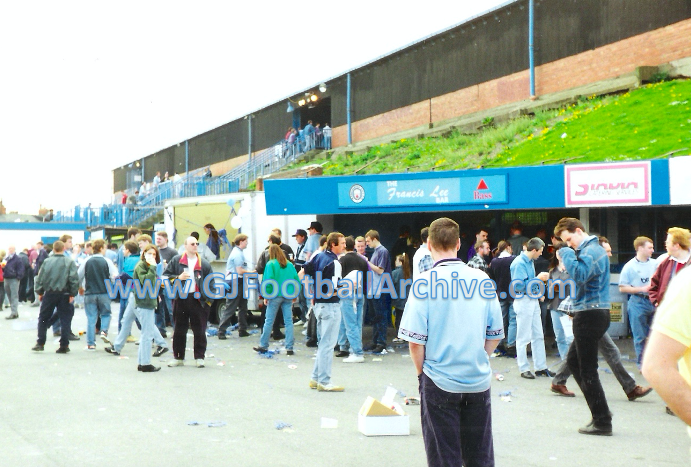
Day 64 of my posts counting down to the centenary of Maine Road’s opening game is this image taken by Steve Worthington from behind the old Kippax Stand during its final season. Notice the player named bar – this one after Francis Lee – and if you look carefully the second staircase visible (left) is the staircase to nowhere which was blocked off in the early 1970s following the safety legislation (that followed the Ibrox disaster) that outlawed the original style of staircase. The one closest to the camera was remodelled but the other was blocked off (see previous Maine Road 100 posts for details).
Steve Worthington’s photo was taken from the area behind the kippax, slightky 1971 aerial image shows the 1957 roof over the Kippax (7 & 8) which was demolished in 1994:
Maine Road aerial 1971 from Farewell To Maine Road
If you’d like to read more on the history of Maine Road, take a look at Farewell To Maine Road, which can be downloaded from this page:
If you enjoy all the free material on my website and would like to support my research and keep this website going (but don’t want to subscribe) then why not make a one-time donation (or buy me a coffee). All support for my research is valued and welcome. It allows me to keep some free material available for all. Thanks.
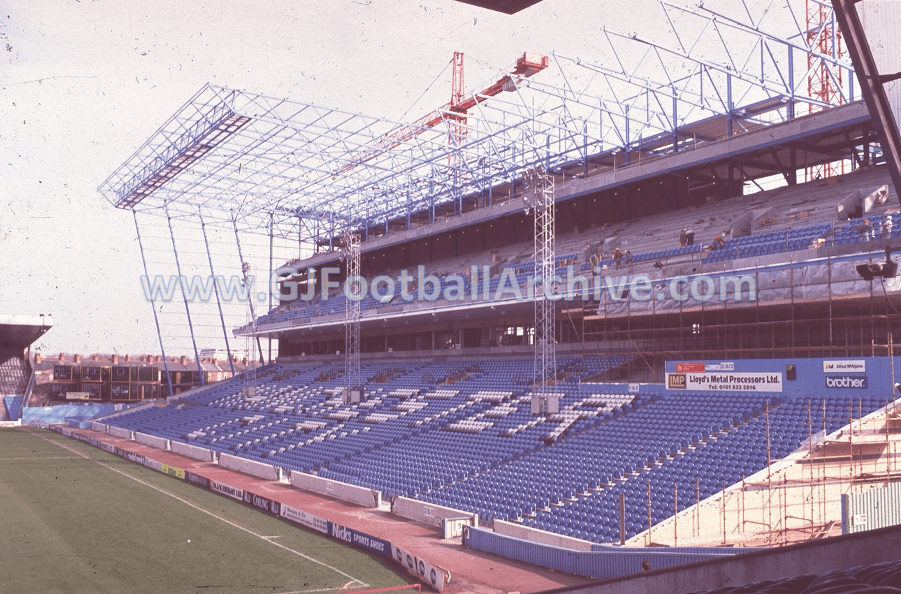
Day 63 of my posts counting down to the centenary of Maine Road’s opening game is this image from the 1994-95 season of the ‘new’ Kippax Stand during construction.
At times during the stand’s construction the capacity of Maine Road had been less than 20,000 – the lowest at any City venues since the 1800s!
The 1994 demolition of the old Kippax saw the original 1923 terracing at that end demolished, meaning that the only part of the 1923 stand construction still standing was the base of the Main Stand.
This 1940s image of the Maine Road shows the original 1923 terracing (left):
This 1971 aerial image shows the 1957 roof over the Kippax (7 & 8) which was demolished in 1994:
Maine Road aerial 1971 from Farewell To Maine Road
If you’d like to read more on the history of Maine Road, take a look at Farewell To Maine Road, which can be downloaded from this page:
If you enjoy all the free material on my website and would like to support my research and keep this website going (but don’t want to subscribe) then why not make a one-time donation (or buy me a coffee). All support for my research is valued and welcome. It allows me to keep some free material available for all. Thanks.
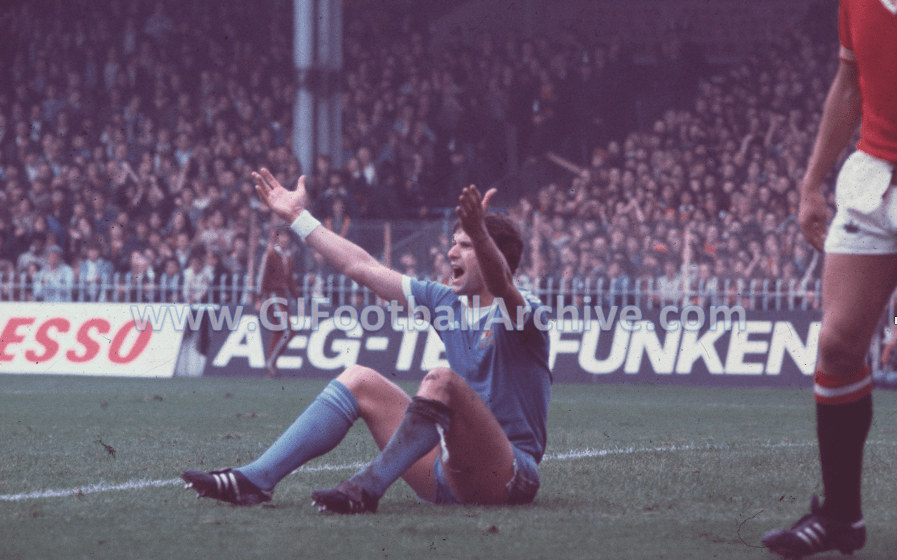
Day 6 of my posts counting down to the centenary of Maine Road’s opening game continues with another segregation image. This is a late 1970s Manchester derby image and the City player is Mike Doyle but look beyond him at the segregation and perimeter fencing. As well as the railings in front of the Kippax Stand the away section (to the right) has an additional chicken wire style temporary fence in front of the United fans.
This was a period when United fans had an extremely bad reputation for pitch invasions and crowd actions and City had been forced to install this additional netting for this derby match after consultation with the police.
The fencing didn’t last of course and so this image is extremely unusual.
If you’d like to read more on the history of Maine Road, take a look at Farewell To Maine Road, which can be downloaded from this page:
If you enjoy all the free material on my website and would like to support my research and keep this website going (but don’t want to subscribe) then why not make a one-time donation (or buy me a coffee). All support for my research is valued and welcome. It allows me to keep some free material available for all. Thanks.
Day 61 of my posts counting down to the centenary of Maine Road’s opening game continues from yesterday and reveals how, years before Manchester City moved to Maine Road, significant football matches were played on fields next to the road.
Yesterday I talked about Dog Kennel Lane, well today here’s a mention of Dog Kennel Lane in relation to football. Manchester Association were the city’s prominent team in the mid 1870s and early 1880s. They promoted the game extensively and subscribers can read their story here:
I explain a lot more about them in The Emergence of Footballing Cultures: Manchester 1840-1919.
The brief newspaper cutting from 1882 mentions their Dog Kennel Lane ground. On the following I show where Maine Road was later built but the Manchester ground was probably further up the road/lane towards what became Great Western Street.
An early 20th century interpretation of an older map, showing modern streets (dotted) with the original roads.Manchester Association at Dog Kennel Lane, 1882
If you’d like to read more on the history of Maine Road, take a look at Farewell To Maine Road, which can be downloaded from this page:
If you enjoy all the free material on my website and would like to support my research and keep this website going (but don’t want to subscribe) then why not make a one-time donation (or buy me a coffee). All support for my research is valued and welcome. It allows me to keep some free material available for all. Thanks.
Day 60 of my posts counting down to the centenary of Maine Road’s opening game is a simple map, showing the Maine Road area before any of the terraced housing was built.
The dark blue shape I’ve placed on the map is approximately where the stadium was built. Maine Road was initially known as Dog Kennel Lane and was renamed in stages as terraced housing was built on it. The lane originally had a bend where the current Maine Road ends and the old lane veered off towards modern day Princess Parkway.
I explain a lot more about this in Farewell To Maine Road and in the Big Book of City. In the MCFC-Chelsea match programme last season I explained:
Maine Road itself was a relatively insignificant street in 1923, but in the previous century the road had the name ‘Dog Kennel Lane’ and it had for many decades been a fairly significant but meandering route south of the city. The street was renamed in stages when the area was developed during the late 1800s. For years the reason Maine Road was picked was not clear, but in 2009 I discovered the truth.
The Maine Road name came indirectly from the US State of Maine but this was a compromise. The following newspaper article explains: ‘Dog Kennel Lane took its name from the kennel where hounds were kept. It stood on the right-hand side at the bend about a thousand yards from Moss Lane, opposite to the road which tracked off to the left and led to Demesne Farm. The common name of this lane is so common and unattractive that when the Temperance Company bought the Trafford land they asked the local board to change the name to Demesne Road, and the subject was compromised by calling it Maine Road out of compliment to the Temperance principles of the petitioners.’
The idea of the Temperance movement was to discourage people from drinking alcohol. On 2 June 1851 the State of Maine passed the first recognised prohibition law, and two years later the United Kingdom Alliance was founded in Manchester, pledging to badger Parliament to outlaw liquor in England.
The ‘Temperance Company’ mentioned in the article was actually part of the movement and had bought some land at the top of Dog Kennel Lane – this area is close to the junction with Moss Lane East. They wanted to create a better standard of living and within that area they erected buildings in keeping with their approach to life, such as the Temperance Billiard Hall. However, the ‘Dog Kennel Lane’ name was clearly an issue and so the selection of the name ‘Maine Road’ was made. So the name Maine Road refers to the US State and the part that Maine played in the Temperance movement.
An early 20th century interpretation of an older map, showing modern streets (dotted) with the original roads.
If you’d like to read more on the history of Maine Road, take a look at Farewell To Maine Road, which can be downloaded from this page:
If you enjoy all the free material on my website and would like to support my research and keep this website going (but don’t want to subscribe) then why not make a one-time donation (or buy me a coffee). All support for my research is valued and welcome. It allows me to keep some free material available for all. Thanks.
Day 59 of my posts counting down to the centenary of Maine Road’s opening game is the story of the day Celtic and Rangers played a game at Maine Road as a combined Glasgow XI. That day was the great City player Billy Meredith’s testimonial.
It was played on 29 April 1925 and saw a MEREDITH XI versus RANGERS & CELTIC XI.
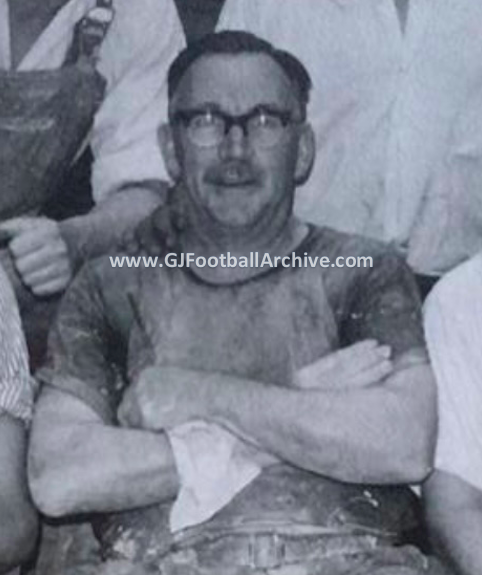
A series of benefit matches and events were organised for Billy Meredith following his retirement in 1924, with this match being the most significant event. Somehow Meredith had convinced Rangers and Celtic to form one side to take on a team of Lancashire based players selected by Meredith himself. The Meredith side, playing in red and white, contained City favourites Frank Roberts and Charlie Pringle, plus of course Meredith, and former City star Horace Barnes – a Preston player at the time of the match. City’s legendary trainer Jimmy Broad trained the team.
The Glasgow side, playing in blue and white, contained five Celtic players – including Jimmy McGrory – and six Rangers men. Former City full-back Johnny McMahon was one of the linesmen, while the other was an ex-United star George Wall, who incredibly smoked a pipe throughout the match.
Meredith testimonial programme, as seen in From Maine Men To Banana Citizens by Gary James
According to the Manchester Evening Chronicle report: ‘Many old friendships were renewed at Maine Road on Wednesday night, and we all laughed at Meredith trying the old backheel to the half-back business with very little success. Incidentally the main image above is of Meredith a couple of years earlier with the Hyde Road ground in the background.
A few moments from the match, including the teams posing for photographs. The footage concentrates on Meredith pre-match, and also shows the Popular Side (later Kippax) and Platt Lane end. The camera was placed in front of the Platt Lane end, close to the goal for much of the action (Platt Lane is the stand numbered 4 & 5 in the image below, although that stand was still unroofed back in 1925).
If you enjoy all the free material on my website and would like to support my research and keep this website going (but don’t want to subscribe) then why not make a one-time donation (or buy me a coffee). All support for my research is valued and welcome. It allows me to keep some free material available for all. Thanks.
Day 58 of my posts counting down to the centenary of Maine Road’s opening game is an aerial photo of the ground from about 1973. Unusually this image looks towards the ground from behind the North Stand (from the city centre direction looking south) and shows the streets that would soon disappear as part of the area’s housing developments.
I’ve highlighted what became recognised as MCFC property with blue lines – that’s the stadium site plus the Platt Lane training complex, which became City’s during the 1970s.
The two areas marked in yellow on either side of Lloyd Street South were redeveloped into Walks and Closes named after former City players. Many of these new Walks & Closes still exist, although some have been remodelled and the names of some, for example the one named after Frank Swift, have disappeared altogether.
The are marked in pink between the player streets and the stadium became the Claremont Road School playing fields which, on match day, provided extra car parking for supporters.
c.1973 Maine Road
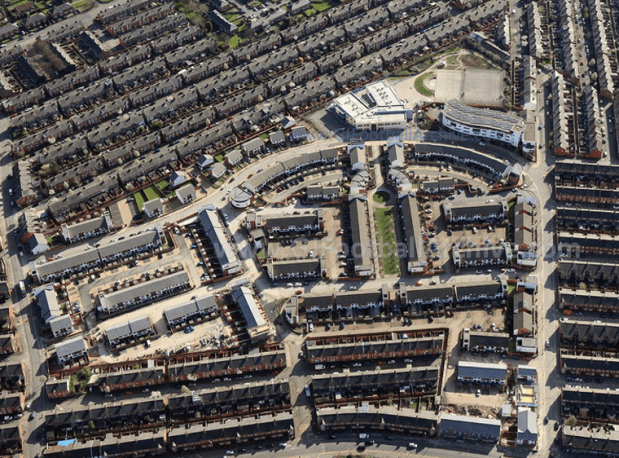
It’s worth comparing that 1970s image with this one from recent years, showing the housing and school now built on Maine Road.
And compare both to this 1940s image of the Maine Road site too:
This 1971 aerial image shows the stadium from another angle, looking west.
Maine Road aerial 1971 from Farewell To Maine Road
If you’d like to read more on the history of Maine Road, take a look at Farewell To Maine Road, which can be downloaded from this page:
If you enjoy all the free material on my website and would like to support my research and keep this website going (but don’t want to subscribe) then why not make a one-time donation (or buy me a coffee). All support for my research is valued and welcome. It allows me to keep some free material available for all. Thanks.
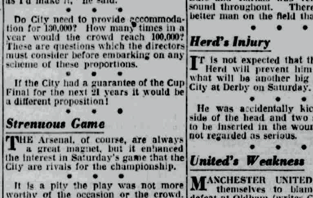
Day 57 of my posts counting down to the centenary of Maine Road’s opening game is a follow on from yesterday. It’s a cutting from the same newspaper, which was produced shortly after City and Arsenal had met at Maine Road in February 1935. It also follows on from some recent articles about stadium improvements. Here, the rumour was that City were planning to make Maine Road a 130,000 capacity venue.
February 1935 City v Arsenal Maine Road extension plans
Maine Road was only 12 years old but already it held a record individual crowd (84,569) for a game on a club ground that still stands today and it held the record League crowd (set at the game with Arsenal in February 1935). It had been expanded a little with the extension to the Platt Lane Corner (near the Main Stand and numbered 3 on the 1971 aerial photo lower down the page).
There was a development plan being developed which would see both the Platt Lane End and Scoreboard End have roofs added and be extended and then attention would turn to the Kippax where a double deck stand was suggested. By that time it was felt the stadium would hold 130,000. As it was the 1930s extensions meant it’s capacity was viewed as about 86,000.
The Platt Lane Stand (number 5 below) was built in 1935 (the old terracing was extended at the back on wooden steps and a roof was erected over the terracing) to the plan but World War Two meant the other plans were put on hold. They were eventually dropped and the next major development would be the Kippax roof and terracing extension in 1957.
Back in February 1935 the local media debated how often City would need a 100,000 capacity venue. The view was that, unless City could persuade the FA to move the FAC Final to Maine Road, then only one game a season would attract that kind of figure to the ground. With United in Division Two for much of the 1930s, and being watched by exceptionally low crowds, the game that most fans saw as the biggest meeting back then was the visit of Arsenal. How times change!
This 1971 aerial image shows the proximity of the housing on Thornton Road (bottom left, near number 6) and behind the North Stand (number 10). They were planned to be demolished in Lee’s 1994 plan.
Maine Road aerial 1971 from Farewell To Maine Road
If you’d like to read more on the history of Maine Road, take a look at Farewell To Maine Road, which can be downloaded from this page:
If you enjoy all the free material on my website and would like to support my research and keep this website going (but don’t want to subscribe) then why not make a one-time donation (or buy me a coffee). All support for my research is valued and welcome. It allows me to keep some free material available for all. Thanks.
Day 56 of my posts counting down to the centenary of Maine Road’s opening game is a simple reminder of the days when local newspapers would highlight faces in the crowd and offer cash prizes to those ringed, squared or triangled. The top row of photos here are from the Manchester City v Arsenal game at Maine Road of February 1935 and the bottom row is from Mossley v Wigan Athletic. Oddly, a bloke who looks uncannily like my granddad appears triangled in the bottom right. He’d have been about 20 when this photo was taken, so it can’t be him as he looks as he did in the 70s but they had it tough in those days! This is my granddad back in early 70s (I think it was 70s; could have been late 60s).
And the man I’m talking about…
Fans at MCFC v Arsenal and Mossley v Wigan, February 1935
Anyone worked out why the City-Arsenal game of February 1935 is still regularly referred to these days? This might help:
If you enjoy all the free material on my website and would like to support my research and keep this website going (but don’t want to subscribe) then why not make a one-time donation (or buy me a coffee). All support for my research is valued and welcome. It allows me to keep some free material available for all. Thanks.
Day 55 of my posts counting down to the centenary of Maine Road’s opening game is a follow on from one from a few days ago. I posted a 1994 plan of what might have been in terms of Maine Road’s development and here’s more on that plan.
This image is of how the entire stadium was supposed to look. To explain the colour image looks towards the stadium from above the Kippax car park. The North Stand is on the right and the Platt Lane on the left. The black and white image is from the other side of the ground, looking towards the Kippax from the Main Stand.
1990s Maine Rd redevelopment plans as seen in Farewell To Maine Road
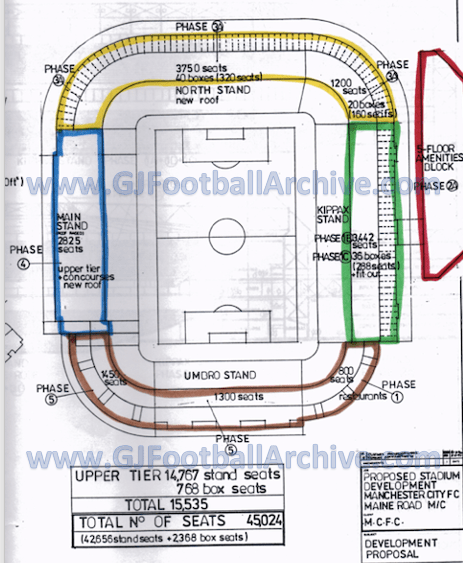
You can see from the black and white image that the plan was to replicate the general look of the new Kippax (being planned at this stage – this was January 1994 and the old Kippax was still standing) around the ground. The North Stand was to have a second tier added and hospitality boxes between the levels, like the new Kippax. The Platt Lane was to have a second tier added above the two lines of existing hospitality boxes.
The Main Stand would have part of the seating chopped away and a new second tier added.
To facilitate all of this some houses were to be bought and demolished on the streets immediately behind the North Stand and the Kippax/Platt Lane corner.
The new Kippax was the first phase of the development but Manchester’s bids for the Olympics changed thinking. Couple that with relegation in 1996 and the wholesale redevelopment of Maine Road was postponed after the Kippax opened and then dropped completely.
As mentioned previously, Lee’s plans would have seen the new Kippax followed by a phased development of each of the other three stands. These images might give an indication of how it would have progressed.
This 1971 aerial image shows the proximity of the housing on Thornton Road (bottom left, near number 6) and behind the North Stand (number 10). They were planned to be demolished in Lee’s 1994 plan.
Maine Road aerial 1971 from Farewell To Maine Road
If you’d like to read more on the history of Maine Road, take a look at Farewell To Maine Road, which can be downloaded from this page:
If you enjoy all the free material on my website and would like to support my research and keep this website going (but don’t want to subscribe) then why not make a one-time donation (or buy me a coffee). All support for my research is valued and welcome. It allows me to keep some free material available for all. Thanks.








 Gary James' Football Archive